3.6 User Behavior Qualitative Driver Experience Analysis - Visitor
Turns and circulation
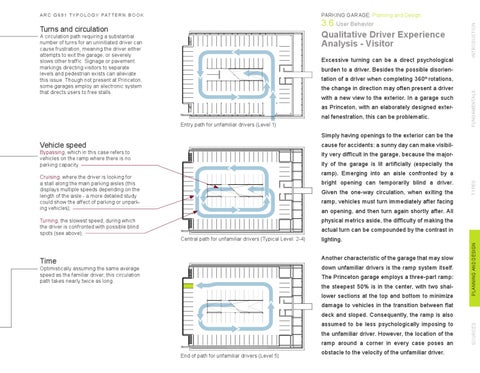
A circulation path requiring a substantial number of turns for an uninitiated driver can cause frustration, meaning the driver either attempts to exit the garage, or severely slows other traffic. Signage or pavement markings directing visitors to separate levels and pedestrian exists can alleviate this issue. Though not present at Princeton, some garages employ an electronic system that directs users to free stalls.
Excessive turning can be a direct psychological
INTROdUCTION
Parking Garage: Planning and Design
ar c G 6 9 1 t y p o l og y pat t e r n b o o k
burden to a driver. Besides the possible disorienthe change in direction may often present a driver with a new view to the exterior. In a garage such as Princeton, with an elaborately designed external fenestration, this can be problematic. Entry path for unfamiliar drivers (Level 1)
fundamentals
tation of a driver when completing 360ยบ rotations,
Simply having openings to the exterior can be the
Vehicle speed
cause for accidents: a sunny day can make visibil-
Bypassing, which in this case refers to vehicles on the ramp where there is no parking capacity.
ity very difficult in the garage, because the majority of the garage is lit artificially (especially the
Given the one-way circulation, when exiting the ramp, vehicles must turn immediately after facing an opening, and then turn again shortly after. All physical metrics aside, the difficulty of making the lighting. Another characteristic of the garage that may slow
Time
down unfamiliar drivers is the ramp system itself.
Optimistically assuming the same average speed as the familiar driver, this circulation path takes nearly twice as long.
The Princeton garage employs a three-part ramp: the steepest 50% is in the center, with two shallower sections at the top and bottom to minimize
PLANNING AND DESIGN
actual turn can be compounded by the contrast in Central path for unfamiliar drivers (Typical Level: 2-4)
damage to vehicles in the transition between flat deck and sloped. Consequently, the ramp is also assumed to be less psychologically imposing to the unfamiliar driver. However, the location of the ramp around a corner in every case poses an End of path for unfamiliar drivers (Level 5)
obstacle to the velocity of the unfamiliar driver.
SOURCES
Turning, the slowest speed, during which the driver is confronted with possible blind spots (see above);
bright opening can temporarily blind a driver.
types
ramp). Emerging into an aisle confronted by a
Cruising, where the driver is looking for a stall along the main parking aisles (this displays multiple speeds depending on the length of the aisle - a more detailed study could show the affect of parking or unparking vehicles);