fundamentals
INTROdUCTION
1 SLOPE:20 5% MAX (2% CROSS SLOPE) SLOPE: 5% MAX (2% CROSS SLOPE)
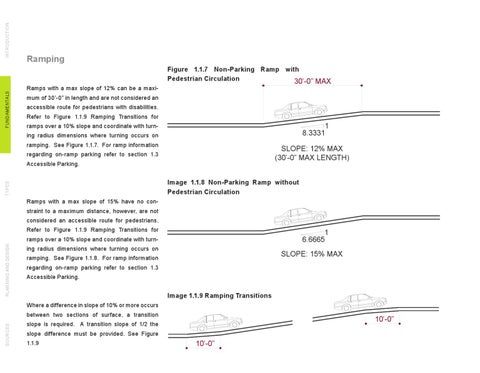
Ramping Ramps with a max slope of 12% can be a maxi-
30’-0” MAX
Figure 1.1.7 Non-Parking Ramp with Pedestrian Circulation 30’-0” MAX
mum of 30’-0” in length and are not considered an
1 8.3331
accessible route for pedestrians with disabilities. Refer to Figure 1.1.9 Ramping Transitions for
SLOPE: 12%1MAX 8.3331 (30’-0” MAX LENGTH)
ramps over a 10% slope and coordinate with turning radius dimensions where turning occurs on ramping. See Figure 1.1.7. For ramp information
SLOPE: 12% MAX (30’-0” MAX LENGTH)
regarding on-ramp parking refer to section 1.3 Accessible Parking. types
Image 1.1.8 Non-Parking Ramp without Pedestrian Circulation Ramps with a max slope of 15% have no constraint to a maximum distance, however, are not considered an accessible route for pedestrians. Refer to Figure 1.1.9 Ramping Transitions for
1 6.6665
PLANNING AND DESIGN
ramps over a 10% slope and coordinate with turning radius dimensions where turning occurs on
SLOPE: 15%1MAX 6.6665
ramping. See Figure 1.1.8. For ramp information regarding on-ramp parking refer to section 1.3
SLOPE: 15% MAX
Accessible Parking.
Image 1.1.9 Ramping Transitions Where a difference in slope of 10% or more occurs
SOURCES
between two sections of surface, a transition
10’-0” 10’-0”
slope is required. A transition slope of 1/2 the slope difference must be provided. See Figure 1.1.9
10’-0” 10’-0”