afterword
There has been a call for “vision,� but it is not outside of the realm of possibility that this vision may in fact be a set of local action plans, each with the intended 94
goal of urban efficiency and connectivity, but each specific to the local user and local environment. In this sense, cultural specificity coupled with global connectivity is essential. From a theoretical perspective, thinkers such as Doreen Massey, Ulrich Beck, and Anthony Appiah recognize local space as a constantly evolving identity in a reciprocal relationship with broader, global space. This local is not one of late twentieth century anti-globalization, but rather one that recognizes and responds to a relationship of mutualism between local identity and global culture, which is locally produced in as much as local culture is affected by the limitless reach of global development. Protecting local space as a victim of global change is not effective; what is needed for invention is constant local engagement with the global in order to challenge the nature of local and constantly redefine identity as a specific construct of both place and the wider world.3 From a pragmatic perspective, the constant becoming of local place within global communications networks reveals an opportunity and mandate for the designer to understand and strategically engage the local power structures and funding sources, to take advantage of local opportunities for new infrastructural development, and to rethink current infrastructural maintenance regimens with an eye toward leveraging developing systems of communication for local efficiency. Martin Felsen’s Eco-Boulevards project is highlighted by Tim Love in the Green Infrastructure panel as a projective example of how such engagement might take place in terms of leveraging public funding already allocated toward maintenance to work more effectively for both the environment and the community, based upon a mash-up of local knowledge and landscape-oriented thinking. In this case, UrbanLab worked with the city of Chicago to institutionalize mechanisms for dealing with water sequestration and conservation by strategically rethinking and redirecting a city revenue stream linked to roadway development and water supply.
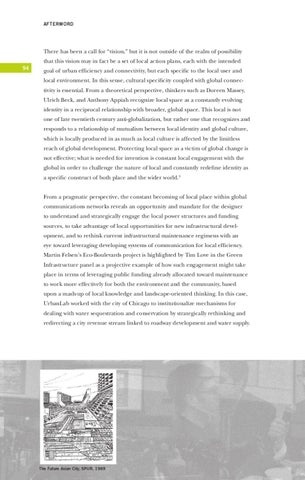
The Future Asian City, SPUR, 1969