Infrastructure and the Future
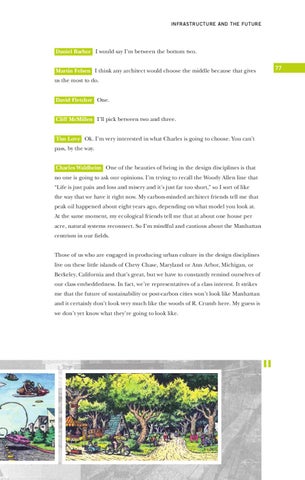
Daniel Barber I would say I’m between the bottom two. Martin Felsen I think any architect would choose the middle because that gives us the most to do. David Fletcher One. Cliff McMillen I’ll pick between two and three. Tim Love Ok. I’m very interested in what Charles is going to choose. You can’t pass, by the way. Charles Waldheim One of the beauties of being in the design disciplines is that no one is going to ask our opinions. I’m trying to recall the Woody Allen line that “Life is just pain and loss and misery and it’s just far too short,” so I sort of like the way that we have it right now. My carbon-minded architect friends tell me that peak oil happened about eight years ago, depending on what model you look at. At the same moment, my ecological friends tell me that at about one house per acre, natural systems reconnect. So I’m mindful and cautious about the Manhattan centrism in our fields. Those of us who are engaged in producing urban culture in the design disciplines live on these little islands of Chevy Chase, Maryland or Ann Arbor, Michigan, or Berkeley, California and that’s great, but we have to constantly remind ourselves of our class embeddedness. In fact, we’re representatives of a class interest. It strikes me that the future of sustainability or post-carbon cities won’t look like Manhattan and it certainly don’t look very much like the woods of R. Crumb here. My guess is we don’t yet know what they’re going to look like.
77