Panel 3: Green Infrastructure
Since I went to graduate school, I’ve heard the constant and regular drum beat that architects need to be more publicly engaged. And every architect I know spends 76
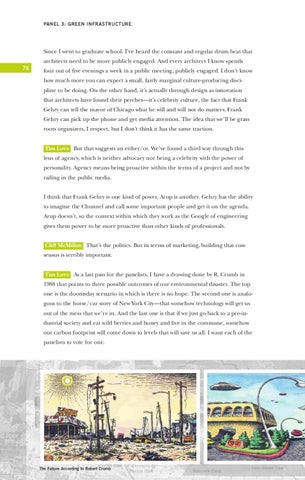
four out of five evenings a week in a public meeting, publicly engaged. I don’t know how much more you can expect a small, fairly marginal culture-producing discipline to be doing. On the other hand, it’s actually through design as innovation that architects have found their perches—it’s celebrity culture, the fact that Frank Gehry can tell the mayor of Chicago what he will and will not do matters. Frank Gehry can pick up the phone and get media attention. The idea that we’ll be grass roots organizers, I respect, but I don’t think it has the same traction. Tim Love But that suggests an either/or. We’ve found a third way through this lens of agency, which is neither advocacy nor being a celebrity with the power of personality. Agency means being proactive within the terms of a project and not by railing in the public media. I think that Frank Gehry is one kind of power, Arup is another. Gehry has the ability to imagine the Chunnel and call some important people and get it on the agenda. Arup doesn’t, so the context within which they work as the Google of engineering gives them power to be more proactive than other kinds of professionals. Cliff McMillan That’s the politics. But in terms of marketing, building that consensus is terribly important. Tim Love As a last pass for the panelists, I have a drawing done by R. Crumb in 1988 that points to three possible outcomes of our environmental disaster. The top one is the doomsday scenario in which is there is no hope. The second one is analogous to the horse/car story of New York City—that somehow technology will get us out of the mess that we’re in. And the last one is that if we just go back to a pre-industrial society and eat wild berries and honey and live in the commune, somehow our carbon footprint will come down to levels that will save us all. I want each of the panelists to vote for one.
The Future According to Robert Crumb