Infrastructure and the Future
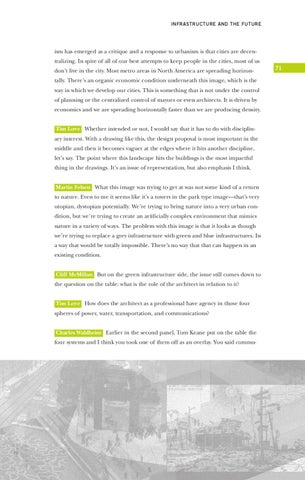
ism has emerged as a critique and a response to urbanism is that cities are decentralizing. In spite of all of our best attempts to keep people in the cities, most of us don’t live in the city. Most metro areas in North America are spreading horizontally. There’s an organic economic condition underneath this image, which is the way in which we develop our cities. This is something that is not under the control of planning or the centralized control of mayors or even architects. It is driven by economics and we are spreading horizontally faster than we are producing density. Tim Love Whether intended or not, I would say that it has to do with disciplinary interest. With a drawing like this, the design proposal is most important in the middle and then it becomes vaguer at the edges where it hits another discipline, let’s say. The point where this landscape hits the buildings is the most impactful thing in the drawings. It’s an issue of representation, but also emphasis I think. Martin Felsen What this image was trying to get at was not some kind of a return to nature. Even to me it seems like it’s a towers in the park type image—that’s very utopian, dystopian potentially. We’re trying to bring nature into a very urban condition, but we’re trying to create an artificially complex environment that mimics nature in a variety of ways. The problem with this image is that it looks as though we’re trying to replace a grey infrastructure with green and blue infrastructures. In a way that would be totally impossible. There’s no way that that can happen in an existing condition. Cliff McMillan But on the green infrastructure side, the issue still comes down to the question on the table: what is the role of the architect in relation to it? Tim Love How does the architect as a professional have agency in those four spheres of power, water, transportation, and communications? Charles Waldheim Earlier in the second panel, Tom Keane put on the table the four systems and I think you took one of them off as an overlay. You said commu-
71