Panel 3: Green Infrastructure
Tim Love Agency, not advocacy is the take away today… 66
Charles Waldheim You could immediately draw a line generationally and half of the people in this room will identify themselves as agents as opposed to advocates. The idea of inter-departmental agency at the federal, municipal, and state levels— or even working with community and grassroots groups to go around the powers that be—all of those are available. I think “agency” more fully describes that practice than “advocacy.” Daniel Barber One of the themes that’s been very compelling throughout the day is the question of policy and something we’ve posed as its flipside, which is the people. How does the architect develop the tools through an interdisciplinary education to approach social problems, thinking spatially but thinking on a much larger scale as well and thinking across disciplines? It’s important to differentiate the policy side of sustainability, which has a certain normative connotation as the people side, if you will, which I would argue is environmentalism. I think what is potentially lost in the distinction between agency and advocacy that we want to lose is the need for a resistant practice. Who is the agent operating for? Tim Love We’re trying to sum up thirty years of design pedagogy in a couple of minutes, but I do think that there are a couple of points that I want to bounce off of the panel. One is that what was happening at Berkeley and MIT in the 1960s and 1970s was as much the result of pressure from within the academy that architects and landscape architects better become like social scientists and get grant funding. A lot of the pressure was not for the good of the people but to snuggle into the provost’s office to be a legitimate discipline, right? Charles Waldheim I was on the Berkeley campus in 1968, but I don’t imagine the landscape architects wanting to snuggle with the provost. I think they were rejecting design culture. The other dynamic here is that landscape and planning were rejecting architects as handmaidens to fascism…
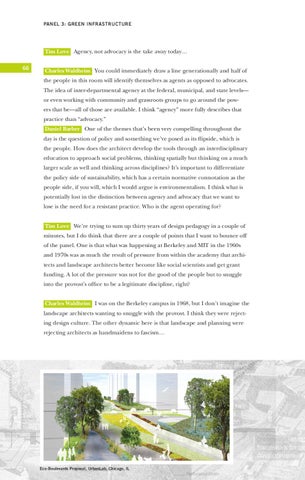
Eco-Boulevards Proposal, UrbanLab, Chicago, IL