Panel 3: Green Infrastructure
Cliff McMillan I certainly think the bottom-up prototype is critical. But I want to come back to some things that were mentioned. Most issues, transportation, 64
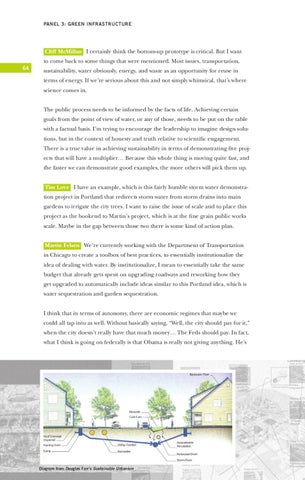
sustainability, water obviously, energy, and waste as an opportunity for reuse in terms of energy. If we’re serious about this and not simply whimsical, that’s where science comes in. The public process needs to be informed by the facts of life. Achieving certain goals from the point of view of water, or any of those, needs to be put on the table with a factual basis. I’m trying to encourage the leadership to imagine design solutions, but in the context of honesty and truth relative to scientific engagement. There is a true value in achieving sustainability in terms of demonstrating five projects that will have a multiplier… Because this whole thing is moving quite fast, and the faster we can demonstrate good examples, the more others will pick them up. Tim Love I have an example, which is this fairly humble storm water demonstration project in Portland that redirects storm water from storm drains into main gardens to irrigate the city trees. I want to raise the issue of scale and to place this project as the bookend to Martin’s project, which is at the fine grain public works scale. Maybe in the gap between those two there is some kind of action plan. Martin Felsen We’re currently working with the Department of Transportation in Chicago to create a toolbox of best practices, to essentially institutionalize the idea of dealing with water. By institutionalize, I mean to essentially take the same budget that already gets spent on upgrading roadways and reworking how they get upgraded to automatically include ideas similar to this Portland idea, which is water sequestration and garden sequestration. I think that in terms of autonomy, there are economic regimes that maybe we could all tap into as well. Without basically saying, “Well, the city should pay for it,” when the city doesn’t really have that much money… The Feds should pay. In fact, what I think is going on federally is that Obama is really not giving anything. He’s
Diagram from Douglas Farr’s Sustainable Urbanism