Infrastructure and the Future
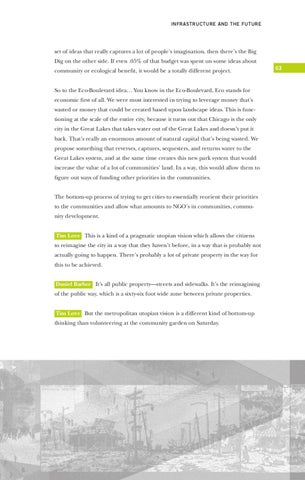
set of ideas that really captures a lot of people’s imagination, then there’s the Big Dig on the other side. If even .05% of that budget was spent on some ideas about community or ecological benefit, it would be a totally different project. So to the Eco-Boulevard idea… You know in the Eco-Boulevard, Eco stands for economic first of all. We were most interested in trying to leverage money that’s wasted or money that could be created based upon landscape ideas. This is functioning at the scale of the entire city, because it turns out that Chicago is the only city in the Great Lakes that takes water out of the Great Lakes and doesn’t put it back. That’s really an enormous amount of natural capital that’s being wasted. We propose something that reverses, captures, sequesters, and returns water to the Great Lakes system, and at the same time creates this new park system that would increase the value of a lot of communities’ land. In a way, this would allow them to figure out ways of funding other priorities in the communities. The bottom-up process of trying to get cities to essentially reorient their priorities to the communities and allow what amounts to NGO’s in communities, community development. Tim Love This is a kind of a pragmatic utopian vision which allows the citizens to reimagine the city in a way that they haven’t before, in a way that is probably not actually going to happen. There’s probably a lot of private property in the way for this to be achieved. Daniel Barber It’s all public property—streets and sidewalks. It’s the reimagining of the public way, which is a sixty-six foot wide zone between private properties. Tim Love But the metropolitan utopian vision is a different kind of bottom-up thinking than volunteering at the community garden on Saturday.
63