Panel 3: Green Infrastructure
Tim Love There is a reemergence of science as a justification for design decisions, you know, within all the disciplines in the schools that I’m aware of, because 62
data is so easy to get now and the visual display of data is its own art form, whether through mapping or displaying of data in all its glory. I suppose that this issue of green infrastructure that is on the table now has to do with that balance between the science involved in the performance of water runoff and its visual expression, which might be seen as a kind of cultural act. This is still being played out in a lot of projects and a lot of programs. Its about the balance between those two things. If you’ve been on any review at all lately in any school, the first half of the review is a PowerPoint show with Edward Tufte quality graphics and the second half of the show is a fully designed object. I wonder if the ideology of leadership in urbanism—whether it’s the architects or the landscape architects—is tied to that idea of legitimacy: “Who’s got the best numbers?” as an issue. Tim Love Martin, we have your Eco-Boulevards project up to propel that idea forward a little bit. Is this more data or is this more design? Martin Felsen There should definitely be a health warning on data that’s discovered in most of these reviews, especially in the schools these days. Most times scientific performance criteria are based upon efficiencies or efficiencies of scales and I don’t think that those capture any actual rationale for doing anything. We could make our buildings, or even our infrastructure, as ecological as possible and we’d still have enormous problems that are unsolvable—land use, transportation problems, and so forth. So much has been said today about policy and about these top-down decision-making processes that get things done but often times they develop from the bottom first. I was just trying to think of a couple of examples. Maybe there’s the High Line on one side, starting out as this bottom-up procedure then developing into a
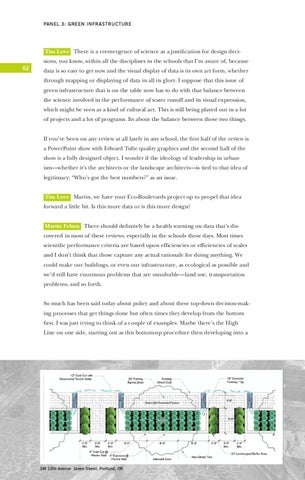
SW 12th Avenue Green Street, Portland, OR