Infrastructure and the Future
tively. We’re placing all of our collective hopes, all of our architectural aspirations, all of our desires for civil urban society, and now all of our desires for a sustainable and an environmentally just world onto it because it’s the only thing we’ve agreed to pay for. Tim Love Let’s save that for a second… I’m not going to take the notion that landscape architects are now better equipped than architects to deal with the city as a foregone conclusion. I want Daniel, who wasn’t there but is researching the birth of environmentalism as an interest to designers, to describe for us where the landscape architects and the architects were back in 1957. Daniel Barber A lot of the issues that are on the table today we have quite literally seen before. That’s what historians are required to say in this sort of context. Relative to the specific question of landscape architects and architects at Berkeley in the 1960s (the cause of environmental design was formed officially in 1962 but not really until 1966) the landscape architects and the urban planners were both legitimated by various quasi-scientific or scientific disciplines. Landscape actually came out of the biological sciences. It had been housed there institutionally. Urban planning had been a political science and architecture was an art which, of course, had some scientific basis, or at least this was the conceit. So how to scientificate the architectural disciplines on the table… This is where the notion of environmentalism as a sort of mechanism of behavioral modification— Tim Love And the thematic glue between the disciplines, too. Daniel Barber The college of environmental design has now regressed or returned to a moment. In fact, there was a moment when Lou Kahn came to Berkeley in 1969 and gave a lecture. All the students are coalesced around him, “We want to be like him,” you know, “We don’t care about social and cultural factors.” “We want to be like Lou Kahn and be a designer” and champion these things.
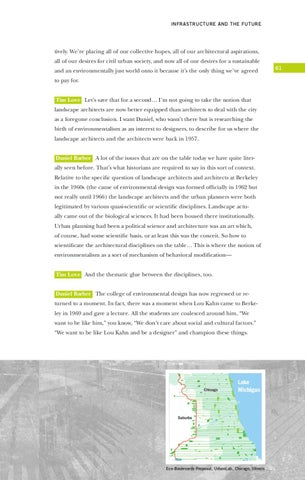
Eco-Boulevards Proposal, UrbanLab, Chicago, Illinois
61