Panel 3: Green Infrastructure
In my experience, a project of this scale could be led by an architect or a landscape architect but once you jump up to the larger scale of the master plan… You 58
know I worked on the Los Angeles River master plan for two years and it was led by an engineering firm, which was absolutely the right thing, partially because they stood out of the way in terms of the design issues, the urban design, and open space master planning. They’re facile at doing EIRs and navigating the gauntlet of public policy needed to achieve consensus. The third thing is that they often hire people from the Army Corps of Engineers or people who have previously worked in the public sector that can help gain consensus among many competing constituents for projects. Tim Love For projects like this, the linking engineering theme seems to be water management or the logic of the idea that a larger, linear system like this might be driven by hydrology and the logics of earth and water flows. This is tied to policy surrounding the Clean Water Act and all of the other policy apparatus that might make it a priority or would fund a project of that scale. Maybe there’s another way into the definition of green infrastructure. Charles Waldheim I’m in favor of it. Over the course of the last ten or fifteen years it’s become clear to many that landscape architects have emerged as the urbanists of our day. Now, what does that mean? It means that, for a whole host of reasons, the traditional disciplines of urban design and planning were seen or perceived by many to be incapable of responding to the challenges of contemporary built environments—specifically urban environments in North America, where the challenges of the city rarely respect traditional or disciplinary boundaries. Having said that, whereas landscape architecture twenty-five years ago was in a period that’s been described as moribund, in the last ten or twelve years it has emerged kind of improbably as the center, the venue in which discussions of urbanism have taken root. Now this is in part a result of urban design having bet on the wrong horse, betting on the horse of density, that somehow we’re all going to
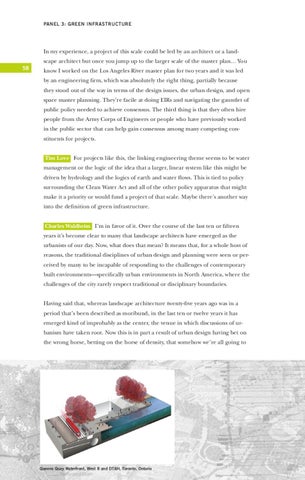
Queens Quay Waterfront, West 8 and DTAH, Toronto, Ontario