Infrastructure and the Future
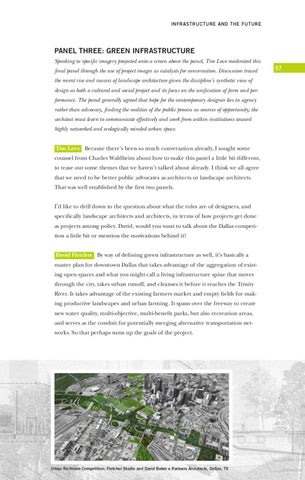
PANEL THREE: GREEN INFRASTRUCTURE Speaking to specific imagery projected onto a screen above the panel, Tim Love moderated this final panel through the use of project images as catalysts for conversation. Discussion traced the recent rise and success of landscape architecture given the discipline’s synthetic view of design as both a cultural and social project and its focus on the unification of form and performance. The panel generally agreed that hope for the contemporary designer lies in agency rather than advocacy, finding the realities of the public process as sources of opportunity; the architect must learn to communicate effectively and work from within institutions toward highly networked and ecologically minded urban space. Tim Love Because there’s been so much conversation already, I sought some counsel from Charles Waldheim about how to make this panel a little bit different, to tease out some themes that we haven’t talked about already. I think we all agree that we need to be better public advocates as architects or landscape architects. That was well established by the first two panels. I’d like to drill down to the question about what the roles are of designers, and specifically landscape architects and architects, in terms of how projects get done as projects among policy. David, would you want to talk about the Dallas competition a little bit or mention the motivations behind it? David Fletcher By way of defining green infrastructure as well, it’s basically a master plan for downtown Dallas that takes advantage of the aggregation of existing open spaces and what you might call a living infrastructure spine that moves through the city, takes urban runoff, and cleanses it before it reaches the Trinity River. It takes advantage of the existing farmers market and empty fields for making productive landscapes and urban farming. It spans over the freeway to create new water quality, multi-objective, multi-benefit parks, but also recreation areas, and serves as the conduit for potentially merging alternative transportation networks. So that perhaps sums up the goals of the project.
Urban Re:Vision Competition, Fletcher Studio and David Baker + Partners Architects, Dallas, TX
57