Panel 2: Systems Infrastructure
in New York City or some of the recreation parks in Austin, Texas, where I grew up, those extend the quality of life that I have. If I think about the things that are 44
available to me, it’s not just the dwelling that I keep and the transportation that I use to get to and from work, it’s those civic outlets. If we don’t actually consider them as this extension of this quality of life then we’re missing the boat with the kind of work we can do as an aggregate. Tom Keane Will, I’m going to make you answer this question specifically with respect to transportation, since that’s been your focus. You’re not an architect. You may have taken a few architecture classes, but you’re not an architect. Do architects really have a role in creating the transportation system in the future? You can say “no.” Will Lark I don’t think the architect is going to define it, but I think there has to be some consideration for other systems. One example we have on campus is a new building—the Stata Center, which Frank Gehry just designed. I’m sure he looked at every nook and cranny of the details in the building itself, but the stuff that matters to me as a vehicle designer is in the basement. Are those power transformers just stuck in a cemented area without any connection to the outer grid? They have four different transformers and less than half of them are used at a time. One of the big issues we have with electric vehicles is being able to rapidly charge them. Transformers are the perfect thing to piggy back off of, but obviously there was no foresight or thought about how these things could work with other systems. Tom Keane But isn’t that more a failure of architecture rather than saying that an architect doesn’t matter? Will Lark Yes.
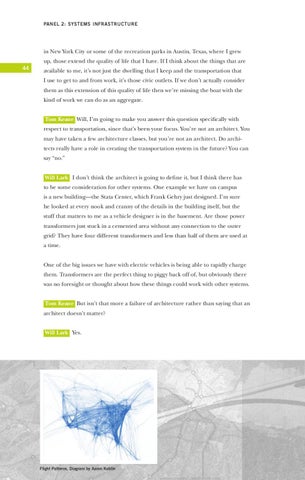
Flight Patterns, Diagram by Aaron Koblin