Panel 1: Civic Infrastructure
Guido Hartray The challenge, as we start to have more concerns with sustainability and systems of infrastructure that we think are invisible, is to recognize that 26
they’re all actually visible in some form. Part of the challenge in making them civic is to make that connection, right? If it’s invisible, then it’s very easy for the infrastructure to be out of sight, out of mind, and without a relationship to the public will. It just happens. Sarah Williams Goldhagen Ok, so one of the goals then, is to take the parts of infrastructure that are invisible, but are critical to the long-term health of the society, and to somehow concretize them in ways that make people aware of the interconnectedness of this kind of thing. Robert Culver The design firms have to be able to get back to being thought leaders about where we are going with the planning, with the development of sustainable infrastructure. Sarah Williams Goldhagen Ok, what would that entail? Robert Culver Back to Adam Smith… the economics now are such that everybody in this room that’s involved with an architectural firm is feeling the heat. It’s a problem that we’re losing the thought leaders. We need to ask whether architectural firms should become more public and should be seen in terms of national policy, as having some sort of vehicle for subsidizing thinking about the future. This is a radical idea, but we are missing out on more thoughts, and the architectural industry is not able—except through really well-defined jobs—to challenge us on what the future ought to look like. It’s a huge issue. Marilyn Taylor I completely agree, and I spend a lot of time at school talking about that. I believe that the world most immediately around us—that is the availability of public funds, the availability of private funds, the real estate industry, and
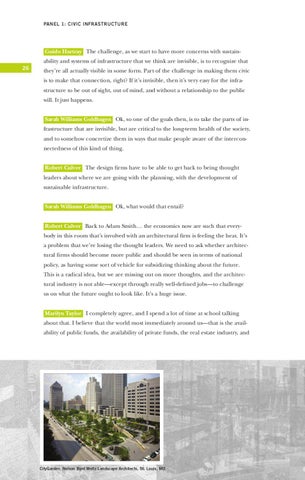
CityGarden, Nelson Byrd Woltz Landscape Architects, St. Louis, MO