Panel 1: Civic Infrastructure
Sarah Williams Goldhagen That’s right, because when you’re dealing with a topic or a subject as big as infrastructure, politics and political expediency is critical. We 22
all know this, right? So, what is it about your city? Is it because you’re the emperor? And I don’t say that facetiously… Robert Culver Benign dictator… The Base Reallocations Closure Act came along. It happens to a lot of large spaces of land here, and in Europe, where all of a sudden, the Department of Defense, the largest employer in the whole world, says, “We’re shutting down hundreds of acres in the middle of some place.” Scared the living daylights out of the body politic, the body politic then said, “Here, we want this agency to run this because we are scared now that we’ve lost twenty-five hundred, three thousand jobs, that we don’t know what to do with this, and in addition to that, we’re going to give you two hundred million dollars for infrastructure development.” Sarah Williams Goldhagen The body politic meaning the local… Robert Culver The regional—the state legislature. Fear and greed. Sarah Williams Goldhagen Ok. All right, we have people who have worked a lot in Europe, maybe you can talk about fear and greed… Byron, tell me your thoughts. Byron Stigge I’m going to talk about my work in the developing countries, because I think that really puts a focal point on how much civic infrastructure we have here in the US. Civic infrastructure is all the things that the private sector won’t do on their own. And the reason they won’t do them is because there are market gaps. Low, below market-rate housing, is a clear market-gap, or drinking water supply, where there’s a market-gap because there’s no economic justification to supply drinking water.
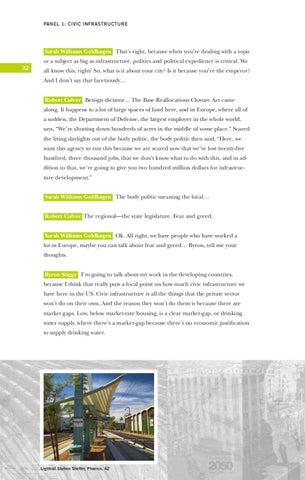
Lightrail Station Shelter, Phoenix, AZ