never mind the buildings
Even before the “Obama Stimulus,” the United States was spending more than it ever had on infrastructure. Much of it goes to maintain existing systems that, 14
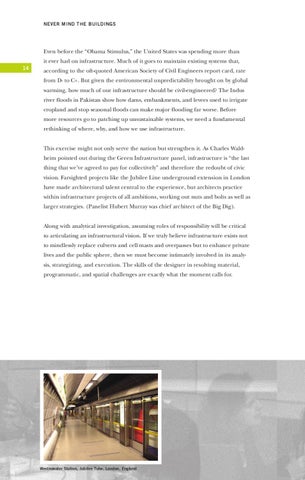
according to the oft-quoted American Society of Civil Engineers report card, rate from D- to C+. But given the environmental unpredictability brought on by global warming, how much of our infrastructure should be civil-engineered? The Indus river floods in Pakistan show how dams, embankments, and levees used to irrigate cropland and stop seasonal floods can make major flooding far worse. Before more resources go to patching up unsustainable systems, we need a fundamental rethinking of where, why, and how we use infrastructure. This exercise might not only serve the nation but strengthen it. As Charles Waldheim pointed out during the Green Infrastructure panel, infrastructure is “the last thing that we’ve agreed to pay for collectively” and therefore the redoubt of civic vision. Farsighted projects like the Jubilee Line underground extension in London have made architectural talent central to the experience, but architects practice within infrastructure projects of all ambitions, working out nuts and bolts as well as larger strategies. (Panelist Hubert Murray was chief architect of the Big Dig). Along with analytical investigation, assuming roles of responsibility will be critical to articulating an infrastructural vision. If we truly believe infrastructure exists not to mindlessly replace culverts and cell masts and overpasses but to enhance private lives and the public sphere, then we must become intimately involved in its analysis, strategizing, and execution. The skills of the designer in resolving material, programmatic, and spatial challenges are exactly what the moment calls for.
Westminster Station, Jubilee Tube, London, England