Infrastructure and the Future
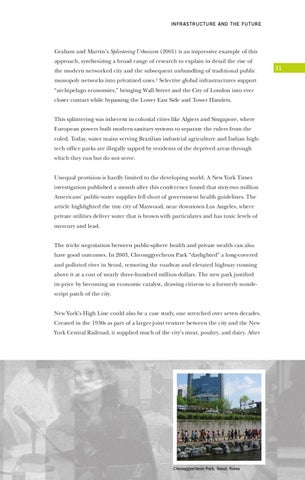
Graham and Marvin’s Splintering Urbanism (2001) is an impressive example of this approach, synthesizing a broad range of research to explain in detail the rise of the modern networked city and the subsequent unbundling of traditional public monopoly networks into privatized ones.2 Selective global infrastructures support “archipelago economies,” bringing Wall Street and the City of London into ever closer contact while bypassing the Lower East Side and Tower Hamlets. This splintering was inherent in colonial cities like Algiers and Singapore, where European powers built modern sanitary systems to separate the rulers from the ruled. Today, water mains serving Brazilian industrial agriculture and Indian hightech office parks are illegally tapped by residents of the deprived areas through which they run but do not serve. Unequal provision is hardly limited to the developing world. A New York Times investigation published a month after this conference found that sixty-two million Americans’ public-water supplies fell short of government health guidelines. The article highlighted the tiny city of Maywood, near downtown Los Angeles, where private utilities deliver water that is brown with particulates and has toxic levels of mercury and lead. The tricky negotiation between public-sphere health and private wealth can also have good outcomes. In 2003, Cheonggyecheon Park “daylighted” a long-covered and polluted river in Seoul, removing the roadway and elevated highway running above it at a cost of nearly three-hundred million dollars. The new park justified its price by becoming an economic catalyst, drawing citizens to a formerly nondescript patch of the city. New York’s High Line could also be a case study, one stretched over seven decades. Created in the 1930s as part of a larger joint venture between the city and the New York Central Railroad, it supplied much of the city’s meat, poultry, and dairy. After
Cheonggyecheon Park, Seoul, Korea
11