Building Trails in the Berskshires: Best of both worlds
Your State Department of Outdoor Recreation
Epic Quebec: NEMBA goes North
NEMBA Trail School:
Doing the work that allows us all to play
NEMBA Ambassadors
Chapter Updates
Staff
Executive Director • Nicole Freedman
Events Director • Amanda Royce
Membership & Outreach Director • Mick Ferraro
Board of Directors
President • Adam Glick
Secretary • Mary McCarthy
Vice President • Matt Schulde
Treasurer • Erin Faccone
At Large • Hunter Ralston
At Large • David Tashji
At Large • Dave Hughes
NEMBA, is a 501(c)(3) non-profit committed to creating epic riding experiences, preserving open space, and guiding the future of mountain biking in New England. With 35 Chapters throughout New England and more than 10,000 members, our goal is to promote the best that mountain biking has to offer, steward the trail systems where we recreate, and ensure access to open space.
Board of Directors Continued
Belfast Area NEMBA • Chris Gardner
Berkshire NEMBA • Alison McGee
Blackstone Valley NEMBA • Kevin Sylvia
Brattleboro-Keene NEMBA • Michael Davern
Cape Cod NEMBA • Frank Merola
Carrabassett Region NEMBA • Valerie Levanos
Central CT NEMBA • John Puziss
Central Maine NEMBA • Chris Riley
Central NH NEMBA • Mike Geldermann
Fairfield County NEMBA • Mike Malwitz
Franconia NEMBA • Tim Clough
Greater Boston NEMBA • Mary McCarthy
Greater Portland NEMBA • Billy Czaja
Housatonic Valley NEMBA • Greg Meghani
Merrimack Valley NEMBA • Way Bo
Midcoast Maine NEMBA • John Lemole
North Shore MA NEMBA • Frank Lane
Northwest CT NEMBA • Jonathan Regan
Pemi Valley NEMBA • Slade Warner
Penobscot Region NEMBA • Aaron Brasslett
Piscataquis County NEMBA • Ken Pfaffmann
Purple Valley NEMBA • Bill MacEwen
Quiet Corner NEMBA • Jeff Doyle
Rhode Island NEMBA • Wayne Asselin
Seacoast NEMBA • Tim Mallard
Six Rivers NEMBA • Reggie Lebel
Southcoast NEMBA • John Tomawski
Southeast CT NEMBA • Brett Seversen
Southeast MA NEMBA • George Lester
Southern NH NEMBA • Christopher Gaudet
Vineyard NEMBA • Jon Malone
Wachusett NEMBA • Kris Monroe
Western Mass NEMBA • Phil Pless
White Mountains NEMBA • Jeremiah Beach
NEMBA, PO Box 2221, Acton, MA 01720, office@nemba.org
Business
Supporters and Sponsors
Thank you, from the entire NEMBA community, for your support of all things mountain biking!
Ashland Town Forest Committee
Airline Cycles
Alpine Bike Works
Battle Road Bikes
Benidorm Bikes & Snowboards
Benjamin Construction
Bike Zone of Cape Cod
Bikebarn
Buchikas Bike, Salem & Nashua, NH
Camelot Tools
Cranky Frankie’s Mobile Bicycle Service LLC
Cranmore Mountain Resort
Cycle Life Physical Therapy
DM Cabinetry Inc.
Earthworks
Gamache & Lessard Co Inc
Green Woodlands Foundation
GRVL Cycling
HairFin
Joe’s Garage Inc.
Marblehead Cycle
Mossy Cog Designs Bike Storage
Norm’s Ski & Bike Shop
One and Done Inc.
Papa Wheelies Bike Shops
Peter Hanney, REALTOR
Philbricks Ski Board and Bike
Peter Roberts Real Estate
Quadcycles
Sansoucy Stone
Seacoast Ebikes, LLC
Steve the Bike Guy
Sugarloaf Inn
Vermont Adaptive Ski and Sports
Wren Sports
A Letter from the Executive Director
I’m thrilled to introduce this latest edition of SingleTracks. Over the past two years, we’ve been on a mission to modernize our signature magazine, making sure it’s more engaging, exciting, and relevant than ever. So, how do you make an annual magazine stand out in today’s instant-gratification digital world?
Simple: with deep dives into the stories you care about, and fresh perspectives you won’t find anywhere else. And by teaming with pro writers and designers to bring this vision to life!
Inside you’ll find some of our most inspiring work from the past year:
NEMBA’s First International Trip: We journeyed to Quebec to experience some of the world’s best and most diverse trails, from the legendary “La Légende” to hidden gems that blew us away. Greater Boston chapter leader Mary McCarthy captures the essence and every adrenaline-packed moment in her write-up.
Expanding in the Berkshires: Fueled by our transformative Quebec adventure, we’re gearing up to create a world-class trail network in the Berkshires. We’re talking professionally designed trails at Shaker Ridge
and a community-driven network in nearby Williamstown—bringing big mountain biking energy to New England.
Outdoor Recreation Advocacy: We had exclusive sit-downs with newly appointed directors of outdoor recreation across New England to explore what their roles mean for mountain biking and NEMBA. They outlined their vision for the sport and what they need from us to help grow it. We’ve already seen positive results – a newly released $300,000 grant for mountain biking trails in MA!
And more: From exciting updates on our local
chapters to our revamped Trail School and rebranded Adventure Series, we’ve got a ton of action-packed news for you.
We hope you enjoy this issue, and we can’t wait to see you on the trails.
Keep smiling, Nicole
BUILDING TRAILS IN THE BERKSHIRES: BEST OF BOTH WORLDS
Shaker
Ridge
& Purple Valley Projects
Big things are happening in the westernmost part of Massachusetts in terms of new trail networks. Ideas have been brewing, permissions given, money is flowing, and plans are coalescing at two locations within a half-hour drive in Berkshire County. Each features different styles of funding, trails, philosophy, and build process. Together, these two trail systems—plus the momentum they could inspire for more—should lead to the Berkshires soon becoming a mountain biking destination.
Shaker Ridge Trails: Hancock/Lanesboro
shakerridgetrails.org
by Dot Burnworth / photos Mike Bagby
“If you build it, they will come.” Chatting with Dee Smith, co-founder of Pinnacle Trail Design, about Shaker Ridge Trails, a proposed largescale, mountain-bike-optimized trail network in the Berkshires, I quickly got a “Field of Dreams” vibe. Dee is passionate about this project, in part because of her background in environmental science and outdoor recreation and in part because she lives 15 minutes from the property. These will eventually be her “home” trails.
Meet the pair making Shaker Ridge Trails a reality
Dee and her husband/business partner, Keenan, have been dreaming of the Shaker Ridge Trails project for years. Finally, the stars seem to be aligning to make it a reality.
The couple met in college in upstate New York, where they were both into mountain biking, environmental science, and outdoor recreation. They got involved in some local trail building, and the rest—as they say—is history.
After graduation, Dee and Keenan were volunteer trail builders at a local forest when a private landowner asked if they would build trails on his property. Seeing a business
opportunity, they started Pinnacle Trail Design, a for-profit LLC in 2017, and have since built trails all over the country. If you’ve ridden the trails at Norbrook Farm Brewery in northwest CT, you’re familiar with their work.
As the couple worked on large-scale, wellfunded, purpose-built, mountain-bikeoptimized trails across the country, they continued to imagine this modern, progressive model implemented in the Berkshires.
The stars align and shine down on the perfect property
Suddenly, last summer, two very important stars aligned.
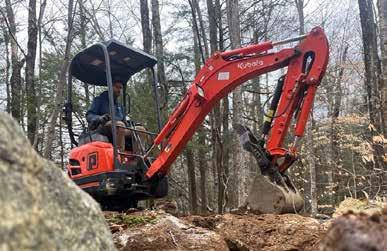
Star #1: Seed funding was secured. Last summer, Pinnacle Trail Design teamed up with a philanthropist (who wishes to remain anonymous) working under an LLC called Cricket Trails. Dee and Keenan outlined their vision to him and laid out how this project would be a huge economic driver for the area. Clearly, they were speaking his language because in January 2024, he closed the deal on 550 acres for phase one of Shaker Ridge Trails. Additionally, he offered $500,000 to begin the construction of the project.
Star #2: The “perfect” property was for sale. The 550 acres purchased by Cricket Trails is a bit of a unicorn in the trail building world. It is actually three contiguous parcels of land split between Hancock and Lanesborough. The acreage includes approximately 900 feet of elevation on a largely dry, buildable mountain. According to Dee, usually a significant portion of any large parcel of land like that would be unbuildable due to wetlands or other issues.
The property also abuts the Jiminy Peak Mountain Resort and a land trust. A link to Jiminy Peak would be mutually beneficial, as riders could patronize their restaurants and hotels, and use their lift to either ride the JP trails or cross over onto Shaker Ridge.
A partnership with the land trust could open up far more miles of contiguous trail.
An ambitious build on an ambitious timeline
Everything on these 550 acres is part of “phase one” of the project—which will cost approximately $2.1 million for the full buildout. This includes public access improvements, parking lots, a skills park, and all ancillary supporting structures, such as a pavilion. Dee believes they can build between 25-30 miles of trail on this property, including 7-10 miles of adaptive mountain bike trail. That’s just the beginning. The larger vision is to create 100 miles of trail, which would be possible through partnerships with Jiminy Peak, Pittsfield State Forest, and the land trust.
Clearly, this is a huge project, and Dee and Keenan have an ambitious timeline. They are hoping to finish the master plan by the end of this summer/early fall, then break ground mid to late fall. They hope to have the first 10 or so miles open by the end of 2025. Realistically, they want phase one to only take 2-4 years. A lot of that hinges on their ability to raise funds.
Fundraising is key to success
Shaker Ridge Trails currently has a formal partnership with regional NEMBA. Through NEMBA, they can raise funds, apply for grants, and promote the project to our huge network of mountain bikers. At some point, Shaker Ridge Trails could become its own entity that can fundraise for its own maintenance and stewardship (in other words, to hire staff and
seasonal crews). Like any nonprofit that would rely on donor funding, grants, and growing an endowment, the hope is that this project will bring in the needed level of support for continued operation.
Dee and Keenan envision Shaker Ridge Trails as a model for progressive mountain bike trail networks in this part of New England. They assert that it can be a sustainable model for economic development and tourism and an asset for the community. Ideally, other entities will collaborate with Shaker Ridge Trails to develop programming such as camps and clinics.
Dee really wants Shaker Ridge to exist so that other entrepreneurial-minded people and community programs can see it as a resource. Fundraising of all types is important. While private and state grants will go a long way, small, private, grassroots donors will help bring the project home.
If you’re interested in seeing the dream of Shaker Ridge Trails become reality, you can donate by visiting member.nemba.org/Donate and indicating your donation designation as Shaker Ridge Trail Network.
See you out on the trails! ~ Dot
Confused about what “modern, progressive model” means? You’re not alone.
Dee explains the concept with what she calls the 6 “M”s:
1. Mountain-bike-optimized trails
2. Mixed variety of trails and terrain
3. Mileage of trails around a central hub
4. Mapped trails
5. Marked trails
6. Maintained trails
Purple Valley, Williamstown, MA
Purplevalleytrails.org
By Cris Cadiz
Bill MacEwan, President of Purple Valley NEMBA, grew up in Canada and spent time riding and racing mountain bikes at the international level on some of the best trail systems in North America. He and his wife moved to Williamstown, MA, in 2021 to raise their children close to his wife’s family. Having lived in mountain communities all his life, Bill was surprised there was no mountain bike trail network in the area.
“I have always lived in places where mountain biking was a central part of the culture. In Williamstown, cycling and gravel riding are huge and there are lots of trail networks over the border in Vermont. But there’s a black hole in the Berkshires for mountain biking.” Bill asked around to find out why. Some told him that people don’t want to provide access, but he started talking to landowners and learned they were pretty open to the idea. “That’s how we got started,” he says.
Launching a chapter to fill the gap
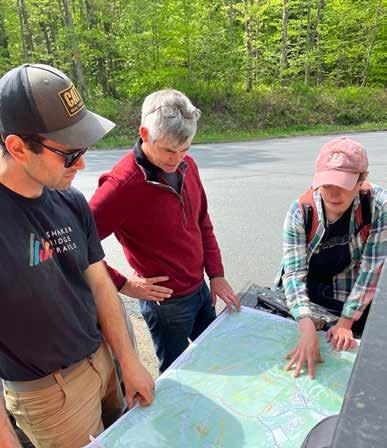
Bill co-founded Purple Valley (PV NEMBA) last year with Dan Gura, avid trail runner, mountain biker, and Stewardship Director for Williamstown Rural Lands Foundation. Within its first year, PV NEMBA organized a large community of mountain bikers, created a plan for a trail network, and gained permission and funding for system that will eventually offer over 30 miles of trails on Berlin Mountain.
“Our idea was to focus on one small part of our backyard and do it really well,” says Bill.
The Williamstown area has beautiful mountains and forests, well-known hiking trails, numerous outdoor enthusiasts, and many mountain bikers, but no community organization or legitimate trail system—until now. “We see people calling a hiking trail or old logging road a mountain bike trail,” says Bill. “That’s great for point-to-point rides but it’s not what mountain biking can be.”
TRAILS
Making Berlin Mountain the initial destination
Bill and Dan started looking for the best site and chose Berlin Mountain, which used to be an old ski hill in a natural bowl rising from 1,000 to 3,000 feet in elevation. “It’s pretty unique in MA and we wanted to take advantage of the ton of vertical,” says Bill. “The landowners were very interested and it was suited to mountain biking, with steeper grades but also some lower pitch and a few spectacular ridge lines.”
Berlin Mountain is located on the Taconic Ridge, a small mountain range that runs from VT down the border between NY and MA. Bill and Dan spent a year working with NEMBA, the town, and Williams College to create a solid memorandum of understanding, allowing for mountain-bike-specific trails, Class 1 eMTB access, and a long-term agreement to build 20-30 miles of trails. Bill says they are developing a good relationship with neighboring landowners who might allow access to the full bowl, which could expand the system to 1,300 acres and up to 40 miles of trails.
A
community
project powered
by
volunteers and an IMBA grant
“This is a community-first, volunteer-driven project,” says Bill. PV NEMBA spent the first year building relationships and a newsletter with an audience now well over 100 and growing. A survey revealed that mountain bikers wanted a mix of machine- and handbuilt trails, using flow to augment a naturally built trail. There was strong demand for more advanced trails but also for progression. “We see a gap for something that’s technical and challenging, pushing people, but also a huge interest in beginner trails for the mountain-bike curious,” Bill says. “We need to build good ramp-up to that.”
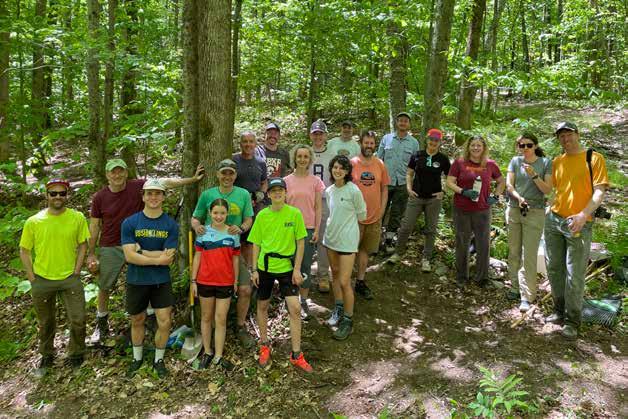
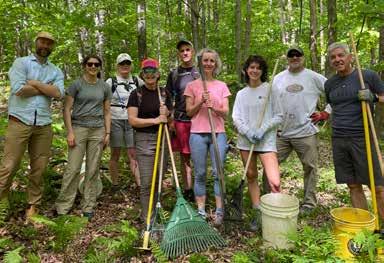
a sidewinder-style back down to the lot— short but fun It’s been incredible to see the community show up. ” says Bill. “We had 30 people our first trail day. We got the whole thing raked and started building berms; everyone was amazed at the enthusiasm. Our first loop is an all-volunteer build, learning as we go. We are also getting to know each other.”
A life-changing investment in regional mountain biking
Bill sees Purple Valley Trails as life-changing for the region. “I think we’re creating something for the kids—that’s what I’m most thrilled about.” He imagines a future school mountain
bike team and local kids learning the sport on trails built for it. He’s also thrilled at the regional investment in mountain biking, including the new Shaker Ridge project just a few miles away. “There’s been a big vacuum here for high-quality mountain bike trails. The fact that both projects are happening is not a coincidence,” Bill says.
“People like to ride a variety of things and big flow trails are a modern marvel,” Bill says. “It will be nice to have two networks with different flavors.” Purple Valley Trails are about serving the existing community. “It’s about getting together after work to ride classic singletrack through the forest, be part of nature, enjoy
It will be nice to have two networks with different flavors.
Purple Valley NEMBA won a $35,000 Trail Accelerator Grant from the International Mountain Bicycling Association (IMBA), awarded annually to just five networks across the country. “It brings world-class trail design to Williamstown,” says Bill. The chapter will match half the dollar amount of the grant, which includes pro guidance from IMBA trail builders and educators.
This fall, IMBA will flag over five miles of trail to create shovel-ready projects. IMBA will develop a network concept this winter, and next summer, they hope to add five-ten more miles.
In July, PV NEMBA opened its proof-ofconcept trail, “a climb through glades, and
each other’s company, and have pride of ownership. I will definitely bring my enduro bike to Shaker Ridge and ride some jumps but enjoy the trails in my backyard for a quiet afternoon. It’s going to be so cool to have both.”
Planets align in the Berkshires…
As mountain biking continues to grow in popularity, communities, governments, landowners, and investors are seeing the many benefits of good trail systems. Alison McGee is President of Berkshire NEMBA, a chapter with a vast geographical area and abundant natural resources. Called “an absolute champion” by Purple Valley’s Bill McEwan, for years Alison has advocated extremely hard for mountain biking and encouraged trail development in western MA.
“We are excited to see focused efforts in the Berlin Mountain area and really happy to have the Purple Valley team become a NEMBA chapter in our region,” says Alison. “The work they’re doing is fantastic and builds off something we wanted to happen for a long time.” Along with Purple Valley’s community-first trails, Shaker Ridge will offer
a professionally built element to allow for the best of all worlds in the Berkshires. “We are always happy to have more trails and hope Shaker Ridge succeeds in bringing something different to the region while also contributing to the surrounding mountain bike and outdoor advocacy community.”
The work they’re doing is fantastic and builds off something we wanted to happen for a long time.
BUILDING TRAILS IN THE BERKSHIRES:
BEST OF BOTH WORLDS
By Cris Cadiz
Your State Department of
Outdoor Recreation
Wheels spin slowly in government, but New England states are finally embracing the fact that outdoor recreation is an economic powerhouse. Mountain bikers and mountain biking advocates who seize this opportunity can help drive the sport forward.
So far, five New England states either have or are in the process of employing a Director of Outdoor Recreation (or similar role). While every office has different goals and responsibilities, each recognizes value in outdoor recreation and strives to support it. Understanding this office and the people who run it can be a powerful advocacy tool. The directors of these offices have various backgrounds but collectively share many years working in outdoor recreation and great enthusiasm for enjoying and supporting access to our natural resources.
In 2023, the U.S. Bureau of Economic Analysis (BEA) measured the entire nation’s outdoor recreation economy. It showed that outdoor recreation generates $1.1 trillion in economic output (2.2% of GDP), 4.98 million jobs and comprises 3.2% of U.S. employees.
~ www.confluenceofstates.com/news
In 2013, Governor Gary Herbert of Utah saw the significant positive impact of outdoor recreation on his state’s economy and created the first Office of Outdoor Recreation.
Following Utah’s lead, eight states formed a bipartisan network called the Confluence of States (www.confluenceofstates.com) in 2018, with the aim of giving the outdoor recreation industry a political voice. Today, 18 of 50 states have signed on to this collaboration, which aspires to “unify communities, bridge societal divides, and improve the mental and physical health of all.”
Hampshire joins in
established an Office of Outdoor Industry & Experiences in 2024 and is hiring a director who will spearhead potentially joining the Confluence. Massachusetts joins in 2024
CONNECTICUT Your State Department of Outdoor Recreation:
https://portal.ct.gov/deep-parks-partnerships
“Connecticut’s $4.6B outdoor recreation economy is the second largest in New England and has demonstrated robust growth each year since the pandemic.”
- CT DEEP website
In January 2024, Governor Ned Lamont created the Office of Outdoor Industry & Experiences to help coordinate and grow CT’s outdoor recreation economy. Mason Trumble is Deputy Commissioner for Environmental Conservation and defacto leader/spokesman during recruitment and hiring of a director. Originally from Maine, Mason has lived and
worked all over New England, loves the outdoors and numerous activities, including mountain biking.
Go-to trail system: Hurd State Park
Recent support for mountain biking: According to Mick Ferraro, “Mason’s leadership and vision for outdoor recreation in CT has been critical to building collaborative partnerships and the trail development at Nepaug State Forest in New Hartford.
CT’s goals for the office:
1. Better promote outdoor recreation
2. Identify demand and partner with the private sector to offer amenities the state doesn’t have resources to provide (i.e., bike shops, equipment rental, après-ride food and bevvies)
How can this new office help mountain bikers?
“I hope it can elevate outdoor recreation as an economic driver and make a case for more. The win we all share is being able to conserve more land, and create more space to handle all the demand in our state for outdoor recreation—so more access.”
How can we support the new director?
“Help identify demand. For example, if we have no destination mountain bike trail system, do we need one? Where should it be and why? How can CT better meet that demand? These are questions the new director can help answer and goals they can advocate for.”
Opportunities to connect:
CT Trails Symposium: Network with agency staff, trail planners, and other trail users at Manchester Community College, Manchester, CT.
https://cttrails.uconn.edu/symposium
A geographically small state, CT has the
2nd largest outdoor recreation economy in New England, according to the U.S. Bureau of Economic Analysis. “It’s shocking,” says Mason. “It means we have a ton of demand.” That’s good for the economy but can exacerbate user group conflicts, which Mason says are not uncommon and flare up among all groups, from bird watchers and hunters to hikers and bikers. “Everyone wants to enjoy the outdoors, but there’s a ton of people and not a lot of space.” He thinks the new office could be positive on many levels.
Wheels are already turning regarding private sector partnerships. A survey was issued statewide regarding demand for outdoor recreation and related amenities. Analyzing the data will help the new director identify need. Then they will issue RFPs, accept bids, and approve businesses to offer services like bike rentals and restaurants near state recreation areas.
Mason admits the new office won’t change the process of trail approval or resolve user group conflicts, but it can leverage our economic power.
Hired in September 2023, Paul Jahnige is a multi-sport outdoor enthusiast who has worked for Massachusetts Department of Conservation and Recreation for 23 years. That included 17 years on trails and greenways before taking a position as the state’s first Director of the Massachusetts Office of Outdoor Recreation (MOOR).
Paul sees lots of room for growth in mountain biking, especially in creating destination trail systems. He knows that New England states with strong partnerships among private landowners, local mountain biking clubs, and state agencies have successful trail systems, and thinks it can also work in MA.
Paul has been doing lots of outreach to learn about current initiatives in the mountain bike sector. “The hope is to bring some infrastructure investment dollars to develop mountain biking through future grant opportunities.” Depending on resources and availability, his office will put out a call for proposals for trail development projects.
Paul’s office works across state agencies, including travel and tourism, to promote outdoor recreation as an important part of the economy. “A lot of mountain bikers are driving through MA right now to spend money in other places,” says Paul. “We want to make sure folks come here and stay here to play more and drive less.”
MOOR’s goals
To promote outdoor recreation and make the state a welcoming place for residents and visitors to enjoy the outdoors
Make MA inclusive, diverse, welcoming, and accessible in all our outdoor spaces and activities
Recent MOOR support for off-road cycling:
Small grants for events, especially for underrepresented groups. Spring 2024 funding supported adaptive cyclists through nonprofit All Out Adventures at the Massochistah gravel ride in the Pioneer Valley. Almost
$5,000 helped provide recumbent trikes and handcycles outfitted for dirt and gravel, support staff, plus an accessible portolet.
How can we help our own advocacy efforts?
Paul praises mountain bike stewardship of current trail systems but feels that authorized trails are key to our sport’s success. “We want to make sure we’re doing things in partnership and collaboration with landowners and go through permitting processes to protect the natural resources we all love and enjoy.”
Opportunities to connect:
Attend the Mass Trails Conference, Oct 26, 2024 www.masstrailsconference.com
“Outdoor recreation made up 3.9% of Maine’s economy, making Maine the sixth state in the country in the value that outdoor recreation adds to a state’s economy.”
~ 2022 Bureau of Economic Analysis, Maine’s Office of Outdoor Recreation website
Maine’s Office of Outdoor Recreation started as a one-person show in 2018. Luckily, it was and still is led by Carolann Ouellette, who also ran the Maine Office of Tourism and more recently was Executive Director of Maine Huts & Trails. Carolann seems to know everyone and everything about Maine’s outdoor recreation picture. Her position, as she describes it, is “connector and convener” … to work with and across state agencies, the private sector, and organizations to understand and answer
the question, “What can we do collectively and who are the partners?” Six years later, Carolann says her position has been “a truly fantastic experience, connecting the dots, and providing the place where things come together.”
How did Maine create their office?
The Office of Outdoor Recreation was industryled by Maine Outdoor Brands, a collaboration of retailers that formed after learning about the Confluence at a conference. “It was a pro-
business opportunity for the state to redefine the outdoor recreation sector and look at it as a whole,” says Carolann. Backed by economic interests, outdoor recreation groups didn’t have to convince anyone in state government their needs were important.
How can the office help mountain bikers?
“We can help NEMBA chapters get connected to people outside the NEMBA circle.” Rather than offer grant funding or create specific initiatives, Carolann listens, understands, keeps track of projects and investments, makes introductions, assists with collaborations, and helps promote completed projects.
Keep Carolann in the loop so she can be a resource and support our projects. Offer specific data on participation, scope of investment, economic statistics, etc. “It helps to hear it firsthand rather than making assumptions,” she says.
Opportunity to connect:
Maine Outdoor Economy Summit is a forum for professional development, ideation, and discussions on topics impacting Maine’s outdoor industry in the areas of economic development, workforce, access and equity. November 13-15 at Sunday River, www.moesummit.com/
“I am an avid year-round mountain biker and enjoy the trails and natural beauty that New Hampshire offers,” says Janel Lawton, Director Office of Outdoor Recreation Industry Development. “My experiences on the trails have given me a deep appreciation for the sport and its impact on both individual wellbeing and community development.”
Go-to trails:
Franconia Area NEMBA trails; Janel is also
VP of Franconia Area NEMBA and working to welcome diverse participation in our sport by making Franconia’s Fox Hill Park adaptive-rider friendly.
The director’s role:
Janel is a “conveyor, collaborator, conduit,” working within government to support the outdoor recreation industry and leverage New Hampshire’s vast outdoor resources to drive economic development. “I provide leadership and coordination among state and federal agencies, local governments, and industry partners.”
Specific plans in NH include working on trail expansion projects, improving trail maintenance, trail building education, and organizing events that highlight the benefits of mountain biking. “Strong trail infrastructure supports initiatives that promote mountain biking to a broader audience and support local businesses related to the sport,” she says.
“Better trails mean a better economy.”
How can we support our sport?
Provide data to Janel’s office to help advocate for mountain biking. “We can demonstrate the economic and social benefits of the sport, helping to build a stronger case for investment.
By working together, we can ensure that mountain biking continues to grow and thrive in New Hampshire, benefiting our residents, visitors and the economy.”
Opportunities to connect:
New Hampshire’s fall outdoor industry event, ROCKTOBERFEST, at McIntyre Ski Area in Manchester, NH.
Epic Quebec
NEMBA GOES NORTH!
Written by Mary McCarthy • Photos by J.Smith
We hit the road at 5:30 PM, jumping into Boston’s rush hour traffic like an amusement park log flume ride, sloshing around, going nowhere. My focus was on sitting for 7 hours. Someone give me a Sprinter – I need to stand up! Where are we going? And why so far when I can ride my bike outside my back door? Well, you don’t know what you don’t know. My mountain bike riding will never be the same. I tasted paradise in Canada.
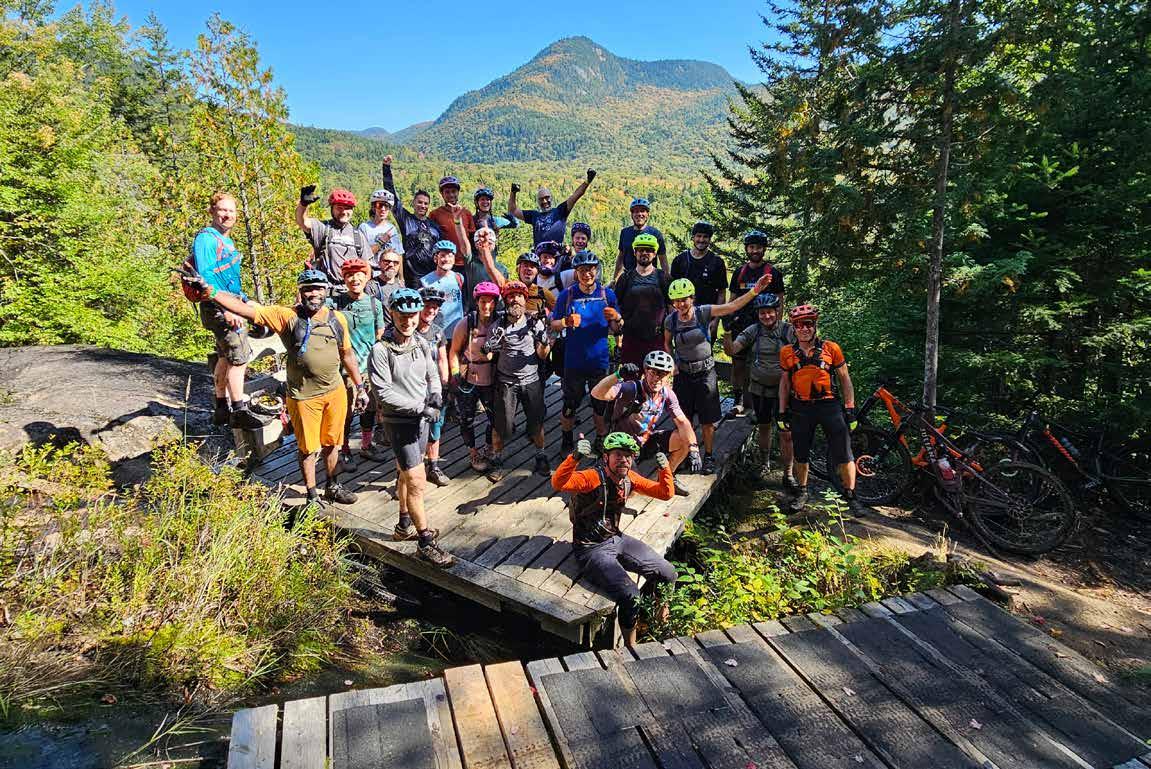
Not one for pilgrimages, I had low expectations. What was the big deal? We pulled into the parking lot at 2 AM. Clean yellow ropes cordoned off freshly groomed dirt spaces set alight by tinkling Christmas lights. I felt like I had arrived at a deserted playground on the moon. This playground was sleeping, but the vibrations of swoop and swoosh, drop and gap, swish, swish, skid were humming just below the surface. In the darkness, I had no idea we were surrounded by towering mountains--the Middle Earth of North America – tucked in a crevasse covered in the most beautiful trees kissed and flecked with autumn color. I unloaded my gear, slinging bag upon bag over my tired shoulders like a Sherpa. We bumbled through the dark by the glow of a bike light, looking for our chalet. Please, God, let there be pillows …
EPIC = Elevation, People, International, Community
Morning came within moments. I burst from our cabin, rushed over a sandy path and was quickly leveled by the mountain spires on all sides. Holy moly… this is definitely not Kansas and it sure as Shimano ain’t Massachusetts. I rushed over to the welcome center at Vallée Bras-du-Nord, Accueil Shannahan, spotted the familiar NEMBA tent, and was delighted to hear Nicole’s cheery “Morning!” Reflexively, I
jumped in beside her, quickly getting the drill, as we handed out t-shirts and hats, trail bars and Gatorade:
“Green wristbands for the whole weekend, red wristbands for today’s ride, yellow wristbands for tomorrow’s – just put them all on!”
“Congratulations, you made it!”
“Did you camp last night?”
Why do we immediately like people when we have traveled to a destination together? Eager eyes and ready smiles made for instant camaraderie. I settled in: we are mountain bikers on a mission, seeking sweet trails and the smell of dirt, trees, and fresh Canadian air. Calm flowed through my veins. I belong here and so do you!
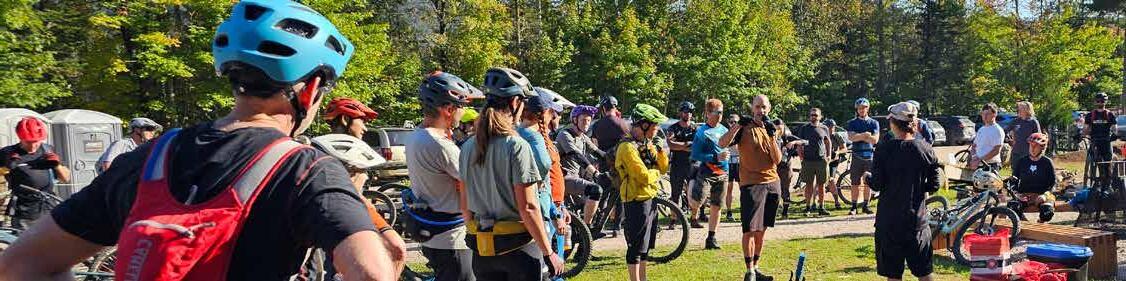
After registration we played an ice-breaker game with one of Nicole’s favorites: “What’s your bike’s name?” Eyeroll and groan, but we talked out the jitters and met the weekend’s characters. Bike names like Farty Marty, Frankenbike, Silver Fox, and Damn It! got us giggling. Lunches were distributed (cheese curds, V8, apple juice, a sandwich fit for a family of seven). They weighed 15 lbs. We joked that it was a good thing we weren’t riding the Tour de France … we were ready to go.
As the ride organizer, I met our local ride guides. Their fitness, posture, ready smiles, and encouraging nods assured me we were in great hands. I described NEMBA culture and an overview of the group’s range. They were given a tall order – hailing from 35 chapters,
our riders’ style and abilities vary as widely as the terrain of their home trails. I asked our guides to be mindful of the giddiness of a group in which many were touring Quebec for the first time. We wanted to have a great time, we wanted to feel like superstars, we wanted to see new trails, and build our rides to climax high after getting our bearings. “Don’t blow anyone’s wheels off in the first hour!”
Native language aside, they got it. On the fly,
they adjusted routes, adopted our secondrider drop silliness, and organized us into five groups with levels from 3 to 7 – 7 being the most technical. Each Canadian lead was paired with a NEMBA sweep. Then we were off –Day 1 VBN Secteur Saint-Raymond trails, aiming to be back by 2 PM for a break and afternoon festivities.
The trails were delicious! Just enough pack from a recent sprinkle, just enough rock sweat to keep you thinking about your tire pressure. I started as sweep in Group 4 – a thankless and thankful, low-pressure task. We began our climb, swirling and twirling, popping, pushing, locking to emerge with giddy laughs
The beauty, the trees, the temperature, the breezes, the glistening late summer light dancing on the rocks and dirt all led to fast, easy friendships.
Epic Quebec
and “Where are you from?” “Which chapter is that?” “Remind me of your name?” The beauty, the trees, the temperature, the breezes, the glistening late summer light dancing on the rocks and dirt all led to fast, easy friendships. We were in Canadian heaven, together, pedaling without a care in the world – except for Frankenbike with a mechanical. Soon, though, a jammed – and I mean jammed – chain gave way to the shared camaraderie of a repair – a bent master link replaced with sheer strength, determination, and no chain tool! We found our inner superheroes. Chain be damned – we are riding! Post-ride gatherings revealed the matured smiles of people who got their asses
handed to them with a friendly smile and had left it all on the trail. We stiffly tip-toed into the vast and rushing river beside Accueil Shannahan base camp.
The weekend was a three-day roller coaster of incredible riding. Valle De Bras du Nord was out of this world with several major trail networks, including the frequently photographed La Legende and Full Neilson, with toe-curling bridges and features built into the rock beside waterfalls. “The NEMBA
Epic Quebec
Quebec trip was amazing,” gushed Aaron Cleaver of Seacoast New Hampshire. “We camped out, were provided lunch and dinner for two days, and met lots of friendly bike people. The trails are fantastic, and the ride guides know them inside and out. We chased big, breathtaking waterfalls. Routes were grouped according to difficulty and speed and every route was perfect!” The beginning of Nielsen Sud, one of Aaron’s favorite trails, was a great lunch spot. Nielsen had fun bridges that curved around boulders with chunky tech and super-duper drops – a crowd-pleaser for the Connecticut bunch.
Other highlights were challenging climbs with a gravity park-style downhill vibe on Kraken Blue Trail, Godzilla, and Octopus for the gapseeking flyers. All three had berms higher than anything most of us had ridden before.
Thrilling, terrifying, and breathtaking all at once. Lots of tech, lots of flow, and lots and lots of smiles. Panoramic views everywhere.
Sunday’s Empire 47 featured a flashier Quebec, more gravity bike park vibe with treacherous trails, more endless bridge features and more gaps. Mirador Trail was a born-again experience. Thank God my guide hopped off her bike early and yelled to us again and again, “Slow down!” before one of its fantastical bridges with an almost 90-degree exit slope. Rounding the corner with healthy speed, I screamed back, “Slow down?” She hollered, “You’re good!”
Anything short of that confident reassurance and I would have grabbed more brake, which was THE LAST THING I needed going into a launch that made for involuntary air. What a delight! Where is the drone? Where is the camera crew? I just flew through the air like a leopard!!! I also peed just a little bit but was laughing, happy, healthy, with friends old and new. I flew through the air on my beloved cross-country bike – joyous, free, suspended in the moment. The moment was the Big Deal … and amazing moments they were!
Warm thanks to all our incredible hosts and
guides, including Nicolas Labrecque-Sauve of Quebec City Mountain Bike; to our VBN Ride Guides: Gabriel Gakwaya, Alexandra Power, Nicholas Desroches, Frederic Germain, Alex Verret, and Genevieve Savard; to the legendary Gilles Moreneau, former mountain bike racer and trail development consultant, for going over and above with an impromptu third ride out to the waterfalls. Thanks also to our Empire47 guides Gerry Beaulieu, Michael Cases, Patricia Charles, Raymond Bouchard, and Luke Levesque.
Thank you Vallee Bras Du Nord, Quebec City Mountain Bike, Empire 47, and Roquemont Restaurant and Microbrasserie.
Thank you, NEMBA, for organizing a transformational experience. I will be back. We will be back!
~ Mary McCarthy, GB NEMBA
NEMBA Trail School:
Doing the Work that Allows Us All to Play
By Cris Cadiz
“Anyone who’s able to attend will get something out of Trail School. Even if you have physical challenges, you can be part of building trails--using the chronometer, figuring out slope--that’s something you can contribute.” Rachel Loeffler
Rachel Loeffler was an avid whitewater kayaker until the pandemic. When carpooling to paddling sites was no longer safe, she tried mountain biking. She started riding solo in central MA, but found just following Trailforks didn’t always make for a good experience. She often found herself struggling to conquer washed-out, rogue trails on a hardtail. Then she went to Kingdom Trails (KT), one of New England’s premier trail networks. “I was blown away,” she says. “I felt safe even though I didn’t have all the skills. I experienced a well-planned system--progressive, sustainable trails that are fun for all levels.”
Today, Rachel loves mountain biking and wants to ride with friends who are new to the sport. Since there’s no place near her home, she is going to build a local trail network on ninety acres she and her boyfriend helped a local land
trust conserve. where they have preliminary permission for new trails. “I realize having wellbuilt, well-signed, safe trails is the way to go.” Rachel’s experience at NEMBA Trail School this past June in the Middlesex Fells will ensure she builds them right.
NEMBA Trail School has come a long way
Since the early days of NEMBA, Trail School has taught the how and why of building good trails. More than 20 years later, NEMBA Trail School has evolved in line with changing trails, bikes, and riders. While retaining and refining the best, the school has added new dimensions to advance the important work of trail building education.
As one of the longtime developers and instructors of NEMBA Trail School, BOD President Adam Glick has invested countless volunteer hours making Trail School better every year. Same goes for Paula Burton. Since attending her first Trail School at Pittsfield State Forest in 2009, she has attended or taught at NEMBA Trail School most years since. Along with longtime core instructors Tom Grimble and Mike Tabaczynski, these volunteer leaders have taught thousands of
NEMBA members while building an impressive knowledge base and wealth of instructional materials.
Once a 2½-to-3 day event featuring a PowerPoint of fundamentals complemented by hands-on instruction, NEMBA has changed both the time commitment and format to inspire more participation. Changes in more recent years include:
Adding one-day events to make sessions more accessible to everyone
Encouraging weekend Trail School participants to review basics in advance through video content that Adam, Paula, Tom, and Mike created
Migrating educational videos to an interactive learning management platform that allows participants to practice what they learn Adapting trails with accessibility in mind
TRAIL SCHOOL
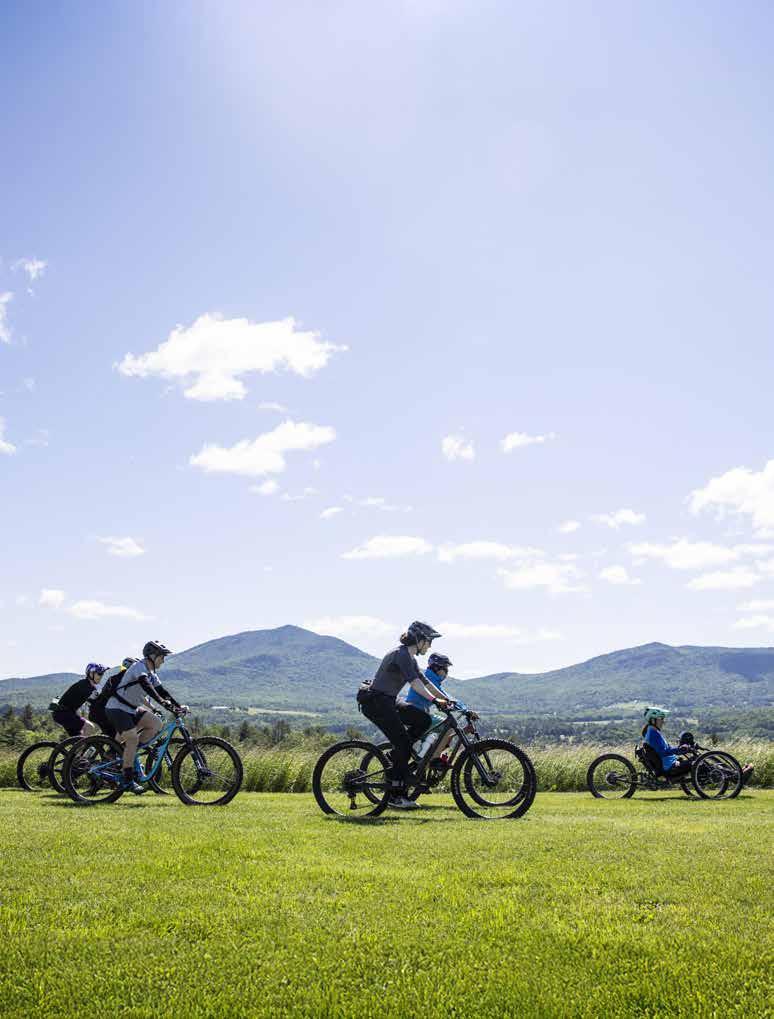
Most recently, Trail School has further modernized by building adaptive trails. With the rise in organizations that help find or fund adaptive mountain bikes (aMTBs), mountain biking has opened to many new riders. According to Kootenay Adaptive Sport Association (KASA -- kootenayadaptive.com), a non-profit based in British Columbia, the term Adaptive Mountain Biking covers events and cyclists “who typically cannot ride a standard mountain bike and require adapted equipment and/or trails to suit their needs.” Typical adaptive equipment includes handcycles, recumbent leg-cycles, bucket bikes, and tandem bikes. With wheel bases of 60 to 72 inches, these bikes generally need wider trails, turns, and trail features (e.g., bridges and rock gardens).
NEMBA Trail School’s efforts in this area were turbocharged in 2024 with new instructor CJ Scott, former Trails Director at KT. In his last few years at KT, CJ helped the 100+ mile network identify over 50 miles of trails that either already qualified or were easily adapted to safely allow non-traditional cyclists to enjoy them. “I was surprised that a lot of trails at KT were pretty much ready to go,” CJ says. Indeed, about half met the requirements with little to no changes. After 23 years helping develop KT, NEMBA was fortunate to bring CJ on for Trail School.
Trail School participants gain invaluable knowledge and hands-on experience
As a landscape architect, Rachel’s background was helpful but she wanted to learn best practices for trail building. She was inspired knowing CJ Scott was instructing for NEMBA Trail School. “I was excited that I could learn from one of the people instrumental to building trails at KT.”
Rachel found Trail School’s new adaptive content enlightening and helped build 100 feet of rock armored trail during the hands-on portion of Trail School.
“It was eye-opening how physically hard it is to build trails and made me appreciate every single foot of trail I’ve ridden.”
She plans her new trails to be adaptive friendly. “It has changed the way I look at trails I’m riding. Adaptive trails can be good for any rider.”
Another June Trail School attendee was Rory O’Connell, who has worked for the Massachusetts Department of Conservation and Recreation for 11 years and is now Park Supervisor for the Middlesex Fells Reservation. “A lot of trails have suffered severe water damage over the last few years. We’ve been trying to implement practices to make them more sustainable,” he says.
Rory’s most valuable Trail School takeaway was recognizing that trails should not be overly steep but rather have a gradual grade.
“We can pass down practices we learned from this class as a blueprint to the workers that help maintain the trails. This will help our trails be sustainable for every type of user the park welcomes, from casual to challenging hiking to mountain biking.”
NEMBA chapters support the effort
“I have always been one of the ‘helping hands’ but did not have in-depth knowledge of the how-tos and whys of trail work,” says Cape Cod Chapter member Terry Downey. A Level 1 aMTB Instructor through the BICP (Bicycle Instructor Certification Program), Terry has built up an adaptive mountain bike program on the Cape through Spaulding Adaptive Sports Centers. The program offers a fleet of adaptive bikes, giving people the opportunity to ride again, try mountain biking for the first time, or try different bikes before they invest in one. With the help of the Cape Cod Chapter, they
groomed eight miles of singletrack at West Barnstable Conservation Area for beginner aMTB riders and installed signs.
“I have been sharing the Kootney aMTB standards with NEMBA chapters for the past three years,” says Terry. “To see this information and hands-on guidance as part of Trail School is fantastic.”
So many trails just need a little tweak here and there to make them more accessible. Just as important is to label trails that have impassible features, such as narrow bridges or tightly situated trees or boulders for the wider threewheel bikes.”
Rounding out the 2024 Trail School season, on September 23, the Franconia Area NEMBA chapter (NH) hosted a one-day Trail School at Fox Hill Park focused on adaptive trail building, led again by CJ Scott. This trail school project updated an existing section of a network not originally designed with accessibility in mind into adaptive-friendly paths. According to Janel Lawton, BOD VP for Franconia Area NEMBA, “The trail work took part on the most accessed trail section to ensure that everyone, regardless of their physical abilities, can enjoy the natural beauty and recreational opportunities the park offers.”
Changes included making stable surfaces, clearance on pathways for wider bicycles, and modifying trail grades. Janel was excited for her chapter’s first time hosting a Trail School as well as welcoming a wider audience. “By enhancing the trail infrastructure, we hope to accommodate a diverse range of users, including individuals with disabilities, and kids and older recreation enthusiasts who require more stable access.”
Trail building is a worthwhile investment for all
Like many of us, Adam Glick grew up happily roaming the woods and “playing bikes.” Our joy in mountain biking as adults depends on good trail systems. Adam thinks every NEMBA member should consider attending Trail School. He estimates about 10% of mountain bikers show up for trail work while just 2%
attend Trail School. “A new generation of people getting on bikes is completely unaware of what it took to allow them to ride on trails,” he says.
The payback of building sustainable trails? Great riding and stronger partnerships with landowners/managers and other trail users. Plus, trail builders understand the time, skill, and dedication necessary to keep our trails open and fun for everyone. We all enjoy the advantages of those efforts. We owe it to ourselves, our fellow riders, and potential new riders to invest in learning to build, maintain, and keep our favorite trails so we can all “play bikes” long into the future.
TRAILBLAZER: AN INTERVIEW WITH PAULA BURTON
By Jen Clark. Jen is the brainchild behind and host of Guides Gone Wild, a podcast bringing to light the stories of everyday, extraordinary women and their inspiring outdoor adventures.
Paula Burton has been a pillar of the instructor team at NEMBA Trail School for decades. Upon learning a scheduling conflict would keep her from teaching at the June Trail School that I planned to attend, I tracked her down to hear more about her experiences as a trailblazing trail builder.
Mountain biking has been around for a long time and it’s definitely been growing lately. More women have been getting into it, which is great to see. How did you get into mountain biking and trail building?
I’m big into mountain biking! I work as a guide at Thunder Mountain (Charlemont, MA). I’ve been leading trail schools. I lead rides. I started the Housatonic Valley Chapter of NEMBA in Connecticut. I’ve been on the NEMBA Executive Board for a number of years, although I stepped back from that this year.
I’ve been a bicyclist since I was five years old. Now I’m 65. As kids, we would just ride around the woods. We didn’t call it mountain biking, but that’s the precursor to it. We would ride in Trumbull, CT, which is like the most technical place on earth. I was off the bike more than on it, and we would ride in the stream, we would cut -- we would do everything that now we tell people not to do!
I was also a huge hiker. When I was doing all that hiking, I realized the coolest people out there are the ones actually building the trail and I wanted to get involved. So, I just started showing up at different workshops to learn different things.
I remember going to scout out a new section of the trail and being told to sit on a rock and eat my lunch. I’m like, “No, I want to see what
you guys are doing. How are you laying out the trail?” Because trail design is my thing. I thought, well, I’ll just eat my lunch while I follow them. I listened closely to what they were saying and asked a lot of questions. I probably was kind of annoying, but I learned. And that was with some very, very good trail designers.
I told the NEMBA chapter president in Connecticut that we needed to do trail work because I’d been doing it with the AMC. I had tools, I knew how to run the chainsaw, I’d done all that stuff by that time. He was okay with it, but wasn’t sure why I was so confident about it. I was like, “Well, I’m just doing it.”
Were they actually building trails at that point or was it more of a ‘free for all’ with rogue trails that would get more established if they were fun?
A little bit of that, but we were really building trails. We had permission to build. I’m very good at convincing land managers to let us go in and build trails.
The International Mountain Bicycling Association (IMBA) had a traveling educational crew that would come to your area in their station wagon filled with tools and they would help train you. I hosted them twice and it was amazing. It just blew my mind. All the questions I had when I was working with the Appalachian Trail guys suddenly made sense. You learn what causes erosion and how to build things sustainably, how to make trails good for multiuse. By that time, I was mountain biking quite a bit more, and I was like, “This is it. This is really what I want to do.”
I got more involved with NEMBA Trail School. Phil Keyes encouraged me to take on a leadership role and start teaching people. I was a teacher for 30 years, so I can break things down, communicate what needs to happen, and manage groups.
It sounds like NEMBA made Trail School a little bit more localized, and enhanced it for our area. Do they have it every year?
I just started doing Trail Schools in my area. I would do two-hour presentations to town officials because I was trying to get permission to build. We had some things at local state parks and a NEMBA club-wide school, which was a two-day intensive and usually had camping and a variety of other activities surrounding it.
NEMBA Trail School generally covers three
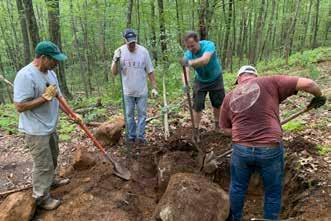
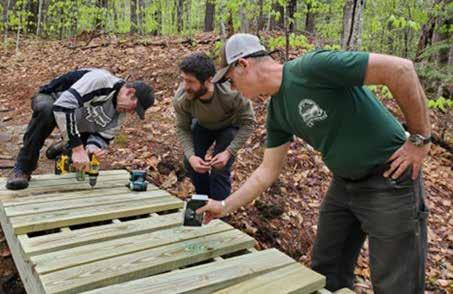
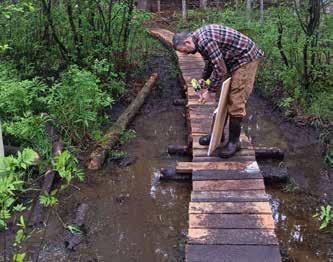
basics: design and assessment, maintenance, and building. We cycle everybody through all three parts, and then usually the second day is something more advanced. We split into groups, and maybe one group does rock work, while another builds a boardwalk.
In two days, you are really taking people from nothing, raw forest, to understanding how to build out what they want.
A lot of it, too, is organizing and safety. “How are you going to organize your people when you get out on the trail?” People are volunteering their time and you don’t want them just standing around. You want them to feel they’re doing something useful and that their efforts are needed.
Depending on what you’re doing, you need to make sure your leadership has the relevant skills. If you have a rock project, you’re going to need someone with the skills to lead a rock project. If you’re trying to get new people involved, you need to figure that out in advance in order to have a successful day. We talk a lot about that in the Trail School curriculum.
And we always have “tool talk.” That’s an important aspect of Trail School.
Representation matters; seeing somebody who is kind of like you, who’s actually doing the thing, makes it more likely that you will want to do the thing, too. Is there anything that you do to make it more likely to get new folks involved in trail building and chapter volunteer projects?
I always try to create an atmosphere from the beginning of “we’re all working together on this.” Maybe put some experienced people
with the new people and make clear the chain of command on any project. Lots of projects require permissions and people with certain skills, and the project leader coordinates all that.
I’ve had guys take tools out of my hands because I’m too slow or whatever. A lot of times, they were my personal tools. I’m seeing less and less of that, though. I just kept asking questions and showing up, and then, pretty soon, people were asking me questions. And that’s how things change.
The trail work thing is kind of like the mountain biking thing. For a long time, some thought a lot of women were beginners. And I knew, from the very moment I started mountain biking and getting involved, there are some really kick-ass women riders. You can’t assume somebody is something just because that’s who you think they are. Try to get to know people a little bit.
Have you noticed any changes in the way people are building trails, and the types of trails that are being built?
Building trails properly and getting the community involved helps preserve what we have.
When I first got involved, everybody was like, “Oh, we’ve got to build the gnarliest, hardest trail on earth.” Then came the whole concept of flow and then having trails that are accessible for different levels and abilities of riders. They don’t have to ride all the rocky, rooty, techie stuff all the time, or maybe they want a little bit of both. So, then you’d design a stacked loop. You build the harder, longer trails on the outside, and inside you make them progressively a little less steep and easier to ride, but still fun.
Machine-made trails, that is a huge revolution! You can make pump tracks, you can make berms--all kinds of stuff that would take forever to do by hand. And over the past three or four years, adaptive trails.
What is your favorite NEMBA trail to ride? And what is a favorite trail you’ve been part of building?
I really like Waldo [George C. Waldo State Park in Southbury, CT]. That’s a little park with seven miles of trail that’s close to my house. I built most of those trails and it’s great.
I’m very proud of what we’ve done at Rockhouse Hill in Oxford, CT. I did a lot of the design work for one of the sections--it’s a lot of fun and people enjoy it. It’s been great to really see it grow. There’s over 15 miles of trail there now, when there was just maybe a mile and a half when it started.
Why do you think it’s important for people to come out for Trail Days and get involved in trail building in their community?
Well, trails don’t build themselves. I think it gives people a chance to give back, but it also gives people a new respect for trails. It becomes their trail, so they’re going to become more protective of it. They’re going to be willing to go to town hall if there’s some issue. They’re going to be willing to come out another day. They can show their friends the trail and say, “Oh yeah, we built this,” and that spreads the word throughout the community as well.
One reason I got into this is because I love the outdoors and want to preserve it. Building trails properly and getting the community involved helps preserve what we have. It’s concentrating the use in one area. People need the trails, and if they’re doing a lot of unauthorized trail building, or they’re not building correctly, it affects the environment…and not in a good way. Creating legitimate trails, teaching people how to build them and appreciate them--it’s all that.
[NOTE: This interview has been edited and paraphrased from the original transcript for length and clarity. To listen to the full interview with Paula Burton, tune in to the Guides Gone Wild Podcast on Apple, Spotify, or access the full audio at GuidesGoneWild.com/podcast.]
NEMBA Ambassadors share the love… and so can you!
By Mick Ferraro
In 2024, we welcomed our first NEMBA Ambassadors. We’re thrilled to have amazing team members sharing the excitement of being outside, riding a bike, and advocating for NEMBA and the sport we love across our region.
An incredibly diverse group, these team members have been charged with sharing their adventures and participating in their local and our regional events. From racing gravel to leading some of the largest women’s rides and long vacation rides, this group is doing it all and inspiring us along the way!
Here’s a peek into what makes them tick and what they bring to our community.
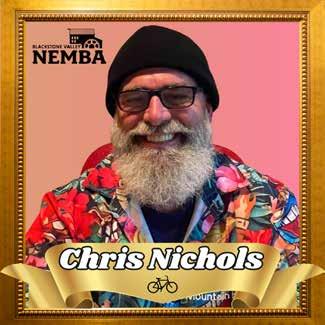
Chris Nichols
Blackstone Valley NEMBA
MTB Director at Hale Education
You hear him before you see him
Professional stoke builder
Why Chris loves bikes
“I love getting people excited to ride, watching their progression, and riding in groups. I love seeing someone learn a skill or overcome a fear they had while riding. Everyone should be on a bike.”
Erika Looman
Western MA NEMBA
Collegiate race scene
Enduro, XC, trail, skis, water
Uphill, downhill, hike, skins, etc.
Why Erika loves bikes
“I love bikes and people who love bikes! Participating in group rides with my local bike shop, I quickly fell in love with the sport and all the gorgeous places that only wheels can take you.”
Paige Redman
Central NH NEMBA
2X Gravel World 300 champ
‘23 Unbound XL 3rd place
ICU nurse
Full-time positive vibes
Why Paige loves bikes
“I love to ride every kind of bike. I love bikes because they give me a sense of freedom and connection to my community.”
Hunter Ralston
Central CT NEMBA
Founder of “Women On Wheels”
Starts with coffee, finishes with beer
Div 1 Equestrian All American
Why Hunter loves bikes
“I love how a bike can be for everyone. I love the freedom I feel on a bike. I love the strength I feel when I am on a bike. I love the community of bikes. I love the fact that a bike can change someone’s life.”
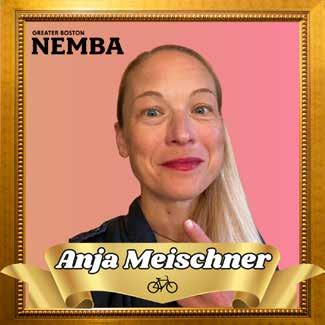
Anja Meichsner
Greater Boston NEMBA
NEYC Coach
Legit CX and gravel game
Good luck keeping up with her and Paige
Why Anja loves bikes
“I’m a true adventurer. The idea of freedom and moving my body within nature is pure joy for me. I live to give back and spread the joy.”
Tabitha Wilson RI NEMBA
Who you want on your group ride
Chapter leadership teammate
Seriously up for any adventure
Why Tabitha loves bikes
“I ride bikes because they make any day better. I love sharing the joy of group rides and getting more people on bikes, especially women and underrepresented folks in our community. When I go to my local woods, I feel like I’m coming home.”
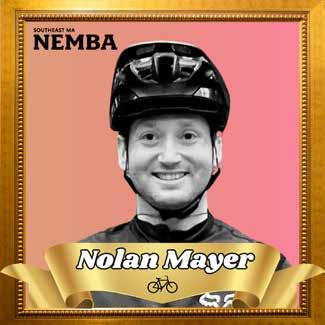
Nolan Mayer
Southeast MA NEMBA
Chapter leadership teammate
Minimum 40 miles
“Faster is funner”
Why Nolan loves bikes
“I love the freedom the bike brings, along with community, creativity, and being able to enjoy the earth in a such unique way.”
Joy Chen
Blackstone Valley NEMBA
Let bikes build the community
Subscribes to “no drop, no apologies”
Strong LFG vibes
Why Joy loves bikes
“Since beginning mountain biking in 2020, this passion has supported my confidence, courage, and humility, in addition to being incredibly fun! I have loved encouraging others along the way.”
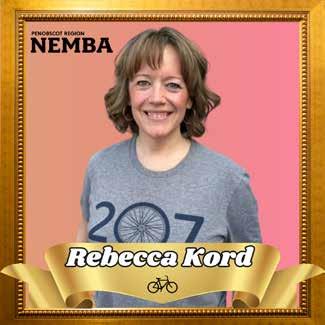
Rebecca Kord
Penobscot Region NEMBA
Happy to sweep with snacks
Community builder
All things 207
Why Rebecca loves bikes
“I love the challenge and excitement of mountain biking! There’s nothing better than conquering something that I couldn’t do the day before. The MTB community is filled with people from all backgrounds and at all ability levels and it doesn’t matter, we just get out and ride our own ride!”
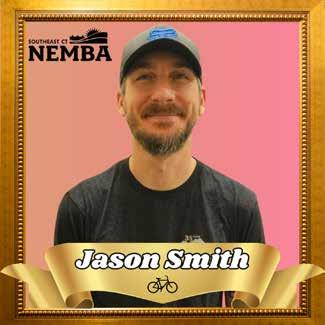
Jason Smith
Southeast CT NEMBA
Will make you stop for video
Never enough giant rollers
100% mellow vibes
Why Jason loves bikes
“Progression is the name of the game! I love seeing others progress their skills.
That progression goes hand in hand with progressive trail building!”
Bridget Connolly
Southeast MA NEMBA
CEO of Bridget’s Army
Coach, Dover Demos
Guaranteed on-trail laughs
Why Bridget loves bikes
“I feel lucky that in my professional life, I get to share my passion for mountain biking with a whole spectrum of mountain bikers, from first-timers to more experienced riders. I truly love sharing the fun and escape that riding provides.”
Now that you know the team, make sure you apply to be a ’25 Ambassador… and share your love of mountain biking in New England. https://nemba.org/ambassadors
Chapter Updates
Belfast Area NEMBA hosted its 4th annual signature Loam on the Range event, attracting 70 riders and an equal number of fans. The chapter is seeing significant
increases in women and youth riders, thanks to consistent weekly rides with 20+ attendees.
2024 By the Numbers: Maintains 3 networks.
Brattleboro-Keene NEMBA just wrapped its third annual race series at the Keene Bike Park, teaming with Alpine Bike Works and Keene Parks and Rec. Despite tricky weather, the chapter and community managed to keep the trails in tip-top shape. Now, they’re gearing up for the second annual TrailBoss Appreciation BBQ!
2024 By the Numbers: Maintains 3+ networks.
Cape Cod NEMBA had a stellar year, keeping 1,000+ miles of trails in top shape. They rolled out a new trail reporting system via Trailforks, rallying 2,700 Facebook followers to help monitor and fix issues. Using satellite imagery, Lidar, Strava heatmaps, and good ol’
ground surveys, they mapped every trail across the Cape. Plus, their Trailforks badge series got riders tackling signature trails while sharing feedback. Planning a trip? Reach out for a tour of Cape Cod’s awesome trail network!
Central CT NEMBA is buzzing with activity! They’re hosting regular weekend rides, including a beginner series led by Jeff Naidorf. Glenn MacGregor ran a sucessful jump clinic, and Tom Tyburski’s “Ride Instead of Work” series takes riders across Connecticut every Tuesday. Check out their Facebook page for
all the ride details. The chapter made great strides on the Smith School trail project and is working with Cheshire to greenlight a new trail network at Yankee Highlands. Board leadership
updates—in the wake of Glenn Vernes’ move to South Carolina, John Puziss is the new president and Paul Wetmore is vice president. Stay tuned to their Facebook for more rides and events!
2024 By the Numbers: Will build 5 new trails, totaling 6 miles. Maintains 3-5 networks.
Central NH NEMBA just finished the “Rooster” downhill flow trail and a new XC trail at Great Gains/Vets in Franklin, giving riders fresh thrills. They also upgraded the “Mighty Chicken” trail at Franklin Falls with awesome new features. Over at Broken Ground, a new trail is set to be completed by year’s end. In Franklin, the chapter is expanding the Great Gains Trails System, adding to the existing 7 trails. They’re working on a master plan to secure $100,000-$200,000 in funding for a 5-year build of hand-built and machine-built trails. Exciting times ahead!
2024 By the Numbers: Will build 3 new trails, totaling 4 miles. Maintains 8 trail networks.
Fairfield County NEMBA added 5 miles of fresh singletrack in Ridgefield, CT, thanks to new land next to Bennetts Pond State Park. They’re also teaming with the Town of Danbury to revitalize 10+ miles of neglected trails in Tarrywile Park and Terra Haute Preserve, set to become Fairfield County’s first eBike-friendly park. Exciting progress!
2024 By the Numbers: Wil build 5 new miles of trails. Maintains 10 trail networks.
Greater Portland NEMBA is building a brand-new trail system, with 8 miles open and more on the way! The East Windham Conservation Area, a 700-acre gem, offers fun flowy trails with exposed ledge for a unique ride. Stay tuned for upcoming trail days!
2024 By the Numbers: Will build ~8 miles of new trails.
Housatonic Valley NEMBA continues to expand the trail system in Woodbury Trolly trails, and plans to repair much trail damage after historic flooding in the region.
2024 By the Numbers: Will build 3 new trails for 2.5 miles. Maintains 5 networks.
Merrimack Valley NEMBA is enjoying trail systems in good shape, so focus in on maintenance. They did an Earth Day clean up at Russell Mill, Billerica State Forest (and bridge build too!) and Lowell Dracut Tyngsboro State Forest and partnered in celebrating Philip Keyes at the PK Memorial Ride in May.
2024 by the Numbers: Maintains 3 networks
Northwest CT NEMBA is bursting with bike-citement, celebrating some major wins by their awesome volunteers:
Secured nearly $250,000 for a skills park and pump track in Canton, CT.
Got the green light from CT DEEP for official trails in Nepaug State Forest.
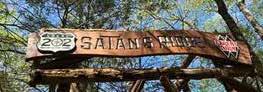
Opened Satan’s Ridge in New Hartford, an advanced riding zone packed with some of New England’s gnarliest features.
Fully rebuilt Miller Time trail in Burlington, one of the state’s most popular. Come visit and experience the trails for yourself!
2024 By the Numbers: Will build 10+ miles of new trails. Maintains 6 networks.
Penobscot Region NEMBA has been hard at work! They built a bridge to reopen a trail at the University of Maine and are teaming with Orono Land Trust for a two-part trail rebuild. The chapter also got the go-ahead to turn two Bangor Hill trails into flow trails— one green and one blue—each costing about $20,000. The first reroute is mapped, with clearing set for Spring 2025, followed by blue trail work in late 2025/early 2026. Fundraising has gotten them over halfway to their $10,000 goal. Don’t miss their annual Spring Social, Summer Sufferfest, and Season Ender S’Ender events!
2024 By the Numbers: Reopened 0.5 miles of new trail. Maintains 8 networks.
Secured a $10,000 NEMBA grant to build a pump track and skills trail at Red Cross Beach this fall.
The Elliottsville Foundation is developing an 84-mile network at Seven Ponds Preserve, with the first mile already underway. While progress is slow, it’s a long-term game-changer for the region!
Stay tuned for exciting trail developments!
2024 By the Numbers: Will build 7+ new trails for 8 miles. Maintains 1 network.
Pemi Valley NEMBA has been busy! They rebuilt a bridge at Fox Park in Plymouth and cleaned up flood debris from the Gyroscope trails in Holderness. Progress is underway on a new skills park at Fox Park, replacing the old pump track. The new park will feature two jump lines and a pump track in a beautiful forest setting. With donations rolling in, they’re set to start building at least one phase this fall!
Piscataquis County NEMBA is making big moves! They hosted their first official trail maintenance day in May 2024 and are on a mission to expand local trails: Completed 7.5-8 miles of singletrack at Moosehead Junction Trails in Greenville, ME, with a grand opening set for September 2024.
Expanding those trails from 6 miles to over 14 by fall, with plans for 6-10 more miles of intermediate and advanced trails in 2025-2026.
Purple Valley NEMBA signed a longterm license to develop a mountain bike trail network on 800 acres in Williamston, MA. It was also awarded an IMBA trail accelerator grant, and began the master plan, and designed, permitted, built, and opened its first trail.
2024 By the Numbers: Will build 2 new trails for 3 miles. Maintains 1 network.
Chapter Updates
Quiet Corner NEMBA is buzzing with activity! Their women’s events are drawing impressive crowds, and the recent kids’ event was a smashing success! Young riders hit the trails, while the team connected with local town managers to rally support for outdoor recreation. Plus, one of their popular trail builds and maintenance days resulted in a fantastic addition—a donated repair stand now proudly stationed at Pomfret Forest.
2024 By the Numbers: Will build 3.5 miles of new trail. Maintains 6 networks.
Six Rivers NEMBA stayed busy all season – rerouting 3 different trails at Neptune Woods, hosting 3 spring cleanups, and kicking off the season with a membership night
2024 By the Numbers: Maintains 6 networks
. Southeast CT NEMBA is on fire! Here’s the scoop:
Kicked off spring with over 70 riders at The Playground Trails in Moodus, CT.
Celebrated volunteers with a fun appreciation event featuring delicious homemade brick oven pizza.
Expanded their group ride program, with leaders hosting rides for all skill levels—those leading multiple rides will snag a custom jersey!
Enhanced trails across Southeast CT, adding awesome new features at The Playground Trails.
Gearing up to design new trails on a freshly acquired 70-acre parcel next to The Playground Trails in late 2024.
Actively seeking approval from CT DEEP to
maintain and improve trails on state land.
Milestones: Grayville trail system and more exciting developments across Southeast CT!
2024 By the Numbers: Maintains 7 networks.
Southeast MA NEMBA is on a roll!
Here’s what they’ve been up to:
Boosted their weekly social rides, adding new routes and welcoming more participants.
Finished one bridge/trail build, with 3-6 more projects lined up for fall!
Launched three exciting special events: the May Season Opener, September member day cookout, and the post-Thanksgiving Turkey Afterburner, partnering with other organizations for added fun.
Kicked off a race series!
Upcoming projects include the Blue Hills
Adaptive trail proposal, expanding the Lind Farm trail network in Norfolk, designing the Campbell Forest trail system, and various bridge replacements and trail improvements.
Southcoast MA NEMBA finished bridgework in Freetown/Fall River State Forest and installed important signage in Village Park Swansea for safety. In September, they hosted the exciting Freetown 50 Bike Race! They also improved access to Dartmouth Town Forest with trail maintenance and signage and teamed up with Wildlands Trust to clean up a site in Wareham, MA, setting the stage for a potential skills park!
2024 by the Numbers: Maintains 4 trail networks
Southern NH NEMBA is having an adventurous season, and there’s more to come! They kicked off with a successful women’s beginner clinic in June and the Bear Brook Boogie in September. The chapter is teaming with town conservation commissions and local land managers to showcase the benefits of collaborating with NEMBA.
This spring, they quickly tackled storm damage at Bear Brook State Park, getting trails reopened in record time! They also partnered with the Merrimack Conservation Commission to replace a 40-foot boardwalk at Horse Hill Nature Preserve and held a Bridge Day with Londonderry Home Depot to repair six bridges at Musquash Conservation Area.
Exciting group rides are in full swing at their favorite trail systems, and they can’t wait to see everyone at the Yuledicky Toy Drive in December!
By the Numbers: Will build 3 new trails for 1.45 miles. Maintains 11 networks.
spots. The Friends of Earl’s trail crew also revamped a section of the popular Tinker Toy trail, adding exciting new flow elements. The Sawmiller’s group in Northampton hosted a trail work day, rallying a big volunteer turnout— including the NCC Trailblasters youth team and Thunder Mountain DEVO team—to replace 50 feet of bog bridge and install trail signage across the network. Plus, they’ve negotiated 5 new miles of NEMBA-designed mountain bike trails at Northfield Mountain, with work kicking off in spring 2025! The chapter is also focused on enhancing the Deerfield River Trails next to Thunder Mountain Bike Park, aiming to improve access for all users. This includes re-routing the main climbing trail and potentially creating a more accessible route from the bottom of the mountain. The chapter continues taking its gnome waypoint sign on a tour of local bike shops to boost membership, and it’s already helped push their numbers past 200!
2024 By the Numbers: Will build 2 new trails, 1 total mile. Maintain 5 trail networks.
White Mountains NEMBA partnered with the US Forest Service to build a new trail that safely diverts bike traffic from a narrow road, adding 1.2 miles of fun, hand-built singletrack. The chapter also retrofitted over 3 miles of trail in the Rogers Crossing network for adaptive access with funds from a NEMBA grant. They’re collaborating with local groups to enhance mapping, signage, and E911 services in the Mount Washington Valley. Plus, they’re kicking off their first aMTB trail network and teaming with Ride NoCo to build a pump track, already raising $6,700! They’re even exploring a 3-mile path in Bartlett to connect the village, elementary school, and rec trails at the Morrel Complex and Rogers Crossing. Exciting times ahead!
2024 By the Numbers: Will build 2 miles of new trail and 3+ miles of aMTB retrofitted trail. Maintains 8 networks.
Western MA NEMBA is making great strides. They completed a fantastic new flow trail at Earl’s Trails, one of the region’s hottest