A-Mayes-ing Place
The heritage of the mill village can still be felt today.
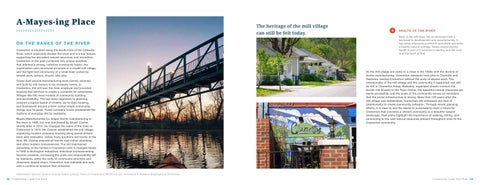
ON THE BANKS OF THE RIVER Cramerton is situated along the South Fork of the Catawba River, which physically divides the town and is a key feature supporting the abundant natural resources and recreation. Cramerton of the past combined two unique qualities that stitched a strong, cohesive community fabric: the organization and communal structure of a model mill village, and the tight-knit community of a small town united by shared work, school, church, and play. Towns built around manufacturing were owned, planned, and built by mill owners to be company towns. In Cramerton, the mill was the main employer and provided housing and services to create a complete for employees. Villages like this were models of community building and accessibility. The top-down approach to planning ensured a logical layout of streets, up-to-date housing, and businesses around a town center where community energy was focused. These company towns established the rhythms of everyday life for residents. Mayes Manufacturing Co. began textile manufacturing in the town in 1906, but was purchased by Stuart Cramer shortly after in 1910. He changed the name of the town to Cramerton in 1915. Mr. Cramer established the mill village, organizing modern company housing along paved streets lined with sidewalks. Unlike many southern mill towns of the time, Mr. Cramer ensured all homes had indoor plumbing and other modern conveniences. The mill maintained ownership of the homes in Cramerton until it changed hands in 1946 to Burlington Industries. Individual homeownership became possible, increasing the pride and responsibility felt by residents, while the roots of community structure and closeness stayed intact. Cramerton was walkable and safe, with a communal essence that remained.
H E A LT H O F T H E R I V E R Back in the mill days, the environment took a backseat to development and manufacturing. It has taken tremendous effort to remediate and build a healthy natural ecology. Today, environmental health is part of Cramerton’s identity, and the river is at the heart of that.
As the mill village era came to a close in the 1990s with the decline of textile manufacturing, Cramerton residents took jobs in Charlotte and Gastonia, leaving Cramerton without the unity of shared work. The intentionality of the mill village and the community it supported can still be felt in Cramerton today. Walkable, organized streets connect the former mill houses to the Town Center, the beautiful natural resources are easily accessible, and the scale of the community serves as reminders that the social infrastructure is strong. More than 100 years after the mill village was established, Cramerton still embraces the idea of intentionality to create community cohesion. Through recent planning efforts, it is clear to see the desire to purposefully chart a future for Cramerton that connects a vibrant community to a beautiful natural landscape. Past plans highlight the importance of walking, biking, and connecting to the vast natural resources present throughout town to the Cramerton community.
Information Source: Gaston County Public Library, Town of Cramerton; NCSU Library Architects & Builders Biographical Dictionary 22 C ra merton L and Use P l a n
Cra merton L a nd Use Pla n
23