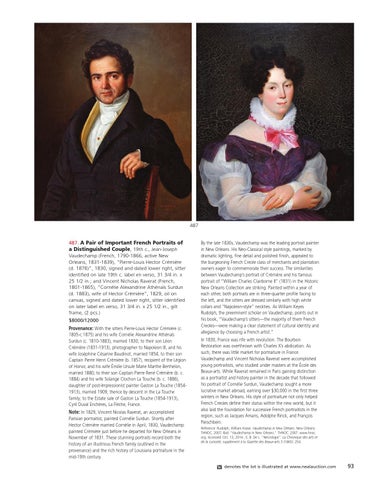
487 487. A Pair of Important French Portraits of a Distinguished Couple, 19th c., Jean-Joseph Vaudechamp (French, 1790-1866, active New Orleans, 1831-1839), “Pierre-Louis Hector Crémière (d. 1876)”, 1830, signed and dated lower right, sitter identified on late 19th c. label en verso, 31 3/4 in. x 25 1/2 in.; and Vincent Nicholas Raverat (French, 1801-1865), “Cornélie Alexandrine Athénaïs Surdun (d. 1883), wife of Hector Crémière”, 1829, oil on canvas, signed and dated lower right, sitter identified on later label en verso, 31 3/4 in. x 25 1/2 in., gilt frame, (2 pcs.) $8000/12000 Provenance: With the sitters Pierre-Louis Hector Crémière (c. 1805-c.1875) and his wife Cornélie Alexandrine Athénaïs Surdun (c. 1810-1883), married 1830; to their son Léon Crémière (1831-1913), photographer to Napoleon III, and his wife Joséphine Césarine Baudinot, married 1854; to their son Captain Pierre Henri Crémière (b. 1857), recipient of the Légion of Honor, and his wife Émilie Ursule Marie Marthe Berthelon, married 1880; to their son Captain Pierre René Crémière (b. c. 1884) and his wife Solange Clochon La Touche (b. c. 1886), daughter of post-Impressionist painter Gaston La Touche (18541913), married 1909; thence by descent in the La Touche family; to the Estate sale of Gaston La Touche (1854-1913), Cyril Duval Enchères, La Flèche, France. Note: In 1829, Vincent Nicolas Raverat, an accomplished Parisian portraitist, painted Cornélie Surdun. Shortly after Hector Crémière married Cornélie in April, 1830, Vaudechamp painted Crémière just before he departed for New Orleans in November of 1831. These stunning portraits record both the history of an illustrious French family (outlined in the provenance) and the rich history of Louisiana portraiture in the mid-19th century.
By the late 1830s, Vaudechamp was the leading portrait painter in New Orleans. His Neo-Classical style paintings, marked by dramatic lighting, fine detail and polished finish, appealed to the burgeoning French Creole class of merchants and plantation owners eager to commemorate their success. The similarities between Vaudechamp’s portrait of Crémière and his famous portrait of “William Charles Clairborne II” (1831) in the Historic New Orleans Collection are striking. Painted within a year of each other, both portraits are in three-quarter profile facing to the left, and the sitters are dressed similarly with high white collars and “Napoleon-style” neckties. As William Keyes Rudolph, the preeminent scholar on Vaudechamp, points out in his book, “Vaudechamp’s sitters—the majority of them French Creoles—were making a clear statement of cultural identity and allegiance by choosing a French artist.” In 1830, France was rife with revolution. The Bourbon Restoration was overthrown with Charles X’s abdication. As such, there was little market for portraiture in France. Vaudechamp and Vincent Nicholas Raverat were accomplished young portraitists, who studied under masters at the École des Beaux-arts. While Raverat remained in Paris gaining distinction as a portraitist and history painter in the decade that followed his portrait of Cornélie Surdun, Vaudechamp sought a more lucrative market abroad, earning over $30,000 in the first three winters in New Orleans. His style of portraiture not only helped French Creoles define their status within the new world, but it also laid the foundation for successive French portraitists in the region, such as Jacques Amans, Adolphe Rinck, and François Fleischbein. Reference: Rudolph, William Keyse. Vaudechamp in New Orleans. New Orleans: THNOC, 2007; Ibid. “Vaudechamp in New Orleans.” THNOC. 2007. www.hnoc. org. Accessed: Oct. 13, 2014 ; E. B. De L. “Nécrologie”. La Chronique des arts et de la curiosité, supplément à la Gazette des Beaux-arts 3 (1865): 254.
W denotes the lot is illustrated at www.nealauction.com
93