Opinion
PAGE 4 • MONDAY, OCTOBER 6, 2014
{ LETTER TO THE EDITOR }
“On-campus” clarification
never lived on campus. All of the places she lived were off campus, including the Sigma Kappa house, which just moved onto campus this year. “Close to campus” and “on-campus” are not synonymous. This error, though seemingly innocent, undermines the University Housing brand, the NC State brand and causes confusion for parents and students looking for on-campus housing. The living experiences provided by University Housing are much different than that of a private, non-university owned facility. We provide more than just convenience to the library and class. From our student and professional staff members who invest in resident success to the more than 3,000 programs and
In the article “Life on campus: Living with the Pack,” Page Harris made some erroneous assumptions about what is and is not “on-campus living.” If students live “on campus,” they are living in one of 20 residence halls, four apartment complexes or 14 Greek chapter houses that are managed by University Housing and Greek Life. Valentine Commons, University Towers and off-campus houses are not part of the on-campus living experience because they are not owned or managed by NC State and are not affiliated with the university in any way. Madison Moss, quoted in the article,
W
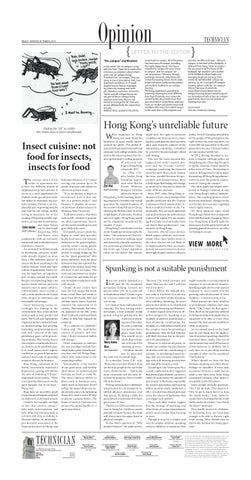
Insect cuisine: not food for insects, insects for food he average male’s dorm room or apartment has at least two different brands of supplemented protein powder. It serves as a meal supplement for students on the go and post-workout shakes to maximize the anabolic window. Protein is an irreplaceable part of growing muscles and vital for any college student trying to maximize his or her training. But protein powder regiments can become monotonous, and some f lavors Tyler Gobin can be downright Staff Columnist disgusting. Why not boost your supplements with an extremely nutritional and overlooked source of protein—insects? An estimated two billion people in developing countries worldwide already depend on more than 1,900 different species of insects for food according to the United Nations’ Food and Agriculture Organization. Insect cuisine has long been an important part of diets around the world. Recipes incorporating bugs into snacks, main courses and even desserts exist in many cultures. Unfortunately, insect cuisine is only a niche market in the United States despite its nutritious and sustainable advantages. Insect harvesting causes exceedingly less damage to the environment than other protein sources such as beef, poultry and pork. The Food and Agriculture Organization has conducted studies demonstrating that growing, harvesting, and processing insects emit only 1 percent of the same greenhouse gases cattle processing produces. Harvesting insects also requires considerably less water. Insects can be raised humanely in small spaces, don’t require antibiotics or growth hormones and pose fewer risks of spreading zoonotic diseases to humans. Rose Wang, cofounder of Six Foods, successfully launched a Kickstarter, earning $70,000 for the sake of founding “Chirps,” chips made out of crickets. “There is no question that insects are the most humane way to eat meat,” Wang said. Bugs have an incredibly small environmental footprint and pack an impressive nutritional punch. Crickets, for example, are high in fats that contain omega-3 fatty acids, rich in protein, and have other key vitamins such as calcium and iron, according to Michael Molloy, an immunologist formerly associated of the National Institute of Allergy and
Infectious Diseases. A 3.5-ounce serving can contain up to 28 grams of protein and replace an afternoon protein shake. “It’s a no-brainer to begin to incorporate insects into our diet as a protein source,” said Florence V. Dunkel, an associate professor of plant sciences at Montana State University. Traditional sources of protein such as fish, chicken or peanuts are often monotonous. Insects are the variety health gurus and gym buffs alike crave. Fortunately, insect cuisine has begun to crawl into specialty health food stores, but remains unknown to the general public. Luckily, today’s young people are known for, or are at least expected, to change things up. We are the “green generation” who desire adventure. Even for those hesitant to bite into a protein bar riddled with crickets, know that the taste is not atrocious. The taste and consistency are similar to a power bar and make for an easy transition to products made with insects. Chapul brand cricket bars were the first energy bar made from cricket flour and reside in more than 200 health, bike and outdoor sports stores. Each bar contains the equivalent of 25 crickets. The founder, Pat Crowely, appeared on the ABC series Shark Tank and convinced Mark Cuban to help him expand the company. “It’s a solution to a problem,” Cuban said. “We need better sources of protein, and over time I think consumer habits will change.” Other companies to embrace the new paradigm include Exo, which makes paleo-friendly protein bars and All Things Bugs, which sells cricket flour to the expanding market. Sustainability is the mantra of our generation, and healthy alternatives to industrialized farming are hard to come by. The insect industry thrives in places such as Southeast Asia, and it needs to exist here. It will reduce the impact from our staple protein sources by siphoning demand to insects and will help us pursue a greener future. The future is worth it. And once you get past the mental hurdle, it’s a quite tasty future.
323 Witherspoon Student Center, NCSU Campus Box 7318, Raleigh, NC 27695 Editorial Advertising Fax Online
515.2411 515.2411 515.5133 technicianonline.com
activities we offer each year – living on campus, in the heart of the Wolfpack, is different from living “close to campus.” We are proud to be the home of the Wolfpack. We wouldn’t call a student of the Wolfpack a Shaw Eagle or an Avenging Angel just because Shaw University and Meredith College are close by. So, let’s not label off-campus housing options with the “on-campus” title just because of proximity. If you’d like to learn about true oncampus housing options found in any of our 20 residence halls or four on-campus apartments, check out our website at housing.ncsu.edu. Susan Grant Director, University Housing
Hong Kong’s unreliable future
Putting the “ick” in cricket Julie Smitka, junior in physics and philosophy
T
TECHNICIAN
hat happened in Hong Kong last week filled the headlines of many media outlets around the globe. The global financial hub garnered international attention with college students who took to the street to protest the Chinese government’s failing promise of universal suffrage to Hong Kong citizens by 2017. In 1984, Chinese leader Deng Xiaoping negotiated with British Ziyi Mai Pr i me M i n i ster Staff Columnist Margaret Thatcher about the future of Hong Kong. In the meeting, Xiaoping proposed a formula that would guarantee the smooth handover of the territory from Britain to China, allowing the British colony to retain a high degree of autonomy, freedom and civil rights. Hong Kong would not be completely transferred for another 13 years. Hong Kong’s constitution written under Xiaoping’s formula explicitly states, “the selection of Chief Executive by universal suffrage upon nomination by a broadly representative nominating committee.” But a few weeks ago, China’s legislature ruled out any chance that citizens
might have the right to nominate candidates for chief executive, insisting that candidates for chief executive must gain majority support of the nominating committee, controlled by powerful businesspeople allied with Beijing. This was the main decision that triggered last week’s massive protests and the “Occupy Central” campaign, paralyzing the financial center for more than a week. Despite the tense standoff between the government and demonstrators, there is little hope that Beijing will change its mind on its decision to limit the scope of future elections. Since 1997, when Hong Kong returned to China, many foreign affair pundits predicted that the Chinese Communist Party would either reform its political system or die. Unfortunately, they are overly optimistic and underestimate the authoritarian nature of the regime. It is not surprising that China’s current leaders have not honor their predecessors’ commitment to Hong Kong. Executive officials issue decrees, which appear arbitrary and inconsistent. Once these leaders retire or die, those decrees are not likely to be implemented by their successors. Instead, successors issue new decrees that might sharply contrast with past
policy. Even if Xiaoping intended to let the people of Hong Kong have the right to elect the chief executive, his vision did not pass down to the new generation because Chinese leaders are not constrained by law. In 2012, Beijing intended to impose a tougher suffrage policy on Hong Kong out of fear that the spirit of public elections would spread to other areas of China, threatening its control. Beijing issued a white paper demanding all Hong Kong administrators to meet the political requirement of “loving the country.” The white paper was largely interpreted as Beijing’s intention to step over Hong Kong’s judicial independence. The resulting protests struck down the mandatory changes in the curriculum but tensions regarding voter’s rights remain. All these ominous signs cloud Hong Kong’s future that is supposed to be fulfilled under Xioaping’s Basic Law. Hong Kong is clearly ready for democracy, but the potential result of opening general elections is too risky for Beijing to accept.
VIEW MORE
TECHNICIANONLINE.COM
Spanking is not a suitable punishment I
was not usually spanked as a child, save for the occasional newspaper lashing. Instead, my parents either sent me to time-out to think about what I’d done or gave me a lecture about why what I did was wrong. Let’s look at these individual reprimands. The first, hitting with a newspaper, is how someone would punish a dog for getting into the trash can or drinking out of the toilet. It is also a common way parents discipline their kids. You would never send a dog to timeMary Anna out or lecture it for chewing up shoes. Rice Children should Correspondent not be punished the same way we punish dogs. As comedian Louis C.K. said, “Here’s the crazy part about it: Kids are the only people in the world that you’re allowed to hit … They’re the most vulnerable and the most destroyed by being hit, but it’s totally OK to hit them.” Hitting someone else is dehumanizing because it is an attempt to establish physical dominance over that person. By hitting a child, the punishment is tantamount to sheer governance by fear. The fact is a child can make no answer to being hit. Children cannot possibly retaliate because the adult will always have the upper hand in physical strength. To the child’s question of “Why should I behave?” the adult asserts,
“Because I’m much stronger and larger than you are, and I will hurt you if you don’t.” I don’t believe the thought process reflects that level of animosity in most cases when adults discipline their children. Spanking, for most parents who utilize it, is a shorthand method for deterring bad behavior. It makes logical sense from an objective perspective. Spanking is an example of positive punishment, a form of operant conditioning. For example, if a child behaves badly and the caregiver reacts by presenting a punishment, then the bad behavior will likely decrease due to the presence of a punishment. However, to reiterate my point, we should not conflate the punishment of children with the conditioning of animals. As developing human beings, kids are extremely complex beings with still-forming personalities and should be treated as such. According to the Washington Post, a study conducted in 2012 suggested that physical punishment can lower a child’s IQ and reduce the amount of gray matter in the brain, responsible for sensory perception and learning ability. Another study, conducted in 2013, revealed that abused girls may cause the release of hormones that can trigger early puberty. These and other studies suggest that the damage of spanking and other forms of corporal punishment stretch much further than bruising or tears. Though it may be a simple and easy-to-employ solution, spanking reduces children to machines that
Copy Desk Manager Megan Ellisor
News Editor Katherine Kehoe
Associate Sports Editors Jake Lange, Jordan Beck
Design Editor Sarah Catherine Smith
technician-editor@ncsu.edu
technician-news@ncsu.edu
technician-sports@ncsu.edu
technician-design@ncsu.edu
Bienvenidos Editor Paula Gordon technician-bienvenidos@ ncsu.edu
Associate Features Editors Kevin Schaefer, Taylor Quinn technician-features@ncsu.edu
Opinion Editor Nicky Vaught
Photo Editor Caide Wooten
technician-viewpoint@ ncsu.edu
technician-photo@ncsu.edu
Editor-in-Chief Ravi K. Chittilla technician-editor@ncsu.edu
Managing Editor Austin Bryan technician-managingeditor@ncsu.edu
Multimedia Editor Russ Smith
ought to produce a certain output in response to an unwanted stimulus. Spanking might also be a way parents endeavor to exert control over the growing individualization of their children—a flawed reason, if any. When parents hit their children as punishment, children don’t only think, “OK, I won’t do that again.” They dwell on the pain they suffered at the hands of the only people they’re supposed to be able to trust. They wonder why their parents would hurt them on purpose. An occasional smack on the hand may be one thing, but the application of recurrent spankings should be examined more closely. This sort of chastisement may ward off instances of bad behavior in children, but it only does so in providing another example of what can be considered “bad behavior.” Where should we draw the line between spanking and child abuse? Perhaps we shouldn’t. If every such encounter between a child and an adult is one blow away from being considered criminal, what makes it acceptable in the first place? Some people proudly proclaim, “Yes, I hit my kids. They deserve it. They’ve got to know how it is, how the world works.” And, unfortunately, they’re learning that the world works under an archaic “survival of the fittest” mentality. They hardly deserve it. Children, by definition, have not lived long enough to be able to discern right from wrong. Why should they be physically harmed for being ignorant?
Technician (USPS 455-050) is the official student newspaper of N.C. State University and is published every Monday through Friday throughout the academic year from August through May except during holidays and examination periods. Opinions expressed in the columns, cartoons, photo illustrations and letters that appear on Technician’s pages are the Business Manager views of the individual writers and cartoonists. As a public forum for Mark Tate student expression, the students determine the content of the publication advertising@sma.ncsu.edu without prior review. To receive permission for reproduction, please write the editor. Subscription cost is $100 per year. A single copy is free to all students, faculty, staff and visitors to campus. Additional copies are $0.25 each. Printed by The News & Observer, Raleigh, N.C., Copyright 2011 by North Carolina State Student Media. All rights reserved. technician-webmaster@ ncsu.edu