Does your business have a happy hour? The Journal’s Cocktail Compass app is coming soon!
Email your happy hour times and deals to clubadvertising@ northcoastjournal.com
CARS. TRUCKS. SUVs. ATVs. Tires, Wheels, Batteries, Wipers, Rubber Mats and More Local Family Owned Since 1939.
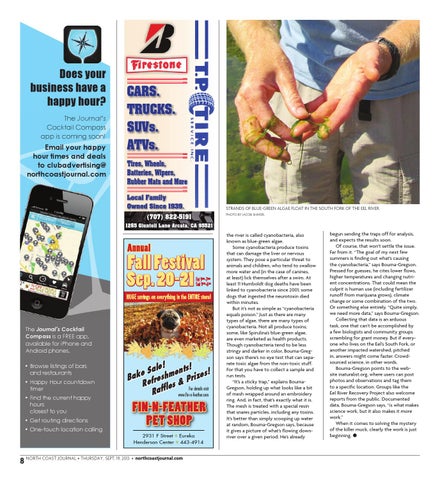
Strands of blue-green algae float in the south fork of the eel river.
(707) 822-5191
PHOTO by Jacob Shafer.
1265 Giuntoli Lane Arcata, CA 95521
Annual
Fall Festival Sep. 20-21
Fri 9am-7pm Sat 9am-6pm
HUGE savings on everything in the ENTIRE store!
The Journal’s Cocktail Compass is a FREE app, available for iPhone and Android phones. • Browse listings of bars and restaurants • Happy Hour countdown timer • Find the current happy hours closest to you • Get routing directions • One-touch location calling
le! ents! a S s! e Bak efreshm & Prize R es For details visit Raffl www.fin-n-feather.com
FIN-N-FEATHER PET SHOP 2931 F Street • Eureka Henderson Center • 443-4914
8 North Coast Journal • Thursday, Sept. 19, 2013 • northcoastjournal.com
the river is called cyanobacteria, also known as blue-green algae. Some cyanobacteria produce toxins that can damage the liver or nervous system. They pose a particular threat to animals and children, who tend to swallow more water and (in the case of canines, at least) lick themselves after a swim. At least 11 Humboldt dog deaths have been linked to cyanobacteria since 2001; some dogs that ingested the neurotoxin died within minutes. But it’s not as simple as “cyanobacteria equals poison.” Just as there are many types of algae, there are many types of cyanobacteria. Not all produce toxins; some, like Spirulina’s blue-green algae, are even marketed as health products. Though cyanobacteria tend to be less stringy and darker in color, Bouma-Gregson says there’s no eye test that can separate toxic algae from the non-toxic stuff. For that you have to collect a sample and run tests. “It’s a sticky trap,” explains BoumaGregson, holding up what looks like a bit of mesh wrapped around an embroidery ring. And, in fact, that’s exactly what it is. The mesh is treated with a special resin that snares particles, including any toxins. It’s better than simply scooping up water at random, Bouma-Gregson says, because it gives a picture of what’s flowing downriver over a given period. He’s already
begun sending the traps off for analysis, and expects the results soon. Of course, that won’t settle the issue. Far from it. “The goal of my next few summers is finding out what’s causing the cyanobacteria,” says Bouma-Gregson. Pressed for guesses, he cites lower flows, higher temperatures and changing nutrient concentrations. That could mean the culprit is human use (including fertilizer runoff from marijuana grows), climate change or some combination of the two. Or something else entirely. “Quite simply, we need more data,” says Bouma-Gregson. Collecting that data is an arduous task, one that can’t be accomplished by a few biologists and community groups scrambling for grant money. But if everyone who lives on the Eel’s South Fork, or another impacted watershed, pitched in, answers might come faster. Crowdsourced science, in other words. Bouma-Gregson points to the website inaturalist.org, where users can post photos and observations and tag them to a specific location. Groups like the Eel River Recovery Project also welcome reports from the public. Documented data, Bouma-Gregson says, “is what makes science work, but it also makes it more work.” When it comes to solving the mystery of the killer muck, clearly the work is just beginning. l