“THE LARGEST CLASS I HAD WAS ABOUT 10 PEOPLE, SO THERE WAS LOTS OF ONEON-ONE INTERACTION WITH INSTRUCTORS. WORKING IN THE LAB AT BRITE, EVERYONE WAS WILLING TO HELP. Rasheena Edmondson 22
NCCU NOW FALL 2016
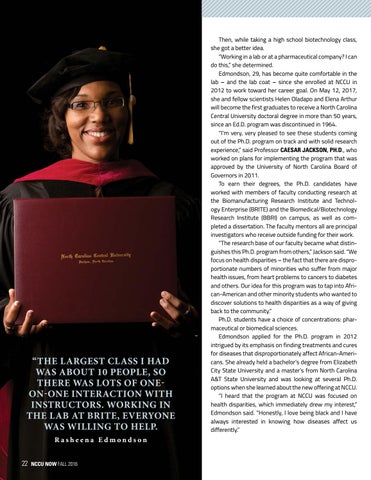
Then, while taking a high school biotechnology class, she got a better idea. “Working in a lab or at a pharmaceutical company? I can do this,” she determined. Edmondson, 29, has become quite comfortable in the lab – and the lab coat – since she enrolled at NCCU in 2012 to work toward her career goal. On May 12, 2017, she and fellow scientists Helen Oladapo and Elena Arthur will become the first graduates to receive a North Carolina Central University doctoral degree in more than 50 years, since an Ed.D. program was discontinued in 1964. “I’m very, very pleased to see these students coming out of the Ph.D. program on track and with solid research experience,” said Professor CAESAR JACKSON, PH.D., who worked on plans for implementing the program that was approved by the University of North Carolina Board of Governors in 2011. To earn their degrees, the Ph.D. candidates have worked with members of faculty conducting research at the Biomanufacturing Research Institute and Technology Enterprise (BRITE) and the Biomedical/Biotechnology Research Institute (BBRI) on campus, as well as completed a dissertation. The faculty mentors all are principal investigators who receive outside funding for their work. “The research base of our faculty became what distinguishes this Ph.D. program from others,” Jackson said. “We focus on health disparities – the fact that there are disproportionate numbers of minorities who suffer from major health issues, from heart problems to cancers to diabetes and others. Our idea for this program was to tap into African-American and other minority students who wanted to discover solutions to health disparities as a way of giving back to the community.” Ph.D. students have a choice of concentrations: pharmaceutical or biomedical sciences. Edmondson applied for the Ph.D. program in 2012 intrigued by its emphasis on finding treatments and cures for diseases that disproportionately affect African-Americans. She already held a bachelor’s degree from Elizabeth City State University and a master’s from North Carolina A&T State University and was looking at several Ph.D. options when she learned about the new offering at NCCU. “I heard that the program at NCCU was focused on health disparities, which immediately drew my interest,” Edmondson said. “Honestly, I love being black and I have always interested in knowing how diseases affect us differently.”