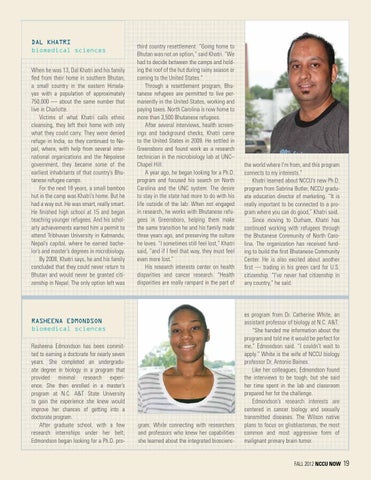
dal khatri biomedical sciences When he was 13, Dal Khatri and his family fled from their home in southern Bhutan, a small country in the eastern Himalayas with a population of approximately 750,000 — about the same number that live in Charlotte. Victims of what Khatri calls ethnic cleansing, they left their home with only what they could carry. They were denied refuge in India, so they continued to Nepal, where, with help from several international organizations and the Nepalese government, they became some of the earliest inhabitants of that country’s Bhutanese refugee camps. For the next 18 years, a small bamboo hut in the camp was Khatri’s home. But he had a way out. He was smart, really smart. He finished high school at 15 and began teaching younger refugees. And his scholarly achievements earned him a permit to attend Tribhuvan University in Katmandu, Nepal’s capital, where he earned bachelor’s and master’s degrees in microbiology. By 2008, Khatri says, he and his family concluded that they could never return to Bhutan and would never be granted citizenship in Nepal. The only option left was
third country resettlement. “Going home to Bhutan was not an option,” said Khatri. “We had to decide between the camps and holding the roof of the hut during rainy season or coming to the United States.” Through a resettlement program, Bhutanese refugees are permitted to live permanently in the United States, working and paying taxes. North Carolina is now home to more than 3,500 Bhutanese refugees. After several interviews, health screenings and background checks, Khatri came to the United States in 2009. He settled in Greensboro and found work as a research technician in the microbiology lab at UNC– Chapel Hill. A year ago, he began looking for a Ph.D. program and focused his search on North Carolina and the UNC system. The desire to stay in the state had more to do with his life outside of the lab: When not engaged in research, he works with Bhutanese refugees in Greensboro, helping them make the same transition he and his family made three years ago, and preserving the culture he loves. “I sometimes still feel lost,” Khatri said, “and if I feel that way, they must feel even more lost.” His research interests center on health disparities and cancer research. “Health disparities are really rampant in the part of
the world where I’m from, and this program connects to my interests.” Khatri learned about NCCU’s new Ph.D. program from Sabrina Butler, NCCU graduate education director of marketing. “It is really important to be connected to a program where you can do good,” Khatri said. Since moving to Durham, Khatri has continued working with refugees through the Bhutanese Community of North Carolina. The organization has received funding to build the first Bhutanese Community Center. He is also excited about another first — trading in his green card for U.S. citizenship. “I’ve never had citizenship in any country,” he said.
gram. While connecting with researchers and professors who knew her capabilities she learned about the integrated bioscienc-
es program from Dr. Catherine White, an assistant professor of biology at N.C. A&T. “She handed me information about the program and told me it would be perfect for me,” Edmondson said. “I couldn’t wait to apply.” White is the wife of NCCU biology professor Dr. Antonio Baines. Like her colleagues, Edmondson found the interviews to be tough, but she said her time spent in the lab and classroom prepared her for the challenge. Edmondson’s research interests are centered in cancer biology and sexually transmitted diseases. The Wilson native plans to focus on glioblastomas, the most common and most aggressive form of malignant primary brain tumor.
rasheena edmondson biomedical sciences Rasheena Edmondson has been committed to earning a doctorate for nearly seven years. She completed an undergraduate degree in biology in a program that provided minimal research experience. She then enrolled in a master’s program at N.C. A&T State University to gain the experience she knew would improve her chances of getting into a doctorate program. After graduate school, with a few research internships under her belt, Edmondson began looking for a Ph.D. pro-
Fall 2012 NCCU NOW
19