nityaà bhägavata-sevayä
top right 3
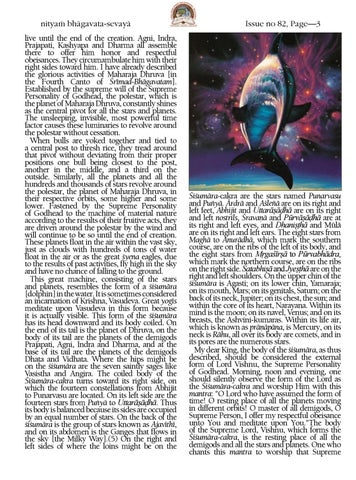
live until the end of the creation. Agni, Indra, Prajapati, Kashyapa and Dharma all assemble there to offer him honor and respectful obeisances. They circumambulate him with their right sides toward him. I have already described the glorious activities of Maharaja Dhruva [in the Fourth Canto of Çrémad-Bhägavatam]. Established by the supreme will of the Supreme Personality of Godhead, the polestar, which is the planet of Maharaja Dhruva, constantly shines as the central pivot for all the stars and planets. The unsleeping, invisible, most powerful time factor causes these luminaries to revolve around the polestar without cessation. When bulls are yoked together and tied to a central post to thresh rice, they tread around that pivot without deviating from their proper positions one bull being closest to the post, another in the middle, and a third on the outside. Similarly, all the planets and all the hundreds and thousands of stars revolve around the polestar, the planet of Maharaja Dhruva, in their respective orbits, some higher and some lower. Fastened by the Supreme Personality of Godhead to the machine of material nature according to the results of their fruitive acts, they are driven around the polestar by the wind and will continue to be so until the end of creation. These planets oat in the air within the vast sky, just as clouds with hundreds of tons of water oat in the air or as the great çyena eagles, due to the results of past activities, y high in the sky and have no chance of falling to the ground. This great machine, consisting of the stars and planets, resembles the form of a çiçumära [dolphin] in the water. It is sometimes considered an incarnation of Krishna, Vasudeva. Great yogés meditate upon Vasudeva in this form because it is actually visible. This form of the çiçumära has its head downward and its body coiled. On the end of its tail is the planet of Dhruva, on the body of its tail are the planets of the demigods Prajapati, Agni, Indra and Dharma, and at the base of its tail are the planets of the demigods Dhata and Vidhata. Where the hips might be on the çiçumära are the seven saintly sages like Vasistha and Angira. The coiled body of the Çiçumära-cakra turns toward its right side, on which the fourteen constellations from Abhijit to Punarvasu are located. On its left side are the fourteen stars from Puïyä to Uttarāṣāḍhā. Thus its body is balanced because its sides are occupied by an equal number of stars. On the back of the çiçumära is the group of stars known as Ajavéthé, and on its abdomen is the Ganges that ows in the sky [the Milky Way].(5) On the right and left sides of where the loins might be on the
Issue no 82, Page—3
Çiçumära-cakra are the stars named Punarvasu and Puïyä. Ärdrä and Açleïä are on its right and left feet, Abhijit and Uttarāṣāḍhā are on its right and left nostrils, Çravaëä and Pūrvāṣāḍhā are at its right and left eyes, and Dhaniṣṭhā and Mülä are on its right and left ears. The eight stars from Maghä to Anurädhä, which mark the southern course, are on the ribs of the left of its body, and the eight stars from Mṛgaśīrṣā to Pūrvabhādra, which mark the northern course, are on the ribs on the right side. Śatabhiṣā and Jyeṣṭhā are on the right and left shoulders. On the upper chin of the çiçumära is Agasti; on its lower chin, Yamaraja; on its mouth, Mars; on its genitals, Saturn; on the back of its neck, Jupiter; on its chest, the sun; and within the core of its heart, Narayana. Within its mind is the moon; on its navel, Venus; and on its breasts, the Ashvini-kumaras. Within its life air, which is known as präëäpäna, is Mercury, on its neck is Rähu, all over its body are comets, and in its pores are the numerous stars. My dear King, the body of the çiçumära, as thus described, should be considered the external form of Lord Vishnu, the Supreme Personality of Godhead. Morning, noon and evening, one should silently observe the form of the Lord as the Çiçumära-cakra and worship Him with this mantra: "O Lord who have assumed the form of time! O resting place of all the planets moving in different orbits! O master of all demigods, O Supreme Person, I offer my respectful obeisance unto You and meditate upon You."The body of the Supreme Lord, Vishnu, which forms the Çiçumära-cakra, is the resting place of all the demigods and all the stars and planets. One who chants this mantra to worship that Supreme