Chairman and Founder, STEMconnector®/Million Women Mentors® (MWM)
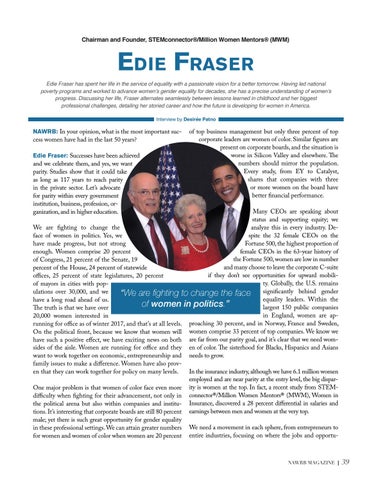
Edie Fraser Edie Fraser has spent her life in the service of equality with a passionate vision for a better tomorrow. Having led national poverty programs and worked to advance women’s gender equality for decades, she has a precise understanding of women’s progress. Discussing her life, Fraser alternates seamlessly between lessons learned in childhood and her biggest professional challenges, detailing her storied career and how the future is developing for women in America. Interview by Desirée Patno
NAWRB: In your opinion, what is the most important suc-
cess women have had in the last 50 years?
Edie Fraser: Successes have been achieved
and we celebrate them, and yes, we want parity. Studies show that it could take as long as 117 years to reach parity in the private sector. Let’s advocate for parity within every government institution, business, profession, organization, and in higher education.
of top business management but only three percent of top corporate leaders are women of color. Similar figures are present on corporate boards, and the situation is worse in Silicon Valley and elsewhere. The numbers should mirror the population. Every study, from EY to Catalyst, shares that companies with three or more women on the board have better financial performance.
Many CEOs are speaking about status and supporting equity; we analyze this in every industry. DeWe are fighting to change the spite the 32 female CEOs on the face of women in politics. Yes, we Fortune 500, the highest proportion of have made progress, but not strong female CEOs in the 63-year history of enough. Women comprise 20 percent the Fortune 500, women are low in number of Congress, 21 percent of the Senate, 19 and many choose to leave the corporate C-suite percent of the House, 24 percent of statewide if they don’t see opportunities for upward mobilioffices, 25 percent of state legislatures, 20 percent ty. Globally, the U.S. remains of mayors in cities with populations over 30,000, and we “We are fighting to change the face significantly behind gender equality leaders. Within the have a long road ahead of us. of women in politics.” largest 150 public companies The truth is that we have over in England, women are ap20,000 women interested in running for office as of winter 2017, and that’s at all levels. proaching 30 percent, and in Norway, France and Sweden, On the political front, because we know that women will women comprise 33 percent of top companies. We know we have such a positive effect, we have exciting news on both are far from our parity goal, and it’s clear that we need womsides of the aisle. Women are running for office and they en of color. The sisterhood for Blacks, Hispanics and Asians want to work together on economic, entrepreneurship and needs to grow. family issues to make a difference. Women have also provIn the insurance industry, although we have 6.1 million women en that they can work together for policy on many levels. employed and are near parity at the entry level, the big disparOne major problem is that women of color face even more ity is women at the top. In fact, a recent study from STEMdifficulty when fighting for their advancement, not only in connector®/Million Women Mentors® (MWM), Women in the political arena but also within companies and institu- Insurance, discovered a 28 percent differential in salaries and tions. It’s interesting that corporate boards are still 80 percent earnings between men and women at the very top. male; yet there is such great opportunity for gender equality in these professional settings. We can attain greater numbers We need a movement in each sphere, from entrepreneurs to for women and women of color when women are 20 percent entire industries, focusing on where the jobs and opportu-
NAWRB MAGAZINE |
39