FEBRUARY 2018
Gentoo giant n A GENTOO penguin appears to tower over HMS Protector, thanks to the camera skills of Leading Photographer Ben Shread. The ice patrol ship called in at Port Lockroy as part of her second work package of the Austral Summer in Antarctica. (see centre pages)
Saint marches on No rest for Royal Navy’s Fleet Ready Escort
Helping hands RFA Mounts Bay returns to hurricane-hit island
Off-sale date: February 28 2018
ÂŁ3.20
GLOBAL REACH
CHF
HMS Cattistock 17(R) TES
HMS Sutherland
Gibraltar Squadron HMS Echo HMS Duncan RFA Mounts Bay
HMS Enterprise
Training or on patrol around the UK
UKMCC COMUKMCMFOR
HMS HMS HMS HMS HMS HMS HMS
HMS HMS HMS HMS 1700
Queen Elizabeth Sutherland Northumberland Forth Severn Mersey Tyne
HMS Argyll HMS Westminster HMS Dragon HMS Hurworth HMS St Albans RFA Tidespring
FASLANE HMS Gannet
Middleton Bangor Ledbury Blyth NAS
RFA Fort Rosalie Naval Party 1022 RFA Cardigan Bay Naval Party 1023 814 NAS 849 NAS Forward Support Unit
ROSYTH HMS Clyde NEFI
YEOVILTON DEVONPORT PORTSMOUTH CULDROSE
Plus one strategic missile and undisclosed Fleet submarines on patrol somewhere beneath the Seven Seas
HMS Protector
This map is a depiction of many, though not all, of the Royal Navy’s commitments over the past month
FLEET FOCUS Protecting our nation’s interests
PENGUINS, historic cabins and supporting the British Antarctic Survey all featured as HMS Protector completed her second work package of the Austral Summer (see centre pages). Supporting communities was also top of the agenda for RFA Mounts Bay as she returned to hurricane-hit British Virgin Islands (see page 11). First on the scene following Hurricane Irma, the amphibious support ship spent a further three days helping with the ongoing clean-up operation. In the UK – or more correctly around the UK – and Type 23 frigate HMS St Albans spent Christmas Day at sea (see opposite page) monitoring Russians – a task which took up most of her time during 2017. We look at the cadre of men and women who have kept alive the flame of fixed-wing flying in the Fleet Air Arm (see pages 16-17) as the Royal Navy prepares to deliver Carrier Strike with HMS Queen Elizabeth and her F-35B fast jets. Personnel from five Royal Navy ships took part in the latest validation exercise for the UK Carrier Strike Group (see page 16). In Portsmouth, an aircraft was lowered on one of HMS Queen Elizabeth’s huge lifts for the first time (see page 16) as the future flagship prepares for her first period of flying trials. In Barrow, the fourth of the Astute-class submarines, HMS Audacious, achieved a milestone with her first dive, see right. HMS Duncan led the first Royal Navy warships to deploy in 2018 (see page 4). The Type 45 headed to the Med to become flagship of NATO’s Standing Group 2. The destroyer was followed two days later by HMS Sutherland, as she left Plymouth for Australia. The deployment aims to reinforce the strong defence ties Britain and the RN enjoy in the region, as well as re-stating the UK’s position in the world after we leave the EU next year. Finally, HMS Cattistock left Portsmouth to join NATO Mine Counter Measures Group 1 in the Baltic. HMS Westminster became the second RN ship to successfully fire the Sea Ceptor missile (see page 5). The missile is replacing Seawolf as the protector of the Royal Navy frigates against aircraft and missile attack. The last minehunting exercise of 2017 in the Gulf saw the Royal Navy’s entire Middle East warfare force – HMS Bangor, Blyth, Ledbury and Middleton and RFA Cardigan Bay – work alongside the Americans (see page 6). Four Royal Navy STEM ambassadors from 1710 NAS guided pupils to victory in the first Lego League contest (see page 19). British astronaut Tim Peake has formally opened the Royal Navybacked college which will produce the scientists and engineers of tomorrow (see page 19). Residents of Orkney paid tribute to 188 sailors lost a century ago when destroyers HMS Opal and Narborough were smashed against rocks (see page 9). Head of the Fleet Diving Group travelled 6,000 miles from Portsmouth to Hyuga in Japan (see page 10) to see how the country’s Maritime Self Defence Force deal with the 21st-Century mine threat. Across to Plymouth and a £5m museum to tell the story of the Royal Navy in the Devon city – and a multi-million pound revamp of the Fleet Air Arm’s heritage – are the cornerstones of a ten-year plan by museum bosses (see page 13). The plans are centered around the former nuclear submarine HMS Courageous. Admiral Lord Nelson continues to be the No.1 draw for collectors who forked out more than £1m on Nelson-themed artefacts (see page 13).
Milestone as new submarine dives
UNDER the bright artificial glow of spotlights, HMS Audacious (mostly) disappears beneath the water for the first time.
Only the top of the fin was still visible above the water of Ramsden Dock in Barrow-in-Furness as the fourth of the Royal Navy’s seven Astute-class hunterkillers performed a test dive. The dock features a giant chasm or ‘dive hole’ – long and wide enough to accommodate a Royal Navy nuclear submarine, but even at 25 metres (82ft) deep it is not sufficient to entirely devour the 8,500-tonne steel leviathan. As Audacious gradually submerged, four trollies collectively carrying 16 tonnes of lead weights
were moved around the vessel so naval architects could confirm the stability of the 97-metre submarine at sea – an exercise known as a trim and incline test. They will use the data gathered to calculate the boat’s precise weight and her centre of gravity. Aboard for the maiden dive was a mixture of ship’s company, constructors and Ministry of Defence engineers – 64 souls in all. “The completion of this successful trial brings great satisfaction to everyone involved and puts HMS Audacious significantly closer to joining the Fleet,” said the boat’s first Commanding Officer Capt Scott Bower. “It was a considerable privilege to take control of HMS Audacious for the first time during the trial, although as Commanding Officer I re c o g n i s e this was a combined
effort across the ‘submarine enterprise’, pulling together ship’s and MOD Staff, BAE and a range of contractors to achieve success.” The dive itself was not a novel experience for Audacious’ first skipper; he went through exactly the same process just over three years ago when in charge of Boat No.3, HMS Artful. Boat No.4 in the multi-billionpound Astute programme was officially named in December 2016 and rolled out of the enormous Devonshire Hall, where all the class of new Fleet submarines have been built, last spring. The £1.5bn submarine is due to leave Cumbria to begin sea trials later this year, joining her three older sisters at their specially-constructed jetty in Faslane. Meanwhile inside the hall, Boat 5 (Anson) is on track to be officially named next year, followed by Boat 6 (Agamemnon) and the still-untitled, but laid down, Boat 7. Picture: BAE
navy news n www.navynews.co.uk n NEWSDESK 023 9262 5255 n ADVERTISING 023 9262 3553 n BUSINESS 023 9262 5235 2
: FEBRUARY 2018
www.navynews.co.uk
GLOBAL REACH Pictures: LPhot Sam Seeley and PO Lee Blease
There was no rest for the crews of the Fleet Ready Escorts who were on duty maintaining the Royal Navy’s
Christmas presence
BET you remember where you were on Christmas Day 2017.
Fire blazing. Belly straining after all the festive grub. Dozing gently while the telly blares out Strictly or another re-run of a Morecambe and Wise yuletide special. The 180 crew of HMS St Albans won’t forget December 25 2017. Nor too the ten souls of the Merlin flight from 829 Naval Air Squadron. It was the helicopter which went aloft in particularly grim conditions on Christmas Day to take a closer look at the brand-new Russian frigate Admiral Gorshkov as it passed the UK. So poor was visibility during the monitoring operation that all we have to show publicly for the festive mission are grainy outlines seen through the Merlin’s WESCAM camera. The Saints were ‘scrambled’ two days before Christmas when it became clear the 4,500-tonne Russian warship was approaching UK waters – barely a month after being commissioned into Russia’s Northern Fleet. It wasn’t entirely a surprise; over recent years the Russian Navy has been busy at a time when the West typically takes it easy (known unofficially in RN circles, as ‘Operation Deny Christmas). The Gorshkov is one of several Russian vessels to have sailed close to the UK’s territorial waters over the festive period – each passage monitored either by Royal Navy ships or helicopters. Ahead of St Albans’ activation, patrol ship HMS Tyne escorted a Russian intelligence-gathering ship through the North Sea and English Channel on Christmas Eve. And a Wildcat helicopter from 815 Naval Air Squadron based at RNAS Yeovilton was dispatched to monitor two further Russian vessels, the research ships Akademik Aleksandr Karpinsky and Admiral Vladimirskiy. The Gorshkov, however, proved to be the ‘fairy atop the tree’. Indeed, Defence Secretary Gavin Williamson said it was imperative that the UK’s Armed Foces responded to any move by a foreign power in home waters. “I will not hesitate in defending our waters or tolerate any form of www.navynews.co.uk
aggression,” he stressed. “Britain will never be intimidated when it comes to protecting our country, our people, and our national interests.” And nor will we let it get in the way of our national customs. Despite the Christmas activation, festivities took place aboard the British Type 23 as usual, including Midnight Mass and the traditional opening of presents on the big day itself. “Christmas Eve saw some particularly exciting and bumpy weather, with some of my newer sailors getting used to their sea legs, but we made sure the job was done,” said Cdr Chris Ansell, the frigate’s Commanding Officer. “Our families were incredibly supportive and even sneaked a few presents into our bags so we had things to open, resulting in a great Christmas Day at sea. “My ship’s company take great pride in serving Great Britain and the role they play dealing with both the routine and unexpected. Missing parts of Christmas and New Year with our families is never easy, but it is absolutely required as part of our duty to keep Britain safe all year round.” Three times last year the Saints were forced to break off their leave and return to their ship to support of CTF 320, the task force responsible for reactive operations in waters in and around the UK. Indeed, the frigate spent 186 days at sea on duty last year, with an exceptionally busy autumn which saw her away from her native Portsmouth on nine in every ten days. The physical sight of a Russian warship – however grainy or obscured by the poor visibility over Christmas – was a rarity for the Saint; most of the time the adversary remained well out of view. But that doesn’t mean St Albans couldn’t see him. Save periods of leave and maintenance, the ship was the duty TAPS – Towed Array Patrol Ship – for most of 2017, a world we don’t delve into much because of the top secret nature of the cat-and-mouse hunts. We can tell you that reports from the patrols the ship has conducted have been
placed before the Cabinet in Downing Street. And of course you’ll have seen the imagery and video footage of some of her surface escort exploits, such as keeping a close eye on the Russian carrier Admiral Kuznetsov. St Albans hasn’t been acting alone in these ventures – and we don’t just mean the staffs directing such operations. For the Atlantic is not ‘our’ ocean; we share the seaboard with several nations, all with a vested interest in its security. So St Albans found her hunts assisted by ships and Maritime Patrol Aircraft from the USA, France, Norway and Canada – each time at short notice and each time with different and unexpected connectivity problems to solve. All of which has put intense demands on the comms/information systems department – especially with many very junior ABs on the team. So the CIS department were worthy winners of a Fujitsu Communications Award. “Being away on TAPS has been hard but I enjoy being in the Navy, it’s like a second family to me,” said 20-year-old ET(CIS) Kelly-Marie Looker, who’s hoping for a change of mission in 2018: a spot of disaster relief or humanitarian assistance. She and her shipmates were back safely in the bosom of Portsmouth Naval Base before Boxing Day was over... but it wasn’t long before the Russian bear was on the prowl again. By then, St Albans had handed over Fleet Ready Escort duties to her sister HMS Westminster, which struck out into the Channel to spend a weekend keeping close watch on four vessels heading for Mother Russia after a deployment to the Mediterranean. So while many people were preparing to return to work at the end of the holidays – not least, the bulk of the RN – Westminster was shadowing two Steregushchiy-class frigates Soobrazitelny and Boiky and support vessels Paradoks and Kola as they headed north. “The English Channel is an absolute lifeline for the UK, and it is very important HMS Westminster and the Royal Navy maintains a watchful eye on this key strategic link,” the CO of the ‘capital ship’, Cdr Simon Kelly, underlined. FEBRUARY 2018 :
3
GLOBAL REACH
I saw three ships... SAILING out, not in though... and on January days.
Farewell to long-serving Pompey NBC THE longest serving Naval Base Commander in Portsmouth since the Napoleonic era, Cdre Jeremy Rigby, acknowledges the send-off from military and civilian personnel as his six years at the helm of the home of the Navy comes to an end. Cdre Rigby served first as captain of the base in 2011, then took the top spot the following year. His extended time in post allowed him to oversee the largest changes in the base, its infrastructure and harbour approaches in its modern history – all to pave the way for HMS Queen Elizabeth’s arrival. With the carrier now safely in her home for the next half century, Cdre Rigby bade farewell not just to the base, but also the Service, leaving the RN after 37 years. “The future couldn’t be brighter,” he said. “We know we have the Type 45s here; we will have at least one class of frigates based here; the carriers will be here and we will be looking after minehunters.” Weapon engineer Cdre Jim Higham, previously head of warship support at DE&S, takes over from Cdre Rigby.
Harry takes over Duke’s RM duties FROM grandfather to grandson... The Queen has approved appointing Prince Harry as Captain General Royal Marines, relieving the Duke of Edinburgh after nearly two thirds of a century. The Duke’s association with the Royal Marines dates back to 2nd June 1953, when he was appointed Captain General in succession to the late King George VI. At the age of 96, Prince Philip decided the time had come to retire from public duties; his last official act as Captain General was to receive Major General Robert Magowan, Commandant General Royal Marines, and Major General Charles Stickland, Commandant General Royal Marines Designate, just before Christmas. Major General Magowan said: “In an ever-changing world His Royal Highness has remained a reassuring constant. The Duke’s interest, support, encouragement, inspiration and ready humour will be sorely missed. We wish His Royal Highness well. “I am delighted by the announcement that Her Majesty The Queen has appointed Prince Harry to be our next Captain General. I look forward to His Royal Highness developing a deep and enduring relationship with the Royal Marines and know that the Corps Family will provide the warmest of welcomes.” 4 :
FEBRUARY 2018
Barely had folk thrown away their 2017 calendars and diaries than the first RN vessels of 2018 were casting off to begin extensive patrols all over the world. No one will be going further than the Fighting Clan, currently making her way towards the sunny skies and inviting beaches of Australia. HMS Sutherland (right) departed her native Plymouth under solemn skies, witnessed by a handful of families who braved freezing temperatures to see the ship as she passed through Plymouth Sound. She’s the first of two Type 23 frigates bound for the Pacific Rim this year; HMS Argyll is heading that way later in 2018 – the first RN surface ships to visit the region in nearly five years. ET Josh Reed was not originally going to sail with the Fighting Clan after three years assigned to her. “I was going to leave the ship on the day before deployment but I requested to stay on board for longer. I’m really pleased that I am now staying to the end of the trip and I’m looking forward to visiting places that I haven’t been to before.” The junior rating’s sentiments were echoed by Sub Lt David Ferguson, on his first tour of duty watch-keeping on the bridge. “I am really looking forward to the opportunities ahead. The chance to visit places that I have never been to is one of the main reasons why I joined the Royal Navy,” he said. The deployment aims to reinforce the strong defence ties Britain and the RN enjoy in the region, as well as re-stating the UK’s position in the world after we leave the EU next year. Forty-eight hours ahead of Sutherland was HMS Duncan, also heading east though the programme takes her no further than the Gulf region. Waved off, inter alia, by Charlotte Wright and her son Frank (bidding farewell to ops room expert PO Gary Wright – pictured centre right), Duncan will partly pick up where she left off last year, and partly fill in for her sister HMS Diamond who was forced to break off her nine-month Gulf deployment before Christmas due to engineering issues. First up for the newest Type 45 in the Fleet is a spell as flagship of NATO’s Standing Group 2, an international force of warships which patrols the Mediterranean and Black Sea… a mission Duncan performed for three months last summer. As a result the ship sailed jam-packed with sailors – not just the ship’s company and Royal Marines boarding party which all vessels heading to the Middle East carry – but also the NATO battle staff to choreograph the movements of the task group, led by the RN’s Cdre Mike Utley. Once done with NATO, Duncan will head through Suez to work with the UK’s allies in the region in stamping out illegal activity in the Gulf and Indian Ocean – piracy, drug trafficking, arms smuggling, people trafficking – as well as conducting operations and exercises with friendly navies, chiefly the Americans. A shorter, colder stint with NATO - three months with Minecountermeasures Group 1 in the Baltic – began for HMS Cattistock in a very wet and icy Zeebrugge. The Belgian port was the setting for a change-ofcommand ceremony as the hosts took charge of the force (led by Cdr Peter Ramboer) from the Latvian Navy. As of mid-January, he had just two ships at his disposal: Dutch support vessel/flagship Mercuur and Cattistock, whose 45 crew were acclimatising to temperatures barely above zero... having joined the Hunt-class ship from a six-month spell in the Gulf. Their task is a mix of present-day mine warfare training and flying the flag for NATO, plus concerted efforts to clear the Baltic of aged ordnance; the waters off Estonia and Latvia are especially peppered with discarded bombs and mines. “Very few divers get to do this trip so it’s a great opportunity,” said AB Craig Wootton. “One of the hardest factors as a diver on this deployment is going to be the cold. We’ll be really looking out for each other, taking it in turns to be in the water, and receiving plenty of hot drinks.”
Baggers bag drugs haul
Pictures: PO Arron Hoare and LPhots Caroline Davies and Rory Arnold
The pennant is mightier than the sword THE boats of the Gibraltar Squadron can now hoist the Fleet Efficiency Flag – a small blue and white pennant – on their RIBs and HM Ships Sabre and Scimitar as they zip around the waters of the Rock. Two dozen sailors and Royal Marines operate some of the smallest vessels in the Royal Navy’s inventory – which are also the most effective. The squadron ended 2016 as the second most effective inshore patrol unit in the RN (up against 1st Patrol Boat Squadron and its P2000s which give university students a taste of life in the Senior Service, and the Faslane Patrol Boat Squadron who safeguard warships and submarines in and around Clyde Naval Base). In 2017, the Gib Squadron – which is located in modern facilities housed in the shell of an historic dockyard shed just a few yards from the iconic Tower naval base headquarters – went one better. Effectiveness trophies are awarded annually across the Fleet, depending on the size or class. As well as the pennants, there’s a trophy to put on the mantelpiece – the first time since 2014 the Gib Squadron HQ has been so decorated. The craft were on patrol in Gibraltar’s territorial waters for around 1,500 hours – just shy of nine whole weeks – last year, 90 per cent of the time either demonstrating UK sovereignty or responding to illegal incursions
of British waters by Spanish warships. The remaining ten per cent of the time was devoured providing force protection, an iron shield around British warships such as HMS Ocean or Duncan, calling in at or departing from the Rock. In addition, there were also rare opportunities to strike out for foreign waters, taking the boats to Portimão in Portugal – a near 400-mile round-trip for boats whose domain is little more than a few square miles – and across to Tangier in Morocco for Remembrance Day services. “Finishing 2016 as runners up was exciting enough, but nothing compares to winning the trophy in 2017,” said Lt Cdr James Myhill, the squadron’s CO. “I am incredibly proud of the small band of sailors and Royal Marines that I have the privilege to command and thank them for their hard work and commitment that have justifiably been rewarded by winning the Effectiveness Trophy.” In the middle of a busy operational programme, the squadron somehow found time to raise £1,000 for the Royal Navy and Royal Marines Charity by battling through a 6.8 nautical mile swim around the Rock. Meanwhile, no Type 23 has hoisted the Fleet pennant more than HMS Somerset, named ‘frigate of the year’ for an unprecedented third time – an award presented by Rear
Admiral Paul Bennett, Rear Admiral Surface Ships, to LS(UWW) Alice Haggett on behalf of her shipmates. The underwater warfare specialist was particularly busy as 2017 began; Somerset started the year as the duty TAPS – towed array patrol ship, responding to the possible presence of non-friendly submarines in home or sensitive waters. And as Fleet Ready Escort, she did much the same above the waves, keeping an eye on non-NATO vessels passing the UK. Somerset also took part in the Royal Edinburgh Military Tattoo and hosted NATO Secretary General Jens Stoltenberg when he visited Scotland. Hand-in-hand with these duties have come training a new generation of engineers (more than 100 ETs qualified after their first spell at sea) and Wildcat helicopter pilots/ observers who completed more than 260 day and night landings. “2017 was an equally challenging and rewarding year for the sailors of HMS Somerset,” said the frigate’s Commanding Officer Cdr Tim Berry. “So this award is a testament to the verve and professionalism that they displayed every day. My thanks go especially to all of our families and friends – without their support and understanding we would not have been able to achieve so much.”
THE Navy’s eyes in the sky helped seize £105m of hashish after a 48-hour hunt in the Indian Ocean. Fliers from RNAS Culdrose in Cornwall spent two days searching hundreds of miles of ocean before they located the suspicious dhow. The helicopter crew guided Australian frigate HMAS Warramunga to the vessel; the ship’s boarding team discovered more than 3½ tonnes of illegal narcotics hidden aboard – the Aussies’ second haul in a week. The drama began shortly before New Year with the Sea Kings of 849 Naval Air Squadron and their home, British support ship RFA Fort Rosalie, enjoying a festive season break in Salalah in Oman. The ship sailed two days earlier than planned when alerted to the possibility of a drugs runner in her area and launched her Sea King helicopters to begin the search on New Year’s Day. Fitted with specialist radar, the Sea Kings are able to track incoming aircraft as well as any movements on the ground or on the surface of the ocean – down to individual vehicles or vessels. The helicopters were used to help Allied air power knock out Iraqi tanks in 2003 and helped track the movement of terrorists, insurgents, drugs and arms smugglers in Afghanistan. The January 1 searches drew a blank, but when the hunt resumed at first light the next day, a dhow was found on its own far from usual shipping routes. The Sea Kings kept an eye on the vessel using their radar, waiting for darkness for the Australians to close in and swoop to catch the trafficker unawares. “There was a massive effort from all parties involved from both Fort Rosalie and, ultimately, Warramunga,” said Sea King detachment commander Lieutenant Commander Dan Breward. “As long as drugs and weapons continue to be trafficked to aid terrorism, we will be here with the coalition members to stop them; we have a track record that we aim to build upon.” This was Warramunga’s fourth drugs seizure since arriving in the Middle East region to support the international effort to stop illegal activity in the Indian Ocean and Gulf region. Her crew have bagged 11½ tonnes of hashish and 69kg of heroin – worth nearly £350m on the streets of the UK. “The Royal Navy helicopter was able to guide us to the suspect vessel that Warramunga’s boarding party searched at night, in difficult conditions. The boarding party did a first-rate job and was able to locate and seize more than three and a half tonnes of illegal narcotics,” said Commander Dugald Clelland, Warramunga’s CO. www.navynews.co.uk
GLOBAL REACH
Up, up and away BIRD away.
The rocket of a Sea Ceptor missile fires into life to power the Navy’s latest weapon against air and sea attack towards its target. HMS Westminster became the second ship to successfully fire the multi-million pound missile system, just weeks after HMS Argyll used it to down drones over the Outer Hebrides. Portsmouth-based Westminster headed to the same ranges with expert engineers from the system’s manufacturers MBDA aboard to put the new weapon through its paces. Sea Ceptor is replacing Seawolf – introduced in the 1970s – as the protector of Royal Navy frigates against aircraft and missile attack. As befits a 21st-Century missile system, it can deal with multiple incoming targets. Unlike its predecessor, however, it can defend more than just the ship on which it is installed. Sea Ceptor can defend an area of 500 square miles – roughly the size of Greater Manchester, which means the system can provide additional protection for a naval task group on top of the long-range Sea Viper missiles carried by Type 45 destroyers. In addition, Sea Ceptor can also be turned against small surface targets – jetskis, speedboats, fast attack craft if necessary. From the research centre at Benbecula, Mirach drones – 13ft long, speeds in excess of 600mph, can fly as low as 10ft – were launched to see whether Westminster could first locate, then track, then identify and finally destroy them with the words: Take with Ceptor. The various tests and scenarios played out
included multiple launches and targets at various heights. “It was great to get Sea Ceptor away successfully – it was never in any doubt as to whether it would hit the target,” said HMS Westminster’s Anti-AirWarfare Officer, Lt Nick Andrews. “We overcame some pretty testing environmental conditions which makes the result even more pleasing. “Westminster managed to explore the real potential of the system during her training and to say it is a real game changer is an understatement. Unlike its predecessor, the system is capable of defending ships other than Westminster herself. “Whether it’s engaging multiple air threats or fast incoming attack craft, Sea Ceptor represents a massive capability upgrade for the Type 23 frigate.” The ship’s company and experts from MBDA spent most of 2017 preparing for the firings. “The past eight months for HMS Westminster have been a terrific journey,” said Lt Cdr Matt Cox, the frigate’s weapon engineer officer in charge of the safe and successful operation of the new missile. “As an engineer officer, there is no greater challenge than regenerating a warship from a deep maintenance period and returning her successfully to live operations. “In the case of Sea Ceptor, MBDA have embedded their own engineering team who have worked hand-in-hand with the ship’s engineers to deliver success, which was signalled by the thud felt throughout Westminster.”
Your WelComE account card... A WelComE account card is assigned to you for your entire military career
and can be used to access telephone and Internet services whilst deployed. You should receive it after basic training. If you haven’t been given it, speak to your admin officer. For more information visit: www.mywelcome.co.uk Lost your account card? No worries! Speak to your admin officer who will be able to provide you with your WelComE account number and a password to reset your PIN.
WelComE Customer Contact Centre customer.support@mywelcome.co.uk | www.mywelcome.co.uk
A Naval Charity providing, personal help and advice for all serving and former members of the Royal Navy, Royal Marines, their Reserves, Families and the RFA on;
Turn on, tune in to clearer sounds YOU can now listen to the Forces’ principal broadcaster on next-generation digital radio. BFBS is extending its service to include DAB+ – the latest variant of digital radio which provides higher-quality sound. Search for ‘Forces’ or ‘ForcesRadio BFBS’ on your DAB+ radio. For more information about how www.navynews.co.uk
to tune in and check coverage in your location, see www.forces.net/dabplus. Listeners can also hear the station via the free app (search ‘BFBS Radio’ in the app stores), online at www.forces.net, on local FM around military bases in the UK and on digital TV (Sky 0211 and Freesat 786).
Personal Finance Including - resettlement finances, pensions and commutation & Civilian Employment For further information; www.whiteensign.co.uk 020 7407 8658 office@whiteensign.co.uk FEBRUARY 2018 :
5
GLOBAL REACH
Jufair fitted out with all MOD cons
Turkey for New Year WE’RE sure there’s a joke in there somewhere. For the crew of HMS Enterprise, flagship of NATO’s Mediterranean minehunting force (aka MCM Group 2), 2018 opened in the city of Izmir and a chance to get to know the first new member of the international task group. Group 2 dispersed at the end of last year, with the participating ships returning to their native countries… with the exception of the flagship. With the advent of the new year, new ships are assigned. First up: TCG Akçay, a German-designed, Turkish-built minehunter. In Izmir the respective ship’s companies showed off their various pieces of equipment to demonstrate what their vessels can do. The Brits demonstrated how they would deal with a flood aboard the 4,000-tonne survey vessel… and the Turks staged a mock fire which demanded the combined efforts of both crews before being brought under control. And there was a spot of combined training in the Bay of Izmir, where the Turks practised ‘rafting up’ – bringing Akçay alongside Enterprise to use her as a mother/depot ship (pictured above). Happy with their combined military efforts, the Brits and Turks sealed their friendship with a football match… won (comprehensively) by the host nation.
A ‘NOAH’S Ark’ of goodies arrived in Bahrain to turn empty buildings into the Royal Navy’s first new overseas establishment in half a century. Forty-nine container loads of equipment have been offloaded at Mina Salman in the kingdom, ready to kit out HMS Jufair, the new complex which will be the hub of naval operations in the Gulf, Red Sea and Indian Ocean. Once the equipment – beds, bedding, desks, chairs, cookers, fridges, lamps, gym kit, basically everything needed to support a permanent presence in the central Gulf – has been installed, the site will be ready to host sailors and Royal Marines, who currently live in apartments peppered around Bahrain. Waiting on the jetty for MV Hurst Point, one of the MOD’s bulk ro-ro transporters used for shipping military kit around the globe, to offload the containers was Cdr Gary Manning, the logistics commander for HMS Jufair. “It marks a significant event in the evolution of HMS Jufair,” he explained. “It’s the culmination of a huge amount of planning work from my highly effective team here in Bahrain, supported by our Royal Navy and MOD colleagues back in the UK. “The furniture and equipment will now be installed into the facility prior to permanent members of staff based in Bahrain taking occupation shortly. “The logistic and engineering support that HMS Jufair will deliver to ships operating from Bahrain will bring a step change in the way we operate in the region.” Jufair is built on land donated by the King of Bahrain and, despite what you’ve read in other media, isn’t a true naval base – there are no dry docks; it’s really a support facility.
It does, however, offer much-improved facilities over the existing jetty and warehouses, better support for any British warship operating in the region – all the way up to the new Queen Elizabethclass carriers – and provide welcome relief for crews of the four RN minehunters based in Bahrain. When their ships undergo maintenance to sustain their three to three-and-a-half-year missions in the Middle East, the 40-45 sailors will move ashore. More typically, on a daily basis, Jufair will be home to around 200 British military personnel and supporting civilians, spread across around half a dozen cream-coloured blocks, stores/workshop complex and central galley/welfare/ entertainment/cinema/shop/gym facility. The site is designed to accommodate just over 300 people, or nearly 550 for short periods if the transit block is used and empty bed spaces across the site are occupied. And two VIP suites have been allocated for senior visitors. Ordinarily most sailors and marines based in Bahrain will enjoy modern rooms with either en suite bathrooms, or sharing heads/showers with a neighbouring cabin, and it’s all air conditioned with WiFi throughout. Shortly before Hurst Point arrived, the Defence Secretary Gavin Williamson paid his first visit to Bahrain and the RN headquarters in theatre, UK Maritime Component Command. He attended a security summit, the Manama Dialogue, before dropping in on UKMCC and receiving a tour of the Jufair site from the RN’s senior officer in the region: Cdre Steve Dainton, who directs the day-to-day operations of more than 700 RN and RFA personnel and their ships and helicopters.
Picture: PO(Phot) Ray Jones
Berth of a Prince
WATER has been lapping at the hull of Britain’s second new aircraft carrier for a month now after HMS Prince of Wales was floated for the first time. In a delicate overnight operation, monitored constantly by crew and engineers from the Aircraft Carrier Alliance, the sluices were opened at No.1 Dock in Rosyth and water gradually filled the space, specially enlarged for the 65,000-tonne warship and her older sister HMS Queen Elizabeth. “For me, seeing water surround the ship has really made it transform from being a ship in build to a ship preparing to go to sea,” said Sub Lt Freddie Spreckley, who’s just joined the ship as a marine engineer after completing his professional training at HMS Sultan in Gosport. “I was privileged to be one of the last few people to walk underneath the ship before the sluices opened and flooded the dock. It was very exciting – a once-in-a-lifetime opportunity – to be involved with this engineering milestone in the ship’s life and historic moment for the Royal Navy.” The next step was to move Prince of Wales from her home for the past three years to the neighbouring basin and J and K berths, where her sister was fitted out before departing on sea trials last summer. A very murky day on the Forth dawned for the move, with a flotilla of tugs on hand to move the leviathan the few hundred feet to her new berth to finish fitting out. Capt Ian Groom, the carrier’s Senior Naval Officer, said that the effort made by teams from industry, the Ministry of Defence and the ship’s company to reach this milestone had been “immense”. He continued: “It has been a massive team effort and I am proud of every individual contribution. “Working as one team we are delivering an unmistakable sign of commitment to the defence of our great nation and that of our allies.” Prince of Wales was 3,000 tonnes heavier than her sister was at the same stage – as the second ship in the class, construction and fitting out has moved more swiftly thanks to the lessons learned building HMS Queen Elizabeth. Originally planned for this year, the ‘undocking’ of the carrier took place ahead of schedule and just three months after the carrier was officially named by HRH the Duchess of Rothesay, as the Duchess of Cornwall is titled in Scotland. The next milestone in the ship’s life will be the first running up of the generators and gas turbines, bringing the ship to life, earmarked for middle of this year, followed by sea trials in 2019.
6
: FEBRUARY 2018
Gulf minehunters face dragons and robots
LAST light in the Gulf on a winter’s day and HMS Ledbury’s dive team return home to mother as the first in the latest cycle of mine warfare exercises draws to a close. The Royal Navy’s entire Middle East mine warfare force – five ships and a command team – were committed alongside American robot boats and the US minehunter Gladiator to test the two navies’ ability to keep vital sea routes open should any nation or group sow the waters with mines. The two navies share the same base (Bahrain), much of the same equipment (in particular the remote-controlled submersible SeaFox which locates and destroys mines) and above all the same goal: to keep the sea lanes east of Suez open to all legal shipping. As well as conducting independent training and working with regional or visiting navies, every quarter the British and Americans conduct a joint Mine Counter-Measures Exercise (MCMEX) to really sharpen combined skills. HMS Bangor and Blyth – specialists in locating deep-water mines – and HMS Ledbury and Middleton, used in shallower seas, their mother ship RFA Cardigan Bay and the Gladiator headed out into the
Gulf to work though a fictional scenario in which key trade routes were suspected to have been mined. Cardigan Bay – which is home to a Royal Navy staff who direct the dayto-day operations of the UK’s Bahrainbased minehunters – provided fuel, food and stores for the Anglo-American force, allowing them to remain at sea longer than their usual fortnight of endurance. The support ship was built to backup amphibious operations involving the Royal Marines and her cavernous loading dock proved ideal for hosting two elite US units: the Expeditionary Mine Countermeasures Company, who use unmanned underwater vehicles to search the seabed, and the Mine Hunting Unit, who use remotely- controlled boats to tow sonars and other search gear in the effort to find mines. Capt Chris Clarke RFA, Cardigan Bay’s Commanding Officer, was particularly impressed by the Americans’ hi-tech systems. “The ship successfully demonstrated it has the ability to remotely control mine warfare assets from the ship,” he said. “This is a most flexible and resilient way to ensure navigation channels can be safely cleared of mines without putting the ship itself in harm’s way.”
Those robot systems are not the only ways of keeping ‘the sailor out of the minefield’. The Americans also make use of air power to clear the seas of mines; MH53E Sea Dragon helicopters from the US Navy’s Helicopter Mine Countermeasures Squadron 15 – aka the Blackhawks – played a key role in MCMEX 18-1 (which was actually held in the closing days of 2017, despite the name). The huge helicopters (21 tonnes to the 14 of a fully-laden Royal Navy Merlin) are able to tow sonar devices through the water to locate mines. It fell to the UK battle staff under Cdr Andy Smith to oversee the mix of helicopters, ships, divers and remotecontrolled systems – and, above all, to get them to work together seamlessly, clearing minefields or paths through them before a deadline passed, allowing merchant trade to once again flow freely in and out of a made-up port. “I was very impressed by the commitment with which British and American sailors worked together to achieve a common goal in a co-operative and collaborative manner,” he said. “More importantly, this exercise has again demonstrated how the Royal Navy helps the nation’s interests in the region.” www.navynews.co.uk
GLOBAL REACH
Britons got Torrent ROYAL Marines engineers headed to the remote shores of western Scotland to test whether they can provide support in the field to an elite amphibious unit.
Fort Rosalie’s net result THREE young loggerhead turtles owe their lives to the kind-hearted crew of RFA Fort Rosalie. In the middle of the drugs bust which led to the Aussies of HMAS Warramunga seizing £105m of hashish (see page 4), the auxiliary came across a large drifting mass of fishing nets. Fort Rosalie’s CO Capt Karl Woodfield decided to investigate and sent out the ship’s Fast Rescue Craft, led by Navigator 2/O Thorsten Brabetz. As the boat cautiously approached the drifting nets, the crew spotted movement and found three juvenile loggerheads – classified by environmentalists as ‘vulnerable’ – entangled in the netting. With delicate cutting of the nets the team managed to free the turtles (pictured above). “It was not what we expected to find when we investigated the floats,” said Thorsten. “It was great to be able to save the turtles and release them back into the sea. It was a real ‘feel good’ moment for the boat’s crew and the entire ship.”
On paper, the boat group from Plymouth’s 539 Assault Squadron should be able to deploy two hovercraft, eight ORC raiding craft/gunboats, and eight inflatable raiders with all their supporting kit and caboodle in five days. The grandly-titled Exercise Raging Torrent sought to put that to the test in the wilds of the Highlands – about as far from regular engineering support available at the squadron’s base in Devonport as you can get. It took the team of 13 engineers – a mix of commando vehicle mechanics and Royal Navy marine and weapon engineers – two days to reach the Kyle of Lochalsh and neighbouring Loch Kishorn in their military convoy of trucks, vehicles, a mobile workshop – a container on the back of a truck equipped with a lathe, pillar drill and various hand tools – with its own power plant, and a newly-introduced specialist crane to launch and recover the craft. They set up camp on the shore at Kishorn, just ten miles away as the crow flies, but a twodozen-mile trek by road thanks to the winding lanes and inlets of Scotland’s west coast. And a good thing they did because the beaches of the western Highlands proved to be troublesome for the craft. Rather than sand, the foreshore on Loch Kishorn consists of large pebbles, stones which were
Corps of duty for Maj Gen
sucked into the jet drive intakes – causing the ORCs, normally with a top speed of nearly 40kts, to run much more slowly; the engineers and their mobile workshop fixed the problem. And some of the beaches and landing sites proved to be unsuitable for the hovercraft – in Royal Marines terminology, LCACs (‘el cacks’ or Landing Craft Air Cushioned) – one of which became stuck and needed rescuing. That was a job for the new Support Vehicle Recovery and its powerful crane… except that
first a line had to be connected to the hovercraft, forcing L/Cpl ‘Tuppers’ Tupman to struggle for 80 metres through knee-deep mud to attach the wire to the stranded craft. Once lifted to safety it was quickly repaired and back in the water in two hours. After ten days in Kishorn, the team moved 50 miles down the coast to set up a second forward support base on golden sands south of Mallaig (pictured)… where it was the turn of an ORC to get stuck on a particularly inaccessible beach. Thanks to permission from the
landowner, removal of a stretch of fence, some skilful driving to manoeuvre a 30-tonne truck down a narrow track and on to the beach at low tide, the stricken craft was hauled to safety. So as well as proving that 539’s boat troop could deploy to a remote location with its mobile support team and vehicles at short notice, Exercise Raging Torrent also proved that the Support Vehicle Recovery does exactly what was expected of it. “Overall it successfully demonstrated its capabilities and proved to be a major asset,” said CPO Luke Jones, “not only recovering wheeled vehicles, but providing crucial support for the craft.”
THE new head of the Royal Marines chats with a lieutenant colonel in charge of one of the Corps’ front-line units – the first act for Major General Charlie Stickland as Commandant General. The drill shed at CTCRM in Lympstone was the venue for transferring the reins of power from outgoing Commandant General Rob Magowan to his successor, a ceremony witnessed by Commanding Officers and Regimental Sergeant Majors from across the Corps. Other guests present included representatives of Fleet Commander Vice Admiral Ben Key, and the commanders of the US and Dutch Marines Corps. Maj Gen Stickland brings 31 years’ experience in the Corps to the top post – experience as varied as patrols in Northern Ireland, anti-smuggling operations in Hong Kong to numerous winter deployments to Norway, the Mediterranean rim and the Far East. He led 42 Commando on a difficult six-month tour of duty in Afghanistan and, five years later, was put in charge of 3 Commando Brigade as it switched from Helmandfocused operations to the Royal Marines’ more traditional elite amphibious infantry role.
Picture: LPhot Baz Wheeler, CTCRM
A Royal Navy Pilot asked us to audit his pension forecast and explain the options available to him “Having burnt my maths books at the age of 16 and embarked on a language degree. this is exactly what I needed to make sense of a complicated system. Quite how anyone is supposed to be able to decipher that without your help is beyond me.” PENSION HELP WHEN YOU NEED IT
INDEPENDENT, NOT-FOR-PROFIT
We deal with hundreds of such pension enquiries
At the Forces Pension Society, we value our independence. It enables us to serve the interests of the Armed Forces community as the Forces Pension watchdog. We hold governments to account, arguing for better pensions and campaigning against unfairness in the schemes. For example, our campaign won the right in 2015 for all future widows to retain their pension on remarriage.
every month from our Members (now c. 50,000), helping them through the AFPS pension maze. Join us and see how we can help you. Or simply become a Member for the peace of mind of knowing we’re here to help when you need us.
VALUABLE MEMBERSHIP OFFERS Our Members also have access to exclusive offers with significant discounts from trusted Affiliates including our exclusive no-age-limit Annual Travel Insurance Plan.
JOIN ONLINE NOW AND RECEIVE A FREE £150 RAMBLING & ADVENTURE HOLIDAY VOUCHER Visit our website at www.forcespensionsociety.org quoting Promo Code NVY2018 (T’s & C’s apply). Annual Membership for you and your partner costs just £38
Forces Pension Society
68 South Lambeth Road, Vauxhall, London, SW8 1RL Tel: 020 7820 9988 A member of Cobseo email: memsec@forpen.co.uk The Confederation of Service Charities www.forcespensionsociety.org
JOIN US AND GET MORE FROM YOUR PENSION FPS-Navy-hands.indd 1
www.navynews.co.uk
11/01/2018 12:57
FEBRUARY 2018 :
7
8
: FEBRUARY 2018
www.navynews.co.uk
l From left, HMS Narborough, William Sissons (courtesy of Orkney Library and Archive), Stanley Cubiss and Edmond Bowly
Never forgotten Tributes to those who perished off Orkney
PEOPLE in the Orkney Islands paid tribute to 188 sailors lost a century ago when their destroyers were smashed against rocks.
Just one man survived when HMS Opal and Narborough ran aground off South Ronaldsay in a snowstorm during a patrol on January 12 1918. One hundred years to the day of the tragedy, Orcadians and representatives of today’s Royal Navy paid their respects with a wreath-laying ceremony at the destroyers’ monument in Windwick Bay, before a memorial event and presentation in a public hall at St Margaret’s Hope. “We stood close to where the two destroyers ended up on the rocks in atrocious weather conditions and all we could hear during the minute of silent reflection was the sound of the wind and the sea,” said Orkney Islands Council convener Harvey Johnston. “It is difficult in such a peaceful place to comprehend what the men on board must have gone through. It was a terrible tragedy and it is so important that we remember their courage and their loss in the service of their country.” The islands served as the principal front-line base for the Royal Navy in both wars with Germany, with the enormous natural harbour at Scapa Flow an ideal anchorage for capital ships. It fell to smaller ships like Opal and Narborough to patrol the waters and hunt down any German minelayers or submarines. So bad was the weather on that fateful Saturday in 1918 that the destroyers were ordered back to base. Instead, they ran into the rocks in nearzero visibility. Some of the Opal’s crew were washed overboard, others were trapped in cabins and compartments unable to escape before the ship broke in two. Lt Cdr Garth Atkinson, who represented the Royal Navy, said: “It was
an honour to attend this commemoration and take a short time to remember the 188 sailors who perished in this tragedy on the night of January 12 1918. “It is true that the sea can be a cruel or harsh mistress for those who choose to work and live upon it and this fateful incident reflects this, especially in the days before the advent of electronic navigation l HMS Opal aids such as radar and GPS, which we now take for granted.” Many of those who died were never found. The graves of 55 of the men are at the Commonwealth War Graves Commission Royal Naval Cemetery at Lyness, on the island of Hoy. Among those who perished was Lt Edmond Bowly. Aged 30 and newly appointed as Captain of HMS Narborough, he had married less than a year before the tragedy. Better known to his family as Mansell – his middle name – he was the great uncle of Tim Jackson, from Gullane, East Lothian, who travelled to Orkney to take part in the commemorative event. “On a previous visit I’ve been to the cliffs above the rocks where the ships went aground,” he said. “That was a very moving experience and it means such a lot to me to be in South Ronaldsay and have the chance to honour and remember a very brave young man from our family, who was lost in such terrible circumstances.” Also recovered from the wreck site was a ring, pictured above, bearing the inscription: To Stanley from Flo – 6 March 1916. It had been given as an engagement present to Stanley Cubiss, who served in
the engine room aboard HMS Opal, saw action at the Battle of Jutland and had been married for less than a year when he died. The ring and other artefacts recovered from the two ships can be seen in a temporary exhibition at Orkney Museum this month. The only crewman found alive, AB William Sissons, was rescued two days later. He was a gunner aboard the Opal and survived not only the loss of his ship but the cold and snow once he got ashore. As for the Narborough, she struck the rocks at speed and heeled over. No man escaped her. “The tragedy that claimed the lives of the crews of HMS Opal and Narborough is a reminder that the sea can be a dangerous place and not just with the threat of enemy action,” said Capt Chris Smith, RN Regional Commander for Scotland and Northern Ireland. “The link between the Royal Navy and the Orcadians has been a long one and we are once again grateful to see that our collective history is being recognised.” Following the laying of the wreaths, the commemorations moved to the Cromarty Hall, St Margaret’s Hope, where there was a community lunch, an information display and a presentation by local historian Brian Budge. Detailed research over many years by Mr Budge, with assistance from another Orkney-based researcher, Andrew Hollinrake, has resulted in a new Book of Remembrance, which brings together the names of all the sailors who died. Created to mark the 100th anniversary, it was dedicated during the event at the Cromarty Hall.
WW1 boat found after 103 years A 103-YEAR search for the first submarine lost in the Great War is over after HMAS AE1 was found off Papua New Guinea. A specialist research vessel located the boat – crewed by 18 Australians, 16 Britons (all her officers, plus men who’d transferred from the RN to the RAN) and one New Zealander – in 1,000ft of water off the Duke of York Islands. The E-class boat – the mainstay of the Silent Service through much of WW1 – was built in Barrow, given the prefix A for Australian and sent to the Dominion with her mixed crew, arriving in Sydney just a couple of months before the outbreak of war. In September 1914 she and her sister AE2 were sent as part of the force dispatched to drive German forces out of New Guinea. One day after the capture of the key port of Rabaul, AE1 headed out on patrol and was never seen again. The Royal Australian Navy has made a concerted effort to find the boat – the very first vessel lost by the then fledgling navy – as part of 100th anniversary commemorations of WW1. After a fruitless search in 2014,
last autumn it joined forces with various search groups, historians and expert wreck hunters, who provided the survey ship Fugro Equator, which is equipped with advanced search technology. She found a ‘contact of interest’ 300 metres down off the Duke of York Islands, which upon closer inspection turned out to be the missing submarine. The first images captured by the expedition show the vessel is remarkably well preserved and apparently in one piece – although there’s no clear evidence of why the 800-tonne vessel sank. Once the wreck’s identity was confirmed, a short service of commemoration was held aboard the survey vessel to remember those officers and sailors who lost their lives in 1914. In the longer term, investigations will continue into how the boat was lost and Australia’s government will work closely with its Papua New Guinean counterpart to consider a lasting commemoration and recognition of the crew of AE1 and to preserve the site. You can read more about HMAS AE1 and her tragic fate at: http://www.navy.gov.au/ hmas-ae1
Spy tech protects wrecks
SATELLITE imagery, radar and other technology is being used to protect the Royal Navy’s most hallowed sites. Naval historians have joined forces with intelligence agencies to use the latest technology to safeguard shipwrecks. The National Museum of the Royal Navy – guardians of the Senior Service’s centuries-long history – and the Maritime Archaeology Sea Trust, who have charted every RN vessel ever lost around the globe, have linked up with the National Maritime Information Centre, which pools information and intelligence on activities in UK waters to deter and detect anyone threatening to disturb RN war graves. They will use satellites, radar, sensors and the AIS identification system – every ship over 300 tonnes must broadcast details of its whereabouts, cargo and destination – plus other sources of information to track or monitor suspicious activity near wreck sites. Nearly 4,800 British warships have been lost over the past 500 years at a cost of thousands of lives. The wholesale plunder of the wrecks of HMS Prince of Wales and Repulse in the South China Sea led to their remains – and other sunken RN vessels – being protected by UK law. Enforcing such protection – especially in the many far-flung parts of the world where some of the 4,793 lost British warships went down – has proved to be tricky. “Our heritage is being lost and people’s graves are being disturbed,” said Prof Dominic Tweddle, Director General of the NMRN. “We need to be more proactive in protecting our wrecks – all too often we’ve been on the back foot, prosecuting people. Let’s stop the problem before the looting. That’s why we’ve asked the National Maritime Information Centre to watch wreck sites and report what’s happening around them.” As well as desecrating British and Commonwealth sailors’ graves, robbers are also disturbing potentially-dangerous/environmentally harmful sites.
LOOKING FOR RETIREMENT ACCOMMODATION?
Greenwich Hospital Sheltered Housing Managed by CESSAC Provide affordable rented self-contained flats for former Royal Navy & Royal Marines, WRNS, QARRNS or RFA aged over 60, their spouses, partners, widows and widowers. 3 locations: Trafalgar Quarters, Greenwich; Greenwich Place, Saltash, Cornwall, and Greenwich Court, Southsea. Enquiries to: ian.wilson@cessaha.co.uk Tel: 02392 829319 Or Download an application from our website www.cessaha.co.uk www.navynews.co.uk
FEBRUARY 2018 :
9
Great year for mail service A NEW transit route enabled British Forces Post Office to cut the time Royal Navy personnel in Diego Garcia waited for their mail from six weeks to just seven days. The new route was one of the main achievements during a busy 2017 for the service dedicated to processing and despatching Armed Forces personal and official mail, as well as the nation’s secrets (known as Protectively Marked Material – PMM). Last year also saw an increase in mail volume of three per cent across the Defence Postal Service when compared with the previous year, alongside a growth of 11.45 per cent in Foreign & Commonwealth Office mail processed by BFPO. The team also launched two new cutting-edge technological capabilities. A new six colour scanner gives an enhanced ability to test mail for chemical, biological, or explosive substances, while the radiological scanner is able to identify any radioactive substances before they enter the BFPO compound. During 2017, BFPO had two routine inspections from the Civil Aviation Authority and maintained their regulated agent status with the Department for Transport. Last year also saw the organisation strengthen its relationship with the Border Force, the regulator in charge of customs controls for goods entering the UK. There were five visits in the run up to Christmas, with BFPO mail passing all random checks. BFPO continued to make improvements in the service delivered to customers, which is ongoing focus for the 230-plus staff at the organisation. Particular successes include the operations team delivering beyond expectations when they were called upon to deliver supplies and PMM to HMS Ocean in support of Operation Ruman in the Caribbean within hours. At the end of the year BFPO
Mine warfare masterclass for Jason-san
IT’S a question we’ve all asked ourselves at some time: How do the Japanese deal with the 21st-Century mine threat?
contended with the Christmas mail rush. Over the festive period, customers took the opportunity to thank BFPO on social media for the difference their work makes to personnel and their loved ones: “@HQBFPO thank you to all your staff for the great service you provide. Helping us stay connected with our loved ones this time of year means so much.” With the successes of 2017 set to bolster BFPO into 2018, it is clear that the organisation’s commitment to Defence and the unique relationship between mail and morale will endure. Summing up the challenges of the year ahead, Hd BFPO, Col Andy Moffat, said: “Where social media may have eroded the frequency of the written word, the advent and growth of online services continues to fuel the growing amount of parcels we are required to process, while Protectively Marked Material requires secure and sympathetic handling. “The need to meet all of these demands in the most swift and secure manner remains.” To stay up to date with BFPO’s news and services, visit www.gov.uk/bfpo and follow them on Facebook and Twitter @HQBFPO.
2017 BFPO statistics n Postal mail dispatched (personal and official) 2,038,573kg n Defence Courier mail processed: 37,177 items n Mail dispatched by the Defence Postal Service over Christmas: over 155 tonnes n Number of charity Christmas Boxes delivered to personnel serving on operations over Christmas: 7,872 n Number of Twitter followers for the BFPO HQ account: 1,346 n Total number of ballot papers processed for the General Election (incoming): 3,090
2017 quirky BFPO facts n The strangest prohibited item of mail in 2017 was a fully assembled adult bike n As of 2017, the top four longest serving staff members have given almost a century of service between them. n The year marked ten years since the purpose-built mail centre at RAF Northolt was created.
10 : FEBRUARY 2018
Learning Japanese Ok, maybe it doesn’t plague every mind. But it is a hot topic for the men and women of the Fleet Diving Group who are determined to remain at the forefront of combating mine warfare. The group’s commander, Lt Cdr Jason White, flew 6,000 miles from his HQ on Horsea Island in Portsmouth to Hyuga at the south-west tip of Japan to join the Maritime Self Defence Force on its annual mine warfare exercise. Despite the distance separating the two nations, the two navies do work together on mine warfare in the Gulf on a regular basis, with Japanese dive teams using British minehunting ‘mother ship’ RFA Cardigan Bay as their base. With the upper echelons of the RN keen to foster closer ties with the Japanese – the two navies, plus the US Fleet signed an agreement to that end in late 2016 – Lt Cdr White headed east to see what he could learn from the host’s large-scale exercise. They committed 21 ships and four aircraft, using some technology the RN either no longer has or never has had: minelayers, minesweepers and aerial mine disposal teams. The exercise opened with the force taking fuel and supplies from two tenders, Uraga and Bungo, while divers dealt with free-floating mines. British minehunters are made of plastic (to prevent triggering magnetic mines); for the same reason the Japanese build their ships from wood, which proved to be robust and capable of taking bumps and knocks when manoeuvring alongside the tenders in 20-knot winds. Having topped up with supplies, the minesweepers got down to their mission: cutting mines free from the seabed as they steamed up and down. That left mines drifting in the ocean, so divers fast-roped out of helicopters into the water to neutralise the floating bombs – a rarely-practised art. Meanwhile, the Uraga was laying a fresh minefield. It’s Japanese doctrine to carry out defensive mining in their own waters, so the precision with which they lay the mines is vital. If that makes it sound like a painstaking affair… wrong. The Uruga dropped 18 mines in just 30 minutes as she moved around the exercise area at 18kts. “The speed and accuracy was impressive and something the whole crew took pride in – they
l Lt Cdr Jason White, pictured below left, joined the JMDF for their annual mine warfare exercise
even switched over the TV from the evening movie to watch the mines slide from their rails,” said Lt Cdr White. He then jumped ship to join new minesweeper JS Hirashima and watched the Japanese performing the British observer’s
favourite task: hunting mines. “The Hirashima had everything expected of a Royal Navy minehunter squeezed onboard and she was immaculate – just like everything else in Japan,” Lt Cdr White said. “Some things took more getting used to than others. Most meals consisted of miso soup, white rice and some meat or fish with pickled vegetables. “Another key tip passed between divers was the pleasure of milk in tea and dunking biscuits, something the Japanese seemed to take to with some relish.” That was the cultural
exchange, as for the war-fighting bit, Lt Cdr White returned to the RN divers’ base in Portsmouth impressed by Japan’s sailors, their ability and their equipment. “The scale of the exercise dwarfs anything I’ve done before and I’ve never seen all aspects of mine warfare work so seamlessly together,” he said. “There is still much we can offer them, with our battlestaff experience in the Gulf, how to operate more efficiently with small crews and specialist diving capabilities, but they are a tier one navy and their kindness and wish for us to be close allies again was humbling.”
www.navynews.co.uk
No shortage of volunteers for part two of clean-up
Good to be back
RFA MOUNTS BAY berths in Tortola as personnel returned to the hurricanehit British Virgin Islands to help with the ongoing clean-up operation. The world’s media spotlight may have shifted but Naval Service personnel were keen to offer their services to people in Tortola, the largest of the chain of islands. Four months have passed since Hurricane Irma wreaked havoc across the Caribbean, resulting in a huge UK Armed Forces operation – spearheaded by RFA Mounts Bay – to bring back some semblance of normality. Back then the ship remained on hand for around a month to deliver materials and aid/provide help ashore. But there is still a great deal of work to do and volunteers were not in short supply as the amphibious support ship returned for a three-day visit. Volunteers included a mixture of RFA personnel, members of a small team of embarked 17 Port Maritime Regiment RLC and embarked Royal Naval medical staff. First up was the Emergency Response Centre, normally the main hub for disaster relief on Tortola, which, along with other government buildings, also bore the brunt of the hurricanes. The volunteers were involved in debris clearance from inside and outside. The second visit was to Elmore Stoutt High School, also caught up in last year’s devastation. Volunteers cleared debris from the lower floor and approximately ten classrooms.
Ship’s company volunteers were assisted in the clean-up operation by the Governor of BVI Gus Jaspert and his family, along with Deputy Governor Rosalie Adams. Capt David Buck, Commanding Officer of Mounts Bay, said: “It has been a privilege for the Mounts Bay team to return to Tortola, the scene of such devastation following Hurricane Irma in September last year. “The resilience of the local population has been readily apparent and despite the fact that a full recovery is still potentially two years away, their spirit and determination is undiminished. “I was therefore thrilled to be able to dispatch small teams to assist the ongoing and massive clearup operation to work alongside His Excellency, the Governor Gus Jaspert, his family and staff. “Although exhausted and a little sunburnt, everyone involved returned to the ship bursting with pride in the knowledge that they had helped in some way and taken away lifelong memories in the process.” In September Mounts Bay was first on the scene for Operation Ruman, the UK’s military response to the hurricane. The specialist humanitarian and disaster relief team on RFA Mounts Bay and her Wildcat helicopter provided assistance to badly-affected areas. Royal Marines from 40 Commando helped to distribute aid and support local police. HMS Ocean was diverted from the Mediterranean and carried a significant amount of aid and equipment.
Personnel from Mounts Bay then helped people on four different islands – Jost van Dyke, Tortola, Virgin Gorda and Anegada. On Virgin Gorda, the third largest island in the chain and home to 4,000 people, RFA engineers worked for four hours in stifling heat to get a power station running again. It was key not only to providing electricity to homes in the Tetor Bay district of the island, but also to the desalination plant, which turns seawater into fresh water for locals. In Road Town, Mounts Bay’s Mexeflote powered raft delivered masses of DIY stores – 75 sheets of plywood, 75 sheets of corrugated iron, 100 planks of timber, a couple of wheelbarrows and an assortment of hand tools. Mounts Bay is currently on patrol in the Caribbean, offering reassurance to UK overseas dependent territories, providing humanitarian and disaster relief during the main hurricane season and conducting counter-narcotic patrols as part of the wider international effort. The personnel who volunteered to take part in the latest clear-up were: RFA: 1/O(X) Jonathan Church; 3/O(X) Euan Ramsay; Cadet (X) Michael Williams; Cadet (E) Rikki McLenaghan; LH (CH) Gordon Wood; AS (CH) Michelle Hook; AS (CH) Gareth Morrell; APP MM Steven Manchester; APP MM Michael Finley; APP MM Thomas Isaac. 17 Port Maritime Regiment (RLC): Sgt Oliver Devlin; Cpl Apenisa Kini; L/Cpl Thomas MacFadyen; Pte Liam Gray; Pte Richard Morgan. Royal Navy medics: LMT Rebecca Houghton and LMT Amy Howell.
Double delight for RFA MEET the Royal Fleet Auxiliary’s ship of the year… …which is the same as the RFA’s old ship of the year… For the second 12 months in succession, RFA Mounts Bay can call herself the best of a very busy flotilla of support ships. The Fleet Efficiency Flag was hauled down… and a clean one hoisted during a pause in operations in the Caribbean. It was those operations – chiefly helping out in the wake of hurricanes which barrelled through the region in September which ensured the banner won’t be changing hands in 2018. Mounts Bay was the first British military vessel to arrive on the scene in British territories in the wake of Hurricane Irma, which caused devastation in a string of Caribbean islands: Anguilla, the Turks and Caicos and the British Virgin Islands. In addition, the ship has supported the ongoing international fight against drug-running in the region as well as generally flying the flag for UK plc by visiting both British territories and Caribbean nations. “Winning the ‘ship of the year’ title for the second year running is a great honour for all those who worked so hard to ensure success while deployed on Atlantic Patrol Task North,” said the-then CO Capt Stephen Norris. “It is a true testimony to Mounts Bay’s versatility and the ship’s company’s commitment to excellence.” Versatility indeed, for the 2016 title was presented for an entirely different mission: rescuing migrants and trying to stop people trafficking in the Mediterranean.
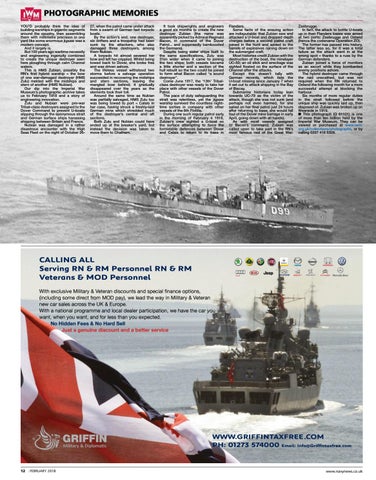
PHOTOGRAPHIC MEMORIES YOU’D probably think the idea of building warships in gigantic segments around the country, then assembling them with millimetre precision in one yard like some enormous jigsaw was a modern concept. And it largely is. But 100 years ago wartime necessity and engineering ingenuity combined to create the unique destroyer seen here ploughing through calm Channel waters. This is HMS Zubian, possibly the RN’s first hybrid warship – the bow of one war-damaged destroyer (HMS Zulu) melded with the midships and stern of another (HMS Nubian). Our dip into the Imperial War Museum’s photographic archive takes us to February 1918 and a story of engineering innovation. Zulu and Nubian were pre-war Tribal-class destroyers assigned to the Dover Command to prevent U-boats slipping through the eponymous strait and German surface ships harassing shipping between Britain and France. Nubian was damaged in a rather disastrous encounter with the High Seas Fleet on the night of October 26-
27, when the patrol came under attack from a swarm of German fast torpedo boats. By the action’s end, one destroyer, six drifters and a troopship had been sunk by the attackers, who also damaged three destroyers, among them Nubian. A torpedo hit almost severed her bow and left her crippled. Whilst being towed back to Dover, she broke free and was driven ashore. The lifeless vessel withstood two storms before a salvage operation succeeded in recovering the midships and stern sections, leaving the mangled bow behind; it gradually disappeared over the years as the elements took their toll. Around the same time as Nubian was partially salvaged, HMS Zulu too was being towed to port – Calais in her case, having struck a freshly-laid German mine which shredded much of the destroyer’s central and aft sections. Both Zulu and Nubian could have ended up at the breaker’s yard, but instead the decision was taken to move them to Chatham.
It took shipwrights and engineers a good six months to create the new destroyer Zubian (the name was apparently picked by Admiral Reginald Bacon, in command of the Dover Patrol... and supposedly bamboozled the Germans). Despite being sister ships built to the same specifications, Zulu was 3½in wider when it came to joining the two ships; both vessels became a little shorter and a section of the hull rebuilt so the two could be joined to form what Bacon called “a sound destroyerâ€?. Come June 1917, the ‘13th’ Tribalclass destroyer was ready to take her place with other vessels of the Dover Patrol. The pace of duty safeguarding the strait was relentless, yet the jigsaw warship survived the countless nighttime sorties in company with other vessels of the 6th Flotilla. During one such regular patrol early in the morning of February 4 1918, Zubian’s crew sighted a U-boat on the surface attempting to force the formidable defences between Dover and Calais to return to its base in
Flanders. Some facts of the ensuing action are indisputable: that Zubian saw and attacked a U-boat and dropped depth charges before a second patrol craft joined in the hunt and added to the barrels of explosives raining down on the submerged craft. Most histories credit Zubian with the destruction of the boat, the minelayer UC-50; an oil slick and wreckage was sighted floated on the surface of the Channel after the attacks. Except this doesn’t tally with German records, which lists the U-boat missing since January 7 when it set out to attack shipping in the Bay of Biscay. Submarine historians today lean towards UC-79 as the victim of the attack, though she was not sunk (and perhaps not even harmed, for she sailed on her final patrol just 24 hours after returning to base; she would fall foul of the Dover mine barrage in early April, going down with all hands). As with most vessels assigned to Bacon’s command, Zubian was called upon to take part in the RN’s most famous raid of the Great War:
Zeebrugge. In fact, the attack to bottle U-boats up in their Flanders bases was aimed at two ports: Zeebrugge and Ostend (hence the codename Operation ZO). The former has passed into history. The latter less so, for it was a total failure as the attack went in at the wrong spot – thanks to a ruse by the German defenders. Zubian joined a force of monitors as an escort while they bombarded enemy positions ashore. The hybrid destroyer came through the raid unscathed, but was not required when the RN returned to Ostend the following month for a more successful attempt at blocking the harbour. Six months of more regular duties in the strait followed before the unique ship was quickly laid up, then disposed of. Zubian was broken up on Wearside in 1919. n This photograph (Q 61101) is one of more than ten million held by the Imperial War Museum. They can be viewed or purchased at www.iwm. org.uk/collections/photographs, or by calling 0207 416 5309.
CALLING ALL Serving RN & RM Personnel RN & RM Veterans & MOD Personnel >P[O L_JS\ZP]L 4PSP[HY` =L[LYHU KPZJV\U[Z HUK ZWLJPHS Ă„UHUJL VW[PVUZ PUJS\KPUN ZVTL KPYLJ[ MYVT 46+ WH` ^L SLHK [OL ^H` PU 4PSP[HY` =L[LYHU UL^ JHY ZHSLZ HJYVZZ [OL <2 ,\YVWL >P[O H UH[PVUHS WYVNYHTTL HUK SVJHS KLHSLY WHY[PJPWH[PVU ^L OH]L [OL JHY `V\ ^HU[ ^OLU `V\ ^HU[ HUK MVY SLZZ [OHU `V\ L_WLJ[LK No Hidden Fees & No Hard Sell Just a genuine discount and a better service
WWW.GRIFFINTAXFREE.COM PH: 01273 574000 Email: Info@Griffintaxfree.com
12 : FEBRUARY 2018
www.navynews.co.uk
A museum at last
A £5m museum to tell the story of the Royal Navy in Plymouth and a multimillion pound revamp of the Fleet Air Arm’s heritage are cornerstones of a ten-year plan by museum bosses.
The team, who have more than doubled tourist numbers to Portsmouth’s Historic Dockyard inside a decade, say the time has come to give Devonport a full-time visitor attraction, centred around former nuclear submarine HMS Courageous. And a 12-year plan revealed by the National Museum of the Royal Navy will transform the Fleet Air Arm Museum in Yeovilton with brand-new facilities. The National Museum was formed a decade ago to bring the Service’s four principal museums – Royal Navy, Submarine, Royal Marines and Fleet Air Arm – under central leadership to better tell the story of the individual branches and the whole Senior Service, and to bring in millions of pounds of investment. And aided by a mix of fundraising and money from National Lottery investment, around £125m has been injected into the RN’s heritage over the past decade. Since the National Museum was formed: n visitors to Portsmouth Historic Dockyard have risen from 350,000 to nearly 900,000 n Mary Rose has been housed in a stateof-the-art museum n the story of the 20th Century Royal Navy is much better served with improved galleries n Great War monitor HMS M33 has been restored as a living memorial to the Gallipoli campaign n HMS Caroline, the only RN warship left from Jutland, has been turned into a visitor attraction in Belfast n HMS Alliance has been completely overhauled and a waterbus introduced to ferry tourists to the RN Submarine Museum and Explosion n The Royal Marines Museum is moving from its Eastney home into the historic dockyard (opening in 2020) n Landing Craft Tank 7074 – one of the few survivors of the vast Normandy invasion fleet – is being restored to form
a centrepiece of the new-look D-Day Museum in Southsea n the 19th Century HMS Trincomalee has been taken under its wing n and HMS Victory – which remains the biggest visitor draw – is undergoing a £50m restoration/overhaul, her most extensive revamp in a century. All these changes and enhancements are only the first stage of a 20-year transformation of the nation’s naval heritage. The second phase will focus on the West Country. “Plymouth’s naval history has not been particularly well served over the years,” said the National Museum’s Director General Prof Dominic Tweddle. “We can do better, so let’s do it.” Over the next decade, the existing museum will move to a revamped and expanded Bonaventure House (also known as Officers’ Terrace) in the South Yard. That will allow the public to see thousands of objects and artefacts held in Plymouth – 10,000 glass negatives of the pre-WW1 base, ships and women at work in the yard; a sizeable collection of ship models; figureheads; and a lot of relics from the ‘end of empire’ – items brought back from former colonies as Britain pulled out after
ĐĐŽŵŵŽĚĂƟ ŽŶ
WW2 tended to end up in Devonport. In addition, submarine HMS Courageous will move to a nearby dock, with a neighbouring building turned into a museum telling the RN’s Cold War story. “Courageous is a fantastic attraction, wonderfully restored and preserved, but at the moment she’s difficult to see. “If all goes well, we will have a museum which tells the story of the Royal Navy and how it relates to Plymouth, as well as the Navy’s story since 1945.” The first work is due to begin on the site later this year with the whole project taking seven to ten years. Further east at Yeovilton, the hangars currently occupied by the Fleet Air Arm Museum are reaching the end of their lives – but a 12-year-plan is in hand to completely rebuild the museum, overhaul the galleries, and display upwards of 100 classic aircraft from more than a century of British naval aviation. In Belfast a waterfront walkway is being created to link the city’s premier tourist attraction – the Titanic Museum – with HMS Caroline, hopefully allowing the WW1 cruiser to tap into some of the 600,000-plus visitors to the former. (The Game of Thrones sound stage prevents anyone looking around the Titanic Museum from seeing Caroline, just half a mile away.) As for Portsmouth, as well as the new-look Royal Marines Museum, a ‘centre for discovery’ will open in the storehouse behind the existing National Museum galleries. It will give a public airing to the majority of artefacts currently in storage – everything from a cigarette case donated by the last Tsar to a Christmas pudding sent to sailors in the Boer War by Aggie Weston’s and a propeller from a decommissioned Trafalgar-class submarine – and also house temporary exhibitions and show off the latest acquisitions. “I believe we can achieve more than one million visitors in Portsmouth,” Prof Tweddle said. “The public want a good day out – they’re looking for interesting things to see, plenty of things happening. So we’re competing with anything that offers that: West Quay, Paulton’s Park, Marwell Zoo. And that means all our museums need refreshing constantly, which is what we’ve done.”
Victory flag fragment snapped up for £300k BRITAIN’S greatest admiral continues to be the No.1 draw for collectors after they forked out over £1m on Nelsonthemed artefacts, mementoes and personal effects. A fragment of a flag flown on HMS Victory on the day of the admiral’s triumph – and death – was bought for just under £300,000, more than three times the sum auctioneers estimated. And bidders smashed the asking price on a portrait of Emma Hamilton; it eventually went under the hammer for £369,000. Nearly 50 items linked with the Georgian admiral went under the hammer as part of Sotheby’s ‘Of Royal and Noble Descent’ auction which raised over £3m for various sellers. The flag segment – 86cm by 92cm (34in by 36in) – was the ‘jewel in the crown’ of 18th/19th-Century ‘Nelsoniana’ made available to buyers. In the run-up to the decisive clash with the FrancoSpanish fleet, Nelson ordered all British warships to fly the national flags as well as their squadron Colours when they went into battle. Of the 33 Royal Navy ships which raised the Union Jack on October 21 1805, only two standards are believed to still exist intact: one is held by the National Maritime Museum in Greenwich, the other is in private hands having been bought for nearly £400,000 a decade ago. After Trafalgar, the flags flown in the battle were carried by Victory’s sailor and marines as part of Nelson’s elaborate funeral service in January 1806. Two of the battle ensigns – one Jack, one St George’s flag – were buried with the admiral, but the largest flag was torn apart by the bearers as a memento. This particular piece eventually ended up in the hands of RUSI, who were donated it by a Royal Navy captain in the early 19th Century. Other objects included a painting of the 1805 battle (valued at circa £80k, sold for £237k), a Faberge-esque commemorative egg (sold for £13,750), ring (£7,500), figurines (£1k), newspapers and pamphlets (£2k), letters penned by Nelson such as to Lady Hamilton (£18,750) and a ‘grog chest’ – a decanter set with wine glasses (£69k).
,ĂǀĞŶ KĨ ī ŽƌĚĂďŝůŝƚLJ
ZĞƐƚĂƵƌĂŶƚ
Think London think Union Jack Club
zŽƵƌ DŝůŝƚĂƌLJ / ŝƐ Ăůů LJŽƵ ŶĞĞĚ ƌĞĂƚĞ LJŽƵƌ ƉƌŽĮ ůĞ at www.ujclub.co.uk For online bookings and Member ƐƉĞĐŝĮ Đ ĞǀĞŶƚƐ͘
General enquiries: 020 7902 6000
&ƌĞĞ 'LJŵ ǁŚĞŶ ƐƚĂLJŝŶŐ
ǀĞŶƚƐ ŝŶ >ŽŶĚŽŶ
^ƵƉĞƌ &ĂƐƚ &ƌĞĞ tŝͲ&ŝ
ϮϬϭϴ &ƌŝĚĂLJͬ^ĂƚƵƌĚĂLJ
SINGLE ROOM ϭ E/',d ^ŝŶŐůĞ ^ŚĂƌĞĚ ĂƚŚƌŽŽŵ
£35
^ŝŶŐůĞ Ŷ ^ƵŝƚĞ
£55
,
dS
Ϯ
ECUd/VE N/'
NS CO
^ŝŶŐůĞ ^ŚĂƌĞĚ ĂƚŚƌŽŽŵ
άϲϬ
^ŝŶŐůĞ Ŷ ^ƵŝƚĞ
BOOK NOW ǁǁǁ͘ƵũĐůƵď͘ĐŽ͘ƵŬ
άϭϬϬ
^ƉĞĐŝĂů Kī ĞƌƐ
dŚŝƐ ƐƉĞĐŝĂů ŽīĞƌ ĐĂŶŶŽƚ ďĞ ƵƐĞĚ ŝŶ ĐŽŶũƵŶĐƟŽŶ ǁŝƚŚ ĂŶLJ ŽƚŚĞƌ ŽīĞƌ Žƌ ŽŶ ƚŚĞ ĨŽůůŽǁŝŶŐ ĚĂƚĞƐ͗ ϮϬͲϮϭ Ɖƌŝů ϭϴ͕ ϰͲϱ DĂLJ ϭϴ͕ ϵͲϭϬ EŽǀ ϭϴ͘ DĞŵďĞƌƐ ŽŶůLJ͘
Navy News 2017 168x264.indd www.navynews.co.uk
1
MEMBERS ONLY
FREE WIFI
ƐƉƌĞƐƐŽ Ăƌ
>ŝŬĞ ŵŝŶĚĞĚ ƉĞŽƉůĞ
ĂƌƐ
ŚĂŶŐŝŶŐ ZŽŽŵƐ
09/01/2018 13:27:30 FEBRUARY 2018 : 13
14 : FEBRUARY 2018
www.navynews.co.uk
RN support helped in cancer battle
C
ANCER – it won’t happen to me! writes WO1 Clint Wheeler.
I am 42, a non-smoker, drink very little and exercise regularly – the last person who you would expect this could happen to. It just shows how wrong you can be... In December 2016 I noticed a lump on the left side of my neck while I was shaving. I wasn’t concerned – I thought I was just under the weather and that one of my glands was swollen. I was feeling fine and not displaying any other symptoms. I had just undergone a particularly stressful period in my role as the Propulsion Warrant in HMS Queen Elizabeth, so I just put it down to my body reacting to the stress. I thought it best to get it checked out and saw a doctor on December 14, just a few days after finding the lump. This action saved my life. The consultant at Queen Alexander Hospital in Portsmouth was very direct when I saw him on December 29 – he said that the lump might be either a cancerous lump or possibly just a cyst; further extensive tests would be necessary. These happened in rapid succession during the following two days – I had an ultrasound, CT scan and a fine-needle biopsy. Still nothing was confirmed. In early January 2017 the consultant explained that if it was cancer, the lump would be a secondary tumour and the primary tumour would be somewhere else within my mouth, throat or neck. They decided to remove both my tonsils to check them for cancer and to conduct biopsies of my throat, mouth and nasal area – all areas the primary tumour would commonly be. I had a CT-PET scan (this can help highlight cancerous cells) prior to the operation to help the surgeons determine where to take the biopsies. Bad news – this showed I had cancerous cells in both tonsils,
Officer with no pressure to exceed my capacities and the freedom to approach them at any time. This has helped me return to work and grow in strength, despite the huge challenge in mental and physical tiredness. The support I have had has allowed me to thrive in the working environment. ome things I will never forget. Getting a hospital visit from a fellow Naval rating goes a long way – yes, I had plenty of civilian friends that visited me but when a Service person visits, it really lifts you. There is a real bond between shipmates, and we could laugh and be jovial about the situation. I enjoyed my copies of Navy News that were brought to my bedside! I could always count on being able to call on a fellow matelot when I was at home on my own and the walls were closing in and it was getting dark and miserable – they would drop what they were doing and pop round for a visit, eat all my biscuits and drink my tea. This is what really lifted my spirits and I would always feel positive and happy again when they left. This, the unwavering support by my family and knowledge of financial security in the Royal Navy, undoubtedly resulted in my returning back to work more quickly and in better health. I plan to return to HMS Queen Elizabeth and show this disease that I have beaten it. We tend to think it won’t happen to us but my attitude has totally changed now – it really can happen. My advice is that you check yourself regularly, and if you find something new or unusual, get checked early. It saved my life and it may save your life too! If you have a medical condition such as cancer in the Service, you are not alone. There are a number of us either in treatment, after treatment and some yet to be diagnosed. As part of my secondary duties I am a member of the Expert Patient Group for a project called Defence People with Significant Illness (DPSI) in MOD. The project provides support to people like me and others, with a multitude of conditions. What I also like about it is that I will have the chance to develop the way in which illness is managed across Defence. My experience with the support of the Royal Navy was excellent and no one should struggle on their own. For more details contact myself at Clint.Wheeler197@ mod.uk or Mandy Islam at Mandy.Islam505@mod.gov.uk
S
l WO1 Clint Wheeler is back at work following his gruelling battle against cancer the base of my tongue and the the treatment would damage the was cancer free! I have to be monitored and jaw, leading to a condition called lump on my neck. In the middle of February, I osteonecrosis if ever in future I reviewed every eight weeks for the had a TORS operation which was had to have one of those teeth next two years, with a reducing frequency after that until the fiveconducted by a robot, operated removed. remotely. This could then require a bone year mark where I will, hopefully, This procedure removes graft from my thigh bone to my be discharged. I joined the Recovery Cell in tissue from the back of the jaw bone. The operation went tongue, which is half way down ahead under my fourth general HMS Nelson and all throughout your throat. The consultants anaesthetic in as many months. they were very helpful, offering explained this would remove Because the primary tumour home visits, which happily I additional, small tonsils that you had still not been found, the did not need, and all kinds of also have in that area, but would radiotherapy was going to be assistance, thus relieving the not remove any tongue muscle. directed at the whole of my throat stress from the condition and the A neck dissection finally and neck area. treatment. diagnosed a Squamous Cell On more than one occasion I rior to the start of Carcinoma of the head and neck. visited or called the Sick Bay and radiotherapy, I had a tube Fortunately, this type of cancer was seen there and then. fitted in my stomach, called has a high treatment success rate, The reception staff were very a RIG, to enable me to be fed helped by my age and lifestyle accommodating, and everyone and medicated at times when it (being 41, I was very happy to be was aware of my circumstances. was not possible to swallow due considered young!). Sometimes I felt at my wits’ With a positive diagnosis, to damage to my throat caused by end and at breaking point, but finally, I thought that radiotherapy the radiotherapy. each doctor I saw managed I underwent six weeks of to compartmentalise each of treatment could finally start with treatment, attending the hospital my issues and, where needed, no further operations. However, first I had to have every day (apart from Saturday prescribed me medication or put another operation to remove and Sunday). my fears at rest. Twelve weeks after treatment four teeth as a preventive I always left feeling positive, measure, as these teeth were in I had another CT-PET scan and looked after and able to see the the radiotherapy target area and received the welcome news that I way forward again. In addition, the Dentist and Hygienist at HMS Nelson have been really supportive with the WORLD Cancer Day takes place every year on deaths will increase to 13.2 million per year by 2030. special medication and dental February 4 – which in 2018 falls on a Sunday – and There is an urgent need for action to raise care my condition required. Without this primary care I is promoted as a single initiative under which the awareness of the disease and to develop practical could not have returned to work world can unite to raise the profile of cancer in a strategies to reduce the burden of cancer. positive and inspiring way. World Cancer Day is organised under the as soon as I did or in the positive This year World Cancer Day is taking place auspices of the Union for International Cancer mental and physical state that I am in. under the tagline We can. I can, and explores how Control (UICC). Occupational Health have been everyone – as a collective or as individuals – can Formed in 1933 and based in Geneva, UICC is the do their part to reduce the global burden of cancer. largest and oldest international cancer organisation, a breath of fresh air; my caseJust as cancer affects everyone in different ways, with more than 1,000 members and 56 partners in worker is extremely proactive and everyone has the power to take action to reduce 162 countries including the world’s major cancer puts forward a comprehensive the impact that cancer has. World Cancer Day is a societies, health ministries, research and treatment plan agreed by me and my line chance to reflect on what you can do, make a pledge institutes, patient groups, and industry leaders. manager – a really robust and and take action. The Union works with its members, key partners, supportive procedure. This year alone, nearly eight million people will the World Health Organization, World Economic I have been supported by my die of cancer, and left unchecked, the number of Forum and others, to tackle cancer on a global scale. line manager and Divisional
P
World unites against disease
Brigadier casts his eyes over Raleigh’s recruits Picture: Emma Densham
www.navynews.co.uk
THE Commanding Officer of 3 Commando Brigade Royal Marines has taken the salute at HMS Raleigh’s first passing-out parade of the year. Brig Gwyn Jenkins (pictured left talking to successful recruits) was the guest of honour for the parade, which marked the successful completion of training for 47 Royal Navy ratings – including 23 budding engineers, 11 warfare specialists, three naval airmen, one chef and one medical assistant. They were watched by their families and friends, and are now ready to progress on to their professional branch training in preparation for taking their place at sea.
Cdr Tony Stevens, Commander Training at HMS Raleigh, said: “Our initial naval training course is a ten-week programme. “These recruits began their training in October and then had to hit the ground running to complete the course after spending two weeks at home with their families for Christmas leave. “As can be seen by their success, they really rose to this challenge and are now rightly looking forward to the next stage in their training for service in the Fleet.” During a day at the base in Torpoint, Brig Jenkins was briefed on the role Raleigh plays in preparing recruits and more
experienced sailors for service at sea. He was shown the extensive facilities available for training on the River Lynher and within the establishment itself, with a tour taking in the Royal Navy Submarine School, an accommodation block used by recruits, the Royal Marines Band complex and the multi-million pound replenishment-at-sea training rig. Brig Jenkins assumed Command of 3 Commando Brigade last April. He was commissioned into the Royal Marines in 1990 and has had a wide variety of regimental and staff appointments.
Experienced staff sought by cadets THE Sea Cadet unit at Christchurch has been thriving for almost 50 years and has long been an intrinsic part of the local community. The unit has a long list of young people that want to join, and some impressive facilities for boating. Over the past couple of years, though, Christchurch has suffered a number of misfortunes with staff, including illness and people moving away from the area because of work. The result is that the unit has lost all of its experienced and exNavy instructors. They have a keen young team of four qualified instructors, but they need support in terms of people with experience of the Royal Navy. If you live within striking distance of Christchurch and have the energy to pass on what you know about boating and the Royal Navy, you would be very welcome. Sea Cadets provide plenty of opportunities for adults to become qualified so that they can teach, so it is not all one way and new instructors will find the experience very rewarding. Christchurch Sea Cadets are holding an open and information evening at Portfield Hall on February 15 at 7pm. Please just turn up or phone the chairman, Mike McAndrew, for details on 07724 507257.
Bristol boys make QA’s day SAILORS who crew the only Type 82 destroyer ever built provided some post-Christmas cheer to patients young and old at Portsmouth’s Queen Alexandra Hospital. Personnel from HMS Bristol – now an accommodation/ training ship berthed at HMS Excellent – held a charity darts night in December, charging loose change and a selection box to enter. With dosh and choccies collected, the time had come to make the short trip first to the wing housing elderly patients, handing over money to pay for some activity trolleys to help their rehabilitation. Five Bristolians – POs Darren Garnett (also winner of the darts contest), Robert Oliver and Scott Gratton and ABs Robins and Parkinson – distributed selection boxes to youngsters spending the festive season in hospital and had a good natter with the youngsters and those caring for them.
Belfast’s big 80th looms THREE days of events will celebrate the 80th birthday of Britain’s last big-gun warship – HMS Belfast – this spring. The wartime cruiser, veteran of the Normandy landings, the final battles with Japan and the destruction of the German battlecruiser Scharnhorst, reaches the milestone on St Patrick’s Day. The birthday weekend itself (March 16-18) opens with a private reunion of former shipmates and a short ceremony. Then on the Saturday and Sunday the emphasis is on visitors and telling some of the stories from the great ship’s quarter-century active career – beyond WW2 exploits, Belfast also served in Korea and the first decade or so of the Cold War. Further details will be revealed via Belfast’s social media pages, such as https://www.facebook. com/hmsbelfast. FEBRUARY 2018 : 15
HENEVER HMS Queen W Elizabeth moves as she conducts her trials and training, armchair admirals hunched over their keyboards can’t resist making a dig.
l Chief of Joint Operations Vice Admiral Tim Fraser joins Commander UKCSG Cdre Andrew Betton in the flyco of HMS Queen Elizabeth Picture: LPhot Joe Cater
Carrier strike operations step closer for Royal Navy
ANOTHER milestone has been reached in the UK’s return to carrier strike operations. Personnel from five Royal Navy ships took part in the latest validation exercise, learning how to work as part of a battlegroup with the nation’s new aircraft carriers. The UK Carrier Strike Group exercise was run by the US Navy and involved the French, Danish and German navies. As well as personnel from HMS Queen Elizabeth, members of the ships’ companies from Prince of Wales, Type 45 destroyers HMS Dragon and Diamond and Type 23 frigate HMS Montrose, also took part. Destroyers and frigates will be escorts for both HMS Queen Elizabeth and HMS Prince of Wales when they deploy. The Multi-National Fleet Synthetic Training Group Command Exercise was run from the Maritime Composite Training System site at HMS Collingwood. Those taking part in the exercise were visited by Rear
Admiral Patrick Piercey, Director for Operations US Pacific Command. “It was an excellent opportunity to review concepts of operations at different threat levels for CSG operations. Key themes discussed focused on the need for range for the Carrier Air Wing and future operational environments,” said Colonel Philip Kelly RM, CSG Strike Warfare Commander. “The Admiral had a very keen understanding of the challenges we both face and was impressed with UK CSG’s progress thus far. I think we the UKCSG will be a welcome addition to any allied force as we bring significant combat power.” The Admiral also visited HMS Queen Elizabeth, touring the hangar and the ship’s Flyco, before stepping out onto the carrier’s four-acre flight deck. Commander UKCSG Cdre Andrew Betton also briefed Admiral Piercey on the carrier regeneration programme and how the two Navies are working together.
“It’s a great opportunity to discuss the UK’s return to carrier strike operations and how we can build our close operational partnerships across the globe,” said Cdre Betton. Following the exercise, Cdre Betton hosted Vice Admiral Tim Fraser, Chief of Joint Operations, visiting from Permanent Joint Headquarters at Northwood, aboard HMS Queen Elizabeth. Vice Admiral Fraser toured the aircraft carrier and met members of the Carrier Strike Group as he was updated on the development of carrier strike. Last year the CSG brushed up their skills when they embarked in the USS George HW Bush for Exercise Saxon Warrior. The build up of CSG has also seen experts from the US Navy and US Marine Corps help to train and mentor the COMUKCSG team, who have also worked closely with the RAF. In the autumn of this year HMS Queen Elizabeth is set to deploy to the east coast of the USA for her first-of-class flying trials with the F-35B.
Anyone need a lift? FOR the very first time an aircraft is lowered on one of HMS Queen Elizabeth’s huge lifts as the future flagship prepares for her first period of flying trials. A solitary Merlin from 820 NAS joined the carrier for two days of checks and tests – simple, but vital preparatory work ahead of four weeks of intensive flying by day and night, by Merlin and Chinooks. Although Merlins landed on QE during her two periods of sea trials last year, they were flying visits – literally; the helicopters were based ashore and flew aboard only briefly before returning to base. To embark means the full range of ‘helicopter services’ must be tested: comms and computer links (aka Telebrief), refuelling, lashings, fire-fighting/damage control/fuel spillage procedures, manoeuvring the mini tractor to push 11 tonnes of Merlin around, and transferring the helicopter from the exposed flight deck to the relative comfort of the cavernous hangar... and back again. QE is equipped with two lifts – each capable 16 : FEBRUARY 2018
of bearing two F-35B Lightning II jets at once (27 tonnes apiece fully loaded), and together able to lift or lower all 700 souls aboard. With the flight team happy that the ship can host, talk to, resupply and re-equip a helicopter on deck and in the hangar, QE had proved “the ship’s aircraft services are ready for action with a live helicopter,” explained Lt Cdr Jim Cobbett, the ship’s Lt Cdr Flying. The FOCRW – First of Class Rotary Wing – trials in the Western Atlantic this month will determine the sea states, roll, pitch and wind limits under which all current variants of Merlin (Mks 2, 3 and 4) can safely take off from and land on the deck, using specially-modified helicopters packed with sensors... and similar sensors taking measurements around the flight deck/superstructure. Before those trials can begin, however, two weeks of FOST instruction and assessment have been lined up for the ship to determine whether her men and women are ready for the more rigorous and intensive training to come.
The ship looks magnificent to be sure, but even with a couple of Merlins on it, the flight deck looks a little empty. The keyboard warriors have branded her a white elephant and suggested a suitable tag for use on social media: #justaddplanes. Towards the end of this year we will do just that. Queen Elizabeth will sail to the Eastern Seaboard where she’ll be met by F-35Bs for the first time. It’s taken a national effort to build the ship. It’s taken an international effort to provide her with aircraft (the Lightning II is an Anglo-American collaboration) and with aircrew. When the Harrier was axed at the end of 2010, it was not merely an immediate shock to the jump jet community, there were widespread grumblings across the Fleet Air Arm and Royal Navy. Was this the end of Naval aviators climbing into fast jets? Or worse, was it even the beginning of the end of the Fleet Air Arm. Half a dozen years later, the answer to both is a firm: no. Decisions taken back in 2010-11, behind the scenes, to little fanfare, are now bearing fruit. We possess a cadre of men and women who have kept the flame of fixed-wing flying in the Fleet Air Arm alive when it could so easily have gone out at the end of 2010. “By the end of this decade the Royal Navy will have enough qualified pilots to deliver carrier strike. The force is continuing to grow and we are on track,” says Cdr James Blackmore, the Fleet Air Arm’s Commander Fixed Wing. In 2010 the RN retired the Harrier along with HMS Ark
Royal accepting an operational pause in carrier strike activity. Now with HMS Queen Elizabeth continuing her journey to full operational capability in Portsmouth, alongside the F-35B conducting deck and ski ramp trials in the United States, it is a good time to see how the Royal Navy’s Fixed Wing Force is managing the transition. So, how many fast-jet pilots remain gainfully employed in cockpits? There are currently 59 qualified fighter pilots in the Royal Navy, plus two dozen more junior pilots in training to become the future F-35B pilots. Of those 59, there are already eight fully-trained Lightning II pilots, a figure which will only rise until eventually 42 per cent of the entire Lightning force is delivered by the Royal Navy alongside pilots from the RAF; it is very much a joint construct. So when HMS Queen Elizabeth enters full operational service during the next decade the Fleet Air Arm will be ready with its core of fast-jet pilots, aircraft handlers and maintainers thanks to some forward thinking, clever planning for the transition and a very accommodating ally in the United States military. It takes around five years to turn a civilian into a Lightning II pilot – officer training at Dartmouth to basic flight training, then to RAF Lintonon-Ouse on the Tucano trainer, RAF Valley on the Hawk aircraft, followed by a front-line aircraft operational conversion unit and then finally a front line squadron. The recruiting and training tap are fully on; in the first half of this decade, between ten and 26 pilots passed through basic flight training at 727 Squadron every 12 months. Now, the number of students climbing into Grob Tutor aircraft for initial flight assessment is around 55 per year to cover the everincreasing demands of Rotary and Fixed Wing aviation in the Royal Navy.
THE most obvious manifestation of the RN fast jet force is its sole (for now) fast jet squadron, 736 NAS. It re-formed back in 2013, replacing FRADU, where the Hawks were largely crewed by retired RAF and FAA pilots. By making it a naval air squadron once more, it’s maintained and trained numerous FAA fast jet aviators – there are 11 currently on its books – who form the core of our trained strength within the UK as the aircraft carrier makes a very welcome return. Supporting Operational Sea Training remains the squadron’s staple diet – air defence exercises on Tuesdays, all-out war on Thursdays. It’s brief, but frenetic as two or three waves of Hawks bear down on warships under instruction at FOST, four to six jets at a time. That hasn’t fundamentally changed in ten or 15 years. Ships have. Warfare has. Type 45 destroyers can – in theory – down cricket-ball-sized targets moving at three times the speed of sound. The latest wave-hugging anti-ship missiles travel at Mach 3 or 4. And flat out the F-35 roars along at 1,200mph. Hawk can do none of that. It’s not even armed. “The challenge is offering training which is relevant with a 41-year-old aircraft,” says 736’s CO Lt Cdr Barry Issitt. “FOST has 22,000 square miles of exercise area [that’s 16 times the size of Cornwall] and
The first ab initio (straight out of basic training, rather than converting from other aircraft types) pilots have just arrived at Marine Corps Air Station Beaufort, USA, to learn how to fly the F-35B. It is a long and challenging road, but there is no shortage of young men and women who want to be a part of the future of the Fleet Air Arm and fly the F-35B. “There could not be a better time to be joining the Royal Navy and the Fleet Air Arm with the opportunity to climb into an F-35B and operate from the Queen Elizabeth Class aircraft carriers; this is a real and highly-exciting prospect,” Cdr Blackmore stresses. In a 21-year career, Cdr Blackmore has flown Sea Harriers with 800 and 899 NAS from HMS Ark Royal and HMS Invincible, helped develop some of the software inside the F-35B, completed two tours of duty in Harrier GR9s over Afghanistan, and embarked in HMS Illustrious. He also flew the F-18E Super Hornet off four US carrier flight decks with Carrier Air Wing 2. But, just as the RN is more than just about carriers, the Fleet Air Arm isn’t purely about F-35Bs. The fixed wing world extends beyond the stealth fighter to embrace four Naval Air Squadrons – the Hawks of 736 NAS, the King Airs of 750 NAS, the Grob Tutors of 727 NAS and the “drones” of 700X NAS – all come under the fixed-wing banner, as do the Sea Harriers which taxi around Culdrose’s training flight deck and the personnel involved in the extensive exchange programme with the US military. That non-reciprocal exchange programme has been operating since the retirement of the Harriers and has seen numerous pilots sent across the Pond to train and fly with the US Navy, and Marine Corps. It has been “fantastic – we owe a huge debt of gratitude to our US colleagues,” says Cdr Blackmore. It began almost
we make use of about half of them. So we are currently working to expand our ‘war’ a little – threaten the ship’s base port of Plymouth, as well as the ship itself, or engage in dogfights off the north coast of Devon. The aim is to present the ops room team with a challenging scenario.” “And we enjoy being put to the test too – testing ourselves against the latest ships with the latest weapons, using the latest tactics. Sometimes, you need to be sneaky…” The raids on shipping off Plymouth are a Falklands/Cold War relic – “and absolutely relevant in the real world,” says Lt Cdr Issitt. “Look at the USS Porter, which was buzzed by Russian fighters in the Black Sea recently.” She was. It made the news. It could have made much bigger news. The Porter had recently been through OST – and came under frequent attack from 736’s jets. “Not shooting can be as important as shooting in my opinion,” says Lt Cdr Issitt. He proceeds to roll out a few real-world examples of cat and mouse, of protagonists constantly testing each other and going close to the limits of provocation. “Nothing is simple in the world of warfare; our people and ships need testing prior to deployment.”
Picture: LPhot Joe Cater, FRPU East
www.navynews.co.uk
as soon as the Harriers were retired and has not merely helped to maintain a kernel of jet pilots in the Fleet Air Arm, but given them unparalleled combat and embarked big flight deck maritime aviation experience. All of which will be of immense benefit when the Queen Elizabeth class carriers are fully operational. Across in the States there are 28 RN pilots, from those at the cutting edge of the F-35B in Edwards and Beaufort, to pilots undergoing advanced fast-jet training at Meridian in Mississippi. At any one time, around ten British naval aviators are serving on frontline US Navy squadrons, for some this has resulted in ninemonth operational combat deployments, flying F-18s on and off the decks of US Navy carriers. “It’s gone far beyond merely giving pilots experience of operating from aircraft
carriers,” Cdr Blackmore says. “It means there is massive combat and embarked experience in theatres such as Afghanistan, Iraq, Syria. “Ten officers have completed deployments to the Middle East, with many more having operated globally with the US Navy and Marine Corps; this vast experience will significantly eliminate the risk of delivering carrier strike over the next decade.”
FOR the past five years, since the Jetstream was retired, the King Air Avenger, its instructors and support staff have continued to ensure that aircrew of the future are well grounded and prepared to join a frontline conversion unit. Since the introduction of the Avenger and UK Military Flying Training System, the squadron has continued in its core roll to conduct Basic Flying Training (BFT) for observers, with 62 graduates from a course which now spans 16 weeks. During that time, they are taught the fundamentals of navigation, aviation and tactical decision making. Up to 16 students a year pass through 750 NAS on basic flying training – around four per course, sometimes only two... “so there are no places to hide,” as instructor Lt Ross Hill points out. Training consists of ‘synthetic sorties’ in a newly-refurbished simulator complex; in addition, students spend around 30 hours airborne, introducing them to the real dynamics of aviation. When students do climb into an Avenger for a sortie, there’s one-to-one instruction for the next couple of hours as the aircraft reaches heights of up to 10,000ft and down to 700ft, heading as far east as Yeovilton, west into the Atlantic and south to the border of French airspace. It’s an area rich in contacts and ideal for training these budding aviators who are put through their paces from homing in on shipping to low-level navigation. Following successful graduation, personnel move to Merlin and Wildcat conversion units where they will learn how to use helicopter-specific weapons and sensors to earn their wings. www.navynews.co.uk
LT CDR Peter Whitehead commands both the largest and smallest squadron in the Fleet Air Arm. Largest? More airframes than any other unit. Smallest? You can fit all of them in a small office. No need for a hangar. These aircraft fit in boxes. 700X (X for ’xperimental) is the RN’s only drone squadron (Remotely Piloted Air Systems (RPAS) is the preferred official term). It’s overseen the use of ScanEagle in the Gulf and Indian Ocean for more than four years. But more and more the specialist unit is looking at downsizing, picking drones off the shelf (literally – they’re stored in boxes stacks of shelves; metaphorically because this is tech well within the budget of gadget enthusiasts). So among its inventory are the DJI Inspire, the Phantom 4 (controlled via an iPad), and the wonderfully-named Parrot Bebop (you can pick one up for under £180). ScanEagle flies for hours; the smaller quad copter drones (despite coming under the fixed-wing banner, the bulk of 700X’s machines are rotary wing...) have a battery life of just 20-30 minutes in most cases – long enough to support the beginning of a boarding operation or conduct a survey of a ship’s mast. It’s the squadron’s job to evaluate these systems and train personnel to operate them in a military or naval environment; you can’t just pick up a drone and fly it in the direction of a warship. “These are part of the future,” says Peter. “And we’re just scratching the surface of what they can do. There’s tremendous potential. “But they also pose a threat – one question we are looking at is
how to stop them flying in our airspace.” There have been numerous instances of drones flying into the Heathrow and Gatwick flight paths and ISIS forces have been looking to put weapons on to small drones. The RN is not looking at weapon-carrying drones, but it is investigating beyond the realms of just surveillance. Top of the list at present is the life-saving drone: launched from HMS Queen Elizabeth if someone falls overboard, the device would follow the carrier’s wake, using the same technology as on Hawkeye in tennis/cricket to locate a body in the water, before releasing a life raft for the sailor to climb into while a rescue boat arrives (which could take up to 30 minutes). Although Peter has designed it with QE in mind, it has potential in Civvy Street if developed for cruise ships, the RNLI or ferries. And internet giant Amazon is looking at drones to deliver parcels. Why not do the same on the battlefield, delivering food, ammunition and other supplies to Royal Marines – without risking their comrades or vehicles?
WHILE aircraft like the F-35 provide the Navy with revolutionary technical potential, that potential can only be unlocked by the people who operate it. Since the early 1950s, the Royal Navy has screened its pilot candidates during officer training. This intense 13-hour ‘flying grading’ selection course reduces the risk of failures during the more expensive flying training courses that are to come, and is a key part of maintaining the high standard of trainee Royal Navy pilots. Since 2001 the job has fallen to 727 Naval Air Squadron – ‘the front door of Naval aviation’ – now based at RNAS Yeovilton in Somerset. With the Navy pilot cadre growing, so has the job of 727. Now responsible for delivering up to 12 Elementary Flying Training graduates per year, the squadron provides the foundation training for the next generation of Royal Navy aviators, adding to the capacity of the wider flying training system. “727 has always been a rich seam of flying experience,” says CO Lt Cdr Jim Ashlin. “As well as using it to select entrants to flying training, we are getting even more value now by using it to impart the fundamentals that will prepare our young pilots for their future on the front-line, whether that is flying F-35 from the carriers or as Merlin pilots deployed alongside the Royal Marines.” FEBRUARY 2018 : 17
Y O U TA K E C A R E O F U S . W E TA K E C A R E O F Y O U . T O G E T H E R W E G O F U R T H ER. C U R R E N T O R F O R M E R M I L I TA R Y P E R S O N N E L C A N S A V E U P T O 2 0%* O N A N E W F O R D .
F O R D F O C U S S T- L I N E S H O W N A VA I L A B L E WITH
15%
C U S T O M E R S AV I N G .
TO FIND OUT MORE, VISIT FORD.CO.UK/MILITARYSALES Official fuel consumption figures in mpg (l/100km) for the Ford Focus ST-Line range: urban 33.2-67.3 (8.5 - 4.2), extra urban 60.1 - 83.1 (4.7 - 3.4), combined 46.3 -74.3 (6.1 - 3.8). Official CO2 emissions 140-99g/km. The mpg figures quoted are sourced from official EU-regulated test results (EU Directive and Regulation 692/2008), are provided for comparability purposes and may not reflect your actual driving experience. *Military Saving programme available to current and ex-Service Personnel. Including veterans and retired members of the UK Armed Forces. Customer savings of 5% to 20% off the Recommended on the Road price available across the Ford range (excluding KA+, Mustang and Focus RS) on vehicles contracted between 1st January 2018 and 31st December 2018 and registered between 1st January 2018 and 30th June 2019. Retail customers only. This promotion cannot be used in conjunction with other manufacturer promotions or incentives. At participating Ford dealers – for terms and conditions, including the eligibility criteria, eligible models and customer savings visit: www.ford.co.uk/militarysales
A brick too far? Not for l Tim Peake talks to student Freddie Willoughby at the UTC Portsmouth
Astronaut hails future stars
FOUR Royal Navy STEM ambassadors from 1710 Naval Air Squadron guided pupils to victory in the first Lego League competition.
Children at Meon Junior School in Portsmouth adopted the name Water Warriors for the regional contest at Portsmouth University. The annual competition challenges children to think like scientists and engineers and presented an ideal opportunity for Lt Dan Emptage, Lt Tom Blackburn, CPO Martyn Owen and CPO Daryl Pr §ichard to offer their expertise. The competition’s theme, the Hydro Dynamics Challenge, was focused on learning about water, how it is transported, used and disposed of. “When this was proposed as a STEM (science, technology, engineering and maths) activity I jumped at the chance to take it on for the unit; however once I had spoken to the school I realised it was a much bigger activity than I initially thought,” said Lt Emptage. “I sought help from other STEM ambassadors within 1710 NAS and it didn’t take long to put a team together as the unit strongly promotes STEM. “Between the team we have years of experience from frontline squadrons so we were sure we would be able to provide sound engineering guidance, not to mention we also all had lots of previous experience playing with Lego.’’ The challenge is based around Lego Mindstorms technology where the children design, build and programme a Lego autonomous robot to overcome several set challenges. This allows the team to demonstrate their core values via teamwork and leadership through a project to solve an identified problem, show technical knowledge of their robot and its design, and produce a presentation. The school’s lead for the
l Meon Junior School pupils prepare their robot Boris
competition, Mrs Jackie Kershaw, contacted 1710 NAS to ask for assistance to help mentor and guide the children through the challenge. The team from 1710 NAS provided mentoring and engineering guidance to the Water Warriors during dedicated weekly sessions to help them produce a robot and prepare for all aspects culminating in the regional competition. Competing against six other teams, the Water Warriors not only achieved the top score in the robot game and subsequently won the prize for the best robot, but they also won the overall event. The Water Warriors were selected for the national finals in Bristol this month, with a chance to compete in the international competition in the USA later in the year. Mrs Kershaw said: “The children were only able to win because, in addition to sharing their own technical abilities, the
team from 1710 NAS were able to coach and inspire them to do their best.’’ The 1710 team will continue to support the Water Warriors with their preparation for the national competition. 1710 NAS is a support organisation based in HMNB Portsmouth that is tasked with the recovery, repair, modification and scientific support of UK military aviation. n BAE Systems has joined with Cranfield University to launch a new post-graduate engineering apprenticeship programme. The first cohort of 76 engineers from the defence firm has started the academic element of their programme. Teaching is delivered entirely online and once completed, apprentices will obtain a Post-Graduate Diploma in Engineering Competence. Those interested in applying for an apprenticeship at BAE Systems this year can choose from approximately 650 apprenticeship training places. For details visit: https://www. baesystems.com/en-uk/ careers/careers-in-the-uk/ apprenticeships
Recognising engineers
SECOND Sea Lord Admiral Sir Jonathan Woodcock has overseen the signing of a new agreement between the Royal Navy and the Institution of Mechanical Engineers. Jon Hilton, who served as the Institution’s 131st President in 2016, signed a new Memorandum of Understanding with the Royal Navy’s engineering training school at HMS Sultan in Gosport. The ceremony celebrated the re-accreditation of the Specially Authorised Process for Marine Engineers, which allows serving personnel to apply for professional registration as an Engineering Technician, Incorporated or Chartered Engineer through a dedicated route mapped to Royal Navy career points. Mr Hilton witnessed Ceremonial Divisions, where more than 1,100 sailors assembled on the parade ground, and presented the Institution’s academic prize to LET(ME) Cyprone Ricardo Barrett. Sultan’s CO Capt Peter Towell said: “This closer working will include three elements: encouraging professional registration, accrediting our engineering career training courses and
FROM outer space to the suburbs of Portsmouth… Two years after blasting off to join the International Space Station, British astronaut Tim Peake formally opened the RN-backed college which will produce the scientists and engineers of tomorrow. The sixth Briton in space was guest of honour at the new £10m University Technical College Portsmouth in Hilsea in the north of the city. The centre of learning opened its doors for the first time in September 2017 with the emphasis on teaching electrical and mechanical engineering and advanced manufacturing, alongside core GCSE subjects for 14 to 16-year-olds and a range of options including Level 3 engineering NVQs and A Levels for those over 16. The college works closely with the Royal Navy to offer practical training to its students, using reallife projects that stretch pupils’ technical skills and creative thinking. Students showed off some of the challenges they’d completed so far for the astronaut, who was impressed by the enthusiasm students displayed. “Young men and women studying here are being taught to aim high and given a deep understanding
of the sheer scope of opportunities that are available to them in the future,” he said. “I’ve been really impressed with the exciting ideas the students have shown me as well as the fantastic questions they have asked. “UTCs impress me because they are not just training the next generation of science, technology, engineering and maths professionals and developing a much-needed skills pipeline, but they are offering their students the opportunity to make the important connection between what they learn in the classroom and how it relates to the real world.” Owen Bradstreet showed off the moon colony he and fellow students had designed. “It was truly inspirational to meet Tim Peake,” the teenager said. “He’s been to the space station and now he’s here talking to us at UTC Portsmouth. We’re really lucky to have him here; what he’s done is great.” Student Zoe Bowbrick added: “It was so exciting to have the opportunity to speak to Tim Peake and ask him questions about the experiments he did in space has been a privilege,” she said. “It’s opened my mind to new opportunities.”
High quality print in the field or back at base Whether it’s printing important documents in the field or print management back at base, Brother will find a solution that’s the perfect fit. We’ll use our expertise and at your side philosophy to design print and technology solutions around your budget and needs. Our dedicated defence and security team have the market experience to understand the challenges you face and our wide range of award-winning hardware solutions and best-in-class services deliver maximum efficiency and value for money.
l Jon Hilton presents an academic prize to LET(ME) Cyprone Ricardo Barratt at HMS Sultan recognising the excellence of individual engineers and technicians through prizes and awards.” Mr Hilton said: “The Royal Navy trains its engineers to an exceptionally high standard, and we are pleased to recognise that excellence with this important agreement.”
Find out more: www.brother.co.uk/defence-and-security CD26609 MOD adverts february x3.indd 2
www.navynews.co.uk
Picture: LPhot Sam Seeley
10/01/2018 12:14
FEBRUARY 2018 : 19
l From left, Personnel brave the snow at Nelson Island, where they saw penguins and undertook an assessment of a heritage hut built in 1957; Protector’s sea boat was launched for a man overboard exercise
l Above, HMS Protector then called in on the British Antarctic Survey base at Rothera, unloading supplies, deploying the James Caird IV for survey work, and enjoying a game of football on a gravel ‘pitch’ l Left, Mountain Leader Ed Hill and Protector’s CO Capt Matt Syrett go ashore at Stonington Point; Below, A hut being restored by the Antarctic Heritage Trust; Right, Sub Lt Helen ‘Toffee’ Crisp; l Left, Sub Lt Libby Mills hauls a fuel can uphill; Above, loading stores at Stonington Point; Below, RN personnel with their hosts at Barry Island; Right a Royal Marine heads back to Protector
Ice Station Protector
MEN WANTED for hazardous journey. Low wages, bitter cold, long hours of complete darkness. Safe return doubtful. Honour and recognition in event of success.
Much has changed since this advert was written by Ernest Shackleton prior to his Nimrod Antarctic Expedition in 1907. HMS Protector protects both its men and women from many of the hazards of the Antarctic, including the cold, and because the ship visits the region during the Austral Summer the sun never sets. Alas, many will always complain about their wages – but we hope to gain the recognition of you, the readers of Navy News. With a hold full of stores and a new captain – Capt Matt Syrett took over from Capt Angus Essenhigh – in the driving seat, Protector enjoyed an unusually comfortable transit across Drake’s Passage to the Antarctic Peninsula. The first stop was Nelson Island, where stores and personnel from the British Antarctic Survey (BAS) were landed by boat. Scientists are studying the Chinstrap penguin colony that resides there. This involves attaching waterproof cameras and GPS trackers to the penguins (using waterproof tape) in order to learn more about the feeding behaviours of these gregarious – and pugnacious – birds. What might at first appear to be a simple task, of landing personnel and stores, can quickly be complicated by the unpredictable Antarctic weather. Conditions can change from serene to calamitous in the space of a couple of hours. Increasing winds cause the temperatures to drop so any team going ashore or in boats needs to be prepared for the worst. One minute you will be applying extra sunblock and the next donning every layer of warm clothing you have in you bag. Fortunately our deployment of personnel and equipment to Nelson Island did not happen on one of these days and it provided an excellent opportunity to perfect the process prior to the more challenging conditions that lay ahead… The good weather held as the ship progressed south of the Antarctic Circle to reach the British Antarctic Survey Station at Rothera. Time to spare, prior to our expected arrival, enabled some exploration of the nearby Bigouden Fjord and Blaiklock Island.
This island is the site of a heritage hut built in 1957 as a refuge for dog sleds making the journey between research stations. A photographic assessment of the hut was conducted which will provide the UK Antarctic Heritage Trust (UKAHT) with information that will help them assess future restoration requirements. These historic sites are largely unchanged since their conception and around the hut at Blaiklock old dog sleds were still in evidence. The journey in and out of the fjord also provided the opportunity for some bridge team training, some of whom were navigating the ship through ice for the first time. Protector delivered 4.5 tonnes of stores to Rothera, as well as 120 cubic metres (31,700 gallons) of aviation fuel and key scientific equipment required for ongoing research. Many of these stores were expected to be delivered earlier in the season by the RRS James Clark Ross but heavy ice conditions had prevented access to Rothera on two separate occasions. Rothera also provided the opportunity for ship’s company to step ashore in Antarctica and take part in guided walks around the peninsula, taking in the sights of Crabeater seals, Adélie penguins and the many icebergs that filled the waters, each a natural sculpture in its own right. The station provided the chance to learn about the science and research that takes place there, the aquarium being a particular highlight, as well as a friendly football match between the BAS staff and the ship’s football team. The match, played on gravel, ended in a goalless draw. However, It was not relaxation for all; the ship’s survey motor boat, James Caird IV, deployed to survey the area south of the runway, as part of plans for a potential extension, as well as the area around the jetty in preparation for the much larger RRS Sir David Attenborough (of Boaty McBoatface fame) which is due to arrive in 2020. The visit was brought to a close with a barbecue onboard HMS Protector for all the Rothera Station staff. Next up was Stonington Island, located 40nm south-east of Rothera. It is a small rocky island that historically was linked to the mainland by an icebridge. In 1946 a research station ‘Base E’ was set up there and became centre for much of the early
mapping of the peninsula using skilled dog teams to access the region. Base E is now a designated historic site maintained by the UKAHT and shares the Island with the USA’s East Base, where old caterpillar tracked vehicles can still be seen. Protector dropped off six UKAHT personnel and their equipment on to the island on what started out as a clear and calm morning. As the day progressed the winds steadily built, making transportation of stores in the ship’s boats very challenging with winds gusting up to 50knots and a worsening sea state making navigation through icebergs to the island more and more difficult. Ashore a team of 15 personnel from Protector unloaded and transported heavy stores and building materials through snow up to a metre deep to allow the UKAHT personnel to set up the camp that will accommodate them (in tents) for the next 11 weeks. The UKAHT team will be carrying out an assessment of the Station E buildings, including the construction of a 3D digital model, while skilled carpenters will carry out targeted restoration of the buildings. HMS Protector will no doubt be a welcome sight when she returns to take them home. Nearby to Stonington Island lies Barry Island, which is home to the Argentinean San Martin Base. Protector made contact with the base, which had not seen any other people since they arrived in February 2017, and were invited ashore to join them for lunch. The team, led by Capt Syrett, were given a tour of the base and then hosted at a barbecue lunch with delicious Argentinean meat that kept on coming. Gifts were exchanged and conversation was lively, thanks to the Spanish-speaking abilities of Protector’s linguist, Lt Martin Garcia-Magrath and Canadian Exchange Officer, Lt Rhys Davies. A group from the base were then invited back to Protector for a tour of the ship and, in good British fashion, afternoon tea. Antarctica is one of very few places left in the world where human interference of the ecosystem is minimal. As such it is an excellent place for research into how the climate is changing.
The science and research that takes place here can provide accurate predictions on the impact, both short and long term, that raising seawater temperatures and climate change may have. In Rothera Protector embarked Dr Christine Batchelor from the Scott Polar Research Institute, who is conducting research into how glaciers advance and retreat over time. After completing our work around Stonington the ship proceeded north to the base of a large glacier in Darbel Bay. James Caird IV was again deployed and spent the day gathering seabed data in front of the glacier. From this data Dr Batchelor will be able to discern patterns on the seabed which tell the story of how that glacier has advanced or retreated over time, including how fast this has taken place. Dr Batchelor said: “The analysis of seafloor glacial landforms allows us to determine the former position and behaviour of glaciers, and to predict how they are likely to respond in the future.” Extrapolation of this data into the future can provide an insight into the speed of glacial retreat overall in Antarctica and how this might affect the ecosystem and planet as a whole. Also embarked for this period is Will Clark who, with the help of the ship’s boats, divers and Royal Marines, has been servicing some of the British Antarctic Survey’s GPS transceivers which are located on rocky outcrops around the peninsula – some of which can be challenging to access. These GPS devices measure the vertical rise of the landmass as the weight of melting ice pack reduces. Over the last 30 years these devices have recorded a 5cm rise. As Navy News went to press, HMS Protector was heading north back to the Falkland Islands to conduct a crew change and embark representatives from the Foreign and Commonwealth Office, before heading back to the ice. Next month Protector will continue her patrol, carrying out further base visits and visitor site assessments in order to keep the region accessible to tourists while safeguarding against any environmental impact their visits may cause. Report: Surg Lt Cdr Andrew Lundie Pictures: LPhot Ben Shread
Recipes stand test of time Book from wartime chief given to RN’s chef school
A HANDWRITTEN recipe book belonging to a sailor who served during WW2 has been presented to the Defence Maritime Logistics School at HMS Raleigh.
The book belonged to CPO Steward Arthur Hayne. Arthur, from Yeovil, was born in 1905 and joined the Royal Navy in Plymouth in 1923, originally as a chef. The recipe book was donated to the school by Arthur’s daughter Mrs Julie Wallace and her sons Jonathan and Nicholas Wallace. Mrs Wallace, who travelled to Cornwall to deliver the book to the school, said: “My father started as a cook, but then he couldn’t stand the heat of the kitchen so he turned to a steward. “He served at HMS Raleigh from September 1942 to September 1944. “I used to come up here with him and went to primary school in Torpoint. “The book has obviously been well used. It’s been hanging around in a drawer at home and I thought when I go perhaps no one else would think it was worthwhile, so I wanted it to go somewhere where it would be of interest to the Navy, to see what someone was cooking back then. “Some of the recipes are familiar to me and I’ve photocopied some to keep. Now the book has gone from me I might be more inspired to cook some of them.” It contains instructions for cooking a variety dishes including chocolate pudding, and hashed mutton, and will be of particular interest to Chef Tom Andrews, who is currently putting together a Royal Navy cook book. He said: “Arthur’s recipe book is really impressive. It’s so small, but you can tell how old it is and how well used it’s been. “For a book that’s nearly 100 years old it’s in amazing condition. “I’ve had a quick browse through so far and there are a few recipes that look good. “I kind of volunteered to write the book. It’s going to have chapters based on Naval traditions, one on old favourites, theme nights and aspects of Navy life that we can translate like action messing when we have to feed the ship’s company quickly during action stations, which will
Chocolate Pud
be quick dishes. “We’re hoping to get an initial investment from a charity and then we will sell the books at a profit for the charity. It’s very much a work in progress at the moment.” Having originally signed up for 12 years, Arthur went on to complete a full career of 22 years, retiring from the Service on December 12 1945. He served in a number of ships and spent some time serving at HMS Vivid and HMS Drake in Plymouth. On leaving the Royal Navy, Arthur continued his connection with the Service until 1970, working as a civilian at Royal Naval Air Station Yeovilton.
22 : FEBRUARY 2018
Put grated ch ocolate on to bo il with the milk When dissolv . ed draw to one side to cool. Cream the butte r and sugar tog ether. Add the yoke of eggs separat ely beating we Stir in the br ll. ead crumbs an d chocolate, m Beat the white ix well. of eggs in basin sep Byfold these in arately very sti to the mixture ff. lightly. Add the vanilla essence then po ur the whole in Steam gently to well greased for 1 hr and tu mould. rn out and po Note: Other su ur sherry sauc itable sauces e round. for above coul d be custard, jam or chocola te.
l Mrs Julie Wallace looks through her father’s recipe book with Chef Tom Andrews; Below, two of the recipes from CPO Std Arthur Hayne’s book
1 pint of stock 2 ozs butter or
Chocolate Pudding
e 2 ozs of grated chocolat 1 ½ ozs caster sugar mbs 3 ½ ozs white bread cru
2 small eggs 8 drops of vani lla essence 1 gill of milk
Method
l Arthur Hayne pictured during his Royal Navy career
2 small eggs nce 8 drops of vanilla esse 1 gill of milk
Method to boil with the milk. Put grated chocolate on one side to cool. When dissolved draw to ar together. sug and ter but the m Crea rately beating well. sepa s egg of e yok Add the . and chocolate, mix well mbs cru d brea Stir in the ly very stiff. rate sepa in bas in s egg Beat the white of ture lightly. Byfold these into the mix well greased mould. then pour the whole into Add the vanilla essence ry sauce round. sher r pou and out and turn Steam gently for 1 hr , jam or chocolate. tard cus be ld cou ve ces for abo Note: Other suitable sau
Trustees required THE Royal Naval Benevolent Trust (RNBT) is seeking five new trustees from April this year. The charity, which helps those who are serving or have served as WOs and below in the Royal Navy or Royal Marines, helps thousands of people each year. A founding principle of the trust is that it is predominantly run by those who are serving or have served as non-commissioned sailors and Royal Marines. Accordingly 11 of the 16 trustees that form the RNBT’s governing body (including the Trust’s Vice President) are drawn from serving and retired personnel who have been or are RN ratings and RM other ranks. The closing date for applications is March 12. If you are interested please contact Rob Bosshardt (Chief Executive) at the RNBT’s Portsmouth-based head office (02392 690112). You can also email a request for an application pack via: rnbt@rnbt.org.uk For more details about the charity visit www.rnbt.org.uk.
ding
2 ozs of grated chocolate 1 ½ ozs caste r sugar 3 ½ ozs white bread crumbs
Method
fat
Hashed Mutto
n
Cold mutton Salt and pepper
.
Onions Flour
Cut all the mea t off the bones. Trim neatly an d place on one side. Chop up the bo nes, cover them with cold water Put on to boil and allow to sim mer for 1 hr – Melt the butte this is to mak r in stewpan. e our stock. Fry off the ch opped onion in it, then add th Stir until deep e flour. brown, then po ur on the stock Gradually all . ow to simmer for 10 Strain into an minutes. other pot, then ad d the trimmed (taking care it mutton and all does not boil) ow to heat throu Dish up and ga gh rnish with cro utons. Note: Pickled walnuts cut in to ½ may als o be added.
1 pint of stock 2 ozs butter or fat
Onions Flour
Method bones. Cut all the meat off the on one side. Trim neatly and place r them with cold water k. Chop up the bones, cove this is to make our stoc w to simmer for 1 hr – Put on to boil and allo ter in stewpan. Melt the but r. floulectured A MEMBER of the Gibraltar He the has on both of add chopped onion in it, then off theretired DefenceFry Police from the these topics, as well as keeping k. the stoc on r pou then n, brow until deep Stirmore force after than 31 years of abreast with on-going criminal for 10 minutes. to simmer of allowMinistry llythe allow to heat through Graduato loyal service investigations. the trimmed mutton and add then Defence.Strain into another pot, To top it all off, Steven also boil) it does not PC 146 joined found time to be the designated ing care Vinent (takSteven s. with croutonBuilding nish started the forceDisin and Custodian, Exhibits A SENIOR rate who planned to raise funds for Cancer Research and gar h up1986 added. may also be ½ into cut s nut his career in the RAF division Officer, Security Officer for has had to postpone his efforts after being diagnosed with a wal Note: Pickled
PC 146 hangs up hat
Buck’s fight against cancer
before moving to the operational department. He was nominated to be a part of the Training and Criminal Investigation Department team. During his career, Steven attended a Public Order Tactical Training Instructors Course in Manchester and also attended a conversion course into the Criminal Procedures and Evidence Act.
the force, Fleet Manager and Training co-ordinator. Further restructuring within the force saw Steven spend his last few years of service as shift duty controller. The Chief Police Officer of the Gibraltar Defence Police, Chief Superintendent Rob Allen, said: “Steven represents everything that is good about the GDP. I am sorry to see him go.”
A FORMER residential home has been earmarked for Plymouth’s newest veteran self-build project. Stirling House on Honicknowle Green will be demolished and replaced by a number of selfbuild housing opportunities for former Service families as well as single veterans, alongside other homes for sale and rent. Following hot on the heels of the award-winning Nelson Project, Plymouth City Council has again teamed up with partners DCH, Form Design and charity Community Self Build Agency for the scheme. The Nelson Project was completed in 2017 and saw exService personnel help with the construction of a 24-home site that includes 12 self-build homes for military veterans and 12 mixed-use affordable homes, including supported housing. In a similar arrangement to the Nelson Project, the council plans to provide the land where Stirling House currently stands to DCH. Norman Biddle, Chairman of the Community Self Build Agency, said: “This is an award-winning partnership that endeavours to replace a tired building, associated with happy memories for many, with something rather special that builds on changing lives and enhancing the community with a contribution to a positive future. “This, combined with our commitment to help disadvantaged groups and social housing as a whole, means there has never been a greater need or time than the present to seek much needed funding and support.” The building of the new homes in Honicknowle will be managed by Veterans’ Self Build, an arm of the Community Self Build Agency, while DCH will manage the completed homes. During the build, the exServicemen will gain a place to call home, will complete construction courses that will help them develop the skills needed to engage with the project and gain job-based skills to build their own homes. The project also has the option of expanding into a nearby disused health clinic. Plymouth City Council is currently exploring this possibility. The Community Self Build Agency is a charity that relies on donations. People can donate to their cause by visiting www. justgiving.com/csba
Grand tour for visitors
Hashed Mutton Cold mutton Salt and pepper.
Veterans build own housing
rare type of the disease. PO(WE) Anthony ‘Buck’ Taylor, who is based at HMS Collingwood, planned to run the London Marathon. He was then diagnosed with neck cancer and faced surgery a few days before Christmas, followed by radiotherapy treatment. “With all of that going on I won’t have time after the surgery to train. So I decided to try the Three Peaks Challenge in the spring with my three-year old daughter in my carry bag on my back,” said Buck. To sponsor him visit https://www.justgiving.com/fundraising/ anthonytaylor2018?newPage=True
HMS SULTAN welcomed representatives from the Worshipful Companies of Plumbers, Blacksmiths, Turners, Shipwrights, Engineers and Fuellers. The aim of the visit was to update the companies’ knowledge and understanding of the Royal Navy and the modern engineering training which is undertaken within HMS Sultan. Guests were treated to tours of the site and a brief about Sultan from the Commanding Officer Capt Peter Towell. The visit also included the opportunity to tour the base’s museums and to see the Sultan Super Sentinel Steam Waggon undergoing maintenance. Lt Sam Leahy, who organised the visit, said: “Guests noted the positivity surrounding our engineering training and the future of the Royal Navy. It was important for the companies to visit Sultan to maintain our close relationship with them as they play a significant role in ensuring the highest of engineering standards are maintained.” www.navynews.co.uk
Pride as officer fulfils Ian’s dream A SAILOR inspired by a Naval officer killed in the line of duty fulfilled his mentor’s dreams when he passed out as a future leader at Britannia Royal Naval College.
Starting them young
Sub Lt Rupert Thomas was guided down the path to becoming an officer by his then boss Lt Cdr Ian Molyneux when serving aboard submarine HMS Astute. Lt Cdr Molyneux was the weapon engineer officer aboard the nuclear submarine when he was fatally shot during an incident aboard in April 2011; he was posthumously awarded the George Medal for his bravery. While the submarine was on her trials around the UK, Lt Cdr Molyneux invited Rupert, who joined the Royal Navy as a rating, to join him in his cabin for a chat. “He told me that I had impressed him during his time on-board and should have a serious think about becoming an officer,” Rupert said. “He provided me with the selfbelief in determining my suitability to pursue this avenue and also gave me a significant insight into the process and a number of coaching sessions to help me prepare for the Admiralty Interview Board. “He is the one reason I have kept going in all the times that have been difficult – he still remains in my thoughts continually.” Rupert, 38, was one of 20 men and women promoted from the ranks to pass out of BRNC during the third and final passing-outparade of the year. “It was important for Ian to see people achieve their full potential,” said Lt Cdr Molyneux’s widow Gillian. “I know without a shadow of a doubt he would have taken great pride in Sub Lt Thomas and all he has achieved.” In total 184 newly-qualified Royal Navy Officers took part in the parade, along with 19 Officer Cadets from nine overseas nations and 14 new recruits to the Royal Fleet Auxiliary service. With the Band of Her Majesty’s Royal Marines Plymouth playing music, Vice Admiral Duncan Potts, Director General Joint Force Development and Defence Academy, inspected the passingout-platoons and took the salute. The 184 new officers bring the tally for 2017 to more than 400 newly-qualified Young Officers delivered to the Fleet this year, along with 45 from international navies. The Royal Naval Leadership Academy, based at BRNC, has also provided nearly 7,000 training places to Officers and Ratings across its sites.
JOSHUA, Eva and Arya ‘take control’ of a digger as the pupils from Woodentots Nursery at HMS Collingwood got a lesson in building techniques. The children have watched from indoors as old buildings at the nursery were demolished and the ground cleared prior to new building work, until finally they were allowed on site to satisfy their curiosity. The budding “Bob the Builders” donned hi-vis jackets and hard hats before Site Manager John Cleary from Building IS guided them around the site, explaining how the diggers, dumper trucks and rollers worked to create the cleared and flattened area where new buildings will be constructed. Nursery Director Lucy Price said, “The children had an amazing experience at the building site, which provided them with lots of new information about the job role of a builder and how their new building is going to be built.” Building work should all be completed by March this year.
Pedalling for pounds
l Above, Sub Lt Rupert Thomas has passed out from BRNC; Left, Vice Admiral Duncan Potts inspects the platoons at Dartmouth
Pictures: Craig Keating
PERSONNEL at HM Naval Base Clyde participated in a Scotlandwide event aimed at raising funds for Breast Cancer Care. The Tour de Scotland was a two-day virtual bicycle race with different organisations competing to be top of the leader board. Royal Navy, Royal Marines and civilians took it in turns to cover the 550km course, each cycling for stints of 15 minutes. With a pair of Watt bikes set up in the Naval Base’s Supermess, the competitors were soon breaking a sweat, cycling in relays from 8am until 5pm on both days. Pictured above are LPT Will Callen, who organised the event along with colleague POPT Barrie Chambers. LPT Callen said: “I’m happy to say the Royal Navy team were top of the leader board throughout with the exception of a tense moment when Barclays Aurora seemed to just move ahead before we re-established the lead. “The event was a huge amount of fun and really brought out the competitive spirit. The response from everyone at Clyde was great too and we have managed to raise £1,850 so far.” During the challenge, the Faslane team averaged between 8.5 – 9.5km every 15 minutes, with one cyclist – Maj Edward Hands from 43 Cdo – taking the prize for fastest male throughout the entire competition, clocking up an amazing average of 11.33km.
Reflecting on a great year
PERSONNEL from across RNAS Culdrose celebrated the achievements of the Royal Navy’s Cornish air station in 2017, at the ‘Ceremonial Station Divisions and Fleet Air Arm Awards’ event. Hundreds of sailors from every squadron and unit based at RNAS Culdrose lined up in their best No.1 uniforms in the hangar of 849 NAS. As the RNAS Culdrose band played in the background, the Guest of Honour, head of the Fleet Air Arm Rear Admiral Keith Blount, inspected the sailors and then presented a number of awards. Admiral Blount said: “You should all be incredibly proud of what you have achieved this year, from ongoing operations in the Gulf to 849 continuing to achieve www.navynews.co.uk
l Sailors on parade at RNAS Culdrose in the Middle East.” Top of the list of honours was the Australia Shield, which is presented to the front-line squadron achieving the highest degree of operational capability. The trophy was awarded to 849 NAS in recognition of the squadron’s enduring presence in
Picture: LPhot Dean Nixon
the Middle East. Individuals were also awarded for their commitment, excellence and professionalism. Lt Cdr Richard Lewis of 849 NAS was given a trophy to recognise his valuable contribution to the development of tactics and training.
The only charity dedicated to supporting children whose parents serve, or have served, in the Naval Service. Originally set up as an orphanage, we now assist children with a wide range of needs and at times of family crisis. Ƃ«« V>Ì Ã V> Li >`i >Ì > Þ Ì i > ` Ì Ãi Ãii } >ÃÃ ÃÌ> Vi V> V Ì>VÌ Ì i vwVi ` ÀiVÌ Þ v À > >«« V>Ì form, or download it from our website. 311 Twyford Avenue, Portsmouth PO2 8RN • t 023 9263 9534 e caseworkers@rnrmchildrensfund.org.uk www.rnrmchildrensfund.org.uk RNRMCF Registered charity number: 1160182 • Patron: HRH The Duke of York, KG, GCVO, CD
FEBRUARY 2018 : 23
Natalie’s great work rewarded
ROYAL Navy Police Officer Natalie Sikora has been presented with an award for her excellence in developing effective relationships. Leading Regulator Sikora was awarded a Provost Marshal (Navy) commendation in a ceremony at HMS Sultan. She was recognised for her ability to develop effective relations within the establishment, and her exceptional report writing and analytic skills. Natalie felt inspired to transfer from being a Writer to a member of the RNP team while serving in HMS Portland. Despite being relatively new to the branch and the most junior member of the Sultan RNP team, she has adapted exceptionally well to her new surroundings. She was presented with her award by Provost Marshal Cdr Jack Hawkins, the Chief Officer of the RNP. He said: “This is quite an achievement to get given this award today. Leading Reg Sikora is relatively new into the branch and she has become an invaluable member of the team. “She has demonstrated that she has the knowledge, intellect and initiative to approach tasks in a mature manner and has demonstrated excellent communication skills when talking with outside agencies. “They’re all qualities of a more senior person and they are just some of the outstanding achievements that have caused me to especially visit her today and recognise the work she has done.” Natalie said: “I am really humbled and it’s really nice to be recognised, but it goes to the team that I work with. “I couldn’t wish to be working with a better team as they are so inspiring and knowledgeable and it just works. “I enjoy my job and I think it’s important that people know that we are approachable and we’re not just there to get people in trouble.”
l The Bishop of Dorking joins pupils at the Royal School in front of the stained-glass window marking the school’s history
Diamond stars in window
BISHOP Jo Bailey Wells, Suffragan Bishop of Dorking, dedicated a new window at the Royal School in Surrey. The window commemorates many aspects of the school’s 178-year history and heritage: n The Royal School’s Patron the Queen’s 90th birthday in 2016 and the school’s links with the Royal Family. n The school’s affiliation with Type 45 HMS
Diamond and its links with the Royal Navy. n The merger between The Royal Naval School, founded in 1840, and The Grove School, founded in 1858, to establish The Royal School in 1995. Designed and created by Sunrise Stained Glass of Portsmouth, the window adds a sense of vibrant colour to the newly-refurbished Chapel. The weavings to either side were created by staff and students at the school.
Preparing for rally good time
DRIVERS from the Royal Navy and Royal Marines Motorsports Association are taking part in a rally at RM Condor to raise funds for military charities.
The event, which is in April, will see profits donated to the Memorial Garden at the Arbroath base. The rally, which is the first to be run by Condor Motorsports Club, will be held within the grounds of Condor, on disused parts of the old airfield. The race, which will serve as part of the Scottish Tarmac Rally Championships, will also help improve the venue for future races. Clerk of the Course Tom Matthews said: “I am passionate about making these events a success and giving back to the military family by donating to the less well known charities associated with the Armed Forces.
l Tom Matthews “It is important after the last couple of years that rallying is portrayed in a positive light and these events can help to do that.” The events are open to all military personnel who hold an MSA licence and belong to BAMA, RFMSA, RNRMMSA or a club affiliated with the Scottish Association of Car Clubs. The event is still in need of sponsors to help reduce costs and
maximise the contribution that can be made to the gardens. Tom, who served in the RAF, added: “We particularly need a main sponsor to help with the cost of repairing the tracks after the last two events when damage was caused and not repaired by the organising club.” RM Condor will allow the Motor Sports Association access to allow training camps to be held for marshals, while future events include sprints and hill climbs, along with other forms of motorsport. Future events will be open to juniors from the sport that has very few venues for their championship. Anyone wishing to speak about sponsorship whether it be financial or in the form of materials, such as trophies, printing, goodies for marshals – anything at all, can contact Mr Matthews at tom@condormsc. co.uk or on 07967240292.
Rising to top at Bottom Field OFFICER Cadets from Britannia Royal Naval College experienced life as a Royal Marines recruit. During a day at the Commando Training Centre in Lympstone the cadets tackled the obstacle course, known as the ‘Bottom Field’. Royal Marines recruits must complete the course in week 20 of their 32-week initial training course. The cadets were also given an overview of Royal Marines officer training and were shown around the centre to see the facilities and find out about the history of the Corps. Capt Rohan Fry, a Divisional Training officer at BRNC, said: “BRNC has a close relationship with the Commando Training Centre and interaction between the two sets of cadets is beneficial to provide each with a better understanding of each other’s roles.” 24 : FEBRUARY 2018
Icing on the cake for Frank ABOUT to have his cake and eat it is 815 Naval Air Squadron observer Lt Frank Suter – the first Fleet Air Arm aviator to clock up 1,000 hours in the Navy’s newest helicopter, Wildcat. The squadron warfare officer/ helicopter warfare instructor has spent four years on Wildcat, first learning how to use its ‘glass cockpit’ – a series of computer displays which feature navigational, sensors and weapons systems – then pass that knowledge on to fellow observers either converting to Wildcat from its predecessor Lynx or joining the new aircraft straight from basic observer training at Culdrose. Frank switched to the Wildcat world after a highly-successful and varied career on Lynx Mk3, on which he qualified, and the Mk8, the final variant operated by the Fleet Air Arm until it was retired in March 2017. He amassed more than 2,000 hours – over 83 days – in Lynx, flying from the decks of HM Ships Liverpool, Kent, Montrose and York. Aboard Southampton, he was involved in a seizure of 3.5 tonnes
of cocaine from the coaster MV Rampage and rescued six people from the fishing boat Lady Sasha off Dominica. From HMS York in 2006, his Lynx was involved with the evacuation of civilians from the Lebanon, completed a landbased tour of duty in Northern Ireland, served as a Flight Commander in the Gulf in 2011 and supported the massive security effort surrounding the 2012 London Olympics. His squadron colleagues were on hand at RNAS Yeovilton after his milestone 1,000th-hour flight to make a small presentation in time-honoured FAA fashion. “My greatest achievement was saving the lives of six people in the Caribbean in 2006,” he said. “The best part of my job is the challenging flying associated with the role. I’m going to keep flying until they stop me!” When not in a helicopter, Frank can be found participating in running events such as the Great Wall of China Marathon and the Jurassic Coast Challenge 100km Ultra-Marathon to raise money for the RNRMC.
Ton up for engineer ONE hundred hours? That’s nothing – there are crusty WAFUs with eight or nine thousand hours under their flying belts at RNAS Culdrose. Except that PO(AET) Adie Culshaw, of the station’s Flight Test Section, is not an aviator. Rather it’s his job to make sure that Merlin Mk2s – the mainstay of helicopter operations at the Helston air station – are safe to hand back to the base’s four Merlin squadrons. As a Flight Test Recorder, supervisor Adie dons flying overalls to assist with the completion of Maintenance and Partial Test Flights, including annual airworthiness assurance flights on Mk 2 Merlin, and postmaintenance test flights on all marks as they emerge from longterm in-depth maintenance here at Culdrose. Hopping into the cabs, he’s able to provide the pilot and observers with expert advice. The senior rating is also trained as ‘left-hand seat’ aircrew which enables him to help the pilot with lookout and airmanship duties in the cockpit of the aircraft. He clocked up his 100th flying hour in ZH864 – the very newest grey Merlin.
“This really is the most interesting and satisfying draft that I’ve had so far,” said Adie. “Best of all is the chance to talk to so many aircrew and start to appreciate how they use the aircraft and see for myself exactly what our engineering effort delivers.” Congratulating the senior rating on his milestone, the Officer in Command of Culdrose Flight Test Unit, Lt Rich Beaumont, said: “Adie is a first-class engineer and shows uncommon aptitude and nouse whilst airborne.” www.navynews.co.uk
Royal thanks for supporting roles Officers leading from the front YOUNG officers Gregory Wintle, Emily Marks, David Lane and Lloyd Jones took the lead when it came to helping an animal shelter. The four Sub Lts, pictured above, were among six trainees from HMS Collingwood who helped the nearby RSPCA Stubbington Ark Animal Shelter. The trainees, who are all on the System Engineering Management Course, began work by cleaning and disinfecting the cat pods, which allows the charity to now accept more felines. Rats had infested two outdoor storerooms that housed blankets and towels and so the team then began cleaning and re-organising the rooms to ensure they were verminfree and the towels, blankets and sheets used by the Ark’s animals stayed clean and hygienic. The Stubbington Ark not only rescues domestic and exotic pets but also farm animals and wildlife and one large field had been set aside for pigs which had made the ground extremely uneven and dangerous for staff members to traverse. This was an issue since the wildlife area was at the far side of the field and staff needed to access this area after dark to care for rescued hedgehogs. The officers levelled out the field, pictured bottom of page, which proved a mammoth task. Finally, the team met some of the Ark’s canine residents and took them for a welcome walk around the grounds, the staff there matching each team member with the most suitable dog. Stephanie Cziczo, the Animal Centre Manager said: “The guys were fantastic – the animal care team were so glad to have them here. “They walked more than six dogs from B block alone – saving one staff member two hours of walking, so that she was able to do more training with the dogs that need it. “Their help with the blanket shed was also much appreciated. We have issues with rats building nests in that shed, so getting the blankets, sheets and towels organised neatly helps us to gather them more quickly and keep them off the floor and away from the rats.” Pictured below are Sub Lts David Lane, Stuart Goodman, Lloyd Jones, Gregory Wintle and Grant Ligethy being studied by one of the Ark’s felines. Pictures: Sub Lt Emily Marks
THE hard work and commitment of Royal Navy and Royal Marines Charity supporters was celebrated with a presentation by Princess Anne.
As the national charity of the Royal Naval Service, the RNRMC is reliant upon a vital network of loyal supporters who help ensure it achieves its charitable goals. The Supporters’ Reception, hosted at Trinity House in London, celebrated the commitment undertaken by the charity’s volunteers, fundraisers and corporate sponsors. As Patron of the RNRMC Princess Anne was in attendance to award a select group of supporters with framed achievement certificates that recognised their individual efforts. One of the groups receiving the award from the Princess Royal was the Solent Committee – a mix of Royal Naval veterans, serving personnel, their families and civilians. This essential team of volunteers help support the South Coast and Central areas of the United Kingdom. Others included in the awards presentation were the Britannia Royal Naval College, the WRNS 100 walkers and select individuals who have excelled on behalf of the RNRMC. Award recipient John Branson, a member of the Solent Committee, said of receiving his award: “It was a huge honour to be recognised by Her Royal Highness Princess Anne for my work with the RNRMC. As a former member of the Royal Navy, I understand how important it is to support charities like the RNRMC. That is why I continue to contribute
l The Princess Royal thanks RNRMC supporters at a reception at Trinity House in London my time towards such a great cause. “All those days selling merchandise, collecting money and passionately talking to people about the RNRMC and the Naval Service has proved to be so worthwhile. “I am incredibly proud of the work I do with the charity and hope to continue for as long as possible.” Another of the evening’s award recipients, WO1 Andrew Rainey, has been volunteering with the RNRMC since 2014. Hailing from the West Country, Andrew has recently left the Royal Naval Reserve after completing his 40th year in the service. In the spirit of “giving something back”, WO1 Rainey has excelled for the RNRMC by helping grow the pay roll
giving initiative- managing an astonishing 90 percent sign up rate of those he presents to. Andrew said: “Volunteering keeps me busy in my spare time but I wouldn’t swap it for anything else. I really enjoy doing something worthwhile. Volunteering is great and I’d certainly recommend it.” Having been the Patron of the charity since its inception in 2007, the Princess Royal met supporters and members of staff throughout the evening before making a short speech in which she praised the charity’s supporters and emphasised their importance to the Naval Service. Speaking about the importance of the RNRMC’s supporters, Chief Executive Robert Robson, said: “The supporters here this evening are the lifeblood of our
charity. Without the help of these fantastic volunteers, fundraisers, corporate sponsors and ambassadors, the charity would cease to exist. For the work they do, we sincerely thank them.” In attendance at the Supporters Reception was First Sea Lord Admiral Sir Philip Jones, who was accompanied by his wife Lady Liz Jones – also a supporter of the charity. The RNRMC exists to support sailors, marines and their families, for life. The charity has recently reached its tenth anniversary and continues to be the national charity of the Naval Service and one of the leading Armed Forces charities in Britain. For more information about the charity call 023 9387 15020 or visit www.rnrmc.org.uk
Lawyers waive fees Grand reward
THE Royal Navy and Royal Marines Charity has joined forces with a number of solicitors for an initiative that offers affordable will creation in exchange for charitable donations. The RNRMC’s ‘Make a Will Fortnight’ project sees firms from Devon, Hampshire and the Isle of Wight waive their fees on standard wills. In exchange, those who require the creation of a will are instead encouraged to make a charitable donation to the RNRMC. ‘Make a Will Fortnight’ starts on February 12 and will run until February 25. Due to high demand, potential clients are encouraged to enquire as soon as possible. Last year, local solicitors managed to generate 60 appointments and 51 donations from individuals and couples. As a result, the solicitors involved helped raise almost £7,000 in charitable donations that contributes directly towards supporting sailors, marines and their families, for life. Discussing her experience of recently making a will, Sara Field, an office manager, said: “I first heard about the Make a Will Fortnight through my husband Bob who served in the Royal Navy for over 25 years. “The initiative was really easy to do. I spent half an hour going through the will and it was then followed up two weeks later and arranged to see the final version of the will – it was
that simple. “The Make a Will Fortnight is something that you can do really easily and it will take very little of your time and it’s also very affordable. You’ll have peace of mind that that side of your affairs are in order and it is done. Plus, you can help support the Royal Navy and Royal Marines Charity along the way.” The initiative’s coordinator, Laura Burnett, Fundraising Project Leader at the RNRMC, said: “Having an up-to-date will is very important and is the only way you can be sure your money and possessions go to those you care about. “A will helps to ensure that your assets are divided among the family, friends and charities of your choice. “Life changes such as getting married, moving house, having a family or retirement are all times when it is important to make a will or update your existing one. A carefully planned will can also help you reduce the amount of inheritance tax you pay.” The suggested minimum donation is £100 for a single will and £150 for a mirror will. More detailed wills may incur an additional charge and should be discussed with a solicitor before a will is completed. This initiative is aimed at both serving personnel and civilians. To take part in the RNRMC Make a Will Fortnight, visit www.rnrnc. org.uk/makeawill
for pay giving
OVER the last decade, the Royal Navy and Royal Marines Charity has created a number of initiatives that offer Service personnel the opportunity to donate a proportion of their pay in a tax-efficient way. The RNRMC’s Payroll Giving Scheme (PRG) has exponentially grown since its inception and is now currently used by 45 per cent of those in the Naval Service. As the generous donations increase year on year, so too do the requests for support and assistance as the need grows. The charity will run a Payroll Giving competition between January and December this year. Not only will competition offer a considerable cash prize, but entrants will help the charity to continue its support of the Naval Service family. Speaking about the initiative, Bob Field, Regular Giving Manager at the RNRMC, said: “This is a fantastic opportunity for the men and women of the Naval Service to show their support for those serving, their families and veterans. “Not only will participants be helping to ensure that regular donations to the national charity of the Royal Navy continue, but there is a fantastic opportunity to win £1,000 for their ship, unit or establishment’s welfare fund.” The winners will be announced and prizes awarded in January 2019. Five prizes will be awarded to the best performing unit in each category. The five categories will be Surface Ships, Submarines, Fleet Air Arm, Royal Marines and Establishments. The ship, unit or establishment which achieves the greatest percentage increase in individuals signed up will win £1,000. This money can be creatively used to improve mess areas or even organise a group BBQ. Further information may be obtained from Dean Rogers or Bob Field at the RNRMC, 02393 871520 or email bob. field@rnrmc.org.uk. Visit: https://www.rnrmc.org.uk/ payroll-giving-competition
VOLUNTEER I DONATE I APPLY FOR A GRANT E: theteam@rnrmc.org.uk
www.navynews.co.uk
025 RNRMC Feb 2018.indd 1
T: 023 9387 1520
W: rnrmc.org.uk FEBRUARY 2018 : 25
26/02/2018 10:19
TWO-SIX
A wealth of assistance available A COMMONWEALTH Network has been established to represent members of the Naval Service who hail from some of the 50-plus countries in the ‘family of nations’. The RN has been recruiting sailors from across the Commonwealth for more than 40 years, but only now has a group been formed to deal with issues affecting personnel from the four corners of the earth – and their families. A Commonwealth ‘event day’ and conference at the Action Stations attraction in Portsmouth Historic Dockyard, was well attended by sailors from across the Commonwealth, their families, and those who have divisional responsibility or interest in matters that affect these communities. A variety of keynote speakers, workshops and updates from internal and external organisations, charities and many others who support Commonwealth personnel attended the inaugural event. The next workshop event is lined up for this month, date to be confirmed. For more information contact CPO(WTR) Janine Potts. NAVY PORFLOT-RNCARIBCMWLTHNETWK (Potts, Janine CPO) or NAVYPORFLOTRNCARIBCMWLTH-NETWK@ mod.uk.
Fast-track to leading hand rate expanded THE initiative to rapidly inject a new generation of leading hands into the engineering arm of the Royal Navy is being widened.
Under a pilot scheme, a single class of marine engineers undertook a roughly two-year programme of sea and shorebased training as probationary LET(ME)s, ‘fast-fowarding’ past the bottom rung on the career ladder. It’s been one of several schemes and initiatives introduced to deal with gaps at the POET and LET levels, above all, at sea. Now the ‘accelerated apprentice’ is being extended beyond marine engineer to embrace weapons and air engineers as well. In November HMS Raleigh welcomed its first LET(WE) and LAET fast-trackers... as well as the second entry of ME accelerated apprentices. Differing from the entry levels required for ETs, all AAs must hold Level 3 (A Level/BTEC Diploma) STEM qualifications across the Maths, Physics and Engineering disciplines. All AAs will undertake training which
l The pioneering first batch of marine engineer accelerated apprentices back at Sultan after a six-month stint assigned to HMS Albion Picture: PO(Phot) Nicola Harper builds upon their previous education, allowing them to progress quickly through the training pipeline. It has also introduced the need to deliver a sea training phase for the ME
Study into hip injuries MEDICAL experts at Headley Court are launching a twopronged study into one of the military’s most pressing health issues: hip pain. One in five men and women across the three Services suffer from a musculoskeletal injury – which in turn leads to them being downgraded. The team behind the MILitary hip rehabilitation Outcome (or MILO) study will look at why and how military personnel damage their hips, and the impact on training/ operations on hips, such as using 3D motion data collection. At the same time, the team from the Academic Department of Military Rehabilition at the world-famous Surrey establishment will investigate treatment of hip injuries, in particular focusing on whether treating patients in hospital or at home is the best course of action. More details on the study is available from DMRCclinicalresearchmanager@ mod.uk.
Covenant funds military-themed park revamp A MILITARY theme has emerged at Queen Elizabeth Country Park in Hampshire, thanks to funding from the Armed Forces Covenant. A ‘forts and fleets’ assault course has been created at the park as part of a programme to bring military and civilian communities closer through a shared love of nature and the great outdoors. Funding from the covenant has also helped the park create a new play area, community space and dog activity trail. For more details see www.forestry.gov.uk/ queenelizabethcountrypark 26 : FEBRUARY 2018
and WE trainees where classes will embark for a specialist sea training period of approximately four months. The AA scheme will get us LETs more quickly. It is also enabling Naval recruiting to make a very competitive offer to college leavers which will sit between the current entry path of degree for Engineer Officer or no specific qualifications for ETs – a mis-match which has been made more obvious over the past five years with the introduction of revised mandatory school leaving ages across the UK.
Perhaps not surprisingly a few cries of “Ah, Fisgard Squadron!” have been heard. For those holding on to that hope there is bad news – these are accelerated LETs, not artificers. Artificers undertook a different training pipeline to enter the Fleet with the artificer skills set. All of the AAs will enter the Fleet with the same skill set as fellow LETs progressing through the relevant regular career path or fast-track scheme. The pathfinder class of 13 MEs have just completed a spell with HMS Albion which included BOST. “They have really got stuck in and done well integrating whilst undertaking an accelerated task book requirement,” said training officer CPO Jonathon Maund. “The ship’s programme was fast paced and the pathfinders were able to experience BOST so early in their training which will be a great asset to their naval knowledge.” “We had to really hit the ground running on Albion,” said Probationary LET(ME) Lewis ‘Ronnie’ Barker. “The programme is challenging but already has its rewards. I learned loads and the ship really supported us. We are all really looking forward to completing LET qualifying course at Sultan and returning to the sea in future.” Upon completion of their course, the now substantive LET(ME)s will proceed to their first LET sea assignments, easing the strain on the LET cadres.
Forces Jews celebrate 2018
The world comes to Dartmouth...
THERE were some Germans, five Chinese, three South Koreans, ten Norwegians and several Italians on the Devon coast. What a cracking example of international co-operation and harmony. Cadets from across Europe and the Far East have been sampling how officers for the world’s most famous navy are trained at Britannia Royal Navy College in Dartmouth. Rookie officers from the German Navy took part in training on Dartmoor alongside their Royal Navy counterparts, while five Cadets from the Wuhan Naval University of Engineering in China’s People’s Liberation Army (Navy) joined students on the river during two weeks at the College, then accompanied cadets on a log run to mark the end of the exercise on the Dart (pictured above by Craig Keating). Three midshipmen from the Republic of Korea Naval Academy, in South Korea, spent three days at BRNC for a quick sampler which also included a visit to amphibious ship HMS Bulwark in Devonport. Ten senior cadets from the Royal Norwegian Naval Academy spent time with Young Officers undergoing initial warfare officer training and were given a tour of the simulators used for navigation training. Senior officers from the Italian Navy’s Accademia Navale have also been given an overview of the role the College provides and were shown the facilities available for training. And last but not least, as part of the on-going exchange programme between the Royal Navy and the Chinese PLA(N), a two-day training symposium was held at the College, attended by representatives from both organisations, to review progress and identify further training opportunities. “BRNC plays a key role in defence engagement, from the international cadets who are sent to us by their navies and defence forces for training, to the influential visitors such as those we have seen in recent weeks,” said Capt Jol Woodard, Captain BRNC. “We actively compare notes on training methods and leadership thinking with other organisations. Years of success have taught us the importance of shared experience and continual learning. “For Royal Navy cadets, the experience of training in an international environment is great grounding for their future careers and often generates life-long bonds and friendships.”
JEWS from across the three Services converged on Amport House in Hampshire for a weekend’s celebration of Judaism to begin 2018. This year, a fully participative and inclusive Sabbath service and kosher menu was augmented by a healthy lecture and education programme. Rear Admiral Chris Gardner, ACNS (Ships) – and also the Senior Faith Advocate for Judaism across Defence – briefed
on the challenge of investing in the Royal Navy’s equipment and personnel. And the community’s Rabbi Reuben Livingstone led a spiritual session in the art and theology of ‘laying tefillin’ – the wearing of phylacteries on the head and arm by some Jews as part of the morning service. And there was a traditional mess dinner with a Jewish twist: kosher wine and port, and grace before meals recited in Hebrew.
Westminster’s crew know where it’s AT A STOP at the remote Glen Mallen jetty on Loch Long afforded 16 members of HMS Westminster’s crew to tackle some adventurous training. The team made the short trip down to Faslane, where AT staff had laid on three days of dry slope skiing, mountain biking and hill walking (pictured). After three days of formal training, most of the group met at the Neptune Sportsdrome for a game of dodgeball and a few other team sports. The remainder planned, then completed, a mountain biking expedition which ran for four days. “We all thoroughly enjoyed the week,” said Assistant MEO Sub Lt Doug Wilkie. “H aving such resourceful and helpful staff made our lives very easy. “I can’t praise the facility and staff enough and hope that other visiting ships take advantage of the training on offer. I believe all ships could benefit from the package we received.”
Drill team commended
THE ceremonial team who’ve drilled sailors for a string of high-profile public events in the South West have been recognised by Devonport’s Naval Base Commander. The staff at HMS Drake Armoury are the public face of the Navy at solemn events – from large-scale ceremonies such as the annual Remembrance Day Parade on the Hoe, to the Lord Mayor’s Choosing Ceremony, freedom parades, decommissionings and Service weddings and funerals. November ceremonies are the key date in the calendar; the staff lead the planning, training and execution, which involves drilling Royal Navy, Royal Marines and Army guards, sentinels, street-liners and wreathbearers – more than 120 Service personnel supported by veterans, Commonwealth War Graves Commission and cadet units. “We have had a variety of ceremonial functions to carry out this year, from the decommissioning of HMS Torbay and handing back the Freedom of the Borough, and a number of Service funerals,” said CPO Chris Westall, Chief of the Guard and team leader. “The highlight of the year – as it is every year – is the Remembrance Day Parade on Plymouth Hoe, which I coordinate and organise.” The challenge for the Hoe event is to deliver pinpoint accuracy at a huge formal event with 450 Service personnel, veterans and cadets parading – all in front of an audience of more than 7,500 people. “All of this has been a huge challenge, but one that is very rewarding,” Chris added. “The satisfaction you get after such a parade is immense and I have already started planning for the 100th anniversary parade this year which will be my swan song.” Cdre Ian Shipperley presented the senior rate and his team with a commendation.
Engineers look ’ere
THE Royal Navy is a strategic partner in the government’s high-profile national campaign to inspire the next generation of engineers and technicians under the banner of the ‘Year of Engineering’. The UK has a proud engineering tradition and the RN has always been at the forefront of technological change. The campaign is seeking to raise the profile of engineering in society, highlighting the key role it plays in our everyday lives and how it is fundamental to the design, build and generation of aircraft, ships and submarines and to sustaining them on operations; engineering is the beating heart of operational capability. Throughout 2018, RN ambassadors in Science, Technology, Engineering and Mathematics (STEM) across the country will lead more than 80 events involving young people in engineering, through activities as diverse as ‘Race for the Line’ (a rocket-powered car building contest), a schools’ Power Boat Challenge and family events in various units (see page 21 for 1710 NAS involvement with Lego). Read RNTM 07-064/17, or contact your local STEM ambassador to get involved in the YOE18 Campaign. We look forward to hearing your stories.
www.navynews.co.uk
TWO-SIX
CIS-ters are doing it for themselves... WELCOME to the Comms Shack, a new home in Navy News for information relating to CIS evolution – now known as Project Mountbatten. Feedback, comments and views are most welcome and will help develop our CIS cadre meet the challenges of operating and maintaining current capabilities whilst best placing itself to exploit the technologies of the future. Your engagement has so far helped us make communityconsidered and endorsed decisions and kept us on the right track. Please continue to engage. A CIS community note sent out in December contains useful updates and is being followed up with a number of visits to major establishments and units. A Chief Naval Signal Officer Vision of how we will deliver CIS support through people in the future will be published soon; this will give you the information you need to make long-term decisions about your career. If you have any specific CIS evolution questions e-mail the project lead, Lt Cdr Tim Lawrenson tim.lawrenson513@ mod.gov.uk.
Services will continue
HOUSING will continue to be serviced, catering facilities run, and buildings and offices cleaned, as well as other services provided by failed contractors Carillion-Amey who went bust last month. Facilities management contracts which provide catering, cleaning and maintenance services for the MOD are all joint ventures involving partners in addition to Carillion. Contractually, these partners are required to continue to deliver services if one of the other partners fails. Where Carillion is the sole provider of services – such as some construction projects – alternative arrangements are being put into place that will not affect Service personnel. All Service personnel should continue to use the existing 24/7 helpdesk telephone numbers.
l ‘Heroes at Home’ winners SDU2 lift up model and soap actress Jorgie Porter as she cradles their Sun Military Award
By Jorgie, it’s the Millies!
TWO Naval ratings, a bomb disposal team and everyone involved in the massive hurricane relief effort in the Caribbean were recognised at the MOD-backed Sun Military Awards – better known as the Millies. Barely a month after she was at Buckingham Palace receiving the Queen’s Gallantry Medal from Her Majesty in person, LS Sally Hughes picked up the ‘Hero Overseas’ award from TV presenters Ben Fogle and Andrea McLean for her brave rescue of 14 crew from a stricken racing yacht. And the frogmen of Southern Diving Unit 2 were named ‘Heroes at Home’, collecting their trophy from Lions star Jamie George and Countryfile presenter Anita Rani during a star-studded ceremony at London’s Banqueting House. The Horsea Island-based team have been called out repeatedly over the past 12 months, mostly to deal with unexploded WW2 bombs unearthed during dredging operations to pave the way for the safe arrival of HMS Queen Elizabeth. And ensuring safety on the new carrier earned WO1 Paul Moonan an ‘innovation award’, presented by Olympic swimmers Rebecca Adlington and Mark Foster. He realised a fire engine was needed given the size of the flight deck rather than relying on existing hoses – but reckoned that existing tractors used by the Fleet Air Arm could be modified, rather than buying a bespoke mini firefighting vehicle. The result will not only save lives thanks to its 60 litres of foam and 450 litres of water, but has also saved the MOD an estimated £4.5m. RFA Mounts Bay, HMS Ocean, 3 Commando Brigade, Wildcat and Merlin helicopters were all dispatched to the British Virgin Islands, Turks and Caicos and Anguilla to provide immediate assistance in the wake of Hurricanes Irma and Maria which caused widespread devastation. In all, some 2,000 military personnel were committed/mobilised as part of Operation Ruman, which ran for a month and saw more than 800 tonnes of aid delivered, not to mention schools, community centres and homes repaired, power and other utilities restored, food and water distributed, medical aid provided and law and order reintroduced. The judging panel – a mixture of senior military commanders, veterans and personalities such as Jeremy Clarkson and Lorraine Kelly – decided the collective Ruman effort was worthy of a special recognition award. The panel pored over submissions from across the forces in ten categories, looking for tales of inspiration, innovation, bravery and dedication. For 28-year-old Sally from Gosport, the Millie for her sea boat rescue aboard HMS Dragon – she injured her arm, but continued to drive the RIB to complete saving 14 crew of the Clyde Challenger in heavy seas – was a “real honour, but it is not just for me, but everyone involved in the rescue.” Lt Cdr Jonny Campbell, SDU2’s CO, said the satisfaction of safely neutralising old explosives was “reward enough, but to be singled out in such a way is truly humbling for all of us.” And WO1 Moonan described himself as “extremely proud. It’s probably the best achievement of my life and certainly my Navy career, because it’s helping everybody out.”
Some dislike change, some thrive on it… others are game changers. Join the brightest scientific and technical minds who are solving some of the world’s most challenging problems. Find out more:
QinetiQ.com/CITcareers
Where to look Galaxy Notices 01 – First Sea Lord’s Priorities for 2018 DINs 01 Personnel DIN 2018DIN01-001: Employment of General Duties Medical Officers (GDMOs) DIN 2018DIN01-002: The Cadet Forces Commission DIN 2018DIN01-003: Recent changes to the State Pension DIN 2018DIN01-004: Defence Augmentation Policy DIN 2018DIN01-005: Operational Deployment Allowance 03 Policy and Operations DIN 2018DIN03-001: Navy Command Counter – Chemical, Biological, Radiological and Nuclear Policy 04 Equipment, Support & Estate DIN 2018DIN04-001: The Management of TACCIS HQ Equipment on James & MJDI DIN 2018DIN04-004: Firemark extinguishers to replace current Chubb fire Extinguishers DIN 2018DIN04-006: Aircrew In-Ear Communication Devices (IECD) DIN 2018DIN04-007: Urgent Capability Requirements
www.navynews.co.uk
05 Management, Organisation and Business Practice DIN 2017DIN05-020: Change to 1710 NAS Emergency Out-of-Hours Contact Numbers DIN 2017DIN05-021: Type 23 Frigate Base-port Changes OS DIN 2017DIN05-022: NCHQ Queen Elizabeth Class In-service Capability Management Responsibilities DIN 2017DIN05-023: How to Commission Support and Services Provided by the Institute of Naval Medicine DIN 2018DIN05-002: Records Management – The 20 Year Rule 06 Safety, Health, Environment and Fire DIN 2017DIN06-026: First Sea Lord’s Environmental Protection Statement DIN 2017DIN06-027: Emergency Pollution Response Service (EPRS) 07 Training and Education DIN 2017DIN07-138: Adventurous Training Offshore Sailing - Planning Expeditions to Cyprus in 2018 DIN 2017DIN07-140: Training/Trials/ Exercises/Sport in Cyprus DIN 2018DIN07-001: Core Recovery Events (CREs) for Wounded, Injured and Sick (WIS) Service Personnel (SP) DIN 2018DIN07-002: Temporary Landing Zone Safety Officer (TLZSO) Course Dates 2018 DIN 2018DIN07-005: Unit Custody Staff Course, Unit Custody Staff Refresher Course and Operational Detention Course
DIN 2018DIN07-006: Unit Welfare Officer Training Courses 2018 - 2019 DIN 2018DIN07-010: Postgraduate studies: Fellowships, Masters and Parttime doctorates within the Naval Service for the academic year starting September 2018 RNTMs 01 Personnel RNTM 01-080/17 Change to Policy for RN Ratings and RM Other Ranks Candidates Refusing Promotion RNTM 01-081/17 Change to Royal Navy Fitness Testing Remedial Training RNTM 01-082/17 Royal Navy Submarine Service ladies’ limited edition watch RNTM 01-083/17 The Admiralty Interview Board - Revised Boarding Programme RNTM 01-084/17 Engineering General Service Mechanic route to Warrant Officer Charge 1 qualification RNTM 01-086/17 HMS Drake Medical Centre: Change of Out of Hours and Fleet MO Telephone Contact Numbers RNTM 01-001/18 Trustee vacancy within the Royal Naval Benevolent Trust (RNBT) RNTM 01-002/18 Ratings and Other Ranks De-Selection from Promotion at Own Request and Voluntary Withdrawal from Professional Qualifying Courses 02 Security and Intelligence RNTM 02-004/17 Navy Command Security Regulations
FEBRUARY 2018 : 27
30 : FEBRUARY 2018
www.navynews.co.uk
UNIVERSITY ROYAL NAVAL UNITS
Cadets bridge the gap at Dartmouth Sea power is topic of talk
OXFORD URNU New Entry Officer Cadets arrived at Britannia Royal Naval College in Dartmouth to learn about and sample Royal Naval Initial Officer Training. From a 06.30 ‘Call the Hands’ and marching down to the Senior Gun Room for ‘scran’, the Officer Cadets began their introduction to the Royal Navy lifestyle, after which they undertook a series of training stances. The Officer Cadets were split into different divisions named after Type 45 destroyers Daring, Dauntless, Diamond and Duncan. They then undertook a tour of the college, the Royal Navy Swim Test, time on the River Dart on board picket boats, practical leadership tasks, an introduction to navigation and time on the bridge simulator, pictured right. In the evening the Officer Cadets were introduced to some Royal Navy ethos in the form of team-based mess games at the pavilion, on the grounds of BRNC, before cracking on with the remaining training serials on Sunday. OC Harriet Sexton said: “The whole weekend was fantastic. I’ve never really done anything like this before and getting to spend the weekend in such a history-rich place was amazing.”
Senior Midshipman Emily O’Donovan said “The weekend was really enjoyable and reminded me of my first Dartmouth weekend. “It was heartening to see the different URNU students from across the country
pitch in and make a great effort for the weekend. It was a great opportunity to catch up with my predecessor for the Oxford URNU, James Letten, who is currently undertaking Phase One training.” Report: Mid Emily O’Donovan
In at the deep end with French PTIs
HMS Smiter, Ranger and Blazer set sail for Brest in France for a two-day PT challenge, writes OC Emily Herbert.
All three ship’s companies, five young officers, four URNU Officer Cadets, Commander 1 Patrol Boat Squadron and Staff Operations Officer were excited by the prospect of challenges set by French Naval PTIs. The aim of the week was to push the group of Royal Naval personnel out of their comfort zones, both mentally and physically, over a 36-hour period using a series of challenging and, sometimes, fun PT stances. The training exercise is used regularly within the French Navy to help prepare their personnel for any situation that may occur at sea and in the line of duty, no matter how mentally or physically demanding. Day one was split into two parts: a high-rope course that tested not only those with a fear of height, but every individual’s determination to overcome difficult obstacles while suspended over 10ft in the air. The second stance was an obstacle course consisting of net crawls, ladder climbs, monkey bars and lots of tyres. The first lap was run in pairs,
the second in groups of seven while carrying either a casualty and stretcher or a very long rope, and the third and final lap was run as a whole team of 14 with all additional items to be carried. Day two was even more intense. A five-metre jump off the harbour wall was a refreshing start to the day – this was followed by a stance in the swimming pool. All the overalls, which had to be worn for every activity, were collected and thrown into the pool. Task one was to get dressed into the suit while in the water – a challenge many underestimated. With multiple new challenges being introduced while in the water, a total of 40 minutes were spent treading water before having to clamber in groups of
STUDENTS at Oxford University welcomed the Royal Navy’s Fleet Robotics Officer for a talk about the development of unmanned systems. Cdr Peter Pipkin also discussed how autonomous systems may be used to better understand the environment in which the Royal Navy operates. In attendance were members of the physics, engineering and earth sciences departments at the university. The discussions were productive, hopefully leading to future collaborations in what is a fast-changing and
dynamic field. A public talk in the evening was also well-attended, including Officer Cadets from Oxford URNU. OC Ben Fernando said: “The discussion and lecture was hugely interesting, and for students was great exposure to the research the RN undertakes.” Lt Will Jones, Commanding Officer of the Oxford URNU, said: “The visit was a great way of bringing students into the fold and growing their interest over time, which is particularly important for URNU attendees who have the potential to join the WE Branch in the future.”
five into a life raft and evacuate the pool. The next stance involved the entire team dragging a large tyre up and down a slope, while two individuals scaled an almost vertical wall and ran a short distance before swapping out with two others until the entire group had run the route. This was repeated three times before stopping for lunch. Once everyone had recovered from the morning we set off for some more sea-based activities. We split into groups of four and had to paddle across the harbour in small boats. When far from land, the PTIs made us get into the water and complete a series of challenges, for instance climbing over a floating platform – far more difficult than you would expect
owing to the weight of our sodden overalls. After a few more stances to complete the two-day exercise we finished the final day with a chance to relax at a social event held in HMS Blazer. The trip to Brest was challenging but rewarding, and thoroughly enjoyed by all involved. “I would commend the trip to URNU members if we are luckily enough to be offered such an experience again.” Lt Will Jones, Commanding Officer of Oxford URNU, said: “The exercise was a fantastic opportunity for the Officer Cadets to experience firsthand how a partner nation’s Navy trains their personnel.” Oxford is one of 15 URNUs across the UK offering opportunities to 750 undergraduates from the country’s leading universities. The URNU’s mission is “to develop an understanding of the Naval Service in undergraduates, so that those who go into civilian employment are positive advocates thereof and to facilitate a Naval Career for those who choose one.” The URNU is a chance to experience military life without commitment and gain new skills applicable to all walks of life.
l Cdr Peter Pipkin
AN introduction to life aboard a Type 23 frigate was enjoyed by Oxford URNU Officer Cadet John Hawke, pictured right. He joined HMS Montrose as she underwent sea trials after her refit at Devonport. This was a great opportunity to see many of the ship’s systems put through their paces, primarily the propulsion and steering systems which included steering breakdown drills, machinery breakdown drills, and other exercises. Hosted in the Wardroom, OC Hawke was also able to gain an appreciation of the work/life balance for officers at sea. The ship also undertook some work on the 4.5in gun, magnetic signature ranging, gunnery serials, man overboard drills and fire fighting. The last day of the experience culminated with a rededication ceremony for the ship. OC Hawke said: “All of the ship’s company were incredibly friendly, and were happy to show me around their respective departments.
Glimpse of future systems
www.navynews.co.uk
MIDSHIPMEN and Officer Cadets from Oxford URNU hosted a number of senior Royal Navy and academic guests at the unit’s annual dinner in Exeter College, Oxford University. The event began with the Hudson Lecture, given by Professor Andrew Lambert, Department of War Studies King’s College London, who spoke on ‘The Meaning of Sea Power’. The thought-provoking lecture was well received and after a short reception in the Exeter College Chapel the unit members and guests were then called in for dinner in the Exeter Main Hall. The dinner itself is co-hosted by the Oxford URNU and the Guy Hudson Memorial Trust and as such follows the conventions and traditions of a Royal Navy mess dinner. Upon completion of dinner Vice Admiral Sir Simon Lister, as the military guest of honour,
handed out the annual unit awards to OC Emily Herbert (CO’s Prize), OC Josh Hatcher (the Green Trophy) and Mid Ben Clarke (the Hudson Trophy). The annual event is funded by the Guy Hudson Memorial Trust, with the Oxford URNU Commanding Officer’s post serving as secretary and treasurer of Trust’s Management Board. The Guy Hudson Memorial Trust was founded in 1997 and exists to “support the education, directly and indirectly, of Royal Navy and Royal Marines Officers at Oxford”, through the use of a generous bequest from the late Lt RGO Hudson DSC RNVR. In addition to supporting the unit the Trust provides funding for the Hudson Fellow, an annual appointment of a senior officer who spends a year in Oxford on an extended research project. This year’s Hudson Fellow is Capt Chris O’Flaherty RN, a naval minewarfare specialist.
It’s showtime OFFICER Cadets Thomas Davies and Ben Fernando joined fellow members of the Worshipful Company of Scientific Instrument Makers for the Lord Mayor’s Show. The two members of Oxford URNU marched with their livery company through the City of London. The parade began with two-minutes’ silence, before setting off from the Museum of London in full academic Navy dress – No.1s with gowns. The route skirted many of the most significant sites in the City of London, including the Guildhall, Mansion House, St Paul’s and Bank of England. The mid-point of the procession was at the Royal Courts of Justice on the Strand, where during the swearing-in ceremony there was an opportunity to embark in HQS Wellington, a WW2 sloop, for lunch prior to marching back to the Guildhall through huge crowds whose enthusiasm really made the event. “The day finished with a stunning firework celebration on the river, which was a great end to a spectacular civic event,” said OC Fernando. Report: OC Ben Fernando
Good time at sea with Katie and Edith
“I had a full tour of the engine rooms, including meeting the two gas turbines, Katie and Edith, the Operations Room, the Ship’s Control Centre, the magazine stores, 4.5in gun and gun bay and many other compartments.” Officer Cadets Tom Davis and Luke Harris have also since had the opportunity to spend time at sea with Montrose. FEBRUARY 2018 : 29
‘ONCE NAVY, ALWAYS NAVY’
Sports and socials in Scotland THE past six months has seen the East of Scotland branch of the RMA strengthen ties both with 45 Cdo and the areas around Angus County. On the sporting side the branch was invited along to the 45 Cdo Golf Open. According to Paul Hughes, our Forfar golf rep, the RM Condor Golf Society’s competition at Kirriemuir Golf Club was organised by Graham Faulkner, assisted throughout the day by his wife Dianne. Heavy rainfall cast early doubts, but the greens staff did a wonderful job and the large field of entrants enjoyed excellent weather on the day. The standard of golf was not of the highest order, but everyone enjoyed themselves and new friendships were made. Organiser Graham won plenty of plaudits, and during the meal and prizegiving that followed it became very apparent that the lack of prizes going to RMA golfers was not down to age difference or ability rather than being outnumbered by the sheer amount of Condor bandits. Early autumn saw the branch bid farewell to stalwart fundraiser Taff Davies, who raised considerable sums through walks around Britain, football collections, bag packs and stall running. The branch wishes Taff all the best as he returns to his native Wales to look after ‘Mum’. October saw the branch celebrate the Corps’ birthday with a superb informal dinner night organised by Ed Bodman and Tim Donovan (branch chairman), aided by their other halves, Moira and Pam. The following month saw the branch represented at the Festival of Remembrance at the Caird Hall, Dundee, where Roddy Campbell paraded with the branch standard. All then enjoyed a night in the Legion at the annual Veterans’ Night function before going their separate ways on Remembrance weekend, with the branch being represented at RM Condor, Arbroath Western cemetery, Barry Buddon Falklands Memorial Garden, Arbroath Sea Cadets, Arbroath Legion Scotland’s church service and Cenotaph wreath-laying parade, Fort William and Spean Bridge. December began with the annual ‘turkey shoot’ – five winning birds for Christmas and five taking home 3lb steak pies for New Year. Soon after, lucky members took home prizes ranging from large spirit hampers to 50in smart TVs at the Christmas Draw evening. The New Year brought a Hogmanay party, with Legion members joining in. 2017 saw the branch bid a sad farewell to members as they embarked on their final posting – Adri Van De Rijt, Steve Reed, Les Daniels, Davie Hepburn and Geoff (Dickie) Dickerson.
Cockleshell Heroes honoured in France
SUBMARINER Cdr Paddy Parvin salutes the block of sandstone that celebrates the deeds of heroes exactly 75 years ago (right). Three miles off this beach at Montalivet in south-west France – and in similarly rough conditions – five canoes (‘cockles’) were launched from submarine HMS Tuna. Their Royal Marines crews faced a 75-mile paddle – 15 to the mouth of the Gironde, then another 60 upriver to the port of Bordeaux to destroy German shipping in the dark days of December 1942. The raid – which has entered history under the banner the Cockleshell Heroes – achieved its objective, but at terrible cost. It is believed that six ships, mostly merchantmen, were damaged by limpet mines, but two of the ten marines died of hypothermia while six more were detained and executed. The 75th anniversary of Operation Frankton, the attack’s codename, was marked with two ceremonies: one at Montalivet, a second, larger event at Pointe de Grave, at the mouth of the Gironde, attended by the Deputy Commandant General Royal Marines, Brig Haydn White, RM musicians, veterans organisations from both sides of the Channel and relatives of the raiders. Jim Sparks, the younger brother of Mne Bill Sparks, one
of the two survivors of the raid, said: “It was truly fitting to attend such an auspicious event and especially remember those who did not return.” Mne Sparks and raid leader Maj Blondie Hasler eventually returned to the UK after escaping to neutral Spain with the help of the French resistance. Eric Boisneau, the organiser of Frankton Souvenir, the group which keeps the memory of the heroes alive in the Bordeaux region by creating a memorial trail and erecting monuments, was delighted so many people braved the foul December weather to pay their respects. “We are especially honoured to see the families of those who turned the tide of war in favour of the Allies,” he added. Having experienced the December weather in the Gironde, Cdr Parvin – the Fleet’s Marine Engineer Officer for Submarines – said he got a brief glimpse of the hardships the raiders faced in December 1942. “This has been a humbling experience – understanding the efforts by the submariners, the locals who helped the commandos, but more so the commandos themselves,” he said. “Most made the ultimate sacrifice and it was to change the way the Nazis thought about their invulnerability – this was the beginning of the victory in Europe.”
Age UK counters loneliness
Expedition follows Frankton trail
A GROUP of serving and former Royal Marines and Royal Navy sailors have retraced the route taken by Marines who carried out the daring Operation Frankton raid on Bordeaux 75 years ago. The 30-strong group (some of whom are pictured right) is the first military expedition including those recovering from long-term physical and psychological issues to complete the 100-mile canoe and 85-mile journey undertaken during the so-called ‘Cockleshell Heroes’ raid that attacked German shipping in Bordeaux. Expedition leader Capt Paul Fleet RM, who works for the Naval Recovery Centre in HMS Drake, Plymouth, said: “We undertook this exercise for a number of reasons. “Firstly to honour the memory of our namesake Maj Blondie Hasler and his men of the Cockleshell Heroes on the 75th anniversary of the raid, but also as a major recovery event for my wounded, injured and sick personnel to set themselves a challenge in order to discover what they can still do, not what they can no longer do due to their
conditions and injuries.’’ The three-day paddle took place in freezing December conditions in replica folding canvas ‘cockle’ canoes. The five-day evasion walk was along the Gironde Estuary to where Blondie and his ‘crew’ Mne Bill Sparks were taken to safety by French agents. Recovering Marines Mne Ollie Wilson-Tancock and Cpl Jordan
Pring completed the full canoe leg; only extreme pain prevented them completing every mile of the trek as they took breaks en route. Cpl Ian McCormack completed the full trek and paddle, while military historian Dr Tom Keene and Keith Breslaur, CEO of Patron Capital and huge supporter of the Royal Marines Charity who supported
the event financially, completed the paddle. Paul added: “The weather was pretty awful at times and my guys had to really dig deep, but the sense of achievement felt by all was incredible and I am immensely proud of them. “We were welcomed with open arms by the locals, many of whom are personally connected to the story, whereby we held short memorial services in remembrance of the local French people who gave their lives to help our men in 1942. “We also left a permanent memorial in honour of Op Frankton at the spot where Hasler and Sparks began their escape at Blaye, which will be looked after by the local land owners Mr and Mrs Villet.’’ The Naval Service Recovery Centre is named after Blondie Hasler, and this challenge was designed to help build strength, stamina and confidence through military teamwork, while also honouring those injured in active service and raising awareness and funds for The Royal Marines Charity.
Gannets and Ganges
THE 849 Naval Air Squadron Gannets hold a reunion at the Hotel Mariners, Haverfordwest, from April 26-29. Details from John Rawling at jsrawl@aol.com Two weeks earlier the HMS Ganges Association hold their AGM and reunion at Mill Rythe Holiday Village, Hayling Island. Anyone interested in the event, from April 13-16, should contact IOW Tours, 3 New Road, Lake, Sandown, IOW PO36 9JN, email enquiries@iowtours.com or phone 01983 405116.
Centenarian Alec
WAR veteran and HMS Cossack Association member Alec Kellaway was due to celebrate his 100th birthday as Navy News went to press. Alec enlisted in February 1936, and after initial training as a Stoker Second Class he became a member of the ship’s company that commissioned HMS Hood that September, serving in her until November 1939, having been rated Stoker First Class. He then returned to Portsmouth until April 1940, when he joined HMS Cossack. He served in the destroyer for a few days short of a year, leaving 30 : FEBRUARY 2018
AGE UK Portsmouth has been awarded funds to run a new service for military veterans and their partners. The Aged Veterans Fund, which is financed by LIBOR money, will enable the charity to help mitigate social isolation and loneliness among veterans. The aims of the service include: n Raising awareness to mitigate against loneliness; n Conduct guided conversations to develop personal plans; n Offer community and peer befriending; n Improved well-being; n Increased access to information and advice; n Increased participation in community activities and social networks; n Formation of peer support groups for sustainability. Kandy Lucas, Socialisation Manager for Age UK Portsmouth, said: “We are supporting and encouraging veterans to engage with others within the community using peer and community befrienders. “Contact between the befriender and the veteran will normally be once a week or fortnightly, and will generally last for one to two hours, depending upon the needs and interests of the veteran.” The charity is also holding specific social outings and events, such as Joining Forces Breakfast Club, held on the second Thursday of the month in the Age UK Portsmouth cafe at the Bradbury Centre, 16-18 Kingston Road, Portsmouth PO1 5RZ. For more details visit www. ageuk.org.uk/portsmouth or www.facebook.com/ageuk. portsmouth
in April 1941 – and that qualified him for membership of the HMS Cossack Association; having served in L03 he automatically became a Life Member. Alec has been a regular attendee at reunions and other occasions, including the dedication of the Cossack Memorial bench at the National Arboretum at the age of 97. After Cossack Alec served in minelayers, frigates and destroyers in various theatres from UK East Coast to West Africa, Atlantic, Indian Ocean and Far East. He was finally demobbed in April 1948. www.navynews.co.uk
ROYAL NAVAL ASSOCIATION
Cracking Cash and tributes at Ganges museum Newark Enigma’s mourns ciphers stalwarts LONG-term Navy News reader S/M W Roper contacted us to say that he read the article on the Enigma heroes and Phil Shanahan’s book in our January edition. “I have deep respect for those three men who perished in U-559, but I have to say that the real Enigma was recovered by HMS Bulldog on May 9 1941,” said Mr Roper. “It happened on my birthday, on the day I sampled my first tot, which I will never forget. “I served in an old American destroyer, HMS Broadway – exUSS Hunt – escorting convoy OB318, in company with Bulldog (Cdr A J Baker-Cresswell), Aubretia (Lt Cdr Smith), Broadway (Lt Cdr Taylor) and Amazon (Lt Cdr Roper). “After contact, several patterns were dropped and eventually U-110 surfaced, the captain ordered his crew to abandon ship. “The order was given to lower a boat from Bulldog with eight men to board U-110. Several items were recovered, which led to the breaking of the German Enigma code.” Mr Roper is correct, but Bulldog is only part of a wider picture. The Enigma coding machine and cipher books recovered from U-110 helped Bletchley Park codebreakers read secret German signals, protecting convoys and making U-boats vulnerable. But later that year the Germans, realising the system had been compromised, added a further level of complexity to the Enigma machine by adding a fourth rotor wheel, blocking the Allies from reading signals. This blackout was only broken when three men from HMS Petard – two of whom died in the venture – recovered codebooks from the sinking U-559 in October 1942, giving Allied codebreakers a crucial long-term advantage.
SHIPMATES from Stowmarket branch have presented a cheque for £357 to the HMS Ganges Museum at Shotley. The museum is dedicated to the 160,000 boys who joined Ganges as boys and marched out as men, from its inception as a Royal Navy training establishment in 1905 to its closure in 1976. The money was raised at the branch’s
l From left, High Sheriff of Suffolk Geoffrey Probert, Stowmarket RNA Chair S/M Olga Anderson, chairman HMS Ganges Museum Derek Davis and Stowmarket RNA standard bearer S/M Gary Dade
Miniature Protector heads for Falklands
HMS PROTECTOR A146 has taken up permanent residence in the Falklands.
That’s A146, not current ice patrol ship A173. And it’s not a real ship at all, but a model... The replica of the original ship, launched as a netlayer in the 1930s and reclassified as an Antarctic patrol ship in 1955, was built using Admiralty drawings, by a member of the HMS Protector Association some years ago. Although it was later presented to the association, because of its size in the display case it created transportation problems for anyone acting as custodian, so the decision was made to find it a new permanent home.
FOLLOWING on from the success of the Falklands Islands 35th Serving Veterans Dinner last year, Cdr ‘Nobby’ Hall and WO1 Mark Barker were able to make donations to the two Falklands
it to Mystery Picture, Navy News, Navy Command, Leach Building, HMS Excellent, Portsmouth PO2 8BY. Coupons giving the correct answers will go into a prize draw to establish a winner. Entries must be received by March 9. More than one entry can be submitted but photocopies cannot be accepted. Do not include anything else in your envelope: no correspondence can be entered into and no entry returned. The winner will be announced in our April edition. The competition is not open to Navy News employees or their families.
Name . . . . . . . . . . . . . . . . . . . . . . . . . . . . . . . . . . . . . . . . . . . . Address . . . . . . . . . . . . . . . . . . . . . . . . . . . . . . . . . . . . . . . . . . ................................................. My answers: (1). . . . . . . . . . . . . . . . . . . . . . . . . . . . . . . . . . . . . . . . . . (2). . . . . . . . . . . . . . . . . . . . . . . . . . . . . . . . . . . . . .
www.navynews.co.uk
veterans’ charities. Receiving their respective cheques for £700 were Derek ‘Smokey’ Cole, Chief Executive of the Falklands Veterans Foundation (FVF) and George Birkett, Regional Co-ordinator for the South Central Region of the South Atlantic Medal Association 82 (SAMA 82). They were also both presented with a commemorative challenge coin, crystal tumbler and slate coaster from the dinner. Details of FVF and SAMA 82 and what they do can be found on their respective websites: www.falklandsveterans.org. uk/ www.sama82.org.uk/
Shipmates visit Sea Cadet flotilla
MYSTERY PICTURE 276
On the strength that the fullsize version was considered by the Falkland Islanders to be ‘their’ ship, it felt right and to offer first refusal to the Islands. The Falkland Island Museum and National Trust in the Historic Dockyard Stanley will be the model’s permanent home, and on its trip south it will call at Ascension Island, St Helena and South Georgia before arriving in Stanley – all visited by the ship during her 13 seasons (1955 -1968). A final farewell took place at the 2017 autumn reunion at the Hadleigh Hotel Eastbourne before the model set off on its journey south (pictured right).
Veterans raise funds
£50 PRIZE PUZZLE
THE mystery ship in our December edition (right) was HMS Mohawk, which was built at the Vickers yard in Barrow-in-Furness. The winning correct answers were provided by M Yates, of Wolverhampton, who wins our £50 prize. This month’s mystery vessel (above) was one of a pair of armaments stores ships ordered at a total cost of £15m. She was launched at her Belfast builder’s yard in March 1966 and served in the RFA for a quarter of a century, including a stint in the South Atlantic in 1982. She was sold in 1992 and sailed to a breaker’s yard in India early the following year. 1) What was her name during her RFA service, and 2) what was the name she was given for her final run to the breaker’s yard? Complete the coupon and send
Trafalgar Night dinner last October. Watching proceedings was the High Sheriff of Suffolk, Geoffrey Probert, who was visiting the museum to recognise the hard work of a number of volunteers who give up their time to help open the museum every Saturday, Sunday and Bank Holiday from Easter until the end of October. One such volunteer was Sheila Wilson, who travels for nearly two hours on two bus routes each way from her home to play her part, and has been doing so for ten years. Sheila is also museum treasurer, and proved her versatility by arranging a display last year marking 100 years since the formation of the WRNS.
MEMBERS of Lee and Stubbington branch visited the offshore vessels of the Marine Society and Sea Cadets (MSSC), based at Fort Blockhouse, Gosport. The visit was hosted by S/M Andy Giles, whose day job is the Deputy Offshore Commander for MSSC. The 14 visitors toured tall ship TS Royalist, motor boat TS John Jerwood and yacht TS City of London, meeting crew members and cadets. The branch supports MSSC by sponsoring a berth on one of the vessels to support the cost of taking a cadet to sea for a week. h RNA Central Office, Room 209, Semaphore Tower (PP70), HM Naval Base, Portsmouth PO1 3LT. h admin@royalnavalassoc. com h 023 9272 3747 h www.royal-navalassociation.co.uk
NEWARK branch is mourning the loss of two stalwart members at the end of 2017. S/M Les Fletcher had been branch president for three years and was a founding member of the branch. He served in various positions on the committee over more than 30 years. Les was a Fleet Air Arm engineer and had drafts to HMS Anthorn in Carlisle and HMS Fulmar in Lossiemouth. (where he met his future wife Millie). He also served in HMS Eagle. On leaving the Navy Les returned to his home town of Newark and continued to work in engineering at Worthington Simpson. S/M Dave Maltby was also a long term committee member, having served in various roles, including Social Secretary. Dave had been a driver with Marshalls Coaches for a number of years and was able to organise holidays and trips away. Newark has had a longstanding reciprocal arrangement to visit Wigston branch and their members often joined Newark trips arranged by Dave, who was also the editor of Buzz magazine. Dave served on Algerine minesweepers HMS Rattlesnake and HMS Hound before becoming a submariner and serving on HMS Trespasser and Tireless. He joined the RNA in 1962 at Nottingham branch before moving to Newark. His son Andrew maintains the Naval connection as a petty officer at HMS Sherwood.
THE MASSED BANDS OF THE BANDS OFMARINES HER MASSED MAJESTY’S ROYAL HER MAJESTY’S ROYAL MARINES
NEW for 2018 NEW SATURDAY MATINEE for 2018 PERFORMANCE SATURDAY MATINEE at 2.00pm PERFORMANCE at 2.00pm
Mountbatten Festival of Music Mountbatten Festival of Music With over 150 musicians these With overare 150renowned musicians for these concerts concerts for displayingare therenowned outstanding displaying the outstanding versatility of some of the versatility of some of the world’s finest military world’s finest military musicians. The world famous musicians. The worldof famous Royal Marines Corps Drums Royal Marines Corps of will feature in the NavalDrums Sunset will feature in the Naval Sunset Ceremony which once witnessed Ceremony which once witnessed in the fantastic surroundings of the in the fantastic surroundings of the Royal Albert Hall is surely never to Royal Albert Hall is surely never to be forgotten. be forgotten.
Friday 9 March 2018 at 7.30pm Friday 9 March 20182018 at 7.30pm Saturday 10 March at 2.00pm and 7.30pm Saturday 10 March 2018 at 2.00pm and 7.30pm Tickets from £12 (Group discount available) Tickets £12 (Group discount available) For ticketfrom availability contact: Box Office 0845 401 5018 For ticket availability contact: Box Office 0845 401 5018
www.royalalberthall.com www.royalalberthall.com
FEBRUARY 2018 : 31
Sign up for the extraordinary SEA Cadets is calling for people to come on board this month to see how being a cadet or volunteer can make a difference to their lives. It is welcoming new volunteers and cadets as part of a national campaign, #NeverOrdinary, which runs throughout February and aims to raise awareness of what the charity can offer. At Sea Cadets, young people aged between 10 and 17 can enjoy land-based and water-based adventure such as sailing, rowing, kayaking, first-aid training, rock-
climbing and drill, as well as earn nationally recognised qualifications, sail offshore, and travel abroad on an international exchange programme. In the recent Sea Cadet Survey, 94 per cent of parents said they felt their child’s selfconfidence, motivation and team-working had “greatly improved” at Sea Cadets. Volunteers, meanwhile, can earn qualifications while helping young people to develop and flourish. There are lots of roles to match different
professions, such as helping manage finances and budgets, fundraising for the unit, organising events and building corporate relationships with local businesses. Alternatively, you could show cadets how to sail, powerboat, kayak, windsurf, play football or learn first aid. All volunteers will receive an induction and will be given training and support. To find out more about the charity and how you can get involved, visit www.seacadets.org
Adventurer opens new City of Bath HQ
Historic role for ex-cadet
A FORMER Sea Cadet helped make history by captaining the Royal Navy’s changing of the guard at Buckingham Palace and Windsor Castle. At the end of last year, for the first time in more than 400 years, sailors replaced soldiers at the palace – and Lt Cdr Nicola Cripps (pictured above giving orders to the guard) was part of the historic occasion. Lt Cdr Cripps, a former cadet at Maidenhead unit, said: “Being Captain of the Queen’s Guard at both Windsor Castle and Buckingham Palace was a great honour and privilege, and something I never dreamed would be possible. “In many respects, the drill we did wasn’t much different to that in competitions as cadets, but the number of people watching was huge!”
Fundraiser wins acclaim
A LEADING Cadet from a Welsh unit has won a special award for helping support the activities of her fellow cadets. LC Courtney was awarded the title of Young Fundraiser of the Year at Radio Carmarthenshire’s Young Achievers Awards. Courtney, from Llanelli unit, was recognised for her fundraising efforts over the past seven years and the amount of fundraising she has done for her unit. Courtney said: “I would like to show other cadets what they can gain and achieve within the Corps.”
Cold comfort
A GROUP of 12 cadets and volunteers from City of Salford unit joined Worsley Rotary Group, Father Christmas and his sleigh to help raise money for local charities by collecting money on a Greater Manchester housing estate just before Christmas. Volunteer PO (SCC) Lisa Holdsworth said: “It was one of the coldest nights of the year and the cadets did an amazing job.”
32 : FEBRUARY 2018
CADETS and volunteers at City of Bath were thrilled when legendary mountaineer and adventurer Sir David Hempleman-Adams officially opened their new headquarters in St John’s Road.
As unit chairman, former Royal Navy officer and charity trustee Capt Peter Dalrymple-Smith said: “We were tremendously excited about the opening of our modern and specially-designed new headquarters. “Sir David was ideally placed to fly the flag for the next generation of cadets, as the first person ever to reach both geographic and magnetic North and South Poles as well as climb the highest peaks in all seven continents.” Sir David spoke of his many adventures, as well as how volunteer instructors, like those at City of Bath unit, inspired him to a life of adventure during his time at Writhlington School. He also shared his considerable experience of youth charities, especially as a trustee of the Duke of Edinburgh’s Award Scheme. Supporters of the unit and local dignitaries, including the Mayor of Bath, Cllr Ian Gilchrist, gathered to see Sir David launch the state-of-the-art facility, enabling the Sea Cadets to continue their work of giving young people from Bath the best possible head start in life through nautical adventure and fun, and in the spirit of the historic customs and traditions of the Royal Navy. For many decades, City of Bath unit has worked in the city,
l Sir David Hempleman-Adams at the official opening of the new City of Bath unit HQ keeping Bath’s long-standing Naval heritage at the forefront of local people’s minds. It is one of the oldest units – the 25th in the Sea Cadet Corps, with photographic evidence of Naval cadets in Bath in the 1890s – and is proud of its history. The earliest recorded meeting took place in September 1942, and the unit moved to its first permanent HQ in 1950 at Elmstead Lodge, 30 St John’s Road. The property was bought for £2,000 with funds from an anonymous donor for the use of the unit in perpetuity or, if the unit disbanded, for the benefit of young people in the city. The original bequest enabling the purchase of the site was an historic, and very generous, step in sustaining over 60 years of
work in the local community. Although linked closely to the Royal Navy, each Sea Cadet unit is an independent charity, and so cadets, volunteers and supporters still need to raise the funds required to keep their HQ active, and their boats and equipment in good repair. In 2016 the original Victorian building was considered to be no longer suitable for training, owing to its material state. Draughty and uneconomical to heat and light, the old premises had poor plumbing, issues with pests, a damp boatshed, and a number of potential structural problems that would have financially crippled the unit had they needed urgent repair. A partner was sought to enable the redevelopment of the site for shared use, incorporating a high
standard of facilities for cadet training on and off the river. The new development is the next historic step. With the agreement of the Trustees of the original bequest, contractual arrangements were made for redevelopment with the ground floor and waterfront retained for the Sea Cadets, and upper floors for the accommodation of a small number of students. But, as Officer in Charge, Lt (SCC) Tim West RNR, was keen to point out, the charity’s longrunning success isn’t just about buildings. “The entire project has been planned, managed and arranged by a small and dedicated group of hard working and professional Sea Cadet volunteers,” said the full-time teacher and former submariner. “Volunteers are central to the Sea Cadets’ work and we couldn’t do it without them.” The building’s waterfront location means cadets can continue to spend most of the summer powerboating, rowing, canoeing, and kayaking. As Sir David pointed out, this exciting programme of activities is enough to tempt anyone. There are currently 25 cadets and seven members of staff and the intention is to expand the unit on moving into the new premises. Sea Cadets in Bath would be delighted to hear from anyone who would be interested in joining their staff (and of course from any budding new cadets). Contact Tim West on oic@ bathseacadets.org
Brief glimpse of Navy life
A group of Combined Cadet Force (CCF) pupils from St Dunstan’s College, South London, have paid a visit to HMS Collingwood in Fareham. The Year 9 pupils, aged 14, had been in the CCF for just three months, and visited the training establishment for an introduction to Service life and an insight into the training offered by the Royal Navy. During their visit the cadets braved the cold to participate in leadership activities at the RN Leadership Academy (pictured right), which teaches core skills of communication, leadership and teamwork. Senior rates from Collingwood were on hand to guide the cadets and offer encouragement. Later, they visited HMS Collingwood’s Close Range Training Simulator, where they
were instructed in the Navy’s latest close-range weaponry, before viewing the base’s stateof-the-art bridge simulator, used to train bridge crews from across the Navy in a variety of vessels. The cadets learned how it recently played an important role in training the HMS Queen Elizabeth bridge crew to navigate the huge aircraft carrier into and out of Portsmouth Harbour. Officer in Charge of the RN Section of the CCF, Cdr Ted Main RN (Rtd), accompanied the cadets on their visit and said: “This is the cadets’ first time out meeting the Royal Navy and we spent the night on HMS Bristol, which gave them experience of living aboard. “HMS Collingwood is our parent establishment and the senior rates here are superb with the cadets.
Citizen Award for Mark MANY congratulations to C/ Sgt (SCC) Mark Jones (pictured above), who has been awarded a British Citizen Award for his services to the community. Mark, of Littleport, Ely, recently started volunteering at Cambridge unit, where he has helped to find new instructors, train them, and launch a new Royal Marines Cadets detachment. The British Citizen Awards (BCAs) were launched in January 2015 to recognise exceptional individuals who work tirelessly and selflessly to make a positive impact on society. They are awarded twice annually, and recognise everyday people whose achievements may otherwise be overlooked. Mark, 46, who also has other volunteering roles in Cambridgeshire, said: “I was really surprised when I was told about the award. “I don’t like watching TV very much, so I just fill my time with other things. “When I was young I went to martial arts, and people gave their time to run the club. “I just think that if people don’t give their time, a lot of those sort of things wouldn’t exist. “I have a young family and want my children to be able to take part in activities, which is why I’m happy to give my time to the organisations that I’m involved with.” Mark is one of 36 medallists who were due to be honoured at a ceremony at the Palace of Westminster as Navy News went to press. The awards are sponsored by Specsavers, Places for People, Irwin Mitchel, Nathan Rous PR and Cisco. Each sponsor was scheduled to present the awards, at the ceremony alongside TV star host Bradley Walsh.
Who made all the pies?
Picture: Keith Woodland
“It’s lovely for the cadets to experience this, wearing their uniforms out for the first time.” Cadet Oscar added, “I’m really
enjoying this, despite the cold! I really like sailing and being on the sea and this is my first time on a proper Naval base.”
A JUNIOR Cadet brought plenty of Christmas cheer to the residents of a care home by providing some festive fare. Eleven-year-old Junior Cadet First Class Rhys, from South Shields unit, made 70 mince pies and delivered them by hand. Acting PO (SCC) Sophie Dawson, a volunteer at the unit, said: “For Rhys, this is just a kind deed he continues to deliver every year. “For others it’s an amazing gesture to those who aren’t as fortunate as some, and a brilliant way to represent what he is also learning with the Sea Cadets and spreading some Christmas joy.”
www.navynews.co.uk
Honours for MSSC volunteers
CONGRATULATIONS go to the dedicated Marine Society Sea Cadets (MSSC) volunteers who were recognised in the New Year’s Honours List 2018. They are: John Eltringham, the Chairman of South Shields unit, who receives an MBE for his voluntary services to young people; Francis Osborn, an instructor at Bexley and Lewisham Sea Cadets and Royal Marines Cadets unit, who receives a BEM for voluntary service to young people; Adrian Prior-Sankey, a chaplain at Taunton Sea and Royal Marines Cadets unit, who receives an MBE for services to the community of Taunton. A special mention also goes out to Vice Admiral Jonathan Woodcock, who received a KCB. Everyone at Sea Cadets is thrilled their valuable contributions have been recognised in such a way, and thank them for making a difference to young people’s lives.
Opportunities overseas
IF YOU are a member of the Sea Cadet Corps aged between 15 and 17 you might be just the person to represent your comrades on an overseas visit. Applications close this month for the Sea Cadets International Exchange programme, which sends young ambassadors for the Corps to far-flung locations including the United States, Australia, Bermuda, Canada, Hong Kong, New Zealand, Japan, the Netherlands and Sweden. The first step you should take is to talk to your Commanding Officer, Officer-in-Charge or Training Officer, and download the form from the members’ area of the website sccheadquarters. com/international-exchanges Don’t hang about – your completed application form has to be handed back to your CO or OiC by Monday February 12, for them to submit on your behalf. MSSC staff will consider the applications and decide on the best. In March SCC Headquarters will let you know if your application has been successful. If selected, you will be invited to the cadet induction day, which will be held at the Sea Cadet Training Centre (SCTC) Raleigh, in Torpoint, on Saturday April 28. For more information email overseas@ms-sc.org or telephone 0207 654 7054.
Kayakers hit the Lakes ON ONE of the wettest days of 2017 in one of the wettest parts of the country (Lake District), Lt Joanne Goodchild, CO of Keighley unit, and parent Ken Judson climbed into kayaks to take on three iconic stretches of water – Windermere, Coniston and Ullswater. The duo were determined to paddle the length of all three lakes (38.6 kilometres or 24 miles) inside one day to raise cash for the West Yorkshire unit – a challenge made even more demanding by the fact that Lt Goodchild hadn’t paddled in seven years… and was also awaiting a hip operation. Nine hours and 30,000 paddle strokes each later and the kayakers completed their epic journey, raising £500 for their cadets. www.navynews.co.uk
Scarborough win Canada Trophy CADETS, volunteers and supporters all work hard to make sure their unit provides an outstanding opportunity to youngsters in their area.
But when it comes to the big prize there can be only one winner – and the latest name to be added to the list of Canada Trophy holders is Scarborough, of Eastern Area. But plenty of other people had reason to be cheerful when the Sea Cadet Corps’ national trophy and award winners were announced, with units, volunteers and cadets up and down the country recognised. Scarborough took the ultimate prize, awarded to the unit considered to have attained the highest standard over the year. Barrow-in-Furness unit from the North-West Area secured the Thomas Gray Memorial Trophy as runners-up to Scarborough – a reversal of last year’s top two placings. Ashington (North) and Bexley and Lewisham (London) units are joint winners of the Captain’s Cup, which goes to the unit that has made a particular impression on the Captain Sea Cadets, Capt Phil Russell. Capt Russell said: “Congratulations to all our 2017 trophy winners. “It’s been another memorable year for Sea Cadets, and it’s great to recognise the fantastic work that our units, volunteers and cadets have been doing up and down the country. “The standard continues to increase, and there were many commendable performances.” Other winners included: Stephenson Trophy: Scarborough; Bexley and Lewisham; Ashington (North); Barrow-in-Furness; Portsmouth (South); Exmouth (South West); McBeath Trophy: Middlesbrough (North); Captain Roddie Casement Sword: Lt (SCC) Michael Farrell RNR, North West; Colditz Award: Basildon (London); SRMO’s Trophy: Salisbury (South); Commander Brown Award: LC Niamh (Sunbury and Walton unit, London); Leadership Trophy: POC
l Members of the UK’s top Sea Cadet unit – Canada Trophy winners Scarborough Ryan (East); McCarroll Trophy: Lt (SCC) R Jiggins RMR (Chelmsford, London); Indefatigable 1906 Shield: Cdt L/Cpl James (Bristol Adventure Royal Marines Cadet Detachment, East); TS Indefatigable Cup: Cheshunt, London; Vernon Award: Flitwick and Ampthill, East; Cleverly Award: Bridgwater, South-West; Navy League District Trophy: Tyne South, North; OSB Trophy (joint winners): A/Sub Lt (SCC) V Harper RNR (City of Liverpool, NorthWest) and A/Sub Lt (SCC) K McPherson RNR (Trowbridge, South-West); Halliday Trophy: Cdt Sgt Charlie (Hull RMCT, East); Amaryllis Trophy: Bangor (North); Northern Ireland Trophy: Bangor (North); The Ledger Trophy: Huddersfield (East), Thurrock (London), Moray (North),
Altrincham and Sale (NorthWest), Hove and Adur (South), St Austell (South-West); Community Social Action Award: Northampton (East), Basildon (London), Inverness (North), City of Liverpool (North-West), Tunbridge Wells (South), Forest of Dean (South-West). Captain’s Certificate of Commendation: Barnsley, Flitwick and Ampthill, Grimsby and Cleethorpes, York (all East); Bexley and Lewisham, Cheshunt, Edmonton, Rickmanworth and Watford (London); Guisborough and Cleveland, Hebburn and Sunderland, Musselburgh, North Shields, Seaham (North); Kirkby and Liverpool North (North-West); Dover and Deal, Gosport, Hove and Adur, Margate, Milton Keynes, Poole, Reading, Reigate, Salisbury, Staines and Egham, Warsash, Winchester (South); Avonmouth, Birmingham Stirling, Bridgwater, Plymouth Drake, Ross-on-Wye and
Monmouth, Tewkesbury (South-West). Gibraltar Cup contenders for 2018: Sheffield RMCD (East), Kingston and District RMCD (London), Hartlepool (North), Preston RMCD (NorthWest), Jersey RMCD (South), Gloucester RMCD (SouthWest). First Sea Lord’s Cadets for 2018 – formerly the Navy Board Cadets: Cdt Sgt Harry (Lincoln, East), Cdt Sgt Harry (Chelmsford, London), Cpl Jonny (Belfast Formidable, Northern), LC Logan (Barrowin-Furness, North-West), POC Adam (Warsash, South), LC Alexander (Dartmouth, SouthWest). New recipients of trophies should contact their Area Office over the transfer of trophies at a suitable opportunity. Ledger Trophy winners and Community Social Action Award winners were presented with their awards at the respective Area Conferences.
top unit in the North West for an unprecedented third consecutive year, against stiff competition from the area’s 52 other units. Barrow also received commendations for its community involvement and its Junior Section. Just before Christmas, CO Lt (SCC) Jason Zaccarini RNR was told that the unit had been awarded the Thomas Gray Memorial Trophy, runner-up to the Canada Trophy as the unit which demonstrates the highest levels of all-round efficiency. Lt Zaccarini said: “Winning the Canada Trophy in 2016 was a fantastic achievement, however the cadets, staff and management team realised what a tough challenge it would be to stay at the top. “I’m delighted that the unit’s performance has been recognised for a second consecutive year, in not only winning the North West
l Rear Admiral John Clink, Flag Officer Sea Training RN, inspects Barrow cadets and guard during a visit last summer of England top award for a third the course of 2017, have quite year in a row, but being acclaimed simply been superb. as the second-best performing “I couldn’t have asked for more unit out of over 400 nationwide from them and they should all in winning the Thomas Gray take credit for their contribution Trophy. to another tremendous year.” “This is an incredible Attention has now turned achievement on the back of the to the current year, and the top award last year and is due in redoubling of efforts to keep the main to our cadets who, over Barrow at the top of the pile.
Barrow maintain standard
BARROW Sea Cadets have maintained their position as one of the UK’s leading units. TS Sovereign, which has been a part of the Furness community for more than 85 years, has been recognised with a national award for 2017 – its second in two consecutive years. In 2016, the unit was awarded the Canada Trophy for the best Sea Cadet unit in the country – the pinnacle for the unit and the target for the other 400 Sea Cadet units nationwide. Following the national success, during 2017, cadets and adults at Barrow strove to maintain their position as the best unit in the North West area with the hope of then being recognised with another top national award. This aim was realised with the notification in early December that Barrow had been awarded the Stephenson Trophy as the
Award for sailing project NORTHAMPTON unit has won the Social Action Award at the Eastern Area Sea Cadet awards. The unit has been running a project in partnership with Standens Barn Primary School and St Mary’s Roman Catholic Primary School called the RYA Onboard Project. Supported by the national governing body – the Royal Yachting Association – the aim of the project is to enable the sport of sailing to be introduced to young people from backgrounds less able to access the sport. The project particularly encourages female and BME participation. Over a period of five sessions in 2017 Northampton unit introduced 16 new young people from outside the Corps to sailing using older cadets as peer mentors. These sessions were completely planned and run by senior cadets from the unit outside of the ship’s normal routine. Over the past few years the unit has enabled these senior cadets to qualify to Dinghy Instructor standard through the organisation, and now they are being encouraged to pass on their knowledge and love of sailing to groups of children that have never participated in sailing before so that they can reach the introductory Stage One standard. Naming the group the ‘Nene Bugs’ and providing prizes for sections of activity, the group was successful in fully engaging the young people. The unit was also commended for supported SSAFA, raising £170 for the Forces charity and the RBL. CO Lt (SCC) Chris Read RNR said: “We are delighted to have received this award, which is testament to all the hard work put in by our cadets and volunteers, who should all be very proud of this achievement. “To be recognised for our local impact really is an honour. “Sea Cadets offers so many opportunities to both adults and young people. “It is important to remember that we are an independent charity that relies on volunteers in the local community to help make a positive difference to the lives of so many young people in your area.” The unit finished the year having organised many activities leading up to the festive season. A fun weekend allowed many of the cadets to try ice skating, and a number of cadets visited HMS Belfast and the Imperial War Museum. During December there were also visits to the Northamptonshire County Council chambers, law courts and prison cells. Roger Coleman hosted a fantastic and informative tour of what happened to criminals finding themselves on the wrong side of the law in the 16th Century. The final competition of the year was the District Ceremonial Drill and Piping contest, where the unit was proud of their Royal Marines Cadets, who looked excellent and for the first time the unit paraded a full guard. Although the district drill and piping was cancelled due to the heavy snow Northampton had a full run through. The ceremonial guard team are automatically through to the Eastern Area competition, to be held this month. One of the last social events of the year was the Christmas Dinner where in accordance with naval tradition the officers served the 90 attending crew an excellent Christmas meal. FEBRUARY 2018 : 33
NOTICEBOARD Deaths
Surg Capt Rick Jolly OBE. While working as a houseman in 1974 he joined the RNR and served twice with the FAA as MO in the training ship HMS Bristol and at BRNC. In 1973 as MO to 42 Cdo RM deployed in Belfast alongside the 3rd Btn Parachute Regt he was awarded his green beret. In 1982 he was commanding the HQ Troop of the Medical Sqn of the Commando Logistic Regiment RM when he and his team embarked at short notice in RMS Canberra to the Falklands. HMS Ardent had been hit by bombs and he was scrambled in a helicopter to help search for casualties on the water. He dropped twice into the ocean successfully saving a sailor each time, both of whom survived. Shortly after, his team was ordered to disembark and create an improvised field hospital ashore which they did in a former meat refrigeration plant at Ajax Bay, and under the terms of the Geneva Convention, he was not allowed to paint red crosses on the roof. Here, in the presence of two unexploded bombs, he and his staff treated more than 650 Argentine and British casualties and carried out 210 operations during a three-week period. No one died of their injuries while in his care. He was appointed OBE in the Falklands honours list and also appointed to the Order of May, with Merit, by Argentina; the only Serviceman to have been decorated by both sides. He retired from the Navy in 1996 with the rank of Hon Surg Captain. He wrote several books including Jackspeak: A Guide to British Naval Slang and Usage (1989), which he kept updated. A founder of the South Atlantic Medal Association he also campaigned for the recognition of posttraumatic stress disorder among veterans of the war. Jan 13. Aged 71. Cdr Paul R P Madge. 849, 809, 737
Reunions
April HMS Glory Association: Next meeting at the Aston Court Hotel, Midland Road, Derby from Fri April 6 to Sun April 8. Still meeting twice a year after 31 years. All who served including family and friends are very welcome. Details from Bernie Cohen on 07806 782720, 0161 946 1209 or email b.cohen2@ntlworld.com Algerines Association: The ex-Fleet Minesweepers’ next reunion is from Fri April 27 to Fri May 4 at Mill Rythe Holiday Village, Hayling Island, Hampshire. Wives, family and friends also invited. Details from reunion organiser George Patience on 01456 450659 or Mrs Anne Knight on 01463 223610. HMS Aisne 1966-68: Reunion for all who served on the last commission at Tillington Hall Hotel, Stafford, April 2730. Tel 07531 546185, email nigeljest@ hotmail.co.uk or enquiries@iowtours. com May HMS Phoebe Association: Cruiser and frigate shipmates are welcome at the annual reunion on May 4-7 at the Queens Hotel, Paignton, TQ4 6AT. Details from Secretary Sharon Corbett on 01235 414916, hmsphoebeassociation@ yahoo.com, or treasurer Bob Hobbs on 01983864508 Bulwark, Albion and Centaur Association: Reunion and AGM at the Duke of Cornwall Hotel, Plymouth, over the weekend of May 11. Details from secretary Denis Askham on 01226 384283 or askhamd3@gmail.com
NAS, HMS Fulmar, Hermes, Centaur, Goldcrest, Seahawk, Devonshire, Heron, Warrior, Brit Forces Cyprus, FONAC, SHAPE and NATO Brussels. Winter 2017. Cdr Nicholas J Mills-Hicks. Joined Fisgard and served 1957-90 HMS Crane, Relentless, Fife, Dido, Leander and Battleaxe. Jan 18. Aged 78. Maj John C Luxmoore RM. 3, 40 and 41 Cdo, RM Plymouth, RM Eastney and Admiral Commanding Reserves. Nov 22. Lt Cdr Anthony R Ashmore. HMS Daedalus, Fulmar, Ariel, Hermes, Sanderling, RN Eng College, MOD Proc Exec, RNAY Fleetlands, Min of Technology and Min of Aviation. Dec 2. Aged 83. Lt Cdr Robert J Cottee. HMS Heron, Bulwark, Seahawk, Hermes, Excellent, Warrior, Goldcrest and Fulmar, also FO Portsmouth and DG Aircraft. Nov 22. Aged 88. Lt Cdr Andrew R Gleadow. HMS Eagle, Goldcrest, Fulmar, Daedalus, Ariel and Victorious. Oct 22. Aged 78. Lt Cdr Alastair P McKenzie-Hill. HMS Kent, Rhyl, Bacchante, Tiger, Yarmouth, Messina, Ghana Navy and Hydrographic Dept. Dec 4. Lt Cdr James Parker-Jervis. HMS Ark Royal, Ocean, Fulmar, Dryad, Girdle Ness and Salisbury. Autumn 2017. Aged 91. Lt Cdr Philip H Stuart. HMS Illustrious, Seahawk, Osprey, Victorious, Heron, Terror and Daedalus. Dec 7. Lt Cdr Robert V Woodward. HMS Osprey, Seahawk, Gamecock and Centaur. Dec 29. Aged 83. Lt Roy A I Ruddock. HMS Ark Royal, Ganges, Raleigh, Ariel, Seahawk, Centaur, Goldcrest, Daedalus and Heron. July 22. Lt John E McMullen RNVR. 882 & 768 NAS. Autumn 2017.
June HMS Liverpool Association: 35th reunion on Sat June 9 at the GIs Association, Whale Island, mustering at 1200. The association is made up of those who have served on the cruiser and the Type 42 destroyer and new members are always welcome. Further information and reunion details from secretary John Parker, info@hmsliverpoolassociation.org.uk, or call 023 9252 1222. August WRNS 1966: Reunion Fri Aug 17 at the Royal Maritime Club, Portsmouth, for all Wrens, officers and ratings who joined up in 1966. Contact either Barbara Cotton (née Binks) on 07889 836610, barbaracotton46@btinternet.com or Maxine Higgins (née Parish) on 07718 744714, maxine_higgins@yahoo.co.uk September HMS Protector Association annual weekend reunion and AGM at the Hadleigh Hotel, Eastbourne, Sept 21-23. All members and guests welcome. Details and booking forms from reunion organiser Doug Harris on 01495 718870, Dougatspindrift@aol. com, or from the treasurer Peter Latham, lathampeter911@gmail.com October The Survey Ships Association 24th reunion is at the Holiday Inn Hull Marina Oct 26-29. Send an SAE to the Secretary SSA, 17 Eliza Mackenzie Court, Lindisfarne Close, Cosham, Portsmouth, PO6 2SB, email: secretary@surveyships.org.uk or ring 023 9232 4795.
NOTICEBOARD ENTRIES
■ Notices for this page should be brief, clearly written or typed and addressed to – The Editor, Navy News, Navy Command, Leach Building, HMS Excellent, Portsmouth PO2 8BY, or email: edit@ navynews.co.uk. If you are sending your notice via email, please include your full address and telephone number. ■ Reunions appear in date order, and requests to place an entry in a particular edition cannot be guaranteed. ■ Please send in Reunions at least two months (preferably three) before the month of the event. ■ There may be a delay before items appear, due to the volume of requests. ■ Entries are free to non-commercial organisations. Items pertaining to commercial work, books and publications for profit can only appear as paid-for advertising. ■ The Editor reserves the right to edit or refuse publication of submitted notices. ■ Space does not allow us to accept more than one free insert. Any subsequent notice will have to be paid for at advertising rates.
Mail Point 1-4, Navy Command, Leach Building, HMS Excellent, Portsmouth PO2 8BY
FEB 2018 No. 763: Founded 1954 Editor: Mike Gray 023 9262 5257 or Mil: 93832 5257 Editorial Business News editor: Richard Hargreaves 023 9262 5255 Production Editor: Lorraine Proudlock 023 9262 5282 edit@navynews.co.uk General enquiries: 023 9262 3553
Business manager: Lisa Taw: 023 9262 5235 Subscriptions: 023 9262 5090 subscriptions@navynews.co.uk Fax: 023 9262 5279 Advertising: 023 9262 3553 advertising@navynews.co.uk
The views expressed in this paper do not necessarily reflect the views of the MOD © Crown copyright This publication is licensed under the terms of the Open Government Licence v3.0 except where otherwise stated. To view this licence, visit nationalarchives.gov.uk/doc/open-government-licence/version/3 Or write to the Information Policy Team, The National Archives, Kew, London TW9 4DU, Or email: psi@nationalarchives.gsi.gov.uk. Where we have identified any third party copyright information you will need to obtain permission from the copyright holders concerned.
Published by Navy News, Navy Command HQ, Portsmouth and printed by Wyndeham (Roche) plc.
34 : FEBRUARY 2018
Lt Michael A Sparks. HMS Daedalus, Seahawk, Albion, Bulwark, Heron, Euryalus and 848, 829, 705 & 706 NAS. Sept 20. Norman E Taviner Charge Chief. Served 1958-93 in HMS Chichester, Whitby, Kent and Blake also Barrack Engineer HMS Nelson 1977-93. Dec 14. Aged 79. Brian Smith Chief Wtr. Served 195175. HMS Ganges, Pembroke, Superb, Jufair, Daedalus, Victorious, Dolphin, Eskimo, Centurion inter alia, also Command and Navy football teams. Dec 29. Aged 83. John G Dix POSM. Served 1947-54 HMS Maidstone and HM Submarines Dolphin, Alaric, Sea Devil and Tradewind. Royal Naval Engineroom Association. Dec 24. Aged 90. Ronald W Draper PO Stwd. Served 1942-47, primarily on minesweepers and corvettes. D-Day veteran and holder of the Legion d’Honneur. Nov 11. Aged 93. Susan Wilkinson (née Dean) L/Wren Write (Pay). Served 1967-75 HMS Dauntless, Pembroke, Heron, Vernon and Neptune. Dec 29. Aged 69. Harold ‘Harry’ H Allton AB Gunner. Served 1946-50 HMS Blencathra (1947) and manned Bofors gun on board HMS St Brides Bay 1947-50. Original member of HMS St Brides Bay Association. Dec 9. Aged 89. John ‘Johnny’ Gates RM. Served 1938-50 in HMS Birmingham, HMS Phoebe (Pedestal Convoy) and when she was torpedoed off Freetown, also went to Korea after the war in HMS Superb, returning to the UK as the ‘driver’ of HMS Belfast. Member of the RBL. Dec 18. Aged 97. John L Evans. Joined HMS Ganges 1943 and served HMS Pembroke, Nairana (43-46) in the Atlantic and several Russian convoys. October 18. Aged 92. Derek Payne. Served 1972-81 in HMS Endurance, Hecla, Fox and Hecate. Survey Ships Association. December. Aged 63. John Pybus. Served 1949-56 in HMS Sharpshooter, Owen, Vidal and SML 322/3. Survey Ships Association. December. Robert Guy AB. Served June 1945 to Sept 1946 in HMS Liverpool and a member of the association. Jan 13. Aged 92. Royal Naval Association Kenneth ‘Ken’ Beales Fleet Chief MEA(P). Served 1956-80 HMS Grafton, Tiger, Loch Killisport, Carysfort, Hydra, Gurkha, Endurance, London and Mobile FMU. Isle of Wight branch and chairman for three years up to Feb 2017. Jan 4. Aged 77. Geoff ‘Percy’ Percival CPOMEM. Served 1961-84 in HMS Protector (61), Wizard (63), Eskimo (64), Torquay (66), Albion (68), Berry Head (71), Ark Royal (72), Andromeda (75), Brighton (76) and Leander (82). Received Life Membership
Nov 2011 for his contribution as treasurer of Torridgeside branch. Nov 5. Aged 74. Thomas W Farminer POM(E). Served 1945-57 in Malta, Hong Kong and Singapore, LST 3516 and HMS Striker and Theseus (Korean War), also Victory and Terror. Member of the RNA, BKVA and 354 Mess Fellowship of the Services. Dec 19. Aged 90. Leslie ‘Jumper’ A H Collins Sto1. Served 1945-48 at HMS Royal Arthur, HMS Duke, Imperieuse, Victory, Southern Prince, Highflyer (Dabchick and Bambara) and Opossum. Ashford RNA. Nov 11. Aged 90. Ronald ‘Jim’ Davis AB Radar Op. Served 1940-45. Survivor HMS Dunedin torpedoed Nov 24 1941 by U124 spending four days in the Atlantic before rescue, and 1943 onboard HMS Stonecrop, which sank U124. Norwich RNA and president of the Dunedin Association. Dec 17. Aged 98. Association of RN Officers and RNOC Capt Jonathan K C Pearce. HMS Gurkha, Pembroke, Exeter, Centurion, Glasgow and Drake also MOD Bath, DGSS Bristol and 2SL. Dec 9. Rev Canon Roger G Devonshire QHC, AKC. HMS Raleigh, Osprey, Matapan, Dolphin, Heron, Blake, Sultan, Hermes (Falklands), Daedalus, Tamar, Cochrane and RN College Greenwich. Dec 30. Aged 77. Cdr Brian Jones. HMS Pembroke, Heron, Phoenicia, Victory RNB, Berry Head, Eagle, Nelson and Seahawk also Service Attaché Ankara, DofQ(N), FOSM and FOF1. Nov 22. Aged 81. Cdr Robert M Romer. HMS Hampshire, Delight, Drake, President, Admiralty Planning Division, Devonport Dockyard and MOD PE. Dec 29. Aged 93. Lt Cdr Brian G Allen DSC. HMS Drake, Fisgard, Ulysses, St Vincent, RNEC Manadon and DGA(N). Dec 2. Aged 86.
Lt Cdr Derek J Lawrence. HMS Cochrane, Fearless, Excellent, Sultan, Drake, C-in-C Nav Home and FO Gibraltar. Nov 29. Aged 78. Lt Cdr John D Shipton. HMS Goldcrest, Heron, Ark Royal, Daedalus, Amazon, Pembroke, FOST and Hydrographic Dept. Bandar Abbas. Dec 24. Aged 82. Lt Thomas M Nolan. Dept of Naval Recruiting. Nov 30. Aged 77.
Sports Lottery
Dec 2: £5,000 – AB L Chuck; £1,800 – AB R Clark; £800 – AB C Warner; £600 – Mne S Raumakita; £500 – Lt Col S O’Herlihy; £400 – Sgt L Smart. Dec 9: £5,000 – AB R Kudyk; £1,800 – LH D Payne; £800 – C/Sgt B Fuidge; £600 – AB S Williamson; £500 – AB S Rankin; £400 – AB D Blackburn. Dec 16: £5,000 – Lt C Thornton; £1,800 – PO C Gillham; £800 – CPO M Impey; £600 – CPO M Needham; £500 – Lt G Poundall; £400 – PO K Ansell. Dec 23: £5,000 – Mne H Barrett; £1,800 – Mne L Decamps; £800 – AB B Pidduck; £600 – AB N Bowers; £500 – CPO D Powditch; £400 – LT C Williams. Dec 30: £5,000 – CPO W Wilson; £1,800 – Mne L Smith; £800 – AB J Myers; £600 – Lt P Weaver; £500 – LH L Nethercot; £400 – AB J Greenway. Jan 6: £5,000 – LH K Ward; £1,800 – LH S Warren; £800 – AB M Smith; £600 – S/Lt J Laister; £500 – S/Lt Z Emery; £400 – LH C Ross. Jan 13: £5,000 – AB D Short; £1,800 – AB A Cyrus; £800 – Lt Cdr O DeSilva; £600 – AB N Moss; £500 – CPO S Warnes; £400 – AB J Lear.
New Year Honours 2018 THE Military Division of The New Year Honours List 2018 – Royal Navy Awards Promotions in and appointments to the Military Division of the Most Honourable Order of the Bath: As Knight Commander (KC): Vice Admiral Simon Jonathan Woodcock. As Companion (CB): Rear Admiral Keith Edward Blount. Promotions in and appointments to the Military Division of the Most Excellent Order of the British Empire: As Commanders (CBE): Cdre Ross Albon, Cdre Ian Shipperley, Rear Admiral Richard Stokes, Cdre Phillip James Titterton. As Officers (OBE): Cdr Johanna
Deakin, Cdre David Graham Elford, Capt Clayton Richard Allan Fisher, Lt Col Damian Jon Huntingford, Cdr Peter John Pipkin, Cdr Philip Charles Richardson, Capt Stephen John Thompson. As Members (MBE): WO1 (CT) David John Bagnall, Maj Kevin Charles Carter, GM, C/Sgt Daniel Gad Curtis, Maj Edward Charles Malet Hall, Lt Cdr (now Cdr) Richard Paul Hewitt, Cdr John Lea, Lt Cdr David Francis McInerney, WO1 (Sea) Robert Ratcliffe, Lt Cdr (A/Cdr) Stephen Eric Saywell-Hall, Surg Lt Cdr Manish Tayal, Lt Cdr David Nicholas Wilcocks. Queen’s Volunteer Reserve Medal: Cpl Timothy Byrom RM.
Senior Promotions and Appointments Rear Admiral P M Bennett to be promoted Vice Admiral and to be Chief of Staff to the Supreme Allied Commander Transformation with effect from Dec 2018. Rear Admiral A D Radakin to be promoted Vice Admiral and to be Second Sea Lord with effect from March 2018.
Cdre M A W Bath to be promoted Rear Admiral and to be Naval Secretary, ACNS (Personnel) and Flag Officer Reserves with effect from June 2018. Brig M Holmes to be promoted Major General and to be Deputy Advisor Ministry of Interior, HQ Resolute Support, Kabul,
with effect from June 2018. Cdre M P Briers to be promoted Rear Admiral and to be Director Carrier Strike with effect from January 2018. Cdre J P Kyd to be promoted Rear Admiral and to be Commander UK Maritime Forces with effect from October 2018.
Maintaining military links FORMER Maritime Reservist Lt Cdr Keith Whitehead might have retired after more than 40 years of dedicated service, but he has no intention of turning his back on the Naval family. Lt Cdr Whitehead (pictured above) worked for the Ministry of Defence, then as a member of the Royal Naval Reserve for more than 32 years. Running concurrently was Keith’s full-time civilian career – he retrained as a chartered building surveyor in 1988, at first working in the private sector before joining Hampshire County Council in 1994. Now Keith is aiming to get involved with one of the Service charities, while also maintaining an interest in military links with Hampshire County Council as a veteran. “I was invited to take part in a course which was provided by the Armed Forces Network, the purpose of which was to train staff to be Armed Forces Champions,” said Keith. “So my involvement with the Armed Forces continues into retirement at HCC and I will be approaching SSAFA or RBL to see if I can be of any assistance with their work.”
Ask Jack AUBREY Cyril George Wylde AB died aged 18 on Nov 15 1942 while serving in HMS Avenger off Gibraltar returning from North Africa (Op Torch). A relative is trying to obtain a photo of him. He was born in the Middle East and sent home to boarding school at Lichfield, near the cathedral. He trained at HMS Ganges and St. Vincent, RNAS Kestrel, Pembroke, HMS Dinosaur and RAF Calshot Coastal Command. If anyone has a group picture of the Avenger crew (with names) or a photo from any training camp up to 1942 Stephen King, of 111 Leicester St, Wolverhampton, WV6 0PS, 01902 833329 would appreciate it. Ex-Navy volunteer staff required to instruct enthusiastic young people at Christchurch Sea Cadets in Dorset. Put your Navy knowledge to good use and come to an open evening at Portfield Hall on Thursday Feb 15 at 19.00 or phone Mike McAndrew on 07724 507257. HMS Jufair, Bahrain 1935-71. In preparation for the opening of a new UK support facility in Bahrain the previous HMS Jufair would like to be fully recognised. Any contribution of memorabilia, photos and memories would be appreciated. Copies can be taken and items returned. Contact Cdr Ceri Marsh at UKMCC-N9LEGAD@ mod.uk or send photos/items with their stories to her at UKMCC, BFPO 632. Henry ‘Jim’ Hardy served in the RN 1956-67 and now, aged 80, lives in Ontario, Canada, with his wife. He would like to contact ex-shipmates from HMS Belfast and Birmingham. Stationed for a long period in Singapore as an electrician and leading patrol officer he spent many duties with a very tall man called Doug Mason, and as Henry was short they were known as ‘Mutt and Jeff’. Before enlisting he lived in Gasgoyne Road, London. Henry would love to ‘swing the lamp’ with anyone who remembers him during this period: tcup12001@yahoo.com
Talking Navy News Navy News is available free of charge as a digital file on memory stick or email from Portsmouth Area Talking News for those with difficulty reading normal type. Contact 07770 088388 and leave a message, or email studio@patn. org.uk A speaker that will take a USB plug is required but this can be obtained from the Talking News, or the file can be played back through a computer.
Submissions for the Deaths, Reunions and Swap Draft columns in March’s Noticeboard must be received by February 13
TRUSTEE VACANCIES 2018 Would you like to be involved in helping to run the charity which helps serving and former serving naval and RM ratings and their dependants in times of need and distress? RNBT has vacancies for ‘Ordinary Member’ Trustees. The Royal Naval Benevolent Trust (RNBT) helps those who are serving or have served as Warrant Officers and below in the Royal Navy and Royal Marines, and their dependants, who find themselves in need or distress. Thousands of applicants, both serving and retired, are assisted every year. We also run a Care Home and an Almshouse. Find out more from our website: www.rnbt.org.uk. A founding principle of the Trust is that it is predominantly run by those who are serving or have served as non-commissioned Sailors and Royal Marines. Accordingly 11 of the 16 trustees that form the RNBT’s governing body (including the Trust’s Vice President) are drawn from serving and retired personnel who have been or are RN ratings and RM other ranks. Vacancies will occur for 5 such Trustee positions with effect from 1 April 2018 as part of the RNBT’s routine planned turnover of trustees. The election of volunteers to fill these positions, including those who are standing down but may wish to stand for re-election, will happen in the last week of March. If you are interested please contact Rob Bosshardt (Chief Executive) at the RNBT’s Portsmouth-based Head Office (02392 690112). You can also email a request for an application pack via: rnbt@rnbt.org.uk
The closing date for applications is 12th March 2018 The Royal Naval Benevolent Trust, Castaway House, 311 Twyford Avenue, Portsmouth PO2 8RN Registered Charity Number: 206243
www.navynews.co.uk
REVIEW
The first sailors who flew COMMANDER David Hobbs is a well-known authority on naval aviation, particularly its history in Britain.
I have always accepted and respected his advice about my own work in this field, writes Prof Eric Grove, and was therefore especially interested to see how he would approach a subject in which I have already carried considerable research, the early development of British naval aviation. He has just produced a major work on this subject The Royal Navy’s Air Service in the Great War (Seaforth, £35 ISBN 978 1 84832 343 3). I had great expectations. Sadly, they were to be rather disappointed. The book takes a comprehensive approach. After an introductory chapter on the origins of Naval flying in Britain the book moves more or less chronologically through the war to the combination of the two former wings of the Royal Flying Corps in the Royal Air Force in 1918. The story is, however taken further forward to the Armistice to follow through important Naval aviation developments. The theme is the pioneering work of the Royal Naval Air Service “as a sea service, that proved itself ... to be adaptable enough to project sea power over land when called upon to do so. That it could do this as well as creating an effective shipborne fleet air arm with aircraft embarked in a number of fighting ships, seaplane carriers and the world’s first aircraft carrier is greatly to its credit.
THE GROVE REVIEW Its history should be included with that of the Navy of which it formed a significant part and not portrayed as some sort of early prototype for an independent air force.” This conclusion is only possible because of an analysis that ignores much important evidence. There are a surprising number of omissions in the book’s research. Key sources on the early days of Naval aviation are ignored. There is no mention of the fact that the July 1 1914 letter setting out the structure of the ‘Royal Naval Air Service’ clearly referred to it still as the ‘Naval Wing of The Royal Flying Corps’ a designation that remained in the Navy List to the creation of the Royal Air Force in 1918. The book’s desire to impose a ‘Fleet Air Arm’ structure on a very different situation prevents a proper understanding of the dynamics of the development of the RNAS in the early war period. The First Lord Churchill and the Director of the Air Department Sueter were clearly out to create an autonomous service with both air and land components. Although the RNAS armoured cars are covered to an extent the best source on the subject was not consulted and the
discussion of the RNAS’ role in the development of the tank is just wrong. No.20 Squadron of the RNAS Armoured Car Division was not abolished when ‘landship’ development was passed to the Army; it was kept as the tank research and acceptance unit as the Army could not do it. Rather than being operated by the earmarked RNAS Armoured Car Squadrons the operational tanks were passed to the Royal Tank Corps, not the Royal Tank Regiment. Also it is surprising the author seems to have missed Bryan Perrett’s book on Locker Lampson’s RNAS armoured cars in Russia, The Czar’s British Squadron. Much is missed out in the account of the changes that took place o n c e Churchill was replaced at the Admiralty. The author writes approvingly of the assertion of more Naval control but it is clear that many contemporary airmen did not sympathise with this development, not least the erstwhile Director of the Air Department, Commodore Murray Sueter. He was clearly devoted to an independent ‘Royal Air Service’, a view the Admiralty did not appreciate. The book is happier with operational and technical detail than with the politics of Naval
aviation. Documents are quoted partially to make the author’s argument rather than produce a fuller account in its challenging complexity. Another problem is that the book’s claims of five U-boats sunk by RNAS aircraft are largely erroneous. Oddly enough, the book misses the first boat generally agreed to have been sunk by the RNAS (UC-66 on May 27 1917). Only one other was probably sunk by British aircraft, UB-32. Only this boat is correctly reported. Three of the others claimed were mined and one was rammed by a French steamer. The author criticises Grand Fleet Commander Admiral Beatty for his support of the creation of the RAF in 191718. When one considers the problems he had had in obtaining aircraft for the Grand Fleet it is hardly surprising he took the view he did. Why was the Admiralty apparently so unenthusiastic about creating a fleet air arm for the Grand Fleet and so pro strategic bombing? In fact, in the short term, Beatty was right and in 1918, with the Air Ministry in charge, the Grand Fleet acquired a powerful and unique air capability, as well described by the author. There is much that is interesting, informative and useful in this 528-page book but I would also recommend Tim Benbow’s British Naval Aviation, the First Hundred Years (Ashgate, 2011).
l A pioneering naval aviator peers from the cockpit of his French-built Breguet biplane in the spring of 1916.
Picture: FAA Museum
From wives and cross dressers to pilots, submariners and commandos THE final days of the 100th anniversary year of the Wrens saw their official history appear in printed form.
Part of the National Museum of the RN’s series charting all aspects of the Senior Service’s life, technology and battles, Dr Jo Stanley’s Women and the Royal Navy (Tauris, £15 ISBN 978-1-780767567) goes beyond the 100 years, all the way back to the late 17th Century. For around 120 years, female sailors dressed as men, hid in the fleet – perhaps as many as 20. And while the stories of Royal Marine Hannah Snell have gone down in history, it was far more common for women to accompany their husbands to sea, such as the formidable Ann Periam who prepared cartridges for the guns of HMS Crescent at the Nile. There may have been as many as 75 women at Trafalgar – and almost certainly one on Victory, for a female nurse is depicted tending to the wounded in the famous painting The Death of Nelson. Yet despite the advent of great naval hospitals at Greenwich, Haslar and Chatham, nursing didn’t become a profession in the RN until 1884 (with some resistance), which is the moment that women became an integral part of the Senior Service. The Naval Nursing Service was introduced to raise standards in hospitals … and because women were cheaper than their male counterparts. Early in the 20th Century these ‘veiled warriors’ earned royal patronage: Queen Alexandra’s Royal Naval Nursing Service, which exists to this day. And it was tiny. Even at the height of WW1, there www.navynews.co.uk
were only around 300 female nursing staff. Male colleagues outnumbered them 666 to one… By then, female nurses were far outnumbered by female WRNS, women who volunteered to “free a man for the Fleet”… much to the chagrin of the womanising commander of that Fleet, Admiral Sir David Beatty. Various names/acronyms were debated and discussed (Women’s Auxiliary Naval Corps or WANCS was among the rejections) before they settled on Women’s Royal Naval Service. In its first incarnation, the WRNS lasted barely a year, its members mostly performing clerical and domestic jobs: clerks, cooks, stewards. And when the war was over, the service was quietly disbanded – to the protestations of its founder, Dame Katherine Furse. Despite their role in victory, the only supporter in the Admiralty seemed to be Second Sea Lord Herbert Heath who hailed the Wrens “a splendid force”. Most of his colleagues, however, “wished them gone”. Gone until the summer of 1938, when the Admiralty returned cap in hand to Dame Katherine to discuss re-forming the WRNS. She was too old, but a worthy successor was found in Vera Laughton Matthews who would eventually preside over a service of 100,000 women, whose work would extend far beyond the largely clerical roles of WW1; 303 would give their lives for the Allied cause. The first real test came in May and June 1940 when the British Expeditionary Force was rescued from France. Like the rest of the RN, WRNS worked flat out to support the evacuation. “Dunkirk was a milestone in our life as a naval establishment,” Wren CPO Powell from Ramsgate recalled. “We were almost, not quite, real Navy.”
At the time of Dunkirk, the WRNS was only about 10,000 strong. At its wartime peak, it would number 70,000 women performing 125 roles across the Service (among them deck hands on harbour vessels, such as the one captured by society photographer Cecil Beaton, left – IWM A 12603). Their contribution, says the author, has often been overlooked, especially in the Normandy campaign. Three quarters of the communications staff on duty on D-Day were female. QARNNS nurses were dispatched to France, while WRNS engineers fixed damaged ships and WRNS cooks prepared meals for men returning from Normandy. Honours were few – the public might be horrified that the Navy was putting women in the line of danger, or that decorating women “would somehow detract from the significance of men’s bravery”. Dr Stanley has drawn upon a wealth of sources, official documents, private papers, first-hand accounts, interviews, newspaper cuttings, cartoons, sketches to produce a richly-illustrated and very readable book which breezes along with insights on every page. In the post-war world, the number of women in the RN has remained largely constant – around the 3,000 mark since 1960, even though the Senior Service itself is one third of the size it was six decades ago. So where does the author think we stand 100 years after the WRNS was formed? Well, for a start, women now go to sea; they’ve been doing so since October 1990 with HMS Brilliant. Some men embraced the changes – among the key advocates was future First Sea Lord Admiral Lord West, whose study three decades ago was instrumental in the Brilliant decision – but many did not, and nor was there an immediate rush from Wrens to go to sea. The first women at sea proved to be, says then deputy director of the WRNS Cdr Maggie Robbins, “a terrible culture
shock”. Older male matelots dismissed the idea as politically-correct window dressing “like having flowers on the table”. And the tabloids sniffed around every possible lurid case involving sex on ships (they were to be largely disappointed; only 14 cases came to court over a 25-year period). As for those trailblazing female sailors, well life at sea didn’t live up to the careers’ office blurb. When Brilliant featured in an eponymous documentary in the mid90s, her female complement took part in a SOD’s opera with their version of Gloria Gaynor’s I Will Survive. We’re not just some little girls Who should bow down to all of you Well, we are sick of all this sea time You can sod your life at sea So here we go out the door... Since then, however, the author believes the RN has “moved light years”. And it wasn’t all negative. Some men found the presence of women on warships “humanised” them. Female sailors worked hard – or harder – than male shipmates to prove a point... and many men felt compelled to raise their game accordingly. Based on 2014’s statistics, across the RN nine per cent of personnel are women though the ratio varies wildly depending on branch. So while medical posts (two in five dentists/dental technicians, two thirds of QARNNS and one third general medical) and the RM Band Service (one in five) have high percentages of women… others (Royal Marines infantry – zero – and engineering – three per cent) are largely bereft of a female presence (although changes are in line in both those areas). The female sailors of 2018 “face far fewer barriers” than any of their predecessors, Dr Stanley writes. “They do not necessarily sacrifice a personal life for career. The short-staffed Navy does all it can to help women stay on. “Most women who try it say: ‘I had the time of my life.’” FEBRUARY 2018 : 35
Yellow submarine is Jacob’s dream
SEVEN-YEAR-OLD Jacob Bland keeps a tight hold of a submarine which he designed himself.
Jacob, from Suffolk, drew his boat and wrote to Defence Science and Technology Laboratory (DSTL) asking if they would like to make it and use it for “sneaking and spying.” With the drawing, DSTL’s scientific apprentices worked up the design and printed out a 3D model using their own 3D printer. The work provided an excellent opportunity for the apprentices to take a concept design and produce an actual model, which contributes to their National Vocational Qualification (NVQ) evidence. Jacob’s dad, Matthew Bland, said: “We are overwhelmed by the thought and effort put in by staff at DSTL. Jake was absolutely made up about the submarine, and it hasn’t left his side yet. He is already integrating your suggestions for improvements into a revision, and talking about his plans for a battleship to accompany the submarine.” Verity Jackson, 19, has been an engineering apprentice at DSTL for two years and, supported by the Platform Systems team within DSTL, she was able to create the 3D mini yellow submarine. Verity said: “It was really great to be able to reproduce this for Jacob. It was a bit tricky and took quite a bit of work to get the model ready to print, but we are all thrilled with the outcome and equally thrilled we were able to bring Jacob’s drawing to life. On the plus side, the mini project will help towards my qualification.”
CLASSIFIEDS ACCOMMODATION Hand painted on wooden base 6” x 7”
PLYMOUTH BACKPACKERS HOTEL. Bunks £15 p/p, p/n, Private Rooms @ £18 p/p p/n. Centrally located, breakfast & evening meals available. Tel 01752213033 or 077891 605661 www. plymouthbackpackershotel.co.uk
£56.95 including UK postage and packing REDUCED PRICES given for orders of 3 or more SPECIAL PRICES given for 10, 25, 50 and 100 CRESTED TIES TO YOUR OWN SPECIAL DESIGN (minimum 50) Specialist experience over 85 years C.H. MUNDAY LTD Rosemary Cottage, Churt Road, Headley, Bordon, Hants GU35 8SS Telephone: 01428 714971 email: enquiries@chmunday.co.uk www.chmunday.co.uk
MILITARIA REGIMENTAL TIES, blazer Badges, Cuff Links, Insignia, Medals, Cap Badges, Militaria. £2.00 for list. Cairncross (Dep. NN), 31, Belle Vue St., Filey, N. Yorks YO14 9HU. Tel: 01723 513287 george. cairnxson@hotmail.co.uk
NAVY LISTS NAVY LISTS 1827 to 2014. View online: www.NavyListResearch.co.uk
Navy News Notice to Readers l Jacob Bland with his certificate and submarine, which was produced by DSTL apprentice Verity Jackson, right Damien Holden, from Platform Systems, said: “We will always need talented, creative people – perhaps Jacob will come to DSTL as an apprentice himself one day.” If you’ve been inspired by Jacob’s design, and would like to find out more about working at DSTL, visit: https://www.gov. uk/government/organisations/ defence-science-andtechnology-laboratory/about/ recruitment
Unique handmade chocolates with any JPEG image on, perfect for personal, business and re-unions
The publishers of Navy News cannot accept responsibility for the accuracy of any advertisement or for any losses suffered by any readers as a result.
Delicious handmade petit fours in a Chocablock tube with your logo on top. Just upload your JPEG image when ordering! Each petit four is made of a hard chocolate outer shell and a fresh natural ganache. There are 50 flavours to choose from, for example, caramel, Pusser’s Rum, orange or strawberry champagne etc. The minimum order is £16 plus P&P for 8 branded chocolates with the image of your choice. Please call Michael on 023 9217 7036 for P&P prices.
Readers are strongly recommended to make their own enquiries and seek appropriate commercial, legal and financial advice before sending any money or entering into any legally binding agreement.
Subscribe to Navy News 12 Issues from just £30
UK offer only.
DECEMB
ER 2017
Hi, Tide Comman
dos tra
001 FRON
T PAGE
DEC 2017
FINAL.indd
in in Vir
1
ginia sw
amps –
pages 20
● New
-21
... and on
after hertanker RFA Tide the sup maiden replenispring is esco port ship rted by shment dedicat HM ion (see debuted in Por at sea refuellin S Sutherland page 6). tsmouth off g ahead ofthe frigate. HouPortland a formal rs later, Picture: LPhot Dea service of n Nixon,
the stree
ts of An
twerp –
FRPU Wes
t
Page 9 Off-sale
date: Dece mber
£3.20
22 2017
22/11/2017
For details or to subscribe call:
023 9262 5090
13:31
or email: subscriptions@navynews.co.uk
For overseas subscriptions please call +44 023 9262 5090 (24hr answerphone), or email: subscriptions@navynews.co.uk 36 : FEBRUARY 2018
www.navynews.co.uk
SPORT
MATCH FACTS Who: Royal Navy v RAF Where: Twickenham Stoop When: Friday April 20, 7.45pm Tickets: Adults £10, Juniors £5 (Group offers available) Visit: navyrugbyunion.co.uk or call: 02392 816255 Women’s match: 3.15pm Veterans’ match: 1pm at Kneller Hall
New dawn for RNRU at The Stoop ROYAL Navy Rugby Union face a tough test against a revived RAF team at their annual fixture in April.
The match is being billed as bigger and better this year as the teams will do battle at the Twickenham Stoop, half a mile from Twickenham Stadium. Though the Navy lead the head-to-head battle with 55 wins to the RAF’s 31, history shows that when a team starts a period of ascendancy they tend to hold it for a good time. The Royal Navy’s dominance in this fixture over the last two decades is their best ever winning sequence, surpassing the early years of the fixture where, as the Senior Service, they restricted their new Service rugby opponents to just three wins in the first 20 matches. The Fleet Air Arm, along with the Royal Marines, have been the strength behind Command Rugby and through this the Royal Navy
l The Royal Navy will be relying on prolific kicker Jon Humphrey
Pictures: Navy v RAF Match
www.navynews.co.uk
team. However, in their early years they felt a real sense of grievance that Naval aviation rugby players were being overlooked in favour of those playing for the two Services sides at Portsmouth and Devonport. Long before the Inter-Command tournament was formed they were lobbying for a cup competition where their players could showcase their talents. Though they won the concession of being part of a trial match to help select the Navy’s representative side, it took a number of years before a reflection of their playing talent was selected by the Senior side. Indeed, since the feisty Navy and Fleet Air Arm hooker Binge Gatehouse ignited the last era of Navy dominance in Service rugby, there have been few occasions when the captaincy of the Senior side has not been entrusted to a ‘Man of Air’ or a Royal Marine. The Fleet Air Arm, through prolific scorer Jon Humphrey, has also been at the centre of Navy fortunes during the recent RAF resurgence. In 2015 his opening 20 minutes was probably the most successful in the history of the fixture. A personal haul of 20 points through three tries, a conversion and penalty kick had put the Navy in firm control of the game. His removal shortly afterwards, through injury, proved to be a turning point and the lack of his long clearance kicks decisive in the final minutes when the RAF recovered to earn a draw and then win their first Inter-Service match for 34 years.
l Dave Pascoe pictured in his playing days In 2016, Humphrey’s three penalties were the difference in a 9-8 win at United Services Portsmouth, with the Royal Navy claiming their first Service title since 2010. Last season it looked as if his three kicks would again be enough, alongside a Dave Fairbrother try, to record the win. However, a missed kick defined the match when Humphrey failed to convert a penalty in the dying minutes after the RAF had staged a late fight back to take the lead. It was a miss that would have resonated with new Senior XV Head Coach, Dave Pascoe. Despite being the Navy’s most successful kicker, Pascoe has often said it was the kicks he missed that stuck in the memory! The move to Premiership team, the Harlequins’ home ground at The Twickenham Stoop, just a Jon Humphrey punt from Twickenham itself, is one which should suit both sides and a move the Navy will embrace. In recent seasons they have produced their best performances on firm, hard pitches and at The Stoop they will enjoy a surface equal to any they play on. The secret will be for the Navy fans to reproduce the atmosphere that they have achieved at United Services Portsmouth in recent years and the enthusiasm that they have been famous for in matches against the Army at Twickenham over the long history of Inter-Service rugby. A strong crowd will no doubt also be welcomed for the Royal Navy Women who play at The Stoop at 3.15pm on April 20. It will be the first match in their history in such a stadium and they will look to regain the competitiveness they used to enjoy against the Royal Air Force Women. The opening match, in a full day of Navy v RAF rugby, will also see the Navy’s Mariners team take on the RAF Vultures across the road at Kneller Hall, kick-off 1pm. The annual Royal Navy v Army battle for the Babcock Trophy takes place at Twickenham Stadium on May 5. FEBRUARY 2018 : 37
SPORT
l The UKAF Men’s volleyball squad
Brummies too hot for UKAF
THE UKAF Men’s volleyball team hosted division one side Birmingham Black Country at RAF Cranwell. Having won the shield last season, Birmingham Black Country would be a real test. UKAF were on the back foot almost immediately in the first set however, after a bit of pressure from serving UKAF setter Sgt Phil Crawford and opposite Michael Grainger, both RAF, it became a tight first set through the middle part. With their defence staying strong and able to stand up against UKAF hitters Black Country managed to see out the set 25-22. Set two saw UKAF get stuck as Black Country players served tough, preventing UKAF from running their attacks and unforced errors began to creep in. However some big hitting from Cpl Steve Kamden Lewe, Army, and Fg Off Ben Dunkley, RAF, saw UKAF gain some momentum in the second half of the set. UKAF closed the gap but the damage was already done and Black Country took the set 25-19. With the UKAF players now facing the possibility of being knocked out of the shield the men started the third set strongly. Some big hitting and blocking from SAC Grainger and Fg Off Dunkley meant they had a strong early lead. A substitution saw FS Willie Cowan come on to serve and, with some great serving by himself and Sub Lt Callum Moir, managed to keep the lead going into the closing part of the set. At 22-19 down the Black Country managed to put pressure on UKAF’s passing unit bringing it back to 23-22 ahead and despite UKAF’s best efforts they won the set 26-24 and the match 3-0.
Talent’s talent show LOGISTICIANS and communications personnel were victorious in the HMS Talent Sports Cup at HMS Drake. The annual five-a-side football tournament featured six teams from the boat – Greenies (electricians) Clankies (stokers) Weapon Engineers, Upper Casing Party, TS (tactical systems specialists), and Rolo (combined team of communicators and loggies). The round-robin tournament, organised by ET Odgers, was played over five rounds and featured some closely-fought matches. In particular, the match between Rolo and TS was a tight and decisive game with both teams battling for the possession until a break from team Rolo
saw Wtr Davies feed the ball to ET Odgers, who opened the scoring with a superb strike to the bottom corner. After that the game opened up and team Rolo secured a threegoal lead before the TSs wrestled back control of the game, scoring with seven minutes left to play – only to have their hearts broken by a late goal from ET Varvel. When the points were finally tallied up team Rolo emerged as victors closely followed by the WEs with the UCs bringing up the rear. For his all-round performance and silky skills AB Ellerington was crowned Man of the Tournament. The event was judged to be such a success, there are plans for another tournament this year.
Dan’s the man as he takes VX title
ROYAL Navy officer Lt Dan Raper took the first VX TriServices title.
The debut championships, which were hosted by Stillington VX Club in York, saw three players from each of the Armed Forces take on each other. VX is a young British sport that was launched in 2006 and which is spreading rapidly internationally. Played in two teams of five there are no goals, zones or markings and points are scored by hitting opponents with the sports balls (scores one point) or catching an opponent’s strike (scores three points). Players can go anywhere and with no stops the action is fast, furious and exhausting. For this first tournament the focus was purely on V2, the singles version of VX. As VX slowly makes inroads into the Armed Forces, the VX community has long wanted to see a VX competition between the three branches and as several VX players have joined the forces now was the time to start. The Army was represented by Cpl Josh Darragh, the Royal Navy by Lt Raper and the RAF by SAC Philippa Fowles. Josh, Dan and Pip all started their VX careers with 2487 (Easingwold) Air Cadets and have since gone on to play at a high level. Dan was the first V2 Youth Champion and he and Pip are both experienced England internationals. Josh has also played internationally in the V2 discipline. The session started with each competitor playing a short warmup match, then it was into the competitive games. First up was Pip against Josh. Pip went straight onto the attack and kept up the pressure so Josh had no time to settle. Keeping Josh on the back foot, Pip pressed home her advantage and went into half time with a strong lead of 38:15. In the second half Josh went onto the attack from the beginning and scored double what he had scored in the first half but Pip was also attacking and despite Josh’s improved second half, she still managed to extend her lead to take the match 75:45. After a break, Josh was up again to face Dan. Like Pip, Dan
l Clockwise from top, Lt Dan Raper competes against SAC Philippa Fowles; Lt Raper with his winning trophy; The three VX2 players who competed for the title at Stillington VX Club went straight into the attack but Josh was getting more into his stride and was going more on the attack himself. He scored more in this half but still found himself 44:27 behind due to the accuracy of Dan’s shots. In the second half, Dan turned up the pressure still further and managed to extend his lead to 75:49. This meant the third and final match was to be the decider. Both Pip and Dan went straight onto the attack. Each of them was scoring well and blocking well but Dan’s higher rate of fire meant he went into half time with a lead of 13 points at 51:38. Thirteen points is not a lot in V2 and Pip roared into the attack in the second half, keeping Dan
under pressure and trading shot for shot. She managed to win the second half but not by enough to overturn the deficit and Dan took the match 95:84 to win the first VX Tri-Services title. Stillington Club Coach Karen Bruin said: “We are especially pleased to be making history again in our club. We saw some great VX from these three and look forward to seeing this tournament grow and develop.” Dan said: “I’ve been playing VX for many years now and it is great to finally see a tournament for the Armed Forces. “I always love playing against Josh and Pip and it was perfect that it was us three who were able to compete in this first championship. “We would love to see VX
become embedded in the forces – it really is a perfect fit!” VX (formerly Rock-It-ball) was designed and developed in north Yorkshire during 2005. Launched the following year, it has been implemented in schools across the UK, is making inroads into prisons, leisure centres, youth groups, hospitals the military and universities. It is now being played in everincreasing number of countries, has seen the establishment of an International Federation, a number of National Governing Bodies and independent clubs. There have been Senior World Cups and a Youth World Cup and VX is being spoken of as a future Olympic sport. For more information contact the England VX Association at www.vxengland.org
Strengthening ties with the Hawks l The Royal Navy archery team
Bowmen lose out
THE Royal Navy Archery Association took second spot in the Tri-Service team event at the National Indoor Championships. Held at Stoneleigh Park in Warwickshire, the event is the largest indoor archery competition in the UK. Twenty-one archers from the RN, Army and RAF joined 420 competitors at the contest. The competition took the format of a WA18 round, which consists of 5doz arrows shot on a three-spot face at a distance of 18m. 38 : FEBRUARY 2018
Only one arrow is allowed in each target face. The RAF took the Tri-Service team title while the Royal Navy’s Lt Lucy Spackman was named Compound Tri-Service Champion after scoring 538. The Senior Service’s Andrew Saunders, Charlotte Irons and Gavin Edward all competed in the Recurve section. The Compound category saw RN veteran Darren Bennion take top spot, with fellow vet Ian Clarke in second spot. Lt Spackman finished in fifth place.
THE Royal Navy Rugby Union and The Glasgow Hawks Rugby Football Club have reinforced the existing partnership between their organisations. Rear Admiral John Weale, Flag Officer for Scotland and Northern Ireland, and Kenny Hamilton, President of Glasgow Hawks, signed a Memorandum of Agreement. The aim of the agreement is to further establish and advance the sport of rugby in the local community and enrich both organisations through the sharing of skills, training and coaching. “This is an exciting initiative and has enormous mutual benefit. Hawks is a proven pathway to the top end of the game in Scotland with ten Hawks players moving on to full-time contracts over the last two seasons,” said Kenny.
l Kenny Hamilton and Rear Admiral John Weale with members of both the Glasgow Hawks and RNRU clubs “Our hope is that we can help We look forward to developing some of the Royal Navy’s top this relationship over the next five performers on that pathway. In years.” addition this strengthens the The agreement will reaffirm community links that the Royal the long-standing relationship Navy in Scotland already has. which already exists between the
Royal Navy in Scotland and the Glasgow Hawks and both will benefit from the arrangement. “I’m really pleased to be able to sign this agreement,” said Rear Admiral Weale. “The Navy is growing in Scotland and for many of my people Glasgow is their home. “I will be incredibly proud of any of my sailors or marines able to pull on a Hawks strip and play rugby at such a good level. “The Hawks are great ambassadors for the game with a track record of producing talent for the highest levels of Scottish rugby. “The spirit of team work, selfdiscipline and mutual respect that are so important to the success of my sailors and marines, are equally important to the success of the Hawks when they play.” www.navynews.co.uk
SPORT
Harry proves he’s rather handy Dartmouth reign
in league decider
AET Harry Bentley lands a body blow on Royal Engineer Sapper Campbell during a Royal Navy v Army boxing show. The boy in blue, from 836 NAS at RNAS Yeovilton, took the middleweight bout with a points win at the display at HMS Sultan. AET Bentley, from Essex, worked as a fitness coach before joining the RN and spent a year in Thailand learning the martial art of Thai boxing. He joined the RN in 2016 and was drafted to the Junglie squadron in July 2017. With no mixed martial arts opportunities being available at RNAS Yeovilton, AET Bentley joined the station boxing club. AET Bentley now has his eyes on the Ultimate Challenge Mixed Martial Arts which takes place in London in May. AET Bentley is also pictured far right with fellow members of HMS Heron’s boxing squad Pictures: LPhot Joe Cater and PO Phot Si Ethell
Medal machines Silverware haul for Royal Navy rowers Royal Navy Indoor Rowers achieved significant success at both the Welsh and British Championships in the lead up to Christmas.
l PO Sean Gaffney was in world-record form at the Welsh Championships www.navynews.co.uk
Following on from the RN Championships in early November, 12 ergers took part in the Welsh Championships at Cardiff – winning 14 medals competing in 2k, 500m and 1k Adpative races. There were 2k wins for HMS Temeraire pair WO1 Tiny Nash in the men’s heavyweight 50+ and CPOPT Helen Richardson in the women’s heavyweight 40+. Lt Cdr Jim Thomson (NCHQ) and CPOPT Daz Hoare (HMS Bristol) took silver and bronze in the men’s heavyweight 40+, just ahead of Lt Col Tom Blythe (JSU Northwood) and Lt Cdr Jim Hyde (DES Bristol). CPO Tim Cox (HMS Collingwood) took silver in both the men’s lightweight 2k and 500m, with Thomson and Hyde second and third in their 500m category. However the outstanding performance of the day was PO Sean Gaffney (RNAS Yeovilton) in the Adaptive Men’s 1k, where the current world champion won in a world-class time of three minutes, 0.6 seconds. Moving on to the British Rowing Indoor Championships (BRIC) at the Olympic Velodrome in London, there was added spice provided by competitor Sir Bradley Wiggins. Another successful day for Royal Navy Indoor Rowing saw 21 ergers compete in 25 races, including 2k, 500m and team 4k relay to achieve one world record and six medals, amidst a range of season and personal bests. Single leg amputee (below knee) PO Gaffney was strong favourite in the Men’s Para Rowing PR3 Category. Motivated by the recent approval of the 2k PR3 category as a formal world-record distance, he proceeded to win gold in a worldrecord time of 6 mins 34.3 secs. Bizarrely, two others in the same category on
the same day in the European Championships in Amsterdam rowed 6.35.0 and 6.36.3. Gaffney later rowed in the able bodied men’s heavyweight 40+ 500m, where he posted the second fastest time of 1 min 20.6 secs. Possessing well-developed upper body strength and power, achieved through training and competition as an international power lifter, he has focused on developing aerobic capacity to promote opportunity for success at the highest levels of indoor rowing competition. The consistently high achieving WO1 Paul Nash rowed to silver in the men’s heavyweight 50+ 2k in a world-class time of 6 mins 20.6 secs. Also taking silver was Mne Jamie Kershaw, who rowed the fastest Royal Navy time of the day, 6 mins 08.7 secs, in the men’s heavyweight 30+. Lt Cdr Ruth Guest (HMS Nelson) was the bronze medallist in the women’s lightweight 30+. CPO Collin Leiba (HMS Drake) was third in the men’s heavyweight 50+ in 1 min 22.0, in a race where the winner broke the world record. ‘Mr Plymouth 1992’ moves up an age group for next season, where he will again have realistic opportunities to set national and international records over 500m and 1k distances. Just missing out on medals were fourth-place finishers LD Willy Bowman (HMS Excellent) in the men’s heavyweight 30+ 500m and Mid Giles Piggott (HMS Sultan) in the men’s lightweight U23 2K. Both Piggott and Kershaw demonstrated the value of good technique honed on the water to enable their efforts. LPT Aaron Snowdon (HMS Collingwood) was just three secs behind Olympian Wiggins in the men’s heavyweight open in a time of 6 mins 25.6 secs. RN Indoor Rowers will compete at the World Rowing Indoor Champs in Washington DC on February 18.
BRITANNIA Royal Naval College took both the men’s and women’s title at the South West United Services Cross-Country League. The final round took place at HMS Raleigh in blustery and overcast conditions. Organised by LPT Megan Meyer, with support from the remainder of the on-site PT department, the event attracted 60 participants of varying abilities from a diverse military, emergency services and university background. The course, renowned as one of the best on the military calendar, consisted of undulating grassland with a small copse switchback circuit that took place within the establishment’s real estate. The men completed two-anda-half laps (5.6 miles) and the women one-and-a-half laps (3.8 miles). The race was the last of six rounds in the league, with previous races being conducted every fortnight during the autumn term within the Devon and Cornwall area. The final race was started by WO1 Bill Bailey (Physical Development Officer, HMS Raleigh), and quickly a lead pack was initiated, though at a reserved pace. However, by the end of the first lap, renowned Royal Navy endurance athlete Cpl Adam Stokes (Commando Logistics Regiment) broke clear, averaging just under a six-minute mile pace to take a comfortable win. Behind him veteran runner Alex Daniels (Devon & Cornwall Police) and junior William Dolding (Exeter University OTC) had a battle royal to finish second and third respectively. For the women, POPT Julie Stroud (HMS Raleigh), pictured below, showed some good form to take the win on the day. The league presentation took place in the Sports Bar, HMS Raleigh on completion with Cdr Pinch Martin, the Commander HMS Raleigh presenting the awards. After six rounds of competitive action, Cpl Stokes was crowned the Senior Men’s champion, with Paul Stevens (Devon & Somerset Fire & Rescue) runner up, Mr Steven Mahoney (Devon & Cornwall Police) third and
OC Jonathon Pawson (BRNC) fourth. Mr Mike Musgrove (Devon & Somerset Fire & Rescue) became men’s veteran champion, with WO1 Sean Childs (BRNC), pictured below, runner up and WO1 Phil Cope (RNAS Culdrose) third. Kevin Shute (RNAS Culdrose) was the junior men’s champion with OC Chris Argles (BRNC) runner up. For the women, Miss Alice Hopkin (DMG(SW)) was crowned senior champion, with Ms Megan Robson (Devon & Cornwall Police) runner up and AB Unaisi Luke (HMS DRAKE) third. Lt Cdr Tilda Woodard (BRNC) took the veteran women’s title, with Ms Sarah Stevens (Devon & Cornwall Police) and Ms Shirley Newnham (Devon & Cornwall Police) completing second and third places on the rostrum, and finally OC Fleur Peoples (BRNC) took the women’s junior title. WO1 Childs said: “The league proved to be a success once again with over 400 athletes competing in at least one round. This is a testament to the perseverance, leadership and encouragement displayed by the relevant team managers. The prize list also reflects a widespread captive audience and community it attracts.” A special mention was reserved for the race organisers; in particular; round one BRNC – LPT Sarah Rushton, round two – CLR, Braunton Burrows, Cpl Stokes, round three – D&C Police, Newnham Park – Mr James Blight, round four RNAS Culdrose – LPT Reed, round five Commando Training Centre Royal Marines, Woodbury Common – Cpl Matt Sorrell, and round six HMS Raleigh – LPT Megan Meyer. However, the highest appreciation was reserved for LPT Tim Scrivener (HMS Raleigh) and LPT Sarah Rushton (BRNC) who as General Secretary and Results Secretary, were the main contributors to the success of the league. BRNC Dartmouth will host the inaugural RN and SWUSCCL Inter-Unit Relay Cross Country Championships on February 21.
FEBRUARY
: 39
SPORT
LAET Ross Taylor soars above the water on his wakeboard at the InterService contest at Box End Park in Bedford.
The member of 814 Naval Air Squadron captained the team as the Royal Navy Water Ski and Wakeboard Association took on the Army and RAF. The Association has now been awarded Category Two ‘approved’ status from the UK Armed Forces Sports Board – not bad for a club only established in 2016 by a group of RN snowboarders looking for something to do in the offseason. For the Inter-Service contest, LAET Taylor was joined by fellow captain Sub Lt Lucy Ingram, from the Institute of Naval Medicine. The wakeboard part of the competition featured two disciplines, boat and cable. Both see the rider towed on a line, using edging techniques to move the board across the lake and perform jumps, either using the natural wake of the boat or artificial features such as kickers or sliders. Notable performances came from LAET Taylor, who bagged a silver medal in the men’s cable competition with a number of
l Members of the Royal Navy Water Ski and Wakeboard Association at the Inter-Service contest; L/Cpl Elliot Underwood in action at Box End Park, Bedford inverted and technical tricks over the features, and Wtr Emily Bainbridge (MOD Block A) who, as a relative beginner to the sport, mastered the dreaded cable ‘start’ through incredible determination and perseverance. Special mention should also go to Lt Nat Grainger (846 NAS, RNAS Yeovilton) who put in her final RN representative performance before she
leaves the Service, after a distinguished sporting career, including RN football and snowboarding. The water skiers, putting out their first RN representative performance, competed in the slalom event where skiers race behind a boat on either a classic two ski set-up or a more modern ‘monoski’, zipping in and out of buoys at increasing speeds to determine overall
INDOOR ROWING and BOXING Page 39
position. Here the team, headed up by captain L/Cpl Elliot Underwood (RMB Chivenor), demonstrated to the other Services that the Navy means business and will be a future force to be reckoned with. CPO Tony White (HMS Drake) in particular displayed impressive agility and allround skill by competing in both the ski competition and
also as part of the wakeboard development team. The event was a huge success for the RN team, with stand-out individual performances and huge progression all around. The association hopes to continue to grow through recruitment of more boarders and skiers at all levels from grass roots to experienced, and through a number of
VX and VOLLEYBALL Page 38
training camps and coaching opportunities this year. For further information on how to get involved join the Facebook Group Royal Navy Wakeboarding. Potential and competent water skiers are advised to contact L/Cpl Underwood. Report: Surg Lt Cdr Stephanie Ingram, chair RNWWA
RUGBY UNION Page 37