MARITIME RESERVE
New Ceres to watch in Leeds The White Ensign flies over Yorkshire’s largest city once again after Princess Anne helped Yorkshire’s only Royal Naval Reserve unit celebrate its formal commissioning.
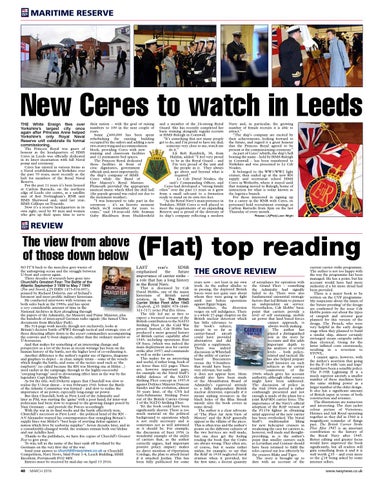
The Princess Royal was guest of honour as the headquarters of HMS Ceres in Leeds was officially dedicated in its latest incarnation with full Naval pomp and ceremony. Ceres has existed in various forms as a Naval establishment in Yorkshire over the past 70 years, most recently as the hub for members of the Royal Naval Reserve. For the past 11 years it’s been housed at Carlton Barracks, on the northern edge of Leeds city centre, as a satellite unit of first Nottingham’s RNR unit HMS Sherwood and, until last year, HMS Calliope on Tyneside. Now it’s a reserve headquarters in its own right, used by 80 men and women who give up their spare time to serve
their nation – with the goal of raising numbers to 100 in the next couple of years. Some £600,000 has been spent refurbishing the existing building occupied by the sailors and adding a new two-storey wing and accommodation block, providing Ceres with new training and classroom facilities and 12 permanent bed spaces. The Princess Royal dedicated those facilities in front of civic dignitaries, government officials and, most importantly, the ship’s company of HMS Ceres while the Band of Her Majesty’s Royal Marines Plymouth provided the appropriate nautical music which filled the drill hall (the parade ground was ruled out due to the inclement weather). “I was honoured to take part in the ceremony – it’s an historic moment which we’ll remember for years to come,” said 18-year-old Able Seaman Gaby Blackburn from Huddersfield
REVIEW
The view from above of those down below SO IT’S back to the merciless grey wastes of the unforgiving ocean and the struggle between U-boat and convoy again. Three decades of research have gone into Churchill’s Greatest Fear: The Battle of the Atlantic September 3 1939 to May 7 1945 (Pen and Sword, £25 ISBN 1473-834-007), penned by Richard Doherty, one of Ireland’s foremost and most prolific military historians. He conducted interviews with veterans on both sides back in the 1980s, and has spent a very considerable amount of time in the National Archives in Kew ploughing through the papers of the Admiralty, Air Ministry and Prime Minister, plus the hundreds of intercepted German radio signals (the famed Ultra documents from Bletchley Park). His 314-page work mostly, though not exclusively, looks at Britain’s decisive battle of WW2 through tactical and strategic eyes of those directing affairs down to the escort commanders accompanying the convoys and U-boat skippers, rather than the ordinary matelot or U-bootsmann. And that makes for something of an interesting change and perspective as a lot of the focus in recent writings has been on the human history of the battle, not the higher level of co-ordinating it. Another difference is the author’s regular use of figures, diagrams and graphics to depict – in clear, simple terms – some of the vessels which fought the battle, and some of the tactics used such as ‘the raspberry’ (so called because the RN was blowing one at Hitler...) used earlier in the campaign, through to the highly-successful ‘creeping barrage’ used to devastating effect later in the war by the legendary Capt Johnnie Walker. As for the title, well Doherty argues that Churchill was slow to realise the U-boat threat – it was February 1941 before the Battle of the Atlantic Committee was formed – and slow to realise the importance of air power, especially long-range air power. But then Churchill, both as First Lord of the Admiralty and later as PM, was starting the ‘game’ with a poor hand, for inter-war politicians had been slow to respond to the growing danger posed by Nazi Germany – and provide the Forces accordingly. With the war in its final weeks and the battle effectively won, Churchill’s successor as First Lord – the political head of the RN – A V Alexander warned his contemporaries that strangling Britain’s supply lines was Hitler’s “best hope of averting defeat against a nation which lives by seaborne supplies”. Seven decades later, and in a considerably-changed world, the sealanes remain both our lifeline and our Achilles heel. Thanks to the publishers, we have five copies of Churchill’s Greatest Fear to give away. To win, tell us the name of the liner sunk off Scotland by the Germans on the very first day of the war. Send your answer to churchill@navynews.co.uk or Churchill Competition, Navy News, Mail Point 1-4, Leach Building, HMS Excellent, Portsmouth PO2 8BY. Entries must be received by mid-day on April 13 2016. 40 : MARCH 2016
and a member of the 24-strong Royal Guard. She has recently completed her basic training alongside regular recruits at HMS Raleigh in Cornwall. “It’s something that not many people get to do, and I’m proud to have my dad, someone very close to me, watch me do it.” LS Rob Kendrick, 38, from Halifax, added: “I feel very proud to be in the Royal Guard – and I’m very proud of the unit and the people in it. They always go above and beyond what is required.” Lt Cdr David Noakes, the unit’s Commanding Officer, said Ceres had developed a “strong family ethos” over the past 11 years as it grew from a small sub-unit to a formation ready to stand on its own two feet. “As the Royal Navy’s main presence in Yorkshire, HMS Ceres is well placed to meet the requirements of an expanding Reserve and is proud of the diversity of its ship’s company reflecting a modern
Navy and, in particular, the growing number of female recruits it is able to attract.” “The ship’s company are excited by their achievements, looking forward to the future, and regard it a great honour that the Princess Royal agreed to be present at the commissioning ceremony.” As part of Ceres’ rebirth, the ship’s bell bearing the name – held by HMS Raleigh in Cornwall – has been transferred to Yorkshire and was presented to Lt Cdr Noakes. It belonged to the WW1/WW2 light cruiser, then ended up at the new RN supply and secretariat school HMS Ceres in Wetherby, where it stayed until that training moved to Raleigh, home of instruction for what is today known as the logistics branch. For those interested in signing up for a career in the RNR with Ceres, its personnel hold recruitment evenings at Carlton Barracks from 8pm on the last Thursday of every month. Pictures: LA(Phot) Luron Wright
(Flat) top reading Last year’s SDSR emphasised the future importance of carrier strike – a role that has a long history in the Royal Navy.
That is discussed by Cdr David Hobbs, one of the major historians of British naval aviation, in his The British Carrier Strike Fleet After 1945 (Seaforth, £35 ISBN 978-1848321-717) writes Prof Eric Grove. The title led me at first to expect a focussed account of the British contribution to the NATO Striking Fleet in the Cold War period. Instead, Cdr Hobbs has produced a more general history of British carrier capabilty after 1945, including operations East Of Suez, (which was indeed the main deployment area for carrier strike after 1957) and commando as well as strike carriers. This makes for an interesting and useful, if rather long, book of no fewer than 622 pages. There are, however important gaps, for example on the Naval Staff ’s skilful defence of the NATO Striking Fleet concept in 1957-8 against Defence Minister Duncan Sandys and the evolution, almost 30 years later, of the CVS led Anti-Submarine Striking Force out of the British Carrier Group 2 of the NATO Striking Fleet. Yet the book could have been significantly shorter. There is too much material on the political background to operations which is not really necessary and is sometimes not as well informed as it should be. For example, the discussion of Suez 1956 (a wonderful example of the utility of carriers that, as the author correctly argues, had important positive policy impact) makes no direct mention of Opertation Cordage, the plan to attack Israel if it attacked Jordan. This has been fully publicised for some
THE GROVE REVIEW years now – not least in my own work. As the author alludes to in passing, the deployed British forces were not quite sure about whom they were going to fight until just before operations against Egypt began. Sometimes, the diversion verges on self indulgence. There is a whole 27-page chapter on the British nuclear deterrent which has little relevance to the book’s subject, except in so far as carrier-based aircaft could have provided alternatives and did provide a supplement. There was indeed discussion in Whitehall of the utility of carrierbased Buccaneers versus the V-bombers that would have been very relevant, but sadly it does not appear here. More should also have been made of the Mountbatten Board of Admiralty’s equivocal attitude to a fully independent British nuclear deterrent, especially if it meant sinking resources in the black holes of the Blue Streak missile silos the book covers in some detail. The author is a clear advocate of ‘The Fleet Air Arm View of History’ and the RAF generally appear as the villains of the piece. This is often true and the author’s points on the different cultures of the two Services are well made, but one does get the feeling reading the book that the Crabs are always wrong. They often are, of course, but it seems rather unfair, for example, to say that the RAF in 1918 neglected naval aviation when it provided, for the first time, a decent quantity
of aeroplanes for operation with the Grand Fleet – something the Admiralty had signally failed to do. There were also fundamental existential strategic factors that led Britain to pioneer an independent air service. Nevertheless, Cdr Hobbs’ basic point that carriers provide a level of self sustaining, mobile air power that land based forces cannot approach, is always worth making. The author has played a distinguished role in the story he recounts and this adds important depth to his analyses at several levels – both policyrelated and tactical. He has also helped prepare staff histories on such subjects as the carrier controversy of the 1960s which gives his account authority, although other sources might have been addressed. The discussion of policy in the vital 1960s period is rather confusingly presented and not enough is made of the plans for a joint RAF/RN carrier force. The importance of the Navy’s official adoption of the RAF version of the P1154 fighter in obtaining intial approval of the new carrier has been overlooked. The Naval Staff’s traditionalist liking for new helicopter cruisers in weakening the case for carriers is, however, well made and thoughtprovoking, as is the author’s point that smaller carriers such as Leviathan and Centaur should have been retained to fulfil the roles carried out less effectivly by the cruisers Blake and Tiger. The story is brought up to date with an account of the
current carrier strike programme. The author is not too happy with the way the programme has been managed. He has a point, but his account would have had more authority if a bit more detail had been provided. There is a major book to be written on the CVF programme. My suspicions about the limits of the ‘future proofing’ of the design are confirmed by the issue Cdr Hobbs points out about the types of catapult and arrestor gear planned for this version of the design. The French, who were very helpful in the early design stage when they planned to build a similar ship, almost certainly envisaged steam catapults rather than electrical. Going for the latter inflated costs enormously, resulting in a reversion to STOVL. I cannot agree, however, with the author’s assertion that going for the F-18 with ‘cats and traps’ would have been a sensible policy. The F-35B Lightning II is a much superior aircraft; a smaller number of these machines have the same striking power as a larger number of the older design. It also has a significant amount of British input in terms of both construction and avionics. The illustrations are numerous and interesting. The dust jacket colour picture of Victorious, Hermes and Ark Royal operating together as they did in 1960 is a magnificent reminder of things past. The British Carrier Strike Fleet After 1945 is an imortant contribution to the history of the Royal Navy after 1945. Better editing and greater focus would have improved the book significantly, but all readers will gain something from it and it is well worth £35 – and even more so the £18 being asked by some internet sellers. www.navynews.co.uk