ss for Navy engineers Trophy tribute to founding father THE WE Branch are to award a new annual trophy to the individual who has made a significant achievement in weapon engineering excellence and technical advancement during the past year. The award, the Rear Admiral Bateson Trophy, sponsored by the Institute of Engineering and Technology, will be engraved with the winners’ names and retained at HMS Collingwood. Winners will also receive £300 cash and the competition is open to all officers and ratings in the WE General Service cadre. Rear Admiral Stuart Latham Bateson was the first Electrical Flag Officer in 1949. He joined the Royal Navy in 1916 and carried out his cadet training at Keyham College, followed by a midshipman year in HMS Marlborough. He then joined HMS Walpole and went to the Gulf of Finland in support of a raid on Kronstadt Harbour in 1919. While on the experimental staff of HMS Vernon, he was involved with mine development trials, including the conversion of submarine M3 into a minelayer and the alteration of the stern of the cruiser minelayer HMS Adventurer to make her capable of laying mines at high speed. He served at the Admiralty in the Directorate of Torpedoes and Mining before being appointed Fleet Torpedo Officer Mediterranean on the staff of Admiral Sir Dudley Pound. branch in network operation, administration and maintenance, meant boundaries between the two branches have become blurred. And so, as of April 1, the formal transfer of all warfare CIS and CISSM personnel into the Weapon Engineering Branch began. Today’s ET(WE)s train in a new building at HMS Collingwood. Rutherford Building – named after weapon engineer and former CO of the base Vice Admiral Malcolm Rutherford – was officially opened this month. “Now is a particularly exciting time to be a weapon engineer,” said Fleet Weapon Engineering Officer Cdr Ian Teideman. “Naval engineers, whether air, marine or weapon, have always been at the forefront of new technology. This is particularly true as a weapon engineer; The next generation of missile, Sea ’ceptor, is being fitted to our Type 23 frigates, Radar 997 gives us a very capable new sensor and the Queen Elizabethclass aircraft carriers have extensive network technology.” uring WW2 electrical training was not confined to one site but the need for a permanent home became quickly apparent as technology advanced. In 1939 the Admiralty had acquired Collingwood, 197 acres of farming landing, under a compulsory purchase order for £7,290 (more than £2 million by today’s standards). The land owner claimed that it was some of the finest cornland in the South of England but, in local opinion, it was much the best snipe marsh in the country. It was certainly wet and boggy and it took until the mid 1950s to clear sufficient water to allow the construction of anything better than a single-storey building or concrete prefab. Wireless telegraphy ratings started their training in June 1940, and a radio direction finding school was added in 1942. Most other training facilities from around
D
As the CO of HMS Latona he undertook a record-breaking journey from the Clyde to Alexandria via the Cape of Good Hope, completing the 15,258-mile journey in 31 days. From Alexandria, Latona made 12 successful runs to Tobruk in support of the Army, at times being obliged to unload some 150 tons of cargo in 55 minutes under air raid conditions and at night. On October 25 1941, while on her 13th run, she was sunk by what was believed to be the only successful night attack by a combined force of German and Italian bombers. After an appointment as Flag Captain to Rear Admiral Rawlings in HMS Ajax which, as a light cruiser, at one stage was the heaviest unit in the Mediterranean, owing to the severe losses sustained in the area, he became Naval Assistant to the Controller of the Navy involved in provisioning for the Pacific War. On September 3 1945, as the CO of HMS London, he received the surrender on board of the Japanese Forces at Sebang one day before the general surrender of Japan. On returning to the UK, Rear Admiral Bateson was appointed as a Captain to be the Director of the Naval Electrical Department and given the task of establishing the Electrical Branch. In 1949 his achievements were recognised with the creation of a new Naval rank and he became the first Electrical Flag Officer.
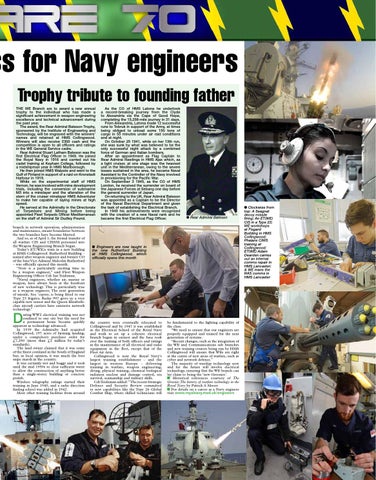
l Rear Admiral Bateson
l Engineers are now taught in the new Rutherford Building at HMS Collingwood, which officially opens this month
the country were eventually relocated to Collingwood and by 1947 it was established as the Electrical School of the Royal Navy and work to set up a cohesive electrical branch began in earnest and the base took over the training of both officers and ratings in the maintenance of all electrical and radio equipment in the fleet, except that of the Fleet Air Arm. Collingwood is now the Royal Navy’s largest training establishment – and the largest in western Europe – delivering training in warfare, weapon engineering, diving, physical training, chemical biological radiation nuclear and damage control, sea survival, seamanship and military skills. Cdr Teideman added: ”The recent Strategic Defence and Security Review committed to new capabilities like the Type 26 Global Combat Ship, where skilled technicians will
be fundamental to the fighting capability of the class. “We need to ensure that our engineers are properly equipped and trained for the next generation of systems. “Recent changes, such as the integration of the WE and Communications sub branches and new training courses being run by HMS Collingwood will ensure that WEs are right at the centre of new areas of warfare, such as cyber and network defence.” The majority of warship technology now and for the future will involve electrical technology, ensuring that the WE branch can lay claim to being the ‘new Greenies’. n Historical references courtesy of The Greenie: The history of warfare technology in the Royal Navy by Patrick A Moore n For details on a career as a Navy engineer visit www.royalnavy.mod.uk/engineers
l Clockwise from top: A Seagnat decoy missile firing; An ET(WE) CIS in a Type 23; WE workshops at Fisgard Building in HMS Collingwood; Phalanx CIWS training at Collingwood; ET(WE) Adam Dearden carries out an internal comms repair in HMS Lancaster; A WE mans the RAS comms in HMS Lancaster