JULY 2014
BACK TO THE FUTURE
l A UK F-35B jet taxis at Eglin Air Force Base in Florida, where a team of RN and RAF pilots and engineers are learning how to operate the stealth fighter which will fly from the Queen Elizabeth-class aircraft carriers. See pages 2, 3 and 4
Picture: Sgt Pete Mobbs, RAF
07 07 9 770028 167160 Off-sale date: August 1, 2014 9 770028 167160
ÂŁ2.80
The Shade of T A
T a thundering 152 decibels it is louder than a commercial jet, a pneumatic drill and a rock concert; It looks incredibly forbidding; its stealth skin gives it a ‘50 shades of grey’ appearance. It’s packed with computer systems. It’s a jump jet but not as we know it. It heralds a golden future for the Fleet Air Arm. Meet the F-35B Lightning II fifthgeneration strike fighter which will fly off the Queen Elizabeth-class carriers. Lightning II marks the return of fixedwing aircraft to the Royal Navy after the Sea Harrier was retired in 2010. Before that can happen – around 20182020 – the jet is being put through its paces thousands of miles away in the USA. Lightning II will be flown and maintained by both RN and RAF personnel with both services making up the first F-35B squadron, 617 RAF and eventually 809 NAS, which will also be RN/RAF. A pioneering team from both Services has just completed a key stage of the programme at Eglin Air Force Base on the Emerald Coast, a popular Sunshine State holiday destination thanks to blue skies, scorching sun and sugar-white sandy beaches. For the past 18 months the UK team has been fully embedded into the United States Marine Corps Fighter Attack training squadron – VMFAT-501, but thankfully nicknamed the Warlords – as the UK and USA pilots and engineers learn what makes Lightning II tick. RN instructor pilot Lt Cdr Ian ‘Tidders’ Tidball is one of three UK pilots who have flown the F-35B and will be passing on his experience to a future generation of British and American aviators. “The Lightning is a really great airplane to fly. I’ve flown both the Sea Harrier and the F-18 Super Hornet and without a doubt this is the most enjoyable aircraft I’ve flown in my career,” he said. As one of the Fleet Air Arm’s most seasoned pilots, Lt Cdr Tidball, who grew up in Weston, Somerset, took part in the very last Sea Harrier fly-past when 801 NAS paid off in March 2006. After initial training as a Commando
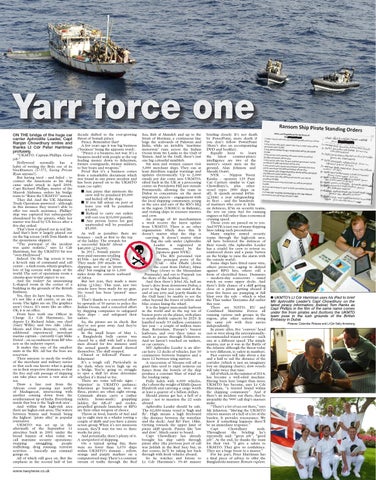
WITH all eyes on the naming of HMS Queen Elizabeth this month, Royal Navy personnel have completed a key stage of the training programme for the stealth jets which will fly off the carrier. Lorraine Proudlock joined them at Eglin Air Force Base in Florida.
Sea King pilot, he switched to Sea Harriers, clocking up over 1,300 hours in the fabled jump jet with all three Fleet Air Arm squadrons (800, 801 and 899) from all three ‘Harrier carriers’ (Invincible, Illustrious and Ark Royal). “The future is bright without a doubt. This aeroplane will be fantastic. I cannot wait until I see it on the deck of the Queen Elizabeth-class carriers going operational in about 2020. “I am hoping to see the F-35B i n t o service. The first-of-class flight trials will take place in 2018 and I hope to be involved in that team in one way or another.” Lt Cdr Tidball, whose first flight in Lightning was on April 10 2013 – his wedding anniversary – is full of praise for the jet. “The great thing about this is the sense of fusion it brings. Obviously it has fifthgeneration stealth capability but the sense of fusion means that information displayed to the pilot is all fused together,” said Lt Cdr Tidball, whose name appears on 501’s sixth F-35B. “So rather than a legacy aircraft where one’s looking at different screens of radar information and electronic warfare information, this is fused so that the pilot has one overall picture which obviously decreases his workload, enabling him to deploy the aircraft in a more effective manner. “I had the idea of wanting to end up in this programme when I left the Sea Harrier and was fortunate enough to get an exchange with the US Navy out in China Lake, California, where I flew the
Super Hornet, conducting operational tests, so coming on the F-35 and flying in operational tests was an obvious step for me – one I clearly aspired to and have been lucky enough to do.” The Tidball family – wife Kirstie and sons Sam, 17, Matt, 15, and Ben, 12 – are USA veterans as prior to the Eglin deployment Lt Cdr Tidball spent 18 months at Edwards AFB working with the Joint Operational Test Team. “They’ve certainly enjoyed the American way of life, they have fully embraced the opportunities that have been offered to them – they even have American accents now.” Lt Cdr Tidball, 45 this month, was attending the naming of the HMS Queen Elizabeth at Rosyth before returning to the USA and setting up a new home in the Golden State of California. He will be a member of 17 Test and Evaulation Squadron, the forerunner of 617, at Edwards Air Force Base – and that is where the real fun begins. The CO of 17 Sqn, Wg Cdr Jim Beck, who had his first flight in Lightning at the end of May, can’t wait to get his family – wife Amy and children Charlotte, seven, and Oliver, five – settled in California and get to work. “Lightning is absolutely incredible, it’s just a completely different aircraft,” said the 38-year-old from Cambridgeshire. “For someone like me with a Tornado background, it flies itself pretty much and you just tell it what you want it to do. “It’s such a remarkable change for everything we do day to day – for not just ourselves in combat air but for the Royal
l Top: CPOAET Ihsaan Aokal stands by to remove the chocks l Above: Cpl Scott Warnaby helps Sqn Ldr Frankie Bulcher prepare for his flight l Below: Some of the UK team at Eglin. From left, Cpl Scott Warnaby, Sqn Ldr Frankie Bulcher, LAET Martin Williams, Wg Cdr Jim Beck, CPOAET Ihsaan Aokal, Wg Cdr Jon Millington, LAET Chris Gaskin and Lt Cdr Ian Tidball
2
: JULY 2014
www.navynews.co.uk
Things to Come Navy, the Army, the RAF.” One of the most amazing pieces of technology is in the £400,000-plus pilot helmet. A system combines feeds from six infrared digital cameras located around the aircraft and other sensors – like radar – into a seamless 360˚ panorama, all in real time. The view for the pilots makes the F-35 completely invisible – look down and all you can see is the ground. “There’s so much autonomy and so much more information that the pilot can see, control and assist and the sheer depth that you give to each role,” said Wg Cdr Beck. “So, for example, in reconnaissance, we are seeing sensors that you never imagined existed years ago and in combat, the air-to-air arena, it’s stealthy so it’s a feather in our cap. “It’s the depth, the multitude of sensors on this aircraft which doesn’t exist in anything else. In fact it combines a whole array of them. “In the air-to-air environment its stealthy technology changes how we do everything day to day. “The programme at the moment acknowledges very experienced operators, selected for their historical capability, so it’s proven test pilots or weapon instructors or people with many thousands of hours who it’s geared to.” he UK team has so far taken delivery T of three F-35Bs – a single-engine short takeoff/vertical landing (STOVL) variant –
named BK-1, BK-2 and, you’ve guessed it... BK-3. A fourth is on order while orders for further aircraft have yet to be announced. A number of UK firms produce components for the F-35, which are assembled at Lockheed Martin’s Fort Worth base in Texas. From an initial one flight a day, F-35s are now flying almost continuously at Eglin. Novel experiences dealing with a new aircraft have included hot-pit refuelling, a procedure usually carried out in combat
www.navynews.co.uk
situations to rapidly refuel aircraft while their engines are running – just like a pitstop in Formula 1 racing. Wg Cdr Beck added: “The programme is enormous, it’s probably the biggest military programme that’s ever existed in the world, with a multitude of different nations; there’s a lot of input but as such there’s a lot of people wanting a lot of capability out of it so it’s a case of managing those aspirations but also looking at what this is going to deliver in 2018-2020 and really focusing on that future date. “I hope to fly off the HMS Queen Elizabeth. I’ll be quite upset if I don’t!” Also heading to Edwards is Sqn Ldr Frankie Bulcher, who has more than 170 hours of F-35B flying under his belt. “Flying the F-35B is not unlike flying the Typhoon from a handling perspective. It’s very manoeuvrable, very powerful as it’s got a lot of thrust – 40,000lb of thrust – but where the aircraft comes into its own is from the missions systems perspective,” said the 36-year-old. “It’s much more advanced than the previous aircraft I’ve flown in terms of what you can do in the cockpit on missions systems. But from a purely handling perspective it’s a joy to fly. “It’s very simple – the aircraft is always looking out for you. It doesn’t take long to learn how to fly it but the difficulty is operating all the mission systems, the sensors etc.” Sqn Ldr Bulcher, who has been joined in the USA by wife Rachel and daughters Josie, five, and Charlotte, two, admitted he didn’t initially think the F-35B would be an option for his career. “I never even considered flying the Lightning until shortly before the opportunity arose. To me it was something that was so far in the future you always assume you’re not going to be involved in something like that. “So to actually finding out that I had the opportunity to come out here to coming out here was three to four months and I didn’t have much time to think about it. “I think in the UK the public don’t realise
how close this aircraft is to coming over to the UK and being based there. It is a reality – we are flying every day, flying hundreds of hours a month with both the US and UK flying together. Being part of this is very exciting and I feel very privileged. “Bearing in mind we were flying one aircraft the day I first arrived, the slow build up to be flying ten aircraft in the same formation on the same day is probably the flying highlight for me so far.” nabling the pilots to have an ‘easy’ job E in the skies at the huge air base – it covers more than 700 square miles and the runway is shared with Fort Walton Regional Airport – is a small team of UK engineers, led by WO2 Martin Fairfield and CPOAET Ihsaan ‘Ish’ Aokal, the avionics manager for the UK maintainers. “The main objective for me is to ensure the guys are getting the necessary training they need for operational tests, ensuring they understand the systems on the aircraft. So when we move to operational tests they will have a fair idea of some of the problems which may come up so they are prepared for that,” Ish said. “The technology is exciting but equally perplexing. There’s a lot to get your head round. I certainly feel we have only touched the surface as to what’s involved with this aircraft. We still have a great deal to learn about it, that presents quite a challenge. “Working on the F-35B was something that was definitely on my radar for a number of years. I was previously on the Harrier circuit and enjoyed working on fixed-wing aircraft. The opportunity to do so ceased in 2010, so when I was selected to be involved in this programme I was obviously delighted. “To be involved in the introduction of fixed-wing aircraft for the Navy was something I was excited about and am still excited about.” Excitement has come in spades for the RN man, as wife Hebah gave birth to the couple’s twins Kareem and Raya a year ago. The couple also have a three-year-old son Zaid. h Continued overleaf
l Main Image: One of the UK's F-35Bs at Eglin Air Force Base in Florida l Top: Sunrise at Eglin with BK-2 in its canopy l Above: LAET Martin Williams prepares BK-2 ahead of a flight l Below: Lt Cdr Ian Tidball in front of BK-2 at Eglin Pictures: Sgt Pete Mobbs, RAF
JULY 2014 :
3
l BK-2 roars into the Florida sky
The Shade of Things to Come
Pictures: Sgt Pete Mobbs, RAF
h Continued from page 3 “Acquiring a couple of American citizens made our expectations out here change completely,” he said. The 37-year-old, who hails from Shrewsbury, believes it’s a fantastic time for Naval engineers. “I’ve been in the Navy for 16 years and we’re now entering a phase of Fleet Air Arm aviation which is on the cusp of delivering fixed-wing aircraft to the Royal Navy – that carrier capability. “Anyone thinking of joining now who has an interest in fixed-wing aircraft – just look at what you can potentially be involved in. “I envy those who join now. They are essentially going to embark on a period of their career when they are working on this great project.” LAET Chris Gaskin, 31, from Croydon, agrees: “Lightning is great to work on. It’s a challenge because so much is under its skin. “It’s a fantastic opportunity to work on a fifth-generation aircraft that no-one else has worked on. Not many of us have worked on the stealth side of things either so it’s a great feeling to be part of this. As soon as I joined up I wanted to work on F-35s.” LAET Gaskin, who has also worked on Merlin helicopters, will shortly move his family, wife Sarah and sons Kieran, seven, and Liam, four, to California. “We’ve settled in the USA really well and are looking forward to a new challenge in California. We will be taking a week-long road trip to get there – it’s a great opportunity to see the US,” he said. LAET Gaskin, who joined the RN in 2007, added: “It’s a fantastic time to join the Royal Navy. A brand-new aircraft going on the new Queen Elizabeth-class carriers. We’ll be sailing the world I imagine, seeing lots of places and working on fifth-generation aircraft. It’s a brilliant aircraft.”
Also heading west is colleague LAET Martin Williams, along with wife Louise and their three-year-old son Toby. “I love the F35. I was a Harrier man before. I chose to work on the Harriers as eventually I wanted to work on the F-35s. Underneath its skin it’s like any other aircraft to be honest.” The 30-year-old from Leicester has enjoyed working with the US Marines. “They are really good fun, there’s a lot of banter. We’ve been working really well together,” said LH Williams, who joined the Senior Service in 2003. “I enjoy working on the Lightning very much – it’s hi-tech which makes it more interesting. “I’m in my 11th year of being a Royal Navy engineer and I’ve not got any regrets. If I had my time again I’d do it all the same way.” RAF Cpl Scott Warnaby is also destined for Edwards. “I think working on the Lightning is most engineers’ dream job. It’s such an
advanced aircraft in every form. It’s a wonderful aircraft to work on. The 36-year-old Brummie added: “The stealth technology is exciting to work on because its a new field for us British guys. “The computer systems are quite advanced and a lot of them are under stealth panels. To get to those panels you have to remove the stealth material and then, when fixed, put the aircraft back into stealth configuration. “My best memory working on the F-35 so far is when BK-2 turned up and I was on the initial team who saw the aircraft in and did the initial service when it came from the factory.” The Warnaby family will swell to four shortly as wife Shaunna awaits the birth of their second child. They have a daughter, Beth, aged four. “I think they have taken to life over here very well. My daughter was two when we came her and she now sounds American with a real southern twang to her accent.” The newest UK arrivals at
l A UK pilot in an American F-35B perfects his vertical landing skills over the hover pad Eglin include RAF Sgt David Aikens, 42, and Cpl Daniel Woodward, 37, who have completed their initial weapons training course for the jet. They will now move to the US Marine Corps base at Beaufort in South Carolina to be embedded in VMFAT-501. Cpl Woodward, from Oxfordshire, said: “The training course included the computer system used to support the aircraft and also the ordnance
l Engineers carry out a hot-pit refuel of BK-2 at Eglin Air Force Base
Your chance to see new jet THE F-35B makes its debut in the UK this month with appearances at the Royal International Air Tattoo and the Farnborough International Air Show. Instructor pilot Sqn Ldr Hugh Nichols (pictured left) will be in the cockpit of the UK plane as it makes a fly-past. “Lightning is fantastic to fly,” he said. “It’s obviously very different from legacy aircraft, but the handling is fantastic. “The way it’s been designed, the ability to amass information means you expend a lot less of your brain power. You are able to help others out.” Three F-35Bs – one British, two US Marine Corps – were due to fly to the UK for their first overseas appearance. In March this year Sqn Ldr
Nichols became the first UK instructor pilot to undertake a short take-off and vertical landing in an F-35B. Sqn Ldr Nichol’s wife Caroline and their 18-month-old daughter Adrianna was joining other family members at both air shows. The 35-year-old Londonborn pilot is part of a USMC exchange programme and will remain with the Warlords as they move from Eglin to its permanent base at MCAS Beaufort in South Carolina this summer. RIAT takes place at RAF Fairford in Gloucestershire from July 11-13, followed by Farnborough Air Show on July 14-20; the first four days of the latter are for the aviation and military industry, with the final two days open to the public.
loading and unloading, the weapons bays etc. “The programme is looking very good at the moment. In the short space of time I’ve spent looking at it, it’s looking very good.” Cpl Woodward, who will relocate to the USA with wife Gemma and their six-monthsold daughter Charlotte, has never worked on jets before. “My background is support helicopters and air transport,
Picture: Sqn Ldr Nikki Lofthouse
among other things. In all honesty I hadn’t heard much about the Lightning programme before I came out here. “I’ve been lucky enough to visit the States before but this will be my first long deployment.” Sgt Aikens added: “Lightning was an opportunity that came up as I neared the end of my last job and it’s one I didn’t want to miss. “I’ve been across here quite a few times on detachment and I am looking forward to spending the next three years of my life in America.” hile Eglin bids farewell to W the UK personnel, one Brit will only move to the other side
of the base’s runway. Wg Cdr Jon Millington, 46, is the UK Senior National Representative and will be working with the 53rd Electronic Warefare Group setting up a laboratory to analyse data from the F-35Bs. “The aircraft is the future. There’s clearly some longevity in this programme. It’s an exciting opportunity and its great to be involved at such an early stage. “My most memorable moment out here has probably got to be every time I’ve seen the guys do their first flight. “Watching them go out after the training and preparation they’ve done in the academic training centre, the simulators, then to get out there and fly their first mission, it’s great.” The UK families’ American dream continues until 2018 at the earliest when 17TES – which saw the Tornado into service – stands up as 617 ‘Dambusters’ squadron and heads for its permanent home at RAF Marham in Norfolk, where the equally-historic Naval squadron 809 will also be stood up. Anyone in the area will certainly hear them when the Lightning II jets arrive.
Compared with Sea Harrier FRS1 WEAPONS LOAD 15,000lbs 4,000lbs
SPEED 1,200mph 740mph
COMBAT RADIUS Strike - 470nm Strike - 250nm
Special souvenir poster of HMS Queen Elizabeth – see pages 23-26 4
: JULY 2014
www.navynews.co.uk
GLOBAL REACH
picture: la(phot) joel rouse
Tireless, but alas not endless
THE Silent Service’s longest-serving submarine has completed her final patrol after 29 years on the front line.
Early in the evening on the first day of June 2014 the T-boat was shepherded past Drake’s Island by tugs Forceful and Careful to make her way up the Hamoaze one last time. A crowd of about 50 friends and family gathered on the jetty to welcome home loved ones who – unusually for their Service and Tireless in particular – enjoyed international publicity in the final weeks of the boat’s life. Some Trafalgar-class boats – of which there will be four of the original seven in commission by the end of June once Tireless formally pays off – have carried out missions in the public eye. And some, like Tireless, have kept very much under the radar due to the nature of the ops they were asked to perform. She did pop up at the North Pole three times (1991, 2004 and 2006). And she also completed the longest deployment by a Royal Navy hunter-killer (ten months in 2010-11 – surpassed last year by Trenchant’s marathon 11-month mission east of Suez). And that’s about all we can tell you about what she did… for as a Cold War warrior she spent much of her early years searching for and stalking adversaries. Try the National Archives in a good 50 years’ time and you might find out more...
Her final, east of Suez deployment was equally stealthy, until Tireless was diverted to use her sonar to help in the search for the missing Malaysian airliner in company with HMS Echo and a flotilla of vessels from around the world. The search continues – although minus the two HM Ships. Among those in the sonar room helping with that search, PO Mike Hyde – in his 11th and final year on Tireless, having risen from the rank of AB. “I have made friends for life on Tireless and sadly lost some very good shipmates as well. So it was with immense pride, tinged with sadness, that I sailed into Devonport with Tireless on her final voyage before she decommissions,” he said. “The professionalism and dedication of the countless members of the ship’s company I have served with is a credit to the Royal Navy Submarine Service.” ‘Scratcher’(coxswain’s mate) LS Nick Ingledew, aged 25, has spent the past eight years in Tireless, from trainee deep to veteran, now with more than 1,200 sea days aboard the boat under his belt – from the Pole to the Gulf to the Med to Australia to home waters. “I have enjoyed some great trips ashore including Goa, Dubai, Gibraltar and Perth. Sailing up river for the last time as the final scratcher on Tireless is a moment of mixed emotions – one of happiness at seeing my wife Tanita and daughter Chloe
THE Navy’s ultimate shield against air attack could be the nation’s ultimate shield against Armageddon after HMS Daring proved the Type 45 destroyer can track – and intercept – ballistic missiles. The state-of-the-art warship followed not one but two incoming medium range ballistic missiles – weapons with a range of up to 3,000 kilometres which climb into space before plunging back down on to their targets on earth – during trials in the middle of the Pacific. Several hundred miles off the US Missile Defence Agency’s Reagan Test Facility in the Kwajalein Atoll in the Marshall Islands – 2,500 miles from Hawaii and more than 3,000 miles from Sydney – Daring and the American destroyer USS Decatur waited for the targets to be launched. And once they were Daring’s Sampson radar – the ‘spinning spiked egg’ atop her main mast – tracked the flight of the incoming
missiles to a point where they could potentially be intercepted. The ship – and her five sisters – were designed to protect the Fleet against conventional missile and aerial threats. The 45s can track hundreds of targets at ranges up to 400km (250 miles), before launching Sea Viper missiles to knock the threats out of the sky as far away as 70 miles from the ship. As part of the trials in the Pacific – carried out in September last year during the destroyer’s global deployment, but for security reasons the success has only been announced now – experts made changes to both the radar and Sea Viper command system to test the ability of Daring to defend against short and medium-range ballistic missiles. The team behind the trials say those trials “exceeded all expectations”, with reams of crucial data gathered by the destroyer’s impressive array of sensors for analysis by experts back in the UK.
again, but also one of great sadness as this will be the end of a big chapter of my life that was Tireless. “It has been an honour and given me great pride to serve on Tireless for the past eight years. She has always been a happy boat and will be missed by all who have served on her.’’ Another Tireless veteran is PO
Dave Helyer, a radio supervisor, who joined her as an able seaman in 2003: “Tireless is known for its professional approach to operations and it gives me great pride to have been able to serve on her for so many years. It’s a sad day bringing her back for the last time – but it has provided me with many happy memories I will never forget.”
For Tireless’ Commanding Officer Cdr Hywel Griffiths, the unexpected, but high-profile, search for the missing Malaysian jet was proof that right until the very end the submarine was at the very forefront of Silent Service operations; his boat has rarely been at home for the past 11 months, such has she been in demand.
“It was with immense pride that I brought HMS Tireless into Plymouth for the final time. “Although a sad day, Tireless has achieved much in her nearly 30-year career. But now she gives way to the modern and worldbeating capability represented by the Astute class – she will be replaced in the Naval arsenal by HMS Artful.”
EE, it’s busy in the survey world BOLDLY going yet again is the star ship of the Royal Navy’s surveying flotilla. HMS Enterprise has left Devonport to begin an 18-month scientific mission, ultimately taking over from her sister Echo. Enterprise will start data gathering in the Bay of Biscay – hopefully the weather gods will be kind and the 50 crew won’t have to Klingon for dear life – before moving on to the Mediterranean, Red Sea and finally Gulf. All the information gathered will be fed back to the UK Hydrographic Office in Taunton to update the navigational charts used by the RN and merchant shipping to safely guide them through the Seven Seas. Having spent much of the past six months dealing with simulated war and damage
scenarios dreamed up by the team at FOST, some of the crew have been itching to head off on deployment and do the job for real. “I couldn’t wait to go,” said AB(HM) Donna Harrison from Hebburn in Tyneside, embarking on her first deployment. “I’ve wanted to be in the Royal Navy since I was 13 and now have the chance to put all my training to good use. The separation from my partner will be hard but I am very lucky – he is massively supportive of me and my career; this is my dream job.” Like Echo before her, Enterprise will be sustained on her mission by rotating one third of her ship’s company every few weeks. Meanwhile HMS Echo hosted Defence Secretary Philip Hammond as the ship
continued her long voyage back from the west coast of Australia following her hunt for the missing Malaysian airliner MH370. The minister came aboard at Sembawang in Singapore, where the ship’s company explained their part in the search and some of the state-of-the-art sonar and hydrographic surveying equipment which was used. Echo’s CO Cdr Phillip Newell said Mr Hammond’s visit – and his gratitude for the sailors’ efforts – “further instilled in them the pride which they all have for our part in the search.” Mr Hammond said the work of Echo and HMS Tireless “demonstrated the Royal Navy’s reach and Britain’s willingness to help its friends in times of need.
Super-calibration-fixing Daring goes ballistic
www.navynews.co.uk
Men and women of the Royal Navy and Royal Marines serve their country, often at times of danger. Established in 1922, the RNBT helps non-commissioned Sailors, Marines and their families (The RNBT Family) throughout their lives. Your donation will help us to help them. The Royal Naval Benevolent Trust, Castaway House, 311 Twyford Avenue, PoRTsmouTH, Hampshire, Po2 8RN T: 02392 690112 F: 02392 660852 E: rnbt@rnbt.org.uk www.rnbt.org.uk JULY 2014 :
5
GLOBAL REACH
HMS Montrose
Gibraltar Squadron HMS Defender
HMS Blyth
HMS Diamond
854 NAS/FDG/1710 NAS 815 NAS
HMS Penzance HMS Chiddingfold
HMS Protector UKMCC HMS Somerset HMS Northumberland HMS Quorn HMS Atherstone HMS Shoreham HMS Ramsey MASF
HMS Portland Training or on patrol around the UK HMS Dragon HMS Mersey HMS Lancaster HMS Tyne HMS St Albans HMS Severn
FASLANE HMS Gannet
YEOVILTON DEVONPORT PORTSMOUTH CULDROSE HMS Illustrious HMS Westminster 820 NAS
HMS Bulwark HMS Richmond HMS Ledbury
FLEET FOCUS Protecting our nation’s interests
THE future of the Royal Navy is a strong theme this month – with the highlight being the naming of the HMS Queen Elizabeth aircraft carrier by the Queen (see page 15). You can study some amazing facts about the new leviathan with our pull-out poster (see centre pages). Thousands of miles away from Rosyth, a group of Royal Navy personnel are in the USA working on the F-35B Lightning II fifth-generation strike fighter which will fly off the carrier (see pages 2, 3 and 4). Back to the UK, and in Cornwall, where RNAS Culdrose is adopting a ‘carrier mentality’ as it trains pilots, observers and deck handlers (see pages 14 and 15). Merlin Mk2s will also fly from HMS Queen Elizabeth and nine of them landed on the flight deck of HMS Illustrious for Exercise Deep Blue (see page 9). While the Senior Service prepares for the future, it is business as usual on operational fronts, as HMS Somerset adds to her haul of drug busts during her six-month deployment east of Suez (see right). Also playing a key role in tracking drugs – as well as insurgents – are Sea Kings from the Airborne Surveillance and Control force, which have marked five years as the UK forces’ eyes in the skies of Afghanistan (see page 8) . HMS Montrose has joined 29 vessels from 14 nations for a major ten-day exercise in the Baltic (see page 8), while minehunter HMS Blyth joined a NATO task group off Italy for a mine exercise (see page 14). The fifth of the Royal Navy’s Type 45s, HMS Defender, has made her first appearance in Gibraltar on her maiden deployment from Portsmouth to the Gulf (see page 7). Also Bahrain-bound are HMS Chiddingfold, who will relieve HMS Quorn and HMS Penzance, who will relieve HMS Shoreham (see page 14). Still in the Gulf, one of the smallest units in the Royal Navy, the UK Maritime Trade Operation, based in Dubai, is helping to protect merchant vessels against pirates (see page 37). Commemoration was also a key theme last month as the Royal Naval Association held its annual meeting and unveiled its ‘gift’ to the Naval Service – a memorial for all sailors, past, present and future. Thousands gathered for the dedication of the striking glass and stone Naval Service Memorial at the National Memorial Arboretum (see pages 32 and 33). HMS Portland and Clyde played major roles commemorating those who died in the Falklands conflict in 1982 as islanders marked Liberation Day (see page 10). At the beginning of the month all eyes were on Portsmouth and Normandy for the 70th anniversary of the D-Day landings (see pages 22 and 27). The Royal Marines’ 1664 Challenge has reached its final phase, with a run around the UK, culminating in a marathon in London this month (see page 20). As part of the Corps’ 350th anniversary celebrations Royal Marines have taken over the historic duty of ceremonially guarding the Royal Family – for only the fourth time in the past 100 years (see page 16). More than 150 green berets from 40 Commando have been on exercises on Salisbury Plain as part of their preparations for the annual Cougar deployment later this year (see page 17). Finally, the White Ensign flies again on the wreck of HMS Repulse, sunk in the South China Sea by the Japanese 73 years ago, after divers fulfilled the wishes of the survivors’ association (see page 40).
navy news : JULY 2014
Naval Party 1022 HMS Echo
ROSYTH
40 Cdo 42 Cdo
6
MCM 3 CTF 151 RFA Cardigan Bay RFA Fort Austin RFA Diligence Naval Party 1023 814 NAS
n www.navynews.co.uk
HMS Clyde RFA Black Rover
Plus one strategic missile and undisclosed Fleet submarines on patrol somewhere beneath the Seven Seas
This map is a depiction of many, though not all, of the Royal Navy’s commitments over the past month
DRUG smugglers lower a ladder for a Royal Marines boarding team – realising they are not going to escape from two RIBs, one Lynx Mk8 and a Type 23 frigate in the form of HMS Somerset.
But this moment was only the end of the beginning for the sailors and commandos – there were another 23 hours to go, toiling in squalid conditions until they finally found what they were looking for: nearly 60kg of heroin, worth £8.5m on the streets of the UK. The fishing dhow’s progress had been monitored by the Devonport-based frigate through the northern Arabian Sea before she launched her helicopter to take a closer look. It remained overhead as the green (RM) and blue (RN) boarding teams closed to intercept. The contraband was finally found stashed under a false deck. It was brought back to Somerset, tested for purity, then destroyed. “Boarding is very unpredictable by its nature as you simply do not know what you will be faced with,” said Capt Steve Taylor RM, in charge of the 43 Cdo Fleet Protection Group team aboard Somerset. “The length of time it took to get this result makes the discovery even sweeter and this was a genuine whole-ship effort.
This was an example of HMS Somerset operating at her very best and achieving excellent results.” The frigate’s Commanding Officer Cdr Mike Smith added: “This is a great example of what the Royal Navy does best. “Full-hearted commitment to the task, courage and team work were central to halting this shipment of illegal narcotics. “I am incredibly proud of what my team have achieved, not only on this day, but for their efforts throughout the last five months of operations in the Middle East.” Somerset’s bust was the ninth heroin seizure of 2014 by the international naval group dedicated to stopping such illegal activity in the region, Combined Task Force 150, led by the RN’s Cdre Jeremy Blunden. The bulk of the recent busts have been carried out by HMAS Darwin – responsible for five busts in five weeks, including the biggest ever haul of heroin seized on the Seven Seas, bringing her total haul of narcotics to over £230m. In a brief pause in that ceaseless operation, Darwin and Somerset joined up allowing the boarding teams from both to discuss the best methods for tackling the narcotics problem – and some of the tricks used by smugglers to hide their illegal transport. Eleven sailors from HMAS Darwin
headed to the Type 23, while nine of Somerset’s commandos headed in the opposite direction. In addition the command team from the Darwin met their opposite numbers aboard Somerset. “Working closely with our task force partners and understanding how we each do business is fundamental to continuing our success in combatting illegal drug movement across the Indian Ocean,” said Cdr Smith. “As single ships we can be successful, but by working together we will make a real difference in this region.” Darwin’s Operations Officer Lt Cdr Barton Harrington added: “The crossdeck meeting presented the opportunity to exchange ideas about boardings at a tactical level. It was a highly beneficial meeting.” While ten years apart in age – HMS Somerset at 20 is the younger – the two warships have much in common; they are roughly the same size, have similar abilities and roles and are crewed by similar numbers of personnel. They’re also both celebrating their birthdays in the next few weeks. HMS Somerset is now just about home – she returns to Devonport on July 4 having handed over east of Suez duties to her sister Northumberland. Picture: LA(Phot) Nicky Wilson, HMS Somerset
Somerset’s sweet reward n NEWSDESK 023 9262 5255
n ADVERTISING 023 9254 7111
n BUSINESS 023 9254 7380 www.navynews.co.uk
GLOBAL REACH Picture: PO Barry Purdue, HMS Defender
Defending the Rock
ICONIC ship. Iconic backdrop. HMS Defender patrols in the shadow of the Rock as the fifth of the Royal Navy’s six Type 45 destroyers makes her debut in Gibraltar. The small British territory and its naval base was the first port of call for the Portsmouth-based destroyer, 1,000 miles into her 7,500-mile journey from the Solent to the Gulf as she began her maiden operational deployment. On the eve of her arrival, the ship’s padre, Rev Mike Meachin, led a service of remembrance on the sprawling flight deck as Defender took time to pause and remember all those involved in the D-Day landings 70 years ago. As the destroyer neared Gibraltar, she was met by RN Gibraltar Squadron patrol boat HMS Scimitar – carrying Gib’s First Minister Fabian Picardo – to escort her safely into the naval base. Alongside in the shadow of Gibraltar’s famous Tower, headquarters of British forces on the Rock, the destroyer opened her gangway to the public. More than 1,700 Gibraltarians – that’s one in every 17 inhabitants of the territory – took
advantage of Defender’s hospitality to look around, enjoying displays ranging from the embarked Royal Marines boarding team, to fire-fighting and damage control, sea boats and gun systems. Not least among those visitors were Mr Picardo and Gibraltar’s Governor, Lt Gen Sir Jim Dutton; the latter praised “the warm reception” he and his wife Liz received from Defender’s sailors. “She is,” Gen Dutton told the complement, “a superb ship and we wish Commander Nash and his whole team a successful deployment and a safe onward journey.” The short stop-off did allow for those of a sporting persuasion to stretch their legs. Defender’s football team had the privilege of a training session with the Gibraltarian national squad. And many members of the ship’s company followed in the footsteps of most other Royal Navy ships before them by participating in the traditional early morning ‘rock race’ to the top of the mountain which gives Gibraltar its nickname. There was a vast array of elaborate fancy-dress costumes, as well as those like Lt Cdr Pete Birch,
the ship’s principal air war officer, who took it seriously. “I’m made up to have won the rock race, particularly ahead of younger members of the ship’s company – including the Royal Marines and the club swinger,” he said. HMS Defender’s visit also provided the rare opportunity to engage in training with the Gibraltar Squadron. With the training done, it was time to continue eastwards through the Med. “My ship’s company have worked extremely hard to ready the ship for this operational deployment and visiting historic Gibraltar as our first stop is a fitting way to begin,” said Cdr Phil Nash, Defender’s CO. “It was great to see so many members of the public visit the ship to show their support and see the extensive capability which HMS Defender brings. We now look forward to continuing our deployment and engaging with our key coalition partners to provide maritime security in the Middle East.”
Six more for T26 SIX more contractors have climbed on board the project to design the Royal Navy’s next-generation warship. BAE Systems is leading the assessment phase of the Type 26 project to build up to 13 versatile ‘Global Combat Ships’ to replace the Navy’s workhorse, the Type 23 frigate. The planned Type 26 will be a multi-purpose warship of around 6,000 tonnes, with an acoustically-quiet hull and power plant to make it a capable anti-submarine ship but also carrying air-defence missiles, a medium-calibre gun and a ‘mission bay’ adjacent to the hangar which could house anything from boats and unmanned underwater vehicles to a field hospital. The ship will be designed to accommodate more than 200 personnel (around 120 of them ship’s company), and be capable of handling a helicopter as large as a Chinook. Last September the first four design contract partners were announced – Rolls-Royce, MTU, David Brown Gear Systems and Rohde & Schwarz, for propulsion and communications equipment. Now a second tranche of contractors has been announced: Babcock (air weapons handling system), DCNS (propulsion shaftlines), GE (electric propulsion motor and drive system), Imtech (heating, ventilation and air-conditioning system plus low-voltage electrical equipment), Raytheon (integrated navigation and bridge systems) and Tyco (fixed firefighting system). Around 80 per cent of the Type 26 programme is expected to come from UK suppliers, with crucial input from allied nations such as France, the Netherlands and Germany. The assessment phase began in early 2010 and currently sustains a workforce of over 600 people from BAE, the wider defence industry and the MOD; around £130m has been invested in the assessment phase so far, according to Geoff Searle, Type 26 Global Combat Ship Programme Director at BAE Systems. Further design contracts will be awarded later this year, and BAE anticipate a ‘main gate’ decision on a manufacturing contract to build the Type 26 around the end of the year. The first steel could be cut in Glasgow in 2016, with the first of class entering service in the early 2020s. The Type 26 is expected to remain in service until the second half of the century. BAE is also hoping the ship will attract overseas customers, with a likely scenario being that the defence company sells the design and support while the ships are built in the purchasing country’s own shipyards.
Whatever you think of your Armed Forces pension, we’ll help you get the most from it. The latest Armed Forces Continuous Attitude Survey shows satisfaction with pensions has fallen sharply over the past 5 years, across all three Services. But you can protect your interests and find out how to get the most from your pension by joining the Forces Pension Society. HOW WE CAN HELP Armed Forces Pensions are complex and we can help ensure you get the most from your pension by advising when to leave (and when not to), commutation, how to deal with pension troughs, the impact of AFPS2015, the implications of redundancy, divorce, how you might be able to top up your pension, and much more. Help is available from our acknowledged Pension Advisory Service experts.
INDEPENDENT, NOT-FOR-PROFIT We value our independence as it enables us to serve the interests of our Members as their pension watchdog. We campaign to put right injustices in the system such as the case we are arguing now for all Service widows who remarry to FPSbe allowed to retain their pension. Our role includes holding the government to account FPS LEGAL & FPS HEALTH FPS TRAVEL MOTORING FPS PERSONAL FINANCIAL to ensure the Armed Forces Covenant recognises the vital importance of pensions. There is no other not-for-profit organisation dedicated to looking after the pension interests of the whole military community. FPS HEALTH
FPS TRAVEL
FPS MOTORING FPS LEGAL & FINANCIAL
FPS PERSONAL
PLUS VALUABLE MEMBERSHIP SERVICES We also offer our Members a range of valuable through-life services with significant discounts from trusted affiliates.
JOIN ONLINE NOW AND RECEIVE A FREE £100 CITY BREAK VOUCHER Simply visit our website at www.forcespensionsociety.org quoting Promo Code NAN2014 (t’s & c’s apply). Membership for you and your partner costs just £35 per annum.
Forces Pension Society
68 South Lambeth Road, Vauxhall, London, SW8 1RL Tel: 020 7820 9988 email: memsec@forpen.co.uk www.forcespensionsociety.org
A member of
Cobseo The Confederation of Service Charities
JOIN US AND GET THE MOST FROM YOUR PENSION FPS-NAN2014-168x264.indd www.navynews.co.uk
1
18/06/2014 17:30 JULY 2014 : 7
GLOBAL REACH
GLOBAL REACH
TOPS stuff from Montrose GERMAN frigate FGS Hamburg conducts a steam-past of HMS Montrose – just two of 30 vessels to converge on the Baltic for one of the largest naval exercises of the year. Fourteen nations committed to BALTOPS – Baltic Operations 14 – a major ten-day workout which put the ships, sailors and more than 50 military aircraft through over 100 ‘serials’. The exercise aims to improve maritime security in the Baltic Sea – not just between the navies whose shores fringe the sea, but also those from further afield, such as the RN – all of whom “come together and work together as partners for peace.” BALTOPS has been run by the US forces in Europe for more than 40 years with the flagship of the Sixth Fleet, USS Mount Whitney, directing the 2014 variant of the exercise. From her, vessels from Belgium, Denmark, Estonia, Finland, Georgia, Germany, Latvia, Lithuania, the Netherlands, Norway, Poland, Sweden, United Kingdom and the US were set their high-tempo tasks. “This year BALTOPS is bigger than previous years, especially in terms of the number of aircraft we have taking part,” said Capt Craig Clapperton, Mount Whitney’s CO.
“Anytime you’ve got 14 nations’ warships coming together, you’ve got to plan something new. You’ve got to look at how the previous exercise ran and then build on it, make it better and make use of the full spectrum of capability on offer.” For Devonport-based Montrose – recently returned from helping to rid Syria of chemical weapons – there were simulated attacks from hostile aircraft, ships and submarines, convoy duties to perform, replenishments at sea, a live firing exercise, and towing a damaged ship. Montrose’s CO Cdr James Parkin said the variety offered by BALTOPS – from the different nations involved to the many challenges his ship faced – made it invaluable training. “It fosters a common understanding between all of the nations taking part and strengthens our regional partnerships,” he added. “As the Commanding Officer of HMS Montrose, it is a real privilege to show her capabilities on an international stage – and demonstrate that my sailors can deliver in spades whatever the Royal Navy is called upon to do, and show how committed the United Kingdom is to our NATO and European allies.” Picture: PO(Phot) Si Ethell
SEAFARER
BOOK OF THE
YEAR
VOTE FOR YOUR BOOK OF THE YEAR! Tell us your favourite books and authors of 2013 for a chance to win one of 5 Kobo e-readers! Terms and conditions apply. visit: marine-society.org/seafarerbook
Vote here:
marine-society.org/seafarerbook A charity registered in England and Wales 313013 and in Scotland SC037808
MS NN new sizes January 14.indd 1
8
: JULY 2014
06/02/2014 11:19:35
Flying eyes flying high MORE than 40 tonnes of drugs, 170 tonnes of home-made bombs and 150 insurgents have been seized thanks to the Royal Navy’s eyes in the skies over Afghanistan. In five years of unbroken commitment to the Allied cause on the ground, Sea Kings of the Airborne Surveillance and Control force – normally based at RNAS Culdrose in Cornwall – have played a key role in locating insurgents’ arms caches, tracking drugs shipments and following the movements of rebels. The helicopters – dubbed ‘cloudwalkers’ by Afghans – were originally designed to provide Royal Navy task groups with early warning of air attack. But their powerful radar has proved to be just as potent over land, with aircrew able to follow movements on the ground – directing Allied troops and security forces to make arrests and seizures. Since arriving at Camp Bastion in May five years ago, the veteran helicopters have completed 2,000 sorties and 9,000 hours – the equivalent of 375 days – flying over Afghanistan. Commander Andrew Rose, the Royal Navy’s Maritime Sea King Force Commander, said his personnel could look back on the milestone “with immense professional pride and a personal sense of a job well done.” He continued: “The men and women of the Sea King Force have delivered on operations in the unforgiving environment of Helmand and have conducted themselves in the finest traditions of the Fleet Air Arm. “There were those who thought that a maritime force would be unable to cope with the rigours of land operations.
“If I compare my first visit to Camp Bastion in 2009 to May this year, we’ve come a long way – and the reputation of the force has grown across the Coalition.
haul of fame 150 40,000kg 172,000kg
3,000kg 4,500kg 50 40 20,000 “Our flexibility, professionalism and can-do attitude has delivered a quality product which has had an impact on the campaign. It’s contributed to the security and stability of the Afghan people and – as a small part of the overall UK effort – protected our national security by helping Afghans take control of theirs.” The Fleet Air Arm operates three squadrons of the helicopters, known affectionately as Baggers thanks to their distinctive black radar sacks: 849 which trains personnel for the front-line 854 and 857. 857 NAS have just handed over to their sister 854 after a 26-month ‘watch’ when it flew 3,000 hours during 800 frontline missions. Lt Cdr James Hall, 857’s Commanding Officer, said the dedication and commitment to the mission shown by the squadron was as strong in May 2014 as it was when the first Baggers arrived in Afghanistan in May 2009 – as was the support of “unsung heroes” back in the UK. “Throughout the time we’ve been operating in Afghanistan there has been an essential role played by our families and friends back in the UK,” he said.
insurgents of drugs (40 tons) of ammonium nitrate for home-made bombs (169 tons) of home-made explosives (3 tons) of weapons (4½ tons) Rocket Propelled Grenades AK-47 rifles rounds of ammunition “They’ve seen their loved ones spend a considerable time away from home and without this ‘back stage’ support the task would have been much more difficult for those personnel who have been deployed.” Ground crews worked in temperatures of 55˚C at the height of summer, while 8,000ft above the Hindu Kush it was as cold as -15˚C for the aircrew. For every hour in the Afghan skies, the Sea King requires 30 ‘man hours’ on the ground from engineers toiling by day and night. “Maintaining Sea Kings which first saw active service in the Falklands is a continual challenge,” said WO2(AET) Neil Copeland, 857 Squadron’s senior maintainer. “The engineers work 24/7, despite scorching summer temperatures and freezing cold winter nights to ensure the helicopters remain available. It’s a mammoth effort, but it’s done in a most proficient manner – and with passion.” With the British presence in Helmand reducing, the Baggers’ role there is under review as the force looks to return to its maritime roots.
JULY 2014 : 5 www.navynews.co.uk
Hunters of the Deep (Blue)
A MERLIN Mk2 refuels while hovering above the flight deck of HMS Illustrious during the aircraft’s biggest test to date.
Exercise Deep Blue saw nine of the helicopters join the ship off Cornwall for a submarinehunting mission. Somewhere beneath the waves lurked British nuclear-powered and Dutch diesel boats as the Fleet Air Arm’s new helicopter underwent its most thorough examination. Exercise Deep Blue was by far the most demanding test yet for the Merlin Mk2 – the newlyupgraded version of the world’s premier submarine-hunting helicopter. The Merlin force is in the final stages of a £750m transformation turning the Mk1 into the Mk2 which looks the same from the outside, but is a generation ahead of its predecessor inside, with large touch screens, huge computer displays and the like. The result turns the back of the Merlin – where the observer and aircrewman sit and direct the ‘battle’ – into a flying operations room, unparalleled in the world
of maritime aviation. To test the potency of the new helicopter, Merlins joined Lusty en masse to practise antisubmarine warfare on a scale probably not seen since the days of the Soviet Union and the Cold War – certainly not by the Royal Navy. To put even more pressure on the submarines, two Type 23 frigates – HMS Westminster and Richmond – also entered the Deep Blue fray. Like Merlin they’re built to hunt down and kill enemy submarines (and, like Merlin, they’re capable of doing so much more). But back to what Merlin observer Lt Cdr Steve ‘Hosey’ Hayton called “a classic Hunt for Red October type thing.” After ten days working up around Mounts Bay, next door to the Merlins’ home at RNAS Culdrose, and the shallower waters of the continental shelf, Deep Blue shifted to the steep Atlantic for the crux of the exercise. The Merlins and frigates formed a shield around Lusty – and the submarines tried to pierce the shield and sink (theoretically)
l Three of the nine Merlin Mk2s aboard HMS Illustrious Pictures: PO(Phot) Ray Jones
the helicopter carrier. From the Merlin viewpoint two helicopters were always airborne and on the hunt, 24/7, with active dipping sonar, or the passive ears of sonobuoys (underwater ears). Were this for real, the identified targets – there’s a comprehensive database of the ‘signatures’ (unique noises) made by ships and submarines – would be
attacked by depth charges or Sting Ray torpedoes. “The classic image of a submarine – that it’s there to just sink ships – is a bit World War 2,” said Lt Cdr Hayton. “Now they are much more involved in intelligence gathering, in just being a nuisance, so antisubmarine warfare is still very, very relevant, particularly if
you look at the proliferation of submarines in the world, there are thousands out there and they are a credible threat.” He’s been in the Navy long enough (24 years – he’ll thank us for reminding people…) to have experienced exercises similar to Deep Blue, albeit with yesterday’s technology. “I started off in Sea Kings. Oil dripping on you, noisy, vibrating,” he says. “This is like flying in an office, smooth, fast, massively capable… and it doesn’t drip at all.” The round-the-clock operation demanded around 250 personnel – aircrew working a ‘sleep – eat – fly – sleep’ routine – and engineers working eight hours on, eight hours off. “The day-to-day business of anti-submarine warfare is something we have always practised,” said Cdr Ross Spooner, CO of 820 NAS and also the Merlin Carrier Air Group. “What we are doing here is refreshing the pace and tempo, getting ourselves back on to the deck with large numbers of aircraft and large numbers of people, making sure we can
maintain those 24/7 operations.” Cdr Spooner added: “We are moving into the Queen Elizabeth era, which is really only a heartbeat away. “Being able to make sure she’s fully protected 24 hours a day from any submarine threat is very much what we’re exercising.” Lest you think that Deep Blue was nothing but a Merlin/subhunt fest... dropping in on the carrier for the first time midexercise was a Wildcat of 700W NAS. The successor to the Lynx is in the middle of extensive trials before entering front-line service next year. “On a busy flight deck operating Merlin and Sea King helicopters, the latest addition to the Fleet Air Arm looked right at home,” said Cdr Mike Ryan, Illustrious’ Commander Air. “As someone who was closely involved with bringing Wildcat into service, it was both a great pleasure and privilege to welcome this highly impressive new helicopter on to Illustrious for the very first time.” The Wildcat was on deck for a matter of minutes to drop off a passenger and to refuel.
Set your sights higher Whatever your role, wherever you are stationed, you can develop your career without disrupting your professional and personal commitments. So can your dependents. Join more than 1,200 students currently in the British Armed Forces and Merchant Navy and take advantage of the special relationship between The Open University (OU) and the UK Armed Forces. Pick from over 600 modules from undergraduate to Masters. Make the most of the cost, flexibility and quality benefits on offer.
Benefits Low cost. The OU is ELC approved Flexibility. Our flexible materials lets you study around shifts and postings, even when on active duty. Support. You’ll have a personal tutor to guide you through, and feedback on your studies. Quality. The OU is ranked amongst the top UK universities for the quality of its teaching.
For further information visit the OU Forces (www.open.ac.uk/forces) and ELCAS (www.enhancedlearningcredits.com) websites. The Open University is incorporated by Royal Charter (RC 000391), an exempt charity in England & Wales and a charity registered in Scotland (SC 038302). The Open University is authorised and regulated by the Financial Conduct Authority. 1407005_NavyNews_168_264.indd 1
www.navynews.co.uk
09/06/2014 16:04:58
JULY 2014 :
9
Never forget
Artisan 2 Target 0 HMS ARGYLL provided Channel fishermen with an impromptu firework display as she became the second Royal Navy warship to smash a target out of the sky with the help of the Navy’s new 3D radar. After a brief, bright flash of fire as a Seawolf erupted from its silo on the frigate’s forecastle, seconds later a flying target disintegrated as the missile struck it. The successful firing not only confirms the ability of the new Artisan radar system, but also Argyll’s readiness to defend herself against air attack. Just weeks after the first successful missile launch using the radar – Artisan tracks the target at long range before handing over to Seawolf ’s trackers – the Devonport-based warship followed the lead of her sister HMS Iron Duke. Artisan – also known as 997 in Royal Navy circles – is being fitted to all the Navy’s Type 23 frigates along with the two new Queen Elizabeth-class aircraft carriers. It will also be the primary radar of the Type 26, which is due to replace the Type 23s in the coming decade. “I think the launching of a Seawolf missile is an awesome sight,” said Argyll’s Navigating Officer Lt Craig Clark. “We have to ensure no craft are within range before we fire and the watching craft said to us on the radio that the firing was ‘quite the spectacle’!” The frigate’s CO, Cdr Paul Hammond, added: “The performance of both 997 and Seawolf was very impressive. “This missile firing marks the end of a challenging regeneration period for my ship and ship’s company. We are now fully trained and in the best possible material state for our Caribbean deployment.” ...which is now under way, for the frigate sailed from Devonport on June 20 for a six-month stint around the West Indies, mixing potential humanitarian aid duties – it’s now hurricane season – with the ongoing international struggle against drug trafficking in the region.
SAILORS from HMS Clyde and Portland honoured the Royal Navy’s fallen of 1982 during a week of commemorations in the Falklands.
l Top: HMS Portland, Clyde and RFA Black Rover anchor in San Carlos Water l Above: AB Lee Gaiger from HMS Clyde l Below: Lyndin Burger from HMS Portland lays a wreath before saluting the Navy’s fallen at First Mountain memorial Pictures: LA(Phot) Caroline Davies and Cpl Ashley Keates, RAF
Calling all Leading Medical Assistants or above, are you ready ?
Calling all Engineers and Technicians The Offshore Industry needs you.
If you’re already a Leading Medical Assistant or above but want to make more of the opportunities currently available within the ‘Oil Industry’ you will need to be qualified as an
Do you hold a formal ‘Technician or Engineering’ qualification or have completed a ‘Trade Apprenticeship’? Are you looking for a highly paid, exciting position as an
HSE Offshore Medic.
Offshore Dive Technician.
This 20 day HSE approved Advanced Skills course costs £2050 and includes: ■ HSE Certification ■ Clinical attachments
Do you like worldwide travel? Would you like 50/50 working/ time at home? If the answers are yes then you will be eligible to start working in the Offshore Oil & Gas Industry as a Technician after completing one of our Dive Technician courses.
■
Modular Training
■
Manuals and materials
As the islands’ present-day Royal Navy guardship, HMS Clyde sailed into Stanley so its sailors could join civilians and members of the Falkland Islands Defence Force at Liberation Day events to honour the 225 Britons who died in the conflict. The patrol ship’s sailors had the honour of being the lead platoon in the march through the heart of the capital. Clyde’s CO Lt Cdr Sarah Oakley said: “It is vitally important that we never forget those lost and injured in the service of their country, made even more poignant by the presence of so many veterans and Islanders for whom this is a living memory. “I am incredibly proud to bring my ship’s company to be a part of a very fitting and memorable parade.” Crew from HMS Portland made the pilgrimage to the HMS Coventry memorial at First Mountain. On the seabed a dozen miles from this spot lies the wreck of HMS Coventry – the last Royal Navy warship lost to enemy action, torn apart by bombs during the brief but bitter conflict to liberate the Falkland Islands. Before sailing for Pebble Island off the north coast of West Falkland, Portland anchored in San Carlos Water with HMS Clyde and tanker RFA Black Rover, which provides fuel for Royal Navy vessels in the South Atlantic. It was here, on May 21 1982, that soldiers and Royal Marines came ashore and the land campaign to re-take the islands from Argentine forces began. That attempt prompted an allout effort by Argentine air forces who sank frigates HMS Ardent and HMS Antelope – the latter famously blew up as experts tried to defuse an unexploded bomb. To remember those sacrifices,
a commemorative service was held at Blue Beach Military Cemetery attended by Cdr Sarah West, Portland’s CO, and members of her ship’s company, before an RAF Hercules flew over the anchored ships, dipping its wings in salute. Thirty miles to the northwest, the acts of remembrance continued at Pebble Island, where HMS Coventry and frigate Broadsword were stationed on May 25 1982 intercepting incoming enemy aircraft – which they did until the Type 42 destroyer was fatally hit. Portland’s Executive Officer Lt Cdr Rob Brann led a team of sailors to the simple but imposing memorial cross and cairn erected to the Coventry and the 19 men lost when she sank, with ET(ME) Lyndin Burger laying a wreath on behalf of his comrades. “I was extremely honoured to lay a wreath at this memorial for our shipmates in HMS Coventry,” he said. “It is important that we remember all those who died during the Falklands War.” Aboard HMS Portland, the ship’s chaplain Revd Matt Godfrey conducted services of remembrance for those unable to attend the services ashore. As part of the commemorations, Clyde hosted three veterans of the war – soldiers Kenny Ward from Scunthorpe and Brian Matthews from Coventry, both gunners with 12 Regt RA, and ‘Dusty’ Miller from Glasgow, in 1982 a private in the Royal Army Ordnance Corps refuelling Harriers and helicopters at a temporary airstrip at Port San Carlos. On Liberation Day in 1982 Kenny raised the Union Flag on the hill overlooking Port Stanley. He made a promise to return and first came back in 2008, when he again raised the flag in memory of those who died. He said: “I keep coming back to remember those who died. “It is a privilege to be here, the Islanders are always welcoming and I have made really good friends.” Brian was only 20 when his
leave was cancelled and he found himself on the way to the Falklands and subsequently spent his 21st birthday on San Carlos Hill during his second tour here. He said of his experiences during the war: “I would do it again – I feel very strongly about it.” Dusty concurred: “It is one of the best things I have done. I am very proud of what we did.” The visits to the battlefields provided a solemn end to Portland’s recent patrol of the UK’s South Atlantic territories which, just a few days earlier, found the Devonport-based frigate spending 48 hours anchored off Grytviken, ‘capital’ of South Georgia, some 850 miles from the Falklands. The visit to the idyllic archipelago gave the ship’s company the opportunity to explore the abandoned whaling station and observe the abundance of wildlife that can be found along King Edward Cove and Cumberland East Bay at close quarters. A popular destination was Penguin River, home to a colony of king penguins – once the sailors had negotiated their way past fur and elephant seals on the shore. Equally popular were the grave of explorer Sir Ernest Shackleton, buried in Grytviken in 1922, and South Georgia Museum, whose exhibits include a replica of the James Caird – the boat Shackleton used to help rescue his expedition party when trapped in Antarctica in 1916. Portland’s church officer, Lt Samuel Wall, led a service in the Norwegian Lutheran Church – one of the most southerly churches in the world. And the ship herself hosted government officials and scientists from the British Antarctic Survey, granting them a tour of the frigate and lunch with a cross-section of the ship’s company. Portland is in the later stages of her South Atlantic and Pacific deployment, having sailed from Plymouth in January.
Courses available are: ■ Dive Technician - Foundation ■ Dive Technician - Air Diving Systems ■ Dive Technician - Saturation Systems
APPROVED BY MoD IN SUPPORT OF THE ELC SCHEME
International Marine Contractors Association
ELC 1646 PROVIDER NUMBER
Call Interdive on +44(0)1752 55 80 80 for course bookings or visit the web site at www.interdive.co.uk Calling all Engineers 80x130-9.indd 1
10 : JULY 2014
6/2/14 10:27:57
www.navynews.co.uk
Powering our nation’s defences today. Creating a force for tomorrow.
Collaborate effectively at SECRET and above with our secure voice, data and video services Our easy-to-use MOD accredited services allow you to securely share information in the UK and overseas. Find out what we can do for you: 0800 389 2272 option 8 dfts.comms@bt.com www.dfts.r.mil.uk bt.com/defence
www.navynews.co.uk
JULY 2014 : 11
SQUADRONS OF THE FLEET AIR ARM No.19
Kings of the Wildcat frontier OK, we’re being a little premature on this one because 825 won’t technically exist for another 31 days.
Facts and figures
Motto: Nihil obstat (nothing stops us) Aircraft: AgustaWestland AW159 Wildcat HMA Mk2 Engines: 2 × LHTEC CTS8004N turboshaft, generating 1,015 kW (1,361 hp) each Rotor Diameter: 12.8m (42ft) Length: 15.22m (50ft) Height: 3.73m (12ft 3in) Weight: 4,700kg unladen (10,360lb) Speed: 157kts (180mph) Range: 420 nautical miles (483 miles) Crew: one pilot, one observer, one aircrewman Sensors: Seaspray 7400E radar; Wescam MX15-di EOD Weapons: .5in M3M gun; Sting Ray torpedo; Future AntiSurface Guided Weapon
Picture: Lee Howard
Fleet Air Arm annals? Well, for one, its forebear flew the Wildcat – Grumman Wildcat that is, the best naval fighter of the first half of WW2. So there’s a nice historical link there. And if you’re looking for a squadron which had a pop at the enemy above and below the waves – exactly as the new Wildcat is designed to do – 825 has a very fine history. The Channel Dash, Bismarck chase, Atlantic and Arctic convoys, Korea and Falklands. Pretty much wherever the Fleet Air Arm was in action over a 45year period from the end of the ’30s to the early ’80s, 825 were there.
The squadron began life in the autumn of 1934 aboard HMS Eagle in the Far East flying Fairey IIIF before replacing those biplanes with new ones: the fabled Swordfish in the summer of 1936. The rugged torpedo bomber would be the squadron’s steed for the next nine years – joined in 825’s inventory later in WW2 by Sea Hurricanes, Wildcats and finally the Fairey Barracuda dive/ torpedo bomber right at the war’s end. The squadron owes the bulk of its wartime fame to the Swordfish. It was an 825 Swordfish from HMS Victorious which hit the Bismarck during
the battleship’s sortie in May 1941 (a Swordfish from Ark Royal probably delivered the blow which disabled the rudder allowing the Home Fleet to kill Hitler’s flagship). The 825 man who scored that hit, Lt Cdr Eugene Esmonde, was at the controls again during the squadron’s bravest but darkest hour when the Swordfish were scrambled to attack German ships making a break from Brest for the Fatherland – known to history as the Channel Dash. Esmonde’s entire formation was shot out of the skies by far superior enemy forces – he earned the VC for his selfless action.
When 825 was re-equipped with replacement Swordfish it returned to sea, spending the bulk of the remainder of the war in the Arctic safeguarding convoys. Its aircraft – individually or in company with surface forces – claimed at least four U-boats destroyed. Post-war 825 was given the Firefly, flying nearly 2,000 sorties over Korea in six months supporting the UN mission in 1952. In its final incarnation as a fixed-wing squadron, 825 flew Gannets between 1955 and 1958, then switched to helicopters with Whirlwinds from 1960 to 1962. Thereafter it vanished from
Battle honours
But what the hell. Come August 1, 700W and 702 Naval Air Squadrons will pass into history… merging to form the re-born 825, back on the Fleet Air Arm roster after an absence of more than 30 years. With the trusty Lynx about to bow out of service, and its successor Wildcat (looks like a Lynx, but isn’t…) beginning to take its place, the Lynx-Wildcat Maritime Force have decided to shake up their world. All things Lynx – training and front-line duties – will come under 815 Naval Air Squadron (previously split between 702 and 815 squadrons respectively). And all things Wildcat – training and front-line duties – come under the re-formed 825 (previously carried out solely by 700W; it’ll be next year before the new helicopter deploys for the first time). The new squadron stands up on August 1 under Cdr Glyn Owen and is formally commissioned the following month. It falls to it to continue the training and development performed by the 700W since May 2009 and, beginning next year, operating the first four Wildcat flights from either Type 45 destroyers or Type 23 frigates. The squadron will be responsible not just for providing the aircrew but also the trained engineers and technicians looking after the helicopter and its hi-tech equipment (although it looks very similar to a Lynx, Wildcat shares just 60 parts with its predecessor – and its sensors and electronics are streets ahead). So why 825 of the scores of defunct squadron numbers in the
Norway.......................... 1940 Dunkirk.......................... 1940 English Channel....... 1940-42 ‘Bismarck’..................... 1941 Malta Convoys.............. 1941 Arctic........................ 1942-45 Atlantic.......................... 1944 Korea............................. 1952 Falkland Islands........... 1982
the Fleet Air Arm books until being hurriedly re-formed in the spring of 1982 for operations in the Falklands, its Sea Kings split between the Atlantic Causeway and the QE2. With the islands liberated, the squadron disbanded in September 1982.
PHOTOGRAPHIC MEMORIES IN AN age when Anglo-French relations on the military front have rarely been closer, this month’s rewind through naval history courtesy of the Imperial War Museum’s photographic archives takes us to the 20th Century nadir of the entente cordiale. Wearing their trademark pompon berets, French sailors help their shipmates from the blazing lower decks of a battleship – possibly the Dunkerque – after the Royal Navy took the ultimate step to preserve its naval supremacy in Western Europe. Barely a week earlier the guns on the Western Front had fallen silent, the French were forced to sign a humiliating surrender – in exactly the spot where 22 years earlier the criminal pride of the German Empire succumbed and capitulated to the Allied forces. Among the many paragraphs and clauses in the armistice Diktat imposed on a beaten foe by a vainglorious Hitler at Compiègne in June 1940, Article 8, “solemnly and firmly” promising that the Third Reich had no interest in the French fleet. The Nazis were, of course, not particularly renowned for sticking to promises and guarantees. With Britain alone and the danger of invasion very real – Hitler ordered his military to begin planning a possible landing (Operation Sealion) on July 2 – Churchill decided to eliminate the French Navy as a potential threat. The result was Operation Catapult: neutralising French ships in ports, wherever they may be. For vessels which had sought refuge in British harbours, Catapult was an almost complete success; the ships surrendered to RN boarding parties without a fight, with the exception of submarine Surcouf, whose crew resisted. One Frenchman and two Britons were killed in the ensuing skirmish. The kernel of the French fleet lay in African, not British harbours – notably Mers el Kébir in Algeria, where the prickly, 12 : JULY 2014
Anglophobic commander Admiral MarcelBruno Gensoul procrastinated until his opposite number, James Somerville, responded with fire, not words. Somerville had mustered his Force H – the RN’s powerful Mediterranean task force based in Gibraltar – off the Algerian naval base: the carrier Ark Royal, battleships Valiant and Resolution, the Mighty Hood, and a dozen escorting cruisers and destroyers. They opened fire shortly before 6pm on July 3. The battle, such as it was, lasted not an hour. The aged battleship Bretagne blew up with the loss of nearly 1,000 souls. The more modern Dunkerque was damaged and run aground, as was the Provence and the destroyer Mogador. Dunkerque’s sister Strasbourg slipped through the Royal Navy cordon and, despite being attacked by Ark Royal’s Swordfish, reached Toulon safely. The carrier’s bombers had more success when they returned to Algeria two days later to have another go at the Dunkerque. They sank the patrol boat Terre Neuve moored next to her – triggering depth charges and causing extensive damage to the battleship. In all 1,300 French sailors lost their lives for just two Britons killed (the crew of a Skua dive-bomber downed by French fighters), while the Dunkerque, Provence and Mogador were all subsequently repaired and rejoined the Fleet. But the immediate danger had passed. While Anglo-French relations were tense for many months to come – Admiral Somerville felt “thoroughly ashamed” at his part in Catapult – the action at Mers el Kébir was a signal to the world that Britain was resolved to stand up to Nazism, whatever the cost. n This picture (HU 63611) – and 9,999,999 others from a century of war and peace – can be viewed or purchased at www. iwmcollections.org.uk, by emailing photos@ IWM.org.uk, or by phoning 0207 416 5333. www.navynews.co.uk
www.navynews.co.uk
JULY 2014 : 13
The flat-top on T
O GET the HMS Queen Elizabeth experience you could head to the north bank of the Forth and marvel at the triumph of British engineering nearing completion in her cavernous dry dock at Rosyth.
All-action test for Blyth in the Med
HOVERING in the emerald waters of the Mediterranean, HMS Blyth recovers a practice mine from the deep with a NATO task group. The cunningly-titled Italian Mine Exercise 14 (we’ll let you guess which country hosted it and what the general theme was) saw the Faslane-based ship link up with counterparts from France, Germany, Spain, Greece, Turkey and Italy for the fortnight-long war game off the Ligurian coast. All participants were given a scenario in which a fictional state has been plunged into a humanitarian crisis after a terrorist group began to undermine internal stability. With most of the state under the terrorists’ control, the UN issued a mandate for minimum force to be used to set up a humanitarian aid corridor to ease the suffering of the people. Cue the NATO’s Mine Counter-measures Group 2 to help clear the way for vessels carrying aid. “The facts speak for themselves, over 17 units from 15 nations took part – over 700 sailors have benefited from a well-planned and well-executed exercise, which has also profited from a number of international observers from as far afield as the Middle East,” said Lt Cdr Mark Redmayne, Blyth’s CO. Concentrated in waters off the naval base at La Spezia, ITAMINEX opened with drill mines laid by the Marina Militare for the hunters to clear. Over the two weeks, each ship had an opportunity to use a state-ofthe-art degaussing range which tests a vessel’s ability to protect itself from mines activated by its magnetic signature. A live firing range was also available, which gave Blyth the chance to use her Seafox to hunt and destroy mines. Battle below the waves was mirrored on and above them – the hunters came under attack from aircraft (a mixture of low-flying jets and helicopters) and fast patrol boats. And at a slower pace, the exercise gave commanders the chance to practise manoeuvring in a minefield, resupplying fuel and provisions, towing and transferring personnel. In all, 50 drill and decoy mines were recovered by the force, with Blyth launching her Seafox 24 times – including one live detonation – to clear 100 per cent of her allocated areas. Picture: LA(Phot) Gaz Weatherston
Or you could turn off the A3083 just outside Helston, aka RNAS Culdrose. Ok, you’ll have to allow us a bit of licence here. HMS Queen Elizabeth is 920ft long, battleship grey (or will be when her paintjob is completed for her naming this month), has two islands, a ski ramp, and a bulbous bow 100ft long and 35ft wide. None of which applies to Culdrose. But there is sea on both sides of the runway (give or take a few hundred yards of Cornish greenery). It’s regularly lashed by strong winds and torrential rain – that’s an experience we all know from standing on a carrier flight deck. It’s the home of fixed wing fast jet flying in the Royal Navy: the Hawks of 736 Naval Air Squadron. And the mentality around the base is focused on paving the way for Britain’s two gigantic new flat-tops. Which is why the team at Culdrose want the rest of the RN to imagine the Cornish station as a ‘carrier in being’ – or perhaps ‘carrier coming into being’. “Queen Elizabeth affects everything we do,” stresses Capt Mark Garratt, the air station’s Commanding Officer, adding pointedly: “If we don’t start now, we will never do it. “How do we operate the air base more like a carrier? The discipline is similar to carrier operations, so that when people leave Culdrose and go to a ship, it feels quite similar.
“So Culdrose has an absolutely crucial role to play in training pilots, observers, providing deck handlers, developing tactics. It’s fundamental to the future of the carriers.” Indeed, come the end of this decade the majority of the helicopters in the carrier’s air group will be drawn from Culdrose. Merlin Mk2s as the shield against submarine attack, another Merlin variant as its eyes in the sky, replacing the current Bagger Sea Kings which perform the function today. That, however, is only the tip of the Culdrose QE ‘iceberg’. No aircraft – Lightning II fighter or helicopter – will take off and land without the direct involvement of the Cornish air station. For key to all flight deck movements will be Queen Elizabeth’s aircraft handlers trained, as all RN handlers have been for more than half a century, at the School of Flight Deck Operations. Teams of up to eight RN handlers at a time have been serving with US carriers for the past 18 months or so, gaining invaluable experience. “You’re on a big deck, working with different types of aircraft, and loads of people – and you have to manage all of them safely. Sixteen or 17 aircraft on Invincible was busy…” says the school’s CPO(AH) Stacy Gager, who served on the USS Dwight D Eisenhower. “There’s also a speed at which everything has to be done – it’s really high tempo.” With only a few dozen British handlers training with the Americans every year, the through-put pales with the 1,500 sailors passing through the flight deck school every year (admittedly, not all of them are destined for a carrier). The US Navy also does most of their deck training at sea – but then they’ve got ten carriers to play with. The solution, once again, is
l Nine Merlin Mk2s head out from Culdrose for Exercise Deep Blue (see backbone of Queen Elizabeth’s shield against submarine attack and (righ the dummy deck the ‘carrier on land’. The school’s ‘party piece’ is the dummy deck – a mock-up of the flight deck of an Invincible-class carrier, complete with working aircraft, and trainee handlers to marshal them. The RN has used a dry deck in various configurations for more than half a century. Even though the jump jet stopped flying at the end of 2010 with the demise of HMS Ark Royal, the school has continued to run 14 twin and single-seat Harriers (all restricted so they can’t take off) to maintain skills. But a Harrier is not an F35. The Lightning II is only slightly longer and wider than its predecessor, but it’s three times heavier. At the very least, the team at Culdrose hope to get hold of three replica F35s for training purposes – and possibly some old RAF Jaguars which size-wise are nearer to the Lightning II. And then there’s the deck itself. The current layout (50˚5’14”N, 5˚14’57”W on Google Earth) is fine for today’s RN, but not for tomorrow’s. The Queen Elizabeths are three times the size of the Invincibles. The mock deck at Culdrose doesn’t come close to matching the length or width of that on the future carrier. Then there’s Flyco (Flying Control). Imagine a signal box on a branch line finished off with pebbledash from a 1950s council
house. This ‘shoebox-sized’ control might meet the needs of the Invincibles (whose Flyco is similarly shoebox-sized), but doesn’t come close to the roomy Starship Enterprise-bridge type compartment on the QE with its huge windows and hi-tech displays. The bottom line is the dummy deck will have to be enlarged and rebuilt by 2015 or early 2016 at the latest to be ready to prepare handlers for the new generation of flat-tops. The cost will be around £5m. Those enhancements aside, the dummy deck remains a firstclass realistic trainer. “This is what the guys need – and want. Rain, noise, fumes,” says Lt Cdr Dave Dougan, in charge of the RN School of Flight Deck Operations. “On the Queen Elizabeth, the principles are the same, but the scale of the ship is different. It’s going to be a massive step up for everyone.” There are still a few in the RN who remember the halcyon days of traditional carrier operations – something not seen since the demise of the fourth Ark Royal in 1978. Like ‘Soups’ Campbell, today responsible for looking after buildings at Culdrose, but in the 1970s part of the waist catapult emergency tractor team. “You cannot describe the feeling. You were 30ft away from
The minehunters sailed two by two THIS is the welcome sight of HMS Chiddingfold sailing past the historic walls of Old Portsmouth – a welcome sight to any mariner, but especially those aboard HMS Quorn. For Cheery Chid’s departure means her sister can prepare for the long journey home after more than three years sizzling in the Gulf. At the same time as Chiddingfold was leaving Pompey, HMS Penzance was sailing from Faslane for the same destination: Bahrain, in her case to relieve HMS Shoreham. The two outbound ships are making the 7,500-mile journey to the small Gulf kingdom in company (as Shoreham and Quorn will do on the return voyage). On the eve of her departure from the Clyde, Penzance hosted her sponsor, Princess Michael of Kent, who launched the ship in Southampton back in 1997 and has followed her progress ever since. The 41-strong crew laid on various demonstrations of what they – and a Sandown-class warship – are capable of, including the launch and recovery of the Seafox system, the Navy’s principal weapon in the fight against mines. “The visit means a lot to the crew as we prepare to deploy to the Gulf,” said Lt Cdr Nick Unwin, Penzance’s CO. “As Lady Sponsor of the ship, Princess Michael of Kent has shown a keen interest in the ship’s activities over the years and the visit allowed her to see first-hand our new equipment.” As for the Cheery Chid, it’s her first deployment since being fitted with new diesel engines – more reliable and more efficient than the old Deltics, which were 1950s technology – during a major refit in Portsmouth in 2012. 14 : JULY 2014
www.navynews.co.uk
n the hilltop Daring Flight honoured
e page 9) – the helicopters will form the ht) handlers lash down a Sea Harrier on a Phantom when it launched. Awe-inspiring. The after-burners lit up the whole deck at night. It really had the ‘wow factor’,” the senior rate says. He trained on Culdrose’s dummy deck in its previous configuration. Invaluable though it was, doing it for real on Ark Royal IV was a different prospect. “It’s very hard to move aircraft around on a moving ship. Aircraft slide. You’re young, you’re inexperienced and you’ve moving huge aircraft worth millions of pounds around and they’re just inches apart. But after a while you don’t get fazed by anything. “For my branch, the Queen Elizabeth is great. We’ve gone through a quiet time. Now we’re coming to a totally new era in carrier aviation. “I would love to be part of it. I had the best time on Ark Royal. The guys on the Queen Elizabeth will feel the same.” k, so that’s how Culdrose O is helping with the fundamentals of running an
aircraft carrier three times larger than today’s breed. But where does it fit in once the aircraft are off the deck? Well, even though the Baggers are in the final few years of their life, there’s still a frontline role for the aircraft, both in Afghanistan (until the withdrawal of British forces at the year’s end – see page 8) and in paving the
way for the Queen Elizabeth. The three squadrons have built up a close working relationship with their counterparts across the Channel – home to the Charles de Gaulle’s carrier air group – to see how the helicopters can work on aerial missions involving supersonic jets. But that’s also something the Sea Kings can practise in home skies too, for Culdrose is home (for now) to the Navy’s only fast jet unit. 736 Naval Air Squadron reformed last year – a deliberate move towards instilling naval aviation traditions in a new generation of aviators. In its previous incarnation as FRADU, the unit is probably best known by most skimmers for its Hawks buzzing ships off Plymouth to sharpen their aerial defences. Pilots from 736 – the RN’s ‘Maritime Aggressor Squadron’ – are instrumental in paving the way for the future carriers – from honing the flying skills of pilots returning from the US on exchange with American flat-tops to helping to develop the tactics used by Lightning II pilots in combat. They are also flying missions for the Royal Navy School of Fighter Control (‘Freddies’) as well as supporting the training of
l Hawks of 736 NAS lined up on the Culdrose tarmac www.navynews.co.uk
Observers in the Airborne Early Warning role for the Bagger squadrons – 849, 854 and 857. “It’s challenging stuff,” said the squadron’s CO Lt Cdr Tim Flatman. “We can do air combat training for anyone – all they need to do is ask.” And they probably will. When they stand up, both front-line Lightning II squadrons – the RAF’s 617 and Fleet Air Arm’s 809 – will be based at RAF Marham in East Anglia, the cluttered, congested air space over the North Sea isn’t ideal for training. Whereas the open expanses of the Western Approaches “offer huge potential”, says Capt Garratt. “We expect the F35 to use this air space a lot.” All of which makes Culdrose’s CO confident in the future of his base and in the role it will play supporting the frontline Fleet. “The Fleet Air Arm has taken some big hits, but looking to the future we can see something to be really positive about,” he says. “We have got to get back to sea, take off our desert boots and put our steaming bats back on.” n We’ll be returning to 736 NAS later this summer for a more in-depth look.
Pictures: PO(Phot) Ray Jones and LA(Phot) Iggy Roberts
l The Lord Provost of Edinburgh, the Rt Hon Donald Wilson, receives HMS Queen Elizabeth’s badge from Capt Simon Petitt and some of the carrier’s ship’s company
An event fit for two Queens
A STUNNING 90-minute ceremony celebrating the past, present and future will formally welcome HMS Queen Elizabeth into the world. Hundreds of sailors and Royal Marines will converge on Rosyth to join 3,000 dockyard workers as Her Majesty the Queen officially names the aircraft carrier – the largest warship ever built for the Royal Navy – on July 4. It’s the first time in more than 15 years that the Queen has named a warship – the last was helicopter carrier HMS Ocean. The new carrier is more than three times the size and, as she’s been built jigsaw-fashion in a specially-extended dry dock, there will not be a regular slipway launch. Instead, organisers of the ceremony – they are at pains to stress it is not a launch – are laying on a mix of traditional entertainment, such as school and military pipe bands, plus the Royal Marines Band, and state of the art graphic and video displays, while HMS Illustrious, whom the new carrier supersedes, will provide a suitable Naval backdrop. What’s particularly impressive about proceedings – aside from the military choreography which means everything has been timed “down to seconds” according to Cdr Craig Mearns – is that workers only down tools the previous afternoon; the Aircraft Carrier Alliance team will be working on the ship right up to the last moment. The core of the event is the hour-long naming during which First Sea Lord Admiral Sir George Zambellas will celebrate the national effort which has gone into creating Queen Elizabeth and, in time, Prince of Wales (blocks of the latter are already in Rosyth, ready to be assembled once her older sister leaves dry dock). As he speaks, Naval personnel and Aircraft Carrier Alliance employees will begin to ‘man ship’, lining the 920ft-long flight deck. Chaplain of the Fleet the Rev Scott Brown will lead guests through a short religious service before the Queen gives her blessing to the ship, in timehonoured tradition pressing a button to send a magnum of
champagne crashing into the hull, shattering (hopefully) and christening the carrier. The RAF’s Red Arrows will fly past trailing red, white and blue smoke over the Forth estuary, joined in Scottish skies by the veteran aircraft of the Royal Navy Historic Flight and presentday Fleet Air Arm Merlin and Wildcat helicopters. At 12.16 precisely HMS Queen Elizabeth’s horn will sound – at 162 decibels it’s even louder than the F35 Lightning II jets which will fly from the carrier – followed by a piper’s solo lament carried from across Rosyth from the flight deck. At that moment, the culverts will be opened on No.1 Dock and water will begin to pour in so HMS Queen Elizabeth can float for the first time – relayed to the audience on two giant screens. Despite lacking the drama and emotion of a traditional launch, HMS Queen Elizabeth’s Senior Naval Officer Capt Simon Petitt is in no doubt July 4 will be a day everyone involved in the carrier project will long remember. “The Queen will name the ship – which will be memorable enough,” he said, “But it will also be a day to celebrate both the future Navy and the fantastic job UK industry has done to build such a complex ship.” In addition to all the preparations for the naming ceremony and completing the ship herself, the ship’s company have been cementing their ties with the capitals of England and Scotland. The ship is affiliated with both London and Edinburgh – marked with the formal presentation of the carrier’s crest to the civic offices of the two great cities. Capt Petitt handed over mounted crests to the Lord Mayor of London, Alderman Fiona Woolf, at the Guildhall, and to the Lord Provost of Edinburgh, the Rt Hon Donald Wilson, in the City Chambers. In both instances, Capt Petitt said the presentation represented “a ceremonial affirmation of this nascent and already fond bond” between his ship and the cities. “Hopefully it will endure in its place on the walls within these illustrious chambers for the lifetime of the affiliation; half a century or more.”
THE Lynx helicopter team who played a key part in helping the people of the Philippines in the wake of last year’s devastating typhoon have been singled out for their efforts. In the first few days of Britain’s response to Typhoon Haiyan, HMS Daring’s Lynx flew vital reconnaissance missions over outlying islands – missions which determined where the UK’s main humanitarian effort would be. The six flights the 815 Naval Air Squadron helicopter – ‘Daring’s Darling’ – scoured more than 42,000 square miles of land and sea, including four dozen islands and 1,200 nautical miles of coastline, in all an area more than five times the size of Wales. And once the most needy areas had been identified, the Lynx again proved crucial in delivering that aid. In total 70 islands were visited by HMS Daring and 7,656 litres of water, 411 boxes of biscuits, 223 kitchen sets and almost 500 shelters were distributed to those in need; all either by the destroyer’s Lynx or her two Pacific 24 sea boats. “This was a high-tempo operation and my first time flying in to a real disaster area,” said pilot Lt Hamish Walker. “We worked from sunrise to sunset and then the ground crew worked tirelessly overnight to prepare the aircraft for the next day.” The Philippines mission – codenamed Operation Patwin – came half-way through the first global deployment by HMS Daring, during which her helicopter flew the equivalent of once around the earth herself. The nine-month tour of duty took the ship to the Americas, Australia, the Far East and Middle East, and exercises with 15 foreign navies, including the FS Charles de Gaulle and her task group as the ‘Sidereal’ deployment drew to a close. As a result the pace rarely let up for either the ship’s company or 200 Flight – aircrew Flight Commander Lt Cdr Jo Harper and pilot Lt Walker, plus engineers and technicians who worked around the clock to maintain the Lynx Mk8. The challenge of maintaining safe and operationally effective aviation over an extended deployment was no mean feat, but a challenge that Daring and 200 Flight 815 Squadron rose to – as evidenced by the award of the Sopwith Pup Trophy (which does indeed feature the legendary World War 1 fighter) as the flight which maintained the highest degree of operational capability over the past 12 months. Running an operational Lynx flight, continuing to improve flight safety and managing the upkeep while maintaining operational effectiveness is a challenge on any deployment, but to do this for nine months on the opposite side of the world from their base at RNAS Yeovilton in Somerset is a real achievement. As for the launchpad of Darling’s Darling, the Type 45 destroyer is undergoing maintenance and a substantial upgrade to her potency, including improvements to many of her weapons, sensors and communication systems, as well as fitting Harpoon surface-tosurface missiles. She will return to sea in the autumn to conduct work-up, then Operational Sea Training in preparation for her third deployment next year. JULY 2014 : 15
‘It’s for the man next to you...’
IN THE shadow of a portrait of the Corps’ Captain General, Maj Gen Martin Smith (left) receives the symbol of office – known simply as the Globe and Laurel – from Maj Gen Ed Davis as the latter stands down after more than two years in command of the Royal Marines. The commandos’ spiritual home in Lympstone was the setting for the formal handover of the office of the Commandant General Royal Marines in front of Commanding Officers and Regimental Sergeant Majors from across the Corps. “Every day that I’ve been in command I’ve been humbled and inspired by the quality and dedication of the smiley, steely and selfless boys and girls that make our Corps so unique, so relevant, and so revered,” said Maj Gen Davis. “I salute each and every one of them for what I know they will continue to do keeping our nation and allies safe and prosperous.” With equally stirring words, Maj Gen Smith told the gathered massed ranks: “We should all understand who is the most important man in the Royal Marines, and it certainly is not me. It’s the next man into action. It’s the next man to engage the enemy. The next man off the helicopter. The next man into that compound. “These are the focus of our attention, and all of us – corporals, warrant officers, commanding officers and the Commandant General – are dedicated to supporting them.” Maj Gen Davis moves on to take over as Deputy Commander of NATO Land Forces based at Izmir, Turkey, this month. As for his successor, in addition to overseeing the Corps, from next month he will take charge of Operation Atalanta, the EU effort to both support the people of Somalia by delivering aid and to tackle the scourge of piracy off the troubled African country’s coastline. Picture LA (Phot) Dean Nixon
Injecting the RN’s DNA into marines
NOT only are they the Royal Navy’s elite rufty-tufty, stealthy, rapid-roping, sea-going troops, but now they can also fight fires and save a sinking ship... The first would-be commandos have gone through a week of training alongside their rookie Royal Navy counterparts – part of an initiative to give them better sea sense as the Corps returns to its amphibious roots after a decade in the sands of Iraq and Afghanistan. The hopeful green berets are being taught procedures for sea survival, life-raft drills and how to tackle fires on board ship. They are also being given an insight into ship locations and what to do should they discover a flood at sea (which basically involves hammering blocks of wood into holes and shoring up bulkheads). The instruction for the men from the Commando Training Centre is part of a wider initiative by HMS Raleigh to sew a dark blue thread of common training into the entire Senior Service. It means every budding Naval officer and Royal Marine will undergo some of their basic instruction alongside ratings. The latter are all trained at Raleigh in Torpoint, all commandos receive their instruction at Lympstone, near Exeter, while the RN’s officer corps undergo their basic training at Britannia Royal Naval College in Dartmouth. “Just about the whole of the Royal Navy now comes through
our main gate during their initial training,” said Capt Bob Fancy, Raleigh’s Commanding Officer. “Naval Officers come to Raleigh twice during their training and now, Royal Marines are also passing through Raleigh. “It means that we set the DNA for the entire Royal Navy.” Naval officers go through weapons training, first aid, firefighting and damage control at Raleigh, and are also issued with their respirators (gas masks) which are tested in the base’s special facility. Royal Marines arrive at Raleigh to be immersed in life at sea, as well as making use of the base’s ranges and conducting amphibious training at Raleigh’s Jupiter Point site with their comrades from RM Tamar across the water in Devonport. “All Royal Marines are trained at the CTCRM in Lympstone, Devon,” said Col Dave Kassapian, Lympstone’s Commandant. “This ‘sea sense’ week is a critical part of the Royal Marines’ 32-week recruit training package. It’s all part of the drive to bring the Royal Marines closer to the Royal Navy.” As part of the wider common thread initiatives across the Royal Navy and Royal Marines, RM Young Officers are heading to Dartmouth to train with RN Officer Cadets, while RN warrant officers are spending time at CTCRM as part of their education.
Royals on Royal duties FOR only the fourth time in the past 100 years Royal Marines have taken over the historic duty of ceremonially guarding the Royal Family.
To mark their 350th anniversary, the Royal Navy’s elite amphibious infantry are on full public duty in the capital, providing sentries at Buckingham Palace, St James Palace – home to the Prince of Wales, the Duchess of Cornwall and Prince Harry – Windsor Castle and the Tower of London. In an hour-long Changing of the Guard, 1 Battalion the Welsh Guards formally handed over the very public role to the green berets of 42 Commando, normally based in Bickleigh, outside Plymouth. With the Band of Her Majesty’s Royal Marines at the front, Lieutenant Colonel Richard Cantrill led the men of Kilo Company, 42 Commando, on to the forecourt of Buckingham Palace as the red of the Army transferred the duty to the Royal Marines in their No.1 Dress – known simply as ‘Blues’. As part of the ceremonial duties the Marines are tasked with manning the sentry positions at St James’ and Buckingham Palaces until mid-July. The first two commandos assigned the duty were Mnes
Luke Salvage, aged 22 from Gloucester, and 21-year-old Mne Henry Holden from West Ealing. “Since becoming a Royal Marine this has been one of my proudest moments to date. Finally, after all the drill training back in Plymouth, we are here and showing we can be as smart as the Guards!” said Henry. Not since 1986 have tourists and Londoners seen such a sight – before that you have to go back to 1978 and 1935 for the only other times in the modern era that Royal Marines have mounted the Guard.
“To be Captain of the Queen’s Guard and to conduct the ceremonial Changing of the Guard with my unit, 42 Commando, is a great honour for me as a Royal Marine,” said Lt Col Cantrill. “We are immensely proud to be able to commemorate our 350th anniversary in this way.” The Changing of the Guard at Buckingham and St James Palaces was mirrored at Windsor Castle, where the Queen is currently in residence, and, without ceremony, at The Tower. At the latter, the public instead witnessed the ancient Ceremony of the Word, carried out daily at 3pm, when an escort walks through the tower grounds to collect a password. At 10pm each night in the Tower, those same Royal Marines will perform the equally historic Ceremony of the Keys – going back at least 700 years – which symbolises that the fortress is secure for the night. n The public can see the Royal Marines performing the Changing of the Guard daily for the next month. The ceremony begins at 11.10am and lasts for an hour, as the New Guard posts its sentries. Visitors to the Tower of London can watch the Ceremony of the Word each day at 3pm; the Ceremony of the Keys is by ticket only and is sold out until October.
Picture: Dave Sherfield, HMS Raleigh
Very busy on the Weston front THE good folk of Weston-super-Mare have bestowed the town’s highest honour on the Royal Marines of 40 Commando. Four years after the Norton Manor men were first affiliated with the Somerset seaside resort, they were granted the Freedom of the Town. After receiving the distinction, the commandos paraded through the town with bayonets fixed, drums beating and colours flying. The latter weren’t the only things flying, for there was a flypast by the Commando Helicopter Force. Continuing the action theme, the commando gunners of 29 Regiment Royal Artillery fired an 11-gun salute, while two LCAC hovercraft from 1 Assault Group RM laid on a demonstration on the waterfront. “40 Commando has always enjoyed a strong relationship with Weston-super-Mare and the
Freedom of the Town further cements that relationship,” said Lt Col Alex Janzen, 40 Cdo’s CO. “Many of the unit’s Marines come from the local area so it’s a very special and proud day.” The ceremonies were tied in with the Corps’ 350th birthday – in particular the 1664 Challenge, which has seen marines skiing, cycling, sailing and now running through Europe – closing with a 1,664km run around the UK. The 1664 team were joined on freedom day by members of 40 Commando, who ran a marathon finishing on the Weston seafront. “What the lads have done is such a huge feat of endurance. The money being raised is for a really worthy charity, and the challenge is such a typical Royal Marines way of celebrating our 350th birthday!” said Mne Edward Smithson of 12 Troop, Delta Company. 1 YEAR’S SUBSCRIPTION
£15 UK £17 o/seas
SHIP of the MONTH Collectors’ Corner
Build an interesting and exciting collection of B&W and colour postcard-sized photographs of ships and aircraft of the Royal Navy and RFAs 16 : JULY 2014
(12 for the price of 10)
Which includes ONE NEW postcard-sized photograph of our featured vessel or aircraft each month. They can also be purchased individually for £1.50 each, (minimum of three).
Pictures: LA(Phot) Joel Rouse, 42 Cdo
Send Cheque/P.O. together with name and address of subscriber to Anne Young at:
Navy News, FRPU, Building 178, Whale Island, Portsmouth PO2 8BY Or phone on - 023 9254 7114 Cheques made payable to: HMG1800 For orders outside the UK, payment is to be made by cheque/International Money Order in £ Sterling
SEND SAE FOR PHOTOGRAPH LIST (Older photographs will be in black and white)
www.navynews.co.uk
Amputees inspire awe
Pictures: LA(Phot) Will Haigh, 40 Cdo
Ready for war FIRE in the hole.
A 60mm mortar round bursts out of its launcher at just under 500mph as Royal Marines Commandos gear up for the Royal Navy’s key amphibious deployment of the year. More than 150 green berets from 40 Commando, based at Norton Manor just outside Taunton, decamped to Salisbury Plain for two exercises to hone skills at either end of the war-fighting spectrum. Some five dozen heavy weapons specialists and their mortars conducted three days and nights of firing on England’s principal ‘workout area’ for ground forces. The Corps carries two mortars into battle – the smaller 60mm which can be carried and fired by a single commando, putting a round down on an enemy up to 750 metres away; and the larger 81mm which requires two green berets to operate and can hurl its rounds up to 5,650 metres (3½ miles). Both weapons can be used to launch highexplosive, smoke or illumination rounds. Having reached the zenith of their training on the plain, the mortar troop laid on demonstrations for 40 Commando’s senior commanders. Hand-in-hand from the pummelling the mortars were delivering, the unit’s logistics company – who provide all the back-up support the men in the front line need such as food, fuel, water, medical care and ammunition – were conducting very different, but equally crucial training.
Exercise Green Dragon saw 100-plus marines practising a peacekeeping mission – not entirely dissimilar to the commandos’ work in Afghanistan, particularly in the later stages of Britain’s commitment there. So the Logistics Company conducted patrols and simulated meetings with ‘local inhabitants’ as part of efforts to provide stability and security. The green berets were also called on to provide aid to refugees and a displaced population as well as moving casualties off the battlefield by Merlins (below). The whole two-week package was designed to ‘sharpen swords’ as 40 Commando prepare to join the Royal Navy’s annual Cougar deployment. “It was a great two weeks for everyone involved – and a great chance for the whole troop to practise and confirm its ability,” said Cpl Ben Hebditch, mortar fire controller with 40’s Bravo Company. “As a bonus, there were some great tans achieved due to the Caribbean-style weather on Salisbury Plain! “Now we’re looking forward to the live-firing package as part of Cougar.” Departing later this summer, Cougar is the annual workout of the UK Response Force Task Group – the Royal Navy’s on-call force which can (and does) react to global events from conflict (Libya in 2011) to humanitarian aid (Typhoon Haiyan in the Philippines last year).
WHAT’S the connection between Prince Harry, the head of the Royal Marines, an Olympic bobsleigh brakeman and two would-be Miss Worlds? Nope, not a tabloid exclusive but high-level support at Lympstone for the 100 Service personnel and veterans competing in the second Royal Marines Rehabilitation Triathlon. Every Royal Marines unit was represented, as were the Army, RN, US and Dutch Marines Corps as competitors completed a swim in the CTCRM pool, cycled around Lympstone and Woodbury Common, then returned to the commandos’ training centre for indoor rowing. “The benefit that the guys and girls taking part get is that it’s competition. It’s a feel-good factor,” said principal organiser and RM PTI Sgt Ryan ‘Mo’ Morris. “These guys can use this event for an aim in their recovery. So rather than the mundane routine of just going to the gym this was a target for them to achieve.” The competition was split into different categories depending on injuries sustained (all the way up to triple amputee), with adapted equipment used where necessary. “Having been in the Royal Marines for 17 years I take my hat off to these guys,” said Sgt John Jackson, 37, who was in the GB Sochi 2014 Winter Olympics team. “Coming back from my second Olympics to see these guys working hard with life-changing injuries to get back to a point where they can do an event is just great. I look at these guys with awe.” Among the competitors, 42 Commando’s Cpl John Richardson, who suffers from severe osteo-arthritis in his knee. “I love getting back into the competitive action on a level playing field. We all get a boost from this live competition which is natural for all Marines who keep fit as a job. “It’s also a rare chance for Marines in the same situation to get together and find out how we are all coping from not being able to do our favourite sports and activities. I can’t run marathons any more, so I’m doing more cycling now, so this triathlon is perfect. “We are all supportive of each other, despite the competition. We are living off each others’ energy and enthusiasm. We have all got a big lift in morale levels from training for this event and having a new mission to aim for.’’ US Marine Corps Col Willy Buhl brought a team across as “one other way of bonding” between “allies and brothers-in-arms”
l RM Bobsleigh Olympian Sgt John Jackson and Prince Harry chat with one of the triathlon competitors Picture: LA(Phot) Dean Nixon, CTCRM
He continued: “This triathlon is like a mini version of our famous Wounded Warrior Games for recovering troops. “Having Prince Harry take time out to support the guys and gals in the triathlon made them all feel extra special and worthy. This is important for gaining momentum in their rehabilitation through shared morale.” Some of the competitors will be competing in the Invictus Games in London in September – an international sporting event for wounded, injured and sick Servicemen and women which was launched by Prince Harry.
Entitled UK Service personnel can top-up the private side of their WelComE account whilst serving on operational duty overseas. Visit www.mywelcome.co.uk for details.
WelComE Customer Contact Centre customer.support@mywelcome.co.uk www.mywelcome.co.uk
www.navynews.co.uk
10260 - © Paradigm. All rights reserved. WelComE is a Registered Trademark of Astrium Limited.
ANDPEACE(keeping)
JULY 2014 : 17
38 : JULY 2014
www.navynews.co.uk
www.navynews.co.uk
JULY 2014 : 39
ROYAL MARINES 350
End is in sight after journey of 6,756km
ROYAL Marines are on the final leg of their epic 1664 Challenge to mark the 350th anniversary of the Corps.
l Royal Marines abseil from a biodome at the Eden Project
Picture: LA(Phot) Joel Rouse
The event, which has seen a core group ski, sail, cycle and row, sees the end of the running phase on July 25 in London. The team will run a total of 1,664km (1,034 miles) around England, Wales and across Scotland, averaging 18 miles per day for a total of 58 days. The team left the Royal Marines Museum at Eastney in Portsmouth and headed to the West Country for the first phase of the run. Mne Philip Wilson, 26, of Plymouth, completed the gruelling 30-mile crossDartmoor run wearing full kit, a full rucksack and in military boots. The run, by 21 members of 30 Commando, replicates the training run undergone by recruits who must pass to join the elite Corps, and took eight hours and 45 minutes. He said: “We’re glad to finish. It was more of a shuffle and fast walk than a speed march because the terrain was so tough and we were carrying heavy loads of kit. “But we all passed it in training and enjoy keeping at peak fitness, as any marine does.”
42 Commando received the 1664 Challenge baton from 30 Commando at the Royal Marines Memorial on the Hoe ready for their speed-march section from Plymouth to Falmouth. The Marines were applauded and cheered as they completed a three-day leg of their crosscountry speed-march from Commando Training Centre at Lympstone, near Exmouth in Devon, to Plymouth. Along the 58-mile route the Marines split into two teams to race each other to the finishing line on Plymouth Hoe – one on a 30-mile cross-Dartmoor route and finally a Chinook helicopter flight, and one by two amphibious fast offshore raiding craft.
They praised the support they received throughout the route from the crowds who came out onto the streets and donated to the Royal Marines Charitable Trust (RMCTF) along the way. Leading the core group is Capt Sam Moreton, of Plymouthbased 42 Commando. He said: “Its fantastic to see all these people cheering us on – it really keeps us going. “We’re very grateful to everyone who comes out to see us and who puts money in the collection buckets.” Royal Marines also put on an abseiling show at the Eden Project to mark the arrival of the team. The run is part of the anniversary charity 1664 Challenge and the core six Royal Marines Commandos team have skied, sailed, cycled, canoed and run 6,656 km, in four 1,664km legs, over a route covering Norway, Spain, France and the UK. The aim was to encapsulate the Royal Marines Commando spirit and Corps values in a significant physical and mental challenge, which has taken the men from the snows of northern Norway to the heat of the Mediterranean coast. The challenge is on course to raise around £500,000 for the RMCTF.
l Right: The core team, from left, Cpl Tony Fairclough, Mne Tom Barker, C/Sgt Ritchie Hayden, Capt Sam Moreton, L/Cpl Matt Rob and Cpl Tom Rounding at the start of the run phase at the Royal Marines Museum. l Below right: A big turn-out in Exmouth for the lads from Lympstone l Below: Reuban Trevenna on a quad bike wearing a Royal Marines Green Beret during the visit to the Eden Project l Left: Royal Marines bandsmen lead the runners through Falmouth
Follow the Royal Marines during their anniversary year at www.Royalnavy.mod.uk/RM350 20 : JULY 2014
www.navynews.co.uk
l AET David Day
Birthday on the beaches
AS BIRTHDAYS go, Peter Thompson’s 19th was memorable – but not for the usual reasons. Because on June 6 1944 there was no cake or presents with family and friends – rather bullets, mines and shellfire on the front line on the Normandy beaches. Peter (above) spent eight hours of his birthday on Sword beach loading and unloading landing craft while mortars flew overhead. Exactly 70 years on and Peter was back in Normandy for commemorative events with his son and grandchildren – the 30th year Peter has made the pilgrimage. Peter joined the Royal Navy in 1943 and was an able seaman on board landing ship HMS Highway, carrying out general duties. “At about 11:30pm the skipper came over the Tannoy and said we were going in to liberate Northern Europe, and that was how I celebrated my 19th birthday,” said Peter. “We were all worried and apprehensive – for many of us this was the first time that we had seen action. “Out on the beach it was hell. The Germans were pushed back but that didn’t stop the mortars landing very close to us.” Peter and his colleagues spent eight hours dropping off personnel and equipment and loading landing craft with the wounded. “We had three surgeons and 24 medics on board the Highway and on our first journey back to the UK that night we had 500 injured troops,” he said. “We stopped in Weymouth on the way back to Portsmouth where we dropped off those who had died during the crossing and then continued on to Portsmouth.” Peter did that journey 26 times and on one of his journeys he transported his brother ashore. Born in Fulham, Peter was one of five boys; three joined the Army, one joined the Royal Navy and the last son, the RAF. All five survived the war. After the war, Peter married, had a son and went on to become a shopfitter in Woking. A contemporary of Peter’s who also made the (clandestine) journey to Normandy made headlines across the world. It is believed that former RN officer Bernard Jordan made a late decision to go to France, ‘went missing’ from his Hove nursing home and turned up with comrades in France. His ‘D-Day spirit’ captured the imagination of people around the world, which meant his plans to celebrate his 90th birthday last month quietly with his wife went by the board – he received 2,500 cards, and even more media coverage. www.navynews.co.uk
l Air engineering trainees from HMS Sultan in front of a Dakota at the former Daedalus airfield, with parachutists Henry Viswat from New Jersey and Holly Mocko from Illinois Picture: LA(Phot) Guy Pool
Trainee engineers support Dakotas
TRAINEES from the Royal Naval Air Engineering and Survival Equipment School at HMS Sultan supported the efforts of air enthusiasts from across the globe who gathered at Daedalus airfield to commemorate the 70th anniversary of D-Day and the launch of Operation Overlord.
Eight DC-3 Dakotas were escorted by a number of other aeroplanes from the period at the former site of HMS Daedalus, at Lee-on-the-Solent in Hampshire, as they set off carrying parachutists from across the world to take part in a mass para-drop in Normandy. Before moving to HMS Sultan in 1996 the Fleet Air Arm had staged its air engineering training at Daedalus. And during World War 2 the Royal Naval air station had an important role within the Normandy landings, with large
numbers of aircraft flown by the Royal Navy, Royal Air Force and Allied Forces packed with paratroopers deploying from there. It was also the base for patrol and fighter aircraft, and the Air Spotting Pool squadrons which helped warships find and hit targets during the naval bombardment of the French coast, making it the busiest air station on the South Coast during the period. To help capture the significance of the site’s contribution towards Operation Overlord Phase 2A students from the RNAESS, working alongside Lee Flying Association, decorated the hangar with flags and erected display boards which would tell some of the important stories of events of 70 years ago. In addition the trainees were there to work as marshals throughout the day in supporting the safe departure of the aircraft and the 21st-Century paratroopers as they headed
south for Normandy. Lt Cdr Brian Lockhart, Maritime Aviation Training Head for the RNAESS, said: “The students here represent the future of air engineering in the Royal Navy and it is fabulous that as they look forward to working on a number of new aircraft in the coming years – including the F-35B Lightning II strike fighter – that they can recognise how technology has played an important role in our nation’s history. “To be part of supporting the celebrations to mark this pivotal event is a real honour for everyone involved. “On a personal level, it is a delight to be back at Daedalus – the site where I conducted my Royal Naval apprenticeship some 25 years ago.” Amongst those enthusiasts re-enacting the paratroop drop was 49-year-old Henry Viswat, an attorney who had travelled to the UK from Middlesex, New Jersey.
Henry said: “The hospitality of everyone involved with facilitating the event has been tremendous. “It’s important to try to make everything that we do as authentic as we can in honour of the veterans, so to have young members of the Armed Forces to support us here is terrific. “It’s amazing to think that those making the jump from here 70 years ago were just ordinary people, such as bank clerks or farmers. “They weren’t necessarily the best in the field, but were brave and demonstrated to everyone what can be achieved if you are willing to try, that you can make a difference.” Less than 24 hours earlier the RNAESS also held a very special dinner within the Warrant Officers and Senior Rates Mess, HMS Sultan, with talks given by veterans of D-Day from all three Services and a civilian nurse who had also been involved in the events of June 1944.
Personal link to landings
SAILORS with names that resonate in the Naval Service turn up in the pages of Navy News from time to time. A Nelson will always raise an eyebrow, for example (not sure if we have had any Cloudesley Shovells). But how about a D Day? David Day, to be precise – AET David Day, currently on a Leading Aircraft Engineering Technicians Course at the Royal Naval Air Engineering and Survival Equipment School, HMS Sultan, where air engineering maintenance skills are taught to officers and ratings within the Fleet Air Arm. Okay, so D. Day is not the most unusual combination of initial and surname, but the 27-year-old Plymouth rating was proud to step forward and support the D-Day 70th anniversary commemorations, having felt a strong affiliation with the campaign since he was a youngster. When asked about the his name (he is known to his parachuting comrades as ‘D-Day’)David said: “There’s always a bit of banter attached to my name, and in particular a couple of the Royal Marines that I parachute with at Netheravon give me a bit of gyp. “But it’s all happy days and I actually enjoy it, I think it’s got a bit of a good ring to it, so I have to admit I do quite like it.” Sultan has its own loose connections with Operation Neptune; air engineering training was taken over from HMS Daedalus at Lee-on-the-Solent, which was a crucial air station in the assault on Northern France.
D-Day guns are fired for anniversary THE skyscrapers of London reverberated to an ear-splitting roar as the guns of a Normandy veteran marked 70 years since the signal was given to launch the invasion of Europe. Tourists in a passing pleasure launch flinched as the guns in the twin forward turrets of cruiser HMS Belfast barked six times, shattering the low-level hum of life in the capital. HMS Belfast, now part of the Imperial War Museum, has had much media coverage in recent months because of her Arctic Convoy pedigree, but the ship was also given a pivotal role in Operation Neptune, the Navy-led drive to put troops ashore on five beaches in Normandy. She was pencilled in to take both King George VI and Winston Churchill to watch the troops go ashore, but in the event it was decided the risk was too great, and the two leaders travelled to Normandy separately in the following days. Belfast was also given the honour of firing the first rounds in the great Naval bombardment, but again was thwarted, if local reports were accurate – an officer in the cruiser noted that another ship opened fire off Gold and Juno beaches at 5.23am, four minutes before Belfast delivered her first broadside. The commemoration in London was organised by Tim Lewin, son of Lord Lewin – who served in HMS Belfast during
the war and was Chief of the Defence Staff during the Falklands Conflict – and Alexander Smolko, maker of the film Allies. During the lunch, sponsored by Russian groups, speakers highlighted particular aspects of D-Day, including the importance of the Russian effort in the wider context. Lord West, former First Sea Lord, noted that the Red Army “ripped the guts out of the German Army” on the Eastern Front – making the venue for the gathering doubly appropriate. For it was the material and supplies which were delivered through the icy northern seas to Arkhangelsk and Murmansk which helped the Russian Army pin down and ultimately crush the Germans in the East. That in turn prevented Hitler from redeploying troops to Western Europe – and the Allies were able to gain a foothold in Normandy before any meaningful reinforcements could be switched to the new Second Front. A number of Arctic Convoy veterans, members of the HMS Belfast Association, gathered on the warship, which lies near Tower Bridge, to celebrate the 70th anniversary of the departure of “the greatest invasion fleet in history.” One such former sailor was Ted Cordery, an LS Torpedoman in June 1944 who had also served on the Arctic runs. Ted was working on the upper decks on
D-Day, and one of his tasks was operating a crane – a grim role as the ship helped with the treatment of injured troops from the first waves ashore. “I was swinging stretchers – more like pallets – on board from smaller boats with the first casualties from the beaches, as we had a large sick bay,” said Ted, aged 91. “I have never seen such injuries. Limbs missing, faces blown off – I would think about 90 per cent of them had no chance of surviving.” Ted, who had also fired three torpedoes at the doomed Scharnhorst during the Battle of the North Cape in late 1943(“I couldn’t tell you if I hit her – it was dark!”), also recalled a lighter moment during the early hours of the invasion of Normandy. “We were worried about the threat of frogmen, so we had 2lb charges and were told ‘if you see anything suspicious, drop one over the side.’ “Just after D-Day I saw something rippling the water. It could have been a big fish, for all I know, but I prepped a charge and dropped it over. “Boom! The next thing I knew all the stokers had come up, thinking the ship had been hit. “When they found out what it was they said ‘Who did it? We’ll chuck him over the side!’ “I said ‘I don’t know – but I’ll help you look for him...”
l HMS Belfast veteran Ted Cordery JULY 2014 : 21
Sadness –
Picture: LA(Phot) Will Haigh
IT TOOK a fair bit of organising.
Planners were casting a nervous eye at the weather forecasts as the big day approached.
Would the sea state mean the beaches were unsafe? Would the clouds be too low for the paratroopers? Would sheer weight of numbers snarl up the rural roads that link the villages of the Normandy coast? And then the whole event was set in motion, with most of those taking part gathering in Portsmouth, departing on June 5 and ending up on the French coast the following day. Grand though the plans were – and successful as well – they were but a drop in the ocean when compared with the breathtaking scope and vision of the amphibious Operation Neptune seven decades earlier. For this was a last chance to formally pay tribute to the men (and boys) who risked all to open a second front against the Nazis. Their official group, the Normandy Veterans Association, indicated that June 2014 would be the last official commemoration, as they plan to disband later this year. So it was that communities on both sides of the Channel welcomed hundreds of elderly veterans, their families and supporters. Smaller towns and villages,
such as Southwick on Portsdown Hill – close to Southwick House, the invasion force’s forward headquarters – marked their role in the Longest Day by reliving the 1940s and staging reenactments, fêtes and historical tours and talks. BAE Systems sponsored a dinner for D-Day veterans at Southwick House, the HQ of Allied Forces during Operation Neptune. Lorie Coffey, of BAE Systems, who organised the event alongside Cdr Steven Shaw, said there were 26 Normandy veterans amongst the 170 guests, two of whom had crossed the Atlantic to attend. There was a fly-past by a Harvard trainer and a display of military vehicles. One such vehicle took the eye of the wife of one of the veterans – the brother of Mrs Pearl Emmings used to be General Bernard Montgomery’s chauffeur, and the very car he drove was on display. The evening raised £800 towards the cost of the Normandy Veterans Memorial which is currently being constructed at the National Memorial Arboretum. But the focal point on the English side of the Channel was Portsmouth, where the city council staged a range of activities and events around Southsea Common. Concerts, a film screening, fireworks and a 1940s-style tea party attracted thousands of visitors.
The Red Arrows put on their customary precision display, winning plaudits and new fans across the city and beyond. And the Royal Navy played a major part, with assault ships HMS Bulwark and Dutch warship HNLMS Johan de Witt acting as a backdrop for a demonstration assault on Southsea beach by 138 Royal Marines and Royal Netherlands Marines. Two Royal Navy Sea Kings from 845 NAS based at Culdrose also swooped in to land Royal Marines in the thick of the action. A running commentary was provided by HMS Bulwark’s Amphibious Operations Officer Lt Col Rich Maltby. But at the heart of the programme – as they would be on the far side of the Channel – were the veterans, heavily bemedalled and proudly recounting their tales of D-Day to young and old alike.
Picture: LA(Phot) Ian Simpson
Picture: LA(Phot) Dan Rosenbaum
Picture: LA(Phot) Dan Rosenbaum
22 : JULY 2014
l (Top) Royal Marines storm ashore at Southsea beach during a demonstration for veterans and members of the public attending D-Day 70 commemorations in Portsmouth l (Above) Veterans sing ‘Auld Lang Syne’ at a tea party in Arromanches l (Left) HMS Bulwark leads an international flotilla in the Channel. Pictured behind the Fleet Flagship are Dutch assault Ship Johan de Witt, Belgian minehunter BSN Crocus and French supply ship FS Somme l (Below) A wreath is cast into the sea from HMS Somerset Picture: LA(Phot) Nicky Wilson
Ships retrace the path JUST as was the case in 1944, Royal Navy ships had a pivotal role in events around June 6. An international flotilla sailed from Portsmouth to the Bay of the Seine (see above) and then went their separate ways to support commemoration events in France. Arriving at Ouistreham Lock, just outside the French city of Caen, in the early hours of June 6, frigate HMS Richmond was a high-profile presence during the period. Following a range of commemorative events including a D-Day 70 anniversary ceremony and Remembrance Services at Bayeux Cathedral and Sword Beach, the CO, Cdr Mark Anderson, and ship’s company welcomed the Prince of Wales and Duchess of Cornwall on board. The Royal couple met a number of the ship’s company and, over a cup of tea, were keen to discuss Richmond’s current operational cycle and the role the ship was playing during the D-Day celebrations. In addition to the Royal visit,
the ship also welcomed First Sea Lord Admiral Sir George Zambellas who hosted a VIP lunch for a range of guests including Admiral Greenert, Chief of Naval Operations for the US Navy, Ambassador Asif Chaudhry, Foreign Policy Advisor to CNO, Admiral Rogel, Chief of Staff for the French Navy, and Capt Christopher Clough, the Naval Attaché for Paris. The visit to Caen was particularly poignant for two members of the ship’s Marine Engineering Department, and one member of the recentlyembarked Wildcat Flight detachment, all of whom had relatives involved in D-Day. LET Cullington’s maternal grandfather Charles Frank Tyler landed on Gold beach in June 1944 and worked as a driver in the British Army. LET Jones’ grandfather served with 47 Commando RM and landed on Gold Beach on D-Day, also seeing action in Africa and Italy through the war. And LAET Wright’s grandfather went ashore on D+1 as a communications engineer
with the Staffordshire Regiment. The ship’s company of HMS Ledbury – MCM2 Crew 4 – only took over the ship the week before the commemorations, working tirelessly to make her ready for sea in time for D-Day 70. After a rapid handover, Ledbury underwent several days of assessments by the Royal Navy’s training organisation, FOST, before sailing through the night to Ouistreham and Caen. Transiting up the Caen Canal, HMS Ledbury passed the famous Pegasus Bridge, site of both the first British casualty of D-Day and the first building to be liberated in occupied France. Whilst in Caen, the ship’s company took part in a number of ceremonial engagements, including Bayeux and the British and Commonwealth Cemetery. Navigator’s Yeoman AB(Sea) Simon Mills said: “It was an honour to be involved with such an important event. “The feeling of passing through Pegasus Bridge with veterans cheering from the shore was amazing, and to be able to meet the Queen has made www.navynews.co.uk
and pride The Princess Royal was VIP guest at the Southsea commemorations, taking the salute at a drumhead ceremony on Southsea Common at which 144 serving Servicemen and women formed a guard of honour. The French and Canadian navies were also represented, as were the Sea Cadets. The military ceremonies in Portsmouth ended with a sailpast of five ships – Bulwark, Johan de Witt, FS Somme, HMNoS Thor Heyerdahl and RDN Sabotoren. The flotilla, which later included HM Ships Richmond, Ledbury, Ranger and Express, crossed the Channel to fly the flag and land veterans and other participants in a number of highprofile ceremonies and services. VIPs included the Queen and Duke of Edinburgh, the Princess of Wales and Duchess
of Cornwall, the Duke and Duchess of Cambridge, First Sea Lord Admiral Sir George Zambellas and his Army and RAF equivalents, Prime Minister David Cameron and Defence Secretary Philip Hammond, as well as 15 Heads of State and VIPs representing Allied countries. At Bayeux, the Queen laid a wreath at a remembrance service at the Commonwealth War Graves Cemetery, where she, the Duke of Edinburgh, Prince Charles and the Duchess of Cornwall also met veterans. Prince Charles and the Duchess of Cornwall attended a Royal British Legion service at Bayeux Cathedral. Prince William and his wife
Picture: LA(Phot) Will Haigh
attended a veterans’ tea party in the town of Arromanches, site of Gold beach, commemorating the 70th anniversary of the D-Day landings. They met veterans who recounted their memories of ‘The Longest Day’ before attending a commemoration event. Also in France to mark the bloody opening of the Second Front was President Barack Obama. l (Right) 40 Cdo RM goes ashore at Port-en-Bessin l (Below right) The Duchess of Cambridge talks to veterans at a tea party in Arromanches l (Below) RN veteran Peter Thompson, 89, pays his respects in Arromanches
Picture: LA(Phot) Dan Rosenbaum
Picture: LA(Phot) Dan Rosenbaum
l (Above left) Veterans attending a commemorative dinner at Southwick House l (Left) Crowds watch HMS Richmond leave Ouistreham Lock after the D-Day commemorations l (Right) Sailors from HMS Richmond pay their respects at the memorial to crews of landing ships, craft and other such vessels involved in the Normandy Landings l (Below) HMS Richmond passes wartime motor boats and launches on the Caen Canal
h of invasion armada everyone back home very jealous. “But far more importantly, we all got to look after and speak to the veterans. “Some of their stories were quite remarkable, and the courage, bravery they all showed 70 years ago was quite humbling.” Royal Marines from 40 Commando and 1 AGRM visited Port-en-Bessin and the memorial to the men of 47 Commando who fought and secured this vital town in June 1944. The men of 47 Cdo landed at Gold Beach on D-Day and then yomped for 12 miles through German-occupied land and took positions behind the town. They attacked on 7 June and secured the town the following day, despite the fact that at some points during the fighting the men were outnumbered by four to one. Three events were held – a service of remembrance at the 47 Cdo memorial on a bluff above the town in the morning, followed by the rededication of the memorial to Capt Terence Cousins RM, who died while he and his men fought to capture the town from the Germans. www.navynews.co.uk
Following this the veterans, Royal Marines from 40 Cdo and 1 AGRM, sailors from HMS Bulwark, townsfolk and visitors moved to the town’s harbour for a wreath-laying ceremony. Two Fleet Air Arm squadrons from RN Air Station Culdrose proudly wear the Normandy battle honours and paid tribute to the predecessors. Both 849 and 854 Naval Air Squadrons now fly Sea King helicopters, but 70 years ago they flew Grumman Avenger torpedobombers on Channel patrols. Another establishment to stage a ceremony was Britannia Royal Naval College – Dartmouth was a major advanced amphibious base for American troops and ships preparing for the Normandy landings, and the college itself was a centre for Combined Operations in the run up to D-Day. Commanding Officer Capt Henry Duffy joined civic dignitaries and veterans for the service at the town’s D-Day memorial. Other ships and units with no direct links to the landings also paid their own tribute, such as
HMS Somerset, in the latter stages of her deployment east of Suez. Sailors held a service on the frigate’s flight deck, with some individuals giving readings. Picture: LA(Phot) Ian Simpson
JULY 2014 : 27
COMMENT
Veryan Bay visited Sao
Triathlon tribute to mark anniversary
I’M an ex-Royal Navy PTI and a member and supporter of the Royal British Legion Riders Branch. I wanted to do something different to commemorate the start of WW1 and raise funds for the Poppy Appeal, and came up with a 1914 Triathlon. To the best of my knowledge this has not been done before and I seek your support to hopefully get others in the Royal Navy and Royal Marines to have a go. At 68 years old and reasonably fit I wanted to give myself a worthwhile challenge to commemorate this historic day, combining an act of Remembrance, a sporting event and fundraising for the RBL Poppy Appeal. Others may wish to support the other charities. As WW1 began on July 28 I decided this would be the day for my challenge and it will consist of a 1,914-metre swim; a 28k cycle
Each month Pusser’s Rum are offering to courier a bottle of their finest tipple to the writer of our top letter. This month’s winner is John Hardman and a 7k run. The disciplines can be done in any order to suit individual’s circumstances. A competitor may have to run/ cycle to the pool and finish the run/cycle ride after the swim. The
aim is to complete the distances and enjoy the experience of taking part in this unique event. There is no set place, start or finish as it can be completed by individuals anywhere in the country. As it’s 100 years since the start it would be fantastic to get 100 people from the Royal Navy and Royal Marines doing this. There are also other commemorative events happening that week and I will link these together by carrying three packets of poppy seeds. On completion of my triathlon I will pass on two packets to the Legion Riders from Hampshire who are riding C90cc motorbikes to Ypres to lay a wreath at the Menin Gate. This event is led by an ex-CPO Steward and he will scatter one packet in the Ypres area. The other packet will be scattered on the original route
the unknown soldier was taken from Dover to Westminster Cathedral, where a wreath at the unknown soldier’s grave will be placed. The third packet I’ll pass on to four Legion Riders from Sussex who will scatter the seeds along the A27 as they run 100 miles each from Hastings to Portsmouth over four days, doing 25 miles a day. The run will end at Gunwharf Quays in Portsmouth on August 2. I’m sure you will agree that this triathlon is unique, something that some serving members of the Senior Service will be interested in doing. Those that don’t wish to take part may feel this is a worthwhile event to sponsor so I have set up a Just Giving page at www. justgiving.com/1914-triathlon John Hardman Fareham
Fun on stage with Pan’s People IT WAS interesting to read Eric Davies’s memory of the Medtrain Revue in February’s Navy News. As one of the participants in the revue I thought it might be useful to provide a further perspective. I was serving on HMS London at the time and was one of a group of communicators who were gently persuaded by our SCO (Lt Cdr D Somerville Jones) to make an effort and provide some input to the revue. We performed as “Jacques Spring Fashion”, providing a more theatrical act rather than just shaking our bits and pieces about. At the time of rehearsals, the CCY was often heard talking about his embarrassment at being responsible for a bunch of “thespians”. It was great fun, and we enjoyed sharing the stage with Pan’s People. We think they enjoyed our company. For the sake of accuracy it was The Western Fleet – Medtrain Revue. It was titled Panomania and was performed at Manoel Island Theatre on March 19 and 20 1971. On a final point, can I just mention for old times sake – to those who where there, remember Torquay. Mike Kilbane Grenada, Spain
Zaire) (including 100 miles up the Congo River to Matadi), French Equatorial Africa, Sao Thome (then a Portuguese colony in the Gulf of Guinea), Nigeria, and Liberia. The visit to Sao Thome and Principe was on February 11-13. We undertook a total of 34 port visits in South America and Africa, before returning to Devonport in March 1957. As a 16/17 year old, this commission was beyond my wildest expectations, only increasing my desire to see the world. This was later realised, with Service afloat in the Home, Mediterranean and Far East Fleets, with commissions lasting between 12 months and two years. John Hartley Lytham St Annes
l HMS Euryalus alongside HMS Formidable
Kamikaze kept us on our toes
HAVING read the article on HMS Formidable in May’s Navy News, it brought many memories to me of my time on HMS Euryalus which was an escort to the carriers and I remember the times the carriers were hit by kamikazes. I remember well when we went alongside one, fired a line across them and transferred the bombs off onto our quarterdeck. I was one of the Royal Marines who were running up and down to pull them across. I remember saying that if one of the kamikaze hit us, plus the depth charge on the stern and being over the magazine, we would not know much about it. We were glad after three days to get rid of them. Mr K Taylor Broadstairs, Kent
Mulberry memories THANK you for the excellent article (May 2014) concerning the construction of Mulberry Harbour and D-Day. It certainly brought back memories of my youth at that time. Viewing the photograph of the Beetle concrete float being launched, I readily recognized the waterfront as seen from this side of the Southampton Water in those days, especially the power station where I was
once employed. So I would suggest Marchwood rather than Weymouth is the location of the launch of that section of the Mulberry harbour. Also as a matter of interest, my father-in law, as an employee at Pirelli’s in Eastleigh, was involved in the manufacture of cable for the PLUTO project, but at the time he was completely unaware of it purpose. Roland Drake Southampton
Mail Point 1-4, Navy Command, Leach Building, HMS Excellent, Portsmouth PO2 8BY l Some of the stars of Jacques Spring Fashion at the Medtrain Revue in 1971
LETTERS to the editor should always be accompanied by the correspondent’s name and address, not necessarily for publication. E-mail correspondents are also requested to provide this information. Letters cannot be submitted over the telephone.
28 : JULY 2014
IN MAY’S Navy News an article on page 19 stated that HMS Portland’s visit to Sao and Principe earlier this year was the first since HMS Herald in 1985, and the only previous visit by a Royal Navy ship was in 1889. In October 1955 fresh from 16 months training as a Boy Telegraphist at HMS Ganges, I joined HMS Veryan Bay at Devonport. Following a work-up period, the ship sailed in March 1956 to join the South American Station. Port visits were made to Bermuda, Jamaica, Peru, Chile, Falkland Islands (four patrols), Argentina, Uruguay and Brazil. In October 1956, HMS Veryan Bay transferred to the South Atlantic Station, visiting ports in South Africa, Mozambique, Portuguese West Africa (now Angola), Belgian Congo (now
If you submit a photograph which you did not take yourself, please make sure that you have the permission for us to publish it. Given the volume of letters, we cannot publish all of your correspondence in Navy News, nor can we reply to every one. We do, however, publish many on our website, www.navynews. co.uk, accompanied by images. We look particularly for correspondence which stimulates debate, makes us laugh or raises important issues. The editor reserves the right to edit your submissions.
July 2014 No. 720: 60th year Editor: Mike Gray 023 9262 5257 or Mil: 93832 5257 Editorial Business News editor: Richard Hargreaves 023 9262 5255 Production Editor: Lorraine Proudlock 023 9262 5282 edit@navynews.co.uk General enquiries and archives: 023 9262 3553/5847
Business manager: Lisa Taw: 023 9254 7380 Subscriptions: 023 9254 7114 subscriptions@navynews.co.uk Accounts: 023 9254 7380 Advertising: 023 9254 7111 advertising@navynews.co.uk Fax: 023 9254 7117
www.navynews.co.uk
COMMENT
Blasts from the past PAMELA Roberts, from Branksome, Poole in Dorset, sent in these photographs and a postcard from her late father’s collection. Left shows a postcard of the Home Fleet at Bournemouth in 1907. Below left is HMS Whitshed on patrol off Hong Kong pre-1940s. Below shows a flotilla in Grand Harbour, Valletta, Malta, year unknown.
Great cakes
WITH reference to the letter from Mr Golding in February’s issue of the Navy News. I joined HMS/M Resolution, Starboard crew, early in the build at VSEL in Barrow. My first watchkeeping position was as a Reactor Panel Operator and then I qualified as a Chief of the Watch. From the time that Reso first went to sea, and the time when I left, I cannot remember any of the ‘back afties’ on a daily working basis. Perhaps there were extra bodies available by the time Revenge went to sea. Back in the days of the tot ration, and in exchange for a tot, the chef on Reso would make an exceedingly good cake. Then there were times when I would lose my tot playing crib with Stan Northedge as I could never detect his ‘timber’ shifting. This was always a joke with Stan who was a good shipmate. John (Nobby) Clarke Derby
Oh dear...
Picture mystery solved
l King George VI with Princesses Elizabeth and Margaret
Let’s not live in the past I REFER to Lester May’s letter in the May edition of Navy News. Whilst I agree with him regarding the Merchant Navy Memorial Gardens, I fail to understand why he objects to an outdoor concert at the Old Royal Naval College. The college is now a university and is virtually open to the public on most days, so a concert should be good for the university’s finances, even if they have to clear up a mess. Lt Cdr May seems to feel that this is some form of desecration but there are no burial grounds of old sailors in the University, and it is not a church, so why not have concerts there? Let’s not live in the past. Peter Harrison London
BRIDGET Frew sent us a photograph of the young Princesses Elizabeth and Margaret accompanying their father on board a ship. She wanted to know if anyone could identify the ship. The photo was among the effects left by her late father-in-law Alexander Frew, a former Royal Marine who took part in the D-Day landings. Navy News published the photo on the ‘Ask Jack’ section of our website and within a short time, Len Inglis contacted us to say he believes it was taken on board HMS King George V at Scapa Flow in June 1944.
Highlight of tour was meeting stage stars RE: Fraser McKee’s letter ‘Blagged posting on the original Astute’ in May’s Navy News. I joined HMS Astute in January 1961. Shortly after we worked up and sailed for Canada to join the 6th submarine squadron based in Halifax. During my time on Astute we went on war footing – under the ice – for Kennedy’s threatened war on Cuba. Later we prepared for war after his assassination. While visiting Ford Lauderdale, we went to the beach with a class of 16-year-old girls to watch Lt Col John Glenn launch into space – the first American to orbit the earth – what a day. Best of all, during a visit to New London, Connecticut, we got free tickets for West Side Story in Times Square. I actually met Natalie Wood – what a lovely girl – and Richard Beymer. All in all the best two years of my 25 years’ Service. Dave Allott East Yorks
Rum error didn’t put me off
RE: ‘Anger as I drank PO Tot’ in April’s edition of Navy News. I have a similar tale concerning a tot whilst serving on HMS Lynx from 1965-68. I was detailed off to be the Chief ’s messman for three months, and one of the perks was you had a tot of neat rum at tot time. Not knowing of this, the first day of duty I thought the Chief Electrician, who was President of the mess, said see it off, so what did yours truly do? www.navynews.co.uk
I drank it all down and left the empty glass. What he really meant was have a gulp. I am still drinking the rum neat at our RNA meetings but if you had seen the Chief Electrician’s face at the time, it was pure white in astonishment of what I had done. I still have a taste of it after all these years and can still see the Chief Electrician’s face to this day. Charles Walton South Wales
PERMIT me to comment upon the article on page 40 of the June edition of Navy News headed “Just tampions.” The correct word is ‘tompions’. It is most distressing to see how our language and professional jargon are being so corrupted these days. O tempora. O mores! R. F. (Bob) Turner Devon Editor’s footnote: ‘Tampion’ is the preferred spelling from the Oxford English Dictionary, which lists ‘tompion’ as a alternative.
A Naval Charity providing, personal help and advice for all serving and former members of the Royal Navy, Royal Marines, their Reserves and Families on;
Personal Finance
Including - resettlement finances, pensions and commutation
Civilian Employment www.whiteensign.co.uk 020 7407 8658 ~ office@whiteensign.co.uk HMS BELFAST, Tooley Street , LONDON, SE1 2JH
JULY 2014 : 29
PEOPLE
New dawn on canvas
Veteran Nobby retires
AFTER 39 years of unbroken service in the Royal Navy, Lt Cdr Nobby Hall has called it a day. He joined the RNR at HMS Sussex while still at school before signing up to the Regular Service in 1977. He was commissioned in 1980 and went on to serve in a variety of conflicts and humanitarian operations around the world, including the Falklands, Northern Ireland, Gulf War, the former Yugoslavia and Sierra Leone. After retiring from the Regulars Nobby rejoined the RNR at HMS King Alfred, where he served until the age of 55, when he was placed on the Retired List. He had a very successful career in the police, rising to the rank of Assistant Commissioner, during which time he commanded a Police Marine Unit in Cyprus and a Police Maritime Division in the Caribbean. He founded the Cyprus Branch of the Royal Naval Association while serving as CO of the Cyprus Patrol Boat Squadron, and belongs to several other Royal Navy-related associations and organisations. During the past two years Nobby has had an ongoing battle with cancer. He is joined in retirement by his wife Helen, a former CPO(ETS) in the Wrens.
Excellent reward for senior rate A SENIOR rating has been presented with a certificate at Plymouth marking 22 years of service in the Royal Navy. CPO Sarah Fisher, from Plymouth, was presented with her valedictory certificate at an awards ceremony by the head of the ships and submarines in HM Naval Base Devonport. The award marks her time served before now leaving the Navy. She said: “It was nice to be presented with my award in front of my peers and I was glad my husband was able to attend.” Sarah is now looking forward to focusing on her family and enjoying family adventures with her husband Paul and five-yearold daughter Erin. Cdre Richard Farrington, Commodore Devonport Flotilla, who presented Sarah with her award, said: “You thoroughly deserve this award and have done a terrific job. “Your career represents a summary of the excellence of our personnel in the modern Navy.’’
LIGHTNING II jets in Royal Navy and RAF livery fly over the new HMS Queen Elizabeth in this painting by military artist Tim O’Brien. The Nottingham-based artist (pictured) said: “With the highly-anticipated launch I thought it was the right time to portray the Navy’s new leviathan carrier and the new aircraft – the F-35B, which I have painted in 617 RAF Squadron and 809 NAS markings to symbolise the joint force. “It will be interesting to see how accurately I have predicted the stealth markings on the aircraft and if I have missed any masts or aerials on the ship. I won’t know until everything is operational.” The painting also depicts an RAF Chinook helicopter on the flight deck, while a Navy Merlin can also be seen beyond the escort, the Type 45 HMS Daring. Tim added: “Having spent some sea time on board HMS Illustrious in 2012 and painting it several times, it will be good to see the new carrier one day and compare her with her predecessor. “Out with the old and in with the new is sad in one respect, but naturally leads on to the painting’s title A New Dawn. “I am excited at the prospect of painting the Royal Navy of the future, just as much as painting historical and contemporary naval topics.”
Culinary ‘Oscar’ for Navy’s top chef
A SAILOR based at HMS Raleigh has been named the Armed Forces Chef of the Year at an awards ceremony described as the ‘chef Oscars’.
LC Laura Willison, from Ampthill, was announced the winner at the 2014 Craft Guild of Chef Awards ceremony at a special gala dinner attended by more than 650 guests. Laura is currently based at the Defence Maritime Logistics School at the Cornish base. This is her second posting to the school and, to date, she has passed on her extensive knowledge of cooking to around 100 new Royal Navy recruits. She is also Captain of the Naval Service Culinary Arts Team (NSCAT). Earlier this year Laura was awarded the prize of the Royal Navy Chef Instructor of the Year by the Worshipful Company of Cooks in London. For this latest award Laura was nominated by her boss at the DMLS, WO1 Chaz Talbot, alongside two chefs chosen by the Army and the RAF.
l Laura Willison with one of her students at HMS Raleigh Laura, 33, said: “If someone had told me 14 years ago that I would be receiving awards in my career then I wouldn’t have believed them. “To get recognition for the job that I do a second time in a few months is really surprising.
“The realisation that I’d actually won the award though took a while to sink in. It made me look back on my career and realise that what I have been able to achieve is something that I should be proud of. It has been tough.” Laura joined the Royal Navy
in 2000 and has served on a variety of ships, including HMS Ark Royal, where she cooked for the Duke of York and the Queen Mother. As well as her duties at Raleigh, Laura is planning for Exercise Joint Caterer, the annual Armed Forces culinary competition, which will be held in October. She is also preparing for a training course of her own in readiness for promotion to PO. Laura said: “Being able to teach cookery to ‘soon-to-be’ Royal Navy chefs is so enjoyable. “I love the challenge of getting a class of trainees, of varying ages, backgrounds and experience, and teaching them pretty much all the skills required to cook out in the Fleet, while passing on my experiences and knowledge.” Her officer commanding, Lt Cdr Gary Manning, said: “This latest award is fantastic news, not only for Laura – who fully deserves the recognition – but for the wider chefs’ specialisation in the Royal Navy. “This award is the highest accolade that a military chef can receive.”
l Ian Hall graduates
Specialist graduates A NAVY welfare specialist has graduated from the Open University with a degree in social work. Ian Hall, 40, from Jarrow, attended a ceremony at Gateshead to receive his BA (Hons), watched by wife Amanda and their daughters Lauren, 16, and Millie, nine. Ian completed the course in two years and has become one of very few social workers employed by the Navy. He is based in Helensburgh and covers all of Scotland, offering social work support to serving members of the Royal Navy and Royal Marines. Ian said: “Gentleness with people is paramount. You’ve got to have it as you’re often working with people who need care, may suffer from low self-esteem and are often vulnerable. For me, being gentle and recognising the value of each person is vital.” Ian is hoping to use his skills to pursue a career in social work.
Keeping it in the family Rocky’s a champ MUSIC is a way life for the Piner family from Portsmouth. Between them, Alan Piner, 76, and his three children, WO1 Bugler AJ Piner, 45, Musician Rachael Wright, 42, and Sgt Bugler Russell Piner, 36, have racked up 108 years’ service in the Royal Marines Band. Alan was in London last month to watch his children take part in Beating Retreat to mark the 350th anniversary of the Royal Marines. WO1 Bugler AJ Piner said: “It was such a huge honour for us to be celebrating the Royal Marines’ 350th anniversary, and having our father watching made it even more special. “I am hugely proud to be part of the Royal Marines Band Service and to serve alongside my brother and sister and l Alan Piner with, from left, AJ, Rachael and Russell during follow in the footsteps of our father.” preparations for Beating Retreat 30 : JULY 2014
AN officer from HMS Collingwood has been crowned the national CaniX champ for 2014. Lt Cdr Howard Clark only became involved in the sport with his beagle-cross Rocky last August. CaniX sees owners run with their dogs and compete against other pairings of different ages on varying courses around the country. The aim is to improve fitness, agility and obedience. The season runs from September through to May and sees participants compete in a total of eight different categories with their four-legged companions.
Howard finished his first season a full 200 points ahead of his nearest competitor. “I was very surprised we won our very first event in age and class category but thoroughly enjoyed it,” he said. “Rocky responded really well to all the directional calls and throughout the race his tail was wagging and I could see he was having fun and wanted to please. “Therefore we entered events on a regular basis and after half the season, I could see that we would be challenging for top spot, so this spurred us on to do our best.” Howard’s wife Sandra, who also takes part in CaniX, finished third in her first year of running.
l Lt Cdr Clark with Rocky www.navynews.co.uk
ROYAL NAVAL ASSOCIATION
Memorial to victims of Thetis A MEMORIAL to the 99 men who died on board submarine HMS Thetis was dedicated to mark the 75th anniversary of the accident. Built by Cammell Laird at Birkenhead, Thetis was undergoing sea trials on June 1 1939 when a torpedo tube door was opened while the bow cap was also open, inundating the front section of the boat and causing her to sink in Liverpool Bay. It is believed a small inspection tube had been blocked with paint, which suggested the main tube was empty. She was carrying 103 men, twice as many as she was designed to carry – 53 crewmen plus engineers and observers from Cammell Laird, Vickers Armstrong and the Admiralty. Although the aft section of the boat broke the surface of the water and four men escaped through a hatch, lines attached to the boat parted and she sank once more, the remaining 99 men drowning or being suffocated as their oxygen ran out. She was salvaged several months later and refitted to serve in World War 2 as HMS Thunderbolt, but was sunk with all hands in 1943 – one of very few military vessels to be lost twice. The memorial was instigated by Derek Arnold, Chairman of the Liverpool Anchorage Club and son of Walter Arnold, one of the Thetis survivors. He organised a fundraising campaign, which resulted in the unveiling of a new memorial near the Woodside ferry terminal in Birkenhead during a ceremony attended by hundreds of people, including relatives of some of those who died. Mr Arnold said most of the funds had been raised from the general public, mainly in the Merseyside area.
Field of poppies sown for Bodmin Solebay SOME time ago, the secretary of Bodmin branch, S/M Mick Hamilton, and his wife, S/M Lorna, came up with the idea of providing a Field of Poppies for the town. A proposal was put to the Highways Department that the branch sowed poppy seeds on the Carminnow Cross roundabout, at the principal road entrance to the town from the east. The idea was greeted with enthusiasm so they then wrote to two seed merchants,
Thompson & Morgan and Chiltern Seeds, who kindly donated a large quantity of seed – so many that half were given to Bodmin Town Council Parks Department to be planted in positions around the town, including the War Memorial and the western road approach. Six volunteers, including S/Ms Brian Daniels, Janet Pearce, Steve Goldsmith, Mick Hamilton and Terry Knowles, with the Mayor and Mayoress of Bodmin, sowed the seeds at Carminnow Cross, where the ground had
been prepared by Howard Jones and his team from EM Highway Services. The seeds were watered in by Howard Jones and his team (all volunteers) – and the shipmates now await the flourishing of Bodmin’s own ‘Flanders Field’. The branch is proud to be instrumental in helping the town contribute to the remembrance of the Great War and those who fell, together with those who gave their lives in the all too many conflicts since.
Island’s salute to the unsung heroes
THE MEN who paved the way for the invasion of Normandy were honoured at a ceremony on Hayling Island.
TV historian Dan Snow and BBC South Today presenter Sally Taylor were among the guests at the celebration of the heroism and vital work of members of the Combined Operations Pilotage Parties or COPP. Hundreds of people attended the ceremony at the COPP memorial on Hayling seafront, close to the operational base of the secret wartime unit, as the nation prepared to mark the 70th anniversary of D-Day. Speakers included Lord Richards of Herstmonceux – the former Chief of Defence Staff Sir David Richards – and the Hon Timothy Knatchbull, who also laid a wreath and unveiled a memorial bench. Mr Knatchbull is the grandson of Lord Louis Mountbatten, the Head of Combined Operations in World War 2. The service was conducted by Revd Anthony Ingham, padre of 47 Regiment RA, supported by
£50 PRIZE PUZZLE
8BY. Coupons giving the correct answer will go into a prize draw to establish a winner. The closing date for entries is August 13. More than one entry can be submitted but photocopies cannot be accepted. Do not include anything else in your envelope: no correspondence can be entered into and no entry returned. The winner will be announced in our September edition. The competition is not open to Navy News employees or their families.
AT A recent reunion former ship’s company of HMS Solebay were reunited with a gangway lifebuoy, which was presented by the ship to the Sole Bay Inn, Southwold, in 1946. The lifebuoy had hung on the wall of the pub for over 60 years. At one stage it had been ‘refurbished’ and the badge incorrectly painted with a red rose – an error which was corrected after Malcolm Clarke, chairman of the HMS Solebay Association, spotted it on his first visit to the pub 16 years ago. On a recent visit he noticed that refurbishment of the pub had meant that the lifebuoy was no longer on display. No problem, though – as soon as it was mentioned, Chris Chapman, the current landlord, brought it up from the cellar and presented it to the Association. “We have virtually no memorabilia of the ship,” said Malcolm, “and this is particularly interesting because of its history. “It was generous of Chris and shows the warm relationship that we still maintain with Southwold and the Sole Bay Inn.”
John honoured
l BBC South Today presenter Sally Taylor addresses the gathering at the COPP memorial on Hayling Island the Hayling College choir, while and Reveille, played by a Royal Fewer than 200 men were throughout, the brass ensemble Marines bugler. organised into a headquarters of the Queen’s Minden Military Over the past seven months section and various numbered Band provided musical support. several COPP veterans have parties, with two-man teams The celebration was presented crossed the bar, meaning this undertaking dangerous by Sally Taylor, and Dan Snow was probably the last opportunity reconnaissance work at landing delivered the keynote address. to publicly celebrate their great sites around the world. Dan said he felt it was an courage. Their work was crucial to the honour to be asked to do so, Three veterans were present – success of Operation Neptune given the background to the day’s John Bowden, John Ashford and in Normandy – not just by events and the bravery of the Roger Gilbert – but Peter Palmer identifying suitable locations in COPP teams. was too unwell to travel. the months leading up to June The Three Belles vocal group Jim Booth was taken ill 1944, when they undertook sang songs from the 1940s, and the evening before, so his survey work on patrolled beaches the men and women of 47 Regt granddaughter Polly bravely in the depths of winter, but also RA, who played an important stepped in at the last minute to by guiding in invasion forces on role in getting the monument deliver his address with great the morning of June 6, including established 18 months ago, aplomb. signalling from miniature helped once more on the big day. The COPP organisation submarines or X-craft to ensure There was also a spectacular was set up to provide detailed landing craft and minesweepers display of military colours which intelligence of proposed landing reached their correct areas of gave real gravity to the Last Post sites under enemy control. operation.
Peter notches notable century
THE mystery Type 21 frigate in our May edition (right) was HMS Active, which became the Pakistan Navy ship Shah Jahan, and the winner was Mr T Hessey from the Isle of Wight. This month’s mystery ship (above) is not the French submarine but the large Royal Navy submarine depot ship looking after her – launched at the end of 1940, she saw war service in Ceylon and Australia. She was broken up in the early 1970s. What was her name? We have removed her pennant number in this image. Complete the coupon and send it to Mystery Picture, Navy News, Navy Command, Leach Building, HMS Excellent, Portsmouth PO2
lifebuoy returned
A CRICKET aficionado notched up a notable century earlier this year – one which has been very well-received. Because the century in this case was 100 donations of blood. Peter Danks was the Secretary for the Royal Navy Cricket Club before David Cooke (who featured in our January edition – also donating blood), and now scores for the Hampshire County 2nd XI and the Bunbury cricket team. Peter reached a century of blood donations at the end of February – almost exactly 56 years after his first, which was made on February 6 1958 while at his first training establishment HMS Ceres, the RN
Supply School, at Wetherby in Yorkshire. Peter continued to donate whenever the Blood Transfusion Service visited ships and establishments at which he was serving throughout England and Scotland. In addition he has donated in New Zealand, Singapore, Hong Kong and Gibraltar. He reached his half-century in 1992 and 75 in 2005, and was grateful to the Blood Transfusion Service for raising the age for male donors so that existing donors could continue beyond the age of 70 – which enabled him to reach 100 donations. Peter said he was delighted to be wearing his Bunbury tie when making the donation.
THE outgoing chairman of Harrogate & District branch, S/M John Rushton, was presented with Life Vice Presidency of the branch by branch president and new chairman, S/M John Stray, at S/M Rushton’s 90th birthday celebration. S/M Rushton, a former Royal Marine, had been chairman since 1972, Area 11 standard bearer from 1978 to 1982 and area parade marshall from 1982 to 1992. He joined the RNA in Doncaster in May 1954, moving to Harrogate in 1972, where he played a pivotal role in the success of the branch.
School support
SHIPMATES from Llanelli branch turned out in force to support a charity fundraising event staged by the Gurkha Nepalese Association at the RNA Club. The event consisted of two raffles and a meal of Gurkha pork and chicken curry. The branch presented a cheque for £250 which helped boost the overall total to more than £1,500, which will be used to buy computers for a Nepalese school which was only hooked up to an electrical supply last year. h RNA HQ, Room 209, Semaphore Tower (PP70), HM Naval Base, Portsmouth PO1 3LT. h admin@royalnavalassoc. com h 023 9272 3747 h www.royal-navalassociation.co.uk
MYSTERY PICTURE 233 Name . . . . . . . . . . . . . . . . . . . . . . . . . . . . . . . . . . . . . . . . . . . . Address . . . . . . . . . . . . . . . . . . . . . . . . . . . . . . . . . . . . . . . . . . ................................................. My answer: . . . . . . . . . . . . . . . . . . . . . . . . . . . . . . . . . . . . . . . . . .
www.navynews.co.uk
JULY 2014 : 31
NATIONAL CONFERENCE 2014 – COVENTRY
Brief – and to the point SATURDAY is usually the focal point of RNA Conference weekend. It is the day that delegates debate major issues affecting the association. New initiatives are floated, discussed and approved or discarded. The to-and-fro of the arguments can take business late into the afternoon, and the evening dinner and the following day’s church parade are chances to draw breath and wind down. But not this year. This year saw the shortest conference for more than a decade, and probably considerably longer. There was no short cut, no stifling of debate – this year the conference was the warm-up for the main event the following day. So there was a sense of purpose as the 115 delegates plus supporters gathered in the Britannia Suite of the Royal Court Hotel in Coventry to work through the 2014 agenda. The Lord Mayor of Coventry, Cllr Hazel Noonan, officially opened proceedings, citing her city’s military pedigree – not least an affiliation with Type 45 destroyer HMS Diamond. First Sea Lord Admiral Sir George Zambellas spoke of the important links between the RNA and the Senior Service, including mentoring, the Shipmates campaign and the new Naval Service Memorial, the latter being a “legacy of the RNA’s role at the heart of the Naval family.” The Navy’s ranking officer then went on to review the role of the Navy and what the future would hold as we move into a “global maritime century”. The discussion of branch motions normally takes up a considerable amount of delegates’ time on Conference Saturday but 2014 was a major exception to this rule. No such items passed the scrutiny of the Standing Orders Committee; three proposed motions of urgency were rejected by the committee, now under the leadership of former General Secretary S/M Paddy McClurg, as none met the required criteria. National chairman S/M Chris Dovey said that although Association funds had fared well despite difficult economic circumstances (see opposite) there would be “cost implications” as a result of the dedication ceremony the following day. But he believed that it would be “worth every penny,” adding: “If anyone has any doubt about the partnership between the RNA and the RN, just look around you tomorrow. No other Naval association could have achieved this.” He also paid tribute to the efforts of General Secretary Capt Paul Quinn in bringing the Charter Challenge project to fruition with the dedication of the Naval Service Memorial, ably assisted by his HQ staff. The Chairman ran through the progress made in flagship RNA initiatives, such as mentoring and the Shipmates campaign, and spoke of his hope that links with the Marine Society Sea cadets could be further developed, building on success with the Huyton unit. Two National Council motions were approved without the need for debate, dealing with the Royal Charter and Rules – a group led by S/M Keith Crawford has spent four years reviewing, updating and clarifying the machinery of the Association. Conference closed at 1.20pm with a cheery “See you all in Folkestone next year” from the President. 32 : JULY 2014
RNA’s monume Picture: Nigel Huxtable (RNA)
A
NEW memorial for all sailors past, present and future has been unveiled at the National Memorial Arboretum in Staffordshire.
The Naval Service Memorial – a bold design of glass and stone – was created as a gift to the Naval family by the Royal Naval Association to mark 60 years since the organisation gained its charter. And as gifts go, it is a real show-stopper – as was the ceremony to unveil and dedicate the installation. Prince Michael of Kent
represented the Queen – the RNA’s patron – at an event attended by some 2,000 veterans, serving Service personnel and guests, with several hundred more visitors to the Arboretum also looking on. Staff said they were surprised at the level of interest, and said it would probably be one of the top ten gatherings at the site this year. The BBC beamed live interviews and reports during proceedings, and ITV also attended – another rarity at the Arboretum, particularly for a single-Service memorial. But this is no ordinary monument, as demonstrated by the collective gasp from those
Picture: National Memorial Arboretum
Picture: Nigel Huxtable (RNA)
gathered as the veil was removed to reveal the 13 glass panels. Based on a concept created by the Assistant General Secretary of the RNA, Lt Cdr Nigel Huxtable, the full design was realised by sculptor Graeme Mitcheson, who created the Bevin Boys memorial just a stone’s throw from the new memorial, and also designed the memorial to football legend Sir Bobby Robson at St James’s Park in Newcastle. The glass panels represent the colours of the five oceans of the world, flecked with white spume and streaks of red to represent the blood of those who lost their lives in the service of the country. The panels resemble sails, and also suggest the stripes of medal ribbons, while the uneven tops create the shadow of a warship on the white pavement which surrounds them. To the east stands the figure of a sailor, cap off, head bowed to the west, beside a gold panel representing the rising sun and the sand of a beach. At the far end is a red panel which represents the setting sun, with the inscription ‘At the going down of the sun, we will remember them.’ Mr Mitcheson said: “This has dominated my life for the past 12 months. It is such an honour to have been asked to do this. “It was really hard to visualise this, really until the day they put the glass up. “I knew it was going to look good, but it is amazing. Better than I had hoped. “It is quite different to
everything else I have done before, but it does look good, doesn’t it? “Whether they like it or not, people will come over to look at it.” The new memorial, a project driven by RNA General Secretary Capt Paul Quinn, chimes in with the policy of the Arboretum, which encourages designs that are imaginative and engaging rather than traditional plaques on stone. To accept the gift, the Naval Service turned out in force – there were serving representatives of all the fighting arms, as well as veterans and cadets. The unveiling was preceded by a fly-past of a Lynx and a Merlin, and in the audience were a defence minister, First and Second Sea Lords, and 15 commanding officers of ships, establishments and other Naval units, while sailors from HMS Collingwood and RN Reservists from HMS Forward, Flying Fox and Sherwood had roles in the ceremony. Sea Cadets from Warsash unit lined the paths and carried wreaths, while the Royal Marines Band Lympstone led a parade from the Armed Forces Memorial to the new monument. At the head of the standard bearers was S/M Bob Coburn, of City of Inverness branch, who regained the title of national standard bearer at HMS Collingwood in May. Behind him were almost 130 standards and more up to 500 veterans and serving personnel, including large contingents of veterans from Ireland and Belgium, all under the control of retired WO Bob Bainbridge, who stepped in to help the RNA’s Ceremonial Officer Mick Kieran In his address, Prince Michael – who was accompanied by Princess Michael – said: “Having had the privilege of being associated with the Naval Service for 20 years, I understand, as we all do, how important it is to acknowledge those who have paid the ultimate sacrifice for our freedom, and especially for our future generations. “As Her Majesty the Queen said in France during this year’s D-Day commemorations: ‘Everything we do, we do for the young… Our peace and prosperity can never be taken for granted, and must be constantly tended, so that never again
shall we have cause to build monuments for our fallen youth.’ “Those remarks alluded to the pivotal role the Naval Service has always paid in securing our peace and prosperity and underline the importance of keeping it strong and vibrant so that it can continue to perform that vital duty for generations to come. “It is fitting therefore, that this memorial embodies that profound sense of duty while paying tribute to all those in the Naval Service, regardless of rank, trade or fighting Arm. “The Royal Navy, the Royal Marines, the Royal Naval and Royal Marine Reserves, the Women’s Royal Naval Service, Queen Alexandra’s Royal Naval Nursing Service, the Royal Naval Auxiliary Service and the Royal Fleet Auxiliary are therefore all represented in this memorial, which draws our attention to the sacrifices made by all those in the Naval Service family past, present and future. “It speaks much for the continued selfless dedication of the Royal Naval Association that its members are presenting this memorial as a gift to the Naval Service on the 60th Anniversary of the granting of their Royal Charter. “The Royal Naval Association continues to play a key role as a guardian of the traditions and memories of all branches of the Naval Service.” RNA National President Vice Admiral John McAnally said the day was probably the biggest in the association’s history, and
l (Above left) Prince Michael of Kent cuts the ribbon to unveil the Naval Service Memorial l (Left) Chaplain of the Fleet Revd Scott Brown leads the service of dedication at the National Memorial Arboretum www.navynews.co.uk
NATIONAL CONFERENCE 2014 – COVENTRY
‘Warning shot’ on Gift Aid
Picture: Nigel Huxtable (RNA)
ental day reaffirmed the strong links that exist between the Navy past, present and future. BBC correspondent Caroline Wyatt, on one of her last assignments before moving from defence to religious affairs, has been following the development of the memorial and declared: “It is beautiful – and really unusual, as memorials go. “It is the lone figure I love – very contemplative. “It is the first time I have seen it, and it is more amazing than I thought it would be. Now we just need some sunshine…” First Sea Lord Admiral Sir George Zambellas, in his address at the ceremony, spoke of the strength of the Naval family: “This new memorial is one for all
generations of our family – past, present and future – family ties that are so visibly demonstrated at this Service of dedication.” Of the memorial, Admiral Zambellas said: “The design of the memorial is powerfully cutting-edge. And that is appropriate too. “Because it reflects the nature of the astonishingly modern equipment which is operated by today’s Royal Navy and is coming into service. “And in a few weeks, Her Majesty the Queen will name our new aircraft carrier Queen Elizabeth, a reflection of national ambition, global responsibility and strategic partnership – and the incoming flagship of our, your, modern, credible Navy.”
l First Sea Lord Admiral Sir George Zambellas and RNA President Vice Admiral John McAnally sport new RNA ties, which feature the colours of the memorial glass panels Picture: Nigel Huxtable (RNA)
Picture: LA(Phot) Alex Knott
www.navynews.co.uk
Admiral Zambellas also thanked those who had contributed to the funding of the memorial, including the Gosling Foundation, the RNRM Charity, Seafarers UK and individuals and branches of the RNA. With the formalities over, the true nature of the Naval family was immediately apparent as hundreds converged on the monument for a closer look. Senior officers, veterans and cadets posed together for pictures and chatted to members of the public. Armed Forces Minister Mark Francois – himself an honorary member of the RNA as a result of the service of his father Reginald, who was on board minesweeping trawler HMS Bressay at D-Day – also thanked the RNA for the memorial. Speaking during the reception that followed the ceremony, he said his recent visit to the D-Day 70 commemorations in Normandy led him to reflect that “D-Day, like so many conflicts, was not just a collection of so many constituent parts – Royal Navy and Reserves, Royal Marines and Wrens, Royal Naval Nursing Service and Royal Fleet Auxiliary. “It was the sum of joint effort and joint sacrifice. “And it brought home to me what, until this moment, has in some way been a historic omission. “Our lack of an inclusive memorial to commemorate the combined contribution of all our Naval Service personnel, regardless of rank, trade or fighting arm. “People like my father. People like Lt Cdr Molyneux, who gave his life for his shipmates on HMS Astute [protecting his colleagues by attempting to disarm a sailor indiscriminately firing a rifle in the boat], and whose widow is here today. “People from past and present conflicts alike. And people from battles yet to come.” Mr Francois concluded: “To all those who put their lives on the line for this nation – your service will never be forgotten. “Wherever a White Ensign flies, it flies for freedom – a liberty we will never take for granted.” The ceremony was the focal point of the RNA’s annual conference weekend, which this year was staged at the Britannia Royal Court Hotel in Coventry. l (Left) Standard bearers relax before parading to the site of the new memorial l (Right) The lone figure of a sailor, which stands at the eastern end of the Naval Service Memorial, is unveiled
l (From left) Armed Forces Minister Mark Francois, RNA President Vice Admiral John McAnally, Prince Michael of Kent and First Sea Lord Admiral Sir George Zambellas lay wreaths at the new Naval Picture: National Memorial Arboretum Service Memorial
ASSOCIATION Treasurer S/M Ray Barraclough told delegates that when all the numbers had been crunched there was a surplus of £94,000 for the year. This represented an increase in RNA reserves of over five per cent, with £76,700 of the figure coming from unrealised gains in investments. S/M Barraclough said: “The main source of income remains subscriptions which have, as expected, fallen from £160,800 in 2012 to £150,000 in 2013, which reflects the increasing age profile of members and the demise of 15 branches.” He also had “a warning shot across the bows” as the amount of income tax reclaimed on Gift Aid fell by nearly £3,000 from the 2012 figure, and he once again encouraged any members who paid any tax to use the scheme. On the outgoings side, the Treasurer said: “Many expenditure items were less than the costs for 2012 as a result of very good housekeeping and further belt-tightening by the HQ staff and officials during 2013.” S/M Barraclough noted it had been “a roller-coaster year for our investments” with early gains being pegged back before a rally at the end of the year, but he said that he was more optimistic about the medium to long-term value of the investments. He also thanked accountants and auditors Brooms Professional Services Ltd for their help and guidance, much of it at no extra cost to the Association. Those extra services presumably included partner Kevin Cornelius and his wife acting as runners for the BBC during the Naval Service Memorial dedication ceremony...
New rules now in play
THE annual awards for recruitment were the first under a new system, whereby figures are worked out as a percentage of existing branch membership. The Sword of Honour was won by Area 9, while the Briggs Dirk, for large branches, was taken by Nottingham. The Briggs Rosebowl (small branches – under 30 members) went to Greenwich, with the overseas equivalent being won by France Nord. Riyadh, in Saudi Arabia, was announced as the most successful large overseas branch. The Tasker Bowl for the area with most Gift Aid returns went to Area 5. One other shipmate with cause to celebrate was RNA webmaster Chris Hore, who was awarded a BEM in the Queen’s Birthday Honours list.
Irish visitor is mourned
Picture: LA(Phot) Alex Knott
FOR the second year in succession delegates mourned the death of a shipmate at Conference. Before the Conference was officially opened, Chaplain of the Fleet Revd Scott Brown told those assembled in the Britannia Suite that a member of the Irish Naval Association contingent, S/M John English, 81, had been taken ill the previous evening, and despite the resuscitation efforts of RNA HQ staff Michelle Bainbridge, Andy Christie, Chrissie Hughes, Nigel Huxtable and Paul Quinn, Spennymoor branch member S/M Liz Lewarne – all trained in first aid – plus former nurse Liz Quinn, wife of the General Secretary, John died in hospital in the early hours of Saturday morning. JULY 2014 : 33
TWO-SIX
Faraday
Where to look
Engineer message will be on film DURING May and June the team has briefed approximately 1,200 engineers at road shows across the country. We are aware that a significant number of people have not been able to attend one of the briefs, so a DVD is being produced that will summarise the presentation and be accompanied by briefing information. This DVD should be available in September. Faraday has been included in a social media trial (JIVE) hosted on the Army’s secure ‘server farm’. It is hoped that JIVE will allow you an alternative place to find current Faraday information as well as ask questions, join in forums and contribute to discussions. All DD/FF and Capital units have been invited to participate and suggest what content they think would best suit this type of site. The SIP Team have been working in conjunction with DE&S to look at the number of outstanding stores demands and how best to reduce the number of overdue items. Following this concerted effort there has been a significant improvement in demands for hand tools, with the number of overdue demands being reduced by 58 per cent in the last four months. Wrapped up in the training redesign, detailed work is ongoing reviewing future WE(CIS) course content and the duration of the ‘cross training’ required to integrate legacy personnel into the revised WE(CIS) training pipeline. The Faraday Team has been enhanced following the arrival of Lt Chris Jones (navy persfaraday CIS SO3), a dedicated communications SO3 to concentrate solely on the WE/ CIS merger. In addition to the CIS SO3 the team has also seen the arrival of an ESM SO3, Lt Spencer Allen-Scholey (navy pers-faraday SO3 SM). This very welcome addition to the team will ensure that any benefits from both Faraday and SIP are effectively communicated and realised across all applicable areas of the Submarine Community. The Faraday team will let you know what has been happening during July in next month’s article, so please look out for this regular feature. If you have any questions or comments on Programme Faraday then please contact me, WO1 Sharky Ward, on 93832 7441 or via e-mail navy persfaraday WO1a. The Programme Faraday Intranet site can be found via the A-Z.
NEED to get your message across? To feature in the Navy News Two-Six pages contact Navy Command Media – Internal Comms Staff Officer: Lt Cdr Emma McCormick, 93832 8809, email (Dii) NAVY MEDIACOMMS-IC-TL (External) NAVYMEDIACOMMS-IC-TL@ mod.uk
34 : JULY 2014
l Second Sea Lord Vice Admiral David Steel signs the memorandum with Vice Admiral Matthieu JM Borsboom aboard HMS Victory Picture: LA(Phot) Alex Knott
Second signs deal to go Dutch SENIOR representatives from the Royal Navy and the Royal Netherlands Navy signed a long-standing agreement to share operational training and naval assets. Second Sea Lord Vice Admiral David Steel and Vice Admiral Matthieu JM Borsboom, Commander Royal Netherlands Navy, signed the memorandum of understanding between the two navies to share operational sea training assets and skills over the next three years. The signing took place on board HMS Victory, where co-operation between the navies was already happening during the
Battle of Trafalgar, with seven Dutch sailors serving onboard. Co-operation has been modernised over the years and the UK and the Dutch have a long tradition of working together to provide sea training between the two navies spanning over 50 years, predominantly with the RN and RNLN training and working together regularly on exercise serials out of Devonport and across the world. The signing was followed by Vice Admiral Borsboom and the Second Sea Lord attending the commemorative Drumhead Ceremony in Southsea with the Princess
Royal and veterans, to honour and remember the sacrifices made during the D-Day landings in 1944. Vice Admiral Steel said: “The aim of this signing is to reinforce the superb training relationship between the RN/RNLN and ensure that this excellent relationship continues over the next three years. “This is particular poignant as we commemorate the mass Allied assault on Normandy 70 years ago, where the two countries operated so closely together.” The memorandum of understanding will be reviewed again in 2017.
RNTMs RNTM 121/14: Officers joining pre-3TC: Targeted re-alignment of retirement age to 55. RNTM 123/14: Update on the Implementation of Mixed Manning in Submarines – Applications Process for Women Serving in the General Service to transfer to the Submarine Service. RNTM 124/14: Learn to Fly on the RN Gliding and Soaring Association Development Week at Portsmouth Naval Gliding Centre, Lee-on-the-Solent, Sept 22-24. RNTM 134/14: Warrant Officer Staff Course (WOSC). RNTM 135/14: Guidance to RN/ RFA Surface and Submarine Engineer Officers on conduct of work on electrical equipment (supersedes RNTM 72/14). RNTM 135: Guidance to RN Ships and Submarines on management of Portable and Private Electrical (PPL) Equipment DIBS 32/14: Publication of the Armed Forces Continuous Attitude Survey (AFCAS) 2014 report DINS 2014DIN01-108: Arrangements for the MOD provision of Passports for Service Personnel and their dependants serving overseas following the closure of Regional Passport Processing Centres (RPPCs) - This DIN supersedes 2013DIN01-195 2014DIN01-109: Re-alignment of Retirement Age for Naval Service Officers with Service prior to Apr 1 1999 2014DIN01-120: Citizenship (Armed Forces) Act 2014 2014DIN02-010: Volunteers for Specialist Debriefing Duties (SpDD) – OS - This DIN supersedes 2012DIN02-016 DIN 2014DIN03-014: P2000 Command – Small Vessel Command (SVC) Qualification DIN 2014DIN08-005: NonEntitled Accommodation Rates - This DIN supersedes 2013DIN08-003
Ensuring a seamless transfer to Reserves
PROJECT Firefly is an NPT (Reserves) initiative to encourage Service Leavers (SL) and ex-Regulars to remain in uniformed service as either a member of the Maritime Reserve (MR) or to take up employment on full-time or part-time Reserve Service. The Project has attracted 110 highly-skilled personnel who would otherwise have left the Naval Service into the Maritime Reserve since its launch in March last year, making a significant contribution to the Future Reserves 2020 recruitment targets as well as advertising more than 300 opportunities in the FTRS Scheme over the last 12 months. Why now? The Reserves are receiving £1.8bn of additional funding in the next eight years. Reservists will be in greater demand generally and further opportunities will come as the RN develops a New Employment Model (NEM) which allows greater flexibility between fulltime and part-time service by regulars and reservists. As a Service Leaver, you have gained a wealth of skills and
Drafty’s corner
experience not just in bespoke branches or specialisations but in command, HR, leadership and management roles. Benefits for seamlessly transferring to the Maritime Reserves (RNR or RMR) As a seamless transfer to the Maritime Reserves, personnel receive several key benefits that they would not normally receive upon leaving the Service. The reward for committing to just 24 days a year (RNR) or 26 days a year (RMR), will qualify
an SL for attendance pay and an annual tax-free bounty while affording them the opportunity to give back to the Service their time, experience and skills. In addition, SLs can help enhance or train volunteer reservists to meet their operational requirements. Being a member of the MRs also offers pension top-ups, further promotion prospects and continued career development and the opportunity to crosstrain into other branches. Serving reservists also maintain use of recreational, social and sporting facilities, and have the opportunity to remain fully involved within the Naval Service ethos and community. Eligibility While predominantly aimed at SLs who have reached the ends of their Terms of Engagement, the Seamless Transfer Programme is open to any voluntary SL who is on the Trained Strength provided that they have not: n Been discharged for medical reasons n Been discharged as a result of disciplinary action n Reached the age cut-off date for mandatory retirement
Additionally, in their final report personnel wishing to Seamless Transfer (ST) should request a recommendation for further service from their Divisional Officer or Reporting Officer. Process An SL who meets the criteria for seamless transfer should submit their request in accordance with 2013 DIN01164. It should be noted that even a delay of 24 hours after TX date is considered a break in service, and will result in the individual having to apply to their local Armed Forces Careers Office as a re-entrant. Benefits of engaging with Ex-Regulars and serving on the FTRS Scheme As well improving the seamless transfer process, Project Firefly also captures the proactive engagement with the ex-regular community under the direction of CNPERS to alleviate any manning shortfalls in the Regular Service. The Project is providing coherence to a letter-writing strategy that targets ex-regulars that are suitably SQEP to serve
on FTRS in particular areas. In addition to this the project has delivered a much more overt approach to advertising opportunities in the FTRS Scheme. This has resulted in more than 300 FTRS positions being advertised externally in the last 12 months. Current vacancies can be found at www.royalnavy.mod. uk/FTRS. Your focal point for Project Firefly initiatives is NPT (Reserves), the team that facilitate the Career Management, employment and administration of the Reserve Forces. If you are interested in understanding more about Seamless Transfers into the MR your point of contact is Lt Cdr Tina Gray (NAVY FORF-SO RECRUITING) and PO Brown (NAVY PERS-RES TPA, 02392 628677). Enquiries about opportunities in the FTRS Scheme can be directed to WO Vic Parsons (NAVY PERS-RES WO) for ratings and Cdr Mel Robinson (NAVY PERS-RES SO1) for officers. www.navynews.co.uk
TWO-SIX
Answers to some of your burning questions THE NFF phone lines are ringing and the email inboxes are filling up fast as families contact us with their enquiries, concerns and feedback.
The subject matter is varied and issues are often complex. A housing concern may actually have childcare at its core, or an enquiry may have come to us as an answer could not be reached via the normal channels. To give a flavour of recent NFF activity, here is a selection of questions raised and the answers we sourced. My husband is in the Royal Navy Reserves, am I able to join my local Military Wives Choir? Yes, membership is available to spouses, cohabiting partners or fiancées of regular Serving personnel, Territorial Army, Royal Navy Reserves, Royal Air Force Reserves and Royal Fleet Auxiliary. Further information can be found on the Military Wives Choir website www.militarywiveschoirs.org. I already own a property; can I use the new Forces Home to Buy Scheme (FHTB) to purchase a second property? No, FHTB loans will not be given for the purpose of purchasing a second property, regardless of the location, occupancy or usage of either property. If an applicant owns a property at the time of application, that property must be sold before (or on the same day as)
Q A Q
A
purchasing a new property. Mobile homes, houseboats and caravans will not be counted as a first property for the purpose of this scheme. Please refer to DIB 201407 for further details or contact the Joint Service Housing Advice Office at www.gov.uk/housingfor-service-personnel-andfamilies. See the summer 2014 edition of Homeport for full details. You can view Homeport online: www. nff.org.uk My son is deploying on a ship shortly, when will he receive his WelComE card?
Q
WelComE (Welfare Communications A Everywhere) provide a range of welfare communication services for
deployed Service personnel and their families, including phone calls, top ups, voicemail and text messaging. The account cards are ordered by the Ship’s Office and given out prior to deploying and will stay with the serving person for their entire military career. Service personnel can set up an online account that allows them to manage their welfare and private minutes, top up and view their call history. Family members and loved ones can also top up and leave FREE voicemail messages for the serving person to pick up. The nine digit account number will
be needed to do this. More information can be found at www. mywelcome.co.uk I have recently heard about the changes for claiming the laundry allowance by other ranks and ratings. Why are the amounts different for the RN compared to RM/other Services?
on our website: www.nff.org.uk. There is also short-term family accommodation that exists in principal to alleviate separation. These family quarters are fully equipped and self-contained. The accommodation is used for short stays by Service personnel, veterans and their families for a minimum of two nights, and a maximum of six months. Accommodation is available in Gosport, Plymouth and Helensburgh. More information is available on our website. Am I eligible to claim free Early Years Education Funding for my two-year-old?
Chinese Laundry Service when on board HM Ships. During this time, operational clothing is laundered at Crown expense; hence the lower rate available. Details are available via 2014DIN01-049 on the Defence Intranet.
From September 2014, additional benefits will be added to the criteria meaning more two-year-olds in England will be eligible for free early education. Further information is available on the GOV.uk website: www.gov.uk/free-earlyeducation. The NFF represents Royal Naval and Royal Marines families to the chain of command, government ministers and service providers. Your experiences form the basis of our discussions. To contact the NFF tel: 023 9265 4374, e-mail: admin@nff.org.uk, or write to: Castaway House, 311 Twyford Avenue, Portsmouth, PO2 8RN.
Q
The reason behind Q A the Royal Navy receiving £80 and To benefit from the free Early Years the other Services receiving £100 is the AEducation Funding you need to be in receipt of certain state benefits. access Royal Navy personnel have to the
Is there accommodation available Q to hire for my friends and family to come and visit me whilst I am on duty? Yes, contact houses or welcome A houses are the houses or flats on an estate available to personnel and their families for short periods of time. To find contact housing in your area please see the HIVE’s tri-Service directory
Meeting happy families
ROYAL Navy personnel and their families from HM Naval Base Clyde have welcomed the completion of a major multimillion pound upgrade of Service accommodation. Captain of HMS Neptune Capt Alistair Willis unveiled a plaque signifying the completion of work at Churchill Estate in Helensburgh. In April 2011 the MOD’s Defence Infrastr ucture Organisation (DIO) invested more than £18m on the regeneration of Service Family Accommodation in the area, with a total of 398 properties being upgraded. Around £11m of that money was spent on the Upper Churchill Refurbishment Project, which saw improvements made to 225 properties with work completed a year ahead of schedule and to budget. “For DIO this was probably the biggest single upgrade project in the UK,” said Andrew Blessing, DIO’s Regional Manager for Scotland and Northern Ireland. “It is about improving the quality of life for the Service families. Much work was done to listen to the aspirations of the
www.navynews.co.uk
SERVING personnel and civilians working at Clyde Naval Base now have even more opportunity to sample the delights of Scotland and further afield in a motorhome. Thanks to a generous grant from the Royal Navy and Royal Marines Charity – and the popularity of the existing van – HMS Neptune has purchased a new Swift Escape motorhome, which is now available for bookings. Captain of HMS Neptune Capt Alistair Willis, who presented the new van, said: “This is a magnificent gesture from the RNRMC and we are extremely grateful to them for this award. “In purchasing this new van, we hope to offer Service personnel and their families, the unique opportunity of exploring Scotland and indeed the UK. “It continues to add value to serving at Clyde. I encourage as many people as possible to take advantage of this motorhome, along with the many other family amenities available at Pine Cottage, Newtonmore and the permanent caravans at Aultbea.” The second van is four/five berths and features a full-size dining area with bench seating that converts into either single or double beds. It also has a kitchen area, shower room with toilet, gas and electrical heating. Between October 1 and May 31, the van can be hired for £300 per week (or £45 per day), while between June 1 and September 30, the cost is £400 (£60 per day). For more information and to book a van, contact Central Amenities Fund manager, Terry Heeney on 01436 677266.
l The refurbished kitchen and dining area at HMNB Devonport
Trainee submariners given new facilities residents, identify their priorities and to make sure the money was invested in meeting those priorities. “The regeneration was particularly challenging because the work was done while residents still lived there, but the end results speak for themselves. We have hopefully instilled a sense of ownership.” The material facelift of the accommodation provided a clear statement of the MOD’s commitment to both the Service
families and to the area. Working with DIO, and undertaking the work, were Turner Estate Solutions, architects Grossart Associates, Mansell, Strangs and Bell Group. Each of the 225 homes received a new roof and entrance canopy; reconfigured gardens including patios, privacy fencing and shed; and a new, brighter paint scheme for the exteriors. The area also benefited from the creation of a multi-use games area, two new play parks,
resurfaced roads, improved footpaths and lighting. Capt Willis said: “The investment that has gone into Churchill the past few years is brilliant. “It is people who make a community and this work has been about families – keeping them happy so that our sailors, submariners and marines can go and do the job of delivering military capability from the Clyde.”
As Companions Maj Gen Ed Davis CBE Rear Admiral Duncan Potts
As Officers Cdr Mark Deller Cdr Mark Honnoraty Cdr James McNair Lt Col Gerard O’Hara RM Lt Col Rupert Pulvertaft RM Capt Berkeley John StanleyWhyte As Members Maj Scott Ashley RM Surg Cdr Andrew Brown CPO(Logs(SC)) Ivor Cross
Cdr Simon David Lt Cdr Neil Loughrey PO(D) Andrew Marshall Lt Cdr Larry Nicholls CPO(WS) Darren Rayner Lt Cdr Alfred Simpson Capt Trevor Smith RM WO1 Marc Wicks RM Associate of the Royal Red Cross, 2nd Class CPO(NN) Jenny Dyson, QARNNS
Picture: CPO(Phot) Tam McDonald
Honours OF THE 169 military personnel recognised in the Queen’s Birthday Honours (www.gov.uk/ government/news/the-queensbirthday-honours-2014), 24 are members of the Senior Service: Promotions in and Appointments to the Military Division of the Most Honourable Order of the Bath As Knight Commander Vice Admiral Philip Jones CB
Travel in style on holiday
Promotions in and Appointments to the Military Division of the Most Excellent Order of the British Empire As Commanders Cdre Keith Beckett Rear Admiral Steven Brunton Cdre Paul McAlpine OBE
BUDDING submariners undergoing training at Devonport Naval Base can now take a little bit of time out from their studies in a newly-refurbished recreation area, funded by a grant from the Royal Navy’s Re-Balancing Lives Fund (RBL). A grant of £3,900 has paid for new furnishings, including a corner leather settee, flat-screen TV, a dining table and chairs. Other amenities purchased include a coffee machine, toasters, kettles, a smoothie/juice maker, meat grill, Playstation 3 for use over weekends, along with a selection of games and some new DVD’s. The facility will be used by trainees undergoing their intensive ten-week Submarine Qualification (SMQ) dry phase training at the Submarine Qualification Centre. With no real facilities for the students to take time out from their studies and enjoy a bit of rest and relaxation, an existing cabin was turned into a new restroom. Current Class Leader AB
WS(TSM) Ben Tate said: “The new facilities are widely appreciated. It gives us an area where we can relax from the intensity of the SMQ course. The new area will also provide us with the space to study and revise as a course.” Cdr Kevin Gomm, Officer Commanding Royal Navy Submarine School, formally opened the new recreation space. PO ‘Jacko’ Jackson, one of the instructors, said: “The students are resident in Raleigh Block, HMS Drake, during their course. “The money we received from the RBL fund has enabled us to enhance the living environment of the students, boosting their morale and putting them in an improved frame of mind for learning. “Along with the new recreational room, they have an additional dining area which can be used to enjoy a meal. It can also be utilised as a group study area.” The centre is a satellite of the HMS Raleigh-based Royal Navy Submarine School. JULY 2014 : 35
MARITIME RESERVES
Fox rocks as awards are handed out
N-n-n-nineteen on R06
NINETEEN reservists (evidently a few are missing in this photograph...) from across the RNR joined HMS Illustrious for a fortnight to spend some time learning and training alongside their regular counterparts on an operational warship. Integrated within host departments on the veteran carrier, they spent time learning about the day-to-day running of the ship, living and working side-by-side with the ship’s company. “The ship’s company has been amazingly helpful and accommodating during our stay,” said AB Mel Wrightson, whose civilian job is as a production planner for a printing company in Yorkshire. “It’s not every day that we get the opportunity to learn, train and work alongside the regulars in such a hands-on manner.” AB Leon Collis, who owns a beauty salon with his wife in Bristol, added: “We’ve loved living on the mess decks with the regulars and being able to really learn about what it’s like to live onboard.” And from LS Aggie Christie, a retired police officer from HMS Forward in Birmingham: “This whole experience has been such a fantastic opportunity to learn and study the way a ship actually works. “It’s been so interesting to see how everything comes together and how each person slots into place on the ship.” Several reservists were invited back to join the ship’s company for the large-scale anti-submarine Exercise Deep Blue, which ran last month (see page 9).
Tor of duty for rookie officers
THERE was a chartered accountant, a management consultant and a teacher. What a cracking example of the broad cross section of society who volunteer for a career as an RNR officer. The latest group of nine would-be officers in the Naval Reserve have completed the first stage of their training at Dartmouth. Drawing from elements of the 30-week initial naval training course for regular officers, the reservists were tested on their basic military skills, including seamanship, weapons training, fitness and marching. They also underwent lessons in strategic and academic studies, and took part in a leadership exercise during a 72hour expedition on Dartmoor. The course culminated in the passing-out parade attended by Cdre Andrew Jameson, Commander Maritime Reserves, and the families and friends of those on the course. “The class performed extremely well throughout a challenging fortnight of instruction and assessment,” said Lt Cdr Rich Turley, BRNC’s Reserves Training Officer. “They immediately formed well as a team. At Okehampton Battle Camp they stood out as a professional group and received praise from the Royal Navy Leadership Academy staff who were running the exercise, for their high standards and professional approach to training.” The next milestone in training for these reservists will be Initial Fleet Time aboard one of the RN’s warships before returning to BRNC for a final leadership exercise using small boats on the Dart. Their final assessment is the Fleet Board examination; if successful they will be commissioned into the RNR as officers.
36 : JULY 2014
Picture: LA(Phot) Alex Cave, RNR Air Branch
Cake time for King Alfred WITH the tarmac still wet after a brief, but violent, thunderstorm which lashed Portsmouth, the city’s RNR unit marches proudly along the Southsea seafront marking its 20th birthday. Reservists from HMS King Alfred were invited to parade as part of the city’s weekend of commemorations to mark the 70th anniversary of D-Day. And there was a heavy Overlord theme to the King Alfred parade, which saw 160 of the unit’s men and women form up in the D-Day arena on Southsea Common. Dame Mary Fagan, Lord Lieutenant of Hampshire and an Honorary Rear Admiral, told the assembled ranks of reservists that their unit’s predecessor had trained 22,000 RNVR officers to support the war effort in WW2 – and that King Alfred
continued to support front-line operations to this day; 311 Royal Naval Reserves personnel from the region were mobilised for operations in Iraq in 2003. Dame Mary presented the Reserve Decoration to 49-yearold Lt Cdr Andrew Fleming for his dedication to the RNR. By day a computer systems expert for Hewlett Packard, he uses similar skills as a Communications Information Systems specialist in the RNR and has deployed twice to Afghanistan. He was one of the last people to formally receive the award which has now been replaced by the Volunteer Reserves Service Medal. Joining HMS King Alfred on their birthday parade was a platoon from Portsmouth’s newest Army Reserve Unit – 679 Squadron Army Air Corps – plus a platoon from 106 Yeomanry Regiment RA with HMS
Collingwood’s Volunteer Band providing the rousing marching music. Portsmouth’s Deputy Lord Mayor Cllr David Horne inspected a number of the platoons on parade while Portsmouth Naval Base Commander Cdre Jeremy Rigby was the RN’s senior officer represented on the dais. He told the gathered ranks of King Alfreds: “Reservists do vital work in support of the Royal Navy, bringing specialist skills to the Naval Service on operations and across defence. “This parade has been an excellent opportunity to raise awareness of the tremendous support the Armed Forces gets from the reservists’ specialist experience.” In addition to the parade, personnel were able to let their hair down with an all-ranks gala ball on Whale Island.
Eaglet’s stance on fire-fighting
SAILORS from HMS Eaglet made the short trip up the right bank of the Mersey to the ranges at Altcar – between Crosby and Formby – and an annual workout for reservists of all three Services from across Europe. Some 150 reservists formed more than three dozen teams for the Altcar Challenge – a weekend of numerous physical and military tests which has been running for more than 30 years. Among those running – rather than competing in – the tests were sailors from Eaglet’s War-Sea-Res branch, who set up a fire-fighting stance to see whether their landlubbing counterparts could deal with a blaze at sea (recreated on land...). The specially-built door/frame commissioned for the event was designed to mimic a ship’s compartment door surrounded by a tent, with competitors donning fire-fighting kit including breathing apparatus, plugging their highpressure hoses into the mains – then tackling the blaze in a high-tempo adrenaline-fuelled 14 minutes. All the time Eaglet’s directing staff of PO Phil Lewis, LS Sarah Lewis and AB Alex McEnaney were providing advice and encouragement, urging the many teams to get suited and booted and ready to combat the fire quickly. Thirty-nine teams completed the test – some more successfully than others – and found it to be one of the most rewarding of the numerous stances provided over the weekend (it was voted the best stance at the Challenge).
Bristol’s RNR unit HMS Flying Fox held a parade on the eve of D-Day for its ship’s company to receive a string of awards for long service and and commitment to military operations. AB Simon Davies from Shepton Mallet received the Operational Service Medal for his work in an anti-piracy role. He was twice assigned to the United Kingdom Maritime Trade Operation in Dubai (see opposite), assisting ships in distress, advising mariners on high-risk areas and updating threat assessments. Back in the UK he’s parish clerk for St Cuthbert (Out) Parish Council, is a councillor and also heavily involved on recruiting for the RNR. “I rejoined the Royal Naval Reserve in 2007 while busy in my civilian life as the Mayor of Wells. “Before that I was a member of HMS Wessex for three years until 1995 and missed the camaraderie and fun of the Reserves.” At the same parade he was also presented with the Webber Trophy for outstanding service in 2013 and 2014. PO Andy Davies is a member of the Mine Warfare specialism and was awarded his 2nd Clasp or bar to the Volunteer Reserve Service Medal, which marks 20 years of ‘efficient service’ within the Royal Navy Reserves. Andy is originally from Bristol, but is now a financial adviser in Wolverhampton and continues to make the journey to his home base. “Those 20 years have gone quickly – I can remember joining up and not expecting to last this long,” he said.“It’s been a lot of fun and some hard work on the way though.” Twenty-year-old recruit Jonathan ‘Jonny’ Turner is nearing the end of his basic training and was awarded the Bosun’s Call for best trainee, having demonstrated consistently high levels of commitment and maintaining the highest standards. “I’m really looking forward to completing my basic training so that I can start to learn a trade,” said Jonny, who is from Winchester, but is studying chemistry at Bristol University. “I’m planning to join the logistics branch this summer so that I can deploy almost anywhere around the world on operations.” OC Gareth Earle was awarded a CO’s Commendation for his role as unit Army-Navy rugby co-ordinator, working across the four key pillars of leadership, project management, communication and motivation. He’s been a member of the RNR since May 2009 and works for Atkins in Bristol. He is continuing his training as an officer cadet and aims to be promoted to midshipman at the earliest opportunity. The awards were made by Capt Jeremy Stocker RNR during his first visit and inspection of the unit. “Seventy years ago your descendants were preparing to conduct the largest seaborne invasion ever to take place. It is a testimony to both them and today’s reserves that the finest seagoing traditions are being upheld,” he told the Foxes. Flying Fox’s CO Cdr Dave ‘Dibs’ Bucknell told his men and women: “I am especially proud of all these hard-working individuals. “The unit continues to grow as we recruit more and sailors such as these provide the backbone as we prepare to next generation.” www.navynews.co.uk
Yarr force one ON THE bridge of the huge car carrier Aphrodite Leader, Capt Ranjan Chowdhury smiles and thanks Lt Cdr Peter Harriman profusely.
“UKMTO. Captain Phillips. Good job.” Hollywood normally has a habit of writing the Brits out of its blockbusters (U-571, Saving Private Ryan anyone?). But having tried – and failed – to contact the Americans as his ship came under attack in April 2009, Capt Richard Phillips, master of the Maersk Alabama, orders his bridge team to “Raise the UKMTO” instead. They did. And the UK Maritime Trade Operation answered – although in this instance they weren’t able to offer too much assistance. Phillips’ ship was captured but subsequently abandoned by the pirates, while her master was freed by US forces after a five-day ordeal. That’s how it played out in real life. And that’s how it largely played out on the big screen (with Tom Hanks as the eponymous skipper). “The portrayal of the incident was quite realistic,” says Lt Cdr Harriman, but the UKMTO bit was “over-Hollywood”. Indeed. On the big screen it was a hi-tech mix of command and call centre – a dark room, whizzy graphics, lots of big screens with maps of the world. The sort of operations room a cinema-goer would expect to see. And the reality? An unassuming L-shaped room in the corner of a building in the grounds of the British Embassy. Yes, they do have big screens. No, it’s not like a call centre, or an ops room. The lights are on. The graphics aren’t Gucci. It’s more like an office. Ok, it is an office. From here work one Officer in Charge (Lt Cdr Harriman), his deputy Lt Richard Adair, one chief (Gary Willis) and two ABs (Alice Moore and Dave Benyon), with an additional experienced merchant marine captain – currently Capt Mike Dowd – on secondment from BP who acts as the industry expert. It makes this one of the smallest units in the RN. All bar the boss are reservists. Their mission: to mesh the worlds of the merchant and military navies so that each one knows what is going on in their respective domains, so that the free and safe passage of shipping can take place across a vast area of sea. Draw a line east from the African coast passing just north of Madagascar, intersecting with another coming down from the southernmost tip of India. Everything inside that box is the ‘high-risk area’. And within that high-risk area there are higher-risk areas. The waters between Yemen and Somali being the highest: ‘pirate alley’ in popular journalese. UKMTO was set up in the aftermath of the September 11 atrocities back in 2001 under the broad banner of what today we call maritime security operations: stopping smuggling, people trafficking, drug running, terrorist activities – basically any criminal goings on. All of which still goes on. But the emphasis in the second half of last www.navynews.co.uk
decade shifted to the ever-growing threat of Somali piracy. Piracy. Remember that? A few years ago it was big business (‘business’ being the apposite word). “Piracy is a business, not war. It’s a business model with people at the top feeding money down to fishermen, former coastguards, former military, to buy boats and weapons.” Proof that it’s a business comes from a remarkable document which was found in one pirate incident and has been passed on to the UKMTO team (see right): n Any pirate that mistreats the crew will be penalised $5,000 and kicked off the ship; n If you fall asleep on post or leave you will be penalised $3,000; n Refusal to carry out orders will cost you $10,000 penalty; n Any person leaves his gun unattended will be penalised $5,000. As well as penalties there are bonuses – such as first to the top of the ladder. The rewards for a successful hijack? About $40,000 (£24,000). In 2011, Somali pirates were paid ransoms totalling $150m – just shy of £90m. They made 200 attacks on shipping, not just in ‘pirate alley’ but ranging up to 1,000 miles from the eastern seaboard of Africa. But last year, they made a mere $20m (£12m). This year, just two attacks have been made for no gain. No vessel has been ‘pirated’ since 2012. That’s thanks to a concerted effort by upwards of 30 navies to police the Indian Ocean, and a concerted effort by shipping companies to safeguard their ships – and safeguard their sailors. So, the pirates are in check. But they’ve not gone away. And they’re still probing. In the small hours of May 1, a Bangladeshi bulk carrier was chased by a skiff with half a dozen men aboard for five minutes until the armed guards aboard showed themselves. The skiff stopped. Chased or followed? Pirates or fishermen? It’s a tough call. Particularly in the dark, when you’re high up on a bridge. You’re going to struggle to spot a skiff let alone determine whether it’s friend or foe. There are some tell-tale signs – ‘tripwires’ in UKMTO parlance: fishermen go hunting in twos or three, pirates are often eight strong. Criminals always carry a (rather rickety, home-made) grappling ladder; the AK-47 and rocketpropelled grenade launcher or RPG are their other weapon of choice. Throw in food, barrels of fuel and up to eight men in a whaler towing a couple of skiffs and you have a pirate action group. When it’s not monsoon season, they’ll wait for two to three weeks for prey. And potentially, there’s plenty of it. A smörgåsbord of shipping. On a typical spring day, there were no fewer than 3,070 ships within UKMTO’s domain – yellow, orange and purple markers on a computerised map. There’s a constant stream of traffic through the Red
Sea, Bab al Mandeb and up to the Strait of Hormuz, a continuous line hugs the seaboards of Pakistan and India, while an invisible ‘maritime motorway’ runs across the Indian Ocean from Sri Lanka to the Gulf of Yemen. And in the Gulf, there’s just one big colourful mixiblob. Six men and women cannot visit 3,000 merchant ships. They can at least distribute regular warnings and updates electronically. Up to 2,000 emails per day come into UKMTO, sifted back in the UK at a processing centre on Portsdown Hill just outside Portsmouth, allowing the team in Dubai to concentrate on the most important aspects – engagement with the local shipping community, acting as the eyes and ears of the RN’s HQ in the region (UKMCC in Bahrain), and visiting ships to reassure masters and crew. An average of 40 merchantmen a week receive the latest update from UKMTO. There is no other organisation which does this. It doesn’t matter what the ship is carrying. It doesn’t matter what flag she sails under (Aphrodite Leader is registered in Panama, owned by the Japanese giant NYK). The RN personnel visit the principal ports of the UAE – Abu Dhabi (down the coast from Dubai); Mina Saqr (closer to the Musandam Peninsula); and out to Fujairah (on the shore of the Arabian Sea). And then there’s Jebel Ali, half an hour’s drive from downtown Dubai, a port so big that you can stand at the end of one jetty and (partly thanks to the Gulf haze) be unable to see the other beyond the forest of yellow and blue cranes lining the wharf. It is the largest man-made harbour in the world and in the top ten of busiest ports on the planet, with plans to nearly double capacity by 2020. It handled nearly 53 million containers last year – a couple of million more than Rotterdam, Europe’s busiest harbours, and over three times as much as passes through Felixstowe. And we haven’t touched on tankers, or car carriers... MV Aphrodite Leader is an übercar ferry. 12 decks of vehicles. Just 30 centimetres between bumpers and a mere 12 between wing mirrors. A succession of Nissans roll off as giant fans used to expel noxious car fumes from the bowels of the ship produce a constant blast of wind on the loading ramp. Fully laden with 6,000 vehicles, she’s about the weight of HMS Queen Elizabeth and carrying a cargo worth at least a quarter of a billion dollars. Should pirates get her, a hell of a prize – not to mention the 22 souls aboard. Aphrodite Leader should be safe. The 62,000-tonne vessel is ‘high and fly’. High means a high freeboard (the distance between the waterline and the deck). And fly? Fast. 18kts. Getting towards the upper limit of pirate skiff speeds. Pirates like ‘low and slow’. Much easier to board. Capt Chowdhury has already brought his ship safely through pirate alley (the previous port of call was Jeddah in the Red Sea) but, in due course, he’ll be taking her back through with fresh vehicles aboard. So he watches and listens to Lt Cdr Harriman’s 35-40 minute
briefing closely. It’s not death by PowerPoint, more death if you don’t follow PowerPoint (there’s also an accompanying DVD and booklet). Equally keen to learn the latest counter-piracy intelligence are two of the master’s senior men on the ground, Alan Johnson and Masaki Osawi. NYK – Nippon Yusen Kaisha – operates 125 Pure Car Carriers similar to Capt Chowdhury’s, plus other vessel types (880 ships in all). It spends around $45m (£26m) a year safeguarding its fleet – and the hundreds of mariners who crew it: $3m on defences, $7m on security teams, the rest on extra fuel for running engines at full rather than economical cruising speed. Those costs are passed on to you. And NYK is just one of many shipping lines taking such precautions. Many employ armed security teams through the high-risk area. All have bolstered the defences of their vessels (the Aphrodite Leader has a citadel for crew to retreat to, reinforced doors and a panic button on the bridge to raise the alarm with the outside world). Some ships have fitted razor wire, others protective caging to defend against RPG hits, others still a form of electrified fence. Dummies – modern-day scarecrows – stand watch on some upper decks. And there’s little chance of a skiff getting close or a pirate getting aboard if your fire hoses are pumping at full blast over the side – which is what the Thai tanker Tateyama did earlier this year. There are NATO, EU and Combined Maritime Forces all running various task groups in the region, plus other nations doing the same job with their navies independently. In pirate alley, five ‘convoys’ head east or west along the internationallyrecommended transit corridor – each one at a different speed. The simple mantra, just as it was in the Battle of the Atlantic although the threat today is very different, is: safety in numbers. Fast convoys will take about a day and a half to sail the distance of the corridor (which is just an imaginary box on shipping charts); slow vessels will take twice that time. All of which, in the summer of 2014, has become a well-oiled machine. Having been here longer than most, UKMTO has become, says Lt Cdr Harriman, “a trusted brand within the shipping community”. And if there’s an incident out there, they’re invariably the ‘999’ call ship’s masters make. “There’s a lot of sea out there,” says Mr Johnston. “Having the UKMTO relieves masters of a hell of a lot of the burden. It provides reassurance. We know if something happens there’ll be an immediate response.” Capt Chowdhury nods. Throughout the briefing he’s repeatedly said: “great job”, “good job”. At the end, he thanks the team for their visit. “I give a salute to UKMTO. They give us confidence. They are a huge boost to a master.” For his part, Peter Harriman has a final piece of advice to offer the Bangladeshi mariner: Remain vigilant.
l UKMTO’s Lt Cdr Harriman uses his iPad to brief MV Aphrodite Leader’s Capt Chowdhury on the latest piracy information; (below) Tom Hanks as Capt Phillips in the film of the same name comes under fire from pirates and (bottom) the UKMTO team pose in the lush grounds of the British Embassy in Dubai Pictures: Columbia Pictures and Lt Cdr Sally Armstrong
JULY 2014 : 37
We improve the lives of all who serve – past and present – and their families
Big charity trek for little vessel
EVENTS JULY
16-19 RM35O South West Proms A four-night visual and musical extravaganza featuring the Band of Her Majesty’s Royal Marines will mark the 350th anniversary of the formation of the Corps. The Proms take place at Plymouth Albion RFC.
ROYAL Navy officer Lt Cdr Steve Fuller paddles his way past RFA Mounts Bay in Falmouth at the start of his sporty challenge. Lt Cdr Fuller, a Sea King Air Engineering Officer at RNAS Culdrose, kayaked along the south coast to Portsmouth – a 250-nautical-mile journey. He hopes his three-week trek will raise £2,500 for the RNRMC and Children in Need. During his trip he called in at HMS Raleigh, Britannia Royal Naval College and HMS Sultan before arriving at Navy Command HQ at Whale Island in Portsmouth. He said: “I feel the spirit of my expedition aligns with what a lot of training establishments are trying to embed in Naval trainees. Along with courage, commitment, discipline, respect for others, integrity and loyalty could be added grit and determination for this challenge. I hope people will give generously to the charities I’m raising money for.” Anyone who would like to donate can find details on his Facebook page: Stephen Fuller Kayak Guide.
AUG
8 Beat Retreat See the Royal Marines School of Music Graduation Concert followed by Beating Retreat in Guildhall Square, Portsmouth. The event features the concert band, the orchestra, the big band and the drums corps.
Royal backing as ship’s auction raises £10,000
THE Princess Royal launched a charity auction in aid of the RNRMC on board HMS Montrose during a visit to London. The auction was hosted by the Worshipful Company of Distillers, which chose to support the charity this year. After tours demonstrating the significant war-fighting and operational capabilities of the ship to groups of visitors, the Princess Royal was formally welcomed on board and was introduced to the guests on the flight deck. Princess Anne gave a speech to launch the event after which the Commanding Officer, Cdr James Parkin, presented her with a cheque for £8,700 raised by the Ship’s Company during their recent seven-month deployment to the Middle East and Eastern
Mediterranean. Fund-raising activities included a 10,000-kick “kickathon” led by the Taekwondo team, a 24-hour continuous run around the upper deck by the Royal Marines, and an auction held in the Red Sea with lots as diverse as acting as Captain for the day, first over the gangway on return from deployment and even a chance to tattoo the Captain. Ever versatile, the ship’s helicopter hangar then fulfilled the role of auction house and with the gavel in action a different form of the charity auction began. Items sold included a rare bottle of 27-year-old Talisker whisky, a seat at the Captain’s table for lunch on board the ship, and a tour of the Thames Distillery in Clapham. In total more than £10,000 was raised.
FUNDRAISER OF THE MONTH RNRMC SOLENT SUPPORTERS’ GROUP
A HUGE thanks this month to the RNRMC Solent Supporters’ Group, who have proven themselves invaluable throughout some of our busiest fundraising events of the summer. Comprised of several military wives, civilian naval base workers and ex-Royal Naval staff, the group of
women have assisted with engaging with the public, bucket collecting and manning stalls for fun, games and giveaways at events such as D-Day 70 on Southsea Common, the Army vs Navy Rugby match at Twickenham, families days and open days. Thanks girls!
Cdr Parkin said: “I’m so pleased that such a keen interest was shown in the items which were auctioned off, and that so much was raised for this worthy charity.” The RNRMC’s purpose is to give a better quality of life for serving and former Naval Service personnel. They focus on those who wear uniform today – ships, squadrons, submarines and commandos – and do all they can to boost morale, improve facilities and ease the pressure that life in the Service can bring, as well as supporting the retired community, families and those bereaved. The ship remained in London for a few further days and conducted tours for Londonbased youth groups, schools and members of the local community.
l The Princess Royal is welcomed aboard HMS Montrose
Grand effort from public
THE people of Portsmouth displayed an incredibly generous level of support for both modern-day and WW2 war heroes over the course of the D-Day 70 commemorations, as the Royal Navy and Royal Marines Charity raised more than £8,000 in public donations from the event. The commemorations, which took place between June 5–8, saw approximately 200,000 residents and visitors descend on Southsea Common to witness a series of military displays, ceremonial tributes and lively concerts, all held in memory of those who set sail for the shores of Normandy in 1944. As principal charity for the spectacle, the RNRMC – which supports both modern-day and ex-serving personnel and their families – is grateful to all those who came out to show their support and donate. Regional Fundraising Co-ordinator Hilary Jukes said: “We’re overwhelmed with how much money has been raised from the great people of Portsmouth, home of the Royal Navy. “The commemorations were all about paying respects to the D-Day veterans and remembering those who had fallen. “It was also, for us, about raising public
awareness of the work of the charity. “The most emotional part of the weekend for me was on Sunday when an 87-year-old former Royal Marine, who was just 17 when he took part in D-Day, insisted on putting a £20 note in my collection bucket. “I tried to stop him, explaining that we are there to help him, not the other way round. “He insisted on donating, saying that he was lucky to still be alive and he wanted to help the generation of Royal Marines who have suffered horrendous injuries and mental anguish in Afghanistan.” A total of £8,184.48 was made up from a series of collection buckets, pots, stand donations and games over the course of the four days – with further matched funding to come from Barclays Bank and its volunteer team. The charity would also like to thank event organisers and sponsors Portsmouth City Council Events Team, BAE Systems, the Belle Isle, Colas, Classic FM and Smooth Radio; our fundraisers, Barclays Bank, the RNRMC Solent Supporters’ Group, HMS Collingwood Victory Squadron; our partner service charities – and of course – the volunteering serving personnel and war veterans for whom we serve.
Having fun on water A TEAM of six personnel from 824 NAS embarked on a week’s adventurous training, co-funded by the RNRMC, by planning and navigating their way around a 102-mile canal waterway route through the countryside of the Midlands on a narrowboat. The team was made up of an officer, senior rates, a junior rate and MOD civil servants and involved them pulling together a range of experiences and personal qualities to successfully complete the route. The route started and eventually finished at Calcutt Boats Marina, Napton Junction and involved transiting several different canals and negotiating 120 locks, linked in a big loop around the Midlands. Team work was a key factor with everyone doing their bit, be it making snacks, drinks or cooking, steering, navigating or helping with the operation of the locks. Every member agreed that they enjoyed the experience, especially working alongside personnel that they wouldn’t normally work. The expedition was funded by personal contributions and Welfare Grants from the Culdrose Welfare Fund, 824 NAS Welfare Fund, RNRMC and Re-balancing Lives.
Snowdon challenge A TEAM of Royal Navy personnel from MCSU on the QinetiQ Technology Park in Portsmouth are planning a charity cycle and climb event for the RNRMC, Sarcoma UK and Football for Cancer. The group aim to cycle 500km from Portsmouth to Mount Snowdon over four days. On day five they plan to climb the mountain. The challenge will take place from September 1–5. Follow the group on twitter at MCSU_Snowdon_14 or on facebook at MCSU-Snowdonchallenge-2014. You can donate via www. uk.virginmoneygiving.com/ team/MCSU_Snowdon_14
FUNDRAISE I DONATE I SIGN-UP TO PAYROLL GIVING CONTACT US: FUNDRAISING@RNRMC.ORG.UK / 023 9254 8289 I FOR MORE INFORMATION VISIT: RNRMC.ORG.UK I FIND US ON FACEBOOK AND TWITTER 38 : JULY 2014
www.navynews.co.uk
FORCE FOR GOOD
Charity Snippets
l CPO James Maaskant
Thanks a million for effort
A Royal Navy submariner serving at Clyde Naval Base has raised £800 for charity after rowing a knee-crunching one million metres beneath the ocean waves. CPO James Maaskant completed his marathon effort while serving on the submarine HMS Vigilant during a threemonth patrol. Taking to the rowing machine in the submarine’s small gym whenever he could, James clocked up a total of 1,750,555 metres, which equates to around 1,087 miles – virtually the same distance as Glasgow to Madrid. Thanks to generous sponsorship provided by his fellow submariners, he will be splitting the money raised between Cancer Research UK and the Macmillan Nurses. The 45-year-old said: “Over the last year I’ve lost an aunt to cancer, my cousin was diagnosed with breast cancer and my mother also was told she had lung cancer, so I wanted to give something back to help both charities continue their work. The row was certainly hard work. “I think on average I was rowing around 22,000m a day. The gym on board is small and there are a lot of people wanting to use it. Everyone on board thought I was mad, but they were really good in letting me crack on. “Sometimes I was there for about two-and-a-half hours and had to design a cushion at one point for the seat. “I would have liked to get to two million metres, but unfortunately the patrol came to an end.” CPO Maaskant joined the Royal Navy in 1986 and has served on all four Vanguard-class submarines, undertaking 25 deterrent patrols. He has now left HMS Vigilant to return to the Royal Navy Submarine School at HMS Raleigh.
l Cpl Anita Cserbakoi, Lt Sue Jeffreys and LNN Ariane MacIntyre cycled aboard RFA Argus to raise funds for a hospital
On their bikes for hospital fund
THREE medics embarked in RFA Argus took part in a cycle ride to support colleagues working in hospital. Lt Sue Jeffreys, Cpl Anita Cserbakoi and LNN Ariane MacIntyre cycled a combined total of more than 180 miles to
help colleagues at the intensive care department of Queen Alexandra Hospital, Portsmouth. The department is aiming to raise £7,000 to buy a specialist piece of equipment called a MOTOmed bike, which can be used to exercise individuals
whilst they are still in bed and make a huge difference to the body’s ability to regain strength and promote early rehabilitation. Sue and her colleagues used state-of-the-art Spin Bikes, of which RFA Argus recently took delivery, thanks to the support
and grant received from Wyvern Centre at HMS Drake. This support is invaluable in maintaining the fitness of not only the RFA and RN who permanently man RFA Argus, but the embarked forces hosted throughout the year.
A DETERMINED former Royal Marine who was injured during service has vowed to live his life to the full by becoming a fullyqualified personal trainer. Peter Greene, 33, from Liverpool, was serving his tenth year in the Marines and had experienced two tours of Afghanistan when he suffered a serious knee injury, prematurely ending his career. Peter underwent several months of physiotherapy and rehabilitation, followed by an extensive operation, but was later informed that he had no choice but to leave the Forces. Left devastated by the prospect of giving up his career, the father-of-one took advantage of personal training courses offered by The Training Room through
Help for Heroes. The course is offered free to injured veterans and equips individuals with industry-ready qualifications. Having successfully gained his qualifications, Peter now works as a personal trainer at Liverpool Personal Training Studios and is looking to the future. He said: “I served almost ten years in the Marines and was determined to complete the full 22 years, so I was devastated when I found out I was going to be medically discharged. “I never anticipated that my time in the forces would be brought to an end so soon and didn’t think I would be able to find another job that I loved so much. I came close to sinking into depression. “Luckily, it was then that I
was referred to The Training Room course. Personal training is something that I have always been interested in and having the opportunity to complete the course for free really gave me the push I needed. “I’m now working under the guidance of an excellent mentor and am looking to open my own personal training business.” Lucy Birch, Head of Training at The Training Room, said: “We are incredibly proud to be able to work with Help for Heroes and support the work that it does. “Joining the fitness industry is a logical step for many people leaving the Forces and, since we launched our partnership with Help for Heroes, we have helped more than 50 ex-Servicemen and women pursue a career in
personal training. “Peter’s story is truly inspiring and it’s wonderful to see him successfully launch a career in personal training following the completion of his course. “We look forward to continuing our work with Help for Heroes and supporting more injured Servicemen and women.” Bryn Parry, CEO and co-founder of Help for Heroes said: “We are hugely grateful to The Training Room for their generous support of our wounded heroes. “For individuals like Peter, the transition into civilian life is an incredibly daunting prospect and by working together we can ensure individuals have the best possible chance at a fulfilling second career.”
New lease of life for injured Marine
Sailor grateful to charity Support for rally team
A ROYAL Navy sailor has thanked the Royal British Legion for supporting him and his family in his recovery from illness. CPO Peter Edge (pictured) was speaking as a guest at the opening ceremony of the newly-converted Plymouth city centre pop-in Advice and Information Centre. The centre is the first in the South West and one of a new network of city centre offices allowing nationwide high street access to Royal British Legion (RBL) services. He said: “I’m honoured to be invited to the opening of the pop-in centre. It’s a fantastic place. This gives face-to-face contact which is ideal for people like me.’’ Peter, who works at Devonport Naval Base, is in remission from cancer. He has been recovering with his family – wife Claire and daughters Gabby, seven, and Poppy, five – and received a ‘Poppy Break’ for them to all go on a holiday in the West Country. Peter said: “I can’t speak highly enough of the Legion. They are a great source of www.navynews.co.uk
comfort and of various help and above all they are independent of your employers, for instance. The Navy has been fantastically supportive to me and my family but the Legion is different. The Poppy Break allowed me and my family to have some respite from the ongoing recovery and trauma that goes with it – and then start my life with my family again. I’d recommend anyone like me to come down to the centre.’’ Officially opening the centre were Sir Eric Dancer, Her Majesty’s Lord Lieutenant of Devon, and Colonel Edward Bolitho, Her Majesty’s Lord Lieutenant of Cornwall, on 174 Armada Way, Plymouth, PL1 1LB. The Legion is undergoing its biggest transformation to make it easier for the Armed Forces community to access support. Serving personnel, veterans and their families will also be able to access help and advice through a new information website (www.britishlegion.org.uk) and by contacting the Legion’s new Contact Centre on Freephone 0808 8028080.
YEOVIL MP David Laws met team members and participants of this summer’s eight-day rally adventure at Royal Naval Air Station Yeovilton. The epic driving event aims to raise more than £100,000 for the UK’s oldest military charity, SSAFA. Mr Laws was introduced to the participants who will be taking on the journey of their life when they navigate across 11 European countries this summer. But this is no ordinary journey; every five miles of the rally will represent the life of a Serviceman or woman who has fallen in combat since the start of the Afghanistan conflict. Heading up the visit was rally team member and Royal Navy WO Baz Firth, who is currently serving at RNAS Yeovilton. The visit took place against the backdrop of the Fleet Air Arm Museum and included a static display of the Royal Navy’s newest multi-role helicopter, the Wildcat, and involved serving members of the Armed Forces. Mr Laws met and spoke with Cdre Jock Alexander, CO of RNAS Yeovilton, and Col Neil Dalton, Commander Army
Aviation Reconnaissance Force. SSAFA volunteers and staff were also given the opportunity to speak to Mr Laws about the difference the money raised by Rally For Heroes will make to the vital work that the charity does with more than 50,000 people from the military community every year. Jim Morrison, from SSAFA, said: “We have had a chance to remind ourselves that the Rally for Heroes team, just like our serving and ex-serving, are ordinary people doing something extraordinary for a cause they believe in. It was a proud moment for them.” SSAFA has been providing support to the serving and veterans’ communities for over 125 years. The rally was due to set off from the Top Gear Track at Dunsfold Aerodrome as Navy News went to press, returning on July 5. The route takes in Alpine passes, Bergen Belsen concentration camp and Hitler’s Eagle’s Nest along the way. To follow the progress of the Rally for Heroes 2014, along with information about where you can see the team in action, visit www.rallyforheroes.com/
n A women’s team is being formed to take part in Survive the Yomp challenge to raise funds for the Royal Marines Charitable Trust Fund. The 30-mile trek will take place around the Spean Bridge area of Scotland on September 13. To take part please contact Lt Cdr Sam Truelove at NAVYPOLNSENGMNT3@mod.uk Anyone wishing to sponsor the team can do so at www. justgiving.com/Sam-Trulove2/ n A team of Royal Navy sailors from the survey ship HMS Scott completed a fourday cycle ride from Devonport to Swansea in commemoration of a historical day and to raise money for St Luke’s hospice. The cycle ride is in commemoration of the 102nd anniversary of the last entry in the diary kept by Capt Robert Falcon Scott, the ship’s namesake, during his ill-fated Antarctic expedition. n Peter Hamill from Accrington won a national limerick competition run by the Shipwrecked Mariners’ Society. The charity, which this year marks its 175th anniversary, ran the contest to raise awareness of its work. www.shipwrekcedmariners. org.uk has more details. n A team of 12 personnel from across HMS Sultan, recently visited Stokes Bay, Gosport, to participate in some specialist training. The personnel involved could be seen running across the shingle beach, climbing grass mounds, racing each other as human wheelbarrows and jumping into the sea, all in order to prepare themselves for the Tough Mudder challenge. The Tough Mudder is a 10-12 mile obstacle course consisting of military-style challenges which are designed to test participants both physically and mentally. n Creative cooks staged a bakeoff to raise more than £400 for Help For Heroes. More than 40 members of the Logistics Support Unit staff at Devonport staged the contest. PO(C) James Williams won the category for the ‘Most Jack’ cake with his Pirate and Old style Navy ship cake. Lt Cdr Chris Cleary won the most decorative cake prize with his chocolate cake truffles which resembled cannon balls. n BLESMA – the Limbless Veterans – held their fundraising week this month to raise cash for wounded Service personnel. Events included a screening of Reach for the Sky, a supermarket collection week and a garden party in Blackpool. For more information visit www.blesma. org/gocamo n The Warrant Officers’ and Chief Petty Officers’ Mess of HMS Montrose recently found time during an intensive post-deployment support and maintenance period to present a cheque for £720 in support of Kidney Research UK. The cheque presentation to Henry Kimbell, a representative of the charity, was the culmination of numerous fundraising efforts by the mess which took place during the ship’s recent seven-month Gulf deployment. Mess Treasurer CPO ‘JD’ Jordan-Davis said: “Kidney Research UK is such a worthy charity to donate to and it is a real testament to not only the WO & CPO Mess but also the whole ship’s company who helped support the fundraising events on board resulting in the £720 raised from a number of fun-packed activities on board the ship.” JULY 2014 : 39
Repulse rising THE White Ensign flies again on one of the most hallowed sites in Royal Navy history. Fifty-seven metres beneath the South China Sea Lt Adam Bolton admires the Royal Navy’s standard fixed to the wreck of battle-cruiser HMS Repulse, sunk by the Japanese 73 years ago. The reservist from HMS Vivid in Plymouth and fellow diver/ photographer Mike Robinson fulfilled the wishes of the survivors’ association to return to the battered remains of the Repulse, one of two capital ships around which Force Z was formed in 1941 to deter Japanese aggression in the Far East. Not only did the two vessels fail to curb Tokyo’s ambitions, but they were also pounced upon by Japanese bombers when they sailed from Singapore to attack enemy ships supporting landings on the Malay Peninsula. After evading nearly 20 torpedoes, Repulse – which was built in WW1 and served extensively in the Mediterranean between the wars – was struck four or five times in quick succession, despite her gunners damaging or downing 15 Japanese aircraft. After just 70 minutes of battle, the 25-year-old ship succumbed to her wounds, capsized and sank, taking more than 500 souls with her – more than half the ship’s company. The Prince of Wales survived for another hour before she too sank about eight miles to the east. In all, around 840 officers and men – including the task force commander Tom Phillips and flagship captain John Leach – lost their lives. Repulse’s captain, Bill Tennant, survived and became one of the architects of the Normandy invasion. The wrecks of both vessels have been visited fairly regularly l Shoals of fish around one of the since being discovered by Royal Navy divers in the mid-1960s shafts attacked by illegal salvagers – although the Prince of Wales has generally received the bulk of the attention. Adam and Mike made five dives on the Repulse and despite fairly poor visibility – around four metres – the duo were able to make a fairly comprehensive survey of the lost leviathan. “Repulse is still a very imposing sight and it was a great honour to replace the Ensign on behalf of the survivors’ association,” said Adam. “The wreck is still in good condition overall, lying on her port side in 57 metres of water. One of the 15in turrets is still facing out pointing the massive barrels up to the sky. “The rest of the secondary armament on the port side is all visible. The seabed is littered with live ammunition – mainly pom-pom rounds and some 4in shells are clearly visible.” Sadly, despite the sanctity of the site – both ships are protected war graves – the Repulse has suffered at the hands of ruthless salvage hunters; pre-nuclear-era steel is particularly valuable. These scrap dealers have removed two propellers and caused substantial damage to aft, using explosives around the shafts. k wrec the on d raise it’s re e Ensign befo l Lt Adam Bolton unfurls the Whit l A Carley seabed er
’s encrusted rudd
pulse l Inspecting Re
l HMS Prince of come under su Wales (top) and HMS Repulse high-altitude bo stained attack from Japanese mbers
armour plate l A hole punched in Repulse’s torpedo hit by a Japanese
float which was never la unched is tra pped on the
pictures: mike robinson 40 : JULY 2014
www.navynews.co.uk
CLASSIFIEDS ACCOMMODATION
Gifts Collection Beanie Hat - Made from 100% acrylic, these
beanie hats are stylishly embroidered with the Royal Navy logo. One size fits all.
£9.99
(includes P&P UK)
~ Portsmouth ~
Closest B&B to Historic Dockyard Gate 10 rooms, most en-suite Singles/Doubles/Twins & Family rooms Freeview TV, Free Wi-Fi Tea/Coffee and full English Breakfast included Roast Dinners our speciality
Royal Navy Baseball Cap - Made from
~ Free House ~
100% brushed cotton, this high quality Baseball Cap is embroidered with the Royal Navy logo and comes in navy blue with a red trim. Available in Adult size, buckle adjuster ensures one size fits all.
£11.99
Tel: 023 9287 0505
(includes P&P UK)
Tim O’Brien GAvA
ARTIST
Hand painted on wooden base 6” x 7”
£53.25 including UK postage and packing
T: 01949 877590 E: tobrienart@hotmail.com
REDUCED PRICES given for orders of 3 or more SPECIAL PRICES given for 10, 25, 50 and 100 CRESTED TIES TO YOUR OWN SPECIAL DESIGN (minimum 36) Specialist experience over 85 years C.H. MUNDAY LTD Rosemary Cottage, Churt Road, Headley, Bordon, Hants GU35 8SS Telephone: 01428 714971 email: enquiries@chmunday.co.uk www.chmunday.co.uk
www.timobrienart.co.uk
Exclusive deals for HM Forces. soft golden fur. He is kitted out wearing his number 8’s uniform.
£33.50 (includes P&P UK) (Suitable for ages 3 years & over)
On car and van hire in the UK and Worldwide. Book now on 0871 384 0004 or visit europcar.co.uk Quoting promo code: 41717760 Calls to 0871 numbers will cost 8 pence per minute from a BT landline, other networks and mobiles may vary. Calls may be recorded for training and monitoring purposes. Terms and conditions apply, visit europcar.co.uk.
01/13
Salty Jack stands at 16” and has
MILITARIA REGIMENTAL TIES, blazer Badges, CuffLinks, Insignia, Medals, Cap Badges, Militaria. £2.00 for list. Cairncross (Dep. NN), 31, Belle Vue St., Filey, N. Yorks YO14 9HU. Tel: 01723 513287 www.cairncrossmilitaria.co.uk
ROMANTIC GIFT DO YOU NEED to prove to someone you love them? For the Ultimate Romantic Gift that your loved one has never received before go to www.50reasonslove.com Big Charlie Bear is 10” sitting. He has soft brown fur with beans in his hands and
feet. Charlie wears a red fleece hooded top with the Royal Navy logo embroidered on the front.
£20.85
(includes P&P UK)
NAVY LISTS NAVY LISTS 1827 to 2011. www.NavyListResearch.co.uk
View online:
£13.45
(includes P&P UK)
(Both Charlie Bears suitable for ages 4 years & over)
Please send your order to: Navy News, FPU(E), Building 178, HMS Excellent, Whale Island, Portsmouth PO2 8ER Along with a cheque made payable to: HMG 1800 To pay by Credit/Debit Card, please call on 02392 547380 or 547114 For orders O/S please add £3.00 to any item to cover P&P.
www.navynews.co.uk www.navynews.co.uk
Our new address is:
NAVY NEWS FPU(E), BUILDING 178 HMS EXCELLENT WHALE ISLAND PORTSMOUTH PO2 8ER The new telephone numbers are:
Mini Charlie Bear is 6.5” sitting. He has soft brown fur and comes in either a red or cream knitted jumper,
NAVY NEWS BUSINESS TEAM HAVE MOVED
Navy News Notice to Readers The publishers of Navy News cannot accept responsibility for the accuracy of any advertisement or for any losses suffered by any readers as a result. Readers are strongly recommended to make their own enquiries and seek appropriate commercial, legal and financial advice before sending any money or entering into any legally binding agreement.
BUSINESS MANAGER – LISA TAW: TEL:02392 547380 Email: bm@navynews.co.uk SUBSCRIPTIONS-ANNE YOUNG: TEL:02392 547114 Email: subs@navynews.co.uk ACCOUNTS – MELANIE ROBSON: TEL:02392 547405 Email: accounts@navynews.co.uk ADVERTISING – SHEILA THOMPSON: TEL:02392 547111 Email: advertising@navynews.co.uk JULY 2014 : 41
815 fliers demonstrate heart in Seoul OUR nation honours her sons and daughters who answered the call to defend a country they never knew and a people they never met… Standing before the names of more than 1,000 Britons, officers from 815 Naval Air Squadron salute the dead of the Korean War at the National Memorial in Seoul as the Navy’s Lynx fliers cement ties with their comrades in the Far East. Twenty-one nations answered the call to defend democracy in the face of communist aggression between 1950 and 1953. When it came to international contribution, Britain’s involvement – some 87,000 soldiers, sailors and airmen – was second only to the United States. More than 80 Royal Navy personnel were killed, many of them Fleet Air Arm operating from aircraft carriers off the Korean peninsula. The delegation from 815 Squadron found the huge plaques on the impressive memorial – the
UN and South Koreans lost around 200,000 men during the bitter conflict – being cleaned and polished by Korean school children, something which impressed Lt Ben Dando, the squadron’s warfare officer, deeply. “It is clear that the war – and the efforts played by the huge numbers of personnel sent to fight here – are still vividly remembered across the country,” he said. “In particular, the school children cleaning the monument were sincere in expressing their appreciation.” Laying a wreath at the monument in the South Korean capital was the last act in a visit by the airmen from RNAS Yeovilton. Late last year Korean fliers visited the UK to begin their affiliation with 815 NAS. Both navies fly the Lynx – the Fleet Air Arm the Mk8, the South Koreans the Super Lynx. And both are switching to the Lynx’s successor,
the Wildcat – Fleet Air Arm and Army Air Corps crews at Yeovilton are undergoing conversion, while Korea will get its first eight Wildcats next year. So the visit by 815 to Korea – including JinHae airbase on the south coast – allowed engineers and aircrew to share their knowledge and experience of the Lynx-to-Wildcat transition, helping the Koreans to understand steps that the Royal Navy have already taken to train technicians and aircrew to operate the new helicopter. “Over the years we have evolved slightly differing ways of operating the Lynx in different situations,” said Cdr Al Haigh, 815’s Commanding Officer. “It is hugely beneficial for us to now look at these differences and see how the tactics and techniques used by each other can be applied to increase our own capabilities.”
Montrose’s dinner for 20
SEATED around the dining table in HMS Montrose’s wardroom are the ten men who have guided the ship on her missions around the globe.
Joining them for 20th birthday celebrations are the ship’s sponsor, Lady Rifkind, and her husband Sir Malcolm – Defence Secretary when the ship was commissioned in Devonport on June 2 1994. The dinner came during the ship’s inaugural visit to the nation’s capital, a few days at West India Dock. Although the frigate has never been to London before, she’s been to quite a few other places in two decades’ service. The capital became the 176th port of call for the Type 23 frigate which has clocked up 602,200 nautical miles – 693,000 miles or the equivalent of a trip to the moon and back… and then back to the moon once more – on training and frontline duties. Most recently the ship was instrumental in helping to remove chemical weapons from Syria as part of an international effort (a duty still ongoing with HMS Diamond flying the flag for the UK). As with her 16 sisters (13 in RN service, three serving under the Chilean flag), Montrose was built initially to serve for 18 years but upgrades and enhancements throughout her lifespan means she’s earmarked to continue under the White Ensign until around 2027. As the ship enters her third decade of service, there are a dozen sailors on board Montrose who were not even born when the ship was launched (the last day of July 1992 on the Clyde). One of the youngest members of the ship’s company, Std Samantha Ormerod, born two years after the ship first entered the water, said: “I’ve really enjoyed my time on Montrose, have done some really interesting stuff around the globe. It’s been really hard work but we’re part of a great team.”
Catching up on what that team has been up to were Sir Malcolm and Lady Rifkind and the former commanding officers – who count six admirals and commodores amongst their number – for the anniversary dinner, hosted by the current CO Cdr James Parkin. “It was a real privilege to be able to invite so many of my predecessors on board and to welcome Lady Rifkind back to her ship,” he said. “I’m very proud of the history of this fine vessel, and I am humbled by all that she and her ship’s companies have achieved over the years.”
The ship left London to head for the Baltic, where she took part in US-led international exercises. And for the record, seated around the dining table are: (left to right) Rear Admiral Niall Kilgour, Vice Admiral Tony Johnstone-Burt, Cdr Parkin, Rear Admiral Bob Cooling, Cdre Adrian Nance, Capt Tony Watt, Cdr Jonathan Lett, Sir Malcolm Rifkind, Vice Admiral Sir Tim Laurence, Lady Rifkind, Rear Admiral Matt Parr – the RN’s Commander Operations – and Cdr Andy Hogben.
Memorial services for Brilliant’s Lynx crash SAILORS, Royal Marines and aviators paused at home and abroad to mark the 25th anniversary of one of the darkest hours in modern Fleet Air Arm history. All nine people aboard HMS Brilliant’s Lynx were killed when the helicopter came down in the bush on its way to Mombasa in Kenya after suffering a catastrophic mechanical failure. A quarter of a century later, HMS Somerset’s flight deck – home to the latest version of the Lynx – was the setting for a service of remembrance, led by the Devonport-based frigate’s chaplain Keith Robus. Lynx Flight Observer Lt Martin Hales gave the reading before the ship’s company observed two minutes’ silence. “It is fitting that the next generation of operationally deployed Royal Navy personnel remember this sad incident,” said Flight Commander Lt Adam Rudkin. “HMS Somerset is proud to have commemorated nine of our own and to have prayed for their bereaved families, friends and colleagues.” The service on Somerset was mirrored in Somerset – at St Bartholomew’s, the Fleet Air Arm Church in Yeovilton. Families, shipmates and current Lynx squadron all paid their respects with a memorial ceremony which closed with the Naval Hymn ringing out from a packed church. Rear Admiral Richard Cobbold, Brilliant’s captain in 1989, took the opportunity to talk to the families and former members of his ship’s company. Jeremy Greenop who was CO of the Lynx’s parent 829 NAS in 1989, said: “While talking to the families and friends, I was pleased that they found comfort in the memorial service and we agreed that it had been a fitting tribute to those that died.” Aircrew Lt Cdr Chris Fessey and Lt Jon Williams and passengers CPOs Simon Banks-Popple, Paul James, Mark Potter and Colin Simpson, LS Colin Roy and Philip Stevenson and AB John Savage were killed when Brilliant’s Lynx crashed 20 miles from Moi International Airport on May 14 1989. The Lynx was flying crew ashore to meet family and friends who’d flown from the UK while the ship was on a stand-down period from a patrol in the Gulf.
SUBSCRIBE NOW! 12 ISSUES FOR THE PRICE OF 10*
From just £28.00! * UK 1 Year only
■ Keep up to date with all the latest news from around the world ■ Subscribe today and get 12 issues for the price of 10
MAY 2014 JUNE 2014 APRIL 2014
A GREAT CRUSADE
YES, I would like to subscribe to Navy News (please refer to the table opposite for prices)
Send the completed form and payment to our new address:
SPECIAL D-DAY 70 PULL-OUT Rhys O’Leary, FRPU East
GULF NAVIE S JOIN FORCES
ARCTIC STARS 001 Front Page
April 2014 Option
CA ULTIMATE DULL OF TY Picture:
£2.80
001 Front Page
167160 9 770028 April 30, 2014 167160 Off-sale date: 9 770028
June 2014.indd
12:43
1.indd 1
Please note, cheques payable to ‘HMG1800’ and not ‘Navy News’ 42 : JULY 2014
£84.00
One
£36.00
Overseas
Three
£108.00
Overseas
Two
£72.00
3. COMPLETE YOUR PAYMENT DETAILS
Payment Amount
Start Date
Country 21/05/2014
21/03/2014
Three
Overseas
£
Expiry Date
Issue No.
Signature
£2.80
1
UK
£56.00
CSC No.
Date
Postcode
06 06
22/04/2014 14:57
13:18
£28.00
9 770028 167160 9 770028 Off-sale date: July 1, 2014 167160
£2.80
001 Front Page May 2014 FINAL.indd 1
One
Card Number
SPECIAL D-DAY 70 PULL-OUT
05 05
9 770028 167160 Off-sale date: May 31, 2014 9 770028 167160
04 04
UK
Two
Tick
I enclose Cheque Postal Order IMO in £ Sterling made payable to ‘HMG1800’ I wish to pay by Visa Mastercard Delta Switch/Solo
HOSTILE SHORES
Picture: CPO(Phot) Tam Macdonald, FRPU North
PO(Phot) Mez
Rate
1. COMPLETE YOUR DETAILS
Address
● Heavily-armed patrol boat HMS Tracker shepherds the Navy’s ultimate weapon, ballistic missile submarine HMS Vigilant, home to Faslane after her deterrent deployment.
ered the snow-cov ● High above of northern peaks and slopes of Junglie Sea Norway a pair on what te Kings fly in formation the penultima could be winter exerciser ‘Clockwork’ do Helicopte with the Comman legendary aircraft. Force for the 21, 22 and 27 See pages for details. Merrill, CHF
Years
UK
Name
DAGGER DRAWN
Region
Subscriptions, Navy News, FPU(E), Building 178, HMS Excellent, Whale Island, Portsmouth PO2 8ER England Tel: +44 023 9254 7114 (24hr answerphone) Fax: +44 023 9254 7117 email: subscriptions@navynews.co.uk
● Royal Marines Squadron stalk of 4 Assault Beach during on Browndown rehearsals by HMS Bulwark key role in 70th for her anniversary commemorations of the Normandy landings. See pages 16 and 23-34. Picture: LA(Phot)
07/14
2. CHOOSE YOUR SUBSCRIPTION
Phone Number Email
This is a New subscription
Renewed subscription
Start my subscription from month
www.navynews.co.uk
NOTICEBOARD Deaths
Reunions
LET(ME) Neal Edmonds. Served HMS Bulwark. June 11. Aged 42. Admiral Sir Hugo White. Attended Pangbourne Nautical College where he was a cadet-captain prior to joining BRNC Dartmouth. He saw action during the Kuwait crisis of 1961 in his first ship HMS Blackpool. Although selected for flying training he volunteered for the Submarine Service where he won the Max Horton prize as the best student on his training course. After serving in the submarines Tabard, Tiptoe and Odin he specialised in navigation in 1966 and became the navigator of Warspite 1967; first lieutenant of Osiris 1968-69 before commanding Oracle 1969-70. He returned to Dartmouth to teach 1971 and became Commander Submarine Sea Training 1973. During the Third Cod War he commanded HMS Salisbury 1975-77 then Captain Naval Plans 1978-80. In 1982 he was Captain of the 4th Frigate Squadron (Fighting Fourth) when the Argentines invaded the Falkland Islands. Work on his own ship, Avenger, was hurriedly completed and he joined the battle, twice surviving attack by Exocet missiles. On June 14 he accepted the capitulation of Argentine forces at Fox Bay. He commanded HMS Bristol 1985 and was Flag Officer Third Flotilla and Commander of the Anti-Submarine Warfare Striking Force 1987, then Assistant Chief of the Naval Staff 1988. At the time of the first Gulf War 1991 he was Flag Officer Scotland and Northern Ireland and in 1992 CinC Fleet. 1995-97 he was Governor of Gibraltar. Appointed CBE in 1985, knighted 1991 and appointed GCB 1995. June 1. Aged 74. Rear Admiral Philip R Marrack CB. DN Ship Production, DGS, CED, HMS Dolphin, ARTE Dounreay. May 29. Aged 91. Cdr Ronald S Borner VRD ACA RNVR. Joined London Division RNVR as a paymaster Sub Lt 1934 and was mobilised 1939. Dispatched via Alexandria to Greece and travelled in plain clothes under cover as a vice-consul, he surveyed the harbours. January 1940 he joined a Naval expeditionary force codenamed Operation Royal Marine, yet there were no Royal Marines involved. He was to disrupt river traffic and destroy bridges by launching floating and bouncing mines into rivers and by May he and his comrades had launched more than 2,300 mines into the Rhine, Moselle and Meuse rivers. They also engaged low-flying aircraft with rifle fire, hunted German paratroops and turned surplus mines into improvised anti-tank traps. He retreated to Paris with orders to destroy temporary bridges, which the Germans were building lower down the river. After the fall of France he assisted taking over French warships which had taken refuge in Portsmouth. He was subsequently appointed to HMS Glendower where he helped train gunners for the Merchant Navy then to the staff of the Director General Shipbuilding Repairs (India) in Bombay. Governor 1972-85 and Vice-president 1985-95 of the Royal Star & Garter Home. March 2. Aged 101. Cdr Terence G Maltby. Served HMS Brighton, Jupiter, Londonderry, Ark Royal and Loch Fada. May 31. Aged 79. Lt Colonel Nigel Martin RM. Served with 42 and 45 Cdo in Korea, Suez and during the Confrontation in Indonesia and as Amphibious Operations and Plans Officer was on the staff of the Supreme
Allied Commander Atlantic. He was an all-round sportsman, playing hockey for the Royal Marines and rugby for United Services Portsmouth and represented the Navy in both polo and the British Pentathlon; he retired aged 45. He was the first general manager of Chessington World of Adventures in 1980 and after retiring in 1992 he continued to serve on the boards of Marwell Zoo (now Marwell Wildlife) in Hampshire and of the Royal Marines Museum. May 14. Aged 86. Lt Cdr James O Robinson. Served HMS Mohawk, Blake, Grenville, Forth, Iveston, London, Achilles, Invincible, RAF W. Drayton and on loan to Granada. May11. Lt Cdr John I Hughes. Capt FPS, HMS Shavington, Sheraton, Scylla and Eagle. May 9. Lt Cdr Nigel J Gilbert. HMS Dolphin, Vernon and Sea Eagle. May 9. Aged 86. Lt Cdr Peter R W Corderoy. HMS Defiance and submarines Superb, Vulcan, Cachalot and Renown. May 29. Aged 73. Lt Percival J Barclay. HMS Colossus, 1846 NAS. April 27. Lt John P Crossman. HMS Daedalus and Seahawk. May 14. Aged 80. Lt Raymond L Batten RNVR. 789, 796, 836, 838 and 766 NAS. Lt Charles G Parsons DSC, RNVR. HMS Copra. June 4. Aged 95. George Toomey LSBA. Joined Royal Arthur, Skegness, 1946 and served in HMS Cossack 1947-49, also RN Hospital, Netley. Founded the 8th Destroyer Association in 1986 and HMS Cossack Association 1991. May 3. Aged 86. Anthony ‘Tony’ Spencer L/Tel. Served 1950-56 HMS Ganges Boy entrant, HMS Cadiz, Saintes and Duchess. HMS Saintes Association. April 6. Aged 80. Paul Thomson. May 10. Gordon Peat AB. Served 1947-55 HMS Cygnet, Whitesand Bay and Crossbow. A founder member of the Whitesand Bay Association and served 21 years as chairman until its decommissioning May 2009. May 12. Aged 84. Les Johnson AB. Served in HMS Ulster, Newcastle, Cardigan Bay, Implacable, Maidstone, Redwing, Bulwark, Cavalier and Rooke. HMS Bruce Association. May 31. Aged 83. Anthony ‘Tony’ Harris Sto/Mech ME1. Served 1947-57 HMS Raleigh, Illustrious, Eagle and Opossum. Member of HMS Opossum Association. April 15. Aged 81. ROYAL NAVAL ASSOCIATION Revd David Lawrence Chief Radio Officer Merchant Navy. Served 194246 thereafter as a missionary in Africa. Associate member Norwich RNA. May 12. Aged 89. Doris ‘Dolly’ Emily Foll (nee Coone) WRNS Steward (General). Served 194546 HMS Victory. Swaffham branch and ex-member of Loughton branch. April 10. Aged 87. Richard ‘Jan’ Lawrence Bidgood PO Electrician. Served 1964-78 HMS St Vincent, Wakeful (65), Fisgard, Tyne (69), Scarborough (70), Excellent (71), Hampshire (72), Kent (75) and HMNB Faslane (78). 1986 he worked at RNAD Coulport, retiring in 2001. Member of the RNA (Electrical Branch), the Alexandria branch of the Armed Forces Veterans Association and the Fisgard Association. May 6. Aged 65. Bernard ‘Bernie’ Allen RM. Served
Promotions & Assignments Cdre J R H Clink to be promoted Rear Admiral and to be Flag Officer Scotland, Northern England and Northern Ireland and Flag Officer Reserve Forces from August 26. Capt P J Titterton to be promoted Commodore and to be Deputy Director Centre of Excellence for Joint Operations from the Sea from July. Capt A Betton to be promoted Commodore and to be Assistant Chief of Staff J5 within Northwood HQ from December. Surg Cdr G Nicholson to be promoted Surg Captain and to be President Medical Board of Survey from July. Revd M Gough to be Deputy Chaplain of the Fleet from July. The Rev Monsignor A McFadden QHC to be Principal Chaplain AFCC from June. Cdr I R Finn to be promoted Captain and to be Deputy Assistant Chief of Staff Air Engineering within Navy Command HQ from July. A/Capt G F Hill promoted Captain and Type 23 MCM Team Leader within Defence Equipment and Support Ships Service Support Agency from May.
Cdr D J D Dominy to be promoted Captain and to be Director South with Flag Officer Sea Training from October. Cdr D W Matthews to be promoted Captain and to be Submarine Combat System Team Leader within Defence Equipment and Support from August. Cdr E L Ablett to be promoted Acting Captain and to be Executive Assistant to First Sea Lord from July. Lt Cdr S D Banfield to be CO of HMS Severn from July 6. Lt Cdr T J Berry to be CO of HMS Clyde from July 23. Lt C L Higgins Faslane PBS as CO from June 28, CO of HMS Raider. Lt Cdr J Blythe to be CO MCM1 Crew 7, Faslane from July 22. Lt Cdr W A Paston to be CO MCM1 Crew 4, Faslane from August 19. Lt D A Snell to be CO of HMS Exploit from July 31. Lt Cdr S Hoyle to be promoted A/Cdr and to be CO of HMS Eaglet September 1. Lt Cdr A M Murray. Promoted A/Cdr and to be CO HMS Vivid September 1. Lt Cdr L Stephen to be promoted A/ Cdr and to be CO HMS Dalriada from September 1.
Sports Lottery May 17: £5,000 – Mid M Magill; £1,800 – AB2 E Baxter; £800 – AB1 C Murray; £600 – AB1 S Powell; £500 – AB1 M McGregor; £400 – AB1 D Knowles. May 24: £5,000 – AB1 D Jewell; £1,800 – Mne C Bebbington; £800 – CPO P Thistlewaite; £600 – CPO A Fleming; £500 – LH A Masztalerz; £400 – WO2 M Hayes.
May 31: £5,000 – LH L D Burke; £1,800 – AB2 A P Gerrard; £800 – AB1 S Bellis; £600 – Mne E G Andrews; £500 – AB1 C L Stocker; £400 – AB1 K Fletcher. June 7: £5,000 – PO C Betts; £1,800 – LH A Peacock; £800 – Lt Cdr S Fuller; £600 – LH B Hutsby; £500 – LH F Francis; £400 – WO1 M Billany.
JANUARY 2014
EYES FRONT 01 01
on the bridge as HMS Defender AB Daniel Bradshaw keeps watch ‘twin town’ of Glasgow – the sails up the Clyde for a visit to her city of her birth. See page 9 for first time she’s been back to the Picture: LA(Phot) Will Haigh, FRPU North details.
167160 9 770028 January 31, 2014 770028 date:167160 9 Off-sale
£2.80
12/12/2013 12:21 001_Front Page NN_Jan 2014.indd
1
our newspaper, help is at hand! Complete this form and hand it in at your local newsagent, they’ll arrange for a copy of each issue to be reserved for you. Some may even be able to arrange for it to be delivered to your home. Just ask! Subject to availability
in the Mediterranean and Middle East. Founder member and treasurer of South Gloucestershire RNA. May 24. Aged 82. ASSOCIATION OF RN OFFICERS Lt Cdr Peter M Staveley. Served in Submarines Thermopylae, Proteus and Teredo, also HMS Medway, Rodney, St Angelo, Magpie and at AWHQ. May 25. Aged 95. Instructor Lt Cdr John Townsend MA. Served HMS Warrior, Goldcrest and Terror. May 28. Aged 91. Lt Desmond R L Yeandle. Careers Service. May 19. Sub Lt Joseph E Panton BEM RNVR. Served HMS Copra. April 24. Aged 92. SUBMARINERS ASSOCIATION V ‘Vernon’ Coles DSM CERA. Submarine Service 1941-53 in X9, X24, Virtue, Tireless, Tradewind, Thorough, Tactician, Telemachus, Sceptre and Tudor. Australia and Royal Berks branches. Aged 94. M E ‘Mike’ Edwards LEM. Submarine Service 1957-64 in Trump, Tudor, Totem, Truncheon, Amphion and Turpin. North East branch. Aged 77. Lt Cdr N J ‘Nigel’ Gilbert. Submarine Service 1948-68 in Truncheon, Thermopylae, Artemis, Selene, Sanguine, Sentinal, Sea Devil, Taciturn and Otter. Royal Berks branch. Aged 86. A M ‘Alex’ Menzies RS. Submarine Service 1962-79 in Odin (63-67), Valiant (68), Warspite (69-74), Orpheus (74-75), Osiris (75-76) and Oberon (77-78). Scottish branch. Aged 70 R B ‘Bob’ Welsh LM(E). Submarine Service 1955-62 in Token, Artful, Alcide, Amphion, Aurochs and Ambush. West of Scotland branch. Aged 78. E ‘Ernest’ Wild PO TGM. Submarine Service 1941-45 in Torbay. Blackpool branch. Aged 94. Lt Cdr Michael Forder. HMS Adamant, Forth, Hardy, Hermes, Ganges and Illustrious. Submarine Service 195460 in Anchorite, Tactician, Thorough, Telemachus, Sleuth and Thule. Dolphin branch. May 17. Aged 82. ALGERINES ASSOCIATION Don Richardson Coder. Served in Larne and Welcome. March 16. Fred Leach AB. Served in Seabear. May 12. Aged 88. Ray Kent CERA. Served in Seabear. May 14. Aged 97. Fred Matthews AB. Served in Chameleon. May 15. Aged 88. Robert Cook AB. Served in Gozo. May 17. Aged 90. HMS ORION ASSOCIATION Lt Peter Dabell Engineering. Served aboard Orion 1943-46. March. Sub Lt John Willetts Engineering. Served HMS Orion 1946-47. December 2013. Percy Sydney ‘Barnie’ Biggs DSM L/Stoker. Served 1938-47. On board Orion (1938-42) when he won the DSM for action at Crete May 1941 and aboard HMS Newfoundland in Tokyo Bay for the signing of the Japanese surrender. Invalided out of the RN after losing an eye when a piece of steel from the ship’s boiler flew into it. March 20. Aged 94. Frederick S Brindley RM. Served aboard HMS Orion 1937-41. January 6. Aged 95.
Ask Jack HMS Triton: My grandfather AB T Saxby was lost with the submarine Triton in 1940. I have been unable to find a picture of her crew at that time. Can anyone help me with my family research? Contact Tim Saxby at timsaxby@ hotmail.co.uk or tel 07783 997372. HM Submarine Revenge. My grandfather Wm Henry Harland was a submariner 1st Class and from HMS St Vincent, served on board Revenge where I understand he sustained a head injury and later died in hospital December 1926; my father was only ten years old at the time. If anyone has any knowledge of this could they please contact Margaret Armstrong on 01726 812288.
Swap draft AB WTR Jones. At SHAPE, Belgium, till Dec 15, would like to swap for any shore or sea draft. Contact SHAPE UKNMR-REG CLK (Jones, Gareth Able Rate)
In Memoriam In memory of Commander Peter John Cantelo RN OBE, who crossed the bar on July 14th 1994. He was greatly loved by his wife Jeannie, children and grandchildren, and is greatly loved still.
Please reserve/deliver my copy of Navy News on a regular basis, starting with issue: .................................................................................... Title ......... First name ............................................. Address .................................................................... ................................................................................... ................................................................................... Postcode .................................................................. Tel. Number ..............................................................
September 2014 Lascaris (Malta) Association: Reunion at the Mercure Royal Hotel, Hull, from September 29 to October 3. Contact Social Secretary at maggsb@gmail.com or Jim Goode at Four Winds, Rock Lane, Ludlow, Shropshire SY8 1SF for more details. October 2014 Regulating Branch & Royal Navy Police Association: Annual Reunion takes place from October 3 to 4. It takes place at HMS Excellent, Friday in the GIs Mess at 2000 and Saturday in the WO & SR Mess at 1900. All retired Regulators and serving Naval Police are welcome. For more information see the website at http://rba93.com or contact the Social secretary, W Dick at maawgd@sky. com or tel 023 9234 5228. RNH Stonehouse Reunion: Takes place on October 3 and 4 at the Holiday Inn, The Hoe, Plymouth. Contact Sinbad Edwards at badsin178edwar@aol.com or tel 01752 790296. HMS Vanguard (Battleship). The association’s 27th reunion to be held October 3-6 at the Royal Court Hotel, Keresley, Coventry. Further details can be obtained from the secretary, Mrs C Harris on 01543 685099. HMS Illustrious Association: The Annual Reunion and AGM will be held at the Royal Beach Hotel, Southsea, from October 17 to 20. Enquiries to the National Secretary, Diane Coleman at dianecoleman@talktalk.net or tel 01424 720745. November 2014 HMS Relentless Association: The 2014 reunion will take place from November 28 to 30 at Tillington Hall Hotel, Stafford. This year’s event will include the dedication of the HMS Relentless memorial at the National Memorial Arboretum. Any ex-Relentless H85 destroyer or F185 Type 15 frigate who served at any time 1942-71 are very welcome. Visit the website at www.hmsrelentless.co.uk/ and find out a little more about us, or contact Steve Newton at secretary@hmsrelentless. co.uk or tel 023 9259 9640. February 2015 HMS Andromeda Association: Annual reunion will take place at the Holiday Inn, Doncaster, from February 27 to March 2. Doncaster Council adopted HMS Andromeda in the 1980s and links have been reestablished, and it is planned that civic events will take place to commemorate the event. All commissions, all ranks and partners welcome. For details of the reunion and the weekend events please contact Isle of Wight Tours on 01983 405116.
Competition The War & Peace Revival competition winners: Mr J Pittock – West Yorkshire and Mr V Evason – Kent.
Arms workers in artwork
UNIQUE pieces of art celebrating the work of naval armaments workers feature in a new exhibition inspired by the people who supplied the Royal Navy with munitions for battle. Visitors to the Explosion, the Museum of Naval Firepower at Priddy’s Hard in Gosport, can see work by the first artistin-residence at the National Museum of the Royal Navy, Helen Snell. Helen used digital laser and water-jet-cutting techniques to create wall-based artwork and sculptures for her exhibition, entitled A Short Fuze. Helen had access to the archives across the museums which come under the National Museum’s banner, including Explosion, which is hosted in the RN’s former armaments depot. The exhibition runs until Friday October 31 and is free with a valid museum ticket. Further information at www.explosion.org.uk or by telephoning 023 9250 5600.
l A-class submarines in harbour pre-1914, with HMS A7 (pennant number 17) in the background
Divers unlock A7’s deep secrets
DIVERS have been given special permission to inspect a 100-yearold Royal Navy submarine so people can learn more about shipwrecks – and the pioneers of the Silent Service. Over the next six months, frogmen will inspect the hull of HMS A7 – one of the very first boats built for the fledgling Submarine Service at the beginning of the 20th Century. The small craft sank in Whitsand Bay in Cornwall in January 1914 while practising mock torpedo attacks on a Royal Navy vessel. All 11 men aboard her died. A century later, international maritime charity Promare is leading an educational and environmental study of the sunken submarine to teach people about the early days of underwater warfare, learn more about how shipwrecks degrade over time – and possibly to find out why A7 sank. The wreck lies with her stern embedded in clay on the seabed about 135ft down. The boat was found in the early 1980s and is a designated war grave – no-one can dive on her without permission from the MOD. The divers will not enter the wreck, but they will photograph and record every aspect of it, measure the thickness of the hull plates and carry out a full survey of the site. What they find will help experts from the University of Birmingham create a virtual reality HMS A7 and her wreck site. The unique 3D model of the boat will be used in a series of public talks and displays in museums to tell the story of A7, early submariners and how they helped pave the way for operations in the Great War. “The story of HMS A7 is not well known, so the project aims to raise awareness – locally and nationally – about her life, her loss and contribution to World War 1,” said Promare’s Peter Holt. “The reason why the A7 sank has never been confirmed, so the project will also investigate the possible cause of loss.”
Doomed battalion is remembered
SAILORS from HMS Collingwood in Fareham attended a special service at Collingwood Corner Naval Division Memorial, Blandford Camp, in memory of the doomed Second Collingwood Battalion. The battalion, which was initially trained at the camp at Pimperne, in Dorset, was almost totally destroyed during fighting at Gallipoli. A Guard of Honour, accompanied by Cdr Andy Donaldson, Officer Commanding the Weapon Engineering Training Group, attended the service together with Revd Roland Wort, also of Collingwood, who
conducted the service. Cdr Donaldson said: “It is a great honour for personnel from HMS Collingwood to be invited to attend this commemoration today. “It is important that we continue to remember the sacrifices of our forebears, especially in this momentous year.” A short remembrance service and wreath-laying ceremony was held, with wreaths being laid on behalf of HMS Collingwood by Cdr Donaldson, the Blandford Garrison, the Royal Naval Association and the trustees of the Collingwood Memorial.
Entries for the Deaths and Reunions columns, and for Swap Drafts, in August’s Noticeboard must be received by July 11 NOTICEBOARD ENTRIES ■ Notices for this page should be brief, clearly written or typed and addressed to – The Editor, Navy News, Navy Command, Leach Building, HMS Excellent, Portsmouth PO2 8BY, or email: edit@navynews.co.uk. If you are sending your notice via email, please include your full address and telephone number. ■ Reunions appear in date order, and requests to place an entry in a particular edition cannot be guaranteed. ■ Please send in Reunions at least two months (preferably three) before the month of the event. ■ There may be a delay before items appear, due to the volume of requests. ■ Entries are free to non-commercial organisations. Items pertaining to commercial work, books and publications for profit can only appear as paid-for advertising. ■ The Editor reserves the right to edit or refuse publication of submitted notices. ■ Space does not allow us to accept more than one free insert. Any subsequent notice will have to be paid for at advertising rates.
Paper back copies are available from 2010. Editions from 1990 to 2003 in PDF format are avaliable on a CD Please call 023 9254 7114 for details, or email subscriptions@navynews.co.uk www.navynews.co.uk
JULY 2014 : 43
Training time in Barbados
A DETACHMENT of Sea Cadets and Royal Marine Cadets from Hove & Adur unit paid a visit to Barbados to train with local Sea Cadets. During the visit, organised by Sub Lt (SCC) Candyce Kelshall RNR, Officer-in-Charge of the unit, the British and Barbadian cadets were invited to the residence of the British High Commissioner, Victoria Dean, and took part in the closing ceremony, attended by senior figures from the Barbados Defence Force (BDF) and the Barbados Cadets. During their time in Barbados, the cadets jointly trained on Coast Guard vessels, improved their shooting at the BDF firing range and undertook sea and land exercises. The British boys and girls also had the chance to visit the sights of Barbados. The leaders of the two organisations were pleased to announce the close links established between them, with Barbadian cadets possibly travelling to the UK next year, to be hosted by Hove & Adur.
Port Talbot think big
Marina trip reveals family history link WHEN Beccles unit cadet Angus Buchanan found himself on shore leave, he decided to do a little family history research.
Angus contacted his father to ascertain which boat his greatgrandfather had been on during the ‘Miracle of Dunkirk’ – the evacuation of Allied troops from northern France on June 3 1940. The answer was Elvin so, armed with this knowledge, Angus went to search the marina to see if the little ship Elvin was present – and it was. Further phone calls and photos between Angus and his father confirmed that this little ship was indeed the ship his late great-grandfather, Lt Cdr Archibald Gray Buchanan RN (Retd), had been with at Dunkirk 74 years ago. By chance a crew member of the Elvin was on board and, after plucking up the courage to speak to them, Angus made contact with the little ship – an elegant 36ft six-berth gentleman’s motor yacht – and its current crew. After agreement with the Captain of TS Royalist, and with the assistance of the Sailing Master, Angus was invited to the Royal Temple Yacht Club to meet other members of the Dunkirk
PORT Talbot unit believe they are the first to register to take part in a world record attempt which bills itself as ‘the largest sailing event in the world’. ‘Bart’s Bash’, which takes place on September 21, will see the Andrew Simpson Sailing Foundation attempting to set a new Guinness world record, creating a mass participation club race across the UK and the whole world. The Foundation is named in honour of Olympic medallist and America’s Cup yachtsman Andrew ‘Bart’ Simpson, who died in a training accident in San Francisco Bay in May 2013, and which aims to encourage youngsters into sailing. Working on the principle that most sailing clubs have a race on Sunday morning, the objective of the Bash is to get all those sailors who would be racing anyway – in a wide variety of boats – participating together at the same time to create one big event race. The Port Talbot unit has a Facebook page (www. facebook.com /groups / 1391773124416500/) and is looking for other cadets in South and West Wales to take part – around 100 if possible. Anyone interested in helping out should contact Mark Evans 80x42 Portrait (col)_Layout 1 14/06/2010 on 07866 921604. www.bartsbash.co.uk
Little Ships and the current owner of Elvin. This was a very special moment for AC Buchanan as he had never previously seen the ship or even met anyone who had owned her. However, unbeknownst to him, he was the star of the show and not the Elvin.
In the words of the current owner: “to actually meet and speak to a Buchanan related to the late Archibald Buchanan is a real honour.” As events unfolded, Angus was invited for a short day’s sail on the Elvin the following day as the current owner’s guest. He enjoyed sailing the little
ship and the crew of the Royalist have never been prouder of one of its cadets and the history of their family. Angus has now seen and indeed sailed on the little ship Elvin, which his greatgrandfather sailed to Dunkirk in 1940 where the boat saved the lives of 23 French soldiers.
Ship’s visit to Royal Yacht
JUNIOR Cadets from Edinburgh Trinity unit have fulfilled one of their modules by going on a ship’s visit – but not just any ship. What better than to visit the Royal Yacht Britannia, permanently berthed in Edinburgh, just a stone’s throw from the unit – and made possible by LC Connor Tracy donating tickets to the Junior Section. Along with the Juniors Officer, CI (SCC) Carol Wilson and Edinburgh Trinity’s First Lieutenant, PO (SCC) Darren Brydon, the juniors went on an audio tour of the former Royal Yacht, occasionally stopping to get some useless information and facts from the First Lieutenant... The tour started at the bridge, with plenty of information given via handsets, with a lot to see and a queue forming for the only seat on the bridge which belonged to the Captain. Britannia still likes to give some surprises. On the top deck, behind glass, is a retired Rolls Royce Phantom V state car. The Juniors did have a history lesson from CI
Wilson, including a demonstration of how people of a certain age used telephones before the era of the iPhone. The highlight of the tour was a visit to the NAAFI, where the cadets were given some complimentary fudge – and that is where we ran into LC Connor Tracy. Connor currently works on board Britannia, which is berthed in Ocean Terminal at Leith Docks. His latest task has been to assist with the refurbishment of the 63ft ocean racing yacht Bloodhound. From 1962 to 1969, Bloodhound was owned by the Royal Family, and she is now owned by the Royal Yacht Britannia Trust. Bloodhound was purchased for Prince Phillip, who sailed at Cowes. LC Tracy has been splicing the fenders on Bloodhound – a skill he learnt during training sessions at Edinburgh Trinity. Which goes to prove that the skills acquired as cadets can be transferred into everyday lives.
SUPPORT YOUR SEA CADETS Volunteer, donate or even leave a legacy Visit sea-cadets.org or call 020 7654 7000
44 : JULY 2014
A charity registered in England and Wales 313013 and in Scotland SC037808
Squadron CO hosted by Malta unit A SEA Cadet relationship has been refreshed with a visit to Malta by the Commanding Officer of one of the Royal Navy’s busiest squadrons. Cdr Alastair Haigh, CO of 815 Naval Air Squadron, was invited to inspect the Parade of the Malta GC unit, handing out awards to a number of volunteers. After inspecting the cadets Cdr Haigh was given a tour of the unit by its Commanding Officer, Lt (SCC) Raymond Emmanuelle RNR, who introduced the staff and explained the work of the unit. Cdr Haigh said “I was very impressed by the discipline of the cadets and the excellent example they set in demonstrating the core values of the Sea Cadet movement. “Their parade was first class and I very much enjoyed meeting them and their dedicated staff at the unit. “There was a wonderful sense of optimism, with a number of volunteers all pulling together to l Cdr Alastair Haigh, Commanding Officer of 815 Naval Air Squadron, lays a wreath at the ANZAC Day ceremonies in Malta
take this unit forward.” Cdr Haigh attended the ANZAC Day ceremony at the Commonwealth War Graves Cemetery, where he laid a wreath on behalf of his squadron and the Royal Navy as a whole. Attended by the President of Malta, the Prime Minister and many senior members of the Diplomatic Corps, this event is a key part of Malta’s year. Many of those wounded in the Gallipoli campaign were evacuated to the island for medical treatment – and those who didn’t survive their injuries are buried there. Cdr Haigh said “It was a great honour to take part in this beautiful and poignant ceremony, and to be able to pay my respects on behalf of the Royal Navy. “Visiting Malta again has been a privilege and a pleasure. “I look forward to strengthening the ties between 815 Squadron and Malta GC Sea Cadet unit.” 815 NAS is the umbrella unit for Lynx helicopters which deploy with Royal Navy ships.
District Officer rewarded
A MIDLANDS Sea Cadet officer has been recognised for his work with members of the Corps. Lt Graeme Dryden, Deputy District Officer of Northants and Leicester District, was awarded the Lord Lieutenant’s Certificate of Meritorious Service by Mrs Deirdre Newham, chairperson of the Northamptonshire Police Authority, at an awards evening. Since joining the Corps, Graeme has attended numerous courses and gained qualifications that have enabled him to provide effective training for cadets. Graeme joined as a Petty Officer in 1994 after being a cadet in Hinckley unit. After a brief period of Naval service Graeme returned to the Corps and held posts in Leicester unit, qualifying as a Sub Lieutenant. In 2002 Graeme transferred to South West Area and commanded Nuneaton unit until 2007, when he returned to Eastern Area to support Loughborough and taking command of Hinckley. While in command Graeme was instrumental in the growth of the unit, which has consistently attained Burgee standard. Graeme has recently been instrumental in opening satellite units in Market Harborough and South Leicester, and both units are moving towards independence.
Padstow tour ships
MEMBERS of Padstow unit paid a visit to HMS Dasher when the Archer-class patrol boat called in at her affiliated port. Unit CO Sub Lt (SCC) Mark Cheetham RNR said: “We are very proud of our affiliation with HMS Dasher, and it was wonderful to see her in Padstow Harbour once again.” That visit gave the cadets a taste for touring Royal Navy vessels, so the following weekend a group from the unit went on board frigate HMS Montrose in Devonport, when they were shown around the warship. The visit was arranged by Executive Officer Lt Cdr John Clague, who lives in the Padstow area and has close connections with the unit. Unit Management Committee chairman Capt John Hinchliffe said: “We all thoroughly enjoyed our visit to HMS Montrose. “The comprehensive tour of the ship gave us a good insight into the ship’s sophisticated equipment and the tasks that the Royal Navy undertake daily on behalf of us all.” He thanked Lt Cdr Clague for arranging the visit, and Commanding Officer Cdr James Parkin for allowing them the opportunity to visit his ship.
Kira captures the fun of the Corps SHEFFIELD unit cadet Kira Robbins scooped a prestigious photography award for an image that captures the essence of the Sea Cadet Corps. Kira, 13, from South Yorks District, was judged the winning entry from 55 in the Sea Cadet for taking the winning image – out of 55 entries – for the Sea Cadet Amateur Open category in the Royal Navy Peregrine Trophy photographic competition. As part of her prize, Kira and her family had the chance to rub shoulders with top Naval officers as well as the best of the Navy’s Photographic Branch as they celebrated their work over the year. Kira was awarded her certificate by First Sea Lord Admiral Sir George Zambellas on board HMS Bulwark, anchored on the Thames at Greenwich. She also won an offshore voyage with the Sea Cadets and £100 worth of vouchers for her unit. Kira’s image (right) caught the eye of the judges for capturing the essence of the Sea Cadet experience – having fun at your unit, making new
friends and learning new skills based on the customs and traditions of the Royal Navy. Kira, who joined the Corps last October, said: “I was really happy when my dad told me that I’d won the photo competition, and a trip to London was the icing on the cake! “I had to keep it a secret from my friends but I’m pleased it’s out in the open now. “We’re having a mini award ceremony at the unit where the CO will present my certificate again to me. I’m really thrilled. “My dream is to join the Royal Navy, perhaps as a photographer or a caterer, and whilst I’m at Sea Cadets I’m gaining qualifications in meteorology, first aid, sailing, cook steward and rowing.” Highly Commended – and runner-up to Kira – was AC Alfie Button, of Southwark unit in London Southern District, who received a £70 Sea Cadet Shop voucher whilst his unit received a £50 voucher. www.navynews.co.uk
Homage to Torvill and Dean
NOTTINGHAM cadets helped pay tribute to two Nottingham sporting legends. The youngsters paid homage to two of Nottingham’s finest winter athletes in a short film which was made in honour of Torvill and Dean’s victory at the Sarajevo Winter Olympics. Cadets and volunteers learned a ten-second dance routine based on the ice skaters’ 1984 Bolero routine, which was then edited together with other clips of groups around Nottingham performing their own sections. The short film was created as part of the Neat14 arts festival in Nottingham. Volunteer PO (SCC) StaceyKing said: “I was only going along originally to drop off my daughter who volunteered to take part, but ended up dancing! “It was an amazing opportunity and I really enjoyed all the practices.”
Royalist opportunity
A CADET from Widnes unit has been given the chance to spend a week on board TS Royalist, thanks to the generosity of the Widnes Group of Masonic Lodges. The unit got in touch with the Chairman of the Masonic group, Derek Williams, seeking a donation to send a Widnes cadet to sea in the Corps’ flagship. That request was met in full with a donation of £260. Mr Williams visited the unit’s headquarters to present their cheque, saying that the request met their criteria in their choices of charities to support. Unit staff then went through a selection process to choose the lucky cadet for a trip of a lifetime. And the individual chosen was AC Adam Keogh, who is specialising in seamanship and marine engineering, and will have the opportunity to see firsthand what both subjects are all about when he takes his place.
Jade makes her mark
JADE Longstaff became the first Sea Cadet in 2014 to achieve the challenging Advanced Seamanship qualification, which only 13 cadets accomplished in 2013. Jade’s achievement was part of a new national partnership with Carnival and Sea Cadets under which the company supports the seamanship qualification, enabling cadets to broaden their career options in the maritime industry. The qualification tests Sea Cadets on their knowledge of rope work, rigging, splicing, canvas work and the like, while there are also practical tests including rig equipment such as shear legs and gyns as part of a team. Jade, a POC at South Shields unit, joined up at the age of 12.
First sergeant
MARCUS Leadbeater became the first Royal Marines Cadet Detachment Sergeant at Bradford unit following a period of training and assessment within the unit and at Crowborough, where he took the relevant exam. Bradford’s Detachment was formed in 2011 with Marcus, being one of the early members, and he has recently been accepted to join the Royal Marines and will undertake the gruelling 32-week training course at Commando Training Centre RM (CTCRM) at Lympstone in Devon. www.navynews.co.uk
Kent cadets rewarded for trying CADETS and juniors from Dover and Deal unit were shortlisted in the Kent Youth Try Angle Awards 2014 in Folkestone. Alongside the Dover Air Cadets, the unit band had been shortlisted as finalists for an award in the Music category. This recognised the young people’s efforts in bringing together two different organisation’s bands to be able to lead parades in the town of Dover – such as the
most recent Remembrance parade. On the night they each received a certificate recognising their nomination for the award. A/C Natasha Miles, 16, was a finalist in the Sports Development Category – Natasha gained 14 qualifications in the preceding 12 months, including going from novice sailor to achieving her Assistant Dinghy Instructor qualification in a year. Natasha won the Dover Area Try Angle in this category and
will go on to represent the district in the Kent Finals to be held later in the year. OC Toby Humphreys, 15, won the Dover Area Personal Development category, and will also go on to the Kent Finals. All cadets were presented with their certificates by Paralympic fencer Dave Heaton. The awards are designed to raise the profile of young people who try to do their best, often with little formal recognition.
Flotilla funds help sea-going training
THE closure of a Londonbased nautical group has resulted in a chance for Sea Cadets to undertake sea-going training and experience.
The London Flotilla was formed in 1939 by members of the Royal Naval Volunteer (Supplementary) Reserve [RNV(S)R]. This in turn was created in 1936 by yachtsmen and boat owners who were interested in assisting the Royal Navy as junior officers should the need arise. Their motto was ‘No Pay – No Promotion’, but despite that bleak-sounding prospect, within a year there were 1,032 volunteers on its books. In the capital, members formed the London Flotilla. They attended training sessions, and bought themselves two steam pinnaces, Response and Reply, which allowed students handson training in navigation, boathandling and other maritime skills. Many Flotilla members served with distinction in World War 2, and the names of 48 members who died in service are included in the Roll of Honour at the War Memorial to all RNVR officers and ratings housed at the Naval Club in London.
l AC Alfie Button, POC Benjamin Wood and OC Ronnie Francis at London Flotilla They are also noted on a closed down its activities, and a memorial plaque in HMS haul-down ceremony to mark its President. closure was held at the Little Ship After the war, the London Club on May 12. Flotilla reformed to provide At the ceremony London a possible source of trained Flotilla President Rear Admiral manpower for the Royal Navy Niall Kilgour announced that should the need arise. the Flotilla’s residual funds are It became a charity and mainly being donated to assist encouraged membership young people to obtain seaprincipally from both retired going experience, training and RN and Merchant Navy officers, development. meeting regularly at the Naval Recipients of these donations Club to present topics and courses include the Sea Cadets, the of maritime interest and to arrange London Nautical School, the ship visits and training at sea. UK Sailing Academy and the But the Flotilla has now Hermitage Community Trust.
Captain Sparrow inspects TS Sarnia
the haul-down ceremony for the The London Flotilla previously helped to sponsor Sea Cadets in TS Royalist – one of whom, selected from Southwark unit, was AC Alfie Button. He spent a week on board in June 2013, and proclaimed it phenomenal and challenging – teamwork at a new level. Alfie was selected to be the cadet who hauled down the London Flotilla’s ensign for the last time, at the ceremony on May 12. A sad occasion, maybe, but conducted by a highly-motivated junior member of society.
Smooth progress ARDROSSAN unit’s four Trinity rowing teams got their bid for national glory off to a good start when they won their events at the Clyde South District competition at Greenock. That put them through to the Northern Area event, where last year’s Boys Open team managed to win their event and went on to represent the area in the national finals in London. Two members of the Ardossan unit will be in the spotlight this month when the Commonwealth Games Queens Baton comes to North Ayrshire. Cadet AC Robyn Gurney and CPO(SCC) John Macdonald have been nominated as baton bearers, reflecting their dedication and commitment to their local community.
Triathlon helps unit STAFF, cadets and helpers from Shirley unit raised more than £1,500 towards a boat storage facility by taking part in the Stratford-upon-Avon Triathlon. Six individuals (who did all three legs) and four relay teams of three people (completing one leg each) took part in the event, which consisted of a 400m swim, a 23km cycle ride and a 5km run. The money has made a considerable dent in the £6,000 target. The new boat storage facility, for canoes, kayaks and sailing boats, will enable staff to spend more time on the water training their 50 cadets.
Top display CADETS from Birmingham (Sherbourne) unit made an impact when they were invited along to a get-together of Naval veterans in the West Midlands. The Royal Naval Engineroom Association asked members of TS Sherbourne to their annual reunion and Annual General Meeting. And, according to association secretary Bob Styants, the youngsters put on a “brilliant display of drums”, under the supervision of CPO (SCC) Dave Rawlinson.
Mess dinner STAFF and cadets at Rhyl unit celebrated a successful review with a mess dinner organised by unit members themselves. Led by POC J McDermott, the senior cadets found a venue, decided on the menu and produced name cards and menus. They also invited the District Officer to give a talk on his life in the Royal Navy and raised funds for the unit.
CADETS from Guernsey unit paraded for a top Royal Navy officer – and then a pirate – at the island’s Liberation Day parade. Members of TS Sarnia, were on duty in front of Second Sea Lord Vice Admiral David Steel and the Lieutenant Governor of Guernsey, Air Marshall Peter Walker, at the ceremonies. And when the formalities had been completed, the youngsters were relieved to be subjected to a less-than-rigorous inspection by another notable seafarer, Captain Jack Sparrow of Pirates of the Caribbean fame (pictured right). Back to the serious side of things, the parade was attended by the RN fencing squad, members of the ship’s company of HMS Daring, a Gurkha detachment and members of the Prince of Wales Royal Regiment, along with Chelsea Pensioners, veterans from the island and other local cadet organisations.
Craig is Tyne and weary A FORMER cadet from Newburn kayaked the length of the River Tyne to raise funds for his old unit. Craig Stanger put himself through a trip of over 70 miles, from the northern end of the Kielder reservoir down the North Tyne to its confluence with the South Tyne near Hexham, and on down to Tynemouth. “The route has a variety of water conditions, ranging from long flat sections to white water sections (reaching grade 4 depending on water levels), and from Wylam downstream the river is tidal,” said Craig. The marathon paddle raised in excess of £700, and helps boost the unit’s drive to gather funds for a new roof at the TS Tyne headquarters – some £1,300 had been raised and there is still money coming in. l Craig Stanger is greeted by Newburn Sea cadets at the end of his kayak trip down the River Tyne
Show time
THE Lord Lieutenant’s Cadets for Suffolk were on duty at the county show in Ipswich at the end of May. During the show the cadets – including POC Jack Thompson, of Beccles unit – had the honour of meeting Prince Harry. Jack said it was a very proud moment for him and one he would never forget.
Belgian date HASTINGS Sea Cadets and Royal Marine Cadets paraded in their twin town of Oudenaarde in Belgium as part of the Victory in Europe Day Parade. While across the Channel the cadets took the opportunity to visit sites of interest to encourage greater understanding and involvement in European affairs. JULY 2014 : 45
RM Musicians’ Mall of fame
COULD there be a more impressive sight to stir the hearts of Britons on a perfect summer’s day? The Massed Bands of Her Majesty’s Royal Marines lead the way along The Mall to Her Majesty’s place of residence after the largest Beating Retreat ever staged. Over two nights, the Navy’s elite musicians celebrated both the birthday of their Captain General – the Duke of Edinburgh, who turned 93 last month – and a milestone in the history of the Corps, its 350th anniversary. The Queen and Duke of Edinburgh attended – with Her Majesty permitting her husband to take the salute on the parade ground, whilst she watched the parade from the Major General’s office within the Horseguards Arch. They saw just shy of 600 military personnel perform – and not all of them Royal Marines. Forty-five ranks from the US Marine Corps’ 2nd Marine Division Band and 60 ranks from the Royal Netherlands Marine Corps Band added to the colour and crescendo. Despite their long histories and very close ties, this was the first time the bands from the three Corps had performed together. Flying the flag for the UK were RM musicians from the Portsmouth, Plymouth, Collingwood, Scotland and the Commando Training Centre RM Bands, along with their colleagues from the Royal Marines Band Service Corps of Drums and Fanfare team. And just for good measure, green berets of 42 Commando formed a Royal Guard. Given the scale and grandeur of this year’s Retreat, in addition to royalty there was a sizeable number of dignitaries enjoying the impressive performance: Defence Secretary Phillip Hammond, First Sea Lord Admiral Sir George Zambellas, the outgoing Commandant General Royal Marines Maj Gen Ed Davis, and the commandants of both the US and Dutch Marines Corps – Gen James Amos and Brig Gen Richard Oppelaar respectively. They, and the crowds, heard a 45-minute musical programme featuring staple military tunes and marches – and one new one: Prince Philip Duke of Edinburgh. The slow march was composed specially for the 350th birthday of the Corps, following a competition instigated by the Principal Director of Music Royal Marines, Lt Col Nick Grace, in recognition of the Duke’s role as the Captain General Royal Marines since 1952. You can hear it, and studio recordings of other songs performed over the two nights, on a double CD produced by the Band Service, priced £10. Details available at: www. royalmarinesbands.co.uk/?product=beating-retreat-2014 Picture: LA(Phot) Rhys O’Leary
REVIEW
Start collecting now HOW do you tell the rich, varied and very long history of the world’s greatest navy?
Tough one. But the historians at the National Museum of the Royal Navy are giving it a good shot in 14 volumes which chart every aspect of the Senior Service in war and peace from the days of sail up through to the nuclear era. Under the banner of ‘A History of the Royal Navy’, the tomes are produced by experts in their field, drawing upon the latest published research as well as a good rummage (academic term...) in various archives. Three volumes in the series, published by IB Tauris, have crossed our desk: The Napoleonic Wars by Martin Robson (ISBN 978-1-78076544-0, £20), Duncan Redford’s and Philip Grove’s A History Since 1900 (ISBN 978-1780767826, £25) and by Redford alone World War II (ISBN 978-178076-5464, £20). All are relatively concise, eminently readable and offer an excellent ‘starter for ten’ as a very good introduction to RN history. They also offer some excellent insights and observations – if anyone has read Hew Strachan’s outstanding The First World War: A New History, the style and erudition is similar. And all three books underline a constant theme in British history: that our nation is reliant on the sea for its security and prosperity, whatever the age, whatever the threat. The Royal Navy reached its greatest size meeting the tremendous challenges of WW1. But it was at the apotheosis of its power 100 years earlier with the end of the Napoleonic wars when, quite simply, “the Royal Navy had no rival.” We forget what an incredible killing machine Nelson’s Navy, for want of a better moniker, was. In 22 years of conflict (ten of those after the admiral’s death), it captured or destroyed 1,200 enemy ships for the loss of 166 of
its own. An equally striking figure is the cost of those revolutionary wars: 101 RN vessels were lost in accidents and natural disasters. The Senior Service’s death toll over the same period was close to 100,000 souls – but just 6,500 died in battle. Upwards of 80,000 men were lost to sickness and disease. Compare those losses with World War 2 when the Senior Service grew sixfold in six years, numbering more than 850,000 souls at its peak. The challenge of the Axis powers to the democracy and security of the Empire cost the Navy more than 50,000 lives. Big though the Navy of 1945 was, it was still a fraction of its size at the end of the first of the 20th Century’s global conflagrations. The RN of 1918 totalled more than four million men and women. For all its grandeur and size, and however much its protracted blockade of Germany had helped to bring the Kaiser’s empire to its knees, the Royal Navy’s performance in WW1 failed to live up to its own, or the public’s, expectations. Above all, it failed to deliver a ‘second Trafalgar’ and promptly spent most of the inter-war period finding out why Jutland was such a disappointment – tearing apart the upper echelons of the Admiralty – but did learn valuable lessons, chiefly that if war came again, the convoy was vital to sustaining maritime trade and that more effective anti-submarine defences were needed. What WW1, and the resulting period of austerity and then depression, did do was denude the Fleet terribly. In 1939 it was no match for the combined foes of Germany and Italy, and certainly not Japan as well. Much has been made of Hitler’s ‘Z Plan’ to create a fleet to challenge British naval superiority. But in the mid-30s, Whitehall drew up equally over-
ambitious plans to rebuild the RN: 15 modern battleships, eight carriers, 70 cruisers and 16 destroyer flotillas. Britain had neither the economic nor shipbuilding capacity to meet the plan (no capital ship had been built since 1925; yards had lost the skills needed to produce them – a problem mirrored when it came to building the Astute-class submarines 60 years later). Its achievements, therefore, during six years of war between 1939 and 1945 are all the more impressive. It was, Redford argues, a better Royal Navy than the one of 1914. Better led. Better trained. Better equipped. It played a part in every offensive action by Britain or her Allies, staved off the direct threat to the mother country (German invasion) and the indirect threat of the cutting of her sea lanes (the Battle of the Atlantic). But the author also believes it has never been fully recognised for its part in victory. We remember the little ships of Dunkirk, not the destroyers; we remember the few of the RAF which kept the Luftwaffe at bay, but not the ships of the Fleet which would have really mauled Operation Sealion. The result, sadly, is that the wartime RN is largely “forgotten and neglected.” The final 90 or so pages of Since 1900 bring the Senior Service story up to (almost) today – a period of intense technological, social and global change. By the mid-60s, the RN had been through several hot wars (Korea, Suez, Borneo) and was still fighting a cold one. It also found Whitehall to be a particularly hostile place. The decision to axe planned new carriers in the 1960s – something which still impacts on today’s Fleet – was a muddle of the first order. It wasn’t solely down to skilful lobbying by the RAF to ensure
they got the F111 (although in the long term, they didn’t...). Politicians weren’t too keen on carriers as they viewed them as weapons of an imperial age. And the RN couldn’t quite decide why it needed them... and so it didn’t get them. (It did get three anti-submarine ‘cruisers’, which would go on to become Invincible, Illustrious and Ark Royal.) When it came to arguing the case for today’s Queen Elizabeth and Prince of Wales, the RN got it right – but it has had to pay dearly for them, according to Redford and Grove. The authors are particularly critical of the 2010 defence review which dealt a temporary hammer blow to RN carrier operations. The decision to axe Ark Royal prematurely was, in their view, immediately shown to be questionable by the Arab Spring and the campaign in Libya especially. The RAF flew more than 3,000 sorties over North Africa, attacking 600 targets. By comparison, the French launched 1,500 missions from the deck of their flagship Charles de Gaulle, carrying out 785 strikes, while when HMS Ocean and her Army Air Corps Apaches entered the fray, they knocked out 100 targets in just 22 sorties – “one sixth of the RAF’s total for a fraction of the effort.” This volume, which brings the RN story pretty much bang up to date, does offer some encouragement to those who feel the RN has been shrunk too much. In the 2020s there will be two supercarriers, seven Astuteclass submarines, half a dozen destroyer escorts, new RFA tankers, the first Type 26 frigates, the new nuclear deterrent boats will be under construction (due in service at the tail end of the decade). “Should the plans of the second decade of this century become reality,” the authors say, “the Royal Navy of the third decade will be more powerful and capable of global deployments in a way not seen in anyone’s lifetime to date.”
Heroes on all sides in Malta epic
MOST convoy battles are faceless, nameless affairs in endless, forbidding stretches of ocean.
But Convoy WS21S has passed into history – albeit under the codename for the operation, Pedestal. The story has been told many times over the years. But there is still plenty of new material to be found, even after more than seven decades. Brian Crabb’s father served as a stoker aboard HMS Kenya (the cruiser was torpedoed but survived), prompting his interest in the battle of August 1942. But Operation Pedestal: The Story of Convoy WS21S (Shaun Tyas, £24 ISBN 978-1907730-191) isn’t a memoir or autobiography. It’s a very comprehensive, detailed and heavily-illustrated account, based on wideranging research in the British archives, with a heavy input from the Italians (whose role in the Med is often underplayed in favour of the Germans), as well as the Luftwaffe. The log of the Italian submarine Axum charts a few devastating minutes which saw three ships – escorts Nigeria, Cairo and soonto-be-legendary tanker Ohio – torpedoed. She was subjected to a sustained two-hourlong depth-charge attack before surfacing to see the results of her deadly attack: “a big ship in flames, another burning with much smoke, a third ship already burnt out.” So bright were the flames that they lit up the outline of Renato Ferrini’s submarine. He dived and left the scene. Elsewhere, it was air attacks which delivered fatal blows. The merchantman SS Waimarama exploded after being hit by up to four bombs from dive-bombers, leaving behind what the 46 : JULY 2014
CO of escorting destroyer HMS Ledbury, Roger Hill, described as “a great pylon of flame on the sea”. His ship closed Waimarama’s last position, but didn’t expect to pick up any survivors given the cataclysm which shook the ship and the oil burning on the surface of the Med. Instead, he found some merchant men in the water and Ledbury spent two hours rescuing them. Hill wrote: “I cannot speak too highly of the sheer guts of these men. They were singing and encouraging each other and, as I went through them explaining that I must get the ones nearest the flames first, I received cheerful answers of ‘That’s all right, sir. Go and get the other chaps...” What’s striking throughout this volume is the heroism on all sides. Italian submariners. British submariners. Merchant seamen. Royal Navy sailors. Luftwaffe aircrew. Fleet Air Arm aircrew. Heroic acts and feats of endurance were performed by all. The commander of an Italian E-boat who sank the Glenorchy was cheered through the streets of Trapani in Sicily for his exploits – and presented with a garland – in much the same way that the Maltese welcomed the battered Ohio into harbour. Helmut Rosenbaum in U73 slipped through the escorts to sink carrier HMS Eagle – earning the German equivalent of the VC for his actions. The 16in guns of the battleship Rodney spewed a wall of fire and steel through which enemy dive-bombers flew, while Fleet Air Arm pilots grappled with their foe
in the Mediterranean skies – the Axis often had faster aircraft, and almost always appeared in superior numbers. Admiral Sir Edward Syfret, commanding Pedestal, described their performance in a single word: grand. Syfret’s judgment isn’t the only bit of choice RN understatement. Fed up with being the victim of constant air attacks, HMS Pathfinder’s CO Cdr Gibbs decided to take the offensive, heading towards Italian torpedo bombers with every weapon on the destroyer blazing until the ship “was almost within a biscuit toss” of an enemy formation. The Italians scattered and dropped their torpedoes at random, while a delighted Pathfinder turned away with a feeling, wrote Gibbs, that she’d “hit a boundary”. At great cost, of course, Pedestal got through. At a pretty bleak moment for the Allied cause – Rommel at the gates of Cairo, Hitler deep in the Caucasus and about to invest Stalingrad – it provided a fillip to flagging morale, not least in Malta. “The battlements of Malta were black with thousands of people, all cheering and shouting and there were bands playing everywhere,” Roger Hill wrote. “It was the most amazing sight to see all these people who had suffered so much cheering us.” This is an excellent addition to the body of Pedestal literature – as well as a very detailed account of the battle, liberally sprinkled with first-hand descriptions from those who were there, there are more than a dozen appendices. www.navynews.co.uk
SPORT
RN prepares for World Cup
Fortunes mixed for day at Lord’s
TORRENTIAL rain put paid to the Royal Navy’s hopes of success at the Inter Services T20 cricket tournament at Lord’s. The first match of the day saw the RN take on the RAF but a downpour with the RAF on 8-0 saw the match declared a draw. The RN then took on the Army, who were declared victors by 39 runs under the DuckworthLewis rule. The final match was reduced to 17 overs, with the Army winning the title with ten balls to spare against the RAF. As well as the inter services tournament on the main ground, the Combined Services Women took on MCC Women on the Nursery Ground with Lt Cdr Charlie Yemm scoring the winning run off the last ball. Lt Hazel Garton received the player-of-the-match award from former England star Mike Gatting for her 47 runs and bowling figures of 2-10. n The Royal Navy Inter Region Cricket competition attracted sides from the RM, Fleet Air Arm, and regions throughout the UK. The competition takes a round robin format with all teams playing each other on the artificial strips on both Burnaby Road (East) and (West) in Portsmouth, followed by a final between the two teams with the most points. The Royals had a string of representative players in their squad, but East looked strong too and although the Royals came out on top in their round robin encounter, East managed to win all other matches to find themselves in the final against the Corps. LETME Viv Richards (HMS Daring) scored a very respectable 63 not out. However a final score of 134 for the Eastern Region did not appear to be enough to overcome an impressive RM unit. LETWE Callum Toft (HMS Nelson) bowled very well, taking two early and crucial wickets, L Reg Chris Howes (HMS Nelson) took two magnificent catches to dismiss Navy players and finally Logs Jason King (Iron Duke) claimed a hat trick to seal the Bootnecks’ fate. Richards was named player of the final and Howes was selected as player of the tournament.
Ball’s in their court ROYAL Navy netballers reached the final of the inter services contest for the first time in more than nine years. The RN team got off to a great start with a 30-27 victory over the RAF in the first match of the open competition. The second game saw the Army beat the RAF 25-20. The RN were in action during the third match against current champions the Army, who proved too strong, winning 42-19. However, the overall placing of second proved a massive achievement for the RN team, who has not won the interservices for 21 years. The Royal Navy will host the inter services next year at HMS Nelson in Portsmouth. Lyn Harris, who took over as coach of the RN side two years ago, said: “I am so confident that I now have the strongest team ever and they have the ability to win. The Army and RAF are worried as they know we can do it.” www.navynews.co.uk
l Chris Macdonald, HMS Ocean, stops a BRNC attack at the Royal Navy Sevens competition Picture: Alligin Photography / © Geraint Ashton Jones
THE Rugby World Cup is coming back home to England next year and the Royal Navy Rugby Union (RNRU) is investing in the future of the game within the Service in the build up to this prestigious event. The tournament will take place from September 18 to October 31 2015, across 13 locations in England and Wales, and will be broadcast to a global TV audience of over four billion. The RNRU Legacy Programme aims to grow the player and wider rugby community base by attracting new people to the sport. Cdre Keith Beckett, who is leading the RNRU programme, said: “Having the Rugby World Cup in the UK next year gives the perfect opportunity to showcase the game and inspire more Servicemen and women to get involved in all aspects of the sport.” As part of the Legacy Programme, a new form of amphibious warfare will come to Weymouth beach in September 2014 with the first-
Pulling power sees huge medals haul
THE Royal Navy Indoor Rowing team nearly made a clean sweep of medals at the Inter Services Indoor Rowing Championships held at RAF Wittering. The combined team of 14 men and women competed in ten-year-range age groups, heavyweight and lightweight categories, over the standard (painful) 2k race distance and also over 500m (different type of pain). Winning every category competed for, the only disappointment was for Lt Cdr Jim Thomson (HMS Lancaster XO), who was delayed by traffic, missing the men’s heavyweight 35+ 2k race, but maximising consequential energy reserves to set the fastest 500m time of the day – 1m 19.6s. CPO Collin Leiba (MCTA, also Mr Plymouth 1992) was a little miffed to row only a world-class 1m 22.6s, but this was tempered by his earlier exceptional personal best of 6m 25.6s to win the men’s heavyweight 45+ 2k. AET Chris Mitchell (RAF
Benson) set the fastest time of the day as he won the men’s heavyweight open race in 6m 21s, also winning his 500m category. Lt Craig Guest (HMS Collingwood/FOST) had adhered to a tough training regime over the preceeding months, regularly setting personal bests. He won the Gold medal in the men’s heavyweight 25+ 2k race in 6m 32.8s, in a close battle with Sgt Tim Hughes (CTCRM). NA(SE) Chess Morton (RNAS Culdrose) won both the 2k and 500m races in the women’s heavyweight categories, rowing sensible paced races with strong finishes, to overcome the opposition in the final stages. Relay team races concluded the day, with four per team. Royal Navy teams finished first, second and fourth. The only surprise was the fact that the winning team was only 0.6 seconds ahead of the runners up despite having much better capabilities.
l Lt Craig Guest rowed to victory in the 500m category
ever Royal Navy Beach Rugby Festival. This is due to take place on September 10 with a number of RN and RM teams competing. Additionally local schools (part of the RFU All Schools Programme) will be invited to test themselves out on a pitch more akin to the Middle East than the more traditional pitches of the UK. The organisers of RWC, England Rugby 2015, are looking for 6,000 volunteers to help create an unforgettable team and spectator experience. Of these 60 spaces have been allocated to the RNRU. Look out for more details on the RNRU 7s ‘Festival of Rugby’ at the RNRU website: www.navyrugbyunion.co.uk Anyone interested in supporting the Legacy Programme should contact Cdr Phil Coope at navyrp-espreviewso1@mod. uk n The Royal Marines finished runners up in the Royal Navy Sevens contest at Weymouth. 30 Cdo went down 14-12 to 29 Cdo RA in the final.
Contest debut for flagship RUGBY players from the Royal Navy flagship HMS Bulwark took part in a Help For Heroes match against Bancroft RFC. The game, in memory of Lt Daniel Clack, saw the Essex side take the trophy with a 43-21 victory over Bulwark. It was the first time a Royal Navy team had taken part in the game, which is now in its fifth year. Both sides played fast, flowing rugby and the teams ended the first half 24-7 to the home side. The second half saw Bulwark start to get back into the game and Mne Brooksy Brookes scored under the posts with AB Riggers Rigby converting to narrow the difference to 24-14. The hard nature of the game took its toll with Buck Rogers having to come off to be replaced by Meg Ryan. Brookes turned his ankle and a reshuffle was needed, with a second Bancroft player making up the Bulwark numbers. Big T Talemaimaleya had to come back on for the visitors but in trying to make too big an impact he broke his arm. Bulwark man of the match was Jay Samuel, who bossed the game from scrum half. With a minis game before the match, a visit by the Essex police helicopter, food and entertainment, more than £2,500 was raised for the charity.
Draw not enough to take trophy THE Royal Marines Rugby League side tied with the Royal Artillery in the annual Sebastopol Cup – but had to leave the trophy with the holders. Wearing the new commemorative RM350 kit, the RMRL turned up at Larkhill feeling confident and strong. As expected the match started at a high tempo with explosive action from both teams. A few early errors meant that the RA scored first after a period of sustained pressure, but this prompted the RMRL to respond with two tries in three minutes. The first was an excellently executed cross-field kick. Cpl Guy Glastonbury touched down in the corner and converted. The second try was scored by Sgt Rob Conde following a kick-and-chase from Cpl Carl Gilson which caught the RA
defence napping on their own five-metre line. Glastonbury again converted to make the score 6-12 to the RMRL. A lack of composure from the Corps side and a testing kick saw the home team collect their own kick-off and drive at the RMRL defence. Within two plays they were over in the corner after the drift defence failed to contain the attack. The conversion was missed so the first half ended with the RMRL leading 12-10. The Gunners regained their own kickoff and spread the ball right for two plays and then flashed it back to create an overlap which again caught out the drift for a converted try. The kick-off was again returned well by the Gunners, who forced a kick under the
posts resulting in another wide-out score in the corner which was converted. The next period saw a penalty awarded for the ball being ripped in the tackle and Glastonbury scored his second of the match. Strong drives from Mnes Lewis Byrnand and Jim Henderson gained good field position, and the ball was spun wide creating an overlap and enabling Mne Nik Antcliff to score. Set completion was much improved by the RMRL and this, along with the fitness levels, proved to be the key elements of their recovery, scoring again after sustained pressure. A high kick was knocked on by the Artillery, and the resulting scrum led to three drives and Sgt John Coe crossing the whitewash.
RMRL captain Mne Tom Marchant coverted. Camped deep in the hosts’ half and perhaps looking for that decisive score, the unthinkable happened. Another marauding RM drive saw the ball being spilt in the collision and retained by the RA. They pounced, resulting in a near-length of the field try by the RA centre to make the final score 26-26. There was one final piece of drama as the conversion was taken. Made difficult by the centre not going behind the posts when he had the opportunity, the RA kicker proceeded to strike the near upright and could only watch as the ball bounced harmlessly infield. As holders they get to keep the trophy for another year. JULY 2014 : 47
SPORT
Submariner hot shots test Marines
FOUR submariners from HMS Trenchant were among the hot shots at this year’s Plymouth and Scotland Skill At Arms shooting competition held at HMS Raleigh. The team, consisting of LET ‘Tanzy’ Lee and ETs Kenny Trubshaw, Damien Harris and Lewis Morgan, were all presented with their marksmanship badges in recognition of their performance during the week-long competition. Competing against teams representing the Royal Marines, the submariners were runnersup in two of the categories and third in another, despite rarely using weapons in their day jobs on the submarines. LET Lee said: “We all specialise in marine engineering and in our jobs we don’t really touch weapons at all, so when we got the opportunity to come across to Raleigh we all jumped at the chance. It was a really good week and overall we did all right.” The Plymouth and Scotland Skill At Arms event is held over five days. With eight team trophies up for grabs and five individual, the Commando Training Centre (CTC) won ten trophies. Their fellow Royal Marines of 42 Cdo won two of the trophies while a team consisting of HMS Raleigh’s Cdr Rich Marratt and Colour Sergeant Kevin McBain won the Commanding Officers’ pistol shoot. Six teams took part this year representing HMS Trenchant, HMS Sutherland, the Commando Training Centre Lympstone, 42 Commando, 1 Assault Group Royal Marines and HMS Raleigh’s Military Training Unit (MTU).
l WO1 Paul Coleman
Judged to be the best
A SENIOR rating has become the only serving member of the Royal Navy to achieve a top boxing judge qualification. WO1 AWW Paul Coleman, who has been involved in amateur boxing for more than 35 years, sat the AIBA National One Star Referee and Judges Assessment Course. WO1 Coleman, 46, started boxing at the age of ten in North Devon and continued the sport when he joined the Senior Service in 1984. He progressed to become a judge and passed on his experience of the sport with Boxing England the Royal Navy. For the past seven years he has been affiliated with Boxing Scotland. In November last year he injured his Achilles while refereeing a bout but during his rehabilitation he sat the assessment course. Wife Mhairi said: “It goes without saying he is a very professional and extremely modest individual. “He would let this attainment pass by, along with all his other achievements but recognition for his services to boxing should be commended and acknowledged to show others what can be achieved when you have commitment and passion.” WO1 Coleman, who now lives in Stirlingshire, is currently serving on HMS Queen Elizabeth.
Top club accolade RNAS Culdrose Football Club has been awarded this year’s prestigious Football Association Community Club of the Year Award for Cornwall. The presentation at Cornwall County Football Association Headquarters in Bodmin was in recognition of the club’s work within the community. “It was a fantastic opportunity for the county to recognise people who put so much time and effort into running clubs,” said Football Development Officer for Cornwall FA Phil Cardew. RNAS Culdrose Football Club offers football for everyone from five years old to senior level.
Navy duo ready for Battle of Britain A ROYAL Navy judo star could face his counterpart from the Royal Marines at the Commonwealth Games this month. Lt Cdr Mark Shaw is representing Wales in the over 100kgs category – the same discipline as Mne Chris Sherrington. Both men are in the Royal Navy’s elite athletes programme. Lt Cdr Shaw, 35, said: “I am very fortunate that the Navy have given me this opportunity to train full time and make the best preparation for selection, and it’s a real honour to have been chosen by Wales to compete in the Commonwealth Games. “Judo is a very unforgiving sport and there is no margin for error, but, if things go to plan I stand a very good chance of a podium finish and I’m determined to give it everything I’ve got on the day and come home with a medal.” The Horsea Island-based diver added: “Chris and I have been training and competing with each other on and off for a long time and know each other well. “I’m quite light for this
l Lt Cdr Mark Shaw
l Mne Chris Sherrington
category, only weighing 109kgs, unlike Chris and the others who are around 125-130kgs. “It’s a lot of weight to give away but I’ve been doing judo since I was the age of six and can rely on a lot of experience and technique to help make up for the difference in weight. “If things go well on the day I can give anyone a good fight. “Whatever the result, it will be great to have two people from
the Navy competing on such a momentous occasion.” Mne Sherrington, 31, a Team GB Olympian, has set himself a target of victory in Glasgow. “To me, anything less than gold will be disappointing as I’m going there to win,” he said. “I’m really proud to play a part in the Commonwealth Games, both as a member of Team Scotland and as a Royal Marine.
48 : JULY 2014
HOCKEY teams representing ships and establishments from across the Eastern Region gathered at HMS Temeraire to play in the Eastern Region six-aside Hockey Tournament. The competition, which was organised by HMS Sultan’s LPT Amanda Howard, saw five teams entered into the grassroots tournament. The competition format saw each team play one another in a round robin, with the top two teams playing each other in a final. HMS Sultan won their first three games convincingly with score lines of 5-0 v HMS Nelson, 4-0 v Fort Blockhouse and 5-0 v HMS Collingwood. HMS Sultan then lost the final group game 4-3 in a close match against HMS Illustrious. The final was contested between Sultan and Illustrious. Once again this was a very close affair and after 20 minutes there was very little between the sides as the clock was stopped with a final score of 1-1. The game entered Golden Goal extra time where Sultan finished the job with a goal inside a minute of the restart. Player/coach Lt Carl Perry said: “It is fantastic to see so many people taking part in tournaments like this, bringing hockey to people at a grassroots level who may have never played the game.”
Greatest feeling on earth at race
Success par for course A TEAM of serving and retired Admirals and Commodores beat the Generals and the Air Marshals in the annual threeway golf competition at The Berkshire Golf Club. Director Ship Acquisition in the DE&S, Rear Admiral Steve Brunton, captained a depleted Admirals team (14 instead of 16) to beat the Generals and Air Marshals in separate matches while the Air Marshals beat the Generals.
“The selection process was extremely hard and there have been lots of things that could have gone wrong, but thankfully they didn’t and I made the selections. “In my opinion, the Scotland judo team is the strongest it’s ever been and I expect us to get lots of medals. “It’s going to be spectacular to be involved in a home Games, especially when the Royal Navy, Army and Royal Air Force will all be there supporting the security, ceremony and sporting excellence. I just hope I do them all proud.” Royal Navy sailor AB Jeremy Osborne is representing Guernsey in the men’s swimming while POPT Stu O’Connor will also be in Glasgow as head coach of the Antigua and Barbuda boxing team. POPT O’Connor is a regular England International coach and former head coach for the Royal Navy and Combined Services Boxing Associations. The Glasgow Games will see more than 6,500 athletes and officials from 71 countries compete in 17 sports over 11 days from July 23 to August 3.
Sultan crowned victors
Picture: Pitlane Photography
ROYAL Marine C/Sgt Bill Callister roars past spectactors at 160mph over Ago’s Leap during the prestigious Isle of Man TT Road Race. The second time he has appeared in the event, this year he competed on a Honda CBR1000rr Fireblade in three races – the Superbike, Superstock and Senior TT. “Practice didn’t quite go to plan,” said Callister. “Normally you get between four or five laps of practice a night but on Monday I got three, on Tuesday I only got two and only one on Wednesday.” Callister’s first race, the Superbike TT was the first time he had competed in a sixlap race and he finished 52nd with a time of 1.58.55, averaging 114.218mph. He said: “I was racing against the world’s greatest and to qualify was a success in itself. I made the ITV4 coverage when the
Published by Navy News, Navy Command HQ, Portsmouth and printed by Wyndeham (Roche) plc.
leaders passed me.” Callister finished 40th in the Seniors, where he set a personal best lap time of 118.712mph. The father of three added: “The bike was set up beautifully when lapping the circuit at 116mph. When I was lapping the course at 118mph the bike behaved very differently and was difficult to ride. The last lap was amazing to ride. “It’s the most exhilarating place on earth. You put your ear plugs in, you put your helmet on and everything just goes quiet, you know what’s ahead of you and everything that is around you is forgotten, its time to get on with the job.” Callister was helped by Bob Henderson, Sam Henderson, Steven Weatherley and Stephen Christian who maintained the bike during the TT fortnight. www.navynews.co.uk
JULY 2014
BACK TO THE FUTURE
l A UK F-35B jet taxis at Eglin Air Force Base in Florida, where a team of RN and RAF pilots and engineers are learning how to operate the stealth fighter which will fly from the Queen Elizabeth-class aircraft carriers. See pages 2, 3 and 4
Picture: Sgt Pete Mobbs, RAF
07 07 9 770028 167160 Off-sale date: August 1, 2014 9 770028 167160
ÂŁ2.80
HMS QUEEN ELIZABETH
‘Semper eadem’ 1 2 3 4 5 6 7 8 9 10 11 12 13 14 15 16 17 18 19 20 21 22 23 24 25 26 27 28 29 30 31 32 33 34 35 36 37 38 39 40 41 42 43 44 45 46 47 48 49 50 51 52 53 54 55 56 57 58 59 60 61 62 63 64 65 66 67 68 69 70 71 72 73 74 75 76 77 78 79 80 81 82 83 84
Aviation store F35 Lightning II Phalanx automated close-in weapons system Forward island bridge Navigation radar Long range radar Forward engine and gas turbine uptakes Forward aircraft lift Merlin helicopter After island emergency conning bridge Mainmast Medium range radar Communication outfit After engine room and gas turbine uptakes Flying control position After aircraft lift Chinook helicopter Automatic small calibre gun Inflatable life-raft stowage Forward mooring deck Junior rates’ six-berth cabins Junior rates’ showers and toilets Ship’s office complex Pyrolysis compartment Forward gas turbine space Forward engine down-takes Fire protection system Hangar forward bay Forward hangar doors Air squadron complex Mass evacuation system RN police office and cells After engine downtakes After gas turbine space After hangar doors Air filtration units Hangar mid bay Hangar aft bay Aft mooring deck Starboard mooring deck Port mooring deck Anchor (port and starboard) Water ballast compartment Chain locker trunk Gym Junior rates’ recreation space Mission systems office Mission systems complex Forward engine room uptakes Bakery Pipe passage Junior rates’ galley Junior rates’ dining hall NAAFI canteen spaces Low voltage distribution compartment After engine room uptakes Hospital area Ward area General medical area HQ1 and ship control centre Senior rates’ dining hall Officers’ and senior rates’ galley Wardroom Wardroom annexe Head of department cabins Flag and commanding officers’ galley Flag officer and commanding officers’ dining Commanding officer’s suite Flag officer’s suite Rudder (port and starboard) Bulbous bow Auxiliary machinery space Naval stores complex Avcat tank Forward engine room Fresh water tanks Stabiliser compartment (port and starboard) Stabiliser (port and starboard) Heel correction tank (port and starboard) Bilge keel Void After engine room Officers’ baggage store Propeller (port and starboard)
inside H
HMS QUEEN ELIZABETH
HMS QUEEN ELIZABETH
Š Crown Copyright (MOD) 2010. Artwork: Ross Watton (Assoc.) RINA, PO Box 83, Llandysul, SA44 9AH, www.navalbroadsides.co.uk/info@navalbroadsides.co.uk. With thanks to the many at the Thales Group, that have helped in the production in particular, Lt Cdr Pauline Aird, Steve Lapsley, Rick Hassal, Eddie Trott, Jason Jones, Lt Tom Ivory, Lt Cdr Toby Mcann, Hempel UK Ltd, Hertel, Rolls -Royce & Wynn Marine. Extra thanks to Cdr Owen McDermott and Mr Tony Graham, especially for their patience.
HMS QUEEN ELIZABETH
outside HMS QUEEN EL
from the tip of the mast to the keel is 239 feet – higher than Niagara Falls each twic
1,500,000
there are square metres of paintwork – that’s larger than Hyde Park, or 175 times bigger than Wembley’s pitch more than TWICE the length of Wembley’s pitch the flight deck will be home to up to 24 F35 Lightning II strike fighters – but could also
the
accommodate people, more than any stadium in the UK
it d
96,000
197 she carries a standard air group of more than 30 aircraft
you could fit TWO Type 23 frigates side-by-side in the hangar
Queen Elizabeth is as long as WEMBLEY STADIUM while her bulbous bow is MORE THAN TWICE AS TALL as a double-decker bus or coach
ho
miles of cables
– that’s London to Liv miles of electrical cab run from Portsmouth
HMS QUEEN ELIZABETH
LIZABETH Queen Elizabeth is 150FT LONGER than One Canada Square is tall
h propeller weighs 33 tonnes – more than ce as much as a double-decker bus
h
it takes 60 seconds to move an F35 from the hangar to the flight deck on a special lift
e ship’s electricity system could power
omes
or
does supply
5,500
300,000 kettles;
28,000 light bulbs on board
link the combat systems
1,300
verpool – out of bling aboard, enough to h to Berlin and back
Queen Elizabeth is THREE TIMES larger than HMS Illustrious
building HMS Queen Elizabeth is a national effort requiring more than 90 firms and around
10,000 people
you could park FOUR jumbo jets on the flight deck
the flight deck is just 20 per cent smaller than a Nimitz-class super-carrier