NAVY NEWS, DECEMBER 2010
45
REVIE
Kiwis who could fly IN LAST year’s celebrations of all thingsWafu—reIated, it
was perhaps forgotten what a cosmopolitan force the Royal Naval Air Service and Fleet Air Arm were during their two
sternest tests.
Indeed, the most
aviation VC a
recent naval was earned not
by
Brit, but by Canadian, Robert
Hampton Gray.
He made the ultimate sacrifice as did 179 Kiwis, whose stories are told in the official history, Flying Navy: New Zealanders Who Flew in the Fleet Air Arm (FAA Murezmr of New Zealand, NZ860 including P&P c.£29). David Allison's book is not a history of the arm he served in (he flew Corsairs in VVW2 and later became curator of the New Zealand FAA Museum in Auckland) but an anthology of biographies of the fallen, from the biplane era over the Western Front to the jet age; the last man listed here was killed flying a Sea Hawk on a training mission at Lossiemouth in 1958. What is clear from the 41-year span covered by this volume is that Kiwis served in every theatre and that naval aviation is a hazardous business, with or without the presence of the foe. Indeed, a sizeable number of the 179 aviators died in accidents —
—
—
wings snapped off, engines
failed, there was bad weather, bad landings (not a few of those killed
‘bounced’ off the decks of carriers and fell over the side or smashed into a barrier often killing deck hands in the process). No New Zealand naval aviator -
earned the VC, but accounts here, at
deserving.
reading the
least
one was
Lt Cdr Ronald Richardson RNZNVR was among the Fleet
Air Arm’s most experienced fliers by the summer of 1944 and was given command of the newly-formed 1840 NAS which took part in three strikes against Hitler's last battleship,Tirpitz, in northern Norway. Richardson possessed, said HMS Indefatigable’s captain, “extreme devotion to duty and reckless gallantry”. He hit the Tirpitz twice with 500lb bombs and, for
good measure, shot up some floatplanes on the water in the Norwegian fjord.
His luck ran out on the final attack in August 1944. The 27-year-oId’s Hellcat was subjected to withering flak and crashed into Tirpit7.’s bridge. Both Indefatigable’s CO and the commander of 1st Cruiser Squadron, Rhoderick McGrigor a carrier advocate recommended Richardson for the Victoria Cross. The Honours and Awards Committee did not agree. From the safety of their committee room they decreed that the late aviator’s bravery “did not quite attain the standard” required of a VC winner. Nor even did the Kiwi earn the next-highest decoration, the DSO; it was not awarded —
posthumously.
—
The best those in the Corridors of power could afford Ronald Richardson in his day was a Mention in Dispatches. Thanks to Mr AIlison’s efforts (sadly he passed away not long after the book’s publication), Ronald Richardson and his ilk have belatedly received a more fitting tribute. I Availablefrom Flying Navy, PO Box 31-240, Milford, North Shore, Auckland 0741, New Zealand or by contacting rla. tichards@c|ear.nat.nz
THERE has been much written of late about the tragic expedition to find a North West passage led by Capt Sir John Franklin which was never seen
again by European eyes after July 1845.
The two recent books by Professor Andrew Lambert have set a new standard, but this has not deterred other writers on the subject such as William Battersby, an investment manager with a long—standing interest in this sad but fascinatinglymysterious affair. In James Fitzjames: The Mystery Man of the Franklin
Expedition (History Press, £20 ISBN
978-0-7524-5512-9) he
the captain of Franklin’s flagship, the sail and steam exploration vessel Erebus, whose rather exotic background the author has worked very hard to disentangle, writes Prof Eric Grave of the Uiiiverrity of Salford. Fitzjames, as suggested by his name, was illegitimate. His father was Sir James Gambier, son of Admiral James Gambier who had replaced Howe off New York in the American War of Independence. Gambier’s family interests obtained the 12-year-old Fitzjames a position as a Volunteer Second Class in the frigate HMS Pyramus, commanded by Fitzjames’ second cousin Capt Richard Gambier. Fitzjames’ real age and place of birth were falsified in his initial records, a factor which has since created confusion about his concentrates on
background.
The young man was immediately thrust into the varied duties of the 19th-Century Royal Navy,
carrying
in
diplomats,
experimental
work
engaging on
ship
designs and deployment to Lisbon
rivers
The Grove Review
as
WHEN
war
interests in the
came
to
Europe in 1939, the Floyal
Navy
in a state of transition from old to was
new. The Fleet was a mish-mash of vessels which had served in the Great War (the Revenge class and Queen Elizabeth-classbattleships), and those built in the l930s to meet the growing international crisis (the King George Vs, Townclass cruisers). The destroyer fleet was no exception.There were new G and H-class ships. And there were more than five dozen V and W5 the apotheosis of British destroyer design in the Great War. Ordered in the later stages of the Great War, some saw action, many did not among them HMS Venomous, whose stirring story is excellently told by the late Robert Moore and John Rodgaard, who completed his friend’s magnum opus. A Hard Fought Ship (Hutwucll House, £18.99 ISBN 978-09559382—0-7) is a completely —
—
—
updated (and copiously illustrated) edition of a book which first appeared 20 years ago. Venomous arrived on the scene too late to fight the Germans... but not too late to fight the Bolsheviks. She was sent to the Baltic to help the Estonians shake off the yoke of Moscow. Thereafter she spent six years on Mediterranean duties before, like most of the V&W fleet,
entering reserve.
With theclouds of war gathering, the destroyers were reactivated. They would prove invaluable.
Having helped safely
escort
the British Expeditionary Force to France in the autumn of 1939, Venomous found herself dispatched (as with many of her V&W sisters) to French shores in the spring of I940 to evacuate the Tommies.
Flt?-James
“CW
the
Sunflcflf aboard the
School hulk Excellent at Portsmouth before
'
the crisis in the
Levant.
The
HMS Asia and later the 120-gun St Vincent, flagship of the Mediterranean Fleet. Fitzjames himself was skilfully able to ‘run rings round’ both the Admiralty and his new Captain to obtain the position he coveted. He had emerged as a determined and intelligent young man who was impatient, to say the least, with established rules when they did not suit his interests. No wonder he covered his tracks, to the confusion of later historians. Through a little more economy
Fitzjames passed for mate (sub—lieutenant) and then, rather impetuously, turned down two good ships to engage in exploration a half-baked scheme led by a rather manic Colonel Chesney to link the Indian Ocean and Mediterranean through Syria and down the Mesopotamian with the truth
—
She was thrown into the cauldron at Boulogne, Calais and finally Dunkirk. The backbone of the stirring tale of evacuation here is told through the account of the ship's CO, John McBeath. It is a classic of RN understatement: he calls the evacuation a “party”, bombing by the Luftwaffe was “a bit of a
dusting".
Venomous lived a charmed life at Dunkirk not one man aboard was killed and brought home 4,410 soldiers, a quarter of them Frenchmen. Language barriers the hampered embarkation of the latter. The ship’s company used a universal language to urge the poilus aboard. “A few blows were struck,” recalled CPO Hugh —
—
Venomous at Dunkirk was slight, but one blast had apparently split a cask of rum in the spirit store. It was a sufficient excuse for McBeath to order Splice the Mainbrace. After duties in home waters, North Atlantic convoy escorts, a run to Russia shepherding PQI 5. Even though it was May 1942 when the Kola convoy ploughed through the Arctic, it was icy enough on the destroyer‘s open bridge for a cup of cocoa to cool in a minute “and the dregs in the cup would freeze solid after about five minutes,” one iunior officer lamented. Things weren’t much better in the Russian port of Polyarny, north of Murmansk. Soviet hospitality extended to black bread, yak meat, and a film show. A Russian sentry was placed at the foot of the gangway to prevent the Brits going abroad. He was bribed with some scraps from the mess; to show his gratitude, to
0f_'31? AdmiraltyHEX!
attended
to
to
McGeeney. Damage
on was
being appointed to Ganges, deployed
A sting i
protecting British
Wflmg 091
‘
midshipman
a
iron
named. After a series of rather amazing adventures, which Battersby describes well, Fitziames returned to Britain to find himself again facing a struggle with promotion to lieutenant which Chesney and the East India Company eventually
AMES
Volunteer First Class. He spent only a short time in this rank, however, and in his next ship he reverted to second-class status. With promotion to oflicer rank apparently thus ruled out, influence was exerted by his adopted parent and his contacts to get him appointed
man an
paddle steamer assembled the Euphrates, after which it
abilities made him valuable to Capt Sartorious who had replaced Gambier. Sartorious to
Basra.
Fitzjames helped
Portuguese civil conflict between its royal sons. Fitziames’ great linguistic
promoted Fitzjames
to
author’s description of this campaign is a little confused but it is clear that Fitzjames played a key role in the coastal bombardments as well as being mentioned in despatches for a
daring mission ashore at Beirut. Fitzjames later distinguished
again in the First China War being quite badly wounded while fighting ashore. At Singapore he also did a great himself
personal financial favour for the Barrow family,which acquired for
him the gratitude and patronage of Sir John Barrow, Secretary to the Lords of the Admiralty. This led to his appointment to command the sloop Clio, an active and significant ship, and then to an important position on the Franklin expedition, a command that miscarried and ended his
promising career. We have daguerreotypes [early forms of photograph] of Fitzjames taken just before the expedition set out and these are reproduced
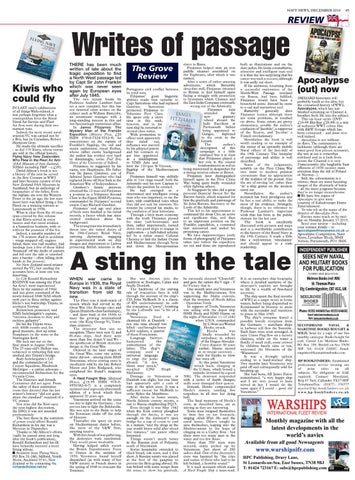
both as illustrations and on the dust jacket. He looks a remarkable, attractive and intelligent man and it is thus the less surprising thathis career was such a success, although it was sadly cut short. If his ambition, returning from a successful exploration of the North-West Passage overland via Russia, had been fulfilled, Fitzjamcs would have been a household name. Instead he came to a sad and mysterious end. does Battersby generally Fitzjames justice although there are some problems, as touched on above. Some errors are pretty elementary, notably the author’s confusion of‘Jacobite’,a supporter of the Stuarts, and ‘Jacobin’ a French revolutionary. Nevetheless the book is well worth reading as an example of the career of an upwardly mobile Naval officer of the first-half of the 19th Century. The interplay of patronage and ability is well described. Some of the judgements, notably on the First China War owe more to modern political correctness than an appreciation of the realities of the period. Also the use of serving ‘on’ rather than ‘in’ a ship grates on the modern naval ear. the Nevertheless author’s research has been prodigious and he has a real ability to make the most of his evidence. Strangely, though, there is no reference to Professor Lambert’s important work that has been in the public domain for the last year. The book is excellently illustrated with pictures and maps and is a worthwhile contribution to the history of the Royal Navy in the 19th Century. It reads a little like a we|l—written ‘whodunnit’ and should appeal to a wide
Apocse (out) now
DIEHARD historians will
probably baulk at the idea, but the colourised history of W\V2,
Apocalypse, which has just
finished screening on Channel 4, breathes fresh life into the subject. This six-hour series (DVD £19.99 Blu—Ray £29.99) is a mix of authenticWW2 colour film with B&W footage which has been colourised and done very well indeed. Apocalypse is not without its flaws. The commentary is lacklustre (although there are —
some
good first-person accounts),
the war at sea is somewhat sidelined and as it hails from across the Channel it is very Francocentric (the laughable Saar offensive of 1939 receives more attention than the fall of Poland
Norway...). Still, the colourisation is a winner; there are some haunting images of the aftermath of battle all the more poignant because they’re no longer monochrome. IWe have five copies of Apocalypse to give away courtesy of Kaleidoscope Home or
—
Entertainment. To win tell us the name of the director of Apocalypse Now. Entries must reach us by midday on Monday January 17 2010. Send your answer including your contact details to —
—
apocaIypse@navynews.co.uk or Apocalypse Competition, Navy
News, Leviathan Block, HMS Nelson, Portsmouth, POI 3HH.
readership.
tale
INDEPENDENT PUBLISHER
SEEKS NEW NAVAL AND MILITARYBOOKS FOR PUBLICATION For luilhei details please write lo.
nervously shouted “Churchill" and gave the sailors theV sign —V for Victory that is.
he
One month later and Venomous was in the Mediterranean, first supporting the Malta convoys, then the invasion of North Africa
Operation Torch. In support of Torch, Venomous was sailing with the depot ship —
HMS Hecla and HMS Marne on the night ofNovember l I-I2 1942 when U515, commanded by U-boat aceWerner Henke, struck. Hecla was fatally wounded by torpedoes; in echoes of the Hogue-AboukirCrecy disaster 30 years earlier, Marne moved in to rescue survivors only for Henke to blow her stern off. At this point Venomous struck back, charging at the U-boat, which loosed a torpedo (it missed by a good 30ft). The destroyer responded with a series of depth charges; sadly none damaged their quarry. Instead, Henke compounded Hecla’s misery, sending five torpedoes in all into her dying hull. The final moments of Hecla’s crew, as described here, are as —
destroyer’s exploits are brought to life by a wealth of first—hand accounts.
The ship spent the final months ofWW2 as a target vessel in home waters, before being dispatched to Kristiansand in Norway to assist with the surrender and transition to peace in May 1945. The ship's company feared a possibly hostile reception from the Germans merchant ships in harbour still flew the Swastika. Such fears were soon assuaged. A tatty Union Flag flew on a factory chimney, while on the water a flotilla of small craft, some crewed by children barely nine or ten, welcomed the Iiberators of the ‘Wanamoos‘. It was a fittingly upbeat ending to a hard-worked ship. Two months later Venomous was paid off and subsequently sold for —
breaking up.
She had been, AB James Eaton remembered, “a very happy ship and I am very proud to have served in her. I would do the same again if I could good old Venomous.” —
& MARITIME BOOKS BOUGHT 8: SOLD. Send for il copy of our free monthlycatalogue. Books bought for cash. (iL‘|'iIld l.ee Maritime Hooks. PO Box 259. Bexhill-on-Sea TN39 3DF. Tel: [ll-I2-'-I 2l30(]T. Email: SECUNDHAND
NAVAL
enquiries?!leemarilimehookscom HP BOUKFINDERS: Established
professional service locating out of titles all on print subjects. No obligation or SAE required. Contact: Mossluird. Brig O‘ Turk. Callander. FKI7 SHT Telephone.r'Fax: (()|877) 376377 martin@‘hp-bookI'inders.co.uk www.hp-bookfinders.co.uk
Monthlymagazine with all the latest developments in the world’s navies
were too
and too More than 550 men were rescued, many picked up by Venomous. Just short of 280 sailors died. One of the destroyer’s crew was haunted by “the cries and curses of those who had to be left behind, a horrible sound." It is such accounts which make A Hard Fought Ship a must-read. water
Phone: 01353 646608 Fax:01353 646602 Emailzmimalitseiaflssoat M:
INTERNATIONAL FLEET REVIEW
—
many men in the few floats.
I‘$T.5I||.l$'lII>'.l)196‘!
WARSHIPS 5%
stirring as they are harrowing. Some men resigned themselves to their fate on her forecastle, singing Abide With Me and the naval hymn. Others sought to save themselves, leaping into the Mediterranean in the hope of clinging on to a Carley float but there
Melrose Books lref: NNI St. ThomasPlate Ely,Camhridgesl1ire,(B7 466, UK
It is an exemplary ship biography where a detailed narrative of the
Availablefrom all good Newsagents
www.warshipsifr.com HPC
Publishing, Drury Lane,
St Leonards-on-Sea, East Sussex, TN38 9BJ T: 01424 723167 E:
subs@hpepublishing.eom