40
NAVY NEWS, JULY 2008
The road to the ‘A definite tingle of pride’ Grand Fleet THE Victorian Navy has often been characterised by tremendous contradictions: an immense technical revolution from sail to the cusp of the Dreadnought on the one hand and slothful and complacent on the other, rather resting on its laurels in those golden years of Pax Victoriana. Except that Pax Victoriana wasn’t as ‘paxful’ as we’ve been led to believe – and the latter years of the Victorian Navy were rather dynamic. The common assumption is that the ‘modern Navy’ was born when Jackie Fisher took office and made a clean broom of the cobwebs of Victoriana. But as Roger Parkinson demonstrates in his authoritative The Late Victorian Navy: The Pre-Dreadnought Era and the Origins of the First World War (Boydell, £75 ISBN 978-1843-833727), the seeds of Jutland were sown a good three decades before that fateful clash of battleships. Parkinson concentrates on the political, technological and strategic thoughts which dominated the officer class in the last quarter of the 19th Century. In doing so, he casts light on an officer corps far less introspective than previously assumed. Indeed, far from being complacent, the Victorian officer kept a close eye on his potential enemies. Attachés sent back detailed – and often highly– technical – reports on the state of foreign fleets and the latest naval innovations. The French Navy of the mid-1880s appeared to be filled with “men of first-rate physique, well dressed and in good discipline”. Not so the Tsar’s fleet. Russian ships were poorly-built by shipwrights with cursory skills. “So far as I have been able to ascertain there is not one powerful or effective ship in the whole navy,” one British captain scathingly concluded. Ineffective or not, the Russian Bear was viewed as a threat to British ambitions at sea. Indeed, Russia and France were perceived as the Royal Navy’s most likely foes in the final quarter of the 19th Century. Through the 1870s – sometimes referred to by RN historians as the ‘dark ages’ – naval spending in Britain surpassed both these two nations combined. Not so in the following decade, and other possible competitors – USA, Italy, Austria-Hungary, Germany – were beginning to swell their Fleets. The growth of foreign fleets demanded the Royal Navy keep pace. Naval intelligence was born in the 1880s when a (tiny) dedicated staff was formed at Whitehall. In time it would not merely study the navies of the world, it would shape the Royal Navy of the future and its strategy. For a start, it dismissed the idea of convoys in time of war to protect trade routes: convoys were cumbersome and indefensible. The merchant fleet agreed, fearing such a move would merely delay the trade on which the Empire was founded. More than three decades later merchantmen – and Britain – would pay dearly for such attitudes. But then the Royal Navy of the age wasn’t really interested in defence. Capt W Hall, the first head of the Foreign Intelligence Committee, outlined a policy of which Nelson would have been proud: engage the enemy more closely. “A defensive policy is utterly at variance with the traditions of the British Navy whose role has always
been that of attack and not defence.” In Hall’s eyes, the Navy would maul the enemy merchant fleet, ravage his ports, destroy his ammunition depots and coaling stations. Except that the Press of the day did not believe the Royal Navy could carry the fight to the enemy. In the mid-1880s, the Pall Mall Gazette led a tireless – and some might say unscrupulous – campaign decrying the state of the RN, too small to meet the demands made of it at a time when “the scramble for the world has begun in earnest”. The bigger the lie, the more people will believe it. The scaremongering was fed by one renegade naval captain – and MP – Charles Beresford who leaked at least one confidential report (of which he just happened to be the author...) to the press to further his aim of a larger Navy. The Press and Beresford captured the Zeitgeist. The Admiralty too was becoming increasingly worried by the growth of the French and Russian fleets, which, it believed, would enjoy near parity in some fields by the last decade of the 19th Century and superiority in others. And so in March 1889, Parliament committed more than £20m to shipbuilding – 70 vessels in all over the next five years. The Royal Navy had to maintain its ascendancy over the combined might of its two closest enemies. And yet the tubthumping did not end with the Act. It continued into the 1890s. The Mediterranean Fleet was too weak, Fleet Street proclaimed. More money poured into the RN, more castles of steel headed down the slipways. The truth of the matter was that there were never enough ships. The Royal Navy which mustered for the review to mark Queen Victoria’s Diamond Jubilee in 1897 was magnificent – and it was stretched to the limit. Home waters, South Africa, the Mediterranean, India and Ceylon, the China Station – the Royal Navy had too many commitments to be master of all the oceans. As the author points out: “It did not matter how many battleships Britain built, there were never enough, and each addition to Britain’s building programme ensured the expansion of someone else’s programme.” And all of this was mirrored a decade later. Dreadnought sparked a building frenzy of other dreadnoughts around the world, while the Press lamented that the Royal Navy was too small... except that now the threat was Germanic, not French or Russian. This is impressive naval history – the author has drawn on manifold sources, published and unpublished – which strips away many of the myths surrounding the RN at the end of Victoria’s rule. It is more academic than narrative history – as reflected by an asking price at which many readers will no doubt baulk. Yet the author argues forcefully that far from being a complacent, monolithic behemoth, the late Victorian Navy was one dominated if not by social change, then certainly by huge technological advances, expansion and powerful shifts in tactics and strategy.
ON SUNDAY November 12 1944, 12,000lb bombs smashed through the armour plating of Hitler’s flagship in a Norwegian fjord, causing the vaunted Tirpitz to capsize.
Several hundred miles away, the men of HMS Rodney were returning from gunnery off Cape Wrath. They didn’t know it yet, but Tirpitz’s demise also sounded the death knell for their own battleship. There was no longer a threat from enemy big ships in European waters. All could be dispatched to the Far East to plunge the knife into the belly of the Japanese beast. But not Rodney. She was tired – she had sailed more than 150,000 miles since her last refit. She would not receive another one. It was a rather lacklustre end to the career of a ship which, in the words of one former marine, “saw as much action” as any other British battleship. Her story is now told definitively by Iain Ballantyne in HMS Rodney (Pen & Sword, £25, ISBN 978-1844154067). Rodney is not perhaps the obvious choice for a biography – of WW2 vintage ships, Nelson, Warspite, Ark Royal spring more immediately to mind. Yet Rodney’s is a story rich with incident and drama. Indeed, in almost every major engagement of the second global conflagration, HMS Rodney was there. Norway, the Bismarck chase, the Malta Convoys, Salerno, Normandy, the Murmansk run, HMS Rodney saw action at each one. In keeping with the author’s previous biographies of ships – Warspite, London and Victory – this is a story less of the machine than the men who sailed in her. And it is not just the most recent Rodney in which Ballantyne is interested. He begins his story in the 18th Century, from which time on there was a succession of Rodneys, ending with the pre-dreadnought of the 1880s (the last RN vessel to mount a figurehead). The core of the book, however, is devoted to the inter-war and WW2 battleship. Rodney and her sister Nelson were Britain’s newest battleships in 1939 (the King George V class were still being built). They were also the most unusual dreadnoughts Britain ever built; restrictions on displacement limited the vessels to 35,000 tons. The resulting design was unorthodox: all Rodney’s main armament – 16in guns – was forward of her superstructure. She could have been a very different ship, however. Work had begun in 1916 on another Rodney, a super battle-cruiser, sister to the Mighty Hood. The Admiralty pulled the plug on the project; only Hood was completed. Hood came to
epitomise the inter-war Royal Navy. But facing Rodney in battle was a far more fearsome proposition. “I challenge any one who claims to possess a soul to stand on Rodney’s fo’c’sle and contemplate the stark, grey mass of turret and gun that stretches before him,” one officer enthused. “I challenge him to stand there by himself and not feel a definite tingle of pride and fear.” In the late summer of 1931, no-one would face Rodney’s guns, however. The leviathan was branded ‘the red ship’ for her role in the Invergordon mutiny. Rodney’s sailors learned of pay cuts imposed on them by Whitehall from the BBC and newspapers just three weeks before such cuts were introduced. There was uproar – uproar entirely preventable, one of her junior officers observed. “The Board of the Admiralty were completely out of touch with the feelings of the lower deck,” he fumed. “A despicable bunch of sods was our immediate, undisciplinary, feeling about them.” The men of Rodney mutinied for a simple cause: they were not communists, not anti-patriotic. They were simply trying to pay their mortgages, loans and other bills. Rodney’s subsequent deeds eclipsed her role in the Invergordon mutiny. She was bombed in the ill-starred Norwegian campaign, played a key role in Operation Pedestal, and hammered the Wehrmacht in Normandy. No man who witnessed her barrage on D-Day would ever forget it. “The sheer volume of noise, the blast of the guns was incredible and you could feel it through your body even if you were quite a distance from the gun doing the firing,” recalled Allan Snowden. “You couldn’t help feeling a bit sorry for the guys on the receiving end.” There was no such magnanimity shown in May 1941, however. News reached the bridge of Rodney that Bismarck had sunk the Hood. The Rodneys were determined, one officer remembered, “to square the deal”. That she did on the morning of May 27 – after Bismarck had been crippled by Swordfish torpedo bombers. A sub-lieutenant marvelled at the men in his turret delivering Bismarck’s mortal blows. “They remember Coventry, London, Plymouth – especially the latter which is home to most of them,” he observed. “Justice, you still exist in this world.” Today there are few Rodneys left. The ship herself was broken up in 1948. But the men of Rodney still remember her fondly. One former marine told the author that he considered her “the finest battleship ever built”. Another’s sentiments will no doubt be shared by many who go to sea. “It’s hard to explain to a civilian one’s feeling for a ship. You forget the hardships, the discomforts, the monotonous food and the dangers, but you remember the comradeship, the runs ashore, the lower deck, indestructible humour. How can you fall in love with a big hunk of steel? But you do, and you never forget.”
The enigmatic heroes SO MUCH of the subject matter of Phil Shanahan’s book The Real Enigma Heroes (The History Press, £19.99, ISBN 978-07524-4472-7) reads like a wellplotted thriller that it is hard to know whether to learn from it as a historical book or just enjoy it as a cracking good story. That it works so well on many different levels – it is also a textbook illustration of good old-fashioned journalism at its best – is a testament to the skills of the author, first in spotting this hidden gem of a story, and then in driving through a campaign to win public recognition for their deeds. At the heart of the book is the story of how three men serving in HMS Petard – Lt Tony Fasson, AB Colin Grazier and young civilian canteen manager Tommy Brown – risked their lives to recover Enigma code books from the sinking U 559 in October 1942 off Palestine. The gamble failed for the two Navy men, who drowned when the boat suddenly sank beneath them. But the recovery of Enigma material before they died is recognised by some historians as one of the pivotal episodes of the war. It allowed Bletchley Park to break the U-boat code, and among other things meant that Allied Atlantic convoys could be protected from the rampaging German wolf packs. The Nazis never knew the code had been broken, because the incident was kept under wraps for decades – hence the lack of recognition of the nature of Fasson, Grazier and Brown’s actions. Around this incredible tale Shanahan – deputy editor of the Tamworth Herald – weaves in other, equally unlikely, elements as his growing fascination with the story leads him to delve deeper into the mystery of the local hero whom history had forgotten.
The heroes’ story appeared in a boys’ comic in the 1960s, but no one can identify the source; author Robert Harris also mentioned them in his book Enigma; former shipmates spoke of three men who had changed the course of the war, and without whose inter vention D-Day may not have been possible. The campaign to raise the profile of the trio also received a timely boost from Hollywood blockbuster U571 which, in creating a fictional American-centric account of seizing Enigma, caused sufficient friction to draw attention from around the world. The two main strands of the book – the story of the heroes and Shanahan’s initiative to make them household names – are expertly intertwined, and genuinely tweak the emotions; prominent figures stand up to shout the worth of the men and a breathtaking monument is built, yet members of the men’s immediate families – including his widow Olive, a bride for just two days before Colin’s final fatal voyage – die without seeing or realising the impact of Shanahan’s campaign. It is indeed a fitting tribute to Fasson, Grazier and Brown, to the RN U-boat hunters, to the codecrackers of Bletchley Park – and to a local ‘hack’ who doggedly pursued a long and frustrating campaign because he genuinely wanted to right a wrong.
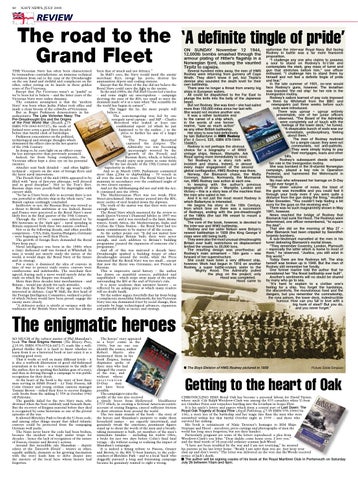
● The Boys Division of HMS Rodney pictured in 1939
Picture: Eddie Simpson
Getting to the heart of Oak CHRONICLING HMS Royal Oak has become a personal labour for David Turner, whose uncle Cdr Ralph Woodrow-Clark was among the 833 casualties when U-boat ace Günther Prien sent torpedoes hurtling into the leviathan in Scapa Flow. It is his uncle’s letters and papers which form a central part of Last Dawn: The Royal Oak Tragedy at Scapa Flow (Argyll Publishing, £7.99 ISBN 978-1906134136), a story less of the battleship and her tragic fate than the men who were entombed within her that fateful October night in 1939 – and those who survived her sinking. His book is reminiscent of Nixie Taverner’s homages to HM Ships Neptune and Hood – anecdotes, press cuttings and photographs of men the world has long since forgotten, but not their families. Particularly poignant are some of the letters reproduced: a plea from Woodrow-Clark’s son John: “Dear daddy, come home soon. I love you.” and the final words of 18-year-old ordinary seaman Jack Wood. “I have not been troubled by the war and I am not worrying,” he assured his parents in his last letter home. “Really I am safer than you are. Just keep your chin up and don’t worry.” The letter was delivered on the very day the Woods received notice of Jack’s death. ■ The author will be signing copies of his book at the Royal Maritime Club in Portsmouth on Saturday July 26 between 10am and 4pm.