8
NAVY NEWS, DECEMBER 2007
Scrabble and scramble WHILE HMS Superb and the Dutch Navy were locking horns (see below right), HMS York was shaking hands with Croatia. The destroyer hosted Porucink Horvete Stipe Skelin and Desetnik Niksa Svilick at the end of Exercise Noble Midas. Apart from being good scores at Scrabble, Porucink Horvete and Desetnik are Croatian for ‘lieutenant’ and ‘ensign’ respectively. Anyway, the duo spent 11 days aboard the Type 42 as she ended her escort duties with HMS Illustrious, sailing home to Portsmouth from the Adriatic at the end of NATO’s three-week Exercise Noble Midas. Apart from embracing all aspects of life aboard a Royal Navy warship, the Croatian pair sampled traditional Senior Service hospitality courtesy of runs ashore in Gib and Lisbon as York made her way back to the Solent. Lt Skelin and Ens Svilick are the first Croatian sailors to enjoy an exchange with the Royal Navy. It is hoped the link-up will help their country towards joining the NATO alliance. “It’s been an extremely rewarding visit,” said Lt Skelin. “I learned a lot about Royal Navy operations in a short time. Some things are the same, some things are not.” Once back in Pompey, the Navy’s specialists in air defence (it is York’s raison d’être) spent a day with the Army’s specialists in air defence, 47 Regiment Royal Artillery, based at Thorney Island between Portsmouth and Chichester. Thoroughly acquainted with the regiment’s kit and activities, the 11 Yorkies moved up the road to Longmoor camp – alongside the Special Air Service (yes, you read correctly). The SAS put the matelots through their paces at a village designed to prepare soldiers for urban combat (aka ‘fighting in someone’s house’). S/Lt Lee Bodkin led the first squad through a damp tunnel, past burning cars and through a haze from smoke grenades to enter the edge of the village and secure several houses. Then it fell to S/Lt Paul Caddy and his team to ferry ammo to the attackers and bolster their attack. Large ammunition boxes and assault equipment had to be hauled across the ‘battlefield’. Unfortunately, one of the reinforcements set off a trip wire moving across open ground, alerting the enemy to their presence. The SAS, not surprisingly, showed no mercy. Despite their mauling, the sailors (heavily camouflaged), returned to the ship with tales of epic bravery in the heat of cross-fire.
We have mist you
VETERAN hunterkiller submarine HMS Sceptre has not featured in the good pages of Navy News for quite some time (I would say about nine months – Ed).
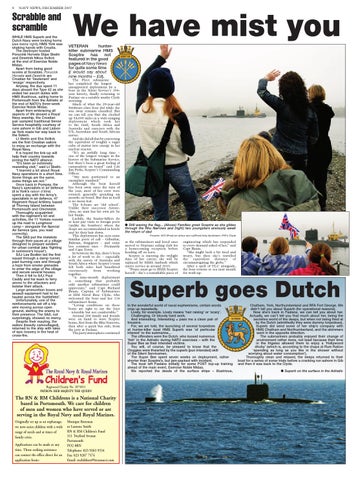
The Fleet submarine has completed the longest unsupported deployment by a boat in the Silent Service’s 106year history, finally returning to Faslane on a suitably murky Clyde morning. Much of what the 29-year-old Swiftsure-class boat did while she was away remains classified. But we can tell you that she clocked up 54,000 miles in a wide-ranging deployment which took her to the Gulf, South Africa and Australia and exercises with the US, Australian and South African navies. And she did all that by converting the equivalent of roughly a sugar cube of matter into energy in her nuclear reactor. “It’s an awfully long time – one of the longest voyages in the history of the Submarine Service, but there’s been a great feeling of camaraderie on board” said Cdr Jim Perks, Sceptre’s Commanding Officer. “My men performed to an exemplary standard.” Although the boat herself has been away since the turn of the year, most of her crew were rotated, generally spending six months on board. But that in itself is no mean feat. The S-boats are ‘old school’. Unlike their successor Astuteclass, no man has his own pit: he hot bunks. Luckily, the hunter-killers do at least pay visits to foreign ports (unlike the bombers) where the deeps are accommodated in hotels and let their hair down. This deployment has seen some familiar ports of call – Gibraltar, Bahrain, Singapore – and some less common ones – Fremantle and Cape Town. In between the fun, there’s been a lot of work to do – especially with the navies of Australia and South Africa where Sceptre’s team felt both sides had benefitted enormously from working together. “A nine-month deployment is something that probably only another submariner could appreciate,” said Capt Richard Baum, Captain of Submarines at HM Naval Base Clyde, who welcomed the boat and her 116 submariners home. “Living conditions on these boats are tight to say the least – tolerable but not comfortable.” Around 200 family and friends were on hand to wave Sceptre home, first from the Rhu Narrows, then after a quick bus ride, from the jetty at Faslane. The party atmosphere continued
Registered Charity No. 1075015 PaTRoN: HeR MajesTy THe QueeN
The RN & RM Childrens is a National Charity based in Portsmouth. We care for children of men and women who have served or are serving in the Royal Navy and Royal Marines. Originally set up as an orphanage, we now assist children with a wide range of needs and at times of family crisis. Applications can be made at any time. Those seeking assistance can contact the office direct for an application form:-
Monique Bateman or Laurene Smith RN & RM Children’s Fund 311 Twyford Avenue Portsmouth PO2 8RN Telephone: 023 9263 9534 Fax: 023 9267 7574 Email: rnchildren@btconnect.com
l Still waving the flag... (Above) Families greet Sceptre as she glides through the Rhu Narrows and (right) two youngsters anxiously await the return of dad Pictures: WO1(Phot) Ian Arthur and LA(Phot) Kelly McAlinden, FRPU Clyde
as the submariners and loved ones moved to Neptune sailing club for a homecoming reception before heading off on leave. Sceptre is enjoying the twilight days of her career; she will be replaced by HMS Ambush which enters service in around 2010. “Praise must go to HMS Sceptre herself – she’s a remarkable piece of
engineering which has responded to every demand asked of her,” said Capt Baum. “She might look a bit tired and weary, but then she’s travelled the equivalent distance of circumnavigating the globe.” After a spell of TLC alongside, the boat returns to sea next month for work-up.
Superb goes Dutch In the wonderful world of naval euphemisms, certain words crop up repeatedly. Lively, for example. Lively means ‘hair raising’ or ‘scary’. Challenging. Or bloody hard work. And interesting. Interesting = pass me a clean pair of trousers. For, we are told, the launching of several torpedoes at hunter-killer boat HMS Superb was ‘of particular interest’ to the submarine... The offenders were the Dutch, who loosed numerous ‘fish’ in the Adriatic during NATO exercises – with the Super Bee as their intended victims. You will, of course, be pleased to know that the Cloggies were thwarted by the superb (pun intended) skill of the Silent Servicemen. The Super Bee spent seven weeks on deployment, rather shorter than Sceptre’s, but jam-packed with incident. The boat left Faslane initially for some FOST top-up training ahead of the main event, Exercise Noble Midas. We reported the deeds of the surface ships – Illustrious,
Chatham, York, Northumberland and RFA Fort George. We didn’t tell you about Superb (for operational reasons). Now she’s back in Faslane, we can tell you about her. Actually, we can’t tell you that much about her, being the secretive world of the deeps, but when not being fired at by the Dutch (admittedly they were dummy torpedoes), Superb did send some of her ship’s company with HMS Chatham and Northumberland, and the skimmers went in the opposite direction. The submariners probably enjoyed their change of environment rather more, not least because their time in the frigates allowed them to enjoy a ‘Hollywood dhoby’ (which is, according to the chaps at Rum Ration ‘spending as long as you like in the shower without worrying about water consumption’). Thoroughly clean and relaxed, the deeps returned to their boat for a series of sonar trials before a cracking run ashore in Gib and then it was back to the Clyde. l Superb on the surface in the Adriatic