Bomb Alley blues
36
NAVY NEWS, AUGUST 2007
UNEXPLODED bombs. Damaged munitions. Booby traps. Covert operations right under the nose of the enemy. Tales of derring-do which deserve a wider telling.
But in the case of the Navy’s clearance diving team in the Falklands, word did not spread far. There is a sense of puzzlement that one of the units genuinely in the firing line – often handling bombs while under air attack – rarely features in official accounts and on the various plaques and monuments dedicated to the conflict. It has certainly bemused Michael Fellows over the years – and as he is still in the same line of business 25 years on, there are constant reminders of the work he and his colleagues did under the most perilous of conditions. In April 1982 Michael was the Fleet Chief Petty Officer Diver, second in command of the Fleet Clearance Diving Team. On April 13, less than a fortnight after the Argentine invasion, Michael and his team were on an RAF Hercules bound for Ascension Island in case ships needed help with unexploded ordnance, and to cover underwater security. Shortly after, they embarked in RFA Sir Tristram and sailed south to prepare for a similar task with the Task Group. The thought that Michael and his team would be dealing with unexploded bombs on British warships was a novel one. “This phenomenon had only happened once in modern history – during World War 2, when Lt Roberts VC and PO Gould VC had the task of removing an unexploded bomb from below the casing of a submarine whilst under threat of an enemy air attack,” said Michael. “But it did happen with a vengeance. I was right in the forefront of the action, and found myself not only removing the first and last dropped unexploded bombs of the conflict, but also conducting the reconnaissance and formulating the draft methodology for the removal of the unexploded bombs that hit warships Antrim, Argonaut, Plymouth and RFA Sir Galahad.” The “real fun” started on May 21 when a 1,000lb bomb smashed into the Sea Slug missile loading doors of destroyer HMS Antrim, bounced through the missile magazine and a pyrotechnic store before wedging itself into a toilet cubicle. Antrim was, at the time, fending off air attacks on SS Canberra in Falkland Sound, and it was during further such attacks that Michael, clutching his ‘bomb bag’, and colleagues LDs Garry Sewell and Nigel Pullen were flown from San Carlos Water to the destroyer. “I dropped out of the lowering strop of the helo on to a foamcovered deck right alongside an abandoned gun surrounded by pools of blood,” said Michael. Down below, in a compartment
filled with smoke and fumes, lit only by emergency lighting, the divers donned breathing apparatus to fight the fires before they could tackle the bomb. “This took some time as we ran out of extinguishers and refills and had to improvise with buckets of water from taps whilst the ship was zigzagging in avoiding action at speed,” said Michael. “The bridge informed us by Tannoy when an air attack was coming in, and initially like idiots we ran forward, away from the bomb to the messdeck, and took cover under a plywood table. “I remember Garry Sewell shouting at me as we collided under a table: ‘You might be the Fleet Chief, but I was here first – bugger off!’ before we both collapsed laughing. “Why were we worried about Argie cannon fire when one slip of the hand or violent movement of the ship could actuate the fusing system of the bomb, killing us and over 400 sailors on board?” Once the debris was cleared the team could see the drab green bomb, white stencilled letters proclaiming ‘Made in England’. The nose and tail were badly damaged and the fuse distorted out of recognition, wires hanging from it suggested a booby-trap. Michael reported his findings to the bridge. The fuse could not be removed, and as there was no precedent, he proposed a ‘lift-andshift’ approach. “I formulated a plan to cut a passage for the bomb up through two decks, move the weapon aft, and then lift it, keeping it on an even keel, by means of a series of tackles and shear legs, to the upper flight deck,” he said. “I also remembered to keep reassuring the lads that I knew what I was doing – and wishing I had put a spare pair of knickers and my reading glasses in my pocket.” Sailors cut away steel decks and rigged shear legs, but it was six hours before they could start moving the live bomb. “I was very worried that the violent manoeuvring of the ship as she came under attack was going to jolt the bomb and cause the fuse to detonate,” said Michael. “We improvised wedges and my two divers lay alongside the weapon to keep it steady whilst I snipped at loose metal around the fuse with pliers in an attempt to identify the origin and type.” Breaking off to send a sitrep to the UK, he sought advice from
l Damage to frigate HMS Plymouth during the Falklands Conflict
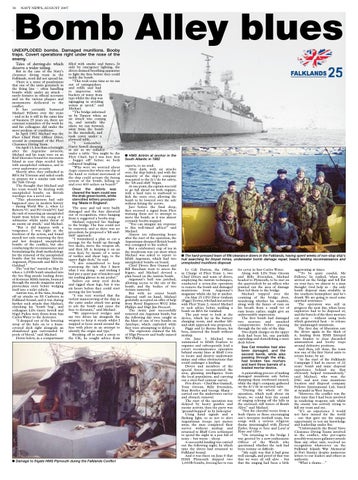
l HMS Antrim at anchor in the South Atlantic in 1982 experts, to no avail. After dark, with air attacks over, the ship halted, and with the majority of the ship’s company evacuated to the fo’c’sle for safety, the ‘lift-and-shift’ began. At one point, the captain was told to go full ahead on both engines, with a hard turn to starboard to kick the stern over, allowing the bomb to be lowered over the side without hitting the screws. Just before the final drop, they received a signal from Fleet warning them not to attempt to move the bomb, as it was almost certainly booby-trapped. “You can imagine my response to this well-timed advice!” said Michael. Almost ten exhausting hours after the start of the operation, the Argentinian-dropped British bomb was consigned to the seabed. But a celebratory cup of tea in the wardroom was cut short when Michael was asked to report to HMS Argonaut, which had two unexploded bombs on board. Chief Divers Ben Gunnel and Bill Baucham went to assess the frigate, and Michael devised a plan based on the Antrim bomb. Argonaut’s hull was patched, allowing access to the site of the bomb, and the bodies of two victims removed. But with no senior bomb disposal staff on hand, Michael gratefully accepted an offer of help from Royal Engineers WO2 John Phillips and SSgt Jim Prescott. The Army pair successfully removed one Argonaut bomb, but the following day were caught in the blast of one of two bombs on Antelope, which exploded while they were attempting to defuse it. The explosion claimed the life of SSgt Prescott and badly injured WO Phillips.
l The hard-pressed team of RN clearance divers in the Falklands, having spent weeks of non-stop ship’s hull searching for limpet mines, underwater bomb damage repair, beach landing reconnaissance and unexploded munitions disposal Lt Cdr Dutton, the Officer in Charge of Fleet Team 1, two Chief Divers and team of divers, employing the Antrim techniques, conducted a seven-day operation to remove the bomb and damaged munitions from Argonaut’s magazine whilst she lay at anchor. On May 25 CPO Diver Graham (Piggy)Trotter, who had just arrived with Fleet Team 2, visited Michael to seek advice before tackling a bomb on RFA Sir Galahad. The pair went to look at the device, which lay in the battery charging room, and another liftand-shift approach was proposed. Piggy and Lt Bernie Bruen, his boss, removed the bomb without mishap. On June 3 Michael was summoned to HMS Fearless to organise and subsequently lead a covert reconnaissance operation behind enemy lines at Bluff Cove to locate and destroy underwater mines and other obstructions that could endanger a landing. Divers and members of the special forces reconnoitred the area, gleaning intelligence from the local population, and carrying out a river-bed contour survey. Five divers – Chief Ben Gunnell, Tony Groom, Billy Evernden, Stan Bowles and George Sharp – carried out the underwater survey and obstacle removal. The start of the operation was delayed by heavy gunfire and enemy activity, then the party was ‘ground-hopped’ in by helicopter Using hand signals and a flashing light, so as not to alert Argentinian troops just metres away, the men completed their survey without mishap and returned to Bluff Cove settlement to spend the night in a pen full of noisy – but warm – sheep. A successful landing was carried out the following night, by which time the divers had returned to Falkland Sound. And it was there on June 8 that HMS Plymouth shipped two 1,000lb bombs, forcing her to run
for cover in San Carlos Water. Along with LDs Tony Groom and Billy Evernden, Michael headed to Plymouth, to be met on the quarterdeck by an officer who pointed out the area of damage then led them to the bridge. Michael tripped over the coaming of the bridge door, wondering whether his stumble, along with the fumes of rum on his breath from a small tot of rum hours earlier, might give an unfavourable impression. The first bomb had damaged two mortars and smashed compartments before passing through the far side of the ship. Two depth charges on the upper deck had been hit, one partially exploding and demolishing a mess deck below. Sea Cat missiles had also been damaged, and the second bomb, while also passing through the ship, had broken two mortars and bent three barrels of a loaded mortar device. A painstaking process of making damaged munitions safe before dumping them overboard ensued, while the ship’s company gathered on the fo’c’sle in survival suits. “During the whole of the operation, which took about six hours, we could hear the sound of singing echoing off the hills in the enclosed, still waters of Bomb Alley,” said Michael. “Not the cheerful verses from a Sods Opera or those encouraging one’s favourite football team, but songs with a serious religious theme intermingled with Eternal Father, Strong to Save and Land of Hope and Glory. “On returning to the bridge I was greeted by a now-enthusiastic Officer of the Watch who questioned whether the task had been routine or difficult. “My reply was that it had gone well enough, and proof of that was that we were all still alive – but that the singing had been a little
aggravating at times. “‘To be quite candid, Mr Fellows,’ he replied, ‘when you arrived on the bridge and fell flat on your face, we almost to a man thought: God help us – the only bomb disposal man available in the southern hemisphere and he’s drunk. We are going to need some spiritual assistance.’” The operation was still in progress the next day, when loose explosives had to be disposed of, and the barrels of the three mortars cut away – without using tools which generated heat – to release the undamaged munitions. The first day of liberation saw the divers again in the thick of it, landing from HMS Intrepid into Stanley to clear discarded ammunition and booby traps around defensive positions. And then, job done, the team was one of the first Naval units to return home, by air. “At the start of the Falklands Campaign I had in excess of 22 years’ bomb and mine disposal experience behind me that obviously helped tremendously,” said Michael, who won the DSC and now runs munitions location and disposal company Fellows International Ltd, based at Arundel in West Sussex. “However, the conflict was the first time that I had been involved in rendering weapons safe whilst the enemy was actively trying to kill my team and me. “It’s an experience I would not have missed for the world – one that gave me the unique opportunity to test my knowledge and leadership under fire. “Unfortunately the Royal Navy Clearance Diving Teams involved in the conflict, who per-capita possibly won more gallantry awards than any other unit, received no recognition whatsoever on the Falkland Islands War Memorial in Port Stanley despite numerous letters to our leaders and others in authority. “What a shame…”