Options
News SEPTEMBER
Victory under the sea 1939-45 SUBMARINE CENTURY
Pt 3 inside
2001
Fifty years on"~? the Sea <T Vixen story FIRST FLIGHT ANNIVERSARY FEATURE p8-9
Duke of darkness ON a dark sea and under lowering skies a chink in the clouds allows enough sunlight to shine on the Duke-class frigate HMS Monmouth to give this dramatic effect. The picture, taken by PO(PHOT) Jim Gibson, has been nominated by Navy News for an award in the Peregrine Trophy event the competition for RN photographers. Meanwhile Monmouth nicknamed the Black Duke after the beheaded, illegitimate son of Charles II won the honour of escorting the frigate USS Winston S. Churchill on her arrival in British waters for the International Festival of the Sea at Portsmouth, taking place soon after Navy News went to press.
Forces to stage Jubilee show at Naval base THE ROYAL NAVY at Portsmouth has been chosen to host the triService military celebration attended by the Queen to mark her Golden Jubilee. Accompanied by the Duke of Edinburgh, she will witness military displays and meet members of the Armed Forces during her visit to the Naval base on June 27 next year. On the programme is a lunch at HMS Excellent with Service people "at the junior end of the spectrum". A project team to arrange the Royal couple's private visit to the Armed Forces has been formed under Commodore Geoffrey Edwardes. It includes two Royal Navy Commanders, a Lieutenant Colonel from the Army, and an RAF Wing Commander and Squadron Leader.
The day will reflect the role of the Forces in the 21st century, with particular emphasis on joint service. The Queen and Duke of Edinburgh will be greeted by a tri-Service guard at HMS Excellent on Whale Island where Her Majesty will view large, static displays on the upper lawn. They will all be tri-Service and planned along the lines of film sets to depict the lives of Forces personnel and the environments in which they work. A number of Service personnel and their families will be invited to witness the event. After lunch the Royal couple will go to Portsmouth Naval Base where, from an aircraft carrier, they will view a dynamic display in the northern (Fountain Lake) area of the harbour. They will then sail down the harbour where ships alongside will pay marks of respect and will have embarked personnel from their affiliated regiments and air squadrons. A tri-Service fly-past will also take place at that point. At the southern end of the harbour, the Queen will be escorted to her helicopter departure point by an Army detachment.
WORLDWIDE MISSIONS FOR FRIGATES p26-27 • SUPPORT SHIP HONOURED p2
2
www.navy new s .co .uk
NAVY NEWS, SEPTEMBER 2001
Last Naval link with Mercury is ending
Options
Ex-RN pilot meets Zero ace who shot him down FORMER Japanese Zero ace Kaname Harada meets the Fleet Air Arm flier who fell victim to his guns during Admiral Nagumo's carrier strike on Ceylon in 1942.
THE NAVY's last links with
Cdr John Sykes RN (retd), a sub-lieutenant at the time, met his opponent in far more friendly circumstances at the Fleet Air Arm Museum at
the site of the former Communications School at HMS Mercury end in November when the Special Communications Unit Lcydene leaves its adjacent location. When Mercury, near Pelersfield in Hampshire, closed in 1993 il was not regarded as cost-effective to move SCU Lcydene with it. Now, further rationalisation and changes in investment appraisal show that a move will he value for money. The unit will move to HMS Collingwood at Fareham at the end of November provided the new facility there - Leydene Building - is completed in time. Operations from the building will begin on December 3 and training on December 14. The W h i t e Ensign w i l l be hauled down for the last time at the current site on November 2') at a ceremony to which staff and their families will be invited, as well as former commanding officers of the unit. Applications to attend must be made by other previous members of staff. Details arc published in General Defence Council Instruction 186/01 and the contact number for the closure and moveofficer, Lt T. J. Davison, is 01730 82 4332 (fax 01730 82 4202). The several trophies that the SCU holds - including many which were HMS Mercury's - will be returned to the RN Trophy Centre at HMS Nelson.
Value of Defence is £86bn - or is it?
THE ROYAL Fleet Auxiliary ship that brought relief to thousands of victims of the Mozambique floods last year has been awarded the Naval Wilkinson Sword of Peace. The replenishment ship RFA Fort George and embarked helicopters from 820 Naval Air Squadron took essential supplies to the people in the central and northern areas of the country during the devastating floods in March 2000. Also honoured - with a special tri-Service Sword of Peace - was 22 Field Hospital which for over a year up to last January was responsible for medical support in Bosnia and Kosovo. The unit deployed a total of almost 700 Regular and Reserve personnel in rotation from all three Armed Forces. They served either in Sipovo, Bosnia, or the Reynolds Hospital in Pristina, Kosovo, providing hospital facilities for UK Service people, UN Forces and the local population, treating a total of over 1,000 locals. They also repaired and improved civil medical facilities and trained local personnel.
RN air station Yeovilton. With them is Museum Director Graham Mottram. Cdr Sykes flew one of the two RN Fairey Fulmars to take part in the dogfight on April 5 almost 60 years ago. No match for the Zero fighter (left) against which it was pitted, the Fulmar was shot to pieces, but Cdr Sykes managed to crash-land it in a paddy field, walking away from the wreckage unhurt. His was one of five British fighters shot down by Kaname Harada that day. The Japanese ace, who has nine victories to his credit, continued to fly until he was seriously injured in combat in the South-West Pacific. He also took part in the pivotal Battle of Midway where he was forced to ditch in the sea after his carrier, the Soryu, had been sunk.
Medics and RFA mercy ship win peace prizes
Speaking of the award to the ship, C-in-C Fleet, Admiral Sir Alan West said: "This is an outstanding achievement, and the men and women of RFA Fort George and the embarked elements of 820 NAS should be justifiably proud of this recognition on the success of their contribution to the relief efforts. "The award is a fitting testament to the essential role played by the RFA in supporting the Royal Navy and British Forces overseas."
During the operation sailors and airmen worked 18-hour days in hot and humid conditions to load the ship with hundreds of tonnes of food, water, medical stores and tents at Beira port. The cargo then had to be transported to areas further south where the need was urgent. For his role in the operation, C'apt Les Coupland RFA, Fort George's Commanding Officer, was awarded the OBE in the New Year's Honours List.
Lancaster salute A Lancaster bomber from the RAF's Battle of Britain Memorial Flight provides a rare sight over Portsmouth as it salutes the frigate HMS Lancaster (F229) as she returns from a hot, fivemonth deployment to the Gulf.
A NATIONAL Asset Register - a sort of Doomsday Book which attempts to quantify in financial terms the nation's possessions has concluded that the Armed Forces have at least £86 billion worth of equipment, property, etc. It shows that among the most valuable assets arc the Navy's Trident submarines which form Britain's nuclear deterrent. However, Defence sources acknowledge that MOD'S assets cannot be valued in financial terms alone and that a price tag could not be attached to the benefits of national security.
a U-boat. A development company is spending £1 million on converting Tamworth's Old Police Station into a luxury hotel - the Colin Grazier Hotel, due to open this month. Phil Shanahan, chairman of Tamworth's Colin Grazier Memorial Committee and Deputy Editor of the campaigning Tamworih Herald, sees this latest development as yet another milestone in the drive to win recognition for Grazier and the two other men from HMS Petard who were involved in the Mediterranean operation in 1942. Lt Tony Fasson, who also died in the action, will have the upper lounge of the hotel named after him, while a third participant Naafi assistant Tommy Brown (who was killed later in the war) will be remembered through the name of the hotel's lower bar. Plans to erect a memorial sculpture in Tamworth to all three men arc progressing, and streets in the town have been named after them.
TWO young ratings from RN air station Culdrosc died as a result of a car crash on July 25.
BRITAIN'S boating enthusiasts will have an opportunity to nominate British Nautical Award winners at Southampton Boat Show on September 14-23. The 11 categories in which the public can make nominations include Yachtsman of the Year, Young Sailor of the Year, and a Marine Environmental Award.
MOD chooses to mark 60th anniversaries It had been MOD practice to take part in 25th, 50th, 75th anniversaries and centennials. Now special commemorative events will normally be initiated by the Ministry only for Jubilees of the Sovereign's Accession and 50th and 60th anniversaries and centennials of the greatest national significance. For the 60th anniversary of World War II, each Service has chosen one representative battle for funded commemora-
THE CAMPAIGN supported by Navy News to honour a war hero in his home town of Tamworth has achieved another remarkable success - the naming of a new hotel after AB Colin Grazier who died while recovering war-winning Enigma coding material from
Sailor chums die in crash
Public asked to pick top sailors
BECAUSE fewer veterans are around to participate in the commemoration of 75th anniversaries, the Ministry of Defence is now commemorating 60th anniversaries of wartime events.
New hotel given the name of hero sailor
tion. For the Navy it will be the 60th anniversary of the turning-point of the Battle of the Atlantic in 2003.The Army will mark El Alamein in 2002, while the RAF chose to commemorate the Battle of Britain. There will be one funded tri-Service commemoration - marking in 2005 the 60th anniversary of the end of the war. There will also be a funded Service commemoration in 2003 for the effective end of the Korean War. MOD makes it clear that responsibility for initiating and organising other commemorative events lies with external individuals or groups such as veterans associations. There is no provision in the Defence budget for veterans' visits or other
activities. Similar circumstances apply to Service widows with the exception of the War Widows' Pilgrimage Scheme operated on behalf of MOD by the Royal British Legion. MOD's Committee on Commemorations will keep under review anniversaries during the next five years and events organised externally to commemorate them. It will make recommendations where it considers that major participation would be appropriate, such as attendance by a member of the Royal Family (except on a purely Regimental or similar basis) or by a Minister or four-star officer. Other events will be classed as minor. They will be supported in Britain as far as possible by local Commands without
reference to MOD, while overseas they will be handled under similar conditions by British embassies. However, the guidelines do not apply to such events as the Queen's Birthday Parade; Battle of Britain commemorative events; Remembrance Sunday services; events such as the Service of Thanksgiving after the Falklands campaign; memorial services for individuals; and the use of Service bands (for which rules already exist). The cost of any other events will have to be met by the organisers. Details of the policy are the subject of General Defence Council Instruction 179/01.
AEM1 Jason Roberts, the passenger in a car driven by AEM! Adam Reader, died at the scene of the accident just outside Hclston, Cornwall. AEM Reader died the next day at the Royal Cornwall Hospital, Treliske. Both were returning to Culdrose when their car was in collision with another. The driver of the other car escaped serious injury.
Centre goes off with a bang AN EXPLOSIVES disposal team from the Navy's Southern Diving Unit at Portsmouth ensured that the launch of a new conference and training centre went off with a bang when they were called in to provide the dramatic opening. Over 80 business people from the South witnessed the launch of the hi-tcch centre and corporate entertainment venue at Explosion! - the interactive Museum of Naval Fircpower at Priddy's Hard. Gosport, a former Navy armaments depot. The venture has been funded by the Millennium Commission.
www.navynews. co. uk
NAVY NEWS. SEPTEMBER 2001 3
Options
Lynx finds plenty of elbow room ROYAL Navy Lynx Mk 8 helicopter has successfully carried out a series of landings and take-offs from the deck of RV Triton, the world's first trimaran warship demonstrator owned by QinetiQ (formerly the Defence Evaluation and Research Agency.
A
Funded by the Defence Procurement Agency, this was the latest success in RV Triton's demanding trials programme and the first time ever that a helicopter has landed on a trimaran. Since delivery by shipbuilders Vosper Thornycroft to QinetiQ (pronounced 'kinetic') in August last year, the ship has conducted a series of seakeeping and structural trials together with major Naval operations trials, which included a replenishment at sea with RFA Brambleleaf.
While visiting the USA's East Coast, she carried out side-byside trials with the US Coast Guard's USCGC Campbell. These included manoeuvring, seakeeping and comparative powering using a number of different bearings and ship's speeds. With the efficient hullform ensuring good seakeeping and excellent fuel consumption, and the large deck area providing flexibility of use, including operating and hangaring two helicopters, the trimaran design is ideally suited for coast guard use. Leading into the major structural trials phase over the autumn and winter of this year, the £13m RV Triton is currently engaged in a major series of hydrodynamic trials. The trials programme has been very successful with results validating earlier research and proving that the trimaran hullform can perform as well as, and in many cases better than, the monohull. The ship will appear at the Defence Systems and Equipment international at the ExCel exhibition centre, London Docklands on September 11-14.
New LCPVs prove their worth
Bigger, faster landing craft ordered for assault ships
SPECIAL DELIVERY
THE MINISTRY of Defence has placed an order worth around £9 million for 12 new landing craft with FBM Babcock Marine Ltd at the Rosyth Royal Dockyard. It will take three years for the yard to complete the work. Announcing the order, Defence Under Secretary Dr Lewis Moonic said: "These landing craft can carry half as much again as the vessels they will replace and are much faster. "The large assault ships HMS Albion and Bulwark, which are both due to enter service in 2003, will each carry and operate four of
structure of the ships. The remaining four vessels of the batch will be used tor training and as trials craft. The LCPV Mk 5 will come into service in July next year when the first four will form HMS Albion's Assault Squadron. The contract contains options for up to four more which could be exercised within the next two
Maltese Fair A MALTESE Fair to mark the 57th anniversary of the end of the siege of Malta in 1944 will be held at Westminster Cathedral Hall on September 8 from I Oam to 2pm followed by Mass and a variety show and dinner/dance. Tel 020 7292 4800 for details.
them. "This order was won against stiff competition from three other UK shipyards and is very good value for money. The contract has been placed at a price slightly below the costs we originally projected." The new vessel - Landing Craft Vehicle and Personnel Mk V - is constructed of aluminium and is expected to have a service life of about 20 years. An early batch has already proved highly successful during operations around the world from the helicopter carrier HMS Ocean. Some 15.7m long with a maximum loaded displacement of 24 tonnes, they have a top speed of 24 knots and a range of 210 nautical miles. They arc crcwcd by three Royal Marines and can carry a Royal Marines rifle troop of 35 men or two li^ht trucks. HMS Albion and HMS Bulwark will each carry four LCVPs on davits on the super-
Coventry's last march FOR what will have been the last time, Ship's Company of HMS Coventry have exercised their right to march through the City of Coventry with "swords drawn, bayonets fixed, colours flying and bands playing." The Type 42 destroyer, which last exercised her right of the Freedom of the City in July, 1989, is programmed for disposal early next year. On this occasion the ship's guard and marching platoons were accompanied by the Band of HM Royal Marines from the Commando Training Centre, Lympstone. For the rest of this year, Coventry will be deployed to the Western Atlantic, conducting exercises, counter-drug operations and defence diplomacy tasks in the Caribbean. •77ie Lord Mayor of Coventry, Cllr Dave Chater, inspects the Guard, escorted by Lt Cat Bell.
4
www.na vynews .co .uk
NAVY NEWS, SEPTEMBER 2001
Options
• One of the many wrecks which
< Sierra Leone's Shanghaiclass patrol boat.
litter Freetown Harbour in Sierra Leone. HMS Beagle undertook a
programme of survey work in Sierra Leone this year. Picture: LW(PHOT) Susan Rose.
• Lt Ivan Williams, Lt Cdr Dave Hunkin, Maj Steve Lee RM, Maj Pete Smith (1 Royal Anglian Regt) and Maj Guy Richardson (Royal Scots) get a
chance to relax on a Sierra Leone beach.
RN role grows in Sierra Leone SIERRA Leone no longer features in the daily news bulletins, as other, more pressing theatres of operation take their place in the headlines, writes Lt Cdr Dave Hunkin. Yet the UK mission in the West African state continues apace, and has scored some
The Navy operated from capital Freetown during both World Wars,
protecting merchant shipping en route to South Africa, Australia
and the Middle East, and it was an important staging post during the Falklands War in 1982. Following on from Operation Basilica, Op Silkman began last
November when it became clear that a more permanent presence was required to complete the British mission in Sierra Leone.
notable recent successes.
During Op Silkman, the RN presence ashore has grown, with
the coast provide reassurance to
RN and RM personnel playing an
And while warships deployed off
the local community and are a increasingly important role in all highly-visible example of the UK's operational areas. continuing commitment to Sierra In the Joint HQ in Leone, the Royal Navy contingent Freetown, RN personnel serving ashore has grown as the have taken the lead in conJoint nature of the operation is tingency planning, civil and fully exploited, with an increasing military co-operation and number of posts being filled by RN operational co-ordination and Royal Marines personnel. and liaison. The Royal Navy has been One indication of jointery at involved in Sierra Leone for almost 200 years - the first work was the fact that Army perGovernors were RN officers and, sonnel were woken recently by PO(TSSM) Mark Fuller's fine renin the early 1800s, a small flotilla of warships operated from Freetown combating the slavery trade.
dition of 'Call the hands' on a Bosun's Call lent by HMS Beagle.
I Have You Missed Us?
CREDIT CARD NEWS My order is attached for: Cardholders Name:......... Cardholders Address: .....
Tel:
Card number: Expiry date Cardholders signature:
Switch Issue No Amount (Min £5):
Junior and senior rates arc employed around Freetown, assisting with driving duties, security, stores accounting, administration and property management. The Navy has been supporting 34 Field Hospital with medical staff since its establishment earlier in the year and a leading regulator has been deployed to work within a very busy RAF Police detachment. Royal Marines continue to
The SLN now conducts fishery protection and anti-smuggling patrols as well as supporting the SLA. They were heavily involved in the re-occupation of Kambia district, putting SLN patrols ashore
to reassure locals and deploying SLA units up the many miles of rivers that cross the region.
deploy as part of the International Military Advisory and Training
Team (IMATT), advising Sierra Leone Army units in the field. The past six months have seen a
marked improvement in Sierra Leone. The country had a relatively peaceful Christmas and
New Year, with Freetown free of the echoes of automatic gunfire for the first time in ten years. There remained, however, areas of fighting between the Revolutionary United Front (RUF) and various factions. The humanitarian crisis reached record proportions at Easter, and the UN agencies were stretched to the limit coping with floods of refugees.
The uniting cause for all agencies in the peace process remains the disarmament and demobilisation of the RUF and other armed groups. The delivery of a co-ordinated, coherent package for excombatants is the key to offering an alternative to fighting and a ces- • Lt Cdr Dave Hunkin spreads some entente cordiale amongst sation of violence. Guinean forces near the border shortly after the disarming of In May the UN began a success- rebel forces in the area. ful disarmament process in the Kambia district, and many I • The beauty of beaches in Sierra Leone belies thousand ex-combatants disthe horror and destruction seen in many villages armed, allowing the newly as a result of the actions of rebel forces. British-trained Sierra Leone
Army (SLA) to re-occupy large parts of previously rebel-held territory without a shot being fired. Initial indications are that the warring factions recognise the futility of armed struggle and are eager to pursue a political path to enable them to play a full part in the forthcoming elections. British troops have now trained upwards of 8,000 members of the SLA, which has become a potent and credible fighting force should the rebels choose to return to violence. Similarly the Sierra Leone Navy (SLN) has received training from both RN IMATT personnel and patrolling RN warships.
Lt Cdr Sam Seward, who has been in Sierra Leone since last August, has worked almost singlehandedly in training the SLN in
various maritime operations.
Options
6
www.na vynews .co .uk
NAVY NEWS, SEPTEMBER 2001
TflH Letters
Options
Treason to go down IN CONNECTION with
your
review of Commanding Officers (July issue), I recollect reading an Admiralty Fleet Order early in World War II to the effect that captains were ordered not to go down with their ships as tradition demanded, as while vessels could be relaunched, there was a grave shortage of regular RN senior officers who could not be
replaced. It was mentioned that in those difficult times it would border on committing treason to waste all their knowledge and experience of seamanship gained by Naval College training by wantonly throwing their lives away in this manner. - R. Scopes, Finedon, Northants.
MY FATHER, Leading Cook F. Hanley, was one of the survivors from the aircraft carrier HMS
Courageous, torpedoed and sunk SW of Ireland on September 17, 1939 with the tragic loss of 515
It ain't half hot, mum then as now
officers and men.
REGARDING HM ships serving in The Gulf in the summer heat, things do not appear to have changed one iota.
Among the papers I inherited from him were several remarkable
While serving in the cruiser HMS Superb in February
photographs of the ship taken as
she was sinking by an officer in an escorting destroyer and later published in the Daily Express. They clearly state and show that her captain, Capt W. T. MakeigJones, did not leave her and went down with the ship. He can be seen on the bridge, saluting the White Ensign.
Also among those lost in this fine, outstanding ship were some Royal Air Force men - and, most tragically of all, eight boys. - R. K. Hanley, Leicester.
Thank you cadets IN RESPONSE to my letter 'Eastney's First Boy' printed in the June issue, I received an invitation
from CSgt J. M. Coombcr to attend the RMVCC Parade on
July 7. My father and his contemporaries would be proud of their success over the past 100 years. Thankyou cadets for an excellent
day. - F. C. Pitt, Exeter.
1956 we were ordered from not Portland work-up, completed, to get through the Suez Canal as soon as possible. Summer in the Gulf is quite
warm - it was impossible to live in the E.M.s' Mess directly under the boat/crane deck and so we worked a system with two other cruisers, whereby one sat in the Gulf, one in the Red Sea and one in Ceylon on rest and recreation. In Trincomalee in April the First Sea Lord, Earl Mountbattcn, came on board and gave the ship's company the Forgotten Army
speech, updated to the Forgotten Ship. He assured us that Superb was well to the fore in the minds of those at the Admiralty. He
explained that our presence was a great help during the present troubles, but that he would ensure that we were not kept there a moment longer than absolutely
necessary, as Superb had been built for Arctic and Atlantic warfare, not the Gulf.
Dropping stitches? REGARDING the letter 'Stitches in Time' (July issue) about embroidered samplers - "Bless us Lord and Keep us Free" etc hanging above the beds in the POs' Mess on Whale Island, I would
suggest it is highly probable that the embroidery was done by the men themselves. I served in the Andrew from
1957-66, during which time I embroidered several dressing table sets and a table runner for my mother and also took up rug making in my last ship, HMS Lynx.
This was done mainly at sea just to pass the time when getting fed up with tiddly rope work etc.
Though not a common practice and one that sometimes caused a few raised eyebrows, my messmates did not seem to think it
too strange and I have seen other matelots similarly occupied. Not so very long ago Navy News
featured another ex-matelot from Kent who spends his time completing needlework pictures to raise money for charities such as the RNLI. I myself completed three kneelers for the Falkland Islands Memorial Chapel at Pangbourne
College, Reading, following a request for volunteer needleworkers in JVavv News a year or so ago.
I would therefore suggest that the practice, far from being unheard of, did occur and for all I
know may still be going strong today. - R. G. Windebank, Romney Marsh.
Recognition at last for a few Cold Warriors I AM sure that N. R. Simpson (July issue) is not alone in deploring the absence of any official recognition of the activities of the Submarine Branch during the Cold War. Whether a Cold War bar will
to due recognition from those he is
indeed be issued to the 1962 employed to defend, and it is high General Service Medal remains to be seen, but work did in fact begin more than four years ago on a
book that would provide acknowledgement of a different sort. It takes as its framework the
Naval careers of half a dozen Cold War submarine COs, covering atrols from the early Fifties to the ill of the Berlin Wall, together Ewith the Falklands conflict - in
which four of the six saw action. Although, inevitably, it cannot give every chapter and every verse of the Branch's Cold War story, it marks the first proper public recognition of what Mr Simpson rightly describes as a major contribution to post war world
stability. We Come Unseen was published by John Murray on July 5 - and, as
its author, I can recommend it unreservedly. - Jim Ring, King's
Lynn. (See review on page 28)
AS A former RN PO myself (minesweepers and Fishery Protection) I have always held the
Submarine Service in high esteem and support Mr Simpson's views
wholeheartedly. I must point out, however, that
there are many thousands of exService personnel who served in key areas of the Western World throughout the Cold War who are also still awaiting recognition. I understand that one or two stalwart MPs are currently attempting to persuade the Ministry that after 45 years it is still
not too late to consider awarding the General Service Medal for the
Suez crises of the 1950s. Any man or woman who has had to face the real possibility of dying
for Queen and Country, no matter what the scenario and irrespective of whether the balloon actually went up or not, should be entitled
time the MOD stopped being so
selective. - G. E. Mayling, Bromsgrove. Worcs.
Echo of Empire I WAS surprised (and somewhat alarmed) to see, in the centre spread of the June issue of Navy News, references to the "Royal Indian Navy" in the context of HMS Gloucester's visit to the Indian port of Kochi. Surprised, that your editorial
staff should have overlooked a minor historical fact. It took a fairly protracted
freedom struggle and two mutinies (one of them by the Royal Indian
Navy) for India to get rid of the "Raj" in 1947. However, our navy retained the prefix "Royal" only till we shed
Dominion status and became a republic in 1950. Ever since then, it's been plain old "Indian Navy". So much for history. What
alarmed me was the stray thought that had we perhaps uncovered an
attempt by HMS Gloucester to re-conquer the Empire without firing a shot!! - Vice Admiral Arun Prakash, Chief of Personnel, NHQ, New Delhi. I have written to Admiral
Prakash, apologising for the error. - Ed Letters to the Editor should always be accompanied by the correspondent's name and address, not necessarily for publication.email correspondents
are
also
requested
to
provide this information.
Not fired in anger: Auriga's last gun
His parting shot was: "I wonder
WITH REFERENCE to the last
when we last treated a cruiser so badly in peacetime. - C. T.
4in gun, HMS Auriga was
Newsham, Wcymouth
submarine to be fitted with a equipped with one for the 1965-68 commission in the Far
avy News
Editorial Lines...
East, being thought necessary for use in the Indonesian Confrontation. It was not fired
Telephone: 023 9229 4228 Telephone: 023 9272 4163
in anger. As we did not carry an
(Mil 24163)
Telephone: 023 9272 4194
No. 566 48th year
(Mil 24194)
Fax: 023 9283 8845
Editorial & Business address:
email: edit@navynews.co.uk
Leviathan Block, HMS Nelson, Portsmouth, Hants, PO1 3HH
Business Lines...
Editor: Jim Allaway Deputy Editor: Anton Hanney Assistant Editor: Mike Gray Business Manager: Glen Gould
Switchboard: 023 9282 6040 Subs & Accounts: 023 9282 6040 Distribution: 023 9272 5136 Adv: 023 9272 5062/9282 6040 Fax: 023 9283 0149
email: enquiries@navynews.co.uk
web: www.navynews.co.uk
ordnance artificer, a discussion arose as to who would maintain the gun and
eventually It was decided that as it was "outside", then the outside
ERA
should
be
responsible. With regard to the Oerlikon fitted to HMS Oberon, a grand
firing demonstration was put on alongside HMS Medway,
the climax of which was that at the first attempt the barrel fell over the side. - W. J. Shuttleworth, Aberdeen. • HMS Auriga diving off Aden, February 1966. Inset:: ex S/M ORE Shuttleworth.
NAVY NEWS, SEPTEMBER 2001 7
www.na vynews .co .uk Options
letters
Leonard Redshaw: he saw a future
in submersibles
ON reading David Healy's article on submarine rescue (July issue) I wondered how many readers arc aware of the significance of the prefix LR in the designation of the submersible LR5? It is in recognition of Sir Leonard Redshaw, the former Chairman and Managing Direetor
of Vickers Shipbuilding Group for his foresight in bringing manned submersibles to the UK. About 30 years ago, when the North Sea oilfields were taking off, he recognised the potential in manned submersibles as repair and maintenance tools for the rigs and pipelines. As a consequence he formed a separate company, Vickers Occanics and after careful consideration purchased Pisces 1 from Canadian Hydrodynamics and converted a stern trawler, renamed Vickers Venturer, as the mother ship.
A special A-frame was designed and manufactured at Barrow which, when fitted to the Venturer, gave the capability of launching and recovering Pisces in up to Force <•>. Eventually it was recognised that there was a need for a more sophisticated craft and the company decided to purchase and operate Perry submersibles. It was on a design based on these very successful vehicles that Vickers started manufacturing their own submersibles. the LR series. With subsequent nationalisation of the shipbuilding industry, Vickers Oceanics was kept out of the nationalisation envelope until it was eventually sold as a going concern and Sir Leonard was remembered as the founder of the British submersible industry by
the LR scries. - R. Herring, Portland, Dorset.
Channel, but for sure it is a prewar photo as shown by the uncapped funnel. The funnels of the "R'-class battleships were capped when they went in for refit and modernisation during the early Thirties. Also, the statement that she stayed in home waters after the bombardment of Cherbourg is incorrect. After the fire blitz on Portsmouth, October 11/12, 1940, we were sent up to Grcenock for a boiler clean and fitting of degauss-
ing gear (anti magnetic mine precautions). Then back to the North Atlantic convoys from Halifax, Nova Scotia, escorting various types of convoy and transporting gold to Canada In June, 1941. in company with
HMS Nelson, we were part of the escort of a troop convoy of over 30 ocean liners, convoy WX7 to Cape Town, which we left below the Azores to return to Halifax with the liner GeorRic. Later, in August, we escorted our own troop ships to Cape Town, arriving
there in September, after which she was assigned to the British East Indies Fleet. - J.Martin, Brighton.
AFTER studying the picture of Revenge, I would think it was taken in the early Thirties. I served in Resolution, 1940-43, and the two ships were often in company. I would say the only difference between the two was the
cise "Strike Topmast" which took all afternoon. - G. Woodley,
Basingstoke.
Malaya medal
FESR.
Revenge, which can be seen in your photo. - J. A. Cockrill,
Gosnclls, Western Australia.
Revenge tall order
THE PICTURE of HMS Revenge revived memories of the 1937 Autumn Cruise when I was
RE: PHOTO of HMS Revenge
197ft. In the Firth of Forth we anchored near the railway bridge - the mast was too tall to pass under it, so classes were asscrn-
one
of
300
Boy
Seamen
embarked. At that time her mainmast was the tallest in the Fleet at
I ,,$*wtrMnfl to Bnoriffs:
-
Tony
Wcekes,
Mirror picture THE PHOTOGRAPHY
• CHEERED IN: HMS Kipling is welcomed at Alex, bearing survivors from HMS Kelly and HMS Kashmir, lost in the Battle of Crete.
Kashmir, Kelly and Kipling IT WAS very interesting to read about HMS Kclly's remembrance ceremony
THE GSM/NGSM Malaya medal came about due to the post-war Emergency declared in Malaya. It was officially stopped for Navy and Singapore Island forces in early 1959 and mainland Malaya mid-1%(). The British tied the award to the declared Emergency, however in 1955 Britain, Australia and New Zealand created the Far East Strategic Reserve to combat and guard against the expansion of communism and nationalism which threatened those countries' vital interests. After a long investigation Australia, on behalf of their veterans, overturned and cast aside the British decision as being Hawed because of the 1955 FESR agreement. In January this year their Navy veterans from that period received the NGSM Malaya which is denied the British. Royal Navy veterans deserve the same as their Australian comrades for the same service under the terms of the original Royal Warrant. We were all part of the
admiral's walk on the stern of Norwich.
(July issue), with the short seas and cloudy sky it could possibly have been taken in the English
bled to witness the complex exer-
Dept
has dropped a clanger with the picture of the HMS Collingwood Volunteer Band (August
issue).Thc PO Wren shows the crossed anchors and GC badges on the right arm. plus all five drums are against the wrong legs. It would appear that the shot was taken of the image reflected in a mirror. - A. Norton, Leyland.
Whoops! In fact the picture was wired to us back-to-front and unfortunately no-one spotted it. Lots of you did, though - Ed.
Sunk? Not this time . THE enclosed cutting from the Nazi newspaper Volkischer Beobachter shows an artist's impression and and text including a telegram of congratulations from Goering to the pilot, Lt Franke, who was awarded the Iron Cross for sinking the Ark Royal.
I was on the Ark at the time of the attack, on September 26, 1939 and
can confirm it didn't look anything like the picture shown here. In fact we
came through unscathed. I served in the Ark for two years, leaving her only two weeks before she WAS sunk about 30 miles off Gibraltar on November 13, 1941. A.Drewry, Liverpool.
bay of HMS Resource, where I got an injection for tetanus, cleaned
up and re-kitted. - Bill Sanders, Keighlcy, W. Yorks.
(August issue). I was one of the survivors of HMS Kashmir, sunk at Crete before
Freelander from £11,710 tax free
the Kelly on May 23, 1941.
export (£13,759 tax paid UK home use)
The photograph shows HMS Kipling entering Alexandra after
picking some of us out of the water. You can sec Mountbattcn on the bridge as we were cheered in by units of the Fleet - I saw him walk over the gangway once we were moored alongside to shake hands with Admiral Cunningham. We had shot down one of the attacking Stukas but lost nearly half our people - I believe 73. I was very fortunate to he alive thrown against the bulkhead. I cut
my head so first stop was the sick
STRATSTONE OF MAYFAIR 14 BERKELEY STREET, MAYFAIR, LONDON W1J 8DX TEL: 0870 333 1824 FAX: 020 7629 9004
New cars at low prices. •
..
js
...and a name you can trust
NAAFI
CarsDired For a great deal on the car you want, phone us now on: 0800 085 6190 Look out for our special Car of the Month offers in NAAFI Stores and NAAFI Financial Branches or visit: www.naafi-financial.com {——
.i
Only available in the UK
\
14-'14-'W.flO t''news
VY NEWS. SEPTEMBER 21X11
.uk
1
Options
-
"
" A de Havilland Sea Vixen FAWI of 899 Naval Air Squadron pictured in 1965.
-
-
"
-
-
-. -,.
-
-
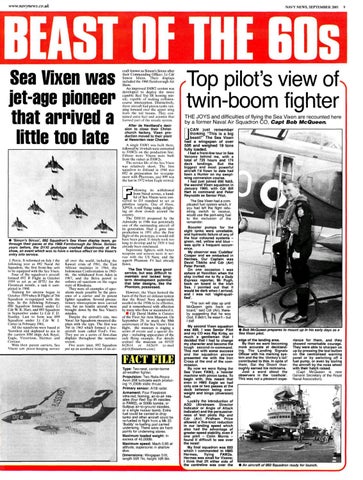
JHE SEA VIXEN was the first of the Royal aircraft to be designed as a U 'weapons weapons system' that included airframe, sensors and weapons. It was also the first British fighter to enter service without guns and an all-missile armament. And it was the last of de Havilland's twin-boom designs.
.
"
1T
Even hr contemporan- standards it had an extraordinan a 194i) period and stemmed originally long de 1-lavilland proposal to the Admiralt lor an advanced. all-weather fighter.
from
gestation
Specification N4('46 was written around this proposal in January 1947. together with the similar F44J46 specification for tile RAF. Prototypes of both night fighter and strike versions were ordered in 19-19, but the RN cancelled its interest later in the year and ordered the more eonservai is-c Sea Venom into production. Prutotpcs were built to the original D1 11 II) design. the first hcin flosn for the first WG23( ii rile on Sc p1enlher 2(i. 195 1
"-
A year later it made headlines in the most unfortunate way imaginable - it broke up during a display at Air Show, Farnborough killing test pilot John Derry and observer Tony Richards, and 29 spectators on the ground.
" An FAWI being catapulted from the angled flight deck of HMS Eagle during trials in the Channel in 1964. ~m."~t Air Ann Museum
In the wake of the accident the RAE bought the rival Gloster design that became the Javelin, and the Navy focused on a 'super Sea Venom' with the designation 1311110. But dc llavilland had insufficient capability to take the design iorss-ard and so offered a revised D11110 as a Sea Venom
J
-
I
b
replacement. A single prototype was ordered in February 1954, followed in January 1955 by an order for 7$ production aircraft to M k I Standard. the name Sea Vixen was selected a 95", the first Sea Vixen FAW I at XJ474 built being Christchurch and first flown on March 20. 1957.
yr
Because radar early screens were better viewed in darkness, the observer sat in an enclosed space to the pilot's right, his only view being through a small, square window to his right. The pilot's cockpit was offset to port.
-
M,,mmmomm-
now~
" An FA W2 refuels in flight from another FAW2. This capability greatly increased the Sea Vixen's 'reach'. The aircraft are from 899 Squadron flying from HMS Eagle in 1968.
I ?'-
? I
of Vixen FAW2 " A Sea dropping 899 squadron bombs four 5001b ses bsession. practice Air 么.rmMU5m picture. Fleet
I-
C-,-'
Both crew member,, had ejection seats. but in the early version the observer had to jettison his hatch first, the scat being unable to eject through it. Later versions had a lrangihlc' hatch through which the observer could eject. The Intensive Flying Trials Unit (I F1'U I. 7001 Flight, formed at RN air station Veovilton in Nin-emhi I)5' tinder (dr NI. I
www.navynews.co.uk
NAVY NEWS, SEPTEMBER 2001
Sea Vixen was
jet-age pioneer that arrived a little too late 4kb
4 4
4
" 'Simon's Sircus 892 Squadron's Sea Vixen display team, go through their paces at the 1968 Farnborough Air Show. Sixteen yea, before, the DuO prototype crashed disastrously at the show, an event which was to have a serious effect on the Vixen's entry into service. J. Petric. It reformed on July 1 the following year as 892 Naval Air Squadron. the first front-line unit to he equipped with the Sea Vixen. Four of the squadrons aircraft formed 892 B Flight in October 1959 to act as an IFTU for the Firestreak missile, a task it completed in 1960. Training for aircrew began in October 1959 when B Flight of 766 Squadron re-equipped with the type. In the following February. 890 Squadron formed under Lt Cdr W. R. Hart, and 893 Squadron in September under Lt Cdr F D. Stanley. Last to form was 899 Squadron under Lt Cdr W. J. Carer in February 1961. All the squadrons were based at Ycovilton and deployed to sea in the carriers tIM ships Ark Royal. Eagle, Victorious. Hermes and Centaur. With their parent carriers. Sea Vixens saw peace-keeping service
all over the world, including the Kuwait crisis of 1961, the East African mutinies in 1964. the Indonesian Confrontation in 196566, the withdrawal from Aden in 1967. and the Beira patrol to enforce oil sanctions on the rogue state of Rhodesia. They were all examples of operations made possible by the presence of a carrier and its potent fighter squadron. Several interceptions were carried out. hut no hostile aircraft were brought down by the Sea Vixen's missiles. Despite the aircraft's size, two Naval Air Squadrons mounted displays with the type. The first was 766 in 1963 which formed a fiveaircraft team called Freds Five. They put on a series of first-class displays throughout the summer Season. Five years later. 892 Squadron 1)111 tip an acrobatic team of six air-
precau-tionary
craft known as Simon's Sircus after their Commanding Officer. Lt Cdr Simon Idiens. Their displays included the 1968 Farnborough Air Show, An improved FAW2 version was developed to deploy the more capable Red 'Fop IR homing missile, capable of making eul'usioncourse interception. I)isti nctively. these aircraft had pinion tanks running forward over the upper wing from the tail booms. They conained extra fuel and avionics that formed part of the missile system. After de Havilland's decision to close their Christchurch factory, Vixen production moved to their plant at Hawarden near Chester. ..\ single FAWI was built there, followed by 14 which were converted to FAW2s on the production line. Fifteen more Vixens were built from the outset as FAW2s. The service life of the Sea Vixen was relatively short. The first Lacirt, . )it to disband in 1968 was 892 in preparation for re-equipment with Phantoms, and 899 was the last in 1972 when Eagle retired. its withdrawal ollowing from Naval service, a handful of Sea Vixens were converted to 1)3 standard to act as pilotless targets. One of these. XP924, is still flying today. delighting air show crowds around the country. The DH) Ill proposed by the Admiralty in 1946 was potentially one of the outstanding aircraft of its generation. Had it gone into production in 1951 after the first flight of the prototype. it would still have been good. It simply took too long to develop and by 958 it had already been outclassed. Supersonic fighters with better weapons and sensors were in service with the US Navy, and the superb Phantom F4 had already flown. The Sea Vixen gave good service, but was difficult to maintain and lacked longterm development potential that later designs, like the Phantom, possessed. However, the Vixen formed the basis of the fleet air defence system that the Royal Navy desperately needed in the 1950s to he effective, and is remembered with affection by many who flew or maintained it. " Cdr David Hobbs is Curator of the Fleet Air Arm Museum. On September 29. to mark the 50th anniversary of the Sea Vixen's first the museum is staging a flight, series of events and a special display including appearance of the only flying example. For details contact the museum on 4)1935 842614 or 842(119 (c-mail tl('(OllI(ti'i,,.(( 'OI I !tf(
"flum Type: Two-seat, carrier-borne all-weather fighter.
Propulsion: Two Rolls-Royce Avon 208 turbojets each producing 11,2301b static thrust. Primary sensor: Al18 radar. Armament: Four Firestreak infra-red, homing, air-to-air missiles (four Red Top IR missiles in FAW2), or 500lb bombs, or Bullpup air-to-ground missiles, or a single nucear bomb. Extra fuel could be carried in drop tanks and other aircraft could be re-fuelled in flight from a Mk 20 Buddy' re-fuelling pod carried underwing. There were six hardpoints for underwing stores. Maximum loaded weight: In excess of 45,00db. Maximum speed: Mach 0.95 at altitude, supersonic in shallow dive,
,
Dimensions: Wingspan Sift length 55tt 71n, height loft gin,
Top pilot's view of twin-boom fighter
THE JOYS and difficulties of flying the Sea Vixen are recounted here by a former Naval Air Squadron CO, Capt Bob Mc Queen. CAN
remember just thinking 'This is a big j beast!" The Sea Vixen had a wingspan of over 50ft and weighed 19 tons
fully loaded.
I had a front-line tour in Sea Venoms behind me, with a total of 725 hours and 174 deck But the landings. biggest and most powerful aircraft I'd flown to date had been a Hunter on my sweptwing conversion course. I had just joined 890 NAS, the second Vixen squadron in January 1960, with Cdr Bill Hart in command and Peter Reynolds as Senior Pilot. The Sea Vixen had a complicated fuel system which, it you had left the flight refuelling switch to receive, would use the port-wing fuel to the exclusion of the remainder. Booster pumps for the eight tanks were unreliable, and hydraulic failure of any of the four coloured systems green, red, yellow and blue was quite a frequent occurrence. My observer was 'Cuddles' Cooper and we embarked in Hermes. Our Captain was David Tibbits and Cdr (Air) Peter Perrett. On one occasion I was ashore at Yeovilton when the ship invited me to fly a Daily Express reporter, Mr Pugh, back on board in the Irish Sea. I pointed out that it would be dark when I arrived, and I was not 'night-qualified'. The sun will stay up until McQueen gets back on board," said Cdr (Air), thereby suggesting that he was God. It didn't, he wasn't - but I did! My second Vixen squadron was 899. I was Senior Pilot and my CO was Rip Kirby, so much a gentleman that I decided that I had to change my character and become the tough second-in-command. This met with some success and the squadron aircrew presented me with the Iron Cross at the end of the commission. By now we were flying the Sea Vixen FAW2, a heavier machine with pinion tanks. To begin with, this meant that even in HMS Eagle we had only one or two passes at the deck between being overweight and bingo (diversion) fuel. Luckily the introduction of ADD Director (Alrstream Indicator or Angle of Attack Indicator) and the persuasiveness of test pilots Rip and Cdr Pridham Price (Air) allowed a five-knot reduction in our landing speed which also had the advantage of greater speed stability, even if one pilot - Cohn Morris found it difficult to see over the nose! My final squadron was 893 which I commanded in HMS Hermes, FAW2s. flying Hermes was small for Vixens; I think that 2ff either side of the centreline was over the
" Bob Mc Queen prepares to mount up in his early days Sea Vixen pilot. edge of the landing area. By then we were becoming more accurate at deckland!rig . The Landing Signals Officer with his marking system and the the 'donkey's tail' contributed to this. In spite of them, Dai the Divert thoroughly earned his nickname. Just a word about the observers in the 'coalhole'. This was not a pleasant expe-
"
-
as a
rience for then,, and they showed remarkable courage. They were able to sharpen us up by pressing the test button on the centralised warning panel or by switching off a fuel pump, or even by taxiing the aircraft by the nose wheel with their hatch raised. McQueen is now (Capt General Secretary of the Royal Naval Association).
t
0 An aircraft of 893 Squadron ready for launch.
9
www.na vynews .co .uk
NAVY NEWS, SEPTEMBER 2001 Options
People in the News Six-shooter Gary is star of Uckers board
York's commanding presence NINE of the 11 former commanding officers of the Type 42 destroyer HMS York attended a reunion on board hosted by the current CO, Cdr Paul Porter. The former COs, led by the senior excommanding officer, Admiral Sir John Brigstocke, were able to 'christen' a new set of crockery which the guest of honour and ship's sponsor, Lady Shona Gosling, had bought for the ship.
showcase COMPANY
With three ranges, forty six standard sizes, and prices from as little as £ 10 'The Showcase Company' ^ offers: Three sizes of base moulding in four different colours Nine base finishes Flush bottom, ball foot or arched foot base All glass, framed glass or shatterproof acrylic cases Choice of glass or mirrored back
• Gary Agaro is well on the way to beating Lt Cdr Keith Creates at Uckers at the Beach House on Andros Island.
The Showcase Company' "* offers the foll<n ing advantages: No witness mark on shatterproof acrylic cases Heavier gauge than injection moulded cases Wider choice Any size of case made to order For your brochure and price list contact us Or write to. Unit 7 Marsh Mill. Luck Lane. Marsh. Huddersfield HD3 4A
at.
:ompa ny.co.uk www.tnesnowcasecompany.co.UK Tel OI484 S4I866 Fax 01484 544
--HOW TO ADVERTISE: Simply write your message (£10 for up to 10 words. Each extra word £ I to a maximum of IS words). Send your cheque or PO payable to 'Navy News' to: ' 'Penfriends', Navy News, HMS Nelson, Portsmouth PO I 3HH. Replies to your box number will be forwarded on daily. (Payment by credit card/switch please use coupon on page 4 ). HOW TO REPLY: Any person who writes to an advertiser must use a stamped envelope bearing the advertisers box number clearly in the bottom left hand corner. The tetter should then be enclosed in a second envelope and addressed as above. We cannot guarantee that unstamped letters will be redirected.
Please note... you must be over 18 to advertise in this column
Name: .............................................................................. Age: Address: .......................................................................................
Tel. No.: WORKAHOLIC, (ACCOUNTS), thoughtful, early 40's, slim,
brunette/green,
female.
W.L.T.
correspond with genuine Officer. Box Sept 1
male
SUM, PRETTY, AIR HOSTESS (25). Seeks single, genuine Sailor/Office for relationship/letters.
Box Sept 2 ROYAL MARINE 28. blond hair, blue eyes. Seeks honest, genuine lady. A.L.A. Box Sept 3 FEMALE, SEEKS MALE PALS Lonely, G.S.O.H. Hobbies cycling, thoughtful music. Box Sept 4
5'7", SINCERE, CONFIDENT, outgoing. W.L.T.M. similar Officer/Marine for friendship, possible relationship. Box Sept 5
FUN LOVING GIRL seeks pen pals. "Lonely" "Gel Box Sept 6
writing" soon.
SUE, 40. ATTRACTIVE brunette, G.S.O.H. Seeks Sailor/Marine
penpals aged 37^2. Box Sept 7 AMANDA 26. TALL, brown eyes. Seeks penpal w i t h G.S.O.H. for friendship/relationship. Box Sept 8 ATTRACTIVE, LONG BROWN HAIR/eyes. Seeks a nice guy, Navy/Marines to correspond/meet with. Box Sept 9
LADY, MID 30'S, would like Navy Penfriends from H.M.S. Dulverton and other ships. A.L.A. Box Sept 10 SEEKING PENPAL FOR friendship. Love reading and music. Photo appreciated. Box Sept II
SINGLE LADY, EARLY 40'S. Seeks genuine penpal, 30+. G.S.O.H. essential! Box Sept 12
SINCERE FEMALE, likes theatre, various music, G.S.O.H. Seeks
genuine penpals. Box Sept 13 MIDLANDS, DIVORCED professional lady 46. Seeks honest genuine friendships/relationships.
Box Sept 14
FIONA 33, DARK HAIR, S'11" G.S.O.H., Exeter. Seeks genuine guy for friendship/relationship. Box Sept IS CIVILIAN LADY, 40 years. Seeks genuine Naval Penpal(male) 44+. Possible relationship. Box Sept 16 I'M BUBBLY, big blue eyed and blond, S'61/2". Divorced, children. Box Sept 17 BEE 52. SEEKS gentleman who wants romance and love back in his life. Photo please. Box Sept 18 SHAZ, 34. BUBBLY, nutty, fun, blond, S'5". Sussex area, G.S.O.H. Box Sept 19 "BUB", LOOKING FOR her medic would like to correspond with a MA. Box Sept 20
together as pen friends. Get to know a companion or partner, like yourself, before you meet. Just exchange letters until you feel comfortable with your new friend. Details: SAE; Linkline (NN), Box 7358, LONDON N1 5QF.
PENPAL MAG for adults, choose yourself a new pcnfriend from over 500 photos. APPROVAL copy from MATCHMAKER, ( A I O ) Chorlcy PR7 4BS. or ring OI257 4X0155 (24hours)
NOTICE
All advertise men Is submitted tor entry into the Navy News Pcnfriend Column are subjected to copy approval. Navy News reserves the right to make any amendments which it considers necessary or to edit copy which is in excess of the number of words paid for.
Please note: We can lake no responsibility for the nature or source of the replies received. You must be over 18 to advertise in this column.
being held together with string, with bottle lops for counters. With his astounding six-throwing prowess unchallenged. Lt Cdr Keith Creates (DPA Abbey Wood) and WO Tim Capcl (MWC) presented Gary with a new Uckers board during this year's trials. Gary - also renowned for his rum punches and support of West Indies cricket - promptly eightpieced Lt Cdr Creates with another
incredible display of six-throwing.
Diver rewarded for his bravery A ROYAL Navy sailor who dived into the harbour in Gibraltar to try to rescue a man trapped in a collapsed crane has been presented with . the Queen's Commendation for Bravery. Diver Baz George, of the Gibraltar Squadron and Clearance Diving Element saw the incident, in which a crane toppled into the harbour while being operated on the South Mole (Navy News, May). The crane was left half submerged, partly snagged on the jetty, with the badly-injured driver trapped with his head just clear of the water.
Baz, a trained diver medic wearing only a T-shirt and shorts, stayed in the water with the trapped man, helping and reassuring him u n t i l the emergency services arrived. The driver later died of his injuries. Speaking after the presentation of the award, by Commodore Andrew Willmet, the Commander British Forces Gibraltar, Baz said the commendation was lor the whole clearance diving team who all played a part in supporting his own actions and efforts. Recently selected for promotion, Baz returns to the UK in September to join Southern Diving Unit 2 before starting his Leading Diver course.
• Cdr Phil Shaw.
• Diver Baz George.
FIVE senior ratings from HMS Raleigh, with a combined service of more than 150 years, were awarded Meritorious Service Medals by the Second Sea Lord, Vice Admiral Peter Spencer, on board his flagship HMS Victory. The five were CPO Fred Dinsdale (33 years), WO Alan Bonas (33 years), WO Brian Taylor (29 years), WO Stephen Houghton (27 years) and CC Jeffrey Curran (31 years). The prestigious medal is awarded for exceptional conduct throughout an individual's Service career of more than 27 years.
defied all conventions to marry his bride on Friday 13. WEA apprentice David, who is undergoing the Artificers Qualifying Course at HMS Collingwood in Fareham, married Rachel on board HMS Warrior I860 in Portsmouth Historic Dockyard - and the day passed without incident. David's colleagues Martin Short and Owen Cameron assisted throughout the ceremony.
Admiral is an Elder Brethren A SENIOR Royal Navy officer has been sworn in as one of the Elder Brethren of the Corporation of Trinity House, London. Rear Admiral Jeremy de Halpert, Naval Secretary and Chief Executive of the Naval Manning Agency, was sworn in at a court meeting in London. The corporation is a marine charitable organisation, the general lighthouse authority for England, Wales, the Channel Islands and Gibraltar, and a deep-sea pilotage authority.
Swordfish pilot flies past the 10,000 hour mark PHIL Shaw has notched up his l(),0()()th flying hour - a record for any Royal Navy pilot - in one of his favourite aircraft, a Swordfish of the Historic Flight.
Ratings notch up 153 years
All goes well Friday 13 PERSONAL on NAVAL rating David Kcrswell LINK LINE is a British Registered Charity committed to bringing people
SIR GARFIELD Sobers may well be remembered as the greatest West Indian six-hitter, bul the greatest six-thrower in those parts is undoubtedly Gary Agaro, bar manager of the Beach House on the Atlantic Underwater Test and Hvaluation Centre (AUTEC) on Andros Island in the Bahamas. Gary has been playing Uckers, the traditional Royal Navy board game, against Britons since the range opened in 1965, and his board was starting to show its age -
Cdr Shaw (51) reached the milestone on July 27, after 32 years in Naval aviation. Phil's first flying hour was a grading flight at Roborough in a Chipmunk, an aircraft on which he has remained current ever since. He has flown 35 aircraft types since, including the Tiger Moth,
Sea Fury, Grumman Avenger,
• Rear Admiral lain Henderson with Lt Cdr Dave Acland, Commanding Officer of 801 Naval Air Squadron.
Farewell visit for departing Admiral A DEPARTING admiral has paid a farewell visit to the air station he commanded in the mid1990s. Rear Admiral lain Henderson, Flag Officer Maritime Aviation and Air Officer Commander 3 Group, called at RN air station Yeovilton, Somerset, where he
was station commander from 1993 to 1996. The Admiral, who is leaving the Navy after 36 years service, visited Yeovilton's Sea Harrier, Lynx and Commando Helicopter Force communities, and went for a final flight in a T8 Harrier of 899 Naval Air Squadron.
Hunter, Canberra, Vampire, Hiller and Whirlwind, and he has more than 5,000 hours logged on Sea Kings alone. His flying has been done from more than 20 ships around the world, and a number of his sorties have been life-saving rescues. Phil has commanded two squadrons - 826 Naval Air Squadron (Sea Kings) and 360 Squadron (RAF Canberras). Many Royal Navy helicopter pilots were trained by Phil, including the Duke of York - whom he described as "the best student I ever had - and I'd say the same if he was the son of a dustman." Phil is due to leave the Service at the end of August to fly Airbus for GB Airways, but he will continue to fly for the Royal Navy for a further two years as pilot of the Historic Flight's unique Sea Fury.
Hero joins Band of Brothers A 'BAND of Brothers' from HMS Ganges rearranged their annual get-together in Portsmouth to fit in with the travel arrangements of one of their number. The band - who took their name from a memoir by member David Phillipson - are from 19 Mess Grcnvillc Division, January 7, 1947, and number 18 at present. They know a further eight of their former colleagues have died. This year's gathering, at the Royal Sailors Home Club, was brought forward to June, from September, so as to coincide with a visit to the United Kingdom by
Alf Lowe, who emigrated to New Zealand in the 1960s after a career in the Royal Navy. Alf was a Boy Seaman who won the Albert Medal for bravery through his actions during an incident in Portland Harbour. A loaded liberty boat from HMS Illustrious was caught in bad weather and capsized, throwing the occupants into the rough seas. Alf rescued a midshipman who was taken ashore, although the young officer later died. Any other ex-members of 19 Mess who would like to join the Band of Brothers should contact Brian Bolton on 01295 680753.
www.navy new s .co .uk
NAVY NEWS, SEPTEMBER 2001
Options
People lit the News Civic award Sponsors visit 'their' ships recipient is last to know
Cattistock officer wins prestigious award
to her ship as it was commissioned -
A JUNIOR officer who now serves in HMS Cattistock has been
lan
Since being accepted by the Navy from Vosper Thornycroft, Blyth has been
Garnett, Chief of Joint Operations, Commodore Clapp, Commodore MFP,
undergoing trials. She also made an informal visit to her
presented with the prestigious Queen's Sword by the Sultan of Brunei at Britannia Royal Nacal College, Dartmouth.
S/Lt John Boullin, who passed out from Dartmouth at Christmas, was deemed the best young officer of the past year - the sword, supplied by Wilkinson Sword, recognises excellence in study and
learning within the Navy. The sword is based on the original 1805 Navy design, with singleedged straight blade, a gold-plated brass hilt and a lion pommel backpiece - and it provides S/Lt Boullin, who is completing his training on the Hunt-class minehunter - with a tangible reminder of his achievements to date.
WO's varied career wins recognition A SENIOR rate whose recent tasks range from lecturing on how to avoid collisions in submarines to protecting VIPs at Wimbledon has won a prestigious award for exceptional service in the Navy. WO 'Bud' Abbott joined up in 1969, opting for the Submarine Service in 1973. Promoted to CPO whilst serving in HMS Spartan during the Falklands conflict, he served in two other submarines - Splendid and Conqueror - before making Warrant Officer in the early 1990s. He spent three years on the team of the Second Sea Lord's Officer Study Group, before moving to Farnborough as consultant to DERA on tactical analysis. In 1999 Bud went to NATO HQ at Northwood, where he chairs a team of submariners whose task is to develop a submarine system that prevents underwater collisions. This takes him abroad to lecture and teach - this year alone has taken him to the USA (twice). Norway, Denmark and Italy. He was also the Officer in Charge of a team of 40 in the Royal Box at the Wimbledon tennis championships - his duties included the security of members of the Royal Family and VIPs.
11
THE SPONSOR of HMS Blyth paid a visit
and Cllr Joe Newman, the mayor of Blyth Valley in Northumberland.
The commissioning cake was cut by
and HMS Middleton's sponsor has called on her ship for the first time in 17 years.
The penultimate Sandown-class vessel was commissioned in Portsmouth.
The Ven Simon Golding, Chaplain of
the Fleet, conducted the ceremony, which was attended by sponsor Lady Charlotte
Garnett,
Admiral
Sir
home town of Blyth in early June, where she attracted more than 2,000 visitors. • LADY Blaker visited HMS Middleton -
Mrs Jill Landrock, the wife of Blyth's Commanding Officer Lt Cdr Graham Landrock, and by SES Sam Mapstone,
the first time she has visited the ship
the youngest member of the ship's company.
first Armed Forces Minister between
Hunt for Hood stirs
since she launched it in 1984.
Lady Blaker, wife of Lord Blaker, the
^^ I
MEMORIES of the mighty Hood have been stirred once again as pictures of the smashed wreckage in the depths of the Denmark Strait were screened by Channel 4. Ted Briggs, the last survivor of the battle cruiser, was taken on an emotional journey out to the spot where 1,418 of his friends and shipmates died on May 24, 1941. Ted was one of just three who lived to tell the talc, and he was invited to lay a wreath by the TV team of Hunt for the Hood, who used remote-controlled sonar to
pinpoint the wreck. Now others who had supporting roles in the gun duel between the opposing forces, and the subsequent search and destruction of Hood's nemcsis, the Bismarck, have told Navy News of their recollections. James McLcan was on board HMS Rodney, and his position at action stations was in the torpedo body room, preparing the weapons for the battle. Rodney carried 24/:in torpedoes, and it was one of these weapons which helped cripple the German battleship. Once the torpedoes were fired, James said he was told to report to the Electrical Damage Control Party forward of the Wardroom, but he and a shipmate made their way via the upper deck. "We had a grandstand view of the Bismarck on our port beam being battered by both Rodney's and King George V's main arma-
• ^^ ^^
ment," he said. "There were quite a number of Bismarck's crew in the water and others jumping over the side. "It was a terrible scene that one cannot forget." The fact that Rodney had helped destroy Bismarck may be down to an incident which came to the attention of Gordon Whybrow, who was a Navy telegraphist at the time. Gordon was in a radio station with three other operators in Malta, receiv-
sen as the Helensburgh and Lomond Citizen of the Year for his work in setting up and running
Brothers meet up...
the Beacon Trust. But the award was decided while submariner Trevor was still
at sea. The award, bestowed by the
TWO BROTHERS with a
Helensburgh Advertiser in conjunc-
combined service of 32
tion with Helensburgh and Garelochside Rotary Club, recognises the work of unsung heroes. Trevor founded the Beacon Trust almost six years ago, working on behalf of the ecumenical churches in the area and providing basic furniture and household items free of charge for those in need. Anyone who can help can contact the Trust on 01436 674077.
years have met for the first time in uniform. Dave Harris (left) is Master-at-Arms on board HMS Coventry, and has 21 years in the Navy, while his brother, LMA John Harris
exercised her right of freedom to
(right), is studying to become an operating theatre nurse after 11 years service. They
met
at
the city - John was there in the
guise of medical support, and enjoyed the hospitality of the ship's company.
Coventry
Baby born in serve together RN helicopter
BIG BIG brother brother willwill be bwatche watch-
I
"
"
?
A
ing LOM Dean Marshall on HMS Trafalgar - Dean's older brother Paul is the submarine's Coxswain.
*<• A BABY has been born in a Royal Navy Sea King helicopter -
believed to be the first such incident in a British military aircraft. The Mk 5 search and rescue helicopter from 771 Naval Air
Paul (right) joined the Navy and Submarine Service in 1983 as a tactical systems operator, with HMS
Sealion being his first boat. He transferred to the Coxswain Branch last year having served as CPO(TS) is HMS Trenchant. Dean (left) joined up in 1987,
moving to the Submarine Service a year later - but this is the first time the two have served together. Both live with their families in
the West Country, but originally hail from Nottingham.
Squadron, based at Culdrose in Cornwall, was called to the Isles of Scilly to airlift Mrs Niki Burns to hospital in Truro after doctors grew concerned at her unborn child's falling heart-rate. The 9lb baby was horn without problems shortly before the aircraft touched down.
ing signals from around the world and passing them to
the HQ at Lascaris, and they were occasionally visited by Admiralty neers.
wireless
engi-
INJURED?
On one visit, one of the engineers told Gordon that the older of two Mr Hcatons who accompanied him - who were not related was on a listening watch on a frequency known to be used by Bismarck for encrypted messages. On sinking the Hood, a message was sent by the jubilant German captain - and picked up by Mr Heaton, who got a direction on it. At first his supervisors refused to believe it, as the German battleship was believed elsewhere, but he finally insisted, and an aircraft was sent from Portreath and the Bismarck sighted heading for Cherbourg. Mr Whybrow wonders if anyone can corroborate this story?
Compensation? ToPaS CAN HELP!
New bunch of phots are developing SIX MORE ratings have passed the exacting 27week course to join the Royal Navy's Photographic Branch. The ratings undertook the three-phase course at the Joint School of Photography at RAF Cosford. The first clement, of 12 weeks, teaches basictheory of light, optics and image formation and theory skills of photography, before moving on to camera handling, defect photography, processing and printing. Phase two is a digital course, providing students with a high level of understanding using cameras and computers. The final 13-week phase looks at public relations and advanced photography, looking at how to cover VIP visits, hometown stories, minor news events, portraiture and advanced camera work, both conventional and digital. • The new LA(PHOT)s are (back row, from left) Paul Punter, Mez Merrill, Budgie Burgess; (middle row)
row)
last to find out about it. CPO Trevor McGrath was cho-
ed Lady Blaker with a bouquet of lilies.
HlfilflflPlfiS - and ^^ I I I
charity work - yet was one of the
Commanding Officer, Lt Cdr Mark Hart. Lt Cdr Hart and S/Lt Ben Day present-
Cathedral, when HMS Coventry
III
A FASLANE submariner won a prestigious civic accolade for his
1979-81, recalled the launch of the Huntclass vessel with officers, including the
Billy Bunting; (front
Gordon Bruce and Sean Clee.
ToPaS, is a new 'no win, no fee' legal service providing a personal injury accident claims facility, at no expense, to MoD personnel nationwide. For decades our caring professional team has recovered millions of pounds annually for victims of every type of accident. We handle minor to catastrophic injuries. CONTACT THE SOLICITORS WHO SPECIALISE IN PERSONAL INJURY ACCIDENT CLAIMS
BEJESH p(~)y
{{.CO
SOLICITORS
0161 832 6131 E-mail ToPaS@beteshfox.co.uk Websites www.ToPaS.org.uk www.beteshfox.co.uk Members of the Law Society Personal Injury Panel and the Association of Personal Injury Lawyers
OFFICIAL MaD SCHEME (DCI GEN 273)
12
www.navynews .co .UK
NAVY NEWS, SEPTEMBER 2001
Options
SEADOGS HAVE THEIR DAY FOR DISTINGUISHED SERVICE
Thereby hangs a tail - OP two TERLING service by two special seadogs has been recognised this summer.
S
sea. Trained to sniff out explosives and drugs,
the flight deck (see left). The second 'top dog' was the survey ship HMS Bulldog, retiring after 33 years' service that rounded off as it had started, with a deployment to the Gulf. Around a dozen former Commanding Officers - including a father and son - attended the decommissioning at Devonport, where First Sea Lord Admiral Sir Nigel Essenhigh spoke of the happy memories he had of the ship during his time as Hydrographer of the Navy.
Castor was abseiled, with his handler, on to the deck of a target ship from a German search and rescue Sea King helicopter which
served in the wartime HMS Bulldog when she captured an Enigma code machine from U-110
The first was a Swedish sniffer dog called Castor, embarked in HMS Campbeltown during operations in the Baltic. Within two weeks of his arrival, he made such an impression on the ship's company that he was awarded a Good Conduct badge. Castor, a German Shepherd, came on board with a 13-strong Swedish boarding team - the first time they had spent a prolonged period at
was also embarked in the Devonport-based frigate.
Later he was winched in a harness on to ships from a Swedish CH46 helicopter based in RFA Fort Victoria. So impressed was the Commanding Officer of Campbeltown, Capt Alistair Halliday, that
Legion sets up Force 1 A PILGRIMAGE to the Far East to mark the 60th anniversary of the sinking of HM ships Repulse and Prince of Wales is being organised by the Royal British Legion's travel service. Force Z - the battlecruiser Repulse and battleship Prince of
Wales - was deployed to the Far East as crisis loomed in 1941. Caught without air cover, both ships were sent to the bottom in a massive air strike off the coast of Malaya on December 10, three
days after the Japanese attack on Pearl Harbor. Many members of the ships' companies were rescued, but 840 perished, including the Force commander, Admiral Sir Tom Phillips, and Capt Leach, Prince of Wales' Commanding Officer. The RBLs Remembrance Travel is organising the eight-day trip for anyone who wishes to join the pilgrimage on November ft-13, during the Armistice commemorations. The visit is being arranged with the advice and support of the Royal Navy and the British High Commission in Kuala Lumpur. It will include a boat trip from Kuantan so that relatives and survivors can lay tributes in the water above the wrecks of the ships.
Those who wish to extend their stay - for example, in Singapore can do so. For details contact Remembrance Travel, Royal British Legion Village, Aylesford, Kent, ME20 7NX, tcl Olf>22 716729; fax on 01622 715768, and c - m ail, r c m e m b r ancet r a vel@ britishlcgion j>rg .uk
Castor was awarded his second Good Conduct badge at a requestmen table held on
York m
back into her city's hearts
Among the guests were John Pegg, who - and Jack the bulldog, mascot for the day, seen above after giving AB Nick Woosey a very moist farewell... 'J Bulldog's last Commanding Officer, Lt Cdr Adam James, has taken command of the coastal survey ship HMS Roebuck, now in the Gulf in advance of the main task group for Exercise Saif Sareea.
URING a busy six-day visit to its affiliated, namesake city, HMS York exercised the right - last done only a year ago - for the ship's company to march through the streets with "Colour flying, swords drawn, bayonets fixed, drums beating, bugles sounding and bands playing. Large crowds watched the parade outside York Minster and lined the route past the Mansion House. There was also the opportunity to make significant contributions to ship's charities and the local community. Galtres School, for young children with learning difficulties, was presented with £2,000 at an evening concert by the Royal Marines Band of Scotland in aid of the school at the Grand Opera House. Commanding Officer Cdr Paul Porter also accompanied the Lord Mayor on a vsiit to the school where he unveiled a plaque marking the ship's donation - which has paid for a hi-tech electric awning. York District Hospital Children's ward was visited by the CPOs' Mess and a donation of over £600 from onboard fundraising was made to buy new TV and video equipment. The POs' Mess called at St Leonard's hospice to hand over £500 raised by an onboard games night and sponsorship of PO(R) Alf Newman in this year's London Marathon. The ship was inundated with local people during Ship Open to Visitors and a further £177 was raised by LS Andy
Burlington who raffled one of his superb knotboards for Galtres School - whose children also visited the ship at her berth at Hull. The York Lions Club also visited and gave £250 to the school. Army and RAF affiliations in the area added further spice to the visit. Army personnel from Imphal Barracks provided stern opposition to the ship's sports teams - York won the hockey match but were beaten at football and golf. Meanwhile 100 Sqn at RAF Leeming generously offered two Hawk flights to be raffled for the ship's company - CCMEA Cat Stevens and CPO(Sea) Wayne Godden, the Chief Bosun's
Mate, were the lucky winners - and a further £100 was raised for Galtres School. Said Cdr Porter: "We have had a fabulous welcome in York and Hull - all our old friends have looked after us superbly and it was great to contribute so much to the local charities and repay the community's hospitality." • Earlier HMS York had been visited by the First Sea Lord, Admiral Sir Nigel Essenhigh - who presented the ship's PWO(A) Lt Paul Beattie with the Grykiken and Beresford gunnery trophies.
New history unit at King's A NEW Naval History Unit is to be set up at King's College London for
studies by undcr-graduates, post-graduates and researchers. The unit, made possible by a generous private donation, will complement the existing tradition of military and defence education provided by
King's for over a hundred years. To enable the best research students to go to King's, scholarships will be available. The unit will be named after the founding father of naval his-
tory, Prof John Knox Laughton (1830-1915) who taught at the college between 1885 and 1914. Director of the unit will be Prof Andrew Lambert.
www.navynews .co .uk
NAVY NEWS, SEPTEMBER 2001
Options
rrlj Solutions
:ff
Defence
INC A becomes BT Ignite Solutions. delivering a world of opportunity. The Defence community now has a new, dedicated highway to BT inspiration and capability - BT Ignite Solutions. DFTS Team:
arconi
IOCKHCCO
M O R T I N
To accelerate delivery of leading-edge communication solutions to Defence, we are combining our experience of Defence Fixed Telecommunications Service (DFTS) achievements with the expertise of BT Ignite Solutions in leveraging new technologies. Now Defence has the power to unleash the potential of advanced communications.
The possibilities are truly exhilarating. You now have faster, wider access to a vast, innovative resource - offering a world of opportunities. BT Ignite Solutions for Defence are committed to bringing you the very best ICT solutions the commercial world can offer. For more information
Tel: 0113 203 6434 email: info@btignitedefencesolutions.com www.btignitedefencesolutions.com
13
14
www.na vynews .co.uk
NAVY NEWS, SEPTEMBER 2001
Options
Moftevwise
Motor Insurance with Portside Risk cover
Watch for a sting in the bankruptcy tail
Call into your local branch of NAAFI Financial or call us on: 00800 76 76 77 77 /-»***, ^^ F'Kt frcm UK & Germany ( NAAFI +44 1603 205 209 \nnancial)
w
www.naafi-financiai.com
FORCES, EX-SERVICE PERSONNEL WOUNDS? DISEASES? INJURIES? CAUSED BY SERVICE?
HILE bankruptcy is the State's acknowledgement of giving the debtor a new start there is a sting in the tail which is not widely known.
This is that during the period of bankruptcy any money earned in excess of one's basic living requirements can be sought by the Official Receiver of the Insolvency Service - pan of the Department of Trade and Industry - to meet his or her costs and make restitution to one's creditors.
a/so INDUSTRIAL INJURIES, DISEASE AND PERSONAL ACCIDENT CLAIMS
You may be entitled to
COMPENSATION CALL THE CLAIMS SPECIALISTS!!! CALL FREEPHONE 0500 22 20 22 NOW!!!
,————~"
.^••••MMlJI^^^B
Specialist legal advice to the Armed Forces in: Family/Childcare -Wills, Probate and Trust Conveyancing, Mental Health - Personal Injury Clinical Negligence - Financial Services Courts Martial
Call 01329 825617
("OFFIN
MEW&
FREE initial advice in many instances
C_I_O\/ER
www.coffinmew.co.uk
TO
Normally all assets are sold and any legacy which becomes payable during the bankruptcy is included as part of the bankrupt's estate. Also the bankruptcy is recorded with the credit agencies Equifax and Experian for six years. That means that it credit, including a mortgage, is granted after the bankruptcy period is ended, it is usually subject to a higher interest rate than normally available, and is described as sub-prime lending. The two-year period of bankruptcy only applies when the debtor petitions to the court for their own bankruptcy order by paying a £370 fee and the amount owed is under £20,000, when the
THORN COMPENSATION SERVICES LTD • MARSH HOUSE 92A MARSHLAND ROAD • MOORENDS • DONCASTER DN8 4SZ
75 Tourer from £12,783 tax free export(£14,999 tax paid UK home use)
dip.mil.tfs®pendragon.uk.com -we buy your used car-
MG ROVER MILITARY SALES
FCL
Follett 18 Berkeley Street. Mayfair. London W1J 8NF Tel: 0870 333 1824 Fax: 020 7629 9005
For FREE Confidential Advice call our trained professionals
now!
"Employment Problems/ Redress by Complaint? " " Need Help and legal Advice " If you're in the ForCGS there's a fast way to make contact with a solicitor who'll speak your language. The Forces Legal Legal Network is a national group of established, independent solicitors who all provide:
FREE 30 minute initial diagnostic interviews Staff with experience of service problems Legal Aid and "No Win-No Fee" accident claims 24 hour emergency legal cover A full range of quality assured legal services
r@
Competitive fees
Free advice that works
One call puts you in touch with confidential advice on any service or family legal matter.
open 9.00am - 9.00pm
www.fcl.org.uk
email: @forceslaw.demon.co.uk
FORCES LAW HELPLINE: REF: NN 01/01
The Forces Legal Network
08456011260
'It was in my pay packet!'
court can issue a Certificate of Summary Administration of the estate. Alternatively, if a creditor petitions for the debtor's bankruptcy for whatever amount over £750 (the threshold amount) or the debtor's own petition is over £20.000, automatic discharge is granted after three years, not two and subject to certain conditions being met. And if the bankrupt has been bankrupted previously in the past 15 years, they have to apply to the court for discharge - which can
only be done after five years of the current bankruptcy. With regard to a bankrupt's home, the Official Receiver initially obtains a charge on it, and depending if there is a partner who has a legal interest in it whether registered or not and children, the Receiver then decides on how it is dealt with. For instance, if the home recently has been purchased and there is no equity in it, the partner or any other interested party can buy the Receiver's interest in the property for£l, although there arc legal fees in addition. Alternatively, if there is equity in the home the partner is given the opportunity to purchase the Receiver's interest - 50 per cent of the equity (the amount between the mortgage and market value). The other 50 per cent is deemed already to belong to the partner. If neither situation arises, the property will be sold, delayed up to a year to allow time for rehousing, or, where there are children, when they reach majority age. If there is no other person with a legal interest in your home, the whole of the equity will be vested in the Receiver. With regard to County Court judgments, they are registered immediately after the order is made by the court. However, if the whole amount is paid within 28 days, then the entry is removed from the register. If paid after that time, it remains on the register for six years, marked 'satisfied', and can be treated by potential lenders as an adverse credit entry. Even if the debt has not been paid six years after the judgment date, the entry is removed from the credit agencies' files. However, the claimant can in the intervening period take further enforcement action, such as asking for an oral examination, which means attending court to explain oneself concerning one's finances. The moral to be taken from all this information, which requires specialist consideration, is that professional help should always be sought when one has debt problems.
_ The information used in this article was supplied by Frank Jones (chairman of the HMS Bulwark, Centaur
and Albion Association) of Portsmouth Business Consultants - tel 023 9282 1908 or 0468.
www.navy news .co.uk
NAVY NEWS, SEPTEMBER 2001
Options
I
I
•COM
I
I
I
SHOUL
I
I
THE SA
INSURE OR YOU?*
NN2
If you're tired of getting a raw deal on your motor, home, kit, travel or
So we reflect that in our prices. And Travel cover that will actually pay up
breakdown cover, speak to Affinitas. We provide Armed Forces personnel
if duty calls and your leave gets cancelled right at the last minute.
with a range of exclusive products, including insurance. We've developed them with you in mind, because we understand the way you live.
All pretty logical stuff, you might think. It's just that most companies don't seem to see it that way. To find out more about Affinitas, call us
They include, for example, Motor and Home cover that appreciate your
on the number below. Or, if you're outside the UK, call +44 1206 393 777 and
possessions aren't at much risk when they're secure in a patrolled area.
we'll ring you straight back. Let someone look out for you, for a change.
0800 3161 317 www.affinitas.com
affmitas looking out for you
15
16
www.navy new s .co.uk
NAVY NEWS, SEPTEMBER 2001
To maintain a quality service, calls may be monitored and/or recorded. Applicants must be 18 or over. We reserve the right to decline to open an account for you. Credit facilities are subject to status. Some ATM owners may levy a charge. This will be advised prior to transaction. Written details, quotations and terms and conditions of our products and services available upon request. First Direct is a division of HSBC Bank pic.
Options
no regimented opening hours At First Direct we're no strangers to some of the demands of a career in HM Forces. In fact, we've been on permanent 24 hour, 365 day standby since our launch in 1989. Which means that whenever you want to bank, you can, whatever the time, wherever you are in the world. Without paying a penny in bank charges for your everyday banking.
enjoy our version of active service In addition to free 24 hour, 365 day telephone banking you can also bank on-line if you wish. We also offer a mobile phone text messaging service which sends you mini-statements showing your latest balance - for example "BALANCE 07 JUNE £2000" - it can also tell you when you've been paid or even warns you when you're close to your overdraft limit.
we've decommissioned bank charges Change to First Direct and you'll bank for free - we've declared open war on charges for everyday banking. We'll also equip you with a fee free £250 overdraft, let you pay all your bills over the phone and give you a card which you can use to withdraw up to £500 a day from over 31,000 cash machines across the UK and 560,000 worldwide. Our Visa card offers a great introductory rate for balance transfers - and enjoys the same 24 hour, 365 day service.
join up here, it's easy You might expect opening a First Direct Cheque Account and transferring all your banking across to be a logistical nightmare. But you're forgetting that this is our particular area of expertise. Simply do any of the following... 1... call free and we'll complete the application form with you over the phone
2... complete the coupon and we'll send you everything you need to join 3... visit our website and apply on-line
call us any time quoting ref: BP079
0800 24 24 24 or visit us at
firstdirect.com or return the coupon post to: First Direct, FREEPOST, Leeds LS98 2RF Mr/Mrs/Miss/Ms
Surname______________
Forename(s)_________________________ UK Address
Postcode Telephone No
noun nan
c
innn
BP079
permanent 24 hour standby
m
•.•->••
NAVY NEWS, SEPTEMBER 2001
www.navynews.co.uk
Helping Hands
Options
In Brief THE ROYAL Navy and Royal Marines in Scotland teamed up with Tayside Police and legal firm Thorntons WS to support the Safer Scotland 'Know the Score' campaign against drug abuse. Part of the campaign is to educate youngsters and to encourage them to take up active pursuits. Players from the Dundee U n i t e d Social Club under-Ids team were presented with Know the Score training shirts, match footballs and water bottles at RM Condor in Arbroath. A FIVE-mile run by WO Gary Conniff resulted in the donation of a TV and video system to a Portsmouth centre providing support to people with mental health problems. Gary, of HMS Collingwood, used donations to pay for the equipment, which will be used by Shaw Trust, Harbour Enterprises, for training.
A WORKING party from 702 Naval Air Squadron, the Navy's Lynx helicopter training squadron based at Yeovilton, has helped create a new play area for Grass Royal Junior School at Yeovil. Team leader Lt Catie Nunnen said: 'A large area of the school's grounds had become overgrown and was unusable by the children. "We worked on the heavy tasks, clearing the area so the school will be able to create a new play area in which the children will be able to grow plants." WHEN foot and mouth disease prevented a Gosport school from making a trip to Wales, staff sought a worthwhile alternative. The teachers, from Holbrook Primary School, contacted Lt Tony West - and sailors at HMS Collingwood, led by LPT Jason Hawkins and RPO
Graham
17
Haynes, came up
trumps by organising a sports afternoon for 36 pupils aged ten and 11,
TWO SSAFA Forces Help community volunteers from Gosport arc to trek through an African desert for charity in October. Linda Lee and Norman Young will trek in the Namib Desert to raise funds for Rukba and SSAFA. Linda's husband is serving aboard HMS Campbeltown, while
the sparse conditions on the trek will be no problem for 73-year-old Norman, a former submariner. If you would like to support Linda or Norman, or want to know more about the trek, contact the organisers of 020 7605 4283. MEMBERS of the WO and SR Mess at HMS Collingwood have presented toddlers' toys to the Ranvilles Children's Play Group, Fareham. The centre, which is run by
Kursk children see the best of Scotland CHILDREN of submariners who died aboard the Russian submarine Kursk had their wish granted twiee over when they spent a ten-day holiday in the UK. The ten - ranging from ten to I') - had expressed a wish to see a Seottish castle, hut ended up as guests of honour at two. Originally dreamt up hy wives of Royal Navy suhmariners. the holiday was a joint effort hetween the Navy, the RN/RM Family Association, the RN Chaplaincy
and the Naval Personnel and Family Services. Royal Sailors Rests, the Naval Christian charity, hosted the children at Braeholm, Helcnshurgh, near Clyde Naval Base at Faslane, and many departments chipped in to organise a programme. Time was spent with the MOD at Faslane - home of the Royal Navy's First Suhmarine Squadron - when they met the police dogs and had a trip in a Fleet tender. HMS Caledonia invited the children, who all study English, to Fife for a civic reception, where they received the Freedom of the Kingdom of Fife. A visit to Stirling Castle and the Loudon Castle Fair proved popular, and a hotel hosted them for an afternoon of activities, including a boat trip on Loch Lomond, swimming, quad hiking and archery. The MOD Police took the party to visit Rangers Football Club at Ibrox in Glasgow, and the local Sea Cadets, TS Neptune, held a barbecue in their honour. A surprise was laid on for their final evening when a local man. who had read about their arrival in
a break TEN victims of the Chernobyl disaster in Russia have visited HMS Raleigh during a two-month stay in Devon and Cornwall. The children were brought to the UK by the Chernobyl Children's Lifeline Charily, which aims to boost the damaged immune systems of the children, aged eight to 12, by providing them with plenty of fresh foods, vitamins, clean air and fun. Their visit to Raleigh began with a competition in the swimming pool, followed by a children's party at which Commodore Laurie Brokenshire, the Commodore of HMS Raleigh, delighted his audience with magic tricks. Flagship Catering manager Paul Johnson provided food and fresh fruit, while Lizzie Duck and Jean Bait of SODEXHO Services came up with party balloons and trimmings, along with goodies bags. The children then went to Jupiter Point, the Sea Sense Training Centre, for a boat trip down the Tamar.
Charity amendment i Children of submariners who died in the Kursk tour the Clyde Naval Base at Faslane.
the press, put on a private dinner party for the children in his castle. They were welcomed on arrival by a piper, and after dinner a family played traditional Celtic music. The children have now returned home to Russia. • The Kursk Kids Committee Fund presently stands at around £16,000. with' half of it being money pledged in kind - offers of accommodation, food and so on. The money has been raised through fund-raising events such as sponsored breakfasts and ear boot sales. Just six weeks ago. in midJune when the idea was first discussed, the fund stood at 82p, all that remained after the initial pur-
chase of items for the committee's first fund-raising venture. Any further donations to the Kursk Kids Committee Fund should he sent to the Royal Sailors Rest in Helensburgh - the ten who travelled to the UK represent less then a fifth of the children who lost fathers in the accident. The Kursk, an 18,300-ton Oscar
II-class nuclear attack submarine, sank in the Barents Sea in Ausuist 2000 with the loss of 118 men.'She was crippled by an unexplained explosion in the forward compartment, and sank in 30()ft of water. Salvage work is under way, with plans to cut away the damaged hows before she is raised on cables slung from a lifting barge.
THE CHARITY Commission proposes to make a Scheme to amend the trusts of the King William IV Naval Foundation charity. A copy of the draft Scheme can be seen at 4. Swanmore Park. Upper Swanmore. Southampton, or can he obtained by sending an SAE to the Charity Commission. Woodfield House, Tangier, Taunton. Somerset TAI 4BL. quoting reference 215897 AFC. Comments or representations can be made by September 13.
Groundforce Glasgow A GROUNDFORCE team from
opened in October 1998 as part of
HMS Glasgow helped a shelter for
the London-based Task Brasil charity. The work done by Glasgow will allow the shelter to double in
abandoned street children and teenagad mothers in Brazil by clearing an area of scrub to make way for a shelter extension. The shelter, named Casa Jimmy in honour of the substantial support provided by Led Zeppelin guitarist Jimmy Page, has cared for
more than 200 children since it
capacity.
The shelter is now a regular call for sailors of RN and RFA ships in the region.
Glasgow has been on patrol in the South Atlantic.
off insurance .
home & motor
Navy Personnel (serving and retired)
volunteers and linked to the HIVE organisation, provides a venue for mothers in the area to take their children once a week to mix with other children
and play free of charge. A RAFFLE winner was treated to a VIP day at sea in HMS
Monmouth. The raffle was organised by the Type 23 frigate to benefit the ship's adopted charity, the St Briavel's Centre for child development and by coincidence, winner Helen Downey is associated with the centre. Helen, accompanied by son Eric and daughter-in-law Katherine, joined the frigate with families and friends of the ship's company.
The visitors witnessed a man overboard exercise, a sail-past hy HMS Coventry, and a fly-past by
three Hercules from Monmouth's affiliated RAF squadron. Monmouth's Commanding Officer, Cdr Tim Stockings, presented a cheque for £1,500 to St Briavels, a total boosted by a sponsored run by sailors from Plymouth to Newport.
v
plus a further 5% discount if you are retired
home insurance
motor insurance
building cover includes:
comprehensive only cover includes:
lire, [lirfi and Hood cover .M-Hour Kmcrgcni.v Home Assistance Line alternative accommodation costs l> million liability cover.
comprehensive lire, tnctt .uid damage cover tree 24-hour roadside assistance (outside a 1 mile radius of your home)
optional monthly payment plan
ontents cover includes:
no-claims bonus guarantee option
new-tor-old replacement an extra £5,000 cover for Christmas and
wedding gihs • replacement locks and keys if house keys are • £750 garden contents cover.
call now
home quoteline
£100 emergency overnight or
return home expenses • free 90 days' cover for the BC. Norway, Switzerland, Hungary, Iceland, Czech and Slovak Republics.
call now
win a european break for two* call now for a quote and you could win a weekend break in Pans, Rome,
Amsterdam, Barcelona or Zurich S,m P lyremvm K .« no-oblivion quoit emers your name MI .xir nmmlily free prize draw lor j
spectacular weekend break
motor quoteline
0800 86 86 86 0800 44 55 88 quote ref: PD9871D
quote ref: PD9871D
lines for both home & motor insurance are open 8am-9pm Monday to Friday, 9am-5pm Saturday. To improve our service, telephone calls are recorded and randomly monitored. Cover and premiums are subject to individual assessments.
• return flight;, froi
offour UKiirtxj
• 1100 spending money
Eagle Star is a member of the General Insurance Standards Council.
www.eaglestar.co.uk
1. no purchase necessary. 2, entrants must be over 18 years of age. 3. winners wi1 be notified by post withir 10 working days of each draw. 4. a £500 cash alternative u available. 5. full terms & conditions are a 'ailable on request. Registered in the Canton of Zurich No 3 74962001 UK branch registered in England No 8R105 UK Head Office Zurich House. Slanhope
Rodd. Portsmouth. Hampshire PO1 10U A member of the Association of British Insurers and the Insurance Ombudsman Bureau This seivite is not available in Northern Ireland ex the Channel Islands
p~ A (~\ I
*•* • * * • VJ A ~nJn
_
FT
www.navynews.co.uk
18 NAVY NEWS, SEPTEMBER 2001 Options
Second Sea Lord points the way forward for a Navy that's -
Around half of today's Navy are young people under 25 - and as their lifestyles and career expectations have changed over the past few years, the Navy has had to change its ideas about them, too. During a fortnight's work experience with Navy News, Daniel McCarthy (15) talked to the Navy's premier 'people person'Second Sea Lord Vice Admiral Sir Peter Spencer: o you people's of the / have changed since you joined? Oh, hugely - I joined in 1965, and in those days the average age people joined the Navy was much younger. There were a lot of 15 and 16-year-olds and they, very largely I think, just wanted to get out of a humdrum life at home and go off and see the world. Now the average age of people joining is 19, and I think it's a more considered decision. They're thinking more of a
career - certainly of wanting to build up a portfolio of experience and education and skills. Probably most people who joined in 1965 stayed until they were 27. These days they don't necessarily expect to stay for a long period
HIGH TEMPO HIGH VALUE
Naval Base, which is good news, and also at Devonport. The areas which worry us most at the moment include HMS
Neptune at Faslane - and that shows up pretty clearly from the 'continuous attitude surveys' and
the messages I get from people when I go up and visit them. So far as sports facilities are concerned, on the whole they're pretty good - partly through public funding and also through things like the Sailors Fund and the Nuffield Trust.
The real emphasis at the moment is to ensure that people are given the time to go and use those facilities. When you're short of people - as we are at the moment - and you've got gaps, it puts the pressure on those who
are left, and commanding officers have to think very hard to make
sure that they devote time in the programme for their sailors to go off and do some sport.
- if they do, it's a decision made after about three or four years.
e the first >»» want to As I say, what I'm trying to do at the moment is to reduce the num-
• "When sailors travel the world to places like Sierra Leone, they say to me: 'Once we got there, we knew why we had to be there'." - Vice Admiral Sir Peter Spencer talks to Daniel McCarthy. closely. And when people say to tor' unless you show them they these days. are.
I know they are - they're what
ber of gaps in the Navy - because
that will reduce some of the pressure on people and their families. That's really the most important thing - and we're putting a lot of
asy - is
some of the shore accommodation, and I've spoken about that to the House of Commons Defence
Committee. It's something I feel badly about - and Ministers have been very receptive to proposals that we should increase spending in that area. This has been very well received by sailors and Royal Marines, but I also have to explain to them that it takes a bit of time to catch up with the back-
log. So it's a question of making sure that you shape expectations to what you can actually do. But we're going in the right direction, there are a lot of building programmes going on - big rebuilding programmes in Portsmouth
makes us the best Navy in the world. But what we need to do is to make sure that we recognise
that if we're going to keep at that level, and still have a Navy work-
effort into that. We certainly have done with
t
No, it is not! For the majority of There are some quite farreaching changes which are just our people, I think the operational being introduced into the Fleet tempo of the Navy is higher today under a programme called TOP- than it was in the middle of World MAST - Tomorrow's Personnel
ing at that level in the future, we've got to ensure that we have a Navy that is an attractive occupation, both for it's people and
But I don't think that most people join the Navy for the money -
they join for other reasons. What you have is a job that is really worthwhile. When sailors and organisation that it is. travel the world to Last year we had 12 live oper- Royal Marines like Sierra Leone and go ations and the expectations are of places and see what's happening a very busy operational pro- ashore the sort of thing they say to gramme between now and 2010, there, me is: "Once we got there, we and beyond. knew why we had to be there, The second reason is that when we turned to and saw the we've got the largest procureroof over the local school had ment programme on contract of Office for the hugely valuable
Royal Marines much more involvement in planning their own
careers. People these days are much more independently-minded. They're educated in different
ways, they don't want to be told
War II - we work them very hard. Because our ships, although they still break down from time to time, are much more reliable than they used to be. And that's partly why the operational tempo is high. You can only really compare against what's happening elsewhere in society. In 1965. for instance, when we used to go away for very long periods of time, a lot of people remembered the war and the long periods of separation that went on then. These days, sailors are a much smaller group of the population and the population at large has a much higher standard of living. We need to reflect that in the way
we accommodate our sailors at sea and ashore.
their families. We're doing a lot of work to find out what it is sailors and Royal Marines like about the Naval Service and what it is they don't like - to ensure that the money is spent to target the improvements which are necessary. One of the things that TOPMAST will do is give people more
stability. At the moment they get moved around very rapidly, particularly the most junior sailors.
That means you can't really plan your life. It means, if you've got a girlfriend and you want to
see each other, you don't know if it's worthwhile to plan - you might only be on a ship for 13 months then move somewhere else. If you've got a longer and more stable employment, you can plan what you're doing much more. The other thing that has
changed, of course, is that today most people's wives and partners • Vice Admiral Sir Peter Spencer enjoys a joke with members of the Gibraltar Field Gun team following his official opening of the Joint Skills and Learning Centre, which aims to provide a well of skills and information for RN personnel based on the Rock. This project entails a wide range of initiatives, including a virtual cafe with the newest kid on the education block, Eleaming - a welcome benefit for younger recruits.
I'm very optimistic - for two
reasons. One is, the Navy - I mentioned its high operational tempo - is recognised by the
paid better somewhere else", I say, "Well, so long as you do the sums properly and take account of the value of the pension you'll get and how much you'll have to contribute to it and all the other benefits - including job satisfaction - you get."
Government and by the Foreign
Management System' - that will make life very much better for all of our people. Again, it will take time to realise. The other improvements I'm making are to give sailors and
what the system is going to do for them, they want to view the options and choose for themselves.
oes to plan do you see the ,,,ation in, say, ten years from now?
me: "I'm thinking of leaving the Navy because I reckon I can get
have careers of their own, so they're not in a position to be able
to keep on moving around the country. We have to think about the impact on their families as The most important thing in all
of this is that you can't say to people 'You're the greatest single fac-
well - because there's a fair amount of family decision about how long people stay in the Navy
any other Navy in Europe - and among the biggest in the world for future ships. We've taken delivery of HMS Ocean - and Albion and Bulwark, the two big landing ships for the Royal Marines will come into service next year. We've also got a whole lot of other logistic ships on order — so the whole of 3 Commando Brigade's amphibi-
ous capability will be completely regenerated. In addition to that we've got the work going forward on the new aircraft carriers and the new aircraft to replace the Sea Harriers. We've got the Astute-class submarines building
up in Barrow - and we've got the Type 45 destroyers soon. So we will have a very capable, very new Navy. And my job, of course, is to make sure we continue to attract and retain a force
of very capable and highly motivated sailors and Royal Marines.
been wrecked". And then they go off to Bosnia, and to Kosovo, and to East Timor
- and when they go to these places and see how they can be part of a 'Force for Good' in this world, they get a busy interest in life, doing things which are highly worthwhile. They're very much more interested in building their
careers once they can see the way ahead - and it's so rewarding. And, in terms of responsibility, of course, at quite an early age you could be seriously responsi-
ble. I've got a lieutenant who works for me who is only 28 - and he's already commanded his own warship. The other thing, in terms of building careers, which I like to
tell people about is that 30 per cent of Naval officers joined the Navy as ordinary sailors. So this is a real meritocracy this is an organisation which talent-spots. We don't care where you went to school or who your
As of today, what are * K ~ career prospects pared with civil? How does me rnoney cornpare?
'I've got people who joined as ordinary seamen who've gone on to command the Navy's destroyers as captains - and that is
I know the money compares because we follow that very
just fantastic.' (See Newsview, page 24)
dad was - we're just interested in what you can do and how far you
can go.
www.navynews.co.uk
NAVY NEWS, SEPTEMBER 2001
Options
ANY ROLEX
WANTED ROLEX SUBMARINER
MILITARY WATCHES
Military £1200 minimum
iwc £300 minimum
Submariner Date £500 minimum Submariner Non Date £400 minimum
ROLEX EXPLORER Steel £350 minimum EXPLORER II Steel £500 minimum
TUDOR OYSTER Steel £50 minimum
ROLEX PRINCE
ROLEX CUSHION
Silver £750 minimi..,, Gold £1,000 minimum
Silver £200 minimum Gold £450 minimum
LADIES ROLEX
PATEK PHILIPPE
ROLEX OYSTER SMALL MENS
Silver £150 minimum Gold £400 minimum
ANY SHAPE
ANY SHAPE
OMEGA CONSTELLATION
Steel £50 minimum Gold £70 minimum
Steel £600 minimum Gold £1000 minimum
Steel £75 minimum
IN ANY
ROLEX £400 minimum
OMEGA £50 minimum
OMEGA SPEEDMASTER
ROLEX CHRONOGRAPH
1950-60
Steel £150 minimum
Steel £1,750 minimum
CONDITION
WRIST WATCHES AND POCKET WATCHES ANTIQUE JEWELLERY FOB CHAINS SOVEREIGN CASES RINGS BANGLES BRACELETS
ANY INTERESTING WORLD COINS MEDALS MEDALLIONS MILITARY MEDALS
BREITLING
CHRONOGRAPH ESPECIALLY NAVITMER
CHRONOMAT TOP TIME
VINTAGE FOUNTAIN PENS, PENCILS AND LIGHTERS PRE 1950
WANTED
ALSO BUYING MODERN ROLEX'S FOR HIGHEST PRICES
POCKET WATCHES
WANTED ALL
NAUTICAL ANTIQUES AND
MEMORABILIA
ANYTHING CONSIDERED ESPECIALLY UNUSUAL OR MULTI FUNCTIONAL TYPES GOLD OR SILVER
ALSO BUYING: MOVADO, JAEGER, ZENITH, VACHERON, LONGINES, ANY MILITARY WATCHES
ANY
ANY
(INTERNATIONAL WATCH CO.)
MILITARY WATCH OR POCKET WATCH
i.w.c.
PATEK PHILIPPE, TUDOR, CARTIER, AUDEMARS, BREITLING, UNIVERSAL, HEUER HANNAH & LADLOW ACQUISITIONS LTD, one of the world's largest dealers in pre-owned time pieces and military watches are offering Navy News readers another opportunity to sell their old watches Simply fill in the coupon here within and mail your watches to us by "Registered Post". We will respond within 24 hours. Upon agreeing a price (note all prices are minimum) we will mail you a cheque the same day. If we cannot agree on a price we will return the watches securely by registered Post to you at no extra charge.
HANNAH & LADLOW 28 Old Brompton Road #2, South Kensington, London SW7 3SS Phone 0208 675 2621 Email: hannahladlow@aol.com
(10am - 5pm Monday to Friday)
Name Full Address
Postcode Phone TYPE OF WATCH
Plese ensure this coupon is in your parcel
19
20
www.navynews .co .1
NAVY NEWS, SEPTEMBER 2001
Cavalier is back in the water
Options
GUNEX out of Africa
BRITAIN'S last World War II naval destroyer HMS Cavalier has been re-floated and part of the ship reopened to the public below decks. During the 18-month project a small, dedicated crew of old sailors, some of whom served in her, and ex-Chatham dockyard maties, signed up once more to help put right over a decade of neglect. HMS Cavalier was huilt on the Isle of Wight and entered service in 1944, receiving a battle honour for action in the Arctic. In 1971 she won a race to become the fastest ship in the Fleet, finally paying off at Chatham in 1972. Shortly after decommissioning, Earl Mountbatten of Burma started a campaign to save the historic ship, by then the last of her kind in the UK. In the late 1980s attempts to preserve her as a stand alone tourist attraction failed. She was bought by South Tyneside Council and moved to Hcbburn to become the centrepiece of a new museum of shipbuilding - but the project never reached fruition. Eventually the ship was threatened with either being scrapped or sold overseas. Her former ship's company led a campaign that resulted in a major grant from the National Heritage Memorial Fund enabling the ship to be bought by the HMS Cavalier (Chatham) Trust and in 1999 she was towed to the Historic Dockyard Chatham and placed in the famous No 2 Dock, the site where Nelson's flagship HMS Victory was launched in
1765. HMS Cavalier is being preserved as part of a national memorial to the 153 RN destroyers and their 30,000 crew lost in action in World War II. Ship Keeper Brian Sanders told Navy News: "When the ship was operational there was a crew of over 150 men to look after her each day. It has taken our crew 18 months to reopen the ship to the public below decks. Looking after a vessel of this scale is a massive
undertaking and will be an ongoing task. We hope to open up more of her as time and money allows." Q Visitors to HMS Cavalier and
the Historic Dockyard Chatham should call 01634 823807 for further information.
KGFS appeal BROADCASTER and writer Libby Purvcs will make an appeal to raise funds for the King George's Fund for Sailors on BBC Radio 4 on September 23 at 7.55am and 9.26pm and on September 27 shortly before 3.30pm. This year's target for voluntary income is ÂŁ1.2 million.
SAILING in company with HMS Gloucester are South African Navy Strike Craft SAS Isaac Dyobha and SAS Adam Kok. The ships sailed from Durban after Glouicester's six-day goodwill call for a day of joint exercising that ended with a GUNEX and the sinking of a trawler hulk. Gloucester fired first with the ship's helicopter fitted with a Heavy Machine Gun mounted on the side. Then from over ten miles away with her 4.Sin gun (inset) before all three ships moved in with their close range guns. Special guest on board the Type 42 destroyer was Mel Baker, one of the few remaining survivors (from the original 85) of the World War II destroyer HMS Gloucester, sunk off the island of Kythira, Greece on May 22 1941.
Mini Navy Days for Guz as NATO squadron calls A VISIT by a squadron of NATO ships which coincides with Devonport Naval Base open days has brought a mini-Navy Days to Plymouth. As well as the ships, visitors will The two-week stopover by the nine ships of Standing be able to tour historic buildings Naval Force Mediterranean within the base, such as the 18th(STANAVFORMED) begins
on September 6, while the open days are planned for the weekend of September 8-9. During the weekend the NATO warships, including the Royal Navy's HMS Chatham, will also be open to the public. The other vessels arc the frigate Bayern from Germany, the Greek destroyer Formion, the Italian frigate Van Ncs, the Spanish frigate Santa Maria, the Turkish frigate Gircsun, the destroyer USS Gonzalez and the German replenishment tanker Rhoen.
century Ropery, the oldest covered slipway in Britain and the Hangman's Cell. Coach tours will be laid on.
Change
of
command
STANAVFORMED takes place at Devonport on September 14 when Rear Admiral G. Bissari of Italy transfers command to Commodore Angus Sommcrville, who will fly his pennant in HMS Chatham. The ceremony will be the biggest event at the base this year. Details of open days are available from Plymouth Tourist Office on 01752266030
FREE PHONE WITH FREE CONNECTION
BRAND NEW MDIKM FREE Nokia 3310 Mobile Telephone FREE Leather Case FREE Car Holder FREE Car Charger FREE 5 Fascia pack! FREE Personal Hands Free
600 Minnies of FREE calls*
FREE 50 TEXT MESSAGES per month!** Calls from as little a 2p FREE nationwide next day delivery 14 day piece of mind guarantee FREE year Warranty on telephone
CALL FONETRADER 0870 444 27 27
BTcellnet
of
Princely gift from Gales
A GIFT of Gales Ales in commemorative bottles made the 15th reunion of HMS Black Prince Association an event to remember. The personalised bottles were
specially
designed
by
Gales
Brewers and presented to the shipmates as they gathered at Llandudno for a three-day reunion.
Marine Cadets are 150 years old HE ROYAL Marines Volunteer Cadet Corps, one of the country's oldest cadet organisations, celebrated its centenary with a formal parade at Whale Island involving over 150 Marine Cadets drawn from across southern England.
T
RMVCC Portsmouth was originally formed at Eastney Barracks, Portsmouth on February 14,1901. Guests of honour were the Lord Lieutenant of Hampshire, Mrs Mary Pagan, and the Commandant General Royal Marines, Maj Gen Robert Fry, who inspected the cadets along with the Lord Mayor of Portsmouth, Cllr Elaine Baker, and the Commodore HMS Excellent, Cdre Adrian Munns. The Colours of RMVCC Portsmouth were re-dedicated at a drumhead service conducted by the Chaplain to HMS Excellent, the Rev Robert Pyne and the parade marched past behind a massed band of some 50 Marine Cadet musicians from the Portsmouth and Plymouth RMVCC units and the Gosport Light Infantry Cadet Marching Band. After refreshments provided by the Parents Association, the guests watched displays by Plymouth's Drill Squad and Portsmouth's Gymnastics Display Team. Mrs Fagan presented Lord Lieutenant's commendations to several longserving members of staff who between them had accumulated over 200 years' service. Finally, a celebration cake made by Portsmouth instructor - and mother of two cadets - Mrs Elaine Cahill was cut by Mr Harry Sawyer, the oldest ex-cadet on parade (he joined in 1923) and the youngest present cadet, Jamie Bulbeck (9). • Maj Gen Fry inspects Cadets of RMVCC Portsmouth.
NAVY NEWS, SEPTEMBER 2001
www.navynews.co. uk Options
21
KEEPING COSTS UNDER CONTROL: A SPECIAL PLEA TO -
Five years ago, the Navy Board commissioned a Strategic Plan to set out where the Navy is going and how it intends to get there. Now in its second phase, it looks ahead 15 years and identifies under five 'pillars' what actions are necessary to achieve the Board's long-term objectives. One of these is Resource Management - and in this special article for Navy News the way ahead here is explained by its pillar 'Champion', Commodore Paul Boissier: hen I was doing my initial Naval training, the Gunnery Instructors on the parade ground used to motivate us by saying that there were two ways of getting things right: the easy way and the hard way.
W
Do it the easy way: concentrate, do a bit of quiet practice on the side, get the drill right and everything was sweetness and light (well, so far as the Gunnery Branch ever was). Do it the hard way, carry on
making the same old mistakes, and you would be there on the parade ground "until you get it right . . . Sir!" It's a bit like that with resource management, too. There is a hard way - waiting until another crisis occurs and then reacting to it where we have to force change against impossible timescales. And there is a very much easier way, in which we have the ideas beforehand, take the initiative and lead change. And this in turn works better if everyone is involved in the process from the start. One of the purposes of the Royal Navy Strategic Plan is to allow us to move the Navy forward the easy way, by developing a pro-
gramme of change that will keep us ahead of the game. And by making sure that people can see in
advance what has been planned, so that they aren't caught unawares when new initiatives come up. It is also designed to put change
into a context, to explain why
things are changing: this is where we want the Navy to go, and if we are going to get there, these are the things that we need to do. Resource Management affects us all - you can't escape from it. In this respect, Defence is no different from our own domestic budgets. If you don't have the money, things just don't happen.
Resources are an enabler - if we want to improve the way the Navy
is, we must make sure that we get smarter at looking after the resources at our disposal. That's not just money; it also includes people's time, knowledge and creativity, their training, the use of assets (buildings, ships, vehicles, equipment etc) and utilities (oil,
gas, water, electricity, telephone bills). Over the past few years we have done quite well in putting together
a number of high-level change programmes: • The introduction of Resource Accounting and Budgeting (RAB) is actually quite a big deal in allowing us to see how well we manage our money and assets.
• Fleet First is a demanding,
that each one of us is a highly trained specialist in our own par-
ticular field, it must follow that we are the ones who will be best placed to identify where and how we can make improvements to the efficiency of the job. "Efficiency" in the MOD context is so often taken to mean
"reduction": doing the same for less. But it can also be about doing more with the same amount of resources. The process of driving efficiency does not always have to be destructive - it can also be about creating a better and more streamlined organisation. I believe that there is a great wealth of ideas within the Royal experience, that we can build on in trying to get the very best out of
the organisation. But we can't take these ideas forward without your help. To that end, I would greatly welcome your views on where we
of running the Navy under control.
But we should also look at a more detailed level, and in doing so I would hope to get people more involved in the process, right across the spectrum of the Royal Navy, from the Royal Fleet Auxiliary to the Royal Marines junior rates, senior rates, officers and civilians. If you take as a starting point
^* .
"*.
af
'flrr^Si^gg^f01'
,
all EXTREME activity 1 ,
rpm T solid stainfess steel with screw-down back
per cent reduction, which is easily achievable, will make a significant
Screw-down setting crown with protection lugs
water, steam are not wasted. Utilities form a significant annual bill across Defence, and even a two difference over the totality of the budget.
Or alternatively, finding a way to make better use of buildings, ships or other assets so that we really get as much value out of them as we possibly can. Or by reducing the amount of resources that we waste. I will guarantee that every single person
reading this will be able to think of something that happens in their
daily life at work where they can say: "What a waste - if only they
Fully adjustable, stainless steel 3-fold closure bracelet PLUS EXTRA security clasp
Absolute precision is ensured with the high performance Swiss quartz movement with
lial displays subsidiary J ^seconds, plus elapsed minutes and seconds to 1/1 Oth second together with split-time functions and date Large luminous hands and numbers Scratch resistant crystal glass
Uni-directional rotating bezel Water-resistant to
did it this way, it would be vastly
YOU NEED SEND NO MONEY NOW
more sensible."
s there somewhere where we can spend a little money to make something . more efficient, and so get a significant return?
I;
And what about our jobs? If
people work for you, are you using their time as effectively as you can? Can you think of a better and more efficient way of doing the job? Are people personally responsible for delivering results and improving performance?
And in your own job, is there another way that you, as an expert,
I would greatly value your views. If you can think of a way of
Taken as a whole, these initiatives will do much to keep the cost
^.. ...• ,•
I can build them into the next stage of the Strategic Plan. They might involve simple things that are no more than good housekeeping, like ensuring that heating, telephones, electricity,
will deliver significant efficiencies.
TOPMAST, to mention just a few.
Hie 'Atlantic1 Chronograph, builtto-perform under the most arduous conditions ,
can become more efficient, so that
can think of that will allow it to be
• There are many others to be taken forward at a high level NRTA Estate Rationalisation, Warship Support Modernisation,
• "The process of driving efficiency does not always have to be destructive" - Commodore Paul Boissier.
Navy, coming from long years of
but very valuable programme of rationalisation.
• The Defence Training Review
Help us wage our war on waste
done more efficiently, with fewer people, in less time?
improving what we do, or how we do it, let me know, no matter how
off-the-wall it might be - and I will bring your ideas to the attention of the relevant authorities. Send your ideas to me, Commodore R. P. Boissier, Naval Base Commander, Portsmouth Naval Base, Portsmouth PO1 3 L e-mail: paulboissier@hotmail.com. I will personally offer a bottle of champagne for the two best
ideas that are sent to me by the end of October 2001. (The results will be published in a future edition - Ed)
ONLYMVAII/ABLEUROMISEWILLS Perfect timing is rarely, if ever a matter of chance, with Sewills it never has been. After all, making chronometers and timepieces for 200 years has meant that the need for perfect timing has literally been our watchword. Never was this demonstrated more clearly than when Sewills Chronometer number 2263 was specified by the Admiralty for a two year Antarctic expedition where it was tested to the limits in the harshest of nautical and terrestrial conditions.
CALL DIRECT ON FREEPHONE
0151 708 54321S Lines open Mon - Fri 9.00am - 5.00pm and Sat 10.00am - 4.00pm Answerphone outside these hours
Or complete and return the coupon below to:
Sewills Sales, FREEPOST LV 7185, PO Box 251, Liverpool L69 3BR. I wish to order my 'Atlantic' Chronograph.
|
J
I understand that I need send no money now and I wish to pay by 10 INTEREST FREE monthly instalments" of £29.99 D I wish to pay in full £299.90 D (+£5 Packing Insurance & Delivery) Mr/Mrs/Ms/Miss ___________________________
2 YEAR GUARANTEE
7 DAY MONEY BACK WARRANTY
To order your 'Atlantic' Chronograph
Address
______
___
__
MAKER TO THE ADMIRALTY
The Atlantic chronograph that can be yours for only
Postcode Signature ______________________________ To help us facilitate delivery please ensure that you enter your telephone number daytime_______________ evening __________ "(By Direct Debit Subject to status)
PLEASE PRINT CLEARLY
You may return your Atlantic Chronograph within 7 days of receipt for any reason and have full refund or replacement
22
www. navy news. co. uk
NAVY NEWS, SEPTEMBER 2001
Options
E POPPY
The Royal British Legion is dedicated to help serving
A P P EA PROVIDES ONLY V2
and ex-service men and women and their families... ...1,000 people are helped to visit war graves every year ...over 300,000 calls for help
are answered every year
HE FUNDS • W E N EED ~
...54,000 people are helped with war pensions every year ...5,000 people are helped with a stay in our homes every year ...100,000 visits are made each year to the housebound or those in hospital.
If you are interested in joining The Royal British Legion, would like to make a donation or require further information, please call 08457 725 725. Alternatively, visit our website @ www.britishlegion.org.uk Reg. Charity No. 219 279
THE ROYAL BRITISH
LEGION
NAVY NEWS, SEPTEMBER 2001
www.na vynews .co .uk
23
Ships of the Royal Navy No
Options
Identity change for ships TWO SHIPS carried the name
Puncher before the launch of the Archer-class patrol vessel, and both started life under a different The first was an escort carrier of 11,420 tons built in the shipyards of Tacoma in Seattle, and originally named the USS Willapa. She served with the Royal
Canadian Navy, and joined the Royal Navy on November 8, 1943 under the Lend-Lease arrangement. She was returned to the Americans on January 16,1946. The second was the former Landing Ship Tank 3036, 2,256 tons, built at Ailsa in Scotland and launched on November 20, 1944. She was renamed Puncher in 1947, and served until she was sold on August 12, 1960, arriving at
Ghent just under a year later to be broken up.
• Archer-class patrol craft HMS Puncher and (right) her predecessor in 1945 with a Grumman Wildcat on deck.
Puncher never gives in H
MS PUNCHER now has a motto to go with her badge, and her Commanding Officer feels it sums up the activities of the little ship over the past 18 months or so. The Archer-class patrol vessel has had a very busy time of late, and with a high turnover in the ship's company, Lt Cdr Gordon Ruddock has been pleased with the attitude and enthusiasm shown by his team - hence the new motto Never give in. Puncher's primary role is to support the University of London Royal Naval Unit, and she has deployed as far as Norway, Denmark, Germany, Belgium, the Netherlands and France. In addition, she has fulfilled the normal term-time activities at weekends, and participated in ship's company training. The Archer-class, also known as P2000s, can enter harbours inaccessible to any other Royal Navy
ships, thereby bringing the White Ensign into the public eye in ports and towns rarely visited. Puncher has also supported Flag Officer Surface Flotilla activities,
being involved with Flag Officer Sea Training programmes out of Devonport, Royal Marines exercises in Dartmouth, ethnic minority recruiting in London and Royal Marines landing craft training. Following operational sea training in June, Puncher embarked on her summer deployment to Northern France and the UK Channel ports, giving undergraduates daily challenges in leadership, seamanship and navigation. Apart from sea training, social and sporting events were arranged, and the patrol craft made a visit to Pegasus Bridge at Caen, site of one of
the
first
actions
of
the
Normandy landings.
During a visit to the ship's affiliated borough of Eastbourne, Puncher welcomed a large number of locals on board, and gave the Director of Naval Recruiting a platform in the town.
Puncher also had a role to play in a search and rescue exercise with Eastbourne lifeboat and the Coastguard helicopter. The Navy patrol vessel simulated an engine fire at sea, requesting assistance from the RNLI and Coastguards, thereby allowing
This is achieved by exposing high-calibre undergraduates to the life of the Services in as realistic an environment as possible.
Of immediate concern for Puncher is the fact that she is hosting Princess Anne, Chief of the Defence Staff Admiral Sir Michael Boyce
and
VIPs
at
the
International Festival of the Sea at Portsmouth.
Facts and figures Class: Archer-class patrol craft Pennant number: P291 Builder: Watercraft, Shoreham,
completed by Vosper Thornycroft, Southampton
Completed: 1988 Displacement: 49 tons
Kensington and Chelsea; Worshipful Company of Bakers; HMS Westminster; HMS Talent;
Complement: 11 (three officers)
Shiplake College CCF; TS Dundas; Moira House School
Main machinery: Two RR CV
for Girls, Eastbourne
Students took the roles of casualties, and an evacuation by air was arranged.
P2000s play an important role in the training of cadet forces and Sea Cadet units, RN Reservists and
NT-NAVY
other units.
But it is in the field of public have such a vital part to play - and recruitment from a University RN Unit is not the main aim, as the focus of attention is to impress upon future leaders and opinionformers the presence and capabilities of the Navy.
No 59
Fairey HID
area. On a more peaceable mission, aircraft of the
Affiliations: Borough of Eastbourne; Royal Borough of
Length: 20.8 metres Beam: 5.8 metres Draught: 1.8 metres Speed: 22 knots
Situated!.«.._ Hotel provides a high, standard comfortable surfoui
First flown in 1920, it became one of the leading types used by the the Fleet Air Arm between 1924 and 1930. In 1925 a HID became the first standard seaplane of the FAA to be catapulted from a ship at sea - HMS Vindictive. Meanwhile, a landplane version flew from carriers such as HMS Argus whose IIIDs helped to protect British interests from Chinese rebels in the Shanghai
Sensors: Navigation: Racal Decca1216; l-band
valuable training in firefighting, first-aid and joint exercising.
AIRCRAFT OF THE ROYAL NAVY
type
Oerlikon gun
opinion that ships like Puncher
Atlantic .................. 1944
THE FAIREY MID was a refinement of the basic design of the the Fairey MIC aircraft (No 56 in this series).
12 M800T diesels
Weapons: Fitted for one 20mm
flying from seaplane carrier HMS
Pegasus at Singapore carried out an aerial survey of Malaya. Like the IIIC that preceded it, the D's armament comprised a Vickers gun forward and a Lewis gun in the rear cockpit. However, it was the only aircraft of the series to have provision for a third crew member. The Fairey MID was powered by a 375hp
Rolls-Royce Eagle VIII engine or a 450hp Napier Lion. The Eagle-powered aircraft achieved a top speed of 106mph and climbed
in 6 minutes 40 seconds to 5,000ft. Range was 550 miles and service ceiling was 17,000ft.
.hon and service in frtendh
We are"bpen to;all serjfftgp5Zcfaantseai&j;efs. In addition, FREE Honorary Membership is avaiiaole to ALL professional seafarefs" with at least five*|2 rs' service and to their dependant families.
..._—-.-hant Navy Hotel 19-21 Lancaster Gate, London W2 3LN Telephone 020 7723 8831 Facsimile 020 7723 4702 E-mail reservations@mnhotel.org.uk www.mnwb.org.uk
www.navynews.co.uk
24 NAVY NEWS, SEPTEMBER 2001 Options
'Twin-boom fighter, they said ... I only heard one!'
NEWSVIEW Still more equal than others S IXTY years ago, in his essay England Your England,* George Orwell wrote: 'The mass of the
people are without military knowledge or tradition,
and their attitude towards war is invariably defensive. No politician could rise to power by promising them conquests or military 'glory'." Orwell made that observation at a time when a large proportion of our population was under arms - getting on for a million in the Naval Service alone - and perhaps a still larger proportion had direct experience of war and
military service. But it is so much more true now than it was then. Orwell added: "A navy employs comparatively few
people, and it is an external weapon which cannot affect
home politics directly." Well, today the Royal Navy employs comparatively far fewer people than it did in 1941 - or even in 1965, as the Second Sea Lord, who started his own career in that
year, told a young would-be journalist who scooped an exclusive interview with the Navy's premier 'people person' in the course of a fortnight's work experience with Navy News. Daniel McCarthy showed commendable courage in making the suggestion to Vice Admiral Sir Peter Spencer that today's sailors might have an easier time of it than did their immediate predecessors - and it provoked a typically robust response from 2SL. Admiral Spencer went so far as to say that for most sailors "the operational tempo of the Navy is higher today than it was in the middle of World War II" - itself a "courageous" statement, as Yes Minister's Sir Humphrey Appleby might have told him, that is likely to provoke a broadside of hot denials from many of our older readers. But it bears close scrutiny. While there was no suggestion that conditions in today's warships - and conditions of Service generally - compare with those of 60 years ago (the Navy would have failed dismally to deliver had they not improved out of all recognition) somewhat paradoxically, the workload demanded of our ships today has grown with their increasing reliability and, not least, with the increasingly high level of education and sophistication of the people who man them. To a great extent, then, the expectations of the Navy today, by Government and taxpayers alike, are dependent upon all these things; in terms of workload, we are
the victims of our own success.
O
rwell's view of the Navy as "an external weapon that cannot affect home politics directly" is also obviously more true today than it was in 1941 and that is much more disturbing. Underlying Admiral Spencer's comments, though, is the comforting knowledge that the Government is more and more aware that it can and should do. Orwell's most famous dictum, from Animal Farm, that "All animals are equal but some are more equal than others" certainly applies to a Navy that allows ordinary seamen to rise to command its destroyers as captains and a third of them to achieve officer status, some of them, through the recently introduced Senior Upper Yardmen scheme, even at a late stage in their careers. It also applies to a Navy still regarded as second to none - and not just by the Second Sea Lord, either. * From The Lion & The Unicorn, Seeker & Watburg, 1941.
UBMARINERS will form the lead platoon at this year's Remembrance Sunday parade at the Cenotaph in Whitehall.
S
For generations the Royal Navy has paraded a mixed platoon representing various branches of the Service.
Now, to mark its centenary year, the Home Office has given approval for the RN Submarine Service to parade a unique platoon as a mark of respect for all those who gave their lives in the service of their country - either by act of war or in submarine accidents. A
specially
commissioned
wreath will be carried and presented for laying at the Cenotaph by the President of the Submariners Association, Rear Admiral Tony Whetstone. To date, 22 branches of
the Association are to be represented together with members of other RN submariners groups. Attendance will be by ticket only. All RN submariners, serving or retired, are invited to march, says SA National Parade Marshal and Ceremonial Officer, lan Tyson. "We aim to have a platoon of 167 submariners - one for every RN submarine lost, including Xcraft. To achieve this most symbol-
Submariners take lead at the Cenotaph ic and reverent number would be worthy of our dedication and of our respect for fallen comrades. "Should numbers exceed 167, then a separate platoon of 'spare crew' will be formed with each man representing an element of
must also be an RN submariner. "You are respectfully invited to arrange your own 'wheels'. The Royal British Legion prefer the use of manual wheelchairs rather than electric - apparently in the past some veterans have arrived the Submarine Service - widows, without having charged their batfamilies and so on. They will teries. They couldn't have been march immediately behind. submariners!" "At present we need more volA post parade refreshment unteers. Those who wish to use muster for finger buffet, hot drinks wheelchairs are of course welcome and a cash bar has been arranged to do so. at the Civil Service Club, Great "Their helper, or navigator. Scotland Yard. It is hoped to pro-
duce a limited-edition parade badge and/or tie for every man who marches. Costs for refreshments and badge alone will be about ÂŁ15.
Q Submariners wishing to volunteer for the platoon should write to lan Tyson at 'Desdemona', Eel Pie Island, Twickenham TW1 3DY, giving full name, any honours or decorations, association
membership (if any), address and telephone number and a precis of submarine service.
NEW SOUNDS FROM RADIO HASLAR VOLUNTEERS
who
run
Haslar Hospital, Gosport's radio station have taken delivery of a new caravan equipped to make outside
broadcasts. HMS Sultan, the engineering training establishment, was originally asked
to repair the local broadcasters' existing equipment, a task taken on by WO Chris Cole. With a team of petty officers, work started - but it was soon clear that the 40year-old vehicle was beyond repair. So the decision was made to buy Radio Haslar a new one - using the proceeds from this year's Sultan Summer Show. • NEW WAVES: WO Chris Cole with engineer John Ward and Radio Haslar Chairman Keith Fossey inside the new outside broadcast unit.
wwwjiavynews .co .uk
NAVY NEWS, SEPTEMBER 2001
25
Enterprise culture lifts exercise to new height
Options
T
HE MOST complex Joint Maritime Course of recent years took place off and on the coast of Scotland, featuring two aircraft carriers - including the giant warship USS Enterprise.
• USS Enterprise, one of the largest flat-tops in the world, is overflown by just a few of the impressive range of aircraft taking part in one of the most complex exercises of its kind for years off British
shores.
Gazelles. There was also an amphibious element, with 3 Commando Brigade, 40 Cdo, 29 Cdo Regt, 9 Regt Army Air Corps and 539 Assault Squadron. The RAF Regiment was represented by 16 Squadron. The JMC began with a work-up - a programme of exercises allowing units to hone their skills and iron out any problems in working together. In the subsequent combat phase, the units were divided into two task groups to fight it out. Aircraft were allocated to each group, and flew regular attack, reconnaissance and bombing sorties against the opposition.
Over the two weeks, more than 14,000 personnel from 12 NATO and Partners for Peace nations used the exercises for training in a multi-threat environment, in the air, on the surface, and under water. The nuclear-powered Enterprise, with an air wing of 90 aircraft, and HMS Illustrious were among over 40 ships involved at sea. A total of eight frigates and destroyers, 15 mine countemteasures vessels, RFAs Fort Victoria, Sir Galahad and Diligence, as well as the German Navy's 7th Fast Patrol Boat Squadron, made up the bulk of the forces.
Fast jets included American FA18 and F14 squadrons, French Super Etendards, RAF Tornados, Jaguars, Hawks and Harrier GR7s, and the Royal Navy's Sea Harriers. Maritime patrol aircraft were represented by RAF Nimrods, Canadian Auroras, French Atlantiques and Norwegian and American P3Cs. Helicopters included Sea Kings of 849 Squadron B Flight and 846 Squadron; 27 Squadron CH47s, 815 • Against an angry sky, HMS Illustrious's Sea Harriers Squadron Lynx, US Navy SH60Fs return from a sortie during the JMC. and 9 Regt Army Air Corps Lynx and
Pembroke House
New radio outfits raise fog of battle ROYAL Marines have been demonstrating a new battlefield communications system to Defence Procurement Minister Lord Bach.
••^
; .av'"
• '''" -'"', "*
A fine, newly modernised home near Chatham for former Sailors, Royal Marines, their wives and widows
The Bowman personal role radio system will help front-line eomhat troops by linking them together, and to commanders, to allow a detailed picture of the fighting- and finally lifting the 'fog of battle'. Each soldier is equipped with a lightweight headset work under a combat helmet and linked to a radio the size of a personal stereo. The combatants can then pass and receive orders and information among themselves over distances of up to 500 metres, whether the site is open, heavily wooded or features buildings. Lord Bach, who watched members of 45 Cdo test the equipment on Salisbury Plain, said: "The one aspect of infantry combat that has
Pembroke House offers the highest standards of care, first class accommodation,
PEMBROKE HOUSE
an extensive programme of activities and
General Manager, Pembroke House, 11 Oxford Road, Gillingham, Kent, ME7 4BS.
a very friendly atmosphere - all at a
Tel: 01634 852431
relatively modest cost. For further information please contact the General
RNBT HEADQUARTERS
_____
Manager, Pembroke House.
The Royal Naval Benevolent Trust, Castaway House, 311 Twyford Avenue, Portsmouth, PO2 8PE.
The RNBT also gives financial grants to serving and ex-serving RN ratings, RM
Tel: 023 9266 0296
email: rnbt@rnbt.org.uk
other ranks and their dependants (the
not changed since the Romans is
the need for squad leaders to shout orders or pass instructions by hand signals . . . The new radio will end this and transform the way our troops fight." The system, produced by Marconi and delivered early and within budget will give British commanders a tactical advantage, and
The Royal Naval Benevolent irust's residential & nursing home
• A member of 45 Cdo wearing the new Bowman personal role radio which is being introduced.
cuts the chance of 'friendly-fire' incidents. The £20 million contract to sup-
ply 45,000 sets and five years support is part of the hi-tech Bowman
battlefield communications system
which will be used by all three Services. With deliveries having begun on July 23, it is hoped that the personal role radio system will be in
Service by next March.
'RNBT Family') to help them in a wide variety of circumstances. For advice and assistance please contact the Welfare
Controller at RNBT Headquarters.
THE ROYAL NAVAL BENEVOLENT TRUST SUPPORTING THE 'RNBT FAMILY'
VY NEWS. SEPTEMBER 2001
p
tèwYo
The
r:T Stavangar
cjD Portsmouth
Devonport Lisbon
0
FW
BarcelonaIstanbul 0 00 Kuwait Gibraltar 0 Rhodes 00 Dubai
' "
Dakar
i4.
L
1" k.
"
are often FRIGATES the workhorses as regarded of the modern Fleet - versatile ships which offer capabilities far beyond their original design as anti-submarine platforms. Their value to the Royal Navy is demonstrated by a glance at the activities of the two squadrons of Type 23 frigates over the past few months.
Spezia and Istanbul hosted 750 official Prime Minister of ( Duke of Kent. She detached from to help commcmorat of the Battle of Crete, veterans on board. The biggest exerci! around 5(1 other Yes. carriers and submarin d'Or, and she later w for Peace ships [cm Bulgaria and the Uki port of Poti. 13y the time the Portsmouth at the leg had steamed some 3 ships company had through l.4(Xlkg of sausages. 2.(M) loav' bags and 5,INKI litres By contrast. HMS home port for hci
The Sixth l)evonport-based Frigate Squadron - HM ships Norfolk, Montrose. Portland, Northumberland. Argyll, Monmouth. Sutherland and Somerset - has had a hand in most of the major Royal Navy activities in the past year. And a trawl through the records of the Fighting Fourth. based in Portsmouth. yields some useful insights into the value of the frigate force - and the Royal Navy - to the UK, as well as the size and complexity of the task in sending these warships overseas. Take U MS Richmond as an example. She assumed her duties as the UK's contribution to the Naval Standing F o r c c Mediterranean from HMS destroyer York at the turn of the year. Richmond joined the assembling NATO force in on Naples 22 and January spent a week or so working up before the first of a series of port visits. to
-.
r!
-
-
Ia
duty. Kent will he away I takes up the duties of Royal Navys presenet She will exercise wi the region, and will boarding shipping in United Nations satict Her Command ni Clink, said: "Sailing I deployment is the cul of trials, testing and v very proud to hc tkii contribute to internat, ty and to act as a forci HMS Lancaster h! stint in the swelterir from Portsmouth at ti She has becomi ports throughout visits included Dubai, Abu Dhab Wudam, Muscat ai
She returned to Po Over the followJuly, accompanied by five months a Lancaster bomber, ing -/ there followed a honour (see page 2). series of exercises, Preceding her into I of days was HMS W training pro- completed her stint grammes and visits Force Atlantic (SNFI. Crete. including Cadiz, the Canaries. She joined the La Casablanca. January and spent 11 , " HMS Lancastei
I
..
tteohplaythe clown to entertain children from Lithuanian orphanages who visited HMS Westminster while she was alongside in Klaipeda.
:
-
;rA-
" HMS Westminster returns to Portsmouth after her NATO deployment.
1
40
I
" -
., S
$
."
4
I
1
0
!11
0
0 " Sailors from HMS Richmond joined the Dt Zealand and the Australian Minister for Vete Souda Bay, Crete, in May to mark 60th annii
uepioymeni on inc lar side ox the Atlantic, starting in Puerto Rico and working her way round the Caribbean - helping to counter drugs smugglers - and southern United States, including port visits to Curacao. Willemstad, Port Canaveral and Mayport. The SNFL focus then shifted to the east as the force headed for Lisbon and Exercise Swordfish before a visit to I)evonport. Working their way gradually northwards, the NATO ships called in at Aarhus and Wilhelmshaven before the cooler waters of reaching Stavangar in Norway in preparation for Exercise Marvlka
The German port of Kid was next on the agenda saw the force prepared for Exercise Co-operative Partner. One of the final visits was to Klaipeda in Lithuania, where the ship undertook the usual wide range of activities to fly the flag for NATO - SNFL is NAlO's oldest permanent international naval squadron. A group of 40 boys and girls aged between seven and 1(1 from local orphanages spent two hours touring the ship, and OM Buttcrworth, CPC) Allan, LREG Boddy And LOM Payne added to the party atmosphere by painting faces. A chance to sit in the captain's chair, ?nd a close look at the ship's guns, proved popular, as did a tea of burgers. chips, ice-cream and drinks. The children left with small gifts from members of the ship's company. When the ten-strong force, drawn from the UK, Canada, Germany, the Netherlands, Portugal. Norway and the United States, opened ships to visitors, more than 10,000 Lithuanians followed the example of their president and went on board to see what NATO was all about. The frigate called in at Gdynia in Poland and Den Helder in the Netherlands on her way home. l-IMS Iron Duke started the year far from the UK - January saw her in Recife in Brazil on Atlantic Patrol Task (South) duties, then she crossed to Africa for spells at Dakar in in Sierra Leone and a Senegal, four-day visit to Ghana. She returned to the UK in February, and after visiting Pull she sailed for Scotland and is currently in refit in R( ".h. It was a relatively quiet start to the year for l-IMS Grafton, with just a visit to Ipswich in in her time punctuating February Portsmouth until the spring, when she joined Exercise Chameleon and took up the duties of Fleet Ready Escort. June saw her call in at Gibraltar and Lisbon as she worked up for Exercise Tapon Oporto was her final visit before she reverted to Fleet Ready Escort ship. It was a similar pattern for ElMS with a to Marlborough, trip Middlcsbrough and Merlin helicopter trials in February before trials in Portsmouth. But the tempo increased in May when the ship took passage to the United States, spending a week in Norfolk. Virginia, and five days in New York for the US Navy's high-profile Fleet Week. She was then tasked to help with trials at AUTEC - the Atlantic Underwater Test and Evaluation Centre - in the Bahamas, with visits to Florida and Nassau before she sailed hack to Portsmouth in July.
Freetown
rke of Kent, the President of Greece, the Prime Minister of New ran Affairs at a ceremony in the British military war cemetery at Ptu,e LW(F'HOT) Penny Taylor 'ersary of the Battle of Crete.
A busy year for the Sixth
THE SHIPS of the Sixth Frigate Squadron, based in Devonport, have been just as busy as their Portsmouth counterparts.
The last 12 months have seen units of the Sixth as far afield as Cape Town in South Africa (HMS Argyll) to Tromso in Norway (HMS Somerset), and from the Bahamas (HMS Norfolk) to the Pitcaim Islands in the Pacific Ocean (HMS Sutherland). Other tar-flung destinations included Odessa in the Black Sea (HMS Montrose) and various Gulf ports (HM ships Monmouth and Northumberland on Armilla patrols), making a significant contribution to British defence diplomacy initiatives. Northumberland is a month into her Armilla deployment, and has already exercised with the Japanese Navy, and spent a day towing a target for the RAF, giving the ship a chance to hone her antiaircraft skills Deployments Included NATO's Standing Naval Force Mediterranean (SNFM), Atlantic Patrol Ship (South) and Naval Task Group 2000. HMS Argyll spent several months off Sierra Leone, and played a crucial role in the release of British military hostages. More recently, there has been considerable activity in maritime exercises, including Exercise Tridente (HMS Somerset), Spontex (HMS Argyll), the submarine rescue Exercise Sedgemoor (HMS Monmouth), and Joint Maritime Courses off the Scottish coast. There has also been full participation in the support programme to career sea training for future Commanding Officers and specialist navigators. Additional duties included acting as guard ship for the Dunkirk Little Ships, and the hosting of two separate memorial occasions in Greece and Crete.
" HMS Monmouth on duty during submarine rescue operations on Exercise SedgemooiPrel-c !,1, 1,11011 St
www. navynews. co. uk
28 NAVY NEWS, SEPTEMBER 2001
www.navy news .co .uk
NAVY NEWS, SEPTEMBER 2001
At Your Leisure
At Your Leisure
Options
29
ANOTHER WAR WE WON - CLIMAX OF A CENTURY OF SUBMARINES
Cold War leaders came
Sad end fora splendid admiral
PEDESTAL PICTURE
'HMS
Victorious
under
air
attack during the Operation Pedestal Malta relief convoy,
August 1942','a limited edition print from an original watercolour by Falmouth maritime artist Tony Warren (1930-94) is available at £24.95 inc p&p from Alton Logistics, Ltd, Unit 4, Battle Road, Healhfield, Newton Abbot TCrl2 6R1
THE SPLENDIDLY-named Sir Cloudesley Shovell is remembered today, if at all, for a navigational mistake which wrecked his ship
and three others off the Isles of Scilly in 1707 - an incident which inspired the prize offered for find-
ing an exact means of establishing longitude.
In fact he was a remarkable sailor of humble origins from Norfolk whose distinguished career spanned the reigns of
Charles II, James II, William III and Queen Anne - and at the time he lost his life in the tragic
accident described above, he was almost as famous as would be that other Norfolk admiral, Horatio Nelson, a century later.
• D1 running ahead of the armoured cruiser HMS Drake, c 1908. The W/T aerials are slung to allow her to receive signals, but she cannot transmit. - From The Royal Navy Submarine Service - A Centennial History.
OW c h a r g e d with conserving the history of the Submarine Service as Director of its museum at Gosport, just a few years ago Cdr Jeff Tall was helping to make it, as Commanding Officer of one of the Polaris boats that car-
N
ried the UK's nuclear deterrent.
Royal Navy at its height. It may
the whole bloody lot. Every patrol
business. Not only are you carrying
not have been a shooting war,
the weight of your own ship, but
His career, together with
thank God, but it was a war, none
those of five of his contemporaries who all had command of RN nuclear submarines, forms
the less - "and we won it," says for-
we did was a contribution to that end, and whatever type of hull it was, we achieved an awful lot for
mer Flag Officer Submarines Vice
our country and for world peace."
the framework of a remarkable study of the Cold War by Jim
Ring, We Come Unseen (John Murray, £20). These
people,
the
author
observes, were the lifeblood of the
Admiral Sir John Coward.
It was primarily an anti-submarine operation in which submarines, for the first time, played very clear about what they did. the lead role. The essential feature Toby Elliott, who like Tall comwas the ability to contact and tail manded both nuclear attack and the opposition without their being Polaris boats, best summarises aware of your presence. their feelings: "The submarine Martin Macpherson was off flotilla fought the longest battle of North Cape in HMS Onslaught - a diesel boat, this, in which all submarine COs began before moving on to nuclear command - when the SOSUS (Sound Serveillance System) chain of underwater detectors picked up a contact in his area. He at once gave the order for silent running, the set of procedures that minimises the amount of sound that the submarine makes to reduce the risk of counter-detection, before setting off on a bearing towards the contact. Sure enough, in due course Onslaught's sonar operator picked up signs of a Soviet submarine. Gradually the two vessels converged and Macpherson was able to pick up her acoustic signature and so identify her as a Yankeeclass ballistic missile boat. For the young CO it was a first: "In a sense, it was easy - I knew he was coming down and I knew where to look. But it was the first time I really got an idea of what Cold War submarining was all about. •'You spend all that time being trained for the job, and all that time talking about these encounters in the bar. But the first time it happens is an exciting - in some respects a frightening - experience. You worry about the men in your own boat and about the others." Jeff Tall agrees: "It's a worrying The submariners themselves are
also the guy you're prosecuting." This would have been an even more exciting story if it had carried
the testimony of "the other guy". The Kursk tragedy showed how far distant such a prospect remains a
decade after the end of the Cold War. One day, maybe. Meanwhile Anthony Preston, in
HMS Astute in February this year.
Important technical developments and specification tables, analysis of single submarines or a whole class of craft, notable actions, important individuals and more unusual events are examined - together with portaits of all 14 submariners who have won the Victoria Cross. Also worth a look is A Century
association with the Submarine
of
Navy Submarine Service - A
Lawrence (Tempus £10.99) distinguished by a set of particularly rare
Museum, has produced The Royal
Centennial
History (Conway
Submarines
by
Peter
£19.99) - a day-by-day account of
and intimate pictures of submarine life.
the RN's submarines from the keel-laying of Holland I in
• Below: Cdr Jeff Tall at the periscope of his first nuclear
February 1901 right up to that of
command, HMS Churchill.
of the
The featured ship for August is HMS Argyll. To receive a postcard size picture of her and of the next eleven featured ships, simply phone 023 9282 6040 or send your cheque/PO for £10.50 to the address below. Each month you will receive a glossy photograph helping you to build a comprehensive and interesting collection.
Orders To: The Business Manager, Navy News, HMS Nelson, Queen Street, Portsmouth, PO1 3HH
Shovell - Stuart Admiral, is told
by Simon Harris and published by
Cheques payable to Navy News, payment by Credit Card/Switch, UK & Abroad, please use the coupon on page 4
the development of the large, fast warships and merchant ships of the 20th century was the screw propeller. This method of harnessing the power of steam
engines, as well as later forms of engine power,
Postcard size pictures from 1956 to present date There are over 500 black and white glossy postcards available on request at a cost of 65p each (min order £1.95). To receive a free list simply write to the Promotions Department or phone 023 9282 6040
Or buy online at www.navynews.co.uk
remains the principal one in use across the world. Its origins were very modest. In 1836 a farmer called
Francis Pettit Smith used a screw propeller derived from a model boat to power a steam launch from the Thames Estuary to Folkestone. With financial backers and engineering partners he founded the Screw Propeller Company. Their ship, the Archimedes, demonstrated the system in 1843, but it was Isambard Brunei who designed
Sounds familiar? MRS ORANGELEAF is a ship who is very proud of her job
with the Royal Fleet Auxiliary, and she and her crew spend their time helping out ships from the Royal Navy whenever they can. but sometimes Mrs Orangeleaf comes across wicked pirates, intent on ill deeds ... This is the background scenario to a new children's book written by Pierre Cornlouer, who is serving in the RFA as a Leading Steward. The idea for The Adventures of Mrs Orangeleaf and Friends came to him when he was serving in the Fleet Support Tanker RFA Orangeleaf in the Arabian Gulf. The story was written for his four-year-old daughter Cassandra and features a host of characters with familiarsounding names - Cousin Fort George, Grandma Olna, Benjamin Illustrious and so on. It has now been published by Pentland Books at £7.99.
Spellmount at £25.
ScreenScene
- by Bob Baker
Shipwreck movies: a cyclical phenomenon?
Tug-of-war' that proved propeller THE INNOVATION which paved the way for
between ships under enemy fire
with his admiral's despatches in his mouth! He was to become a national hero in 1676 with his audacious burning of several ships in the harbour at Tripoli, right under the walls of the Dey's castle. Surviving calls for his court martial and execution after being forced to salute the King of Spain's standard in the Mediterranean, Shovell played a significant role in the Glorious Revolution of 1688 and was knighted the following year for his gallant service at Bantry Bay. Soon afterwards he was to mortally offend his former sovereign James II by shooting up his footguards in the royal presence in Dublin Bay. He also fell foul of Samuel Pepys - partly because Pepys did not consider him a gentleman and also because he refused to perjure himself at the inquiry into the fall of Tangier.
His story, Sir Cloudesley
All NEW subscribers will receive 6 FREE postcard size pictures to kickstart an exciting and interesting collection of ships of the Royal Navy ONLY £10.50 FOR 12 MONTHS
Shovell went to sea between the ages of nine and 12 shortly after the Restoration of Charles II. It wasn't long before he made an early impression by swimming
the first iron-hulled steamship deliberately fitted with a screw propeller, the Great Britain. The Admiralty still wasn't convinced - until in 1845 a 'tug-of-war' was arranged between HMS Rattler, fitted with a screw, and a conventional paddle steamer of
similar size and engine capacity, HMS Alecto. Rattler won. Further modifications were needed before steamships could effectively supplant sailing ships, but it is estimated that from 1850 to 1870 the proportion rose from roughly 15 per cent to about 50 per cent -
and by 1880 British ships accounted for over half the world's steamer tonnage.
The story is told by Philip de Souza in Seafaring and Civilization (Profile Books, £12).
EARD the one about the stoker, the RAF pilot, the millionaire and the nun, all alone on a raft in the middle of the Pacific?
H
No, it's not a smutty joke. It's actually the plot of a
movie - Sea Wife, made back in 1957.
Based on a novel
by J. M. Scott, it was set in the aftermath of the fall of Singapore, with all the characters carefully selected by the author for their capacity to get on each other's nerves. Cast adrift: slow death in the company of people you can't stand. It's a dramatic situation, but from the cinematic point of view, one with such limitations that
only a handful of film makers have ventured to exploit it - for a complete movie, that is, rather than for just a single episode in a longer story. In 1944, however, two productions had a try.
In Hollywood, Lifeboat was made by Alfred Hitchcock, who doubtless relished the challenge of maintaining visual interest when all the participants are crammed into a confined space. The tensions on this occasion had nothing to do with nuns and millionaires, but arose out of the survivors' suspicion that the mystery man in the lifeboat might be from the Nazi sub which sank them. The film was shot in the controlled conditions of the studio tank at 20th Century Fox. In Britain, meanwhile, Western Approaches was being filmed on the high seas. And as if that didn't present difficulties enough, the producers decided to shoot it in colour an almost kamikaze gesture, considering the enormous size of Technicolor cameras in those days, and
the amount of light that was needed to secure an acceptable image. The drifting seamen in Western Approaches are all
shipmates, and discord-free. The excitement of the plot arose from their realisation that the U-boat which sank their ship is still shadowing them, evidently hop-
ing to pick off their rescuers. If that sounds a grim little anecdote, it was nothing compared to the grimness of the one which formed the basis of Seven Waves Away, also known as Abandon Ship — released, oddly enough, in the same month as Sea Wife: movies about shipwrecks do seem to be a cyclical phenomenon.
This was based on an actual incident which took place in the 1930s. A cruise liner sank; dozens of survivors clustering on or clinging to a single lifeboat. The ship's captain, reckoning that the supplies
couldn't possibly meet the situation, forced a number
DO YOU HAVE A BOOK TO PUBLISH? We are currently seeking books in all categories. Please write for details quoting reference 'S23" to:
SERENDIPITY Suite 530, 37 Store Street, Bloomsbury, London. WC1E7QF Telephone & Facsimile 0845 130 2434
ruthless culling had been unnecessary, after all.
Predictably, this depressing if intriguing picture did not attract much of an audience. But what about Sea Wife, and the very mixed company aboard her raft? Well, a shark ate the stoker, the millionaire grumbled about everything and the nun and the flyer fell in love - though this being 1957 and a Ll-certificate movie, very little was allowed to come of it. Q Most of these films have been available on video.
The RN and Hong Kong Was £21.96 Now £9.99 THE NAVAL WAR OF 1812 Well Illustrated history of the Napoleonic Wars from Chatham Pictorial series Was £30.00 Now £20.00 THE ROYAL NAVY DAY BY DAY
NAVAL AND MARITIME BOOKS BOUGHT AND SOLD LARGE STOCKS - MONTHLY CATALOGUES SHOP OPEN 10-4 (SATURDAY 10-1)
SEND FOR FREE CATALOGUE
Frank Smith Maritime Books, 98/100 Heaton Road., Newcastle Upon Tyne, NE6 5HL Telephone: 0191 265 6333
Was £32.50 Now £27.00 SUBMARINE ACTION (Kemp) Submarine
warfare through the 20th century
Was £25.00 Now £16.00
GET YOUR BOOK PUBLISHED Have you or your family a story you
wish to share? Let BDP produce it. Our specialist publishing service will ensure the highest professional standards.
ALL OUR PRICES INCLUDE UK POSTAGE ______OVERSEAS ADD 10%______
MARITIME BOOKS
Lodge Hill, Liskeard PL14 4EL
Bernard Durnford Publishing The Old Museum, Bramber, West Sussex, BN44 3WE. United Kingdom Tel: 01903 816677 Fax: 01903 816655
PUBLISH YOUR BOOK With
The Pentland Press
©GO
Tel: 01579 343663 Fax: 01579 346747 S<ad lor MT caMogne orlMk «p M Ike m* at
www.navybooks.com
Contact us for further infonnalion or send us your manuscript
To advertise your business call >
023 9272 5062 Lenny Wolstenholme
023 9272 4226 Lyn Hodge
Now you can reach a truly global audience! To find out more contact the Navy News Advertising Department on
www.novynews.co.uk
Edinburgh Cambridge Durham USA
Established publisher welcomes books in all subjects Write for details or send your manuscript to: Pentland Press (NN), 1 Mutton Close, South Church, Durham DL14 6XG Tel: 01388 776555
Fax: 01388 776766
Periscope Publishing Ltd Producers of the acclaimed video films
'The Mystery of HMS Affray' 'Shipwrecks of the Battle of Jutland' 'Titanic's sister - HMHS Britannic' These 30-minute films combine unique colour underwater film and maritime history to recreate great sea tales of the 20* Century. Available for £16.80 each ind. p&p from PO Bra 1183. Maidenhead S1.6 9YX (01628) 522566 www.periscopepublLshing.coin
HP BOOKFINDERS: Established professional service locating out of print titles on all subjects. No obligation or SAE required. Contact: Mosslaird, Brig O' Turk, Callander, FK17 8HT Telephone/Fax: (01877) 376377 martin@hp-bookfinders.co.uk
of the older and more seriously injured passengers at
gunpoint to swim off into the night, to their inevitable death. Thirty minutes later, against all the odds, the lifeboat was spotted by a rescue vehicle: the captain's
This Month's Book Bargains WHITE ENSIGN, RED DRAGON (Melsom)
"HMS. GANGES (The final farewell) . . video. Ideal birthday /surprise present. Documentary includes all aspects of GANGES before demolition. One tear-jerking hour of nostalgia, produced by JOHN DOUGLAS author H.M.S. GANGES (Roll on my dozen!) & H.M.S GANGES (Tales of the T.R.O.G.'S.) S.A.E. details Douglas Hse, Penmarth Redruth. Cornwall TR16 6NX
Through the years in the Royal Navy to mixing with the stars of the music industry
Follow Ronald Bell
'RIDING MADLY OFF IN ALL DIRECTIONS'
Price £14.95 To order or for further details contact:
Ronald Bell, 7 Park Road, Sawston, Cambridge CB2 4TA Tel: 01223 832872
THE ILLUSTRIOUS AND IMPLACABLE CLASSES OF AIRCRAFT CARRIER 1940-1969 By Neil McCart
or the first lime in one volume, here are the comprehensive histories of the six fleet aircraft carriers which dominated Ihe Royal Navy's aviation between 1940 and the early 1950s; Illustrious, Formidable, Victorious, Indomitable, Indefatigable and Implacable. The career of each vessel is described in detail, with plenty of photographs. Hardback, with laminated dust jacket. I
Price £23 plus p&p.
ISBN 1 901225 04 6
Also Still Available: HMS EACJ1.K 1942-1978 (Hardback) £18.95 plus p&p HMS VICTORIOUS 1937-1969 (Hardback) £21.00 plus p&p HMS CENTAUR 1943-1972 (Hardback) £16.95 plus p&p THREE ARK ROYALS 1938-1999 (Hardback) £23.00 plus p&p TIGER, IJON & BLAKE 1942-1986 (Hardback) £21.50 plus p&p SS CANBERRA 1957-1997 (Hardback) £21.00 plus p&p Please add £2.5(1 p&p for Ihe UK & EU or £4.00 for worldwide surface mail. Payment by sterling cheque, postal order, or by VISA/MASTERCARD. Telephone/Fax orders welcomed. From FAN PUBLICATIONS. 17 Wymans Lane. Cheltenham, Glos GL51 9QA. Tel/Fax 01242 580290, or order from good bookshops.
ww w.navynews .co .uk
NAVY NEWS, SEPTEMBER 2001 29
Options
Sad end fora splendid admiral
At Your Leisure PEDESTAL PICTURE
'HMS Victorious under air attack during the Operation Pedestal Malta relief convoy, August 1942','a limited edition print from an original watercolour by Falmouth maritime artist Tony Warren (1930-94) is available at £24.95 inc p&p from Alton Logistics, Ltd, Unit 4, Battle Road, Heaihfield, Newton Abbot TCrl2 6R1
THE SPLENDIDLY-named Sir Cloudesley Shovell is remembered today, if at all, for a navigational mistake which wrecked his ship
and three others off the Isles of Scilly in 1707 - an incident which inspired the prize offered for find-
ing an exact means of establishing longitude. In fact he was a remarkable
sailor of humble origins from Norfolk whose distinguished career spanned the reigns of
Charles II, James II, William III and Queen Anne - and at the time he lost his life in the tragic
accident described above, he was almost as famous as would be that other Norfolk admiral, Horatio Nelson, a century later.
Shovell went to sea between the ages of nine and 12 shortly after the Restoration of Charles II. It wasn't long before he made an early impression by swimming between ships under enemy fire with his admiral's despatches in his mouth! He was to become a national hero in 1676 with his audacious burning of several ships in the harbour at Tripoli, right under the
walls of the Dey's castle. Surviving calls for his court martial and execution after being forced to salute the King of Spain's standard in the Mediterranean, Shovell played a significant role in the Glorious Revolution of 1688 and was knighted the following year for his gallant service at Bantry Bay. Soon afterwards he was to mortally offend his former sovereign James II by shooting up his footguards in the royal presence in Dublin Bay. He also fell foul of Samuel Pepys - partly because Pepys did not consider him a gentleman and also because he refused to perjure himself at the inquiry into the fall of Tangier.
His story, Sir Cloudesley Shovell - Stuart Admiral, is told
by Simon Harris and published by
Sounds familiar? MRS ORANGELEAF is a ship who is very proud of her job
with the Royal Fleet Auxiliary, and she and her crew spend their time helping out ships from the Royal Navy whenever they can. but sometimes Mrs Orangeleaf comes across wicked pirates, intent on ill deeds ... This is the background scenario to a new children's book written by Pierre Cornlouer, who is serving in the RFA as a Leading Steward. The idea for The Adventures of Mrs Orangeleaf and Friends came to him when he was serving in the Fleet Support Tanker RFA Orangeleaf in the Arabian Gulf. The story was written for his four-year-old daughter Cassandra and features a host of characters with familiarsounding names - Cousin Fort George, Grandma Olna, Benjamin Illustrious and so on. It has now been published by Pentland Books at £7.99.
Spellmount at £25.
ScreenScene
- by Bob Baker
Shipwreck movies: a cyclical phenomenon? EARD the one about the stoker, the RAF pilot, the millionaire and the nun, all alone on a raft in the middle of the Pacific?
H
No, it's not a smutty joke. It's actually the plot of a
movie - Sea Wife, made back in 1957. Based on a novel
by J. M. Scott, it was set in the aftermath of the fall of Singapore, with all the characters carefully selected by the author for their capacity to get on each other's nerves.
Cast adrift: slow death in the company of people you can't stand. It's a dramatic situation, but from the cinematic point of view, one with such limitations that
only a handful of film makers have ventured to exploit it - for a complete movie, that is, rather than for just a single episode in a longer story. In 1944, however, two productions had a try. In Hollywood, Lifeboat was made by Alfred Hitchcock, who doubtless relished the challenge of maintaining visual interest when all the participants are crammed into a confined space. The tensions on this occasion had nothing to do with nuns and millionaires, but arose out of the survivors' suspicion that the mystery man in the lifeboat might be from the Nazi sub which sank them. The film was shot in the controlled conditions of the studio tank at 20th Century Fox. In Britain, meanwhile, Western Approaches was being filmed on the
high seas. And as if that didn't present difficulties enough, the producers decided to shoot it in colour an almost kamikaze gesture, considering the enormous size of Technicolor cameras in those days, and
the amount of light that was needed to secure an acceptable image. The drifting seamen in Western Approaches are all
shipmates, and discord-free. The excitement of the plot arose from their realisation that the U-boat which sank their ship is still shadowing them, evidently hop-
ing to pick off their rescuers. If that sounds a grim little anecdote, it was nothing compared to the grimness of the one which formed the basis of Seven Waves Away, also known as Abandon Ship — released, oddly enough, in the same month as Sea Wife: movies about shipwrecks do seem to be a cyclical phenomenon.
This was based on an actual incident which took place in the 1930s. A cruise liner sank; dozens of survivors clustering on or clinging to a single lifeboat. The ship's captain, reckoning that the supplies
couldn't possibly meet the situation, forced a number of the older and more seriously injured passengers at gunpoint to swim off into the night, to their inevitable death. Thirty minutes later, against all the odds, the lifeboat was spotted by a rescue vehicle: the captain's ruthless culling had been unnecessary, after all.
Predictably, this depressing if intriguing picture did not attract much of an audience. But what about Sea Wife, and the very mixed com-
pany aboard her raft? Well, a shark ate the stoker, the millionaire grumbled about everything and the nun
and the flyer fell in love - though this being 1957 and a U-certificate movie, very little was allowed to come of it. Q Most of these films have been available on video.
DO YOU HAVE A BOOK TO PUBLISH? We are currently seeking books in all categories. Please write for details quoting reference 'S23" to:
SERENDIPITY Suite 530, 37 Store Street, Bloomsbury, London. WC1E7QF Telephone & Facsimile 0845 130 2434
GET YOUR
BOOK PUBLISHED Have you or your family a story you wish to share? Lei BDP produce it. Our specialist publishing service will ensure the highest professional standards.
This Month's Book Bargains WHITE ENSIGN, RED DRAGON (Melsom)
The RN and Hong Kong Was £21.96 Now £9.99 THE NAVAL WAR OF 1812 Well Illustrated history of the Napoleonic Wars from Chatham Pictorial series Was £30.00 Now £20.00
Bernard Durnford Publishing
ALL OUR PRICES INCLUDE UK POSTAGE OVERSEAS ADD 10%
MARITIME BOOKS
Lodge Hill, Ltskeard PL14 «L Tel: 01579 343663 Fax: 01579 346747
www.navybooks.com To advertise your business call '
023 9272 5062
PUBLISH YOUR BOOK
023 9272 4226
The Pentland Press
Upon Tyne, NE6 5HL Telephone: 0191 265 6333
SUBMARINE ACTION (Kemp) Submarine warfare through the 20th century Was £25.00 Now £16.00
Tel: 01903 816677 Fax: 01903 816655
With
SEND FOR FREE CATALOGUE Frank Smith Maritime Books, 98flOO Heaton Road., Newcastle
THE ROYAL NAVY DAY BY DAY Was £32.50 Now £27.00
Contact us for nutter infofmation or send us your manuscript
The Old Museum, Bramber, West Sussex, BN44 3WE. United Kingdom
NAVAL AND MARITIME BOOKS BOUGHT AND SOLD LARGE STOCKS - MONTHLY CATALOGUES SHOP OPEN 10-4 (SATURDAY 10-1)
Lenny Wolstenholme
©ra ©OB W7GB0Dff3? Now you can reach a truly global audience! To find out more contact the Navy News Advertising Department on
©2S02 £72322(3 www.novynews.co.uk
Lyn Hodge
Edinburgh Cambridge Durham USA
Established publisher welcomes books in all subjects Write for details or send your manuscript to: Pentland Press (NN), 1 Mutton Close, South Church, Durham DL14 6XG Tel: 01388 776555 Fax: 01388 776766
Periscope Publishing Ltd Producers of ihe acclaimed video film-s
'The Mystery of HMS Affray' 'Shipwrecks of the Battle of Jutland' •Titanic's sister - HMHS Britannic' These 30-minule films combine unique colour underwater film and maritime history to recreate great sea tales of the 20* Century. Available for £16.80 each incl, p&p from PO Bra 1183. Maidenhead SL6 9YX (01628) 522566 www.periscopepublishing.com
HP BOOKFINDERS: Established professional service locating out of print titles on all subjects. No obligation or SAE required. Contact: Mosslaird, Brig O' Turk, Callander, FK17 8HT Telephone/Fax: (OI877) 376377 martin@hp-bookfinders.co.uk
"HMS. GANGES (Trie final farewell) . . video. Ideal birthday /surprise present. Documentary includes all aspects of GANGES before demolition. One tear-jerking hour of nostalgia, produced by JOHN DOUGLAS author H.M.S. GANGES (Roll on my dozen!) & H.M.S GANGES (Tales of the T.R.O.G.'S.) S.A.E. details Douglas Hse, Penmarth Redruth. Cornwall TR16 6NX
Follow Ronald Bell
'RIDING MADLY OFF IN ALL DIRECTIONS'
Through the years in the Royal Navy to mixing with the stars of the music industry
Price £14.95 To order or for further details contact:
Ronald Bell, 7 Park Road, Sawston, Cambridge CB2 4TA Tel: 01223 832872
THE ILLUSTRIOUS AND IMPLACABLE CLASSES OF AIRCRAFT CARRIER 1940-1969 Ity Neil McCart < or
the first time in one volume, here are the comprehensive histories of Ihe six fleet aircraft carriers which dominated the Royal Navy's aviation between 1940 and the early 1950s; Illustrious, Formidable, Victorious, Indomitable, Indefatigable and Implacable. The career of each vessel is described in detail, with plenty of photographs. Hardback, with laminated dust jacket.
Price £23 plus p&p. ISBN 1 901225 04 6 Also Still Available: HMS EAGLE 1942-1978 (Hardback) £18.95 plus p&p HMS VICTORIOUS 1937-1969 (Hardback) £21.00 plus p&p HMS CENTAUR 1943-1972 (Hardback) £lft.95 plus p&p THREE ARK ROYALS 1938-1999 (Hardback) £23.00 plus p&p TIGER, LION & BLAKE 1942-1986 (Hardback) £21.50 plus p&p SS CANBERRA 1957-1997 (Hardback) £21.00 plus p&p Please add £2.50 p&p for the UK & EU or £4.00 for worldwide surface mail. Payment by sterling cheque, postal order, or by VISA/MASTERCARD. Telephone/Fax orders welcomed. From FAN PUBLICATIONS. 17 Wymans Lane. Cheltenham, Glos CL51 9QA. TclTFax 01242 580290, or older from good bookshops.
ww w.na vynews .co .uk
NAVY NEWS, SEPTEMBER 2001 Options
Roval Naval Association
Town honours men of the old Rotherham THE BOROUGH of Rotherham is to bestow its highest honour on the association for veterans who manned the destroyer that was funded and adopted by the town in World War II. Members of the HMS Rotherham Association will receive the Freedom of the Borough at a ceremony on September 2. HMS Rotherham was sponsored by the town during Warship Week
in 1942, and the link was maintained throughout the war. Sold to India as the Rajput in 1949, she continued serving that country's navy until finally retired in the mid-1970s. Links between the Rotherham Association and the town have strengthened over the past 20 years through the association's annual reunion being held there. In consideration of the age of the members - all of whom are over 70 - there will be no formal parade, the proceedings beginning instead with a church service at
which the Guard of Honour will be provided by the local Sea Cadets. Association members will travel to church courtesy of First Bus, in a bus named after the ship's wartime Commanding Officer, Capt (later Vice Admiral) H. W. Biggs. After the service the party will travel to Rotherham Town Hall for the presentation ceremony in the Council Chamber. The Freedom scroll and casket will be kept at Rotherham Town Hall with copies at Rotherham Parish Church and Elton Hotel, where the reunions are held.
Around the Branches Showing Tons Northallerton of goodwill in of The 60th anniversary of the loss HMS Hood was a memorable for the pupils of Applegarth new link-up day Primary School, Northallerton. At
THE Suffolk village of Somerleyton has become affilated to the Ton Class Association, made up of former officers and men of the many Coniston-class vessels which once formed the backbone of the Navy's mine countermeasurcs force. HMS Somerleyton was built at Lowestoft and launched in 1955 by Lady Bridget Somerleyton. The ship was transferred to Australia in 1962, serving for a further 14 years as HMAS Hawk. The affiliation ceremony in the village hall was presided over by the president of the Ton Class Association, Sir John Cox. A greeting was read from the ship's former Australian crews, and an account given of her operations during the Indonesian Confrontation in the 1960s. At a parade the salute was taken by Lord Somerleyton (Lady Bridget's son) and Sir John Cox. Another Suffolk affiliation with the Ton Class Association is due to take place on September 16 at Bildeston, near Ipswich. For details contact wwwJca2000.co.uk
morning assembly they were joined by members of the branch and 16 former pupils for an act of remembrance. Led by the Rev John Parker, the service was held in memoiy of the 1,419 men lost when the battlecruiser was sunk by the Bismarck. Many of the ship's company had corresponded with ex-pupils of the school. The children, who had learned the Naval Hymn for the occasion, also recited 'Hood's Prayer" which, they were told, some of the men in the ship had kept under their hats for good luck. For the veterans it was a poignant moment to see the school's collection of Hood memorabilia, photographs of her sailors and letters from them. The event was arranged by Shipmates Walter Brown and Ted Lewis, respectively branch president and chairman.
Caerphilly A surplus in funds announced by the treasurer, Shipmate Keith Williams, enabled donations totalling £400 - £100 each - to be made to Pembroke House, St Dunstan's, and Barry and Rhondda
• RNA Shipmate Ronnie Fearn is the newly created Lord Fearn of Southport. Shipmate Fearn, who until his retirement as MP for Southport at the last General Election, was a Royal Navy National Serviceman in 1949-51, serving in HMS Illustrious.
Sea Cadet units. The cadets regularly support the branch at Remembrance Day parades.
Dartford Shipmate Ted Wheeling, branch president, and his wife Gloria, were guests of honour at the branch's 40th annual dinner dance attended by 117 shipmates and friends.
TAMED GIANT AT THE WINDOW
Falklands tribute Gloucester CAPT John Knowles, HMS Ardent's Operations Officer when she was sunk by Argentinian aircraft in Falklands Sound, stands in quiet reflection before Service and ex-Service repre-
sentatives lay wreaths at Market Drayton war memorial. Capt Knowles, now Commandant of the nearby Defence Helicopter School at RAF Shawbury, joined the veterans of all three Services, and family members, for the commemoration.
A major commemorative service is planned in the town next year to mark the 20th anniversary of the Falklands War. For
details contact Dave Lewis on 01630 658153.
York
Plymouth
Members had a day out at Chatham Navy Days, the coach trip being organised by Shipmate Ruth Lawson of the Association of Wrens. Visits were made to ships and local clubs, including those of the United Services, Army & Navy and Civil Service. Members had a happy encounter with their old friends, the stokers of Sevenoaks Mess, on board HMS Kent, and as a memento presented a book of Naval verse signed by the branch secretary, Shipmate Mick Farrington, and the author, Shipmate Bernard (Bootie) Hallas.
The branch was presented with the Mary Hannon Trophy for the greatest increase in membership in No 4 Area. It was received by branch secretary Shipmate Arthur Gutteridge who was also presented with the national award for recruiting at the annual conference (Navy News, August). Shipmate Charles Thompson presented the Area trophy named after his late sister.
Littlehampton A gala dinner followed the next day by a church service and parade was how the branch marked its 55th anniversary. Formed in 1946 as a branch of the Royal Naval Old Comrades Association, it became part of the RNA when the Association's Royal Charter was granted. The event brought back many memories for founder member Shipmate Bob Laker, guest of honour. Also present were the chairman of No 3 Area, Shipmate Fred Flood, and National Standard Bearer Shipmate Tony Avery, who led the parade of standards after the church service. A reception was attended by National Council member Shipmate Rita Locke and the Chairman of Arun District Council, Cllr Rosemary Cooper. The secretary, Shipmate Sylvia Cousins, was presented with a life membership certificate, and a collection raised over £60 for Pembroke House Amenities Fund. A Royal Marines band concert had raised over £5,000 for Naval charities.
No 3 Area
THIS previously unpublished picture of a surrendered Vittorio Veneto-class battleship at Port Said in 1943 was turned up by Beccles branch member Shipmate Peter Mutton, following our items about HMS Derby's part in the surrender of the Italian Fleet at Alexandria (Navy News November, January and May). In 1943 Peter (inset) was one of the sailors manning the harbour defence ASDIC station L on the breakwater. The battleship arrived on
October 17, and Peter took the picture through the window of his ASDIC station. He was friendly with a group of soldiers at Port Said and recently made contact with two of them - Ron Brealey and Frank Richardson but would like to trace the others. Peter, whose daughter-in-law Katharine is an RN lieutenant on the training staff of HMS Excellent, lives at 18 St Annes Close, Beccles (tel 01502 714504).
J
For achieving a membership increase of 22 per cent - beating the Isle of Wight by one per cent Portsea branch is the winner of the Area's Basil Brenton Shield. Named after the Area's late chaplain, the trophy was donated in 1998 by his widow. It was presented to Portsea by National Council member Shipmate Rota Lock. Facilities provided by HMS Nelson resulted in a very successful Area standard bearers competition, won by Shipmate Simon Sillence (Liss & District). His deputy, Shipmate Ken McDonald (Aldershot), was runner-up. The open competition was won by Shipmate Ron Smith (Reigate) and the novice event by Ken McDonald with Keith Merrett (Worthing) runner-up. Nelson will also be the venue for the National Standard Bearers competition which will be hosted next year by No 3 Area.
Hereford Branch funds received a boost through a fete held jointly by the RNA and RNLI in the grounds of Fawley Court (by permission of Mrs A. Clay). Local companies and individual donated raffle and tombola prizes.
window attacked by vandals
VANDALS have caused up to £1,000 worth of damage to a window in Gloucester Cathedral dedicated to the memory of the 722 officers and men who died when the cruiser was sunk off Crete in 1941.
Stones thrown by the vandals made 12 holes in the window installed in the Cathedral in 1982, the damage being caused less than a week before Gloucester veterans and members of Gloucester branch of the RNA held a special service there to mark the sinking of the ship. Shipmate Kevin Stevens, president of the HMS Gloucester association - The Fighting G Club and one of only a small group of remaining survivors, said: "The window was dedicated to all the men who did not come back and gallantly gave their lives so others could have freedom." He said the window was being repaired.
€50 PRIZE PUZZLE
MYSTERY picture in our July edition was the seabed operations vessel HMS Challenger, operated by the Royal Navy in the 1980s. Winner of out £50 prize for the correct answer was John Makinson of Morecambe. This month's picture, of a warship in heavy weather which is conveniently obscuring her pennant number, was named after a naval comman-
der of old. Which one? The correct answer wins another £50. Complete the coupon and send it to
Mystery Picture, Navy News, HMS Nelson, Portsmouth PO1 3HH. Coupons giving correct answers will go into a prize draw
to establish a winner. Closing date for entries is October 15. More than one entry can be submitted, but photocopies cannot be accepted. Do not include anything else in your envelope: no correspondence can be entered into and no entry returned. The winner will be announced in our November edition. The competition is not open to Navy News employees or their families.
MYSTERY PICTURE 79
Name. Address
My answer
www. navy new s. co. uk
NAVY NEWS, SEPTEMBER 2001
Options
Roval Naval Association
Don's Glasgow chronicle fills a gap in the records Herts
of oak
A CHANCE encounter at Ware railway station of four Naval Reservists led to the commissioning some months later on November 8, 1938 of Herts branch. It was the first branch of what was then the Royal Naval Old Comrades Association to be formed in the county of Hertfordshire, and commissioned with 17 members. The figure rose to over 100 during the war, 75 of whom served with the Armed Forces, six being killed in action and three becoming prisoners of war. Wartime letters were read out at branch meetings to keep those on the home front in touch. One such letter typically complains about the difficulty in getting a pint of beer in Gibraltar, and its cost - two shillings and sixpence (a very pricey ale for the time!). How the value of money has changed can be judged by the seemingly small sum of £56 raised by the branch to help dependants of those lost in HM submarine Thetis when she sank in Liverpool Bay in June 1939. As the average weekly wage was then about £2, the raising of that £56 was no mean feat. In the post-war years to the present, Herts members have gone on to raise huge sums for Naval, local and national charities, including Hertford & Ware Sea Cadets and the local hospital, providing it with six orthopaedic beds. Branch meetings are at 2000 on the first Wednesday of the month at TA HQ, St Andrew's Street, Hertford.
j SERVED in 14 ships - the most beautiful was I Glasgow. So says Rear Admiral Guy Liardet in his J foreword to a remarkably detailed story of HMS Glasgow from 1937 to 1958. Author Don Oliver, a mem-
ber of Ipswich branch, has produced a meticulously researched
much-loved
of
the
Southampton-
class cruiser In Peace and War. As a National Service Royal Marines gunner he was himself a member of the ship's company for
her last commission in the mid1950s. In the mid-Nineties he decided to write an autobiography for the
time before another such. BELOW: September 1953 Glasgow's ship's company watch the Mediterranean Fleet Regatta in Navarin Bay. BELOW RIGHT: At war -
Glasgow is hit on her port hangar while supporting the assault on Cherbourg in June
H.M.
1944.
KING GEORGE VI AND QUEEN ELIZABETH TO CANADA AND UNITED STATES MAY 6™ —JUNE 22"° 1V39
benefit of his children, but when it came to his Service life his
thoughts turned to the ship in which he had served.
He said: "As I continued to
research the subject my interest
continued to grow, and having realised that no one had written a book on the subject, I decided to write one myself, dedicated to all those who served on board, to record for posterity the exploits of this beautiful ship, both in peace and war, from the time her keel was laid until she finally went to the breaker's yard." The project became a three-year labour of love, and is as much a story of the people who served in the vessel as a history of the ship herself. Every attempt has been made to produce a complete and accurate account which includes first-hand recollections and 150 illustrations. Don Oliver takes the reader through the ship's brief service before war broke out, and follows
her glamorous role in 1939 as escort to RMS Empress of
Australia for the US-Canadian
tour by the King and Queen in the last months of peace.
year she was involved in the victory of Taranto, hut her luck almosl ran out that December when she was severely damaged by two torpedoes dropped by Italian aircraft as Crete.
milk, utensils, etc, fell on me.
fter a spell in the Indian . Ocean, the cruiser _ _^returned to home waters to prepare for the freezing hell of
From then he charts the ship's It is here that the book's starkest distinguished battle record from her first action, against attacking accounts are to be found. enemy aircraft, on October 9, 1939 In this passage, John Goodyear ("for the Royal Navy there was no recalls: Phoney War"), to her highly successful role off the Normandy beaches in 1944.
Always in the thick of it, the Glasgow was, however, hailed as a lucky ship, surviving life-threatening damage by bombs, torpedoes and shells. In 1940 she took on U-boats, and rescued King Haakon of Norway from the path of the advancing Wehrmacht. The next
men crowded together, each vying for a spot. My first billet was under the mess table and the second was on the table under the mess shelf, where on occasions when rough
she lay at anchor in Suda Bay, weather was encountered, the
the Arctic convoys in winter.
Naval Quirks AFTER THENUKNBE&3 WAS SUNK BV HMS KENT AT TME FALKLANDS IN I9IH-.-
history
RIGHT: A memento of a 1939 Royal visit - it would be a long
"I was part of the W/T Department where the watch routine was four hours on followed by
four hours off, during which you
got your head down wherever you could find a spot.
"Every so often between watches we would don oilskins and huddle round the funnel in an attempt to keep warm, but even then our oilskins froze solid." In a mess designed for ten, "20
ACH! THERE'S NEVER AN ANCIENT ATTACKEP Trie MARINER A00UTj STRlk36UNG SURVIVORS WHEN Y0U IN THE WATER... KEEP ONE/
"Later on I was able to get a proper billet, but this was next to the ship's side where when the ship rolled I was bounced against the steel plates." The battle with the ice was
constant - layers of it had to be chipped away from the superstructure to prevent the cruiser becoming topheavy and prone to capsize.
On the upper decks it was so cold that to touch metal with bare hands could result in serious injury. One man who unwisely did that suffered 'burns' which took two weeks to heal. With the war at an end, the Glasgow's tale returns to less spar-
earlv 1950s and flag-showing, diplomatic deployments as the Cold War took hold.
Across the brow of the ship during that time stepped a succession of the great and the good - kings, queens, and others who have shaped history. Among them were, of course, the Queen and Duke of Edinburgh, Princess Alice, King
of Libya, the Yugoslav dictator Joseph Tito, Field Marshal Montgomery, and Juan and Eva
Pcron of Argentina. - A. H. The 337-page paperback In Peace and War is available from
Paul of the Hellenes (and Prince, later King, Constantine), King
Don Oliver at £14.95 plus £2 postage and packing, all proceeds being donated to RN charities and his local children's hospice. Don is at 2 White Hart Cottages, High Street, Wickham Market, Woodbridge, Suffolk, IP13 ORA (e-mail
Ethiopia Haile Selassie, King Idris
Mariposa@wickhammarketfreeserve. co. uk).
Hussein of Jordan, the Emperor of
THE ROYAL NAVY OF WWII ON VIDEO NEW...PART 11...BODIES/BRITISH PACIFIC FLEETS...
(2nd PHASE)...
Trinco, Sydney, Manus, Sakishima etc. Making maximum use of all surviving RN archive film, including colour, this 2nd Phase video continues the epic story of both these fleets. AIT other episodes still available. Part 9 Op.Neptune (D-Day period) Part 8 Op.Torch. Part 7 Hazards of Russian Convoys. Part 6 Perilous Waters (action in the Atlantic). Part 5 Tragedy & Triumph (Bat. of N.Cape) down to and incl. Part 1 Battleships at War. Each is 60 mins. Price UK £21.90 post paid. Elsewhere add £3.05. For multiple orders large discount available. Full details of this & all programmes send SAE. N.V.T.C. BECK HOUSE. ESCRICK. N.YORKS YO4 6JH (01904) 728239
tan missions and the author follows
MODERN WARSHIP MODELS
her career as Mountbatten's flagship in the Mediterranean in the
1:1250th scale replica models hand cast in white metal, painted, and mounted on a wooden plinth with brass nameplate.
CtfN'T W0RRYJTWAS JUST A COMMON SEAfiOLL, NOT A flLOOP-THIRSTY AL&ATKOSSJ
HMS Invincible (1982) HMS Ark Royal (1991) HMS Illustrious (1999) RFA Green Rover, RFA Olwen, RFA Resource, RFA Argus, RFA Fort Grange, RFA Hdespring, RFA Diligence, RFA Bavleaf, RFA Lyness HMS Fearless (assault ship, illustrated) HMS Triumph (repair ship)
NOR A -(CROSSBOW!
To order your model send your name, address and daytime telephone number, (and chosen model) along with your cheque or credit card details (visa/mastercard) to:
Angela Bowler, SKYTREX LTD, Park House, 25 Park Road, Loughborough, Leicestershire. LEU 3ED Tel: 01509 233298 Fax: 01509 210336
^
Email:skytredtdgcompuseTYe.coin PLEASE ALLOW 28 DAYS DELIVERY
f
32
www.na vynews .co .uk
NAVY NEWS, SEPTEMBER 2001
NoticeBoard
Options
NAVY NEWS looks back through its pages to recall some of the September headlines of past decades...
THE TIME OF YOUR LIVES
4Q years 3QO THE NAVY'S largest carrier, HMS Ark Royal, recommissioned and was to embark 800 Naval Air Squadron equipped with Scimitars, 890 NAS with Sea Vixens, 849 with Gannets and 815 with Wessex helicopters.
30 years ago SMALL, missile-armed patrol boats, speedy and effective, were becoming the main weapon of smaller powers, warned the Editor of Jane's Fighting Ships, Raymond Blackman. In his foreword to the latest edition he said: "Much the same as the submarine was in the past reckoned to be the weapon of the weaker power, so the diminutive missile boats with surface-to-surface systems will give smaller powers an offensive power out of all proportion to their modest size."
20 years ago THE
WRNS
training
establishment,
HMS
Dauntless, held its last passing-out parade before • 1981 - HMS Alliance is opened to the public as a preserved submarine at the Royal Navy Submarine Museum at Gosport
Swop drafts
males.
draft for three months only {Sept 24 to Dec.
21) for any Devonport or Portsmouth shore draft, or any ship not deploying. LCH Burns, HMS Drake (01752 555747), drafted HMS St Albans (Portsmouth Type 23), Nov. Will swop for any Devonport ship deploying or not. CPOfSEA) Jacks, HMS Excellent ext 7062, drafted Faslane POST MRV (sea draft), March. Will swop for any Portsmouth Type 23 or carrier. STD A. Coulter (L2 First-Aid), HMS Nottingham, BFPO 346 (deploying). Will swop for carrier, but any serious offer considered. Ratings seeking to swop drafts must meet the requirements of article 0506. In particular,
they should be on or due the same kind of service - sea or shore; have time to serve in their current draft; be the same rate; and be of similar experience. All applications must be made on Form C240 to NDD, Centurion Building.
Rear Admiral A. K. Backus to be Flag Officer Surface Flotilla in succession to Rear Admiral I. A. Forbes. Nov. 27. Commodore J. C. Rapp to be promoted Rear Admiral and to be Flag Officer Sea Training in succession to Rear Admiral A. K. Backus. Nov. 20. Lt Col M. K. Taylor RM to be CO RMR Bristol. Oct. 12.
what is more traditionally a time for long-term mainte-
Lt Cdr P. J. Douglas to be CO nance and rectification of defects," said Cumberland's HMS Tracker. June 23. Weapon Engineer Officer, Lt Cdr Peter Coulson. Lt Cdr D. P. Reindorp to be The Type 22 frigate is only the second ship to CO HMS Northumberland. Oct. be given the MOD 1 4.5in gun. The angular 19. appearance of the turret quickly led to it being Lt Cdr R. M. Ryan to be CO nicknamed Kryten, from the android character HMS Cattislock. Dec. 1. in the BBC science-fiction comedy show Red Lt Cdr J. B. Woods to be CO Dwarf. HMS Bangor. July 16. Lt Cdr H. A. H. Merewether, Other upgrades include the ship's electronic warfare CO HMS Inverness. Dec. 1. system and electronics support measures.
The former winch-room for the Type 2031 sonar sys-
Promotions to Officer THE FOLLOWING have been selected for promotion to sub lieutenant E, WE/WESM, Senior Upper Yardman, with effect from January next year. CPOWEA S. A. Crosland (RN Gibraltar), CCWEA M. P. Daly (SSA Bristol), CCWEA M. E.
Dootey (St Albans), CPOWEA S. R. Elliott (FOSF), CCWEA R. P. Evans (Ocean/CFM Drake), CPOWEA A. J. Gibson (Nelson), CPOWEA P. 6. Harvey (Collingwood), CPOWEA G. Hopper (Illustrious), CPOWEA A. D. Leaver (Cumberland), CPOWEA J. Pearce
MAJOR upgrades more normally undertaken during a refit are being carried out on a frigate during a docking period. HMS Cumberland is in DMCs frigate complex in Devonport Naval Base, swathed in plastic sheeting and riddled with wire, pipes and ducting.
"What is interesting about this docking period is the sheer amount of capability we are having inserted in
m Appointments
LWEM(O) Teagte, HMS Chatham, BFPO 253 (Gyro/GWS60 section), will swop/loan
BR14,
its role was transferred to HMS Raleigh, previously the new entry training establishment solely for
Cumberland's whirlwind transformation tem is being replaced by a joint operations planning
(Cardiff), CPOWEA R. G. Say (Cardiff), CCWEA C. D. Sharp (Somerset), CPOWEA M. A. Thomas (Dumbarton Castle), CPOWEA K. M. Tumifty (SSA/MCTA Portsmouth), CCWEA K. J. Vardy (Monmouth). CCWEA R. A. Lee
(CSST Shore Devonport), CPOWEA P. R. Mortimer (Turbulent), CPOWEA R. F R. Nash (Raleigh), CPOWEA T. P. O'Brien (Collingwood/Trenchant), CPOWEA P. T. Pike (Vigilant Stbd), CPOWEA C. J. Scarlet!
(Victorious Port), CCWEA T. J. Sheehan (Sceptre), CCWEA D. A. White (Vanguard Port).
room, in support of which the ship's combat support system (CSS) is being enhanced - also a first for the Type 22s. "On the main mast, the radar has been removed for
work to be carried out, so this work really does stretch right through the ship," said Lt Cdr Coulson. Cumberland entered the docking period at the beginning of May, and she is expected to be back at sea for trials in October. She will shake down before Christmas,
then move on to basic operational sea training in the new year.
Deaths Lt David William Paton. July 25. PCT Neil A. Ward, HMS York. July 22. Diver 2 David M. Murray, Fleet Diving Unit 3. July 24.
Mne Troy Robson, 45 Cdo at Muidrum village on A92. July 17. AEM1 Jason Robert Roberts, RNAS Culdrose. July 25. AEM1 Adam Robert Reader. RNAS Culdrose. July 26. Vice Admiral Sir Allan Trewby KCB, Chief of Fleet support 1971-74 and pioneered gas turbines for warship propulsion. Served
1931-74. Appointments: BRNC
Dartmouth (King's Dirk), RNEC Keyham, RNC Greenwich (Newman Memorial Prize), Frobisher, Barham, Nelson, Duke of York (N. Africa landings), Dido (landings in Sicily, Italy and S. France), Cadiz, Albion (Suez), Director of Engineering RNEC (to 1959), Sultan (CO 1963-64), Imperial Defence College 1965, Portland Naval Base Commander 1966-68, Assistant Controller Polaris 1968-71 (responsible for completing Polaris programme). Institute of Marine Engineers Akroyd Stuart Award 1955 for gas turbine work. Fellow of Royal Academy of Engineering and consultant to it 1982-85. Member of Court of Cranfield Institute of Technology 1973-85. July 23, aged 84. Rear Admiral (an Jaffery (Tim) LeesSpalding CB, Chief Staff Officer (Technical) to C-in-C Fleet 1971-74. Served 1939-1974. Graduated from RNEC Keyham. Appointments: Sinus (Mediterranean, landings in Sicily and Italy), HM submarines Trespasser, Teredo, Truculent, Andrew, HMS Cleopatra, Duchess, Tiger. Commander (Executive) of RNEC Manadon, Chief of Staff to C-in-C Naval Home Command 1969-71. Administrator of London International Film School 1975-79. In 1981 with fellow yachtsman Cdr Dick Hewitt started yachting handbook Macmillan and Silk Cut Nautical Almanac, retiring as Editor 1992. Awarded King's Commendation for Bravery for rescuing elderly woman from blitzed house in Plymouth (1941), and awarded Royal Lifesaving Institution Medal for saving man from drowning (1942). July 20, aged 81. Capt E. T. L. Dunsterville, Signals Officer to Lord Louis Mountbatten in HMS Kelly. Other ships included Loch Quoich (CO). Gambia (CO). Member of Loch Class Frigates Association. July 27, aged 88. Cdr George Robert Marshal (Bobby) Going DSO, OBE, veteran of FAA attack on Taranto 1940. Served 1931-46. Appointments: Submarines before joining FAA as air observer 1937. Ships: Glorious, Illustrious (Taranto, Malta - wounded, losing right leg. DSO). Left leg broken in flying accident out of Prestwick. Training vessel Activity, returning to Illustrious as air staff officer to Admiral, then fighter direction officer (Pacific. OBE 1944). Supervised completion of new RN Air Direction Centre at Keete, Pembs. 1945-46. Founded Sea Cadet units in S. Wales. Former Test Valley district councillor, governor of a comprehensive and special school, worked to develop sport for disabled in Andover. Member of Association of RN Officers. July 19, aged 87. Cdr Anthony Langridge DSC, WW2 submarine CO, served 1933-58. Appointments: Frobisher, HM submarines Narwhal (North Sea), H34, P31, H44 (CO 1942), Utmost (CO), Sturgeon (CO), Spirit (CO - Far East. DSC). Post-war: Mauritius,
Royalist, Vemon , Ulster (CO), Wilton (CO). Belfast (Korea), Intelligence and Admin officer on staff Commander Allied Naval Forces
N. Europe and British Naval Attache Oslo, HMS Sanderling (Exec. Officer 1956-57). In 1960s trained crews of British-built launches in kingdom of Libya, ran Ethiopian Imperial Naval Training College 1967-70, then Eastern Area Appeals Secretary for Cancer Research Campaign. Member of Association of RN Officers. Aged 85. Lt Cdr Ronald (Pluto) Westlake DSC, RNVR. WW2 Atlantic destroyer officer and submarine CO. Served 1938-47. Appointments: Rodney, Walker (1941 action in which U-boats commanded by aces Prien, Schepke and Kretschmer sunk). HM submarines Sibyl, Safari (Med.), H50 (CO), Upstart (CO). Voracious (CO). Supervised transfer of Upstart to Greek Navy 1947. Later Divisional Superintendent Singapore Police, District Officer Ugandan Police, QIC Marine Police N. Borneo, OIC Tawau Police District (Indonesian Confrontation). Colonial Police Medal and Malaysian Commemorative Medal. Aged 81. Rt Rev John Hughes CBE, Bishop to Armed Forces 1966-75, suffragan Bishop of Croydon 1956-77, honorary Assistant Bishop in dioceses of Canterbury and Southwark. S/Lt John Goddard, served 1945-67, last remaining of ten crew members of HM submarine Affray left behind to make room for trainee officers and RM commandos embarked for boafs final departure before being lost with all hands, 1951. Ships (as rating): St George, Anson, Solebay, Loch Ruthven. HM submarines Alcide, Tireless, Affray, Tudor, Tabard, Sanguine, Talent, Token. Commissioned 1960, then Diana, Whirlwind. Latterly worked as technical author for Navy and BAE. Founder and secretary of (TS) Exmouth Old Boys Association, founder member, president and former secretary Southampton branch of Submariners Association. Aged 72. Canon (Lt Cdr) Keith Hobbs, member of Instructor Branch 1946-56, Archdeacon of Chichester 1981-91. June 18, aged 76. Peter Hiley, ex-LCK, served 1953-65. Ships: Pembroke. Coquette, Ceylon, Collingwood, Victorious. Member of HMS Ceylon Association and Cheltenham branch of RBL. June 12, aged 67. Richard Bloomfield, ex-PO, served 1935-60. Served many years in HMS Illustrious. June 16. William Berry, member of HMS Penelope Association (served in ship 194142). Alan Gray Cameron (Butch) Siviter, exAB, served 1956-67. Pupil RN Hospital School Holbrook, boy musician RM Band Service 1955, seaman gunner in Ocean, Eagle, Leopard, Dido, Zest. Member Portsmouth Field Gun Crew 1962 and 1965. MN bosun 1968-72. April 23 in Western Australia. Memorial service planned in UK early next year (01932 229716). Ralph Brown, 4th Engineer RFA Olna sunk Souda Bay, Crete 1941. Aged 85. Cdr Peter Shrives, air traffic control specialist, served 1952-84. On retirement formed
firm of Shrives Associates. July 14, aged 67. Stan (Brad) Bradbury, ex-PO, served 1942-66. Ships: St George, Ramillies, Victory, Duchess, Ecellent, Eagle. July 5, aged 74. D. Holland, ex-AB, member of HMS Cossack Association (served in ship 194951). June. John Angus, ex-WO COXN submariner. Boats as COXN: Oracle, Revenge (twice), Resolution, Repulse. July 6. William (Bill) RWgeway, ex-LEM. Ships: Gabbard, Duchess, Birmingham. July 12,
aged 66. Lt David Wargent RNVR, served 194046. Ships: Wishart, Somali, Domett, captured German destroyer 238. July 13, aged 85. Arthur (Mossy) Groom, ex-RM, member of HMS Belfast Association (served in ship 1945-47 and 1950-53 - Korea). July 15. Robert Morrison, ex-CPO COXN and PTI, served 1944-69. Ships: Howe, Vengeance, MTBs, Birmingham, Loch Quoich, Defender. Founder and CO Cardenden Sea Cadet unit 1968, life member Loch Class Frigates Association. Peter Charles Brand, served as RN submarine officer WW2. MID for covert operation 1944. Navigating officer when HMS Venturer
sank U-864 1945. Settled in Canada and served in several official positions in amateur motorsport, including vice president of Candadian Auto Sport Car Club. Member of Submarine Officers' Life Members Association, Dolphin and Canada (West) branches of Submariners Association, Naval Officers' Association of British Columbia. June 26 at Kelowna, BC, aged 80. S. L. (Len) Bell BEM, ex-AB, served 1935-47. Ships: Exeter (River Plate), Hermione (survivor). Wildfire, MTBs, minesweepers. Aug. 2, aged 80. ASSOCIATION OF RN OFFICERS
Capt H. S. Barber. Served: Courageous, Hermes, Cumberland, King George V, Alacrity, Loch Fyne, RNAS Culdrose. Capt (E) R. A. H. Bartley. Served: Dorsetshire, Nelson, Anson, Myngs, Condor, Bellerophon, Excellent, NATO. Lt Cdr F. G. Carter. Served: Bicester, Cossack, Pembroke, Delight, Torquay, Blake, Terror, Aisne, Excellent, Warrior, Rooke. Lt A. E. Davey. Served: Eagle, Bulwark, Forth, Adamant, Condor. Cdr (S) J. W. F. Gwillim
Served:
Revenge, Iron Duke, Medway, Eaglet, Newfoundland, Drake. Capt J. L. Haynes RM. Served: Arethusa, Copra. Lt Cdr (E) J. F. Lane. Served: Bellerophon, Boxer, President, Theseus, Sandhurst, Sea Scout, Neptune. Cdr (I) W. Philp Served: St Vincent, Frobisher, President, Excellent. Cdr (E) C. Preston. Served: Howard, Condor, President, Daedalus. Capt (S) P. Sheehan CBE. Served: Vengeance, Swiftsure, Bramble, Tamar, Terror, Royal Arthur, Victorious, Bulwark, Sultan, Victory, Rooke. Cdr A. H. Young MBE. Served: Terror, Troubridge, President, Wakeful, Theseus, Vemon, Nigeria, Wolverine, Weston, Osprey. ROYAL NAVAL ASSOCIATION
S. E. Luker, chairman and founder member Cirencester. Chairman Cirencester branch of RBL. Aged 71. George E. Shonk, Birchington-on-Sea. Ex-L/Sig. Aged 81. Lt Cdr J. Oxlade, Margate. Ex-boy seaman HMS Ajax (River Plate). Terence Gormley, former committee member Wythenshawe. Ships: Jamaica, Illustrious, Eagle, Troubridge. June, aged 69. W. D. H. (Andy) Andrew, secretary Harrogate & District. Ex-Sto Mech, served 1946-54. Ships: St George. Imperieuse, Victory. Chameleon, Perseus, Narvik. Charles Gordon (Charlie) Thompson, for over 30 years chairman Dereham. Served 1941-45. Ships: Ausonia, Ashanti (Arctic convoys, N. Africa landings), Baldur, Cowslip (Atlantic convoys). Member of Russian Convoy Club. Made 539 appearances for
Dereham Town FC first and reserve teams. Player, committee member and groundsman Dereham CC. June 14, aged 77. Cyril (Ziggy) Kirk former social secretary and PRO Newark. Ex-LRO, served 1951-63. Ships: Ganges, Battleaxe, Highflyer (Trincomalee), St Angelo, Forth, Mercury, Goldcrest, Newfoundland, Redpole, Bulwark, Victory. Member of Ganges Association. July 13. John Darling, Horley. Ex-LWTR, served 1944-47. Ships: Royal Arthur, Golden Hind, Pepys, Terror, Indefatigable. Secretary of HMS Pepys Association and British Pacific and East Indies Fleets reunion committee. Member of RNR Old Hands Association and Richmond Yacht Club. Commodore of Rochester Cruising Club.
Terence Hartley O'Grady secretary Peel, Isle of Man. Joined RN 1936. Served as electrical specialist in destroyers and was survivor of HMS Edinburgh, sunk on Russian convoy duty. Former chairman Manx Labour Party, president of Isle of Man Trades Council and member Board of Education. Chairman of Joint Ex-Services Association. Aged 81. Harry Plastow, Harlow. Ex-RM. Member of Hoddesdon Normandy Veterans. July 14. Ernest King Whitworth, founder member and chairman Fleetwood. Chairman Fleetwood Coastal Organisation and member of RN Patrol Service Association. July 22, aged 76. Ronald Wells BEM, life member and former chairman and secretary Basingstoke. Life vice president No 6 Area. Served in 42 Cdo. Founder member Basingstoke branch
• A stretch in dry dock for frigate HMS
Cumberland has involved major work at
Devonport including installation of the new 4.5in gun, making her only the second warship to receive it. Picture: LA(PHOT)
Sean Clee
First meeting since day of terror in 1941
of RMA. July 18, aged 75.
Tom Palmer, Barnes & Mortlake. Served in minesweepers in Med 1940-43. July 25. Harold Stratton, former vice chairman and committee member Devizes. Ex-PO/MM, served 1941-46. Ships: Attack, Wasp, Beehive, Leonidas, Hornet, AFD 56, MGB 333, 5th & 35th MTB Flotillas, 104th HDML
Flotilla. Member of Coastal Forces Veterans Association. July 21, aged 79. John Keys, Leyland. Ex-Sto, served 1950-58 after membership of Preston Sea Cadet unit. Ships included Ulster. Drake, Contest. MN as engineer officer 1958-63, then mental and physical healthcare nurse. Member of 25th Destroyer Flotilla Association and RN Engine Room Association. April 16, aged 69. Kenneth James Wardley, Leyland. Served 1939-45 mostly in Flower-class corvettes including HMS Bergamot (Atlantic, Arctic and Gibraltar convoys). Member of 25th Destroyer Flotilla Association and RN Engine Room Association.
Pete (Robby) Roberston, Weymouth. Ex-CAF, served 1947-72. Ships: Perseus, Centaur (892 NAS). Hermes (892), Bulwark (first commission as commando carrier - 848 NAS). August 2, aged 71. Norman Hadland, Leicester. Ships: Ramillies, Volage, Express. Aged 80. Paddy Robinson, Stourbridge & District. Member of Russian Convoy Club. Fred Field, Stourbridge & District. Jack Raymen, committee member Mitcham Morden & Wimbledon branch and club. Ex-FAA rigger, Swordfish squadron. July, aged 79. Barry Marsh, associate member and club entertainment manager Portsmouth. Aug. 6, aged 56. Joseph Luke, Portsmouth. Veteran of WW2 Atlantic and Pacific campaigns. July 26, aged 86.
TWO former shipmates from HMS Barham meet for the first time since the day 60 years ago that they faced death in the waters of the Mediterranean. Keith (Wiggy) Bennett (left) and Ted Sibley - both aged 80 - met up in much less exciting surroundings to recount the day in November 1941 that they survived the massive explosion which
sent the Barham to the bottom. Torpedoed by a U-boat, Barham took with her almost 870 of her ship's company of 1,200. Keith and Ted were pals on board and
entered the water as the Barham turned turtle and just before she blew up. Both men were deafened by the blast and spent more than two hours in the water until picked up by an Australian destroyer. Their reunion, at a pub near Ted's home in Emsworth, Hampshire, was arranged by Keith's son, David Bennett, who
traced Ted through the Internet.
w w w.na vynews .co .uk
NAVY NEWS, SEPTEMBER 2001
Face to face with. Jaws Cornwall sailors lead expedition to study Great White sharks A GROUP of Service divers, led by a team from HMS Cornwall, have been taking a very close look at one of the world's most feared predators, the Great White shark. The encounter was the culmination of a diving expedition to South Africa which included wreck and reef diving in both the Atlantic and Indian Oceans. The aim was to sec the Great White shark in its natural environment, and to learn more about the species and the poachers and fishermen who hunt it for trophies or for their fins. Team leader Lt Cdr Dave Bence said: "The Great White shark has a bad reputation because of its size, powerful features and fear-inducing gaze which conjure up visions of ferocious, mindless killers that hunt and kill man for fun. "This image is far from the truth. Due to over-hunting, their numbers have dwindled to such an extent that they are now a protected species, and expeditions like this will go some way to redressing the balance by supporting conservation efforts and increasing awareness of the sharks' behaviour." The diving took place off the Dyer Islands, home to 40,000 Cape Fur seals, the sharks' staple diet. The expedition boats followed the standard practice of anchoring then 'chumming' the water with bait, creating a slick which attracts sharks, which arc so sensitive they can detect the equivalent of a drop of blood in an Olympic-sized swimming pool. Bait and decoys keep the sharks close to
the boats, and a cage may be dropped over the side for a diver to get a very close look. The six-strong team, completed by S/Lt Mike Abbots, WO Pete Batchclor, Lt Keith Ashby, S/Sgt John Storric RM and RAF man Fit Lt Ben Barndon, spent four days diving with the sharks, and the first three days proved very productive. But the final day brought the best results, with five sharks - one more than five metres in length - circling the two boats for more than two hours, nosing at the cages and sticking their heads out of the water in attempts to take the bait. John Storric had a particularly good view: "It was amazing - the shark went vertical, pushing the front part of its body out of the water, and still its tail was far below the bot-
tom of the cage. "The water was a white, foaming mass as the shark thrashed around to pull the bait from the rope. Fantastic." The expedition was supported by the Royal Navy, Crew Clothing and Divex. Lt Cdr Bence is a member of the UKbased charity the Shark Trust; for more information or to support the cause, contact the trust c/o National Maritime Aquarium, Rope Walk, Coxside, Plymouth PL4 OLF, or sec
their website at www.sharktrust.org Lt Cdr Bence was confident that the expedition fulfilled the requirements of such trips, encouraging people to take up, or improve in, a sport or activity which builds confidence and self-esteem, directly helping to improve professional ability. • A Great White shark nudges close to a cage during the Service diving expedition to South Africa. The picture was taken by team leader Lt Cdr Dave Bence
Triple treat for Richmond teams ADVENTURERS HMS Richmond
from have
clocked up three expeditions already this year. The Type 23 frigate, on NATO duty with the Standing Naval Force
Mediterranean, went alongside in Naples in January while the group of warships
and near-constant snowfall. Heat rather than cold was one of the crucial factors in the third trip, which took place while Richmond visited Thessaloniki in Greece. Litochoro in the Mount Olympus National Park was the destination for a group
Highs and lows of a Greenland trek TWENTY unclimbed mountains, gaping crevasses, blizzards and temperatures plunging to 25 degrees below zero were just some of the challenges overcome by a Navy expedition to Greenland.
of 19, who started their trek with a five-hour walk through an impressive And that gave 11 mem- gorge in temperatures up to bers of the ship's company 32C in the shade, gaining a chance to travel to the 800m in height. Matese range in central Italy A swim in one of the natfor a skiing expedition.
The six-strong Arctic Explorer team, led by Cdr Brian Pancott, spent a month in the ice and snow
formed up.
Patient tuition by local
instructors soon had the team
-
including
eight
beginners - testing themselves on the slopes, and then moving to higher altitudes for better snow and more varied runs. The frigate's Commanding Officer was delighted when the team returned uninjured and raring to go for a busy deployment. A second expedition, this time nine-strong, took place while the warship was visiting Cadiz in March. The destination was the Sierra Nevada, but the new team of beginners had to be patient, as the first day's skiing was cancelled because of 100mph winds at the 3,300m ski fields. An alternative walk in the adjacent national park, with fresh air, panoramic mountain views and good tracks, made up for the disappointment - and despite ominous signs the next morning, the
sailors were ready at the top of the mountain by 0930. Again, a good standard of instruction and extensive ski area made for good results, despite a cold wind
of the Rignys Bjerg mountain
range, having selected an area never before explored. After being dropped off by skiplane, the team set up base camp
ural pools set the group up for the climb to 2,100m and
and spent the next few days climb-
a refuge which would be
ing the peaks in the immediate area. None of them had been climbed before, as the area was so inaccessible and the environment so harsh. Once the peaks were climbed, the team packed their equipment on to sledges and moved on to another area, climbing the peaks, and on again. By the end of the trip, they were proficient at climbing, sledging and survival in Arctic conditions, and had walked more than 100km in
their base for two days. Although small - 20ft by 10ft - the cabin offered spectacular views from a rocky balcony all the way to the Aegean Sea. Budding mountaineers had the opportunity to see if they liked the sport the following day when the group climbed to the summit, the final hour bringing a combination of scrambling and basic rock climbing. Then, after admiring the views and reflecting on their achievements, there was a rapid descent to the foot of the mountain and a return to the ship via one of the Aegean beaches. • A group of 15 officers from HMS Collingwood also headed for the hills on Expedition Alpine Experience. A 15-hour journey by
minibus
took
Vercorin
in
them
to
Switzerland,
from where they hiked and climbed amongst snowcapped peaks, waterfalls and lakes, staying in cabins and ascending to 3,000m before finishing ten days later in St Luc.
• Cdr Brian Pancott stands atop a Greenland peak (top) - and emerges unharmed from a hidden crevasse (above). Massive crevasses (right) were usually easier to spot.
use of ice axe, crampons, ropes and
sledges. He is possibly the only novice mountaineer in the country who can claim that his first 20 winter summits were all previously unclimbed. Meanwhile, Lt Pete Le Gassick RM took his opportunity with both hands, when he stepped in at short notice to replace a colleague who broke his leg playing rugby. Pete had trained in 1999 for an RN team heading to Arctic Spitzbergen, but ended up as nontravelling reserve. But having completed Commando training, the 6ft 4in Royal Marine from 40 Cdo was already super-fit, and became the expedition's big man, leading the team through deep snow and handling the expedition rifle, in case of polar bears. The team - the other members were PO Steve Bright, CPO Barrie
Whitehead
and
LAEM
Tim
Brookes - spent 28 nights in ten different campsites on the ice, and all water for cooking, drinking and washing was produced from snow. At first the outside temperature was around -10C, but with winds snow shoes. chilled by the Greenland ice-cap For one member of the team, this often dropped to -30C, with NA Craig Dickie - who only joined consequent risk of frostbite. the Navy last year, and who is only All members of the team were just starting out as roped at all times, as were the a climber - the sledges, which meant they could expedition, sup- quickly recover from minor ported by the crevasse incidents - the worst Sports Lottery and being when Cdr Brian Pancott and Sailor's Fund, another team member went into a came as a golden hidden crevasse at the same time. opportunity. They scrambled out without He answered an injury after falling just a few feet. expedition advert The discomfort and danger were asking for more than outweighed by the benyounger, inexperi- efits: "The memory of sitting on enced members of top of a classic peak, soaking in the the Navy to apply, views and solitude, in perfect and by the time he Arctic weather, will live with everyreturned he was one for a long time to come," said confident in the Cdr Pancott.
34
www.na vynews .co .uk
NAVY NEWS, SEPTEMBER 2001
Options
Recruitment & Business Opportunities
FBH
FLS Aerospace Limited
LEAVING THE
have immediate vacancies for the following:The prospect of joining FLS Aerospace is an exciting one.
HELICOPTER FITTERS AVIONIC FITTERS
Already a
leading independent provider of full support maintenance services to the airline industry, FLS aim to be a world leader.
to work in 1st & 2nd Line maintenance at Middle Wallop.
Suitable applicants for these positions will have a service background and hold BTEC (or equiv.) in aero/electrical engineering. Experience of Lynx and/or Gazelle helicopters would be an advantage.
LICENSED ENGINEERS COMMERCIAL PERSONNEL
Mr A Biles, Engineering Manager, FB Heliservices Ltd Middle Wallop, Stockbridge Hampshire SO20 8DY
Please apply in writing enclosing CV Senior Personnel Officer, FLS Aerospace Limited. Long i London - Stansted Airport. Essex CM24 1RE
I
Ready to move on?
For Company information see our website at:www.FLSAeropsace.com
01753890243
Fax No : 01279 680085
CVs & Job Search for all Ranks of Service Personnel www.jobsearchers.co.uk
DEVELOP THE SKILLS THE POLICE ASSESS. HOME STUDY PROGRAMME
New Leaf Education Tel: 01302 859954 www.newlcafeducation.co.uk
Leaving the Navy? You've had the best training - shouldn't you earn what you're worth, and realise your dreams??
For all your recruitment and situations vacant advertising needs please call;
Imagine working from home, part or full time, running your own business with the support of a market leading eompany. Too good to be true? I've done it so what's stopping you? You can easily earn I'ar in excess of your Forces income - I am.
SERIOUS ABOUT YOUR FUTURE? THEN DON"! CALL NOW
IGNORE THIS -
www.ngminternational.com
Telephone: 020 8621
j^^^ SPARE TIME? i U|L_ HT^
e-mail:
alan.biles@bristow.co.uk
023 9272 5062
ROYAL NAVAL R E S E R V E
T H E
T E A M
www.rnjobs.co.uk/rnr
01980674314 01264 782439
An FR Aviation Group Ltd and Bristow Helicopters Ltd Joint Venture Company
excellent benefits and sound prospects for career advancement.
PO Box 460, DONCASTER DN4 9XL
Tel: Fax:
FB Heliservices Ltd
I This is an outstanding opportunity to join a growing organisation that offers in attractive remuneration package including a competitive salary.
International home-based Business Full training & support
WHY NOT BE PAID IN YOUR
Salary range: £15,500 - £18,700 pa.
Applications from qualified engineers welcomed. Experience in Aerospace advantageous, but appropriate training will be provided where necessary.
£5()0-£l,500 Month/P/Time £l,500-£5,000+FullTime www.hbitl.net/7690
1
1
Applicants should write, fax or 'e' giving full details of experience and qualifications and quoting Ref: NN to:
MECHANICAL/AVIONIC WORKSHOP MECHANICS
I
FULL TIME NAVY...?
1
W O R K S 08456 07 55 55
Please quote "Navy News" when enquiring I
ff^\
INVESTOR IN PEOPI.K
the MOD is introducing a policy oi routine notification of reserve setvice to civilian employers. With effect from 1 Jufy 2001. you will be required to provide full details of your employer on joining the reserve forces and you will then be expected to inform them of your reserve liability. Recruits are normalty British or Commonwealth subjects, aged between 16 and 40 (45 for ex-RN], male or female and physical^ fit.
Retiring Soon? Special niche skills?
TfcUSTGD
Interested in keeping your mind active? Do you wish to work in a stimulating enviroment? If you have answered yes to any/all of these questions, then we have a very attractive proposition for you. We are the Trusted Experts, a wholly QinetiQ (DERA) owned consultancy service, designed to provide customers with access to the wealth of knowledge available from military staff, who have retired after a significant numbers of years service.
All interested parties should contact the Trusted Experts office on 01684 894989, Fax 896163 or email TrustedExperts@QinetiQ.com for further information. Alternatively visit our website: www.trustedexperts.com Trusted Experts: Working for You with You
Lenny Wolstenholme
023 9272 4226
1019
Lyn Hodge
DARA FLEETLANDS MECHANICAL/ENGINE FITTERS FLEETLANDS, GOSPORT
PETTY OFFICE]:l MEDIC AL ASS STANT
da
DEFENCE AVIATION REPAIR AGENCY
£18,723 p.a. + Other Benefits (This includes a Recruitment and Retention Allowance of £1,250)
YOU'LL FIND A HEALTHIER FUTURE WITH THE ROYAL FLEET AUXILIARY
With a fleet of 22 ships operating around the world, the Royal Fleet Auxiliary supplies and supports Britain's armed forces, particularly the Royal Navy. All our ships are crewed by civilians - men and women who want to work to the highest
high standard of workmanship within a Self-Directed Team, to work on
Recruitment and Selection Centre DARA Sealand Deeside Flintshire CHS 2LS
You must have a recognised Indentured Engineering Apprenticeship or Service INVESTOR IN PEOPLE
responsible for your ship's medical department and for the ongoing provision of first aid training.
equivalent. Experience of Aero/Marine Engines would be a distinct advantage. Working 37 hours per week (Monday to Friday lunchtime), plus the opportunity for task related overtime, we offer flexible
Ideally, you will have completed the Royal Naval Medical Branch Senior Rates Professional Qualifying Course and possess a valid first aid instructor's qualification.
In return, you'll enjoy a competitive salary and benefits package, including generous leave entitlement and a non-contributory pension scheme, as well as all the advantages of civilian terms and conditions.
working hours, Civil Service pension scheme and holiday entitlement, staff restaurant, sports & social club + other leisure facilities.
Interested? Please contact, in the first instance, the Recruitment Officer, Office of the Commodore, RFA Flotilla, Room F4, Lancelot Building, HM Naval Base, Portsmouth P01 3NH, tel: 023 9272 5371, fax: 023 9272 6021 or e-mail us at:
rfarecruit@gtnet.gov.uk Completed application form and CV to be returned by 30th September 2001 The RFA is fully committed to equal opportunity policies.
For further details and an application form, please contact:
Aero/Marine Gas Turbine Engines.
possible standards, have a taste for adventure and are keen to make a real difference in their day-to-day roles. You will provide the necessary back up in terms of primary care and occupational health, with substantial input into matters of health and safety. You will also be
We are currently looking for Mechanical/Engine Fitters, capable of working to a high standard working to a
www.rfa.mod.uk
A 'No Smoking In Working Area' policy exists at DARA Fleetlands The Civil Service is an Equal Opportunities Employer. A suitable qualified applicants will he considered regardless of disability, race, ethnic origin, gender, age or religion.
www.navynews .co .uk
NAVY NEWS, SEPTEMBER 2001
Options
35
Education
Navy News advertising feofure
James breaks down a language barrier
Three of St John's College ballet girls, Robyn VernonHarcourt, Emily Rose and Laura Weston put on an alfresco show for the camera in the school grounds.
JAMES HUME (18), vice school captain at St John's College, Southsea, has been able to fund a trip to Kenya to work on a community development project by creating software that enables the user to type in a foreign language.
West Hill Park A great start with a great finish
He said: "I wanted to give people a useful product rather than just ask for donations for the trip, and I developed The Foreign Text Editor software.
For example, some students have found it a useful tool to help them write French or German A-level coursework. The Foreign Text Editor allows
West Hill Park is a co-educational Preparatory School for children from 3-13 years, Nursery, Pre-Preparatory and Preparatory Departments with boarding from 7-13 years.
OPEN • Saturday 29th September DAY ' 10.00am-12.00 noon
West Hill Park School, Titchfield, Hants PO14 4BS For a prospectus please contact the School Registrar
T: 01329 842356 W: www.westhill.hants.sch.uk West Hill School Trust Limited A company limited by guarantee. Reg No. 633736 Charity Reg. No. 307343
the user to type continuously with the correct accents and punctuation in the two languages. James is now working on further language versions. Every year, students at St John's College, a member of the international de la Salic network of schools, are given the opportunity to assist on development projects around the world.
The network's charitable arm runs schemes to improve the environment of children in remote and disadvantaged regions. This year James is one of four students working hard to fund their trips. His idea has certainly been a success. Pupils and parents have bought the software individually, and St John's has bought a site licence. And other schools have
Ballet moves in^ Jt John's CCF cadets'
BALLET has moved into the limelight at St John's College. As part of an extensive extra-curricular programme, dance, drama and now ballet have emerged as popular options for many of the pupils. Headmistress Mrs Bell has encouraged the introduction of
this most disciplined yet expressive art form. Mrs Lewis, a new
expressed an interest in buying the
member of the PE department, has continued to develop all aspects of dance. Her initiatives in the House dance competition made it the best ever and created an excellent backdrop to invite
rights to use the product.
Mrs Munday into St John's to start formal teaching of ballet.
Every Child Comes First
Military school that instills confidence Course for the Service leavers BLACKBURN College runs a vocational education training programme to help members of the
Armed Forces and industry to
attain BTEC/Edexcel higher educational qualifications - HNC and
• • • •
97% success rate at 'A' Level Separate sciences taught 34 acres of playing fields Small teaching groups
• • • •
Taster Days Scholarships available Full time & flexible boarding Nursery Open 51 weeks per year Sam-6pm
Set your children up for life. Join the increasing number of parent's choosing St John's College. Tel: 023 9281 5118 Fax: 023 9287 3603 Email: info@stjohnscollege.co.uk Web: www.stjohnscollege.co.uk This independent Catholic day and boarding
St John's College Grove Road South, Southsea, Hampshire POS 3QW school with a strong interdenominational and
international dimension provides an excellent education for boys and girls aged 2 to 18.
THE BIGGEST DECISION OF THEIR LIFE...... OPEN DAY Saturday 6 October 10.00a.m. - 12.00 noon ....YOU'LL EVER MAKE For further details apply to:
The Registrar, Kelly College, Tavistock, Devon, PL19 OHZ Tel: 01822 813153; Fax: 01822 612050; Registrar: KirwinC@kellycolIegc.com http: www.keltycollege.com
Preparation for life
HND - in engineering disciplines. The college, based at the East Lancashire Centre of Excellence, also caters for those people who wish to undertake a certificate or diploma in management studies. Since its inception in 1995, the programme has grown in stature and popularity with students and awarding bodies, and in 1997 the college was recognised by the TriScrvice Resettlement Organisation as a preferred training provider, a privilege still enjoyed under the Career Training Partnership.
DUKE of York's Royal Military School is a magnificently resourced boarding school for the 11 to 18-yearold sons and daughters of serving and retired British Armed Forces personnel. In 150 acres of attractive parkland 2km north of Dover, the school offers accommodation and facilities which are first-class as a result of years of generous funding
and careful husbandry. Education there is about the development of each child. It is about preparing all pupils to take their places in society with the confidence of a high standard of academic achievement behind them, a sense of self-discipline and an ability to work co-operatively. There are nine single-gender boarding houses in the school, serving the needs of 500 pupils. Academic work for 11 to 16year-olds follows the national curriculum, and with more time al its disposal the school is able to offer more than the minimum requirements. Pass rates arc much higher than the national average, while the vast majority of sixth-form leavers enter university.
THE DUKE OF YORK'S ROYAL MILITARY SCHOOL, DOVER HHiiulcd ill 1X03
"LOOKING FORWARD WITH CONFIDENCE - LOOKING BACK WITH PRIDE" The unique hoarding school for children of service personnel.
• Tilt Duke of York's School hns excellent exam results across a broad curriculum, and high expectations in all that it does It is a 1IK)9< hoarding school for 5(10 pupils providing precisely
the caring, secure and stahle environment needed for service children. • With outstanding facilities and a strong reputation in sport, music and drama, pupils are given many opportunities to excel. ~ Subsidised fees for sons and daughters of serving and retired service personnel.
Further enquiries to:
Headmaster The Duke of York's School Dovert'TISSEQ Phone: (01304)245024 Fax: (01304)245019 K-muil: dukc@ easvnct.co.uk
lake sailing adventure
CADETS from Wellington School Combined Cadet Force - RN and Army sections - experienced an exciting week's sail training this year. Two 36ft yachts were chartered on Lake Windermere, and the 11 cadets, supervised by five officers, lived on board and ran the vessels. The excitement of sailing big yachts in plenty of wind but on flat water enthralled everyone. The cadets covered most of what they needed to know for the Royal Yachting Association's competent crew qualification, including knot-tying, steering, putting up sails, compass use and rowing. The last activity was carried out on a windless afternoon on the final day and produced a good deal of laughter - and a rowing race. The week ended with both crews going for a meal together at a local restaurant, giving them a chance to swop stories. Wellington School's CCF RN section has 50
members who spend every Friday afternoon during summer term sailing from Exmouth. A Canadian canoe camping expedition was held this summer as well as a sailing cruise through Loch Ness and the Caledonian Canal.
Portsmouth
High School
We offer a safe, structured and vibrant environment in which each member of our community can flourish and develop. Peg Hulsc, Ik'adtcacher
A LEADING INDEPENDENT SCHOOL FOR GIRLS (4-18)_______
• • • •
Outstanding academic standards Strong personal, social and health education Excellent information technology provision Highest levels of achievement in a wide variety of sports • Creative arts, music and drama • Encouragement of imaginative ideas, exploration and discovery For further information and a school prospectus, please contact the Admissions Secretary: © 02392826714
©
02392814814
© admissions@por.gdst.net @ www.gdst.net/portsmouthhigh Financial assistance available in the senior school.
GIRLS' DAY SCHOOL TRUST
36 Options
www.navy news .co .uk
NAVY NEWS, SEPTEMBER 2001
Education Choosing a School?
The Independent Schools Information Service (ISIS) provides you with up to date information about independent fee paying schools. Phone for a free regional ISIS handbook giving details of schools
in the South and West.
Tel: 01736 799250
^ISIS Independent Schools Information Service
(quoting ref.(NN0901) or write to:
ISIS (Soutb and West), Trevarrack House, Lelant, St Ives, Cornwall TR26 3HA
compare the results contrast the fees consider............
HAPPY AND CHALLENGING West Hill Park's ENVIRONMENT warm welcome
KELLY College provides a high-quality, well-balanced education and enjoys an established reputation for good academic results and its cultural and sporting achievements.
Last year all its sixth form leavers were able to go on to university or tertiary education. Kelly College is an HMC co-educational secondary school of about 370 pupils aged 11-18, but offers all the facilities of a larger school while retaining the advantages in individual care and class size of a smaller establishment. Its Junior School of 140 pupils aged twoand-a-half to 11 is close to the site. Kelly College's aim is to provide a happy, balanced and challenging environment in which boys and girls can fulfil their individual talents and respect one another as equals. The school is proud of its heritage and reputation for friendliness. It has a sense of community and a commitment to the wellbeing of pupils.
School for Service children QUEEN VICTORIA School at Dunblane is an independent boarding school owned by the Ministry of Defence and is for the children of Scottish personnel and those who have served in Scotland. Set in 45 acres in Perthshire, QVS is home to 270 pupils between the ages of 11 and 18. Parents make a termly contribution, currently under £250 per child, to running costs. For this the school provides everything a parent would wish from an independent boarding school. Pupils are offered a wide curriculum under the Scottish educational system, and the school has strong learning support provision. Most leavers go on to university and further education, and many also enter the Services. The school provides sporting and extra-curricular facilities and activities, and gives pastoral care a high priority, providing a true home-from-home. Security, stability and sound, all-round schooling are cornerstones, providing a key service for the Services.
QUEEN VICTORIA SCHOOL Set in 45 acres of beautiful Perthshire countryside •f Stable and uninterrupted co-educational boarding for 11 -18 year olds; •f Quality education including school clothing at low cost termly charges below £300; + School hospital and resident Sister; •• Overall pupil teacher ratio 8.5 to 1; total school roll 275; •• Eligibility includes children of Service personnel, serving or have served in Scotland; » Easily accessible by road, rail or air; • Warm, friendly, lively atmosphere where pastoral care takes high priority; 4- Full range of curriculum following the Scottish Education system; + Extensive programme of sport, music and extra-curricular activities;
Cdr. R D Coupe QBE RN
Visits to the School are welcome at any time.
Wellington School, Wellington, Somerset TA21 8NT
For prospectus (ind farther inforttuition or «n (tppointtnent.
01823668800
THE HEADMASTER, QUEEN VICTORIA SCHOOL IHJNBLANE, PERTHSHIRE. FK1S (MY
Email: admin@wellington-school.org.uk Reg Charity No 310268 to provide quality education tor children
NAVY NEWS, SEPTEMBER 2001
WEST Hill Park School at Titchfield, Hampshire, begins the new academic year with a warm welcome to families during Open Morning from 10am to 12 noon on Saturday, September 29. With its self-contained nursery, outstanding Pre-prcp and Prep School. West Hill Park offers children a fine all-round education. Children thrive and grow in confidence with committed teachers, excellent facilities and a very happy, settled atmosphere. Once again, excellent SATS results have been achieved, with many children gaining exceptionally high marks. All common entrance candidates have also passed into the schools of their choice, and three scholarships have been won.
Kingswood - - far beyond a classroom experience AT KINGSWOOD School they believe that each child has a variety of talents and abilities needing development to the full. That is why education there goes far beyond the classroom experience. The school has a dedicated and caring staff committed to encouraging their pupils to reach this goal in every way, in an atmosphere of enthusiasm, enjoyment, security and respect for others. A co-educational school for pupils aged three to 18, Kingswood is dedicated to providing continuity of education from nursery through to sixth
form in a happy, caring and disciplined environment based on Christian principles. It offers facilities for hoarders and day pupils in one of the most beautiful settings in the South - 218 acres of parkland at Lansdown near Bath. The Preparatory School was built in 1995 to the south of the senior school site, and a new headtcacher, Anita Glcave. is joining the school this month. Kingswoocl recently launched a new CD Rom interactive prospectus, and for appointments to see the school, or to receive a prospectus, call 01225 734210 or e-mail: ref>isirar@kini;sw(K>tlJxitli.'iclijik
Tel: 0131 310 2901 or 01786 822288 Fax: 0131 310 2926
KINGSWOOD SCHOOL
CHILDREN EDUCATI
Service Children's Education (United Kingdom) Do you require information on boarding schools? Do you have concerns about your child's education? Are you having problems getting a school place for your child? Contact SCE(UK) for advice, support dr information.
Services Children's Education (UK) Trenchard Lines, Upavon, Pewsey, Wiltshire SN9 6BE Telephone Helpline: 01980 618244 Mil: 94344 8244 Fax: 01980 618245 Mil: 94344 8245
Lansdown Bath BA1 5RG Tel: 01225 734210 Fax: 01225 734205 E-Mail: registrar@kingswood.bath.sch.uk www.kingswood.bath.sch.uk
A unique experience for boys and girls aged 3-18 at one of Bath's finest educational establishments
Caring is Where mutual respect and secret of thought for others prevail success MAYVILLE School enters the new academic year with excitement and anticipation. After the floods of last September the school now has a new, purpose-built, pre-prep department, and looks forward to continuing the rebuilding programme.
It also looks forward to opening its boys senior department in September next year, with the first entrance exam for boys next January 16. Mayville is unique in its small family atmosphere, where each person is treated as an individual with their own special contribution to the life of the school. The girls and boys are of differing academic abilities, sporting aptitudes and creative flair, but they come together to make the vibrant, caring community that is the secret of the school's success. Mayyille's Dyslexia Unit is recognised for its excellence, and the school has a programme for gifted children. Sport is featured highly, and on the academic front pupils are offered a broad curriculum. GCSE results are excellent. Mayville is open Sam to 6pm 50 weeks of the year to provide before-school and after-school cover, with holiday activities for children with working parents. The school's Drop-in Day (the next one is on October 5) is designed to allow parents of prospective pupils to see the school at work.
37
Education
Henry News advertising feqfure
Wellington School
for further details, please contact the Bursar
www.na vynews .co .uk
NEWLANDS School, Seaford has long had a reputation for being a happy and caring environment in which each individual, whatever their ability, can truly flourish.
Small classes, taught by highly qualified, dedicated teachers, ensure that each child is helped to reach their maximum potential, and successes in external examinations and scholarship awards underline progress made by the school over the past few years. At Newlands a mutual respect between pupils and teachers leads
to a friendly, positive feeling within the school, which adds to the general ambience that is evident. The pupils enjoy the spirit that prevails and they are encouraged to think of the needs of others as
much as themselves. Newlands is set on a 21-acre campus east of Seaford, and provides quality education for boys and girls from ages two-and-a-half to 18.
Mayville High School P)rOn in
F^aV
F r i d a y 5th
October
LJ\U\J
Scholarships and
111 LJdy
10.00am till 11.30am
Trustee assisted
places available
1.30pm to 3.00pm 4.00pm to 6.30pm
We look forward to meeting you. If you would like a prospectus or any other information, please contact the school as detailed below.
35-37 St, Simon's Road SOUTHSEA
NEWLANDS Co-educational day & boarding school for pupils aged 2"2 - 18 years
GREAT BALLARD SCHOOL
Quality Education
Open spaces and activity
Co-educational LAPS Day & Boarding 2-13 Saturday morning lessons years 7 & 8 only.
DUKE of Kent School is an
independent boarding and day school for boys and girls aged four to 13 and is set in the magnificent countryside of the Surrey Hills. Aim of the school, with 198
pupils, is to offer an exciting and challenging all-round education which will allow each child to flourish. The day school is packed with activity and includes structured time for academic work, sport, art, music and reading, as well as time for less structured play. Of the 50-plus boarders, some board weekly, while others are at home on Saturday, Sunday and Wednesday nights. One of the school's great strengths is space - the 40acre grounds include a sports hall and covered swimming pool.
Tel: 023 9273 4847
www.mayvillehighschool.com
Specialist small
group teaching.
Academic, Cultural & Sporting Excellence Fees in line with BSA High percentage of Forces boarders Accelerated Learning Centre Theatre Arts Course
Flexible boarding arrangements.
Tel 01323 490000 Fax: 01323 898420 e-mail: newlandsl@msn.com
For further details, please contact: Great Ballard School, Eartham (between Chichester &C Arundel)
www.newlands-school.com
on 01243 814236
Newlands School, Eastborne Road, Seaford, East Sussex BN25 4NP
Charity No 297606
To Advertise Telephone O23 9272 5O62 NOW!!
We're proud of what we build here If you'd like to find out more about why we are in such demand, please phone for an individual appointment. You will be made most welcome. We award service bursaries.
instein '
Meets JVlarie C^urie Outstanding careers begin with an outstanding education. The Duke of Kent School makes an important difference in young lives. The curriculum is excitingly varied. The environment is helpful and caring. The results are often remarkable. Contact the headmaster, Alan Cameron, to discover how you can give your child a flying start.
DUKE OF KENT SCHOOL •Co-ed 4-13 1 Day, full boarding and half board ' Scholarships
Designated area of natural beauty 1 Superb facilities ' Caring culture
1
Happy family atmosphere 1 Bursaries for service children
Ewhurst Surrey GU6 7NS
1
Tel (01483) 277313 Fax (01483) 273862 wwwdukeofken tschool.org.uk emaihdolcschoollSVirgin.net
Vocational Education Training Programme
Convert your experience into qualifications We offer BTEC / EdExcel Qualifications in HNC & HND Engineering disciplines under the above programme.
OPEN DAY
PH A PREFERRED SUPPLIER TO
Saturday 13th October 2001
CAREER TRANSITION PARTNERSHIP The Ministry of Defence working with Coutts Consulting Group pic
Apply now for a copy of our new CD Rom Interactive Prospectus * HM Forces Remissions * * Special Talent Awards * Scholarships - for Yr 7, Yr 9 (boarding only) & Sixth Form entry Registered Charity No. 309148
LOMOND SCHOOL Helensburgh 10 Stafford Street, Helensburgh, Argyll & Bute G84 9JX. Telephone: (01436) 672476.
The programme is an initiative by Blackburn College to assist members of HM Forces to attain recognised qualifica tions using the accreditation of prior learning (APL) process for a portion of the award.
Interested? Then contact Barbara Clarkson at the following address: Vocational Education Training Programme, Blackburn College, East Lancashire Centre of Excellence, Saturn Centre, Challenge Way, BLACKBURN, Lancashire, BB1 5QB
Telephone: 01254-694441 / 672328 / 691237 / 692417 / 611438 Fax:01254-679647 Email: vets@blackburn.ac.uk Blackburn College exists to serve the educational & cultural needs of the local, national and international community
www.navynews.co.uk
NAVY NEWS, SEPTEMBER 2001 37
Options
education
••—,,-, »•„-,-, „ ,f,,H ^ag, y_ „ IWIVJf NO MrS UUVOI IUIIII|
Caring is Where mutual respect and secret of thought for others prevail success MAYVILLE School enters the new academic year with excitement and anticipation. After the floods of last September the school now has a new, purpose-built, pre-prep department, and looks forward to continuing the rebuilding programme.
It also looks forward to opening its boys senior department in September next year, with the first entrance exam for boys next January 16. Mayville is unique in its small family atmosphere, where each person is treated as an individual with their own special contribution to the life of the school. The girls and boys are of differing academic abilities, sporting aptitudes and creative flair, but they come together to make the vibrant, caring community that is the secret of the school's success. Mayville's Dyslexia Unit is recognised for its excellence, and the school has a programme for gifted children. Sport is featured highly, and on the academic front pupils are offered a broad curriculum. GCSE results are excellent. Mayville is open Sam to 6pm 50 weeks of the year to provide before-school and after-school cover, with holiday activities for children with working parents. The school's Drop-in Day (the next one is on October 5) is designed to allow parents of prospective pupils to see the school at work.
NEWLANDS School, Seaford has long had a reputation for being a happy and caring environment in which each individual, whatever their ability, can truly flourish.
Small classes, taught by highly qualified, dedicated teachers, ensure that each child is helped to reach their maximum potential, and successes in external examinations and scholarship awards underline progress made by the school over the past few years. At Newlands a mutual respect between pupils and teachers leads
to a friendly, positive feeling within the school, which adds to the general ambience that is evident. The pupils enjoy the spirit that prevails and they are encouraged to think of the needs of others as
much as themselves. Newlands is set on a 21-acre campus east of Seaford, and provides quality education for boys and girls from ages two-and-a-half to 18.
Mayville High School I Y~\
I
1-5 \ /
Scholarships and
111 LJdy F r i d a y 5th O c t o b e r
10.00am till 11.30am
Trustee assisted places available
1.30pm to 3.00pm 4.00pm to 6.30pm
We look forward to meeting you. If you would like a prospectus or any other information, please contact the school as detailed below.
35-37 St. Simon's Road SOUTHSEA
NEWLANDS Co-educational day & boarding school for pupils aged 2[>2 - 18 years
GREAT BALLARD SCHOOL
Quality Education
Open spaces and activity
Tel: 023 9273 4847
www.mayvillehighschool.com
Co-educational LAPS Day & Boarding 2-13 Saturday morning lessons years 7 & 8 only.
DUKE of Kent School is an
independent boarding and day school for boys and girls aged four to 13 and is set in the magnificent countryside of the Surrey Hills. Aim of the school, with 198
pupils, is to offer an exciting and challenging all-round education which will allow each child to flourish. The day school is packed with activity and includes structured time for academic work, sport, art, music and reading, as well as time for less structured play.
Of the 50-plus boarders, some board weekly, while others are at home on Saturday, Sunday and Wednesday nights. One of the school's great strengths is space - the 40acre grounds include a sports hall and covered swimming pool.
Specialist small group teaching.
Academic, Cultural & Sporting Excellence Fees in line with BSA High percentage of Forces boarders Accelerated Learning Centre Theatre Arts Course
Flexible boarding arrangements.
Tel 01323 490000
For further details, please contact:
Newlands School, Eastborne Road, Seaford, East Sussex BN25 4NP
Great Ballard School, Eartham
Fax: 01323 898420 e-mail: newlandsl@msn.com www.newlands-school.com
(between Chichester & Arundel)
on 01243 814236
Charity No 297606
To Advertise Telephone O23 9272 5O62 NOW!!
We're proud of what we build here If you'd like to find out more about why we are in such demand, please phone for an individual appointment. You will be made most welcome. We award service bursaries.
instein '
Meets Marie Curie Outstanding careers begin with an outstanding education. The Duke of Kent School makes an important difference in young lives. The curriculum is excitingly varied. The environment is helpful and caring. The results are often remarkable. Contact the headmaster, Alan Cameron, to discover how you can give your child a flying start.
DUKE OF KENT SCHOOL •Co-ed 4-13 • Day, full boarding
and half board • Scholarships
• Designated area of natural beauty • Superb facilities • Caring culture
' Happy family atmosphere ' Bursaries for service children
Ewhurst Surrey GU6 7NS
Tel (01483) 277313 Fax (01483) 273862 wwwrdukeofkentschool.org.uk email:dok-school@Virgin.net
Vocational Education Training Programme
Convert your experience into qualifications We offer BTEC / EdExcel Qualifications in HNC & HND Engineering disciplines under the above programme.
A PREFERRED SUPPLIER TO CAREER TRANSITION PARTNERSHIP The Ministry of Defence working with Coutts Consulting Group pic
LOMOND SCHOOL Helensburgh 10 Stafford Street, Helensburgh, Argyll & Bute G84 9JX. Telephone: (01436) 672476.
c
The programme is an initiative by Blackburn College to assist members of HM Forces to attain recognised qualifications using the accreditation of prior learning (APL) process for a portion of the award.
Interested? Then contact Barbara Clarkson at the following address: Vocational Education Training Programme, Blackburn College, East Lancashire Centre of Excellence, Saturn Centre, Challenge Way, BLACKBURN, Lancashire, BB1 5QB
Telephone: 01254-694441 / 672328 / 691237 / 692417 / 611438 Fax:01254-679647 Email: vets@blackburn.ac.uk Blackburn College exists to serve the educational & cultural needs of the local, national and international community
J
www. navynews,co.uk
38 NAVY NEWS, SEPTEMBER 2001 Options
www.navynews.co.uk
NAVY NEWS, SEPTEMBER 2001 39
Sea Cadets
Sea Cadets ^WILSON SCC
DALBEATTIE BEATS ALL TO THE CUP DALBEATTIE beat units from all over the UK to win an annual award for outstanding performance. TS William Wilson was put forward for the McBeath Trophy by the
Commodore Sea Cadets, Cdre Roger Parker. It is awarded annually in memory of Admiral McBeath, who served as Honorary Commodore SCC from 1958-75. The award was presented by his daughter Rosemary to PO Cadet Jonathan Coupland. Dalbeattie is a tiny township 13 miles from Dumfries on the southwest coast of Scotland. The unit was only formed in 1991 and has also achieved Burgee standard.
How Chris worked his way in...
Helen's six weeks that led to 20 years ALONG-STANDING member of Kendal Sea Cadets has bowed out of the unit after 20 years' service - having joined almost by accident in her teens. Administration officer Helen Turner remains committed to her duty as liaison officer between TS Royalist and their adopted ship HMS Cumberland, and intends to continue supporting the unit's fund-raising committee. In March she joined Cumberland in Malta and revisited friends at the island's own SCC unit. Helen has served four commanding officers and three unit chairmen. She first joined the cadets in 1981 when a college course required her to do a project on a youth organisation.
She came for six weeks - "And that was it, I was hooked! "The Cadets have been great to me and I've thoroughly enjoyed the years in uniform. Helen was presented with a "leaving gift" of a silver photo frame.
We say it with flowers! GOSPORT Sea Cadets - 0/C Jo Mann in the foreground - from TS Hornet stopped to check the time at Southsea's famous flower clock this summer specially planted to spell out 'Navy News'. The clock was presented in 1948 by Smith's, the London watch and clock makers to the people of Portsmouth for their bravery in World War II. Originally in front of the City Council parks building near Southsea Castle, it was moved 200 yards to its present position at the entrance to the Castle in 1963. This is the first time the clock has been sponsored commercially and it is part of Portsmouth's entry in the Southern England in Bloom competition.
Picture: LA(PHOT) Paul Punter
c
ADET PO Christopher Stevens of Worksop UNIT is the first SCC candidate to achieve the NCFE "preparation for V-Xientry to uniformed service - intermediate level" qualification. This has come through a project run as a pilot partnership between
the SCC, Dearnc Valley College and the qualification's awarding body.
The project asks candidates to
examine what is required for the award and apply specific cadet
activities to it. Christopher included his work towards his Duke of
Edinburgh's Award. The College's Public Service
Section - which numbers HQ Staff Officer Lt Cdr Geoff Smales among its staff - assessed his work,
which also covered competitive sports, health and safety, map reading and navigation. • Christopher Stevens, who is shortly to enter the Royal Navy as a Weapons Technician, shows off his certificate to his shipmates at Worksop.
Steadfast Companion, Colonel Paul HONORARY Colonel of the Royal Marines Reserve and the Marine Cadet Corps, Col Paul Cautley, forms a vital link between Sea Cadet headquarters and individual units. Newly appointed a Companion of the Most Noble Order of St Michael and St George, the Colonel was greeted by a guard of honour when he visited TS Steadfast at Kingston. He spent an evening watching the Cadets in action, performing evolutions which included boatwork, band, seamanship and junior training.
/////I • TALKING POINTS: Flashing the Bridge (above) from HMS President; flag hoists (right); and working out the message (below).
NCKED' and "cool" - that was the verdict of London Area cadets who spent a day learning the art of Naval communications at HMS President, London Division Royal Naval Reserve. Three RNR Senior Ratings, headed by CPO(C) Bomber Mills, looked after 13 Cadets from London Borough of Sutton and Newham (J. T. Cornwell VC) Units, under the watchful eye of CPO(SCC) Sue Brockwell, the London Area Staff Officer (Communications). Throughout the day they were kept busy learning Tape Relay, Flashing Light procedures, Flag Hoists and Semaphore. Said SCC Headquarters Staff Officer (Communications) Lt Cdr Brian Bilverstone: "This is exactly the sort of thing which gets and holds Cadets' interest. I sincerely hope we can arrange more of these visits."
PORTRUSH GIVES THANKS FROM Elaine Foster, Admin Officer TS Duke of York, Portrush Unit:
"I would like to thank you for publishing our letter - and all your readers for their kind help. This has been a big boost for the committee, staff and cadets who were demoralised when they saw the damage sustained by the unit."
www.navynews,co .uk
NAVY NEWS, SEPTEMBER 2001 39
Sett Cadets
Options
Helen's six weeks that led to 20 years ALONG-STANDING member of Kendal Sea Cadets has bowed out of the unit after 20 years' service - having joined almost by accident in her teens. Administration officer Helen Turner remains committed to her duty as liaison officer between TS Royalist and their adopted ship HMS Cumberland, and intends to continue supporting the unit's fund-raising committee. In March she joined Cumberland in Malta and revisited friends at the island's own SCC unit. Helen has served four commanding officers and three unit chairmen. She first joined the cadets in 1981 when a college course required her to do a project on a youth organisation.
She came for six weeks - "And that was it, I was hooked! "The Cadets have been great to me and I've thoroughly enjoyed the years in uniform. Helen was presented with a "leaving gift" of a silver photo frame.
We say it with flowers! GOSPORT Sea Cadets - 0/C Jo Mann in the foreground - from TS Hornet stopped to check the time at Southsea's famous flower clock this summer specially planted to spell out 'Navy News'. The clock was presented in 1948 by Smith's, the London watch and clock makers to the people of Portsmouth for their bravery in World War II. Originally in front of the City Council parks building near Southsea Castle, it was moved 200 yards to its present position at the entrance to the Castle in 1963. This is the first time the clock has been sponsored commercially and it is part of Portsmouth's entry in the Southern England in Bloom competition.
Picture: LA(PHOT) Paul Punter
MCKED' and "cool" - that was the verdict of London Area cadets who spent a day learning the art of Naval communications / /
• TALKING POINTS: Flashing the Bridge (above) from HMS President; flag hoists (right); and working
out the message (below).
at HMS President, London Division Royal Naval
Reserve. Three RNR Senior Ratings, headed by CPO(C) Bomber Mills, looked after 13 Cadets from London Borough of Sutton and Newham (J. T. Cornwell VC) Units, under the watchful eye of CPO(SCC) Sue Brockwell, the London Area Staff Officer (Communications). Throughout the day they were kept busy learning Tape Relay, Flashing Light procedures, Flag Hoists and Semaphore. Said SCC Headquarters Staff Officer (Communications) Lt Cdr Brian Bilverstone: "This is exactly the sort of thing which gets and holds Cadets' interest. I sincerely hope we can arrange more of these visits."
PORTRUSH GIVES THANKS FROM Elaine Foster, Admin Officer TS Duke of York, Portrush Unit:
"I would like to thank you for publishing our letter - and all your readers for their kind help. This has been a big boost for the committee, staff and cadets who were demoralised when they saw the damage sustained by the unit."
40
www.navynews.co.uk
NAVY NEWS, SEPTEMBER 2001
Options
if\:J
PET RES ANOTHER LUCKY MEMBER OF THE PRESS GANG.'.' Well done to Kathleen
Adams - she has been
chosen as another member of our special Press Gang. We ask our press gang to
go out and report on
Well, did you have a really good summer holiday? All the crew had a great time!
keen on all the TV programmes about Pet Rescue so he decided to find out more about how you can help.
bon't forget to send us some snaps of your holidays too. The best pics win prizes!
There are lots of organisations that look after animals. Most of them don't get money from the government so they have to raise money to keep them going.
That's all from the crew - keep in touch, we want to hear from you!
If you or your school are thinking about good causes to raise money for this year why not consider animal charities? Technocat has been looking at a few of the larger ones.
MARINE CONSERVATION SOCIETY Captain Plank is keen on this one! It's a charity that helps to protect the sea and all its wildlife. The seas around the UK are threatened by pollution and other dangers such as overf ishing and damage to habitats.
PROTECTION CATS PROTECTION You might guess that this is Technocat's favourite charity!! This is the oldest cat charity in the UK. It works all
You can catch her individual report in our special edition in October. Watch out for our "Mysteries of the Deep" four page special.
BATTERSEA DOS'S HOME
Why not find out about the Kitten Club?
Nearly everyone has heard of this famous dog's home. They are proud to say they find homes for any stray dog or cat, however long it takes. Sometimes dogs are just lost and the home try really hard to find their owners.
For more info: www. cats. org. uk tel:01403 221919
If you want to help you could become a junior member.
It also provides information on how to look after cats properly.
MARINE CONSERVATION SOCIETY
The crew loves hearing all your news so, get out those new pens and drop us a line. If your letter is picked as the "Star Letter of the Month" then you'll get a very special prize.
Thanks to Paul for all your drawings - we are going to use them to paper one of the ship's cabins!
Kathleen was asked to go
over the country rescuing cats and getting them new homes.
Now it's back to school! Still at least it's a chance to meet up with all your friends and find out the gossip! Technocat is very
Hello to Harriet Hirst who wrote the crew a top letter. Harriet has five brothers and no sisters - cor, bet noone's rude to you!!!!
important events -
mmmr^速
MESS DECK
to the International Festival of the Sea in Portsmouth.
Cat Protection help find homes for 75,000 cats per year.
For more info: www. dogshome. org tel: 020 7622 3626
If you want to help protect the sea and its shores you could get involved in some of the MCS projects. For more info: www.mcsuk.org teh 01989 566017
RSPCA
ROYAL SOCIETY FOR THE PREVENTION OF CRUELTY TO ANIMALS (RSPCA)
The RSPCA also run hospitals and clinics to treat sick animals.
This is a very old charity, formed in 1824. The RSPCA now has 328 inspectors who look into reports of animal cruelty and take action when needed. The charity also rescues thousands of unwanted animals and encourages us to be good pet owners.
pounds per year to keep the RSPCA going so why not find out how you can help raise some of that money?
It costs 71 million
For more info: www. rspca. org. uk Cruelty line (to report ill treatment of an animal) 0870 55 55 999 Look in your phone book for local RSPCA's
www.navy news .co.uk
NAVY NEWS, SEPTEMBER 2001
Your Top Team Footy File
YOU COULD WIN A LOVELY RED
The football season is now well underway. How's your favourite team doing?
SCOOTER FROM
Options
Jack and Susie both love football and they've put together a great file for you to fill in as you celebrate or suffer with your team! If you are lucky enough to go to your team's matches why not write and tell us all about it. We have a great prize for the best letter!!
STEAM: STRIP MANAGE NEW SIGNINGS CAPTAIN LEAGUE/ DIVISION WEEKLY POSITION
41
DOME GROUND:
GEHLRIA TOSCEOR YECCL PRUMTEOC
SEND ANSWERS ON A POSTCARD WITH...
IFIKST SATURDAY u.os.oi
Your Name, Address, Age and Membership Number to:
'RALEIGH SCOOTER CO MP', The GangPlank Club', Navy News, HMS Nelson, Queen Street, Portsmouth PO1 3HH The Editor's decision is final. Relatives and employees of Navy News are ineligible to enter.
CLOSING DATE FOR ENTRIES - 5th OCTOBER 2001
VIP TOUR FOR LUCKY WINNER/
LAST SATURDAY 20.04.02
WELL CAPTAIN PLANK IS OFFERING YOU A CHANCE TO WIN A VIP TOUR OF HMS WESTMINSTER.
DAT TRICKS
RED CARDS
The Type 23 Frigate will be making a historic trip to its hometown, London in October. One of the special events will be HMS Westminster leading the annual musical procession of Trinity College of Music down theThames from the Houses of Parliament to Greenwich.
TOP SCORER OF THE SEASON „ TROPHIES OF THE SEASON WHERE TO GET MORE INFO
If you would like the chance to win the tour of the ship rearrange the phrase below to spell the name of one of Her Majesty's Ships and send your answer with your name, address and age to
Captain Plank, Navy News, HMS Nelson, Portsmouth PO1 3HH. Your answer should reach us by 21 September. The winner will be the first person drawn out of Captain Plank's treasure chest after the closing date.
Stir men stew
Birthday Congratulations^t • James Abbott Naomi Archer Adam Atter Jordan Attis Christopher Aydon Hannah Bailey Katie Baoman Robert Bateman Alexandra Bird Luke Blampied
Jack Booth Rachel Broome Scott Bull Peter Bustin
Richard Eldridge Philip Elgey
Elliot Evans Hannah Fletcher Sophie Fletcher Laura Fletcher
Robin Francis Steven Game Danielle Gatenby Cameron Geddes Joseph Greig Hannah Griffiths Daniel Harding David Harding Jodie Harn
Douglas Lincoln Aisha Livingstone
Gavin Mackenzie Karyn Mackenzie Timothy Martin Hamish McTrusty Christopher Moore
Ellen Mould Jordan Musker Lucie Newbury Lauren Norton Boss Nunn
Alex Caswell Samantha Clarke Benjamin Clink Matthew Colter Oliver Copsey Cassandra Cornlover Gillian Cotter Marc Dancer Georgia Didymus Liam Dillon Kelly Donovan
Thomas Hawkes Simon Hetherington
Damon O'Kane Matthew Olive Nicholas Quid Christopher Paddison George Palmer Alice Pardoe
Simon Hewitt
Andrew Perry
Christopher Hide
Mark Reeve Sian Richards Jamie Ritchie
Christopher Dyson
Nicola Lewis
Jonathan Cameron Mark Carter
Sam Harris
Jessica Hull William Johns
Alexander Johnstone Euan Kennedy Keaton Kerridge Josh King Elisha Langridge
Eddie Robinson Neil Rooney Jennifer Ryan-Fessitt Joel Scrafton Craig Searle Robert Seaton
Karen Shaw Christopher Short Jack Smith Charlotte Spark Autumn Spayne
Nicole Stevens Stuart Stirton Aimee Stockton
Samuel Taylor Leyton Thomas James Thompson Connor Thores
Holly Thorogood Alex Towers
Benjamin Trevett Dominic Tucker Lauren Twist Jack Tyler Edward Warren Lewis Wells
Samuel Whale Alexander Wilkins Joshua Williams Owen Williams-Power
ARE YOU GOING TO ANEW SCHOOL??? Have you gone to a new school this term? - well, Bert the Deck Hand wants to hear all about it. He's got a very special prize for the best story. Is it big? What games do you play? Is it a bit scary? Have you made any new friends?
Lewis Wintle Andrew Wood
A \
Vmfc
] J Club
Please enroll me as a member of The Gang flank Club. Jf I enclose a PO/cheque (payable to Navy Hews) for: £4.25 1 year UK - £7.50 2 year OK (saving £/)
Name ..... Address
................................................. Postcode D.O.B ...................................... Tel No ......
E-mail address .......................................... School attended ........................................ Joined by: Parent ~i Grandparent ~i Other ~\ Do you have any Brothers n Sisters ~i Ages ~l Special Interests: Sport ~l Music ~i Film/TV ~i Friends ~i Reading i Send your completed form, together with a postal order/cheque for £4.25 or £7.50 to:
'The Gang Plank Club' Navy News, HMS Nelson,
Joshua Wihnan Amie Wingrove
"SANGPIA
Bert wants to hear all about your brand new school - write soon!
Portsmouth PO1 3HH call 023 9273 3558 or 023 9282 6040 (24 hr Answerphone) We will also accept payment by:- Visa, Delta, Access, Mastercard /T\ or Switch on orders of E5.00 or over \JJ
42
www.navynews .co.uk
NAVY NEWS, SEPTEMBER 2001
Miscellaneous
Options
WALL SHIELDS OF ROYAL NAVY SHIPS
LOST YOUR MEDALS? WE CAN REPLACE THEM NOW - WW1 TO PRESENT DAY IN FULL SIZE AND MINIATURE WE MOUNT MEDALS TO WEAR - COURT OR SWING STYLE PROFESSIONALLY SEWN AVAILABLE NOW THE GENERAL SERVICE CROSS, VOLUNTARY SERVICE AND MARITIME SERVICE MEDAL SAE FOR DETAILS & REPLACEMENT MEDALS LIST
Hand painted on wooden base 6in x 7in
£26.75 + £1.40 UK Postage. REDUCED PRICES given for orders of 6 or more SPECIAL PRICES given for 10, 25, 50 and 100 CRESTED TIES TO YOUR OWN SPECIAL DESIGN
(minimum 36) specialist experience over 85 years
C.H.MUNDAY LTD Oxford House, 8 St Johns Road St Johns, Woking, Surrey GU21 1SE Telephone: 01483 771588 Fax: 01483 756627
GOLD WIRE BADGE Co
LOST MEDALS
REPLACED IN RECORD TIME KUI.I. SIZE & MINIATURE 3 DAY MOUNTING SERVICE WRITE OR PHONK FOR QUOTATION
RAYMOND D. HOLDICH Trafalgar Square Collectors Centre
7 Whitcomb Street London WC2H 7HA
TEL 020 79301979 FAX 020 7930 1152 e mail:rdhmedals@aol.com www.rdhmedals.com
A R WENTWORTH (SHEFFIELD) LTD Tankard House, 25 Leadmill Road, Sheffield 51 3JA
NEWTON FERRERS. Nr PLYMOUTH. DEVON. PL81DH. Tel 01752 872672. Fax 01752 872723. £11.00
WHITE LEATHER GAUNTLETS
E22.00
STANDARD CARRIERS STANDARD CARRIERS MADE TO ORDER STANDARD CARRYING CASE BRASS INSERTS WHTTE COTTON GLOVES
£25.00 £30.00 £30.00 £12.00 £4.00
WHrTE COTTON MASONIC GLOVES
£6.50
.. Tel: 0114 272 5676 Fax: 0114 272 6651
/ fo
presents 5 new bath
WORCESTERSHIRE MEDAL SERVICE LTD
made in Britain, our
superior quality towels are 100% cotton,
NAVY/BLACK BERETS 6% — 7V,
£7.00
£4.50
Specialists in Medals and Medal Mounting.
28x50 inches (bath
R.N. S NAVAL DIVISION TIES R.N. BOW TIES
£9.50 £9.50
56 Broad Street, Sidemoor, Bromsgrove, VVorcs B61 81,L
BLACK CUP-ON TIES
£4.50
towel size) and are woven not printed. Simply phone for more information or send a cheque or postal order to our address, making it payable to: Old Albion.
Tel: 01527 835375
R.N. BUTTONS LARGE £1.60 SMALL El.50 R.N.. R.M., R.RA. WALL PLAQUES 7"X6" £17.00 PACE STICKS £60.00 W.R.N.S. STYLE HATS £22.00 FRIDGE MAGNETS MOST SHIPS £2.00 KEYRINGS MOST SHIPS £1.50
Fax: 01527 576798
MEDALS PROFESSIONALLY MOUNTED COURT OR ORDINARY STYLE. FULL SIZE REPLACEMENT AND MINIATURE MEDALS SUPPLIED. MEDAI-S DISPLAYED. RIBBONS AND ACCF-SSOR1ES ALSO AVAILABLE. SEND SAE KOR LATEST CATALOGUE
EMBROIDERED GARMENTS WINTER BLOUSONS, BLACK, R.NA, R.M. NAVY BLUE V-NECK JUMPERS : R.NA, R.M. WHITE PILOT SHIRTS R.NA, R.M. SWEATSHIRTS R.NA, R.M., NAVY, GREY,
Order online usiii<; our secure* website www.wnrcinedals.coin K-niiiil us at winsC" worcnieclals.com
£22.00 £12.00 £12.25 £15.50
— FRAMED COLOUR PRINTS—] From own original paintings
Officers Cap Badges ..................... £12.00 Gold Sword Knot ........................... £23.00
Tel/Fax: O17O6 846648 www.thegoldwirebadge.co.uk E-mail:- robroy@thegoldwirebadge.co.uk
To Advertise Telephone — O23 9272 5O62 NOW!!
EMBROIDERED LEISUREWEAR
Wide range of quality garments. Low minimum order. Full colour brochure.
Caps & Printed garments supplied.
Florida. Our Skydiving School is British owned
and operated. Located on the east coast of Florida, this tropical paradise is a great place for
mailorder2000 tel: 0121 355 6200 web: mailorder2000.co.uk
Over 400 available Print laminated with canvas texture film to resemble an original oil painting size 8"xl6" for £35 plus P&P For list please send SAE to:
Call now for a catalogue
SEART, 5 THE CHASE. GOSPORT. HANTS PO12 3TD
Freefall Adventures, Florida 400 W. Airport Drive. Sebastian. Florida 32958, USA
Tel:(561) 388 0550-Fax:(561) 581 4468
Email: skydiveMik@aol.com www.ffadventures.com
Navy News Notice To Readers
website: hitp://www.sigeorge. cwc.net
PURE NOSTALGIA Individually hand-built waterline presentation model of your ship, perhaps long gone but never forgotten.
Contact for further details: Ron Hughes, Model Shipwright,
Hayle, Cornwall TR27 5HA.
Feldemore, Bacton, Stowmarket Suffolk, IP14 4LF
Tel/Fax: O1736 85O724
01449781741
The publishers of Navy News cannot accept responsibility for
E U R O
any money or entering into any legally binding agreement
ENS
and seek appropriate commercial, legal and financial advice before sending
CONTACT
FREE
Disposable contact lenses on-line
L E N S E S
THE EASTERN SERVICE MEDAL
48, Old Lane, Birkenshaw, Bradford, BD11 2JX Tel: 01274 688103 Fax: 01274 652524
TIES, BADGES & PLAQUES
Send s.a.e. for vour application form today.
TO BFPO ADDRESSES
UK
0800 897275
Germany 0800 1822593
Italy
800015480
Holland
0800 0221447
Spain
9009 93967
Belgium 080073195
DPS Awards, P.O. Box 6961 Bromsgrove, B61 8LA
By Mail Order
SHIPS/SQUADRONS/ REGIMENTS/CLUB
SHIPPING
www.eurolenscontactlenses.com
This superb die-struck commemorative medal is available in Full Size & Miniature to all who served in the Near Middle & Far East.
www.bananamoon.co.uk
HM Services and custom-made for Clubs,
Bands, Choirs, etc. Blazer buttons, medals, ribbons & sundries
——— The
Please send SAE for lists
Bookshop
Edge End, Coleford, Glos. GL16 7HA Tel/Fax: 01594 832200
REGIMENTAL TIES, blazer Badges. Cuff-Links, Buttons, Medals. Cap Badges, Militaria. £2.00 for list. Cairncross (Dep. NN), E-Mail: karen@bosunsbooks.com 31, Belle Vue St., Filey, N. Yorks The Royal tal Museum Trading Company limited YO149HU. W Store, HM tal Base Jain Road, Portsmouth, P01JPK www.cairnxson.freeserve.co.uk
Gift Shop ———
BRITANNIA ROYAL NAVAL COLLEGE
Over Briar, Beech Well Lane,
For more details, Tel: 023 92826682 Fan: 023 92821881
ROYAL NAVY TIE SPECIAL PRICE.......................... £ 8.50 BOSUNS CALL: Brass & Copper with chain......................... only £ 6.95 CUFF LINKS: RN Crown, White Ensign, RM, BRNC......................................... pair £ 7.95 POLO SHIRT: RN Badge S,M,L,XL........ £ 15.95 Submariners gilt brooch......... £ 9.00 EMBROIDERED BADGES: White Ensign, Royal Navy, Union Jack.................... ea £ 2.95 LAPEL BADGES: White Ensign, Navy Crown, Royal Marines, BRNC, Sailor,
Britannia, Submariner, RN Anchor, WRNS, and many others................... £ 1.75 TIES: RNA, RNR, RM, MN.......... £ 9.00........ FAA, Submarines and others........ £ 11.50 Prices include P& P. Cheques payable to 'SODEXHO LTD'. Send SAE for more detailed list.
COLLEGE SHOP, BRNC, DARTMOUTH, DEVON, TQ6 OHJ.
TEL; 01803 677118 FAX: 01803 834797 (Credit Cards Welcome)
WANTED!
SHIPMODELS^
10% off
Our Motor Insurance if you have our Kit & Contents Insurance
Call into your local branch of NAAFI Financial or call us on: 00800 76 76 77 77 /AM^T^X
^4 1W3 205 209 %"<**•> www.naafi-financial.com
e-mail: sai n tgeo rge@cwcom. net
TEL: 07957 151706
EMBROIDERED BADGES CUMMERBUNDSJIES Cummerbunds - Silk £25, Polyester £17.50 Cap Tallies, and Baseball Caps All made to order.
the accuracy of any advertisement or for any loses suffered by any readers as a result. Readers are strongly recommended to make their own enquiries
BANANA MOON WORKSHOP
THE HERALDIC CO. (GB) NN
Res! of the world
+£2 P&P (UK) each
London SW18 4WY
7 Wall Road, Gwinear,
Free embroidery proof. No origination charge. Embroidered Polos from £6Mea, Sweats t8.00ea, T-shirts CSMea.
'Jiosun s A LARGE SELECTION OF ROYAL NAVAL AND MARITIME TITLES
FH
£10
OLD ALBION PO BOX 24189
l " f | i
Ross Art Embroidery
your skydiving vacation.
Come join us for extreme fun in the sun. Contact us for further details
Old Albion proudly towel designs. 100%
all prices include P&P
Freefall Adventures, Florida are happy to offer Skydiving Courses for beginner to advanced students in beautiful Sebastian,
_
ANY ASSN BERET BADGE
n.Daretead Drive, Sfxnv.CMum, lanes. OL28TJ
CV FLORIDA
^__^ ,__-^^^^
e-mail: chrissy@toadhallmedals.com www.toadhallmedals.com
Leather Sword Belts ..................... £70.00 Sword Bags ................................... £30.00
' SKYDIVING COURSES
High quality pewter tankards, j I hip flasks, goblets, plates and OT much more. Engraved with Ship's Crests, Badges and | Logo's to your own designs. Competitive prices. Full colour brochure.
TOAD HALL MEDALS
email: enquiries@chmunday.co.uk
GOLD WIRE BADGES-ALL SHIPS ETC
the Fteoteners FORMERLY CORIVO PRODUCTS
Professional modeller tak-
ing commissions for naval vessels .Also builds aircraft and military vehicles and figurines. For details write or phone. Mr Ion Ruscoe, 29 Eagle Street, Hanky, Stoke-on Trent, Staffordshire, k ST1 3PD Tel No. 01782 239485. I
mr-
FLAGS GLOBAL
H.M.S. Bell's
Also Tread Plates Thomas Kerrigan,
EMBROIDERED Polo shirts, Badges
ECONOMY SFT X 3F T FLAGS £7.99 POLES, TABLE FLAGS & BUNTING
Teeshirts, Sweatshirts, Badges, Coffee mugs
FREE COLOUR BROCHURE ALL MAJOR CREDIT CARPS ACCEPTED
ELPEES ENTERTAINMENTS Unit C6 Laser Quay, Medway City Est. Rochester, Kent ME2 4HU Tel: 01634 297708 Fax: 01634 297709 www.elpees-cntertainments.co.uk
/.
Sweaters, Sweatshirts
Bigg QUALITY HAND SEWN JSilfiS! NATIONAL FLAGS & ENSIGNS.
PRINTED And lots more, all from one supplier S(o artwork or setting up costs on majority of goods High quality, competitive prices, prompt delivery.
BFPO tax-free service
12 Roses - Red/Ycllow/Pink/Whitc/Mixcd. Plus Gyps ............................................. £13.85 24 Roses - Rcd/Ycllow/Pink/Whitc/Mixcd. Plus Gyps ............................................. £18.50 40 Frecsia & Ferns .................................................................................................. £14.75 Bouquet - DC Luxe. Mixed Flowers. 50 Flowcrs/Fcms/Gyps ................................... £20.00 Bouquet ~ Luxe. Mixed Flowers. 30 Flowers/Ferns/Gyps ........................................ £17.50 Bouquet - Carnations, Mixed or Rcd/Ycllow/Pink/Whitc & Gyps. 30 Blooms ........ £17.50 Bouquets - Mixed Flowers. Range from ................................................. £11.50 - £20.00
All C/Cs Accepted & Cheques Made Payable To Joys Roses & Flowers, Flamingo, St. Sampsons. Guernsey. C.I. GY2 4WB
Telephone 01481-246708 or Fax 01481-243406
ADVERTISING RATES (excl, VAT) as effective from 1st April 2OOO
00 353 214501573 Collector in UK monthlv
~ A Gift of Love ~
Flowers For AH Occasions ~ Not Just Christmas/Valentines Day/Mothers Day But For ~ Anniversaries, Congratulations, Births, Birthdays, To Whoever You Have Forgotten flowers Sent To Any Address In U.K. &N.I.
DISPLAY
12 Summerhill North, St Lukes, Cork IRL ».
Joys Roses dr Flowers
CLASSIFIED
Full Page................. £2,180 Lineage . . . . . . 90p per word Trade minimum ....... 30wds. Half Page................. £1,204 Quarter Page .............. £680 For Sale, Minimum ...10wds. S.C.C........................£13.50 Box number................... £3 PENFRIENDS See details on ........................ pagelO Discounts, Colour Rates, Technical Details available on request
Tel: 023 927 25062 for a full Media Pack
Navy News Own Products
51/52, High Street, Lincoln, LN5 SAP
If you are not satisfied with one of our own products sold through this paper, simply return it to us unused within14 days and we will replace it free of charge or issue a full refund (including postage)
Tel: 01522 513333
This guarantee does not affect your statutory rights
Send for our new price list:
Reynold Sports
Fax: 01522 530383
www.navynews.co.uk
NAVY NEWS, SEPTEMBER 2001
Options
43
Accommodation
Hampshire Court Hotel
Province Of Natal Hotel
29/31 Hampshire Terrace, Southsea PO1 2QF
5, Greenhill, Weymouth, Dorset DT4 7SR
Delightful listed building, 1823. Central for seafront, stations, city centre, ferry ports etc. Private car parking Tea/coffee making facilities, colour TVs in all rooms + full English breakfast
The Hotel was a gift after World War 2 Its purpose is to provide holidays and short breaks for all serving and ex-serving RN, RM, WRNS or QARNNS personnel and their reservists, families and close relatives.
Prices from £18 per person per night
*50 yards from beach, safe swimming and fine sands. *Half a mile from the shops and station. *AII rooms en-suite with tea and coffee facilities and colour TV lift to all floors 'Residents bar 'Children and Pets welcome 'Double, Twin and Family rooms available 'We cater for small ships re-unions
Telephone (023) 9282 3522 iQRTSMOUX LADY
PLYMOUTH HOE
AA
*
Closest B+B to Naval Base, 100 yards from main gate, HMS Victory/Mary Rose/ HMS Warrior/ Museums all on doorstep. 22 rooms most en-suite,
Lockyer St, PL1 2QD
"*" ROYAL SAILORS HOME CLUB to- pie4&tt <bteC M<i Accommodation • Leisure Facilities • Bars and Restaurant All at attractive prices.
Private functions catered for by professionals Hands to dance and skylark to live music most weekends Family & Associate membership now available Royal Sailors' Home Club, Queen Street, Portsmouth. P01 3HS TEL: 023 9282 4231 FAX: 023 9229 3496 email: sailors@homeclub.fsnet.co.uk web site: www.homeclub.fsnet.co.uk HOME CLUB - HOME COMFORTS - HOME IN !
Registered Charity No 22h44f>
RAC
*
Telephone: (01752) 227311
family rooms, colour T.V, Tea+Coffee facilities, free house
Elegant Victorian Building with 22 Bedrooms - 5 Ground Floor. Nautical Flavour Cocktail Bar. Colour TV, Radio, Tea/Coffee/ Telephone all rooms. Most en suite. Large car park. Navy News Readers 10% Accommodation Discount. All Credit Cards accepted. Brochure & or Booking contact
^ Tel: 02392870505^
"A 'Personal Service'Comfortable Hotel"
singles/doubles/twins +
4
Croup booking discounts available For more information Tel: 01305 784108 or Fax: 01305 770575
HOTEL
HAMILTON
f~*+-
Lt. Cdr. Alan Jones RNR (Ret'd)
Welcome to the...
Holiday Inn PORTSMOUTH & Holiday Inn FAREHAM All naval personnel who produce their ID card can stay for only £49.00 per room any night of the week' *(sul)jc><:l to .iv.iil.ibilily).
For Reservations Call Holiday Inn Portsmouth: 023 9285 6333 Holiday Inn Fareham: 01329 844012
Garian House Holiday Flatlets
Self-catering flatlets, near sea and shops. Fully equipped. Colour TV, fridge, cooker, linen, etc. Ideal for a visit by family or girl friend. MINIMUM 2 PERSONS OR CHARGE TOR Charge f WEEKLY JULY & AUGUST . . . . . . . . . . . . . . . . . . . . . . . . . . . £80
per I WEEKLY JUNE & SEPTEMBER . . . . . . . . . . . . . . . . . . . . . . £70 person 1 OTHER MONTHS . . . . . . . . . . . . . . . . . . . . . . . . . . . . . . . . . £50
I Nightly (Out of Season) . . . . . . . . . . . . . . . . . . . . . . . . . . . . £10 ALL WITH OWN BATHROOM AND TOILET Guests, who anticipate a late arrival should inform the management before 2pm
Children 12 years or under - HALF PRICE if sleeping in the same room as adults. ivww.c3nterburyhotelgmup.com
BOOKINGS ARE SATURDAY TO SATURDAY ONLY DURING MAY - OCTOBER. MR CURTIS, 70 RESTING GROVE, SOUTHSEA, PORTSMOUTH, HANTS.
TELEPHONE: 023-9273 3581 MOBILE: 0802-938559
** SOUTHSEA HOTELS ** RESERVATIONS 023 9229 3136 - En-suite Rooms - Bed + Breakfast / Room Only - Hotels all near seafront - Private Car Parking - Specialist in Group Bookings / Discounts - Room Only from £15 per person
- B+B from £18 per person
•
Wthmcasy »« °"'
To Advertise your accommodation Telephone O23 9272 5062 NOW!!
Let history know you were there.
IN THE SUMMER
WITH NAVY NEWS AT THE SENSATIONAL
INTERNATIONAL FESTIVAL OF THE SEA Friday 24th - 27th August TWO FANTASTIC WEEKENDS WITH ENTERTAINMENT FOR ALL THE FAMILY!!
WILL BE!
! HMS ILLUSTRIOUS Come aboard and visit our
NAVY CYBER CAFE) 3 THE STREET MARKET
'«r^±2K£ of the day-
4
BOATHOUSE7
™U be on sate on mm
• • ••flf
TREASURE TRAIL Collect your Treasure Trail Map
From D-Day - 6* June 2001 - onwards, if you are a member of the Armed Forces, an ex-Service man or woman, or the relative of someone
who has served, you can add your Service experiences to The Odyssey Timeship. This time capsule, created by The Royal Star £ Garter Home (in association with Abbey National pic), will give future generations a unique first-hand account of life in the Armed Forces.
from the Navy News stand at Boathouse 7 Loads of super prizes to be won!
All it takes to become a part of The Odyssey Timeship is a £10 donation to The Royal Star & Garter Home. To make your contribution, log on card
to www.OdysseyT1mesMp.com and follow the onscreen instructions. Alternatively, if you don't have access to the Internet call Tony Maher,
Odyssey Project Manager, on 0208 439 8114. Remember, The Odyssey Timeship is your opportunity to give tomorrow's children something history books can never provide, a
personal account of Service life in the 20*-" and early 21st Centuries. Please, play your part and
ILOOK!
get involved.
Navy News Editor Jim Al la way will be signing copies of his books
'The Navy In The News' & 'More Navy In The News' (Book signings only on Friday 24th August)
Ri.-gisH-ri.-d Chirity No. > 10119
Enterta
44
www.na vynews .co .uk
NAVY NEWS, SEPTEMBER 2001
Options
Sheffield snapper snapped with a snappy nappy
NAVY CAMERAMAN Mac Macdonald finds himself in the frame as he greets his four-month-old son Harry during HMS Sheffield's welcome home to Devonport on August 9. LA(PHOT) Macdonald, photographed by his colleague LA(PHOT) Brum Clews from HMS Drake, had been supporting Sheffield's six-month patrol duty In the
Caribbean. Many of the shots Mac has taken have appeared as part of the coverage by Navy News of Sheffield's drugbusting operations and diplomatic visits. While away the ship's company also raised more than
£3,000 for charity, including £500 netted by eight of the ship's company - including her Commanding Officer,
Cdr Simon Williams - who staged a sponsored cycle ride round the island of Curacao. The money is going to Sheffield Children's Hospital. Throughout the deployment the Type 22 frigate was supported by the tanker RFA Gold Rover which is staying in the region to back-up Sheffield's relief, HMS Coventry. After leave and maintenance Sheffield sails to Hull in late September for a visit to her affiliated city of
Sheffield.
Tradition put into reverse at 810 Squadron finale
THE OLDEST and longest serving member of 810 Naval Air Squadron was chosen to perform the final honour for the unit's decommissioning. CPO Christopher Spittlehouse (53) helped Dawn Stanton, wife of the squadron's Commanding Officer, Lt Cdr David Stanton, to cut the specially baked and decorated decommissioning cake. Christopher, an aircraft handler, is believed to he the oldest uniformed member of RN air station Culdrosc. He was chosen to reverse the normal procedure for the cutting of commissioning cakes in which the youngest member of a ship or unit enacts the ceremony with the CO'S wife. Since its re-formation in 1983 the squadron, equipped with Sea King helicopters, has provided advanced and operational flying training. It was first formed almost 70 years ago and had a distinguished war record, including crippling attacks against the Bismarck by its Swordfish torpedo bombers flying from HMS Ark Royal in 1941. Re-equipped with Barracudas, its service in the latter part of the war included deployment to the Far East. After the war the squadron reformed and disbanded several times until its last commissioning in 1983.
• RNAS Culdrose's oldest sailor, CPOfAH) Chris Spittlehouse cuts 810 Naval
Air Squadron's decommissioning cake with the CO's wife, Dawn Stanton.
Fearless: Last steam check WHAT is probably the Navy's last
steam staff sea check has been carried out on board the assault ship HMS Fearless. The check followed the ship's seven-month maintenance period in the wake of her main machinery
fire last November. Fearless passed the test and continued with training through July. Her steam team was congratulated by Flag Officer Sea
Training, Rear Admiral Alexander Backus, for helping to return the Navy's last steam-powered ship to
Porton 'cold MOD-backed forum research' for veterans meets ads sought for the first time by police
FIRST meeting of the Veterans Forum has been hosted by the Minister for Veterans Affairs, Dr Lewis Moonie.
COPIES of advertisements said to have drawn notice to experiments at Porton Down in the 1950s and 1960s are being sought by police conducting Operation Antler - the investigation into the Service volunteer programme. The adverts, displayed on notice boards and circulated in station orders, are said to have referred to research into the common cold. Wiltshire police are asking for anyone who has copies or who may have prepared the notices or helped in their distribution to contact the Operation Antler team on
01380 735020. However, the police do not wish to see those who merely remember seeing the notices.
Ports history web launched THE National Maritime Museum has been awarded £1.64 million by the New Opportunities Fund to create an Internet-based learning resource based on its collections. Under the title Port Cities, the Museum will co-ordinate a range of websites to help communities to understand their maritime past.
Dr Moonie, who was named as Britain's first Veterans Minister last March, said the forum was still in its early stages, but he was determined that veterans would see an improvement in the support that Government provides. lan Townsend of the Royal British Legion said he was pleased that the Government had given a
strong commitment to veterans issues. "We look forward to being able to make a positive impact on behalf of all veterans through the
forum," he said. Aim of the forum will be to identify issues that need attention. These will then be passed on to a Ministerial task force for action.
The forum will meet again in October to agree priorities for action before the task force is convened the next month. Several Government departments - covering such things as pensions, education, employment and transport - are members of the forum, as are many Service charities including King George's Fund for Sailors and the Royal
British Legion.
Study over benefits to the unmarried ALL THREE Armed Services are considering the extent to which unmarried people living together as partners should receive similar benefits to those enjoyed by people married to Forces personnel. The issue was highlighted by the case of Anna Homsi, the partner of an Army
pension under the regulations. It is understood that if Miss Homsi had been married to Trooper Tinnion - killed during the operation to rescue British Army hostages from Sierra Leone bandits last year - she would have a pension of £18,000 a year.
Secretary of State Geoff Hoon said MOD was looking afresh at Miss Homsi's
soldier killed in Sierra Leone last year.
case and had every sympathy for her.
Miss Homsi, who is the mother of Trooper Brad Tinnion's eight-month-old
The Ministry was confident that a satisfactory outcome would be reached.
baby is not eligible for a full widow's
A MOD spokesman said that the
Ministry was committed to making decent provisions for all Service personnel. However, while marital status at present determined certain benefits and entitlements - as with other authorities at home and abroad - the social trend
was towards an increase in non-married unions.
Reconsideration of the issue was aimed at compiling more factual and authoritative information to provide a clearer understanding of any problem
that might exist.
Navy's chiefs at submarine centenary ball THREE of the most senior serving officers of the Royal Navy, led by the Chief of the Defence Staff, attended a ball at the Dorchester Hotel on July 21 to commemorate the centenary of the Submarine Service. The guests included the CDS, Admiral Sir Michael Boyce; the
First Sea Lord, Admiral Sir Nigel Essenhigh; C-in-C Fleet, Admiral Sir Alan West; and Flag Officer Submarines, Rear Admiral Rob Stevens. Also present was the Minister for Defence Procurement, Lord Bach, and several notable submariners, including wartime submarine ace Vice Admiral Sir lan McGcoch.
HMS Exmouth
memorial service plan RELATIVES of the 189 men who died when the wartime destroyer HMS Exmouth was sunk are planning a memorial service following the discovery by civilian divers of the wreck off the coast of Scotland near Wick. The Exmouth's entire ship's company died when she was torpedoed by a U-boat in January 1940. Some of the bodies that were recovered were buried at a cemetery in Wick where the service is being planned. It is hoped that the Royal Navy
will be represented at the event planned for September 2. Details from Sue and Paul Eastman, 25 St Peter's Court, Broadstairs, Kent, CT10 2UU, tel
01843 604816 or e-mail: suzyeasnvood@hotmail .com
www. navynews. co. uk
NAVY NEWS, SEPTEMBER 2001
Options
45
family Matters
GANNET'S GETTING A WHOLE NEW LOOK WHILE the future of RN air station Prestwick is now assured, it will be in a much smaller form - and as the "Greensite" on the north side of the Monkton, Ayrshire base is due to close in March 2002, HMS Gannet's Families Day this summer will have been the last in the traditional format. Familiar attractions included the Golden Lions Army Parachute Display Team, a bouncy castle, and model aircraft and trains - plus all the thrills and spills of gokart racing. Over 1,000 people attended, 819 Sqn Seakings flew all day providing a rare opportunity to view the local area from a bird's eye perspective and it was hoped to raise £500-plus for chosen charity Craig Park School. • NEW LOOK CAMO: LMA Rob Pointon assists with
the face painting.
Ground force of Sea Scouts
•PO Andrew Tyne (left) holds baby son Charlie (seven weeks) alongside PO Dave Dawick and his son Joseph (six months) for a double christening on board HMS Ocean. Rolls Royce supplied the font - an upturned piston! - for the service conducted by the Rev /an Wheatley
MARGATE Sea Scouts helped sailors from HMS Illustrious re-landscape the garden of the Martha Trust home at Deal, Kent - and appeared on TV with Ground Force star Charlie Dimmock. At the end of five months' work, the result was a stunning "sensory" garden - because many people at the home are visually impaired, they rely on touch to appreciate their surroundings. Afterwards the Scouts from the Holy Trinity Group (RN 50) were invited to visit the aircraft carrier in Portsmouth, had lunch on board and took a harbour tour to view the ships alongside. It was on board one of them, HMS Bristol, that the Navy hosted its annual Summer Camp for RN-recognised Sea Scouts. Over 200 Scouts and their leaders from around the country took part in a wide range of activities including offshore sailing in Meridian Trust yachts, dinghy sailing, canoeing and visits to many local attractions.
Picture: LA(PHOT Sean Clee.
• Left: Russell Bates of Holy Trinity Sea Scouts at the helm of HMS Illustrious. Below: Sea Scouts sailing the Navy's Laser Dinghies in Portsmouth Harbour.
Subscribe to Navy News! COMPLETE COUPON AND POST TODAY... REGION YEARS RATE TICK
YES, I would like to subscribe to Navy News (please refer lo the table opposite for priee):
UK UK UK
Send the completed form and payment to:
Navy News Subscriptions, Navy News, HMS Nelson,
Queen Street, Portsmouth, Hampshire, PO1 3HH, England Telephone +44 02392 826040 (24hr)
One Two Three
£17.00 £31.00 £46.00
Overseas* One Overseas* Two Overseas* Three
£20.50 £36.00 £52.00
I enclose a Cheque/Postal Order/International Money Order made payable to 'Navy News' °b
YOUR DETAILS;________________
I
! Name:....................................................................
for: (£ Sterling) or pay by Visa/Mastercard/Delta/Switch using the coupon on page 4.
Address:.
Holiday watch offer
*Ovcrscas Surface Mail including Republic of Ireland. Europe. Canada. USA & Australasia (Airmail rates available on request)
DO YOU live in Service Family Accommodation? Arc you going on holiday?.
Orders under £5.00 will not be accepted on credit cards. You may also order online at our website.
If the answer to both questions is "yes" then the Ministry of Defence
Police and the RN Service Police run a Holiday Watch scheme where you
Due to administration costs, a refund
can register details of your SFA and dates of your intended holiday.
Writing in her latest newsletter, NBSA Portsmouth's Crime Reduction and Community safety Officer Constable Jo Thompson advises that registered properties can then be checked on daily patrols. The service is provided free of charge and the scheme is run all year round. Also available on a temporary loan basis are electronic timers, portable alarms and dusk-to-dawn landholders.
cannot be given should you wish to cancel during the first six months.
Postcode:. Country:.. Tel No:...,
lavy News www.navynews.co.uk
This is a new subscription Renewed subscription
Start my subscription from month:
D
46
www.navynews.co.uk
NAVY NEWS, SEPTEMBER 2001
Options
At Your Service Calling Old Shipmates
Reunions HMS St Vincent 11 Entry, Feb 11, 1958: Seeking members with a view to a reunion.
Contact Tony Dewhirst on 01722 341593 or email: dewhirst@bhd.com HMS Condor, Arbroath; Aircraft Artificers: Barney Byrne plans a reunion for
apprentices at HMS Condor 1954-8. Contact him at 11, Roebuck Close, Steynton, Milford Haven SA73 1AS. tel: 01646 692968, email: barney@byrne98.freeserve.co.uk A memorial to the crews of MMS 1 - 313, MMS 1004 - 1084 and BYMS 2002 - 2282, in
service 1941-59, has been commissioned by a crew member of 122MSF at the National Memorial Arboretum. Contact D. Lanfear, 120, Charlton Rd, Kingswood, Bristol BS15 1HF.
September HMS Argonaut Association reunion at
HMS Glory Association reunion at HMS Seahawk, RNAS Culdrose, Cornwall, on September 7-8. Details from B. Skam, 15, Tenterfields, Great Dunmow, Essex CM6 1MH,
tel: 01371 873106.
HMS Highlander reunion, Fernlea Hotel, Rotherham, Sept 7-9. Survivors of SS Lancastria picked up by Highlander welcome. Contact Ken Chaplin, 15, Great Eastern Rd, Hockley SS5 4BX, tel: 01702 202725.
Royal Naval Secondary School, Tal Handaq, Malta 1947-78: A reunion is
planned for Sept 22 at Colerne, Wiltshire. Contact Viv Daly, 07966 549397 (day), 01752 894846 (eve), email: vivdaly@bigfoot.com 360 Squadron reunion at the Officers Mess, RAF Wyton, Sept 29. Contact Leslie Stephens, Bramble Cottage, Moditonhom, Saltash PL12 6NN, tel: 01752 842976.
October
HMS Nelson, Portsmouth, Sept 1, £10.50 including buffet. Eric Jones, 5a Alexandra Rd, Southampton SO15 5DH. tel: 023 8032 3853,
email: mollsinbad@btinternet.com
HMS Exmouth memorial service at the Old Parish Church, Wick, on September 2. Details from Paul and Sue Eastwood at eastwood.construction@btinternet.com or
suzyeastwood@hotmail.com or Steve Goldsmith on 01294 601722. See more information on page 44 in this issue.
Also at Llandudno on Oct 12-13. Contact Harry Pinkerton on 01492 874685 or email:
harry@pinkertone.freeserve.co.uk. HMS Eskimo, 1965-8 commission reunion, Oct 13, Keppels Head, Portsmouth. Contact Rab Butler, 57, Old Road, Wateringbury, Kent ME18 5PW, tel 01622 817071,
email: cliff@thebutts57. freeserve.co.uk HMS Belfast Association reunion and Trafalgar Night Dinner on board HMS
Belfast, Pool of London, October 20. Contact John Rooke on 020 8992 9009. HMS Llandaff: 25th year since selling of
HMS Llandaff; reunion Llandaff Cathedral on October 20. Details from (an Bailey, 2, Birch Row,
Bromley BR2 8DA, tel: 020 8249 3786
or email: bailey.i@cwcom.net
HMS Wizard & HMS Cadiz Association
HMS Arethusa Association reunion October 5-8, Hadleigh Hotel, Eastbourne. All commissions 1935-1989 welcome. Contact Tom Sawyer, 1, Manor Drive, Flockton,
Liverpool. Open to all commissions and any-
'When Britain went to War'
one who served in a Type 12 frigate. Details
Channel 4 series on the Falklands War's Home Front wants to hear from you if the war changed your life.
Oct 12, Home Club, Portsmouth. Details: Secretary Mrs S. Durrance, UPO, HMS Sultan,
Call Kate Werran, Janice or Charlie on 020 8743 2040
from Martin Slater on 01512
866992.
RN Writers Association reunion dinner, Gosport, Hampshire, tel 023 9254 2424. HMS Protector Association reunion in Portsmouth, Oct 6; contact Bill Bartlett, 01202 480767, or bill@bartlett73.freeserve.co.uk.
DOES ANYONE HAVE
a photo of the 'Passing Out' ceremony/parade of Were you in Convoy CE21 on 5th January 1941, the day Amy ditched
in the Thames?
Call Ben Barker Lion T.V.
O208 735 4OOO
HMS
Caledonia
of
December 1976 that I can borrow so I can make a copy? All photos will be returned. Box NN004
Royal Navy Officers Patron Her Majesty The Queen
ARNO is both an officers charity and a membership association which is open to serving and retired commissioned officers of the RN.RM.QARNNS.WRNS.and their
Brants to members In need and bursaries for children Trade discounts Including:
Reserves. Formed In 1925, ARNO's primary purpose is to assist officers and their
• Private Health (nsurance • Jeweflery & China
dependants in need with grants and bursaries from the proceeds of its assets, which exceed i3 million. Today ARNO's 9,300 members are offered both financial and other advantages, the former very comfortably exceeding the annual subscription (£10 per annum or £150 for Life)
Tel: 020 7402 5231 Fax: 020 7402 5533 e-mail: ARNO@eurosurf.com www.eurosurf.com/ARNO
• Insurance & Assurance • Automobile Association
• Mortgage and Legal • Trave/ & Accommodation • Dining Out
nnniul Vear Booh uiltti much useful and Interesting Information A list of members names and
addresses mm *»iukii CD ran Free financial, legal 6 property adulce Free or reduced cost medical consultations Re-Training Grants Regional Social Functions (subsidised) Group Holidays nbroad at fauourable rates mail Redirection Home Exchange "Bank" mastercard Used Uniform Sales Facility Use of The naval Club in mayfair
For membership application form, please complete the following:
TO: LT CDR I H P COOMBES RN. ARNO, 70 PORCHESTER Tee. LONDON W2 3TP P/eose send me details and a membership application form:
Buccaneer reunion on October 27 at RNAS Yeovilton. Contact Dave Clark on 01935 474862, email: waems@bigfoot.com
Survey Ships Association reunion on October 27-28 in Taunton. Details from the Secretary, SSA, The Elms Guest House, 48, Victoria Rd, Southsea POS 2BT (include an SAE);
tel/fax: 023 92 823924 or e-mail:
SurShipsAss@aol.com
November Submariners Association Remembrance Day Parade at the Cenotaph: more volunteers are needed to form a 167-man platoon (one man for each RN submarine lost, including X-craft). Contact lan Tyson, 'Desdemona', Eel Pie Island, Twickenham, TW1 3DY. See also page 24 in this issue. HMS Victorious Association 1956-68 reunion on November 17 at the Home Club, Portsmouth. All ranks, ratings, RM and Squadrons welcome. Contact Brian Randall on
023
9235
7878
or
blacky@cwcom.net (include postal address). The Escort Groups reunion and AGM will be at the Stretton Hotel, Blackpool, from November 19-22. Advance booking is essential via the hotel (tel: 01253 625686). Details from Secretary Marie Lupton, 01772 812838.
December 881 Combined Operation Bombardment Battery RA (TA) reunion at the Stag and Hounds and 327, St Leonards Rd,
Windsor, on December 4. Details from N.R. Feeley, tel 01753 868771. HMS Aldenham: In memory of the loss of Aldenham, the last British destroyer lost in
WWII, a reunion will be held on Dec 8-9 at the RBL. Bushey Mill Lane, Watford, and St Johns Church. Aldenham. Details from W. H. Jones, 21. Besant House, Raphael Drive, HMS Protector Association reunion at Weymouth on December 8 (contact Bill Bartlett on 01202 480767 or email: bill@bartlett73.freeserve.co.uk). Also at Torquay April 12-15 - book direct with the Trecarne Hotel on 01803 329292.
January 2002 HMS Illustrious Association, Remembrance service and reunion on January 9 at St Mary, Alderman/, Bow Lane then at a nearby hostelry. Contact the Secretary (Southern Branch), 71, Kingswood Ave. Bromley BR2 ONR, tel: 020 8290 6775.
February HMS Essex (Southend Communications Training Centre, RNR): A reunion
for all who served here will be held in Southend on February 2. Details from Jeremy Snelling, 82, St Cyrus Rd, Colchester C04 4LR, or email: jeremy.snelling@btinternet.com HMS Penelope Association reunion for the cruiser 1938-44 or frigate 1963-92, or rel-
atives, in Blackpool, February 15-17. Contact Mike Bee, 1, Oddfellows St, Mirfield, WF14 9AB, email: mike.bee@ntlworld.com Website: http:// homepage.ntlworld.com/ mike.bee/penelope_association.htm
Ever since 1867 Royal Alfred has provided safe havens of care for retired seafarers and their dependants. Our Homes and Housing, at
Banstead in Surrey and Eastbourne in Sussex, provide long term and respite eare for up to 125 people and are open to anyone who has served at sea in the Royal Navy or the Merchant Navy, or worked in allied trades and professions. The Society is dedicated to providing high standards of service, and has recently embarked on an extensive modernisation programme which includes the construction at Banstead of a brand new nursing and
residential home for 56 residents, plus 22 newly built or refurbished sheltered housing units. The cost of this development will be close to £3 million and it will strain our resources. Please help us with a gift if you possibly can, or, for the longer term, remember us with a legacy.
Further information about the Society is available from the General Secretary who will be glad to advise about tax-efficient ways of giving, or to provide
Jane, son Justin), John James Clarke (wife
782609, email: dblackburn40@hotmail.com Wally Bentley hopes to make contact
SEAFARERS' SOCIETY Dept NN, SBC House, Restmor Way, Wallington, Surrey SM6 7AH Tel: 020 8401 2889. Fax: 020 8401 2592. Est.lS6S Keg. Charity 209776
Waterlooville PO7 5HN, tel: 023 9264 1106,
email: WrightLipgloss@aol.com HMS Heron: John (Tug) Wilson seeks
asked to contact him at 22, Esdale, Ryhope,
Contact
3LD,
tel: 01442 263405.
Batavia 1946: Calling shipmates who served on NP 2481
(HMS
Harmony) in Java.
Joe Jopson, 'Doc' Marlborough, Tony Tubb et al. Contact Russell Jones on 01326 376376, email: rumajones@lineone.net
HMS Tenacious: Tom Fogg served on board from 1943-46 and wishes to contact shipmates, especially Dougie Hurst. Contact Tom at 8. Swallow Close, Meir Park, Stokeon-Trent STS 7FN, tel: 01782 398143 or
email Tom's son at tony.fogg@talk21.com HMS Cockade (1956-58) L/Sig Roger Houghton seeks communicators or crew members of that commission. Write to 18,
Brook St, Bampton, Devon EX16 9LY, tel: 01398331854.
HMS Royal Arthur, Skegness; 102 class, Sept 1940: Any members of the class are asked to write to Frederick Lowe, 22, Pipers Close, Haverhill, Suffolk CB9 OLW. HMS Loch Fada, Derry Flotilla: Graham 'Knocker' White seeks stokers, especially Geordie Carroll and LKA Durham, from that era. Ring Graham on 01243 827342.
HMS Haydon: Any shipmates from mess 10, 1944-7 - do you have photos of that era
that C.J. Douglas can copy as he has lost his? Contact him at 14 Kitchener Square, Folkestone, Kent, tel: 01303 223517. HMS Campania: Alan Drury was a steward on board when she undertook a 6-month tour around Britain.Anyone else on board is invited to write to Alan at 15, Grace Close, Well End. Borehamwood WD6 5NQ. HMS Rifleman 1954: Would ERA John
John
at
161,
Brewer
with his old mates, 1947-8, Mull of Kintyre, Rd, 'Geordy' Mitchell, Pete Edmonds. 1948-54, HM submarines Acheron, Ambush, Artemis. Selene, Subtle: "Snobs' Taylor, 'Bobo'
Forrestfield, W. Australia. 6058, fax: +61 89 454 6269, email: panpac@comdek.com.au Tom Cunningham joined Ganges 1968, served Aurora, Ajax, Naiad. Ark Royal, Yarnton, Warrior, Brilliant. Tom wants to contact shipmates; contact him at 624 Ridge Trail Drive, Columbia, South Carolina, 29229, USA or email: tcunnin739@aol.com Edward (Ted) Chinnery was Slim Johnston's oppo at HMS St Vincent, on
board Implacable and Burghead Bay. Ted was also Slim's best man in 1959 but they have lost contact. Last known address Weymouth. Any info to Bill (Slim) Johnston,
7, Hopegood Close, Charlton Marshall,
one from 845, 5FO Mess HMS Hermes, from Jan 1974, Rick Shaw (Gillingham), Deano (Oxford), DJ. Contact Tony (Soapy) Watson, 2 Aspen Close, Market Weighton YO43 3BB or email: wheely@soapy.karoo.co.uk
Maralinga - South Australia - HMS President: Seeking all commissions 195666, RN and RAN,
Electrical and Engineering
staff, Harry Vacey, Dave Everitt and the rest. John Austin RAN in contact. Reunion in Australia. Tel Gordon O'Neill on 0151 336
3577 or email: gordononeill@ntlworld.com or John Austin: jaustin@idl.net.au
Gavin (Seth) Woodhead seeks old shippers from HMS Birmingham. Joined tail end
of refit 1987 to WIGS '90. Contact Gavin at 21, Allenby Place, Beeston, Leeds, tel: 0113 226 3255. email: gwood49316@aol.com Seeking old shipmates of Walter (Tom)
Northfleet, Kent DA11 or email his grandson Graham (Taffy or BFG) Davies seeks anyone who served with him 1963-75, especially Jan Doherty (of Penzance) who served in HMS Glamorgan and Cambridge with him.
Korea August 3, 1952. Seeking Bow, Stern Sheetman and stoker, also PO Jock Barry and members of 4 and 7 Messes. Contact Cox'n of the motorboat on that night, Gerry
Also spent 18 months at Tombeau Bay
with Ernest is asked to contact him at 2/12 Margaret St, Devonport. Tasmania. 7310.
Fair Isle 1943-45, Radar Station: Colin
Albert Dundas Ayers, who served on MMS1 in the Med from 1941-5, would like to
Crescent, Pill, Milford Haven, Pembrokeshire, email: dun.dun@virgin.net HMS Scylla: Anyone in HMS Scylla 19857 in the ROs Mess is asked to contact Andy Wright, 93, Flamborough Rd, Ruislip Manor,
(Portchester), Jock McCann (Coatbridge), Taff Mingher, Tom Lee, Simon Bull. Also any-
Night action Train busting, East Coast, North
Ernest Norman Challen, stationed Devonport 1942-6. Served mostly on MTBs but shortly before the end of the war he was in Duncansby Head. Anyone who served
Canada, email: vnewton@csource.net
or in the same flotilla of minesweepers stationed in the Med. Contact him at 18, Milton
at: Hediards@yahoo.com
Rogers, on 0116 233 6370.
Australia, email: walbar@optusnet.com.au NP 200: In 1943. as a Chatham telegraphist. Vie Newton was drafted to RNP 200 to Archangel, North Russia, taking passage on HMS Musketeer from Scapa Flow. Vie wants to hear from anyone in the same party, or who served in Archangel. Contact him at 620. Rosedale Ave. Sarnia, Ontario.
Benbow 28: Seeking others like Marty Pryor
HMS Hartland Point: Reunion planned for first commission (the slow boat to China). HMS St Brides Bay: Motorboats crew.
Warners Bay Rd, Charlestown. NSW, 2290,
email: biH@bjohnston.in2home.co.uk HMS Raleigh, August 8 1972 intake,
Brooks contact Tony Ward on 01926 859081.
Hailsham 8N27 3NX, tel: 01323 845449.
Bowen, 'Buster' Browne et al. Write to 448,
Blandford DT11 9QA, tel: 01258 480791 or hear from anyone who served on the MMS1
Thomas, especially Ronald (Tex) King. Walter was aboard Gambia and Vanguard as part of 40 Cdo RM and was discharged in 1960. Write to 1, Pickwick Gardens,
Contact Tom Walter, 68, Ingrams Way,
mobile: 077597 58034 or email:
HMS York and Exeter: Dave (George) Blackburn, ex-RO1, served in Exeter from 1985 and then in York during the Queen's tour of China. Anyone remembering Dave is
Hawthorne, Somerset, in 1943-4. WRNS Penny, Barbara and Betty with POs HMS Whitesand Bay: Still seeking EM
University of York, Heslington, York YO10 5DD,
jn105@york.ac.uk
REM(A) on 766, 700P, 767 Sqds and Tower
Shirley nee De'ath, daughter Trish), Nick Feriday (MQs llchester) and Mick Cliff.
'Knocker' White or AB 'Dick' Barton, circa 1952. Contact Geoff Nightingale, 268, Galley Hill, Gadebridge, Hemel Hempstead HP1
Contact John Nixon to get in contact
anyone he served with 1965-70. He was
794 Squadron: Seeking members of the Squadron when stationed at Charlton
(1964-66). Contact Graham at 51, King
Street, Peterhead AB42 1TA, or email at graham_davies 10@ hotmail.com Ex-Wren Trish Kington (1974-79) seeks anyone who remembers her or served with
her at HMS Drake, RNAS Culdrose, HMS Neptune and Naples. Contact Trish Debenham, Ney-Arriba, King St, Bradfield, Manningtree, Essex, tel: 01255 870826 or
email: Deb101@btinternet.com HMS Ganges Drake 320/321 classes
Navy News on tape Navy News is available free of charge on tape from Portsmouth Area Talking News for those with difficulty reading normal type. For more details, contact 023 9269 0851 and leave a message on the answerphone with a contact telephone number. No special equipment is required to play the tapes, which are standard 90-minute cassettes.
Middlesex HA4 ODQ, tel: 01895 631420,
email: A W@it.singer-friedlander.com
Former CPOPT 'Mick' Sheean (HMS Mercury/London/RNDQ's etc): If anyone knows where he is, last known serving in the
Saudi Armed Forces and married to Sal, contact Lt Cdr Grassy' Meadows, HMS Forward, 42 Triton Rd, Birmingham B9 4PP, tel:
0121
506
2202,
or
email:
grassymeadowsRN @apl.com HMS Herald: All shipmates who worked in
Herald
1990-1 with
Russell (Clint)
Eastwood: contact his best man, Dave Jones, on 07773 381143 (mobile) or 01530 230021 to get togther for a 'Stag' weekend at the end of September. Ex-POEM(A) Brian Whitworth: late
1960s part 2 training Lee-on-Solent, originally from Rochdale. 892 Sqn Ark Royal, last seen Culdrose 1984: Your presence is
required by old mates. Contact Barry (Tippo) Tipton on 01204 61818 or tippo@tippo.freeserve.co.uk
email:
Blue Jackets Band, Portsmouth & Chatham: Ted Hunt and Peter Hillman seek former members of both bands from the 1950s and early 60s with a view to a possible reunion and 'rig-up'. Contact Peter at 15, East Mead, Pagham, Bognor Regis PO21 4QT,
tel: 01243 265901.
HMS Caledonia: RN Engine Room Artificers (Boilermakers), passed out May
1955. Mick Price seeks Mike Brearey, Mick Burchett, Brian (Coffee) Camp, Taff Eynon, Roy (Stokes) Surrage and Dan Rayner for reunion; tel 01752 812296.
HMS Ganges 1959: Were you in 19 Recruitment joining Ganges Annexe on January 6? If you are interested in a reunion contact Bernie Harper on 01329 665153
HMS Loch Alvie 1957-8 Commission: Bob 'Smudger' Smith seeks John (SSA), surname forgotten, married to Jo. John's parents lived in a cottage in Hastings Park. Would anyone from this commission ring Smudger on 01604 646457.
HMS Dainty Association Standard was dedicated in May at Liverpool. The Association is expanding rapidly, and former shipmates of all commissions are sought. Contact Peter Hillman, 15, East Mead, Pagham, Bognor Regis PO21 4QT, tel: 01243265901.
HMS Triumph: Would anyone serving during 1947-8 who might have known and
has a contact address for PO/RM JGI Mackay (Radio Meek POS) please advise Mrs V. Ritchie, 38, Orchard Brae Ave, Edinburgh EH4 2HN, tel: 0131 332 7536.
surviving members of the crew of HMS
Albatross at the time of the D-Day landings until she was badly hit by enemy action. Contact Michael at 1, Auckland Road West, Uckers: Some time ago Dr Bernard Archer was sent a copy of the rules of Uckers, which he had never seen written down. They varied from those passed down by his father and those of other personnel. If anyone knows any variations could they send a copy of the rules to him for collation. Contact Dr Archer at 1. Fairfield Grove, Buttershaw, Bradford BD6 2LU. Henry Maund, born Merthyr Tydfil, March 22, 1922, joined the RN in April 1938 at HMS Ganges and known to have served in various ships until HMS Minos at Lowestoft 1941. From this point nothing is know up to demob in 1947. If anyone knows of him, contact Debbie Maund, his grandaughter, on 01865 405751 or email: debbie.maund@mhelt.com Eric Turner, ex-OA 1947-69: Eric, thanks for writing but you omitted your address, apart from a Glasgow postmark. Please get in touch again. Contact Sam Spooner, 37 Manor Rd, Sudbury CO10 1PB, tel: 01787 376028.
John (Charles) Frederick Lennox, Lt RNVR: Alexandra Wilsher's (nee Lennox) father arranged for her to be christened on board a ship which was called into active duty at the time of the christening (around DDay 1944). Can anyone tell her the name of the ship, its class or pennant number or other details and officers? Contact Mrs A.P. Wilsher, 75, Cowper St, Hove BN3 5BN. HMS Rocklngham: Mrs S. Franks seeks info on Ronald Gant, a family member who died aged 19 on September 27, 1944, when Rockingham strayed into minefields off the East Coast, and struck a mine. He was born at Hintlesham, Ipswich. If anyone remembers him, contact Mrs Frankis, 24, Church
Connock Park, Main Road, Fish Hoek, 7975, Crescent, Sproughton, Ipswich IPS 3BJ. served here. Of particular interest is photos Escort Group: Peter Mullet's 10th of the Belvoir Park demense, Belvoir Hall RSA. father's submarine U-989 was sunk by HM Lt Cdr D. Mansfield RNR. is believed to (the billets) etc. Contact Jim Ginn, 37, ships Braithwaite, Loch Dunvegan, Loch Eck Kirkliston Park, Belfast BT5 6EB or tel: 028 have been the first CO of K474, HMS Foley. and Bayntun (10th Escort Group) on 9024 7202 (day) or 028 9065 8453 (home). Has anyone any info regarding his subseFebruary 14, 1945. Four men were rescued, HMS Balder, LST 3514 1944-45: Any info quent career? Contact A.R. Salter, 59, Holme (Neutzling, rescued by Loch Dunvegan, died about this vessel is sought by H.A. Biggs, Grove. Burley-in-Wharfedale, Ilkley LS29 that day, V. Roitberg, Bauer and Ernst 'Ripstowe', Coggleshall Rd, Bradwell, 7QE, tel: 01943 862318. Tearllen, rescued by Bayntun, died on the Braintree CM7 BED, tel: 01376 562793, fax: Stoker PO Alt Nicholson (Nick): Terry 15th). If anyone has any recollections of this Nicholson is researching his late father's 01376561608. incident could they contact Peter Muller, Frederick Marrison: Sydney HaskeJI naval career from 1941-47. He served in 24539 Neumunster, Marienweg 8. Germany HMS Bridgewater in 1941 and HMS seeks Fred, an old schoolboy chum from HMS St George 1944-45: Seeking inforCatford. Fred contacted Sydney in 1945-46 Blencartha in 1947; he also mentioned his mation concerning Lt Evans, the Divisional to ask him to be best man at his wedding to service on the Russian Convoys. If anyone Officer for 44 and 144 classes at HMS St a Wren whose father had a shoe shop in knew him or any other ships that he served George. Contact M. Austin on 01604 863960. Hull. Sydney moved to South Africa in 1947 on please contact Terry Nicholson, 145, HMS Ceylon 1945: Stephen Griffiths Alexander Drive, Cirencester, Gloucester where he married an English girl from seeks anyone who served in HMS Ceylon GL7 1UQ, or email: terry.nick@virgin.net Bournemouth. Contact Sydney at 1, with Peter Peel, his wife's father. Contact Stephen at 19, Marley Road, Poynton, Cheshire SK12 1LY, or email: magoogriff@hotmail.com RFA Resurgent: Did you serve in the vessel or her sisters Retainer, Reliant or Resource? Charles Brown is trying to build a model of Resurgent out of photos, and has Established 1950'S two side photos, but needs a photo or drawings of the upper decks. A pattern or rough hand-drawn chart would be appreciated. Contact Charles at 2b, Sintra Apartments, Bilbel Str, St Pauls Bay, Malta, SPB 06. HMS Defiance 1917: lan Turner has a We specialise in Uniform & Dress for most Services. small wooden cross with a brass plate inscribed HMS Defiance 1917. He would like We pride ourselves on a quick to know all about this Defiance and any hisLacing & Medal Mounting Service. tory about it. Contact lan at 4, St Georges Rd. New Lambton, 2305, NSW, Australia. S/Lt Maurice Maggs FAA (Pilot): Does anyone have any info on this officer, believed We Stock : killed in an air crash in Scotland? Possibly from Lossiemouth. Contact Brian Hazelwood
NAVAL & MILITARY TAILOR & OUTFITTER
on 02476 742153.
Belvolr Park, Armaments Depot, Co. Down 1939-45: Researcher wishes to hear from anyone, or their descendants, who
details about the accommodation available.
Royal Alfred
Seeking mess members for 40 year reunion. Contact Shiner Wright, 5, Park Farm Rd,
1968:
with those who have already met up (Mick Ross, Dennis Barnard, Terry Rice and Kevin Calvert). Contact John at Derwent College,
Over to You HMS Albatross: Michael Bilton seeks any
Southsea POS 3NY, tel: 023 9229 8384.
WELCOME ASHORE!
Sunderland, Tyne and Wear, tel: 07719
Noel at 191, Holland St, Crewe CW1 3SL.
Kennedy, Riddell and Heath. Contact Les
Watford WD21 4GU, lei: 01923 444692.
<f
Radio Sect. In particular Geoff Aylett (wife
Arrowsmith on 01489 892981.
Wakefield WF4 4AW, tel: 01924 848191,
email: hmsarethusaf38@yahoo.co.uk HMS Plymouth (F126) Association reunion October 6, Birkenhead and
er under Capt Gordon Campbell VC. Contact
from October 26-27. Details from Tom Fox, CV7 7HX, tel: 01676 523296.
Doncaster DN7 5BP, tel: 01302 841806.
Donaldson seeks anyone who served at Fair Isle. Contact him at 20, Hollins Green, Middleton, Manchester M24 6EL, tel: 0161 643 2796, email: colin@hollins20.fsnet.co.uk HMS Ganges, Benbow 28 Mess 1964-5:
reunion at the Nautical Club, Birmingham, Maroheto, Church Lane, Meriden, Coventry
The River Plate Veterans and Families Association reunion at Royal Fleet Club, Devonport, October 5-7. Details from J. Smith, Lyntondale, Kirton Lane, Stainforth,
Charles Edward Brown served in HMS Illustrious in WWII and will be 70 on September 8. There is a surprise party for him at the Imperial Hotel, Morecambe, and former shipmates are asked to contact Mrs L. Green on 01274 689427. Edward George Sidney Owens entered service in February 1943 at Chatham, served as a stoker then gunner. Noel Owens' father seeks anyone who served with him. Noel also seeks photos of Q-ships Pargust and Dunraven on which Arthur served as a stok-
Navy News Online carries updated reports and background material, as well as a selection of articles from this edition of the paper. There is also a gallery of photographs, some of which have not been published in the paper. Check the website at
www. navy news. co. uk
MEDALS, WALL PLAQUES, REGIMENTAL TIES, CRAVATS, BLAZER BADGES, CUFF LINKS ETC. We put our Clients First, Offering a Unique Quality Service at a Competitive Price.
Contact us at:-
140, Union Street, Plymouth PL1 3HL Tel/Fax 01752 665763 EMAIL:fenecks.tailors.uk@talk21.com
www.navynews.co.uk
NAVY NEWS, SEPTEMBER 2001
Options
SUEDE PEAK BASEBALL CAP £9.50 UK Price inc P&P £9.99 Overseas)
LADIES SEAHORSE SCARF
PREPARE FOR AUTUMN WITH THIS COSY FLEECE!
£21.99 UK Price inc P&P (£22.49 Overseas) Polyester 30" x 30" square Seahorse design with Crown. Navy blue, aqua and cream colour mix.
•
Water repellent and breathable Polartec 200 tunic fleece
Midnight navy Sizes Sm — Med — Lg — XLg •
Half length zip with detachable Royal Navy zip pull I
Draw string bottom
A fleece of outstanding quality £59.99 UK Price inc P&P (£60.99 Overseas)
LADIES SCARF £12.99 UK Price inc P&P (£13.49 Overseas)
CLUB TIE
White Ensign design on a navy blue background featuring diagonal red *%nd white stripes. 52"x 9" (Polyester).
A traditional design with White Ensigns on a navy background separated by diagonal stripes.
£12.25 UK Price inc P&P (£12.75 Overseas) Also available as a clip-on at £1.00 extra
MONOCULAR TELESCOPE £31.99 UK Price inc P&P (£32.74 Overseas) 8x magnification, weighing only 62 grams and branded with the Royal Navy Crown. Easily pocketable present in a small nylon carrying case.
CASUAL TIE A contemporary design with White Ensigns cascading against a navy blue background.
£12.25 UK Price inc P&P (£13-25 Overseas) Also available as a clip-on at £1.00 extra
NAVY BLUE SWEATSHIRT £19.95 UK Price inc P&P (£20.70 Overseas)
\Navy\ Traditionally styled and \News \ Embroidered with the ! COLLECTION iBROCHURE J REQUEST FORM • NAME
ELEGANT ROYAL NAVY ANCHOR CLOCK PAPERWEIGHT
White Ensign motif. \ Keep warm this Autumn.
£21.99 UK Price inc P&P (£22.99 Overseas) This hand polished solid brass paperweight is a stunning gift for all occasions.
\ADDRESS
[ Post Code J Email i Brochure I^J
\ Ship of the Month Picture Postcard List
' Please tick which you would like us to send to you.
PILL Box £42.99 UK Price inc P&P £43.50 Overseas) A handmade collectable enamel box in Royal Blue, hinged with a 22ct gold plated bezel. The Royal Navy Crown features on the lid. A splendid addition to any collection.
To order simply phone 023 9282 6040
© CROWN COPYRIGHT/MOD Reproduced with the permission of the Controller of HMSO
Or write to -The Business Manager, Navy News, HMS Nelson, Portsmouth, Hants PO I 3HH Cheques payable to Navy News to accompany orders. For orders outside the UK payment can be made by Cheque/International Money Order in £ Sterling and drawn on UK bank. Or for payment by Credit Card/Switch, UK & Abroad, please use the coupon on page 4.
Please note: items shown not actual size "Please allow 28 days for delivery
47
48
www.navy new s .co .uk
NAVY NEWS, SEPTEMBER 2001
Options
UN medals for Britons get seal of approval
Draftv
Killick shortage could be your chance to shine
O SERVING readers of this article can be unaware of the overall shortage of 344 Warfare Branch leading hands, and the effect that it is having on all units of the Surface Flotilla.
All at Commodore Naval Drafting are acutely aware of the particular problems that this shortage is causing, manifesting itself in shortening duty rosters and additional workload. Unfortunately, the situation is not going to improve much within the next two to three
years, and we are going to have to manage gaps as best we can. Balanced against the Warfare shortages is the need to be fair and consistent when con-
sidering requests for branch transfers out of
Warfare. Be assured each case is, and will continue to be, looked at on its merits. As a general rule, taking into account the investment already made in training OMs, it is not unreasonable for ratings to have at
least completed one full sea draft as an OM1. On the other side of the coin, it is very encouraging that on average we process about a dozen requests each week for ratings to withdraw their 12-months notice. However, every cloud has a silver lining,
and if you are an OM1, this could be your opportunity to make a name for yourself - or at least get yourself promoted.
With the exception of divers and seamen, there is not a single Warfare Branch specialisation that has sufficient numbers of personnel to meet the requirement. In Old Speak - all rosters are DRY. Therefore, if you
complete your task book and get
WANTED Any AB trained ship's diver as a safety diver for the Emergency Underwater Escape Unit (Dunker) at RNAS Yeovilton from November for 18 months (shore draft). Any AB for security duties at RNAS Yeovilton from now for six months (shore draft).
yourself qualified, you have an excellent chance of early promotion. The bald facts are that the shortfall in the specialisations is: UW/S, 49 of a requirement for 205; EW, 49 out of a required strength of 141; MW, nine short out of 72; AWW/M, 46
short out of 244; AWT/R, 76 short out of 274; Comms, 114 short out of 403; and SR one
THREE medals for separate UN peacekeeping missions have been approved by the Queen to be worn by British Service personnel. They are the MONUC medal for sevice with the UN observer mission to the Congo from November 30,1999; the UNMIK medal for service with the UN Interim Administration in Kosovo (from June 10, 1999); and the UNOMSIL and UNAMSIL medal for service with the observer or advisory missions in Sierra Leone from October 1,1999. Regular and Reservist members of the Services who com-
WARFARE BPAMtH SHORT Of 344-
short out of 30. The requirement for 77 Divers is in surplus by six, and there are four more than the needed 109 in the Seaman specialisation. 'Are they playing hookey?' Apart from the obvious DCI and, if in doubt, check the details in a benefits of promotion, more money, killick anchors on your shoulders, better choice of further signal from NMA Portsmouth bunks in the mess, you will also benefit from WAW/IAV dated 011530Z Dec 00. a better sea-shore ratio. This should give you The current D1 drafting team is: longer ashore and greater personal and fam-
ily stability. Talking of money, the LOM Financial Retention Incentive (FR1) was very well
received, and many LOMs have taken advantage of the £3,000 bonus. However, the second phase of FRI has not, as yet, had the
same take-up. Remember that the second part of the scheme makes the same £3,000 bonus available to all Warfare Branch OM Is and ABs on passing their Provisional Professional Examination and passing in all respects for leading hand. Royal Navy Defence Council Instruction 124/00 has all the relevant details. And under
Pay 2000, of course, Warfare Branch and Source Branch Ops and WEMs move to the
higher pay table on promotion to leading rate. So start studying now. Get hold of that
D1 - Cdr Steve Turner, Drafting Commander and WO Appointer. Office manager - CPOWTR Billy Bingham. Admin assistant - Amanda Simpson. D1A - Lt Cdr Tony Woodruff (R, M, WA, AWT, AW, AWW).
AD1A - POWWTR Lorna Morgan (M, R, AWW, AWT(S/Rs), WA all rates). LWWTR Jo Stocks - OM(AW)1/2. LWTR Dean Chataway - LOM(AWT), (AWW). OM(UW) Stan Harvey - Admin/OM(AW)2. D1B - Lt Cdr Derek Long (S, SEA, D, EW, SR, UW, MW, SE(S)). LWTR Gary Thornton - JR UW, S. LWWTR Tracy Bale - JR SR, MW, D. ALWOM(EW) Nicola Sowden - JR EW, SEA, SR. D1C - Lt Cdr Bob Villier (Comms, CT, Tel, WEM). POWWTR Helen Wright - SR Comms. LWWTR Kathryn Reeves - JR Comms. OM(C)1 Dale Dreye - OM(C)2. POWTR Paul Lindley - SR WEM. LWEM(O) Andy Kay - JR WEM.
pleted 90 consecutive days' service in one or more of those regions are eligible for the relevant medals. In addition, the Queen has
approved a cut from eight to six years' service for the award
of the Clasp to the Cadet Forces Medal (which is awarded after 12 years' service). Details about all four awards are published in Joint Service Defence Council Instructions 107-110/01.
Search on for Whittle champ THE
ROYAL
Academy
bution to novel developments in international transport.
For details contact Jennifer Lindley on 020 7227 0523 or www.raeng .org.uk
Royal Navy ships are always in J the news - in the year 2000 alone f they were engaged in 12 live operations. Our calendar features some of the busiest units of the Fleet, and looks back through the Navy News files to pick up some past headlines when we reported on their activities around the world. A collector's calendar of splendid colour pictures printed on fine grade paper, wire bound at the head and with high quality spot varnish cover. Size approx: 37cm. x 28.5cm.
UK (inc P&P) Surface Mail Abroad (inc P&P) PLEASE ALLOW 28 DAYS FOR DELIVERY
Please send your orders to: The Business Manager, Navy News, HMS Nelson, Portsmouth, Hants PO1 3HH Cheques payable to Navy News to accompany orders. For orders outside the UK payment can be made by Cheque/International Money Order in £ Sterling and drawn on UK bank. Or for payment by Credit Card/Switch, UK & Abroad, please use the coupon on page 4. ffiiaU Crtentor Oesigr may dtBw jUigtolv *™» »>» *w"i
of
Engineers is inviting nominations for the 2002 Sir Frank Whittle Medal. The medal will be awarded to a UK engineer who has made an exceptional, sustained contri-
Telephone: 023 9282 6040 Fax: 023 9283 0149 or order online at www.navynews.co.uk
www.no. vynews .co .uk
NAVY NEWS, SEPTEMBER 2001
49
Motoring
Options
CAR FACTS MODEL: Vauxhall Frontera 3.2 Sport RS V6. PRICE: £18,995. ENGINE: 3.2-litre petrol, 24-valve V6 producing 202bhp at 5,400rpm;
290Nm torque at 3,000 rpm. TRANSMISSION: Rear-wheel drive in normal mode with five-speed, manual change; high and low ratio shift and push-button, all-wheel drive selection at up to 60mph.
(£8 864 TAX PAID UK HOMEUJQ
PERFORMANCE: 0-60mph in 9.6
sees; top speed 114mph. ECONOMY:
Combined
cycle
21.4mpg. INSURANCE: Group 12E. TOWING: Maximum 2,400kg
(braked).
RANGERS MILITARY SALES
• Unbeatable deals for HMF's serving in
the UK and overseas.
For your free information pack on how to purchase a new peugeot at special tax free or concession tax paid prices.
JSES21- www.peugeotmilitarysales.co.uk or call UK 01980 653434 to order by telephone
Muscular Vauxhall - with a bit of a thirst! IF YOU have an action lifestyle you need transport to match - and Vauxhall has come up with a muscular, 3.2-litre V6 version of its Frontera Sport. The Sport is the three-door
NOT TUI5T fc NUIW6EY.
THE NEW PEUGEOT 307
Peugeot Export UK Tel: 020 7791 9050 UK Fax: 020 7499 9478 peugeotexport@peugeotnet.co.uk
Natocars Limited Freephone: 0800 0859 806 UK Fax: 01278 450396 sales@natocars.co.uk
Charters of Aldershot Freephone: 00800 00306406 UK Fax: 01252 330185 sales@peugeottaxfree.com
Beacon Export Limited UK Tel: 01823 673195 UK Fax: 01823 672809
beaconexp@aol.com
Rangers TMS Limited UK Tel: 01980 653434 UK Fax: 01980 654256 colin@peugeotmilitarysales.co.uk
EXPORT
model, as opposed to the fivedoor estate, but unlike most of the other 'lifestyle' 4x4s, it is roomy and has a robust feel, with the body mounted on a ladder chassis. At £18,995, it is some £2,500 less expensive than the lowestpriced Land Rover Freelander three-door V6, yet boasts 27bhp
more for gutsy performance. It is capable of 0-60mph in just 9.6 seconds, and a potential top speed of 114mph where permissible. A bonus of this muscle is that it
MILITARY KIT, PERSONAL ACCIDENT OR DEATH POLICIES
WITH OUR
MOTOR INSURANCE
Exclusive rates for HM Farces in the U.K., Northern Ireland & overseas. New Platinum Insurance. Only available to H.M. Forces. Covers Car Breakdown in U.K. & Europe, Travel Insurance, Kit, Road Rage, Lost Keys & Personal Accident All tor less than 4Qp per day
Special schemes available tor military kit, home contents, buildings & travel insurance.
Personal loans for any purpose
• Written quotations available on request subject to status.
£1500 - £25,000 *
0800 074 9402
Open 365 days a year (8am to 10pm weekdays & 9am - 9pm weekends) Forces Direct Insurance Service Ltd (Credit Brokers), The Manor House, 10 St. Margarets Green, Ipswich, Suffolk IP4 2BS Tel: (01473) 211951 Fax:
(01473) 213898
E-mail: sales@forcesdirect.co.uk
www.forcesdirect.co.uk
10% off
Our Motor Insurance If you insure two vehicles with us*
Call into your local branch of NAAFI Financial or call us on: 00800 76 76 77 77 hcetrorri UK 6 Germany
S NAAFI
^\
+44 1603205 209 \financial) Rest of the world
www.naafi-financial.com
'Off main policy only
can tow a braked trailer such as a caravan or boat weighing up to 2.4 tonnes, and standard roof rails can carry a load of up to 100kg on road - 60 if venturing on to the rough stuff. The down side is that it can be rather a thirsty beast, returning only about 16mpg around town, 21.4 on the combined cycle. In general use the five-speed manual transmission drives just the back wheels, but if the going gets tricky, the touch of a dashmounted button brings the front axles into play as well, at speeds of up to 62mph - and if it's that tricky you probably won't be travelling so fast! That said, the Frontera Sport handles well on the road, with wide track and beefy tyres on smart, six-spoke, alloy wheels. There is none of the roll found in
There isn't another car on the market that can match the Octavia's outrageous blend of space, pace, price and practicality .
many 4x4s. The body styling is sporty, with a metal cab over just the well-bolstered front seats and steeply raked pillars behind the front
Available from Natocars who offer
Special Military Prices on over 1,500 new cars, TAX FREE for export or TAX PAID for UK use
doors, and then a fixed, resin hard-
top over the back seats and luggage bay. For safety there is a stout rollcage behind the rear seats, but one down side of this styling is that small passengers in the back don't get much of a view through those raked pillars. The specification is what one comes to expect these days in this price bracket, with air-conditioning, anti-lock braking and a trip computer using the high-level audio display separate from the audio unit. This is part of Vauxhall's acclaimed security which includes remote, double central locking
and alarm.
Best rate part exchange • Low rate finance Discount insurance
Call Natocars 01278 455555 NOW! Q3GO
j®. (T) mvKH \—7
S ±,
^•••V ForPfople Who Drive A GoodDtal!
Wylds Rood • Bridgwater • Somerset TA6 4BH Tel: 01278 455555 • Fax: 01278 450396 www.natocars.co.uk * E-moil: sQles@natocars.co.uk (Please give Ml postal address)
50 Options
www.navynews .co .uk
NAVY NEWS, SEPTEMBER 2001
Snort CO takes chess title on home territory
RN win polo prize
after 104 year wait A NAVY polo team broke a 104-year duck by winning the annual Captains and Subalterns polo tournament at Tidworth. The Navy side, captained by Lt Cdr Adrian Aplin, beat the Queen's Royal Lancers 4-1 and 3rd Division 3-2 on the first day to set up a final showdown against the Royal Military Academy Sandhurst. And it was the Navy who won the hard-fought final by 7-3/2. The victory was particularly sweet for Lt Cdr
Aplin, who has competed for the trophy for the past 11 years, and for whom this was the last chance - tournament rules only allow one Lt Cdr/Maj in each team, and Adrian has been selected for promotion to Commander.
Squash offer at South Bank AS PART of a recruitment drive, new members who join the Civil Service Squash Club before June 2002 pay only a £10 subscription for the year's membership. The club uses the facilities at the London South Bank Club in Wandsworth Road, and professional coaching is available. Details from Allan Buchan on 020 7270 8972 or email allan.buchan@maff.ff.ii.Kov.uk
Sultan are top at clay shoot THE HMS Sultan team won the RN smooth bore trophy at the annual clay pigeon competition held at Sir Donald Gosling's estate. The field of 17 teams raised more than £20,000 for Naval charities during the event. Lady Essenhigh, wife of the First Sea Lord, presented he trophy to team captain Mick Beaton (Armoury workshop), watched by team members LAEM Morse (MASU), MEM Ross, Lt Weaver and Lt Routlcdgc (HMS Sultan).
COMMODORE Laurie Brokenshire obviously felt at home at this year's Combined Services chess championships. The Commodore won the Royal Navy trophy at the event, held at HMS Raleigh - where he is the Commanding Officer. Although describing himself as "an occasional player",
Commodore Brokenshire produced an excellent score of 4.5/7,
• LPT Mick Breed is flat out at the end of a gruelling 800m
4
race in which he was beaten to the silver medal on the line.
No golds, but plenty of heart
THERE were no gold medals for the Navy's athletes at the inter-Services championships, but the Dark Blues proved no pushover, writes Lt Graeme Riley. The fighting spirit was no
more evident than in the men's 400m, where LPT Gary Ihhotson (HMS Raleigh) obviously recalled last year's onelap hurdles race, when he led into the home straight, only to be caught in the final strides. This year a new strategy so nearly paid off. Coming round the second bend in fifth place, he carved through the field, but his lunge for the line was a fraction too late, and although he recorded a personal best, he was denied gold by l/50th of a second. Mne Wayne Dashper (HORM) also had hopes of going one better than last year to take gold, but he failed to match a mid-race break by an Army runner and had to settle
for silver. While the Navy continues to be the poor relation to the Army and RAF in pure athletics terms, many of the results have to be viewed from a different perspective to see their true quality. The 400m hurdles is a case in point - a technical event where the strides to each hurdle are rehearsed to the point that an athlete could almost run the race blindfolded. Now try to prepare for this on the flight deck of a frigate at sea. This was the preparation LPT Edwards (HMS Richmond) took into the race - yet he still came away with a second place. This determination to make the best of the facilities available, and the heart to give your all when it really counts, are qualities which should sec Brum pick up more medals in the future. The same can be said for S/Lt Laurie Evans (HMS Grimsby). With third place in the 400m hurdles last year, Laurie could have been forgiven for thinking her
• LWPTs McAllister (left) and Zoe Hambly in the 100m.
chances were remote after a year in HM ships Montrose and Grimsby. But not only did she go one better by claiming runner-up spot in the 400m hurdles, but she also took silver in the sprint hurdles as well. LPT Mick Breed (DMSTC Aldershot) has been dogged by injury over the past year, but seems to be returning to his best form. His third place in the 800m was another example of determined running as he gritted his teeth down the home straight in a battle for silver, missing out on the line. There were other medals in the field for LWPT Kate Mobley
(RNAS Culdrose) and OC Rob Weston (BRNC), second and third respectively in the triple jumps. Lt Jamie Summers repeated his performance from last year by picking up bronze in the hammer. The athletics focus now shifts towards the winter cross-country season, which begins next month with the Hampshire League at Parley Mount on October 13 and the Westward League at St Austell the following day. Full details can be obtained from Cdr Davies (9380 23994 -
Hampshire League) or Lt Riley (9352 33293 - Westward League).
Squash team places at stake PORTSMOUTH Navy Squash Club, based at HMS Temcraire, currently fields two teams in the Hampshire Leagues - and is happy to hear from any serving personnel from all three Services in the area, as well as ex-RN personnel. Membership is free, and club night is held on Mondays.
Team trials will be held on Monday September 3 and 10 prior
to the start of the new league season. Establishment-level (or above)
players who would wish to be considered for the Portsmouth Navy teams are encouraged to attend these trials. Contact Cdr Chris Lightfoot on
PNB 20063 or CCWEA Pete Jukes on PNB 24973.
Bowled over FLEET Support Ltd beat the Naval Base Commander (Portsmouth) team at bowls - and promptly presented an annual trophy. The FSL team won 63-41.
losing just a single game to the Championship runner-up, Sgt Alec Toll (RAF). Raleigh hosted 36 competitors, ranging from International Master to Novice, in a seven-round Swiss pairing event, when players with like scores meet providing they have not played before. All three Services competed for their respective Service trophies, as well as the grand title, which was won for the tenth time by Sgt Andy Hammond (RAF). Ex-Service personnel and MOD civil servants competed for the Victor Ludorum trophy - while also at stake were places on the Combined Services team for the NATO champion ships, due to be held in San Rcmo in Italy. This year saw the amalgamation of the three individual Service organisations to a Combined Service Chess Association, and they are keen to sweep up as many RN, ex-RN and RN MOD civil servants into the new group as possible. For further details, contact CRS(SM) David Ross on 9360 43024, 0191 2I7 049I, or email davldc.wss@tesco.net
Away day blues for league side The NAVY'S first away rugby league fixture of the season took them to the heartland of the game for a contest with the Civil Service. Prior to the match, the Navy squad used HMS Forest Moor's
excellent
facilities
in
North
Yorkshire to prepare, before crossing the Pcnnincs to Bolton for the game itself. Despite missing several regular first team players the Navy showed more purpose from the kick-off than in previous games, but the Civil Service drew first blood with a converted try. The Navy quickly replied when a kick was collected deep in their own half and quickly taken into opposition territory before Sgt
Chris Williams took the ball and sliced through the defence to score
mendable victory. Other foursomes winners were the pairings of LWEM Alistair Westbury (DCSA St Vincent)/LMA Scott Gilbert (RH Haslar) and Lt Guy Norris/LWEA Al Shearer (HMS The encounter is traditionally the final event Nottingham). before the inter-Services championships, and as With the opposition boasting one of their many as eight players on view were vying for a strongest ever teams - the highest handicap place in the side that will defend the title at the being two - the afternoon singles were always same venue in mid-September. going to be difficult. Unfortunately, the RN team were unable to However, despite some determined effort, repeat last year's success in the corresponding the opposition strength really took effect and fixture, and the selectors were left with more sadly, the RN players had but two halved matchquestions than they had before the match. es from Norris and Westbury respectively to All started well in the morning foursomes show at the end of the day. where, although the RN suffered narrow losses The WA Consultants Challenge Trophy in the top two matches, the bottom half of the therefore passes back to the Civil Service - with draw produced some gutsy performances to the promise of it merely being on loan until next send the team to lunch with a 3-2 lead. year. There was a particularly sterling effort from The match did give many of the RN interthe pairing of Cpl Nigel Small (Cdo Logs Regt Service team an early chance to see the course RM) and OM Paul Lambert (HMS Vigilant), prior to the main event of the year. who had hung on to their opponents gamely to Despite the conditions being atrocious for be all square on the final tee. Lambert, having the majority of the day, the players will have just returned from sea, was struggling to find gained significant benefit from increasing their form, but produced an excellent drive up the knowledge of this excellent course. par five 18th. Until recently it was the venue for the Bcnson Small then hit the shot of the day, a long iron and Hedges International on the PGA to three feet to eagle the hole and secure a com- European Tour, and is probably best known for
NAVY selectors were out in force at Fulford Golf Club for the annual match against the Civil Service, writes Navy golf secretary Cdr Gary Skinns.
Bernhard Langer's shot from the branches of a large tree by the side of the 17th green. Navy golf now enters the most important phase of the season, with both the ladies' and men's inter-Services taking place within two
weeks of each other. The ladies' event is at Cutnberwell Park, Bradford-on-Avon, Wiltshire from September 3-5, and the men's competition days are September 18-20. All support would be most
welcome.
Squash date set THE 2001 Royal Navy squash championships will be held at HMS Temeraire between October 19-21.
Players of all standards are welcome. Events include men's singles, men's under25 singles, men's doubles, men's veterans (over 40 on October 19), men's vintage (over 50 on October 19) and plate trophy. Entry forms from establishment and ship PTIs or from the Secretary RNSRA, Lt Cdr D.M. Cooke, HMS Temeraire, Burnaby Road, Portsmouth PO1 2HB, tel 9380 23741 or 023 9272 3741. Entries should reach Lt Cdr Cooke by Friday, October 12.
near the posts. MEM Buck Taylor slotted home the conversion to level the scores. Increasing pressure from the Navy brought a penalty goal, again scored by Buck Taylor, and the lead changed hands twice more before the break, with Buck Taylor notching a try to make the half-time score 12-10. The Civil Service scored first in the second half, then both sides probed at the opposing defence without troubling the scorcboard until Buck Taylor levelled the scores at 14-14. But a series of handling errors by the visitors in the final quarter allowed Civil Service scrum-half John McAteer to score two tries,
putting the game beyond the Navy's reach at 24-14.
The final fixtures of the season are the inter-Services matches against the RAF at Uxbridge (September 14) and the Army at Burnaby Road (September 21), with the Navy having high hopes of
a winning finale.
NAVY NEWS, SEPTEMBER 2001
www.na vynews .co .uk
Snort
Options
Winner is so close to the star prize THE WINNER of the 16th RN Divers golf championship might have taken the honours - hut he was agonisingly close to an even bigger prize. After nearly ten years, Lt Tug Wilson won the title by one shot, scoring 151 over the two rounds at the Southwick Park club. But at the par-three 17th he hit the flag with his tee shot - and had it dropped into the cup, Tug would have been driving home in an MGZ car, the top prize for a holc-
Kent links up with the Gills Current PTIs have the edge
THE NAVY'S newest operational warship has forged a new link with a First Division football club. Following initial links when HMS Kent visited the county, a Gillingham youth team travelled to Portsmouth to take on the frigate's football side, accompanied by the club's commercial and public relations manager John Evans, who spent nine years in the Navy. Before the match John presented LPT Howe, of HMS Kent, with a new home kit
for the sailors. The Navy side soon realised they would have their work cut out. Already weakened by key players being away on leave or taking courses, they had to play without influential central midfielder PO Paddy Maunder, who was knocked off his bike the night before and suffered a dislocated shoulder.
Despite Paddy's encouragement from the sidelines, his team-mates struggled to cope with the Gills' stars of tomorrow.
Jones Awuah grabbed a hat-trick as the visitors rattled in seven goals without reply, although OM Jamie Beckley and STD Pony Moore went close. HMS Kent has now deployed to the Gulf, where the football side will spread the word about Gillingham while playing local teams. Photographs and match reports of fixtures the ship plays on tour will be sent back to the UK to feature in the Gills' match day programmes.
in-onc. Another competitor was just four inches from the hole, but the car, and a series of other prizes, including holidays, at other parthree holes were unclaimed. Helped by the Mediterranean weather conditions, the competition attracted a record 126 entries, presenting officials with a major headache in sorting out the scores at the end of the day. Second in the main competition was CPO(D) A. Wheeler, with PO(D) W. Sharp crowned
The prizes were presented by Cdr Chris Amcyc of the Defence Diving School, and the raffle helped raise £300 for AB Diver Eddie Silcox, who recently underwent surgery to remove tumours from his brain. The following supported the event: Haskel Energy Systems, Solent Divers, Carlcton
Technologies Inc, MSI Defence Systems Ltd, Molecular Products, Divcx, David Williams Engraving, O'Donnel's Bar, Oban, Key
Transport Services, Vie Andcrton Repairs.
Switch to snow no problem SKIERS from HMS Cumberland, recently returned from the heat of the Gulf and India, made an effective switch to snow in order to win a top prize at the RN Artificial Ski
Slope championships. Held on real snow at the Snozone complex at Milton Keyncs, the event took the form of a series of slalom and hcad-tohead dual slalom races which tested skiers and snowboardcrs from
across the Royal Navy and Royal Marines. Cumberland's team of four performed well in the individual slalom, winning the Minor Units title, and also provided the backbone of the Plymouth Command team which lost narrowly to Naval Air Command in the dual slalom
event. Two of the frigate's team - Lt Cdr Alex Bark and Lt Gavin Jappy - have been selected for this winter's Royal Navy ski team. CMEA Andy Beddard and MEA Adam Hawkins completed the
Cumberland team.
FOR THE first time in three years, the current crop proved to have the edge in the annual cricket clash between serving PTIs and
their predecessors. Played at HMS Dryad, the game was a close affair, with many making the 25 and having to retire - a local rule! The ex-serving PTIs were all out for 143, a tricky target, but the youngsters stuck to their task and matched the score with two wickets still in hand. The victory charge was led by WO(PT) Duncan Roberts (25*) and POPT Henry Cooper, while the partnership of CPOPT Dai Whitchcad and LPT Scan Cole hit the winning runs. This marked the last year that Gcoff Osbourne would captain the ex-serving side, as he is heading off to the United States. lan Rees will take over the reins.
Aussies are too strong for Services
Fullerton Sherwood Stablcford champion. First and Second Division winners were cx-CPO(D) E. Pattinson and ex-AB Diver K. Kcablc, scoring 77 and 75 points respectively. The Crookhorn Stcclcrs won the Solent Divers team trophy, and PO(D) W. Sharp and exLeading Diver S. Silcox won the pairs. Cdr Tony Podmorc was the Guests First Division winner, and ex-Lt Cdr J. Coggins won the Veterans' Trophy, played over 18 holes.
51
THE COMBINED Services cruised to a win against the ECB
Schools at Vine Lane, but then came unstuck against a strong Australian touring side at Burnaby • HMS Nelson wicketkeeper Lt Andrew Ainsley attempts to catch a Heron batsman during the Navy Cup final at Burnaby Road.
Champions routed NAVY cricketers' confidence going into the inter-Services competition proved unfounded as the reigning champions lost both their matches to finish bottom of the pile. The first day at Burnaby Road saw the RAF restrict the Army to 176-7 in 50 overs. With the wicket drying and a heavy roller used between innings, the experienced RAF openers got their team off to a flying start, and the airmen reached their target in the 39th over with eight wickets in hand. On the second day the Navy invited the Army to bat on a damp wicket, and with the home bowlers keeping up the pressure the Army struggled to 111-7 before heavy rain forced the abandonment of
the game. The Navy again won the toss on Day 3 and put the RAF in. Despite a very early breakthrough, when RAF captain Mark Bray fell to the
second ball of the day, the RAF built up momentum and finished on 181-9, with LS Steve Miles
returning figures of 4-32.
other end. Miles hit a breezy 29 not out, but AEM Steve Robinson (75*) the Navy fell short by 24 runs. maintained the attack, but when New Navy caps were presented Snelling fell Robinson started to to the following during the tournarun out of partners until the arrival ment: Mne Stuart Phelps, AEM
Confident of bettering a scoring rate of less than four runs an over, the Navy got off to a shaky start, losing two wickets with just 15 on the board. Accurate scam bowling of Steve Miles at 185-8 off 44 from SAC S. Sergeant (6-32) pre- overs, with a target of 11 runs an vented the RN batsmen from settling in, and only Lt Peter Andrew (22), skipper Lt Paul Snclling (18), new cap PO Gary Braithwaitc (22) and Ll Cdr Chris Slocombc ( 1 1 ) managed to get into double figures. The Navy could only manage 92 in 36 overs, 89 short of the new champions, the RAF. A SCORE of 103 in the Navy The spare day was invoked to Cup cricket knock-out final did complete the tournament, and not look nearly enough for again Paul Snelling won the toss Heron to take the title from and asked the opposition to bat holders HMS Nelson - but the but this time the Army batsmen air station's bowlers had other ideas. proved more difficult to winkle out and their side amassed 263-6 off With dark clouds threatening their 50 overs. throughout, Heron struggled to The Navy were quickly into their a paltry 103, with Lt Cdr Chris stride, with opener LPT Mark Slocombe (31) and CPO Paul Toogood smashing a rapid 71 off Barsby (29) providing most of 59 balls while Paul Snelling (28) the runs, while Lt Cdr Guy played an anchoring role at the Lewis netted 4-16 for Nelson.
Steve
Robinson,
PO
Gary
Braithwaite, Lt Cdr Guy Lewis and Lt Andrew Ainsley.
Low score proves more than enough But when the home side came to the crease they found the Heron bowlers too hot to handle. Lt Cdr Slocombe bagged 6-11 and CPO Barsby 2-20 as the holders were skittled out for just 80, with PO Yprkie Kitchen scoring 25, to give Heron victory by 23 runs. Simon Bateman of Allied
Domecq presented bottles of rum to all the players, with a large bottle going to man of the match Chris Slocombe.
Records fall at Bisley competitions WARRANT Officer Tom Sands has won a record fifth Queen's Medal by claiming top honours at the annual Royal Navy and Royal Marines Skill at Arms competition at Bisley.
the honours. The final phase was the prestigious interService competition, when the combined eight competed against the Army and
units across the Navy, using the SA80 Service rifle. Individual honours in the Royal Navy pistol championship went to Capt Simon Lucas RM, who achieved the highest overall score in the six stages shot with the standard issue 9mm Browning pistol. Concurrent with the individual competitions was the team event, between the Royal Marines. Portsmouth, the Fleet Air Arm, and Plymouth and Scotland - and for the first time the Royal Marines went away with the lion's share of the trophies, with the Fleet Air Arm close behind. The final event of the single Service phase of Bisley was the keenly-fought head-to-head match between the RN and the RM for th Aldershot Cup. This Service rifle team event pits 11 marksmen from each team, firing in precision rapid, snap and fire with movement practices, and it was the Navy which took
record scores but were just unable to catch the Army, though they consigned the RAF to third place. Meanwhile HMS Sherwood won
England/Wales Under-19s side against India U19s there was evidence of nerves in the field, and a steady pace was achieved by the Services batsmen, who reached 177 with five wickets in hand and two overs to spare. Put in by the Australian
Crusaders, the Services were pinned down from the start by tight bowling, and only 11 runs were on the board after ten overs
at the fall of the first wicket. The home side eventually crawled to 116 for 9 in 49.3 overs on a challenging wicket - but the tourists, in what they regarded as one of the premier matches on their tour, made a brisk start, despite losing a wicket in the third over. Stands of 50 and 30 for the second and third wickets against an undcr-strength Services attack put them well on their way, and the Crusaders passed their hosts' tar-
get after only 28.2 overs to win by eight wickets. The Services Under 25s had a good win against a touring Indian
Academy side at Aldershot. Arshad Ayub Cricket Academy was put in to bat and struggled to
130 in the 41st over, but the Servicemen found the mixed pace
brought them a five-wicket victory in the 33rd over.
In both events the Navy team set
Sports climbers to battle it out
all but one event at the RN Reserve skill at arms competition at Bisley. The team came first in the Roupell (Graham Challenge tro-
THE inter-Services sports climbing championships, organised by the three Service mountaineering associations, take place on
phy), the Whitehead (Duke of
in the history of the RNR to achieve this.
overs. With places at stake for the
expected, and they had to work hard for the 134 runs which
RAF using pistol and rifle.
Westminster trophy) and the pistol (Viscount Elvedon trophy) competitions, and second in the Fibua competition, securing the Cock of the Fleet trophy. And for the ninth year in a row, PO Nigel Raddie won the Tync Cup for rifle champion at arms, and the Vulture Cup for pistol - the only rating
wicket down and a combination of nagging Services bowling and athletic fielding, the scoring rate was low, and the youngsters' innings closed with 17ft on the board for the loss of nine wickets after 50
and spin attack caused them more problems than they might have
Royal Navy and Royal Marines team of
WO Sands (CTC Lympstone) took the championship after seven days of competition between 50 sailors and Royals, representing the best shots from
Road. The Schools won the toss and elected to bat, but with an early
September 12. Details of the event, sponsored by Cotswold Essential Outdoor, High Places and HB Climbing Equipment, arc available from Lt • A Bisley marksman's view of the Bisley ranges.
Mick Cookc (RNAS Yeovilton) on 935106027(01935456027).
52
w ww.na vynews .co .uk
NAVY NEWS, SEPTEMBER 2001
Options
Happy 101, Ma'am' SAILORS and contractors in HMS Ark Royal send special wishes to the Queen Mother for her 101st birthday. The Queen Mum launched the fourth Ark Royal in 1954 and the current ship in 1981, maintaining close links with her ever since. The ship took the opportunity to send the message while on trials in tyhe North Sea after her extensive refit at Rosyth. The 0 in 101 was formed by workers and contractors from Babcock Rosyth Royal Dockyard which has been carrying out the work. While the ÂŁ147 million refit package will not formally be complete until November, Ark was due to return to
Portsmouth on August 31 - an event marked by a fly-past of Sea Harriers, RAF Harrier GR7s and Merlin helicopters. The ship is due to rejoin the Fleet in the autumn and rededicate at Portsmouth on November 22.
Cog Kjnq
pilot sent to fly with Argentine Forces
Maritime power display that will offer -
~[~r\ KV-I O h| O \A/ Lf
A Warning 10
fires from Trafalgar
_ "
. "
men behaving badly... HIS MONTH the main Royal Navy forces involved in the biggest series of exercises since the Falklands War were leaving Britain for a four-month deployment described by its commander as "a demonstration to anyone on the world stage who might behave badly".
T
Led by the carrier HMS Illustrious, the 25 warships, submarines and support vessels will take part in exercises in the Mediterranean and
Middle East, collectively titled Exercise Argonaut. • Lt Andrew Patterson
A ROYAL NAVY helicopter pilot is taking part in a military exchange scheme with the Argentinian armed forces. It is the first time that such an exchange has taken place since the Falklands War in 1982 when Naval Sea King
pilots were in action against Argentinians in and around
the islands. Lt Andrew Patterson of 819 Naval Air Squadron at HMS
Involving several overseas navies, the scries of exercises will reach its climax in October with the major, tri-Scrvicc Exercise Saif Sareea (Shining Sword) based on Oman. Flying his flag in Illustrious, the Commander UK Maritime Forces, Rear Admiral James BurnellNugent will have under his command he frigates and destroyers HM ships Marlborough, Southampton, Monmouth and Nottingham and the submarines Trafalgar and Superb.
The Illustrious group is due to leave Portsmouth on September 3 and while away will operate RAF Harrier GR7s as well as the Navy's Sea Harrier FA2s. The group will
Gannet arrived at Buenos Aires on July 29 to spend a week in an induction programme, including tuition in
be supported by RFA Fort Victoria and joined in the Middle East by
Spanish.
tanker RFA Bayleaf. Also under Admiral Burnell-
At Espora Naval Base at Bahia
Blanca, 350 miles south-west of the capital, he has been piloting Sikorsky H3 helicopters similar to the Sea King Mk Vis he flies at Gannet. After mountain flying in the Patagonian Andes he was returning to the UK on August 26. The exchange is part of an inter-governmental contact scheme set up by Britain and Argentina on the resumption of diplomatic relations after they had been broken off with the outbreak of the Falklands War almost 20 years ago. It also coincided with the visit by Prime Minister Tony Blair to the country.
Gulf patrol ships HMS Kent -
which left in August - and the Nugent's
command
will
be
Britain's Amphibious Task Group under Commodore Andrew Miller
flying his pennant in the assault ship HMS Fearless.
His group also comprises the helicopter carrier HMS Ocean, the landing ships RFAs Sir Tristram, Sir Bedivere, Sir Percivale and Sir
Galahad. Commodore Miller will have 3 Commando Brigade embarked for the amphibious phases of the exercises, and will be supported by RFA supply ships
Fort Rosalie and Fort Austin and the tanker RFA Oaklcaf. Already en route for a 13,000milc round trip, as Navy Newx went to press, was Argonaut's mine countcrmeasures force - HM ships Quorn, Inverness, Walncy and Cattistock supported by the fleet maintenance ship RFA Diligence. Survey ship HMS Roebuck left on August 13. The exercises arc intended to demonstrate the UK's ability to deploy, operate and sustain a substantial maritime task force, and to reinforce the British Government's commitment to the security and
stability of the Mediterranean region and Middle East. Describing Argonaut as "a big
JUST before her return to
Portsmouth on August 3 at the end of a six-month
deployment, HMS Glasgow took part in an exercise with the French frigate Surcouf off the West African coast. HMS Richmond was also back on the same morning after seven months as part of a NATO force in the Mediterranean.
display of maritime power", Admiral Burnell-Nugent said Britain was sending 8,500 Royal Marines and sailors to the Gulf. "It is a major operation," he said, "and we might have to put it into practice at any time, as we did with Sierra Leone. "This is a demonstration to anyone on the world stage who might behave badly, and it is a demonstration for our own people in the Navy." Some Argonaut ships will enter the Gulf for exercises and visits, including Illustrious. In all, over 20 countries will be visited including Oman, Saudi Arabia, the United Arab Emirates, Kuwait, Bahrain, Jordan (at Aqaba), Egypt, India
and Kenya. Q Frigates of the Fighting Fourth - p26-27.
luiiicti ictvv
THE TOMAHAWK Cruise Missile system is set to achieve full operational capability with the Royal Navy after a successful launch from the attack submarine HMS Trafalgar in the Gulf of
Mexico. This provides the UK with a third Tomahawk-fitted submarine at the date originally planned and its success significantly enhances the Royal Navy's ability to deploy a
continuous Tomahawk capability worldwide. The missile was flown to a target using the satellite Global Positioning System and Digital Mapping Navigation techniques over a pre-planned route to the test range at the US Air Force Base Eglin in western Florida. It then made a simulated aerial detonation above its target, before being recovered safely by parachute.
All mission planning and targeting data for the test flight was provided to HMS Trafalgar via satellite communications from the Royal Navy's operational headquarters at Northwood. Minister for Defence Procurement Lord Bach said: "Tomahawk has already proved its worth in action with the Royal Navy during the Kosovo campaign in 1999. The test has set a number of notable firsts. It is the first firing from a submarine fitted with the new Submarine Command System and it is also the first use of a joint US/UK version of the Advanced Tomahawk Weapon Control
System software, which promotes
French connection
Do you recognise these men? MOD Police at RN air station Yeovilton would like to eliminate these men from their enquiries into a burglary at the NAAFI shop on the RN Married Quarters in llchester. If you can help, please contact PC Sandy Dunning pn 01935 455657 or contact Crimestoppers on 0800 555111 quoting reference number 24QC/006 200/01.
9"770028"167078 Published by Navy News, HMS Nelson, Portsmouth, and printed by Portsmouth Publishing and Printing Ltd, The News Centre, Hilsea, Portsmouth PO2 9SX
commonality and interoperability between the Royal Navy and US Navy."
Inquiries as two die in accidents INVESTIGATIONS are under way into the circumstances surrounding the deaths of two RN personnel within a day of each other . Lt David Paton, an experienced member of the Royal Navy Raiders parachute display team, crashed to the ground duringa display at Whale Island on July 25.
Eyewitness accounts say his parachute had opened before the accident. Boards of inquiry will be held by the British Parachute Association, under the authority of the Civil Aviation Authority, and the Royal Navy into Lt Paton's death. The 27-year-old officer joined the Navy in 1991 as a junior rate, and was commissioned as an officer in 1998. He was studying engineering at the University of Southampton, and was destined to become a weapon engineer officer. David was secretary of the Raiders, handling all the paperwork and bookings. He started jumping with the Raiders during the 2000 season, and as a parachuting instructor at Netheravon in his spare time had completed more than 500 jumps. This is the first incident the Raiders have suffered in 17 years of existence. The team has performed in public all over the UK, including the Royal Military Tattoo in London last year. David's colleagues cancelled their final display of the season, at HMS Dryad, as a mark of respect. The day before a 28-year-old Navy diver died during deep-water trials in Scottish waters. The body of Diver 2 David Murray was recovered from the water off the Kyle of Lochalsh four hours after he had gone missing during an 80-metre descent on July 24. He was a member of Portsmouth-based Fleet Diving Unit 3 which was ncaring the end of a month-long mission to trial new equipment and to train in Scotland. During the fatal dive he and a colleague were diving from a support vessel. A board of inquiry was set up. Diver Murray was married and lived in Portsmouth.