NAVY NEWS, SEPTEMBER 1998
29
Options
Focus on an experimental warship of the future - and one of the past
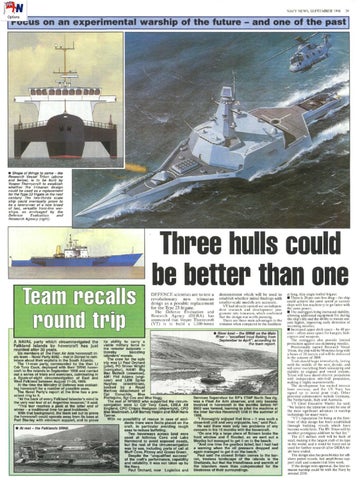
• Shape of things to come - the Research Vessel Triton (above and below) is to be built by Vosper Thornycroft to establish whether the trimaran design could be used as a replacement for the Type 23 frigate in the next century. The two-thirds scale ship could eventually prove to be a forerunner of a new breed of fast, versatile front-line warships, as envisaged by the Defence Evaluation and Research Agency (right).
Three hulls could be better than one DEFENCE scientists are to test a revolutionary new trimaran design as a possible replacement for the Type 23 frigate. The Defence Evaluation and Research Agency (DERA) has announced that Vosper Thornycroft (VT) is to build a 1,100-tonne
A NAVAL party which circumnavigated the Falkland Islands by hovercraft has just reunited after 30 years. Six members of the Fleet Air Arm hovercraft trials team - Naval Party 8902 - met in Dorset to reminisce about their exploits in the South Atlantic. The 11-man party, commanded by the then Lt Cdr Tony Cook, deployed with their SRN6 hovercraft to the islands in September 1968 and carried out a series of trials and exercises, culminating in a figure-of-eight circumnavigation of East and West Falkland between August 11-26,1969. At the time the Ministry of Defence was evaluating hovercraft for a number of possible uses. The Naval Party's report at the time has a prescient ring to it. "At the back of every Falkland Islander's mind is the very real fear of an Argentine invasion," it said. "This fear reaches a peak at the latter end of winter - a traditional time for past incidents." With that background, the team set out to prove the hovercraft could operate away from its base at Port Stanley1 with minimum support, and to prove
its ability to carry a viable military force to the remoter outposts thereby boosting islanders' morale. The crew for the epic trip was Lt Paul Orchard (pilot), PO Shiner Wright (navigator), NAM1 Big Mac McNeill (crewman), AM1 Phil Adams (engineer) and LEM Spike Hughes (electrician), backed by a Royal Marines detachment of Cpl Conachie, Mne Prettejohn, Sgt Cox and Mne Hogg. The rest of NP8902 who supported the circumnavigation were Lt Cdr Tony Cook, CREA Alf England, CPO Chippy Hodgson (shipwright), CPO Mac Macintosh, LAM Barney Halpin and NAM Hank Tanner. With no possibility of rescue in case of accidents there were limits placed on the craft, in particular avoiding rough seas to reduce buffeting. Two hoverways across land were used at Isthmus Cove and Lake Hammond to avoid exposed coasts, but the rest of the circumnavigation was by sea, including ports of call at Bluff Cove, Fitzroy and Goose Green. Despite the "unqualified success" of the craft's performance, capability and reliability, it was not taken up by the Navy. Paul Orchard, now Logistics and
demonstrator which will be used to establish whether initial findings with smaller-scale models are accurate. VT had already carried out an independent research and development programme into trimarans, which confirmed that the design was worth pursuing. There are three main advantages to the trimaran when compared to the tradition-
• River boat - the SRN6 on the Malo River - "excellent trout fishing from September to April", according to the team report.
Services Supervisor for BP's ETAP North Sea rig, was a Fleet Air Arm observer, and only became involved in hovercraft in the months before NP 8902 was formed, learning to pilot the machine at the Inter Service Hovercraft Unit in the summer of 1968. "I thoroughly enjoyed that time - it was such a close-knit unit and very enjoyable, too," said Paul. He said there were only two problems of any concern in his 16 months with the hovercraft. "On one trip a large piece of flotsam broke the front window and it flooded, so we sent out a Mayday but managed to get it on to the beach. "And one time the gearbox failed, but I had had a warning when the oil pressure dropped and again managed to get it on the beach." Paul said the closest Britain comes to the barren, treeless landscape of the islands is the Shetlands, but that the friendliness and warmth of the islanders more than compensated for the bleakness of their surroundings.
al long, thin single-hulled frigate: • There is 20 per cent less drag - the ship could achieve the same speed as current ships with less machinery or go faster with the same power; • The outriggers bring increased stability, allowing additional equipment fits during the ship's life and the ability to mount sensors higher, improving early detection of incoming missiles; • Increased upper deck space - by 40 per cent - offers more space for hangars, helicopters and weapons. The outriggers also provide limited protection against sea-skimming missiles. Provisionally named Research Vessel Triton, the ship will be 90 metres long with a beam of 20 metres and will be delivered in the autumn of 2000. Trials should begin immediately, lasting until the middle of the next_ decade, and will cover everything from seakeeping and stability to engines and towed systems. Triton will have diesel-electric propulsion with independent side-hull propulsion, making it highly manoeuvrable. The development has excited interest from overseas, and the US Navy has signed up to initial joint trials. Other potential collaborators include Germany, the Netherlands, Italy and Australia. VT Chief Executive Martin Jay said: "We believe the trimaran could be one of the most significant advances in warship technology for many years. "VT's reputation for being at the forefront of ship design has been established through building vessels which have become world firsts. The RV Triton will be another prestigious addition to that list." The £13 million craft will be built of steel, making it the largest craft of its type in the world, and it could be hired out or used for further research after DERA trials have ended. The design also has possibilities for offshore patrol vessels, fast amphibious support craft and commercial ferry work. If the design wins approval, the first trimaran warship could be with the Navy by around 2010.