2
NAVY NEWS, AUGUST 1997
Options
GOTCHA! - AFTER 58 YEARS THIS second-by-second sequence of pictures is a graphic illustration of the size and power of a World War II explosion - happening nearly 60 years later than intended. Cause of the blast in Loch Ewe was a German ground mine, found and detonated by an AngloFrench force of mine counteimeasures ships, out looking for nothing more than practice mines. The harmless duds had been laid in the path of ships taking part in a Joint Maritime Course from Faslane - and so had the
real German mine, probably as early as October 1939. It is known that the submarine U31 laid a number of them at the entrance of Loch Ewe, one of them damaging the battleship HMS Nelson on December 4 that year, and putting her out of commission for seven months. The French minehunter Sagittaire - operating in company with HM ships Brecon, Hurworth and Bridport - found the mine, containing 560kg of high explosive. She can be seen in the first frame. The mine was moved two miles
to a safer area before Navy divers detonated it, watched by foreign and Commonwealth attaches. During the exercise the force, under the command of Cdr Tim Williams, CO of the First Mine Countermeasures Squadron, were supported by the French diving support ship Styx and by the RN's Forward Support Unit 1. For HMS Brecon, the incident brought her back to minehunting work with a bang, after a tour of duty in the Fishery Protection Squadron. She acted as safety ship during the operation. When it was over she visited Hamburg.
exercises
BACK in home waters after two exercises in the Mediterranean are the minehunters HM ships Brocklesby, Bicester and Inverness. Forming On Call Force 20 they took part in Exercise Linked Seas (as reported in our July edition) and later in Exercise Alcudra, which was designed to consolidate minehunting and sweeping techniques.
Rare visit
'
HMS London in 'Marie Celeste' yacht mystery
Mine ships inMed
The force was joined by mine ships from Belgium, Spain, USA, Holland, Denmark. France and Italy. Also taking part in Alcudra was the Standing Naval Force Channel, including HMS Cattistock. During their deployment the British mine ships visited Oporto, Gibraltar, Ajaccio and Palma. Earlier Bicester had called at Gijon in northern Spain, making her the first Royal Navy ship to call at the port for 12 years.
Lucky 13 in Africa rffc'i
S' .S&i
• **,.
WHEN HMS London came across a yacht adrift in the western Atlantic, it sparked an adventure involving mystery and survival on the high seas worthy of TV's The
X Files. The ship's story, which had much in common with the discovery of the abandoned Marie Celeste, began on July 6 when the 50ft German-owned ketch Ruth was spotted by LS Nick Bartlett, on watch on London's bridge. The warship was 400 miles north of the nearest land - Puerto Rico. "It looked exactly like something from the movie Dead Calm," he said. "We could see there was something wrong. There were no sails up and the yacht was obviously drifting." London's Commanding Officer, Cdr Iain Greenlees, sent a boarding party over, led by his First Lieutenant, Lt Cdr Don Chalmers. "It was as if whoever was on board had just got up and left," said Lt Cdr Chalmers. "There were dirty dishes in the sink, a book left open on the table, ashtrays full of cigarettes, and personal belongings scattered about."
No clues Rotting food in the cabin indicated that the vessel had been adrift for a long period - perhaps months, although surprisingly she had shipped no sea water. "The place was riddled with cockroaches, and the skeletons of three flying fish lay on the deck," said Lt Cdr Chalmers. The yacht was cleaned up and it was decided to put a crew of six on board to sail her to Puerto Rico. Skipper was the London's doctor, Surgeon Lt Suzanne Porter, with CPO(OPS)(R) Glyn Williams as mate. Nothing was straightforward about the voyage. From the moment that London disappeared over the horizon at sunset, until the moment the Ruth sighted land six days later, the crew were alone with the sharks - and trouble. "When we sighted land we felt sheer relief," said Lt Porter. "The relief was all the more overwhelm-
ing because all power had failed on the second night out." The crew had resorted to pedalling a bicycle to try to generate power, but without success - which meant they had no navigational aids. The navigator, Lt Doug Dalena, on exchange from the US Navy, had to sail by dead reckoning. Even so, when they sighted land they found they were only ten miles off course. Other members of the Ruth's crew were POMEM(M) Paul McGarry, LS(R) Steve Carter, and WOM(AW) Bryony Bartlett. Bryony, at 21 the youngest of the Ruth's prize crew, said the most memorable part of the adventure for her came when she encountered a large shark. "I was dangling my feet over the side when this huge fin just came out of the water.
After that I kept checking my toes," she said. They are now safely back on board HMS London, a member of Standing Naval Force Atlantic. The German couple who owned the Ruth have been traced. They reported their vessel stolen last September after she disappeared from her moorings in the Canary Islands. It appeared she may have crossed the Atlantic all by herself. The Ministry of Defence said the Navy were entitled to claim salvage rights. • Before her yacht adventure, HMS London visited Halifax, Nova Scotia, with STANAVFORLANT. There, 11 survivors of Arctic convoys were welcomed on board to be presented with Russian commemorative medals by the Lieutenant Governor of Nova Scotia.
.':**'•.
THIRTEEN members of 847 Naval Air Squadron have returned home to RN air station Yeovilton to relate legends of the falls - the Victoria Falls in Zimbabwe. This helicopter, pictured flying over the spectacular site, was one of two 847 Gazelles deployed to Africa for training exercises with Zimbabwe air force and commando units. The squadron, whose aircraft are flown by Royal Navy and Royal Marines pilots and maintained by REME soldiers, were on view at Yeovilton during Fleet Air Arm Heritage Day on July 23.
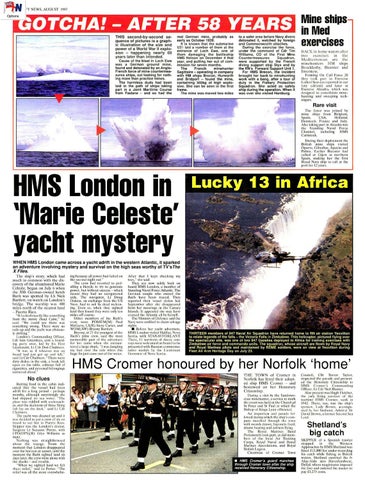
HMS Cromer honoured by her Norfolk 'home' THE TOWN of Cromer in Norfolk has feted their adopted ship HMS Cromer - and bestowed on her Honorary Citizenship. During a visit by the Sandownclass minehunter, a service to mark the event was held at the Church pf St Peter and St Paul at which the Bishop of Kings Lynn officiated. An inspection and parade followed during which the ship's company marched through the town with swords drawn, bayonets fixed, drums beating and colours flying. The Royal Marines Band Portsmouth took part, as did members of the local Air Training Corps, Royal Naval and Royal Marines Associations, and Royal British Legion. Chairman of Cromer Town _ HMS Cromer's guard marches through Cromer town after the ship received Honorary Citizenship.
Council, Cllr Trevor Taylor, inspected the parade and presented the Honorary Citizenship to HMS Cromer's Commanding Officer, Lt Cdr Neil Hunter. Also present was Hugh Fletcher, the only living survivor of the wartime HMS Cromer, sunk in 1942. There, too, was the ship's sponsor, Lady Brown, accompanied by her husband, Admiral Sir David Brown, a former Second Sea Lord.
Shetland's big catch SKIPPER of a Spanish trawler stopped in the Western Approaches by HMS Shetland was fined £15,000 for under-recording his catch while fishing in British waters. Shetland escorted the fv Alay-Alde into Haverfordwest, Dyfed, where magistrates imposed the fine and ordered the master to pay £1,275 costs.