(NEWS, MAY 1993 Options
4k"a
BATTLE F THE
Raw statistics struggle for s
94 Ui
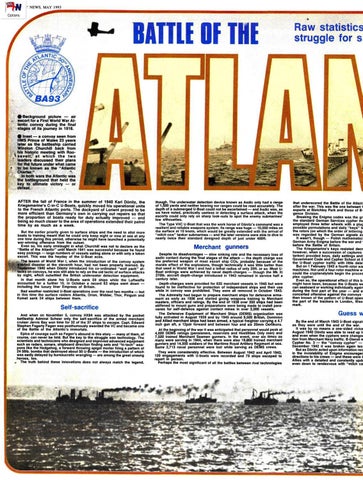
93 *Background picture- air escort for a First World War Atlantic convoy during the final stages of its journey in 1918. " Inset - a convoy seen from HMS Prince of Wales 23 years later as the battleship carried Winston Churchill back from his historic meeting with Rooat which the two leaders discussed their plans for the future under what came to be known as the "Atlantic Charter." In both wars the Atlantic was the battleground that held the key to ultimate victory - or defeat
" his "
,. "rt P.4,,.
0".-.. --
.
--1
fall of France in the summer of 1940 Karl Donitz, the Kriegsmarine's C-in-C U-Boats, quickly moved his operational units to the French Atlantic ports. The dockyard of Lorient proved to be more efficient than Germany's own in carrying out repairs so that the proportion of boats ready for duty actually improved - and being so much closer to the area of operations extended their patrol time by as much as a week. AFTER the
But the earlier priority given to surface ships and the need to allot more boats to training meant that he could only keep eight or nine at sea at any one time during this period, otherwise he might have launched a potentially war-winning offensive from the outset. Even so, his early onslaught in what Churchill was not to declare as the "Battle of the Atlantic" until March 1941 was successful because he found easy pickings - large numbers of vessels sailing alone or with only a token escort. This was the heyday of the U-Boat aces. " The lesson of World War I, when the introduction of the convoy system jlsrted disaster at the eleventh hour, had not been properly learned. By September 1940 when Donitz introduced his co-ordinated "wolf pack" attacks on convoys, he was still able to rely on the old tactic of surface attacks by night, which outwitted the British underwater detection equipment. In that month alone his U-Boats sank 59 ships while the Luftwaffe accounted for a further 15. In October a record 63 ships went down including the luxury liner Empress of Britain. Bad weather restricted U-Boat operations over the next two months - but in this time the surface raiders Atlantis, Orion, Widder, Thor, Pinguin and Komet sank 54 ships between them.
Self-sacrifice And when on November 5, convoy HX84 was attacked by the pocket battleship Admiral Scheer only the self-sacrifice of the armed merchant cruiser Jervis Say won time for 32 of the 37 ships to escape. Capt. Edward Stephen Fogarty Fegen was posthumously awarded the VC and became one of the Battle of the Atlantic's immortals. Epics of courage such as Fegen's abound in this story- many of them, of course, can never be told. But the key to the struggle was technology. The scientists and technicians who designed and improved advanced equipment such as radars, sonars, shipboard direction finding sets and "hi-tech" weapons like the Hedgehog, a forward throwing spigot mortar firing a pattern of 24 561b. bombs that destroyed about 50 U-Boats - the introduction of which was sadly delayed by bureaucratic wrangling - are among the great unsung heroes, too. The truth behind these innovations does not always match the legend,
though. The underwater detection device known as Asdic only had a range of 1,500 yards and neither bearing nor ranges could be read accurately. The depth of a submerged U-Boat could not be ascertained - and Asdic was, as we have noted, practically useless in detecting a surface attack, when the escorts could only rely on sharp look-outs to spot the enemy submarines' low silhouettes. The Type VIIC U-Boat that was the work horse of Donitz's command was a resilient and reliable weapons system. Its range was huge -10,000 miles on the surface at 10 knots, which would be greatly extended with the arrival of "much cow" tanker submarines and the later versions were able to dive to nearly twice their standard designed depth of just under 40011.
Merchant
gunners
Despite its disadvantages - slow sinking rate and the necessary loss of asdic contact during the final stages of the attack - the depth charge was the preferred weapon of most escort ship COs, probably because of the morale effect of the explosions, though technically it was little better than that used in World War I and had a lethal radius of only 2Oft. or so. Most UBoat sinkings were achieved by naval depth-charges - though the Mk XI 2701b. aircraft depth-charge introduced in 1943 remained in service half a century later.
Depth-charges were provided for 635 merchant vessels in 1940 but were found to be ineffective for protection of independent ships and their use while in convoy was prohibited. They were all removed in October 1943. The Admiralty had begun to prepare merchant ships for defensive armament as early as 1936 and started giving weapons training to Merchant masters, officers and ratings. By the end of 1938 over 350 ships had been stiffened to mount guns and preparations were being made to install paravanes for self-defence against contact mines in over 2,000 vessels. The Defensive Equipment of Merchant Ships (DEMS) organisation was fully activated in August 1939 and by 1945 around 9,500 British, Dominion and Allied merchant ships had been armed, a typical freighter carrying a 4.7 inch gun aft, a l2pdr forward and between four and six 20mm Oeriikons.
At the beginning of the war it was anticipated that personnel would peak at 4,000 DEMS ratings (pensioners, reservists and Hostilities Only men) and 7,500 trained Merchant Seamen gunners. In the event, over six times as many were serving in 1944, when there were also 19,000 trained merchant and 14,000 soldiers of the Maritime Royal Artillery Regiment at sea. Rome 2,713 naval personnel were lost while serving as DEMS crews. Some They were considerably effective. Between August 1942 and April 1943, 120 engagements with U-boats were recorded and 79 ships escaped to report in person. Perhaps the most significant of all the bathes between rival technologies
..ttw3s*t#
a
that underscored the Battle of the Atlanti after the war. This was the one between I experts at Bletchley Park and those of Bgence Division. Breaking the Enigma codes was the gri the standard German Services cypher m employed three letter wheels with a plug possible permutations and daily "keys" tc the rotors (on which the order of lettering was regarded by the German signals e It wasn't, though - Polish mathematici German Army Enigma before the war and I before the Battle of Britain. The Kriegsmarine's keys resisted decr however, when a succession of captures tanker) provided keys, daily settings and Government Code and Cypher School at C the U-Boat cypher traffic with little deIa But on 1 February 1942 a fourth rotor wa machines. Not until a four-rotor machine wi could the cryptanalytsts begin the proces plex cypher. Even so, the operational effect of this bi might have been, because the U-Boats wt can seaboard or working individually again during the first part of the year - and e concerted offensive against the convoys then known of the pattern of U-Boat open the part of the trackers in London, Wasl mark.
Guess
By the end of March 1943 U-Boat signal, as they were until the end of the war. It was by no means a one-sided victor August 1940 DOnitz was able to read up h and even when the cyphers were changec tion from Merchant Navy traffic. B-Dienst n - the Cypher No. 3 "convoy cypher" December 1942 it was broken again let But as Donitz acted upon information rec in the inviolability of Enigma encouragec directions to his crews - and these were ii Allies with a detailed and constantly upd even down to rendezvous with "milch co
d t,tt:A,
c1
.i
4,