Kped they will never forget...
NAVY NEWS, AUGUST 1977
I
- a cluster of separate the y lie on a line Passage U) the rn the southern eia tive 'tOflC S
21
Elephant Island 1976-1977
ubers of ,a Joint
Furse of the
or do the photographs capture what Cdr. Furse des.cribes as "the magic of Antarctica": that mdctiniahie reason 16 sane men chose to spend 100 days in acute discomfort and eser-present danger. o picture can conjure up the "delights" of living anilid the clamour and stench of thousands of Chiinstrap penguins, being I>ecked as each hoot slid pus;t on the muck-covered scree. Under such conditijons, people quickly stop loving penguins. Of a thousand other incidents there is no photograiphic record for the simple reason that those invuilved were too busy keeping warm, or dry, or aflmat, or alive. lI.ikc the four-man voyage in damaged, rafted and ladlen canoes round the southern end of Ctarenct Islaind. The nightmare started when heavy brash ict
scraped off make-shift patches on the canoes, and rising winds made it impossible to turn hack. Mile-high cliffs gave no hope of a quick beaching. While pumping furiously to keep the water down, they ere struck by "williewaws,'' sudden gusts of wind sshich blew one raft a mile out to sea. They landed safely after four hours, only to lose all four canoes a few days later when an ice avalanche crashed on to the same beach. These voyages, the first made by canoes on the Antarctic, were totally unsupported. Much had been expected of the canoes, but had sscather severely curtailed their use and only three out of ten survived the expedition. One of the most uncomfortable journeys of the expedition was by Chris liurran's party to collect
kit from the tiny refuge hut on Elephant Island. Instead of two days, the trip took four. Ilalfwa) across a big glacier they were caught by a rainstorm and, unable to pitch tents in the high winds, pressed on to a snow slope in which a shallow trench was dug and roofed with skis. The party spent the night practically underwater in polythene survival bags, their heads and shoulders under the makeshift shelter. Next day they reached the beach, built a stockade against wind and elephant seals, and pitched their tents. After a day drying out and another of foul weather, the party continued eastwards. Caught rain and wind, and baulked above the again b icefall, they forced on to base camp and reached it. wet and exhausted, hours after dark.
One of the closer calls involved Cdr. Furse himself. After an eventful three-hour trip along the south coast of Elephant in two cataniaranned canoes, he and two others barrelled in on the crest of a ten-foot "dumper" wave, to be smashed against the ice at the back of the beach. "The seas then rather took charge. At one point I lay on the beach, pinned helplessly by two and loaded canoes, while swamped Lenny (Lance-Cpl. Len Ifunt) held my head above the water," was how Cdr. Furse later described the incident. The day before H.M.S. Endurance arrived to embark the party, a force 12 hurricane hit the island, gusting up to 100 knots, It seemed a fitting farewell.
Two hours of unexpected luxury, punctuated months of hard living for eight members of the expedition. Cdr. Chris Furse and his team had timed their proposed canoe crossing from Aspland Island to Gibbs Island so that the tourist ship MS. Lindblad Explorer could ''mother' them across the 15 miles of open sea. Came the day. January, 8. and the conditions were too hazardous for canoes. So the intrepid explorers paddled out to the ship and hoisted their canoes aboard. Unkempt, unwashed, smelling of a month among the penguins, and fully, accoutred for canoeing. they promptly demolished the piles of food laid before them on immaculate table linen, posed for the tourists' cameras, then canoed ashore at Gibbs as the the ship steamed off on the next stage of her Antarctic cruise.
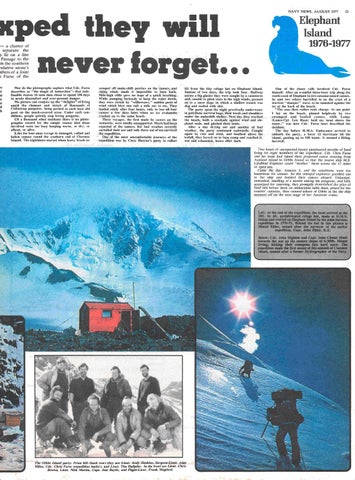
Left: At the end of the expedition, the team arrived at the lOft, by 6ft. prefabricated refuge but, made at H.M.S. Sultan and erected on Elephant Island by the Joint Services expedition in 1970.71. Behind the hut in this picture Is Mount Elder, named after the surveyor of the earlier expedition, Capt. John Elder, R.E.
a
.4
c'HL I
i-' 4oa i a
Below: Cdr. John Highton and Capt. John Chuter climb towards the sun up the eastern slopei4 of 6,300b. Mount Irving, kIcking their crampona Into hard snow. The expedition made the first ascent of this summit of Clarence Island, named after a former Hydrograpber of the Navy.