1957
NAVY
NEWS
SUBMARINE COMMAND NEWS COMMAND Combined Fleets Home Fleet Squadron
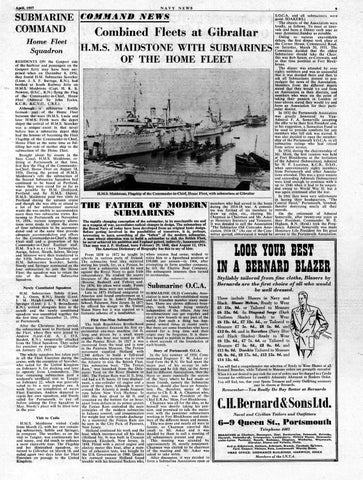
RESIDENTS ON the Gosport side of the harbour and passengers on the Gosport ferry may have been surprised when on December 8, 1956, they found H.M. Submarine Scorcher (Lieut. J. S. F. Burrage, RN.), had berthed at South Railway Jetty on H.M.S. Maidstone (Capt. H. R. B. Newton, D.S.C., R.N.) flying the Flag of the Commander-in-Chief, Home Fleet (Admiral Sir John Eccles, K.C.B.. K.C.V.O., C.B.E.). a submarine flotilla Although formed part of the Home Fleet between the wars (H.M.S. Lucia and later H.M.S. Forth were the depot ships) the arrival of H.M.S. Scorcher was a unique event in that never before has a submarine depot ship had the honour of becoming the Fleet Flagship of the Commander-in-Chief, Home Fleet at the same time as fulfilling her role of mother ship to the submarines of the Home Fleet.
Brought about by events in the Sue,. Canal. H.M.S. Maidstone, refitting at Portsmouth at that time, first flew the Hag of the Commanderin-Chief, Home Fleet on August 18, 1956. During the period of H.M.S. Maidstone's refit the submarines of the Second Submarine Squadron had continued to be based at Portland, where they were cared for as far as was possible by H.M. Dockyard, Portland and by H.M.S. Osprey. H.M.S. Maidstone paid tsvo visits to Portland during the autumn cruise and though she was able to attend to a lot of her submarines' material wants she was unable to accommodate more than two submarine crews. Returning to Portsmouth on November 19, 1956, various temporary alterations were made to allow the crews of four submarines to be accommodated and at the same time provide adequate accommodation and offices for the Commander-in-Chief's Home Fleet stall and a proportion of his Commander-in-Chief Eastlant stall. H.M. S u h iii a r i n es lermopylae. Auriga. Solent. Sleuth. Selene. Shrimp and Minnow were then transferred to the Fifth Submarine Squadron and H.M. Submarines Scorcher. Subtle. Sturdy and Springer nominated as the four submarines to join the Home Fleet, the squadron was to retain the title of the Second Submarine Squadron. Newly Constituted Squadron
Submarines Subtle (Lieut. H.M W. L. Owen, RN.), Sturdy (Lieut. J. M. Haigh-I.umby, R.N.), and J. L. S. Beauchamp; Springer RN.), arrived alongside later in the month and the newly constituted squadron was assembled together for the first time on December 21, 1956. at Portsmouth. After the Christmas leave period, the submarines went to Portland with the Heet, where they were joined by Andrew (Lieut.-Cdr. A. J, WA. Hurdett, RN.). temporarily attached from the Third Squadron. They sailed for exercises on passage to Gibraltar on January 25. 1957.
(lieut.
The whole squadron has taken part in all the Fleet Exercises during the cruise, with the exception of Scorcher, who sailed for the United Kingdom on February 9. for docking and later to operate from Londonderry. 1 he four remaining submarines paid a weekends unoflicial visit to Tangier on February 22. which was generally voted to he a very popular one. A week later, on completion of major Fleet Exercises. Andrew departed to rejoin her own squadron, and Sturdy sailed for Portsmouth. to pay off before joining the First Squadron in May. Sturdy's place will be filled later in the year. Visit to Cadiz H.M.S. Maidstone visited Cadiz from March 12, with her two remaining submarines, Subtle and Springer, in company. The weather, as on the visit to Tangier, was continuously hot and sunny, and did much to enhance a most enjoyable time. The Flagship and her diminished squadron, returned to Gibraltar on March 18. and sailed again two days later for Fleet Exercises on passage to the United Kingdom.
-
at Gibraltar
H.M.S. MAIDSTONE WITH SUBMARINES OF THE HOME FLEET
N
AIM
/
-.w
H.M.S. Maidsloue, Flagship of the Commander-in-Chief, home Fleet, with submarines at Gibraltar
THE FATHER OF MODERN SUBMARINES The rapidly changing conception of the submarine, in its merehantile use and as a weapon of war, necessitates radical changes in design. The submarines of the Royal Navy of today have been developed from an original basic design. Before getting Involved in the possibilities of tomorrow, it Is, perhaps, interesting to learn something of the "father" of the modem submarine. A man whose obsession was to build a submarine to sink the British Fleet, he never achieved his ambition and England gained, indirectly, immeasurably. l'hat it~ was .1. P. Holland, born February. 29, 1840, died August 12, 1914. The American Dictionary of Biography has this to say of him:
From 1858 to 1872 he taught in schools in various parts of Ireland. The submarine boat idea occurred during his youth, for, as a Fenian, he saw how a submarine could be used against the Royal Navy to gain Irish independency. He studied the scanty literature of the submarine pioneers (Bourne. Bushnell and Fulton) and, by 1870, available. financete Late in 1873 Holland emigrated to America and found employment as a schoolmaster in St. John's Parochial School. Paterson. New Jersey. In 1875 he offered his design to he United States Navy but it was rejected as a fantastic scheme of a landlubber.
when success had come, wished to retire him to a figurehead position at SlO,000 per annum-in 1904, after attempting to form another company, he left the Electric Boat Company. His subsequent interests then turned to aeronautics.
Submarine O.C.A.
SUBMARINE OLD Comrades Association is now a well-established name and its branches number many memhers. There are eleven different branches. each branch being entirely independent of the others. Any two ex-submariners can get together and start a new branch in any part of the world. Just such a thing has happened several times in recent years. But there are some branches who have existed for a long time and their origin may he forgotten. It is fore hoped to publish in these columns a short account of the foundation of each branch.
First One-Man Submarine The Irish Republican Brotherhood (I:eniztn Society) financed his first experiniental one-man machine (14 It. long and driven by a small steam boat was tested in 1878 in the Passiac River. In 1927 it was recovered from the mud and is now in the Paterson Museum. The Fenian Story of Portsmouth O.C.A. Holland with movement supplied In the late summer of 1930, Com' 2.300 dollars to build a full-sized submarine whose purpose was to cross missioned Engineer F. \V. Asker rethe Atlantic to sink the British Fleet. tired from the RN. He had spent the This submarine boat. "The Fenian major part of his service in subRam." was launched from the Deli- marines zwd he felt that, as the Army mater Yard on the River Hudson in had its different Associations, then the 1881. The Fenian Ram was 31 ft. long! Navy or more especially the section and had a 6 ft. beam, 19 tons displace- of the Navy where he had made so ment, a one-cylinder oil engine and .i many friends, namely the Submarine crew of three men. Although it never Service, should also have an Associacrossed the Atlantic it made frequent tion. He, therefore, spoke of this runs below New York Harbour. In matter to Ch. E. R. A. Chapman who, 1883 this boat dived to 60 ft. and at that time, was President of the remained on the bottom for an hour Chief ERAs.' Mess. Fort Blockhouse. apart from defects in its power system Chapman was all for the idea, as he the Fenian Ram embodied the main himself was shortly taking his penprinciples of the modern submarine sion, and promised to talk the matter in balance control, and compensation over with the pensioner submariners for weight lost with torpedo discharge working in Fort Blockhouse and memAs a memorial the Fenian Ram can hers of the different boats and messes. This was done and nearly all were in be seen in the City Park of Paterson, New favour, so Chapman reported this Holland continued his work and the result to Mr. Asker and it was boat which incorporated all his ideas decided by them to call a meeting of (Holland No. 9) was built in Crescent all submariners present and past. This meeting was attended by Shipyard, Elizabeth. New Jersey, in 1898. Fitted with a petrol engine and approximately 30. mostly pensioners. electric motor this boat, after a num- Chapman is elected to he chairman her of exhausive tests., was bought by of the meeting and Mr. Asker was the U.S. Government in 1900. Despite asked to take notes. his outward success Holland found After discussion, it was decided !o trouble with his financial backers who, form a Submarine Association open to
there-engine)-this
Jersey.
members who had served in the boats during the 1914-18 war. A committee was formed of six members to draw tip rules, etc., electing Mr. Chapman as Chairman and Mr. Asker as Honorary Secretary and Treasurer. It was decided to call the Association "The Submarine Old Comrades Association, 1914-18." (As one of the Committee quoted, abbreviated it would be
S.O.C.A. and all submariners were good SOAKERS.) The objects of the Association were briefly, as follows. To meet at intervals and have a Dinner each year as near Armistice -Sunday as possible. unavoidable Owing to various delays, the first dinner took place at the Corner House, Commercial Road, on Saturday. March 30, 1931. The Committee decided that the oldest Submariner should take the Chair; this was Bob Spicrs, cv-Coxswain. and at that time postman at Fort Blockhouse. The dinner was attended by over eighty members and was so successful that it was decided there and then to ask all Submariners present to promulgate the news of the Association. Members from the different depots stated that they would try and form an Association in their districts, and members who were on the point of taking their pension in London or near-abouts stated they would try and form an Association for their particular district. In 1932 the Portsmouth Association was greatly honoured by ViceAdmiral F. A. Somerville accepting the offer to he their first President and, at his suggestion, a Samaritan Fund to be used to provide comforts for any members who fell sick was started. It was also decided to open the membership of the Portsmouth S.O.C.A. to all submarine ratings who had retired from active service. In 1934. during the chairmanship of Mr. Moth, the first reunion was held at Fort Blockhouse at the invitation of the Admiral (Submarines), Admiral Sir N. F. Laurence, K.C.B., l).S.O.. when approximately eighty members from Portsmouth and other Associations attended. This was a great success and succeeding Admirals (Submarines) were kind enough to continue with it up to 1940 when it had to he suspended owing to World War II: but it was again continued after the war. In 1941 they were very unfortunate in having their headquarters, "The Central Hotel," Portsmouth, bombed, thereby destroying nearly all their records. On the retirement of Admiral Somerville, after twenty-one years as their President, Commander W. E. Higham. RN. (Retd.) took the Presidency. Admiral Somerville was made Honorary Life President for his great service to the Portsmouth Association.
LOOK YOUR BEST IN A BERNARD BLAZER
Stylishly tailored from fine cloths, Blazers by Bernards are the first choice of all who would be well dressed. c'
include Blazers in Navy and Black. Blaier Mehon, Ready to Wear £5 ISa. Od. or Tailored to Measure These
£6 15s.
Od. In Diagonal Serge (Dark to Wear Uniform Shade) Ready £6 12s. 641., £7 12s. 641., or Tailored to Measure £7 5s. 041., £8 5.. Od. and £12 Os. Od. and in Barnihea (Navy Blur and
Black
Shades)
Ready to' Wear 7s. 641, or Tailored to 041,, £8 Os. 041. and
£6 12s. 641., £7 Measure £7 5s. £1109.0d. Doeskin Tailored
-
, .
e
to Measure £8. Os. Od., £8 17s. 641,, £12 15s. Oil, and £14 12s. 641. You will find a comprehensive 'ire selection of Beady to Wear Blazers at all ll'rnard Branches, while Tailored to Measure orders are promptly executed When it is not desired to pay cash the cost of orders may be charged to a Credit Account for settlement by monthly Admiralty Allotment or Bankers Order. You will find, too, that your Sports Trousers and every Outfitting accessory may be chosen at lkrnards.
Re,,ie,nbcr-You Really Do Buy Better at Bernards
C.B.Bernard&SousLid. Naral and Civilian Tailors and Outfitters
6-9 Queen St., Portsmouth 4403 Telephone
BRANCHES at Chatham. D.vonport, Deal, Dunfermline. Falmouth. Grimsby, Harwich, H.l.nsburh, Invergordon, Londonderry, Milford Haven. Newcastle. Portland, Roiyth, Sk.gn.,s, W.th.rby. Weymouth, undsr-Lyms, Rothasay. Gibraltar, Sliema and Valletta, Malta. And at Abbot,inch. Anthorn. Arbroath, Brawdy. Corham. Eginton, Ford, Gosport. H.i,ton, K.t., Lo,,iemouth Worthy Down, HEAD
OFFICE:
ORDNANCE
BUILDINGS.
HARWICH.
Me,,ibera of the I.T'.T.A.
ESSEX