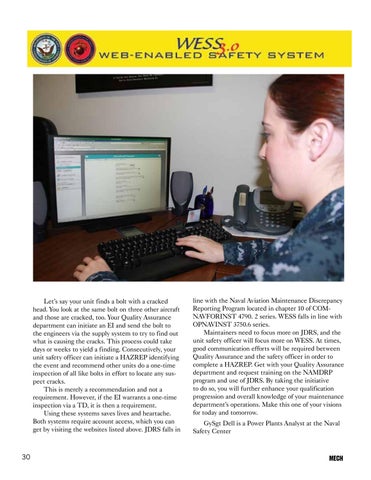
Let’s say your unit finds a bolt with a cracked head. You look at the same bolt on three other aircraft and those are cracked, too. Your Quality Assurance department can initiate an EI and send the bolt to the engineers via the supply system to try to find out what is causing the cracks. This process could take days or weeks to yield a finding. Consecutively, your unit safety officer can initiate a HAZREP identifying the event and recommend other units do a one-time inspection of all like bolts in effort to locate any suspect cracks. This is merely a recommendation and not a requirement. However, if the EI warrants a one-time inspection via a TD, it is then a requirement. Using these systems saves lives and heartache. Both systems require account access, which you can get by visiting the websites listed above. JDRS falls in
30
line with the Naval Aviation Maintenance Discrepancy Reporting Program located in chapter 10 of COMNAVFORINST 4790. 2 series. WESS falls in line with OPNAVINST 3750.6 series. Maintainers need to focus more on JDRS, and the unit safety officer will focus more on WESS. At times, good communication efforts will be required between Quality Assurance and the safety officer in order to complete a HAZREP. Get with your Quality Assurance department and request training on the NAMDRP program and use of JDRS. By taking the initiative to do so, you will further enhance your qualification progression and overall knowledge of your maintenance department’s operations. Make this one of your visions for today and tomorrow. GySgt Dell is a Power Plants Analyst at the Naval Safety Center
Mech