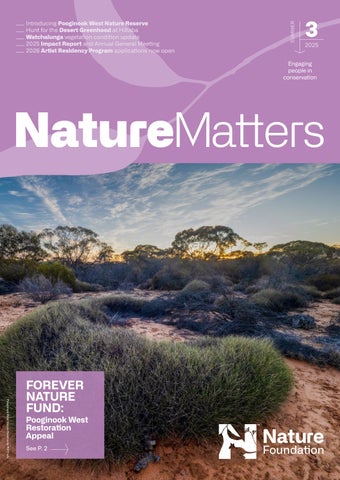
Pooginook West Nature Reserve by Bill Doyle
FOREVER NATURE FUND:
Pooginook West Restoration Appeal See P. 2
SUMMER
Introducing Pooginook West Nature Reserve Hunt for the Desert Greenhood at Hiltaba Watchalunga vegetation condition update 2025 Impact Report and Annual General Meeting 2026 Artist Residency Program applications now open
3
2025
Pooginook West Nature Reserve
AT A GLANCE
New Riverland nature reserve shelters some of the nation’s most vulnerable Introducing Pooginook West Nature Foundation is delighted to announce the acquisition and establishment of its tenth nature reserve, Pooginook West Nature Reserve. This 2,396-hectare reserve is on the traditional lands of the Ngawait people, about 25 kilometres northeast of Waikerie. Crucially, Pooginook West sits beside Pooginook Conservation Park to significantly increase the connectivity and amount of protected land available for local species. The site will also provide a southward migration pathway for key arid-zone species seeking cooler conditions as the climate changes. A haven for endangered ecological communities and threatened species Our initial research indicates that Pooginook West Nature Reserve supports the Critically Endangered Mallee Bird Community of the Murray Darling Depression ecological community, and may be home to the nationally Endangered Black-eared Miner, four nationally Vulnerable bird species and seven Rare South Australian bird species. The Murray Mallee Striated Grasswren (nationally Endangered) has been previously been recorded in the area and we hope it may find a home at Pooginook West in the future.
Pooginook West Nature Reserve
The reserve also shelters South Australia’s only known (and possibly Australia’s largest) population of the Mallee Bronze Azure Butterfly. Protecting this butterfly’s habitat is vital, as research indicates its extinction is highly likely. Acquiring and protecting Pooginook West is just the start The property was a working farm, with sheep and cropping. Around 400-hectares had been cleared for cropping and this has dramatically affected the site’s ability to naturally revegetate. This land will now need to be actively managed to increase biodiversity and support native flora and fauna. Habitat and biodiversity monitoring, fencing, weed control and pest animal control are all needed to start the conservation process, but revegetation will be our longterm focus. Nature Foundation has successfully secured a Native Vegetation Council Restoration Grant to help support this work over the next 10 years. But we need your help now to fast track Pooginook West’s restoration program and protect the critical Mallee species it supports.
•
Area: 2,396-hectares (23.96 square kilometres)
•
Location: Riverland, South Australia
•
Traditional custodians: Ngawait people
•
Acquired: September 2025
•
Major aims: Reducing total grazing pressure and revegetation
•
Key threatened species in the area: Red-lored Whistler, Black-eared Miner, Southern Whiteface, Eastern Regent Parrot, Murray Mallee Striated Grasswren, Malleefowl, Showy Lawrencia, Sticky Daisy Bush, Southern Ningaui, Knob-tailed Gecko Mallee Bronze Azure Butterfly and more.
•
The area supports eight EPBC nationally-listed bird species, seventeen South Australian state-listed bird species and two Endangered ecological communities.
Credit: David Donovan
Murray Mallee Striated Grasswren – Endangered Amytornis striatus howei Murray Mallee Striated Grasswrens look like fairy wrens (their relatives) but are much larger (up to 18.5 cm). They live in areas with well-developed porcupine grass, usually in association with mallee eucalypts and sandy soils, where the white streaks across their plumage help them camouflage. Habitat loss through clearing and overgrazing makes these incredible birds vulnerable to extinction. We’d love your help to position Pooginook West as a safe haven for these birds and the many other threatened species in the region that need refuge.
P
2
naturefoundation.org.au
FOREVER NATURE FUND Pooginook West Nature Reserve by Bill Doyle
Summer Appeal
Our Forever Nature Fund was established to raise capital to purchase and manage critical habitat areas and prioritise using data-driven scientific and environmental assessment tools.
Fund the future of Pooginook West Restorative revegetation key to biodiversity, resilient ecosystems The revegetation of Pooginook West Nature Reserve will support a huge variety of native species, not only those that are endangered or under threat, but all of the different species that form part of a healthy ecosystem. Invertebrates, reptiles, birds, mammals, fungi and bacteria – they all need plant life to thrive. Around 400-hectares or 17% of Pooginook West’s total area has been significantly disturbed. This has dramatically reduced its ability to naturally revegetate and increased the amount of time it would take for the land to recover.
The compounding impacts of climate change are accelerating the decline of Australia’s biodiversity, with increasing numbers of species and ecological communities listed as threatened. This urgent situation makes our mission to protect and restore critical habitats more crucial than ever. Nature Foundation aims to double our impact to 1 million hectares protected by 2030. We have made positive strides towards this goal in 2025 with the acquisition of Pooginook West. Your donation today will ensure this work continues for years to come. We value your support of our mission to conserve the precious habitat of South Australia and beyond.
Credit: LFHunt
We’re fast-tracking Pooginook West’s restoration and we need your help
naturefoundation.org.au
We’ve developed a restorative revegetation program to kickstart the reserve’s recovery. The program includes both direct seeding and tubestock planting to balance cost effectiveness and efficiency with overall revegetation time. We’re now seeking your financial support to help us start planting. Plant a seed (or tree) for change Your donation to the Forever Nature Fund: Pooginook West Restoration Appeal will directly support our restoration program. Every dollar will help to create a safer home for endangered species and ecological communities. Ways to donate: •
Get in on the ground storey – kickstart Pooginook West’s revegetation today with a one-off donation
•
Grow an ecological community – join us on the full restoration journey with regular monthly contributions
Donate your way today: naturefoundation.org.au/pwa All donations are tax-deductible.
Mallee Bronze Azure Butterfly – extinction highly likely Ogyris subterrestris subterrestris The Mallee Bronze Azure Butterfly has a fascinating symbiotic relationship with a sugar ant, Camponotus terebrans, that nests at the base of tall mallee eucalypts. The butterfly lay its eggs close to the nest entrance, where the ants then gather the butterfly eggs, take them into the nest and tend to the butterfly larvae as they grow. When their evolution to adulthood is complete, the butterflies leave the ant nest to begin the cycle again. These intricate relationships highlight how the survival of a single species in an ecosystem can be crucial to prevent the extinction others.
P
3
From the Chair Jan Ferguson OAM While the busyness of the year hasn’t yet eased, I can’t help but take some time to reflect on the activities and progress of 2025. There have also been a range of events over the past few months that have invited this reflection, and an opportunity to look both back and forward to what’s next in 2026. Events such as the 2025 Impact Report Launch and AGM, the Member and Supporter Thank You, and the Volunteer Thank You have all been rewarding occasions to connect with our varied and passionate community and celebrate our collective efforts. A point I have stressed at these occasions, and do so again, is that all support for our organisation and cause is valuable, and makes a difference. Something that may seem simple, such as talking about Nature Foundation and sharing our work with your friends and family, has a tangible impact on awareness of our organisation, helps grow engagement, and ultimately helps us have a greater positive impact on our natural environment and biodiversity across Australia. The connections our team, members, supporters, donors, volunteers, and partners make with each other and beyond not only strengthen our relationships but also ripple through our communities. It has been wonderful catching up with many of you over the past few months, and you can read about some of these recent events in this edition. I would also like to thank our growing community of volunteers, which includes my fellow Board Directors. We recently celebrated International Volunteer Day with a BBQ for our volunteers. It was a rewarding opportunity to acknowledge and celebrate the individual and collective efforts of this group,
P
4
and the significant contributions they make to the work of Nature Foundation in a variety of ways, from field conservation work to supporting in the office, at events, and more. You will see in this edition several recent volunteer activities that have contributed to on-ground results. And it is this combined support and action that is required to achieve our big goal of doubling our impact by 2030, with another strong stride taken in this direction through the acquisition and establishment of Pooginook West Nature Reserve. The team is constantly assessing land acquisition opportunities, and this one truly is a gem—with some polishing required—though I have utmost confidence in the ability of our team (with the assistance of our members, volunteers, donors and supporters), combined with sound systems, processes and frameworks, to achieve it. I do hope you enjoy learning about our latest nature reserve acquisition, and if you are in a position to do so, to contribute to our initial efforts to kickstart the restoration revegetation program at Pooginook West. Every contribution helps. Finally, I wish you and those close to you a safe and happy festive season; I look forward to your continued support in 2026. Thank you.
naturefoundation.org.au
From the CEO Alex Nankivell
Pretty Point, Hiltaba Nature Reserve by Bill Doyle
The Ecological Society of Australia held its ESA2025 conference in Adelaide in late November, and a few colleagues and I had the opportunity to both attend and present some of our recent work to this network of terrestrial ecologists. around, I could also see that it was a rare mix of potential. It is next to the Pooginook Conservation Park, which will provide high-quality habitat for flora and fauna to move through. Pooginook West is a mix of high-quality habitat and degraded areas that, with the right management actions, will significantly improve over time, expanding the refuge of the Pooginook Conservation Park.
As someone who has worked for the organisation for nearly 20 years and is now honoured to lead it, I am immensely proud of the team’s collective efforts and the incredible support we receive from our network of members, volunteers, donors, partners, and more. It takes the united effort of a future-thinking group of individuals to help create the type of transformation our landscapes need. You can see many of these activities in this edition of Nature Matters.
While these systems support a consistent approach, your ongoing support is vital in strengthening our ecosystems and building resilience across native habitats for future generations, enabling us to make a greater impact together.
The staff team have put in a stellar effort this past year to finalise the review and update of our science strategy, reserve management framework and policies, to ensure we are equipped to facilitate impact at scale across the growing network of nature reserves, which now includes Pooginook West. When I first visited this property before purchasing, I was aware of its conservation values, particularly the importance for Eastern Regent Parrots. After spending a couple of hours driving and walking
naturefoundation.org.au
It was a valuable opportunity not only to connect, share, and learn from peers, but also to witness the impact of our organisation. In addition to the data-driven presentations from our immediate team members, there were presentations from research partners undertaking work on Nature Foundation reserves, including recipients of our Student Research Grants Program.
Thanks, as always, for your commitment and support. Our staff team will be taking a welldeserved break over the festive period. I wish you warmth and joy this holiday season, and we look forward to sharing more milestones with you in the new year.
P
5
Reserve updates
Hiltaba Nature Reserve Hunt for the Desert Greenhood Orchid The Desert Greenhood (Pterostylis xerophila) is a small, terrestrial orchid endemic to inland South Australia and Victoria. Little is known of its biology, ecology, distribution and abundance. It tends to be found in generally remote locations in semi-desert environments, mainly growing on rock outcrops under low shrubs, with only eight populations that are currently known, containing about 150 plants in total. Threats to the species include grazing and habitat degradation by native and introduced herbivores, disturbance, and climate change. The Desert Greenhood is listed as Vulnerable under the Commonwealth Environment Protection and Biodiversity Conservation Act 1999; Threatened under the Victorian Flora and Fauna Guarantee Act 1988 and Vulnerable under the South Australian National Parks and Wildlife Act 1972. In 2010, the Australian Government established a national Recovery Plan for the Desert Greenhood to increase understanding of the species distribution, habitat, and threats, and establish the recovery objectives and actions necessary to ensure its long-term survival. Unofficial records indicate the historical presence of the Desert Greenhood in the Gawler Ranges region and on Hiltaba Nature Reserve, with the last sighting around 40 years ago. This area, with its unique ecosystem, could be a crucial habitat for the Desert Greenhood.
P
6
In May 2025, the SA Arid Lands (SAAL) Landscape Board arranged a survey expedition to explore areas of habitat believed suitable for the species in the Gawler Ranges region, as part of SAAL’s Discovery4Recovery project, funded by the Australian Government’s Natural Heritage Trust. The survey brought together team members from the SAAL Landscape Board, South Australian Seed Conservation Centre, National Parks and Wildlife Service South Australia, Gawler Ranges Aboriginal Corporation, Far West Coast Rangers, and Nature Foundation. With the focus of the survey on identifying potential habitat areas, combined with the time of year and exceptionally dry season, the group wasn’t expecting to find Pterostylis rosettes; however, they were surprised and delighted to spot multiple rosettes hugged near the granite rocks at several sites. The sightings were a tangible example of the benefits of the long-term grazing management undertaken at Hiltaba since its establishment as a nature reserve in 2012, which has supported the recovery of a range of native vegetation. The teams returned to Hiltaba in October, following the winter rains and once the plants had flowered, to revisit the sites based on the GPS locations that were recorded in the May survey. While the rosettes weren’t identified as Pterostylis xerophila they were another species of Pterostylis commonly known as the Dwarf Snail Orchid (Pterostylis nana). Nature Foundation are excited to be involved and continuing to support this valuable survey.
Inset: Pterostylis xerophila from Atlas of Living Australia by JuneN
naturefoundation.org.au
Bullock Bridge Nature Reserve Drone AI weed detection trial
Unique sighting of Common Scaly-foot predation
Nature Foundation is proud to have partnered with the Centre for Invasive Species Solutions (CISS) to participate in the national WeedRemeed™ project, utilising drones to capture images of native plant and weed species. The technology then uses advanced colour picking – Artificial Intelligence (AI) and Machine Learning (ML) to identify and locate important native plants and weed species.
A benefit of our work is spending time in nature and the opportunity to witness interesting occurrences; and such a situation occurred in February this year for our Science & Knowledge and Reserve Management teams while they were visiting the Bullock Bridge Nature Reserve in South Australia’s southeast.
Our Nature Foundation Reserve Management team members, Kelsey Bennett and Jem Shimmield, accompanied the then CISS Project Lead Baxter Massey, to Bullock Bridge in late May. Together, they set up ten 5 x 5 metre test plots across the 203-hectare reserve, targeting Coastal Wattle (Acacia sophorae), an invasive native species present at the reserve. Ground truthing surveys were then completed at each plot, recording the vegetation composition and presence of the target species. Drone surveys using a quadcopter were then completed across each plot by Chris Warrior from Wiru Drone Solutions. These surveys tested the software’s detectability success in a range of different habitat types, varying canopy cover and growth stages. The drone capture and ground truthing results have been provided to the WeedRemeed™ software developer for processing and analysis using Artificial Intelligence and Machine Learning technology. We are pleased to be involved in this valuable, practical research, which will significantly support conservation actions nationally. We look forward to seeing how this innovative technology solution progresses. Learn more about the WeedRemeed™ project here: invasives.com.au/research/weedremeed-drone-aidetection-of-priority-weed-species-at-scale/
This observation is significant as it provides a rare glimpse into the natural behaviour of the Common Scaly-foot, contributing to our understanding of its ecology and predator-prey interactions. To our knowledge, this is the first observation of the foraging and consumption of a burrowing spider by a Common Scaly-foot. Common Scaly-foot is a widespread legless lizard found in coastal forests, heaths, and dunes of southern Australia. An active forager, the lizard feeds on invertebrates, mainly nocturnal mygalomorph burrowing spiders and their egg sacs, during the day. However, most of the information on their diet and prey handling comes from stomach-contents analysis or feeding experiments, rather than direct observation, particularly in the wild. The team was buzzing with excitement at this rare sighting, staying close to observe and document the process with videos and photos. After completing their observations, they conducted some initial inquiries with the South Australian Museum to validate the uniqueness of the situation. This process confirmed that it was indeed the first observation of a Common Scaly-foot preying on a burrowing spider. This significant finding was then documented as a short note and submitted to Herpetological Review, where it has been accepted for publication. Certainly not something you see every day!
P
7
naturefoundation.org.au
Our Bullock Bridge Nature Reserve, located in southeast South Australia, 20km inland from Kingston SE, was selected as one of the multiple trial sites nationally to trial the WeedRemeed™ software. This software, a cutting-edge tool in conservation, is designed to detect target flora species in the field using colour-picking technology, and machine learning. Its development is a significant step towards a cost-effective, national solution for large-scale weed management.
While they were inspecting the monitoring sites and remote cameras, some movement drew attention to the ground. Upon closer inspection, they observed a Common Scaly-foot (Pygopus lepidopodus) entering a spider burrow under the leaf litter. The lizard entered the burrow to a depth of more than half of its body length and emerged around five minutes later with a large adult spider in its mouth. The lizard held the spider in its mouth for about two minutes after emerging from the burrow, likely crushing the spider in its jaws before slowly ingesting it headfirst, a process that took more than 15 minutes.
Reserve updates
Witchelina Nature Reserve
Murbpook Nature Reserve
Research Paper: Habitat suitability modelling of the North Flinders Ranges Thick-billed Grasswren reveals dynamic shifts at the landscape scale
Equipping our volunteers to identify weeds
After three years of dedicated research, we are excited to announce the publication of a paper in Wildlife Research that highlights habitat suitability modelling of the North Flinders Ranges Thick-billed Grasswren (Amytornis modestus raglessi). In collaboration with Nature Foundation CEO Alex Nankivell and volunteers David Gobbett and Andrew Black, the research revealed a notable shift in the distribution of suitable habitat for the Thickbilled Grasswren, with Witchelina Nature Reserve’s habitat improving markedly since its acquisition, demonstrating tangible conservation progress. This research not only advances scientific understanding but also exemplifies the tangible benefits of long-term conservation activities, reinforcing our commitment to protecting native species and habitats. You can read the full paper here:
The successful receipt of a Friends of Parks and Nature Grant has enabled our Reserve Management team to conduct a series of crucial native plant and weed identification and control training sessions for volunteers at Murbpook Nature Reserve in August. The sessions were facilitated by two of our Murbpook weed control contractors, Amanda and Petrina, who educated the group about the priority weed species on the reserve, how to identify between exotic and native plants, along with a range of weed control techniques and their recommended timings. Volunteers then tested their training by mapping some sample weed locations around the reserve and recording their findings in our data collection platform. These newly acquired skills will be put into action at future volunteer working bees at Murbpook, as well as other volunteer activities across the rest of the reserve network. The grant funding will also support a multi-day working bee at Mongolurring Nature Reserve in September focused on identifying and controlling African Boxthorn (Lycium ferocissimum), ensuring our volunteers are well-prepared for the tasks ahead. Many thanks to Conservation Land Manager Kelsey Bennett for arranging and managing the workshops, to contractors Amanda and Petrina for running them, and most importantly, to our dedicated volunteers for their active participation in the training. You can learn more about our volunteer program and register your interest here: naturefoundation.org.au/volunteer
This project is supported by the Friends of Parks and Nature Grants Program and is jointly funded by Nature Foundation and the Department for Environment and Water.
P
8
naturefoundation.org.au
Watchalunga Nature Reserve Vegetation condition update Watchalunga Nature Reserve encompasses approximately 92 hectares of low-lying wetland habitats, including Fleurieu Peninsula swamp areas along the lower Finniss River, which are listed as a critically endangered ecological community. It is an essential patch of remnant habitat containing highly significant South Australian biodiversity, including the critically endangered Mount Lofty Ranges Southern Emu-wren (Stipiturus malachurus intermedius). The primary conservation focus for Nature Foundation at Watchalunga Nature Reserve is to restore and enhance habitat for this subspecies of Emu-wren, with its key structural feature being a low-density layer usually up to 1m above the ground, dominated by shrubs and sedges. Since acquiring the reserve in 2014, vegetation condition has improved significantly, resulting in the largest known population of Mount Lofty Ranges Southern Emu-wrens in the region.
Vegetation condition has been monitored across Watchalunga since 2018 via the Bushland Assessment Method (BAM) and point-intercept transect surveys. There has been a consistent increase in Vegetation Condition Scores obtained through BAM surveys across the reserve from 2018 to 2024, with point-intercept transect surveys during that time showing a steady increase in native species cover and a corresponding decrease in exotic species cover. Revegetation areas have considerably improved under Nature Foundation’s stewardship, with Mount Lofty Ranges Southern Emu-wrens observed utilising the new habitat since 2021. Ongoing planting efforts are also revisiting previous revegetation sites to fill gaps and plant out the understorey, further enhancing the habitat.
2024
We estimate that, since the acquisition, we have achieved an overall revegetation survival rate of ~70%. Unfortunately, the prolonged drought conditions of 2024, which were among the worst on record for the area, significantly impacted revegetation survival rates, which dropped to ~40-50%. These conditions also drove large mobs of kangaroos onsite in search of food, which they found in the form of new seedlings, further exacerbating the impact on revegetation survival. In response, Nature Foundation has invested in planning and infrastructure to increase our capacity to water new plants during these prolonged dry periods, ensuring greater survival during the establishment phase. We will also manage increasing macropod pressure by installing exclusion fencing to protect revegetation areas. Vegetation monitoring and revegetation efforts will continue through the Nature Foundation Biodiversity Monitoring Program and the Reserve Management Program, supported by a significant Native Vegetation Council Restoration Grant.
naturefoundation.org.au
Management actions on the reserve have centred on weed control and revegetation. Considerable effort has been put into controlling the native common reed (Phragmites australis), under permit from the Native Vegetation Council, to prevent it from swamping the Emu-wren habitat. Revegetation work began in 2017 and has focused on restoring and enhancing areas of the reserve likely to provide shelter with suitable refugia plants, including Lignum (Duma florulenta), and various sedges (e.g. Cyperus gymnocaulos, C. vaginatus, Carex appressa, Gahnia filum) and grasses (e.g. Juncus kraussii, J. pallidus, J. pauciflorus, Ficinia nodosa). This work continues as part of annual management activities, with > 20,000 seedlings with a mix of > 30 different species planted to date.
2017
You can read more about the Native Vegetation Council Restoration Grant at Watchalunga Nature Reserve in the 2025 Impact Report: naturefoundation.org.au/impact
P
9
Reserve updates
Watchalunga Nature Reserve (continued)
Causeway repair returns access to southern section Before its acquisition by Nature Foundation and establishment as a nature reserve in 2014, Watchalunga was used as farmland for grazing cows. Previous owners had constructed a simple causeway across the water passage to allow access to the southern section of the property. Over the years, this causeway deteriorated, with the aftermath of the 2022 floods significantly damaging the remaining structure, rendering it unsafe to cross by vehicle. The lack of vehicle access greatly hindered our team’s ability to undertake large-scale weed control and other management tasks in this section of the reserve, with access required by foot and activities restricted to using lightweight equipment that could only be carried by hand. Our annual Vital Work Appeal helps support infrastructure requirements across the reserve network, and the causeway repair was identified as a priority for the 2024 appeal. We were delighted not only to reach the $100,000 appeal target but also to exceed it by a further $49,000, which supported the causeway repair, along with other priority projects. This repair, made possible by your support, has significantly improved our ability to manage the reserve, allowing water to pass through between the wetland and the river, as well as vehicles and equipment to safely pass over, enabling us to extend weed management efforts, habitat management and revegetation, along with other conservation tasks. Thanks go to our members, donors, and supporters who contributed to last year’s Vital Work Appeal, which funded the causeway work. Your support has been invaluable, and we are deeply grateful. We look forward to further work and positive results for biodiversity at Watchalunga! Photos supplied by South Coast Sand and Civil.
P
10
naturefoundation.org.au
Biodiversity Monitoring Program update
A key aspect of the new 2025-2030 Science Strategy is the establishment of the Nature Foundation Biodiversity Monitoring Program, which consists of standardised surveys of vegetation, birds, reptiles, and mammals implemented across all Nature Foundation reserves each autumn and spring, combined with targeted, appropriately timed, species-specific surveys to capture important information on key threatened species. This process involves determining a range of sites across each reserve to give a good spread of data, as well as cover various habitat and ecosystem types, which exist across the larger nature reserves. These sites then each have remote cameras set up, along with tiles to assist with reptile surveys. Vegetation and bird surveys undertaken in these areas build a wholistic picture of the area.
naturefoundation.org.au
Our Science & Knowledge and Reserve Management teams have had a busy start to spring, getting out across the nature reserves to set up standardised survey sites as part of the new Biodiversity Monitoring Program. Following this set up season, we now have over 120 monitoring sites established across the nature reserves, with a network of more than 200 remote cameras All data is recorded in our integrated data management system, and ensures that we can seamlessly capture, process, analyse, and display all information required to meet the Foundation’s strategic goals in a standardised manner across the organisation and nature reserve network, ensuring that resources are used most effectively to maximise positive outcomes for biodiversity. We look forward to sharing findings and outcomes from these surveys. You can read more about the 2025-2030 Science Strategy in our 2025 Impact Report: naturefoundation.org.au/impact
P
11
25 NatureFoundation
Impact Report
2025 Impact Report Launch and AGM update In late October, Nature Foundation members, Board Directors and staff gathered at the Wine Centre and online to celebrate the launch of the 2025 Impact Report and participate in the Annual General Meeting. The evening commenced with an engaging presentation from the staff team, who shared highlights from the 2025 Impact Report, aligned with the five goals outlined in Nature Foundation’s Strategic Plan: Towards 2030. You can read the full details of Nature Foundation’s achievements in the 2025 Impact Report: naturefoundation.org.au/impact The Annual General Meeting featured a summary of highlights from the Chair, Jan Ferguson OAM, including: •
An update on membership growth and demographics
•
Significant findings from recent research papers
•
Progress on Nature Foundation’s land acquisition targets
•
Recognition of the 15th anniversary of Witchelina Nature Reserve and its turning point for the organisation
•
Repair of the causeway at Watchalunga Nature Reserve, funded through the generous support of donors for the 2024 Vital Work Appeal
•
And the deepening engagement of the Aboriginal Advisory Group with Nature Foundation, alongside our ongoing collaboration with Traditional Custodians of the lands we work on. Board Director and Chair of the Audit & Risk Committee, Douglas Ransom, provided an update on the financial reports for the year ending 30 June 2025, highlighting the organisation’s strong financial position. Jan Ferguson OAM also welcomed Bec Hardy back to the Nature Foundation Board as a Director for a three-year term. She thanked retiring Director Claire Fuller for her service and contribution to conservation.
Following a break for further drinks and canapés, we enjoyed a dynamic presentation from Kristoffer Wild, the 2025 recipient of the Mike Bull Award for Early Career Nature Scientists, who shared his research into aridzone reptiles, building on historical field data and modelling their impacts in a warming climate. Thank you to all the members who joined us for this special occasion. It was a vibrant evening celebrating the efforts and achievements of the previous financial year and looking positively to the future.
P
12
naturefoundation.org.au
Kids on Country™
Officeworks Make A Difference Appeal raises over $20K for Kids on Country™ Junior Ranger Program We were overwhelmed by the generosity of Officeworks staff and customers during June’s Make a Difference Appeal, with the 10 stores across South Australia, Victoria and New South Wales who were supporting Nature Foundation raising $20,518 which will go directly towards our Kids on Country™ Junior Ranger Program!
In 2024, Walkley Award winning journalist and documentary filmmaker Daniel Clarke joined the Kids on Country team and students and teachers from Le Fevre High School on a five-day camp at Witchelina Nature Reserve in remote northern South Australia. The resulting film includes insights from Kuyani/ Adnyamathanha Elder, Beverley Patterson, and captures the journey of a group of Aboriginal young people experiencing this life-changing program. The Kids on Country documentary has been acquired by NITV and is now available to stream via SBS On Demand. Search for “Kids on Country” within the SBS On Demand website or apps: sbs.com.au/ondemand
Huge thanks go to the participating stores and their customers; your support really does make a difference. The stores supporting Nature Foundation throughout the appeal were: •
Marion
•
Noarlunga
•
Adelaide
•
Keswick
•
Croydon
•
Albury
•
Wodonga
•
Wagga Wagga
•
Wangaratta
•
Shepparton
And thank you to the Marion Officeworks store for hosting this very special big cheque presentation with our Kids on Country team following the appeal.
naturefoundation.org.au
Kids on Country™ Documentary now available on SBS On Demand
There is a lot of funding finding that goes on behind the scenes of the Kids on Country program, and this extra boost is enough to support one school to attend a camp.
Please note: A free SBS On Demand account is required to access SBS On Demand content.
Thank you for supporting the 2025 Vital Work Appeal! Thank you to all those who contributed to our 2025 Vital Work Appeal. We set ourselves a target to raise $150,000 to support volunteer and fieldwork resources and equipment to assist with conservation action across the reserve network, and to contribute towards essential fencing work at Mongolurring Nature Reserve. With your generous support we raised over $185,000!
P
13
Safewill Partnership A Will is important for every Australian over the age of 18, regardless of what you own. Writing a Will ensures that your assets and possessions are distributed according to your wishes, as well as selecting who administers your estate and who will be the appointed guardian for your loved ones. Without having a Will in place, a court may determine how your assets and possessions (and even your pets) will be administered. Nature Foundation has partnered with Australian company Safewill to provide a comprehensive yet straightforward, cost-effective, and secure way to write and manage your Will online. Safewill is Australia’s leading online will writing platform, supported by award-winning affiliate law firm Safewill Legal, an industry-leading specialist Wills and Estates practice based in Sydney and operating Australia-wide. The platform allows you to easily write your Will online, before having it reviewed by Safewill’s Australian legal team. The Safewill platform also allows you to consider and leave a bequest in your Will to a charity, such as Nature Foundation, to support nature beyond your lifetime. If you would like to learn more about Safewill and write your will online, visit: safewill.com/naturefoundation
2026 Artist Residency Program applications open Following another successful Artist Residency Program and exhibition, applications are open for the 2026 Artist Residency Program. The Nature Foundation Artist Residency Program was founded in 2019 and aims to:
Nature Foundation gratefully acknowledges sponsorship of this program by the Helen James Endowment Fund.
•
Reflect Nature Foundation’s conservation vision by encouraging artists to become immersed in the natural environment, and to respond to it in their creative work.
•
Support the work of participating artists with an interest in remote natural environments, by providing them with opportunities with visits to Witchelina, Hiltaba Nature Reserves, or both.
•
Offer participating artists the opportunity to exhibit their work and discover new audiences and markets for their work, particularly collectors who are specifically interested in artwork inspired by nature.
See full details about the residency and apply online here: naturefoundation.org.au/arp
P
14
naturefoundation.org.au
Event Updates Watchalunga Planting Day Following a reschedule due to the originally planned planting day for National Tree Day on Sunday 28 July being too wet to go ahead, our annual Watchalunga Planting Day was held in mid-August. Nature Foundation has been holding our annual planting days at Watchalunga since 2017, and while plantings have generally focused on revegetating new areas of land, this year’s focus was on infilling the understory areas of the original planting area. The 1,750 seedlings incorporated a mix of native groundcovers, rushes, sedges and shrubs will, over time, create the thick cover that Mount Lofty Ranges Southern Emu-wrens prefer for nesting and hiding. naturefoundation.org.au
A sincere thank you to everyone who attended and supported the day. Your presence and efforts have made a significant difference to Watchalunga Nature Reserve and, most importantly, to our endangered Emu-wren population. Your contribution is critical to our conservation efforts.
Conservation Conversations Thank you to everyone who contributed to the success of August’s Conservation Conversations. It was a wonderful opportunity to gather and converse in a variety of ways about our favourite topic, conservation! Thank you very much to our host, Prue Adams, along with Cliffy Wilson who provided the Welcome to Country, and the Honorable Susan Close MP, for her opening comments. Thank you also to Nature Foundation Chair, Jan Ferguson OAM, along with CEO, Alex Nankivell, Science and Knowledge Program Manager, Dr Paul van Ruth, and Senior Conservation Land Manager, Jem Shimmield, for your updates and contributions. And many thanks to our special guests, Karleah Berris from the Kangaroo Island Landscape Board for stepping in at the last minute to present on behalf of Jo McPhee, who was unwell, along with Professor Hugh Possingham, and Dan Duval, Senior Collections Officer for the SA Seed Conservation Centre.
P
15
Event Updates
2025 Nature Festival Nature means the world to us. It’s in our name. It’s intrinsic to everything we do. We are proud to have once again been part of this year’s Nature Festival, both as a Festival Partner and involved with several events. A twoweek celebration of our love of nature in South Australia, Nature Festival ran from 26 September to 12 October 2025, and offered hundreds of events for all ages, full of creative ways to connect with nature and each other. Nature Foundation’s Nature Festival events •
•
7x7 Flow, an engaging afternoon at the Art Gallery of South Australia, featuring seven diverse speakers each presenting for a strict seven minutes on their interpretation of the festival theme of “flow”, hosted by Jo Laverty from ABC Radio Adelaide. The speaker line up included friends of Nature Foundation, Professor Hugh Possingham and Sputnik, and the audience “clap’o’metre” saw Barkindji song woman Nancy Bates declared the winner. KIDS+BIGKIDS Art Sessions with Julia from The Beach Studio at West Beach Social, saw children to grown-ups guided through painting their own artwork featuring threatened native birds that can be found at Nature Foundation’s wetland reserves: the Mount Lofty Ranges Southern Emu-wren at Watchalunga Nature Reserve, and the Eastern Regent Parrot at Murbpook Nature Reserve.
•
Now into its third year, Birds & Bingo at the Wheatsheaf Hotel, was another hit, bringing people together to play bird-inspired bingo hosted by Sputnik, and learn more about threatened native birds from Professor Patrick O’Connor representing ReBird the Ranges, and gain birdwatching tips from Amanda Vallance from Adelaide Bird Club.
•
And the Nature’s Foundations 4 exhibition and launch (see more details in the following article).
Nature Festival is an engaging time to encourage a range of people to interact with, educate about and consider nature, and a wonderful opportunity for Nature Foundation to connect with and grow our community and support for our cause. We hope you had a chance to experience the festival!
P
16
Nature’s Foundations 4 exhibition launch Thank you to everyone who joined us for the opening of the Nature’s Foundations 4 exhibition at The Gallery – St Peters in early-October. It was a wonderful evening celebrating the resulting artwork from our 2024 Artist Residency Program recipients: Kirrily Anderson, Catherine Bourn and Josephine Lennon. It was standing room only as guests gathered to appreciate the impressive works created following each of the artists residencies on one of our remote nature reserves. While each artist has their distinct style, there is a clear connection and relationship between the artworks, representing the vast and arid landscapes that inspired them. Held as part of Nature Festival, we were delighted to have the Chair of Nature Festival, Vicki-Jo Russell AM open proceedings for the evening. Vicki-Jo shared her heartfelt reflections on the relationships between nature and art. Vicki-Jo’s comments were followed by Nature Foundation CEO, Alex Nankivell, who introduced the artists and shared the background of the Artist Residency Program, funded by the Helen James Endowment Fund. Kirrily Anderson then spoke on behalf of the artists, sharing the value of the residency for her both personally and professionally. Many thanks to Emma Comely, Arts Officer for the City of Norwood Payneham & St Peters, for expertly arranging the artworks and supporting the artists and Nature Foundation with the exhibition, and for everyone involved in the evening and exhibition.
naturefoundation.org.au
Left: KIDS+BIGKIDS Art Sessions Below: 2025 Watchalunga Planting Day
Conservation Conversations webinar series We know how passionate our community are about conservation and nature science, and so earlier this year our Science and Knowledge team commenced hosting bi-monthly webinars to provide an opportunity to share more information about the projects, research and results occurring in this space. Two webinars have been held so far, with the recordings available to watch on our website:
Watch the webinar recording: naturefoundation.org.au/ wr-june-2025
Student research projects and outcomes for nature Watch the webinar recording: naturefoundation.org.au/ wr-oct-2025
Understanding the brown food web in arid environments Watch the recording here (available from 12 Dec 2025): naturefoundation.org.au/ wr-dec-2025
naturefoundation.org.au
Rebirding the Mount Lofty Ranges
Many thanks to our generous guests who volunteer their time to share their work with our audience. Look out for more webinars in the series coming in 2026.
P
17
Member Matters
Member renewals Just a reminder that since we moved to a calendar-year based annual membership, all annual memberships will be due for renewal on 31 December 2025, for the whole of 2026. Depending on your preferences, members will receive either email or postal reminders to renew their membership ahead of this date. Those who have opted in for auto-renewal with a valid credit card will have their membership automatically renewed on 31 December 2025. For those with manual membership renewals, encourage you to renew your membership as soon as possible following the renewal reminders. Simply click the link in the email to renew or follow the steps in the renewal letter. You can also review and update your contact details at the same time. Annual membership fees: •
Individual: $50
•
Couple: $80
Lifetime membership fees: •
Individual: $1,500
•
Couple: $2,400
Our members play a vital role in supporting Nature Foundation and our work, and benefits include: •
•
Priority option to receive postal updates. We prefer to send information digitally where we can, however membership fees support administrative costs and allow us to post you key updates if you prefer them over email. Periodic offers and discounts; our 2026 member offers will include discounts for Cleland Wildlife Park and Bec Hardy Wines—details will be sent to renewed members in January, and new members soon after joining.
•
Member only events and opportunities, with most events offering free attendance for members.
•
Our Nature Matters magazine (two to three editions per year, with option for printed copies) and regular e-news updates
•
Our annual Impact Report (with option for printed copy)
•
Special member pricing on our 2026 Nature Calendar—$20 rather than RRP$30 with the discount code provided to members.
•
Voting rights for and invitation to the AGM, held towards the end of each year
2026 Member Offer Thanks to the generous support of our likeminded partner Department for Environment and Water (DEW), Nature Foundation members can enjoy immersive nature experiences in the Adelaide Hills with 25% off the regular day pass price for Adult, Child and Concession entry to Cleland Wildlife Park throughout 2025. Cleland Wildlife Park has been providing immersive nature experiences since 1967 and plays a key role in DEW’s commitment to creating a sustainable environment that can be enjoyed by everyone both now and into the future. Visit the Cleland Wildlife Park website for more information including location details and opening hours: clelandwildlifepark.sa.gov.au Details on how to redeem the discount are sent directly to members via email or post depending on communication preferences. Please call us on (08) 8340 2880 or email members@naturefoundation.org.au with any queries.
If you have any questions about your membership, please email members@naturefoundation.org.au If you would like to learn more or join, you can do so online here: naturefoundation.org.au/join
P
18
naturefoundation.org.au
2026 Nature Calendars now available Enjoy our unique Australian landscapes, flora and fauna throughout the year with Nature Foundation’s 2026 Nature Calendar. This A4 wall calendar features 13 stunning photos taken across Nature Foundation’s reserves by members, supporters and team members. Printed on high quality environmentally friendly 100% recycled card, using a solar-powered print press, the 14-leaves are white spiral-bound. The calendar opens to A3 size, with one image and one month visible on each open internal spread, and a pre-drilled hole for hanging. The calendar features Australian dates and public holidays for all states, along with nature-related dates, e.g. World Lizard Day and Biodiversity Month. This unique calendar makes a special gift, and all sales support the ongoing work of Nature Foundation. Calendars are available for immediate delivery or pick up from our Prospect head office. Order now for Christmas. Free shipping Australia-wide. RRP$30 or $20 for Nature Foundation members using the discount code provided.
VOLUNTEER FOR NATURE IN 2026 Volunteers make a vital contribution to our conservation efforts in many ways. If you share our passion for nature and are interested in hands-on conservation work, supporting our nature reserves, or helping with office-based projects or events, there’s a role that’s perfect for you. As a Nature Foundation volunteer, you’ll be part of a supportive community. You’ll receive a uniform, personal accident insurance, travel reimbursements, and regular updates. Most importantly, you’ll undergo comprehensive training to ensure your safety and success in all activities, with the reassurance of continuous support from our team. If you would like to register your interest to volunteer when our 2026 season opens, visit our website to learn more and get started: naturefoundation.org.au/volunteer
naturefoundation.org.au
View and purchase the calendar online here: naturefoundation.org.au/2026-calendar
THE BOARD Chair Deputy Chair Directors
STAFF Chief Executive Officer Deputy CEO Corporate Services Program Manager Science & Knowledge Program Manager Senior Conservation Land Manager Marketing & Communications Manager Strategic Initiatives Advisor Conservation Land Managers
Get social with Nature Foundation! Do you follow us on Instagram? If not we'd love you to follow our account and help us get the word out about the amazing work we do for nature! We are also active on Facebook and LinkedIn. See you online soon.
Jan Ferguson OAM Greg Limbert Assoc. Prof. Jeremy Austin Glenise Coulthard AM Bec Hardy Douglas Ransom Lynn Wood
Science & Knowledge Project Officer Science & Knowledge Project Officer Marketing Coordinator Philanthropy Coordinator Youth Programs Coordinator Youth Programs & Conservation Officer Field Ecologist Work Health & Safety Policy Officer Conservation Officer (Trainee)
Alex Nankivell Daniel Leinfelder Georgie Fiedler Dr Paul van Ruth Jem Shimmield Erica Stacey Mark Ashley Kelsey Bennett Samuel Hughes Paul Drummond Dr Lucy Clive Kelly Arbon Jen Evison Patrick Mentzel Katie Perry Warren Milera Dr Hugh McGregor Gillian Elix Raijieli Bovoro
VOLUNTARY POSITIONS Patron Patron Patron
Dr Barbara Hardy AO Dick Smith AC Reg Nelson
Nature Foundation Ltd Level 2 Payinthi 128 Prospect Road PO Box 34, Prospect SA 5082 Phone: (08) 8340 2880 Email: info@naturefoundation.org.au naturefoundation.org.au @naturefoundationau facebook.com/naturefoundationau linkedin.com/company/nature-foundation
Printed on 100gsm Grange Laser paper stock, PEFC Certified and Australian Made using Responsible Forestry Practices. Printed by Print Junction, a Supply Nation Certified printer.