TREASURED LANDSCAPES Photo by Shutterstock.com / trekandshoot
A BACKYARD TO MILLIONS:
ngeles A National Forest By Darcy Poletti-Harp Just beyond the fringes of the concrete jungle of Los Angeles lies an area as wild as any night in a Hollywood club. The rugged landscape is home to mountain lions, black bears, rattlesnakes and bighorn sheep. In the fall, the Santa Ana winds come rushing through the canyons and down into the city, carrying the parched breath of the Mojave Desert, fierce and unsettling. Snowfall graces the higher elevations through the winter, and springtime brings a bloom of wildflowers to the meadows and hillsides, the brilliant orange and purple of poppies and lupine forming a striking palette. Summers are hot, the dry chaparral apt to burn with the smallest of sparks.
As one of the few remaining open spaces in Southern California, the over 650,000 acres that make up the Angeles National Forest are truly a breath of fresh air no matter the season. Every year, millions of visitors flock to the forest to find respite from the hustle and bustle of the city below. The Angeles is the most “urban” of forests, providing the residents of the Los Angeles Basin with everything from clean drinking water to the wonder of a wilderness experience. A Dynamic, Diverse Landscape
In a city of so many celebrities, the San Gabriel Mountains really are the stars of the Angeles National Forest. On a clear day, they dominate the city skyline, their striking silhouette reaching up past the downtown skyscrapers. Long before the words “Los Angeles” conjured up images of palm trees and the decadence of fame, these mountains were formed under the same pressures that are still shaping the landscape of Southern California today. The San Gabriel Range rose up between the Mojave
and the Los Angeles Basin as a result of the interaction between the San Andreas Fault system, the Pacific Plate and the North American Plate. Because of the nature of its geological formation, the San Gabriel Range is orientated east-west, unlike most of California’s north-south stretching mountains, earning it a “transverse range” classification. Today, visitors wanting to learn about the geological history of the area can stop by the Big Pines Visitor Center located directly on top of the San Andreas Fault itself. Ecologically, the Angeles is a unique natural area. With elevations spanning from 1,200 feet to over 10,000, the forest supports a wide range of plant and tree communities. Lower elevations are home to chaparral forests of scrubby ceanothus and manzanita, dry as tinder during the summer and fall, but vibrant and alive with wildflowers in the spring. Moving up, pines and firs begin to dominate the landscape. Overall, the forest is home to some 29,000 acres of old growth and a wide variety of
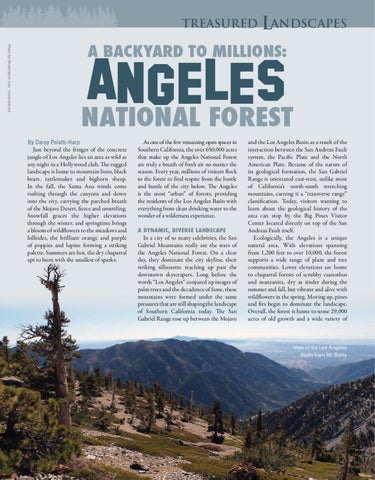
View of the Los Angeles Basin from Mt. Baldy
www.nationalforests.org
n
WINTER – SPRING 2011
n
YOUR NATIONAL FORESTS
17