Native title rights achieved for two groups continued from page 1 “Firstly I would like to thank everyone for coming here. But what I said then in language was, that a long time ago European people came to this country. They brought along jam, sugar, flour, and they gave it to my people. And my people thought that was great. It was a different taste but it was great. They hadn’t realized what was happening. “In 2009 we were successful at bush court at Nepabunna. That was a very special day. The people, my people were happy. And we are happy today. “Native title means that we can continue our traditional practices in peace. My culture is a vital part of everything I do. We Adnyamathanha people are lucky that our culture is still strong and our language still spoken fluently. “I have also made a commitment to sharing my culture not only with the younger generations of Adnyamathanha people but also members of the wider community,” he said. Adnyamathanha elder Geraldine Anderson, recalls the start of her people’s journey for native title recognition. “I remember when we first started fighting for native title. It was like a tree
growing, and every time a new leaf would grow in one direction, we would be pulled in another.
Frank Warren, Director for the Dieri Aboriginal Corporation recalled growing up on Mumpee.
“Now that we have our native title, I feel we have gained so much in our lifetime and we can enjoy our land without having to worry that someone might be looking over our shoulder. We can hunt for food and enjoy our land, and that is what native title is all about, our rights to use the land the way we always have,” she said.
“There are lots of important sites on Mumpee that are of great significance to the Dieri people. This is the reason that I am so happy that we have been able to sort out that overlap with neighbours and that we are here today for the consent determination
The next day at the Cooinda Club, Port Augusta, the determination of Dieri 2 native title claim was made by Judge White, covering approximately five thousand square kilometres of land, also including parts of Murnpeowie station, or known to the Dieri as Mumpee, that was not included in Dieri’s first claim. Stephen Kenny, the Dieri People’s solicitor said the land around Murnpeowie station is very significant to the group. “To many of us Mumpee may seem like a fairly harsh and desolate environment, but I can assure you your honour the Dieri people who lived there recount a very wonderful and happy childhood in what they consider to be a very important place to them spiritually and emotionally,” said Mr Kenny.
“I consider I was one of the lucky ones growing up on Mumpee. That’s where I began to walk, and Aunty Alice and Aunty Renee used to take good care of me. My life was great growing up as a child. I remember we lived in a humpy, a bush shed, which was near the main homestead on Mumpee. “When I lived there, there were lots of people settled at the time, family, relatives and I know we have a strong spiritual connection to that country, and I still feel it now. “Many Dieri people put a lot of work into the consent determination, and I would like to acknowledge the work that they have done. Today, we can be proud,” said Mr Warren. Judge White, in his comments at the Adnyamathanha Consent Determination said “the Adnymathanha people and the Dieri people are to be congratulated on reaching that agreement. Making two determinations on the one occasion is not usual.”
Justice White again congratulated the groups at the Dieri Hearing. “Negotiations usually involve some give and take and a willingness to respect the views of others, and that’s what has occurred here. It is good that the Adnyamathanha and the Dieri peoples have reached agreement, they are to be congratulated.” He said the decisions under the Native Title Act are about celebrating and preserving Aboriginal culture rather than denying it. “It is worthwhile recalling how things were in Australia only 50 or 60 years ago. The policy of assimilation had it that Aboriginal people would be absorbed into the wider Australian community. “Today instead of denying Aboriginal history and wishing for its destruction, the court makes a public statement in recognition of it and makes a public statement which will and should assist in its preservation,” said Justice White. The consent determinations recognise the non-exclusive native title rights to access, hunt, fish, camp and to gather and use the natural resources. They recognise the right to undertake cultural activities, conduct ceremonies and meetings, and protect places of cultural and religious significance on respective determined areas.
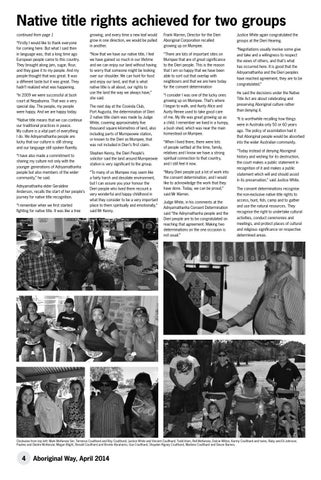
Clockwise from top left: Mark McKenzie Snr, Terrence Coulthard and Roy Coulthard; Justice White and Vincent Coulthard; Todd Irlam, Rell McKenzie, Dolcie Wilton, Karmy Coulthard and twins, Ruby and Eli Johnson; Pauline and Diedre McKenzie; Megan Blight, Ronald Coulthard and Bronte Abrahams; Sue Coulthard, Shayden Rigney Coulthard, Marlene Coulthard and Devon Barnes.
4
Aboriginal Way, April 2014