Naguenian
October 2019 — June 2020
NAGUENIAN
THE OFFICIAL SCHOOL PUBLICATION OF NAGA CITY SCIENCE HIGH SCHOOL
EDITORIAL BOARD School Year 2019 - 2020
Editor-in-Chief — Julliane Gayle Tan Associate Editor — Danielle Isabel Asinas
Managing Editors — Val Stephen
Agapito, Jazmine Clare Ramos, Jyla Mir Dangca
Circulation Managers — Lyndee Buenagua, Helena Francine Ebio, Mc Luis Glen Aserdano News Editor — Jessie-Jandrei Swing Feature Editor — Hannah Micah Hernandez
Sports Editor — Ron Francis Joven Head Cartoonist — Ariadne Paul Alvarez
Writers — Mikaela Reese Porsona,
Chantal Chloe De Guzman, Rick Marion Balce, Sophia Aquino, Lemuel Dave Azaña, Anna Kaye Cirujano, Cynara Glodette San Andres, Estifanie Meer, Shylla Mae Vegas, Christine Anne Balcueva, Rex Preconcillo, Kenn Andrei Martirez, Daryl Son De Leon, Rose Vi Mae Ebora, Paul Robert Donacao, Fred Ernest Jarapa, Joie Iris Faye Panizal, Alexa Cariño
Cartoonists — Shem Japeht Ham Sotero, Odranoel Buban, Aloysius Gian Nisolada, Jan Ivan Razonable Photojournalists — Gurleen Kaur, Vince Carlo Puno, Rjay Mikko Martirez Layout Artists — Jeremy Del Carmen, Martin Adrian Plaza, Samuel Jaime Acabado
Moderators — Floris Wayvell Tubale, Cherry Ann Pacheco, Liezl Lazo
Principal — Erwin de los Reyes
SERVICE FOR GOD AND MAN
OPINION
Volume 2 Issue No. 2
EDITORIAL
Taking off the Digital Mask
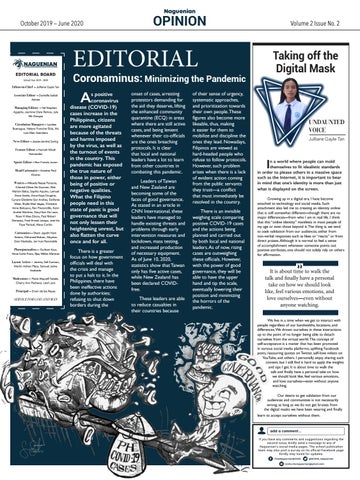
Coronaminus: Minimizing the Pandemic
A
s positive coronavirus disease (COVID-19) cases increase in the Philippines, citizens are more agitated because of the threats and harms imposed by the virus, as well as the turnout of events in the country. This pandemic has exposed the true nature of those in power, either being of positive or negative qualities. What the Filipino people need in this state of panic is good governance that will not only lessen their heightening unrest, but also flatten the curve once and for all. There is a greater focus on how government officials will deal with the crisis and manage to put a halt to it. In the Philippines, there have been ineffective actions done by authorities; refusing to shut down borders during the
onset of cases, arresting protestors demanding for the aid they deserve, lifting the enhanced community quarantine (ECQ) in areas where there are still active cases, and being lenient whenever their co-officials are the ones breaching protocols. It is clear that local and national leaders have a lot to learn from other countries in combating this pandemic. Leaders of Taiwan and New Zealand are becoming some of the faces of good governance. As stated in an article in CNN International, these leaders have managed to handle existing threats and problems through early intervention measures and lockdown, mass testing, and increased production of necessary equipment. As of June 10, 2020, statistics show that Taiwan only has five active cases, while New Zealand has been declared COVIDfree. These leaders are able to reduce casualties in their countries because
of their sense of urgency, systematic approaches, and prioritization towards their own people. These figures also become more likeable, thus, making it easier for them to mobilize and discipline the ones they lead. Nowadays, Filipinos are viewed as hard-headed people who refuse to follow protocols. However, such problem arises when there is a lack of evident action coming from the public servants they trust—a conflict that must immediately be resolved in the country. There is an invisible weighing scale comparing positive COVID-19 cases and the actions being planned and carried out by both local and national leaders. As of now, rising cases are outweighing these officials. However, with the power of good governance, they will be able to have the upper hand and tip the scale, eventually lowering their position and minimizing the horrors of the pandemic.
undaunted voice Julliane Gayle Tan
I
n a world where people can mold themselves to fit idealistic standards in order to please others in a massive space such as the Internet, it is important to bear in mind that one’s identity is more than just what is displayed on the screen. Growing up in a digital era, I have become attached to technology and social media. Such attachment also led me to creating an identity online that is still somewhat different—though there are no major differences—from who I am in real life. I think that this “online identity” manifests in most people of my age or even those beyond it. The thing is, we tend to seek validation from our audiences, either from non-verbal responses such as likes or “reacts” or from direct praises. Although it is normal to feel a sense of accomplishment whenever someone points out positive attributes, one should not solely rely on others for affirmation.
It is about time to walk the talk and finally have a personal take on how we should look like, feel various emotions, and love ourselves—even without anyone watching. We live in a time when we get to interact with people regardless of our bandwidths, locations, and differences. We drown ourselves in these interactions up to the point of no longer being able to detach ourselves from the virtual world. The concept of self-acceptance is a matter that has been promoted in various social media platforms; uplifting Facebook posts, reassuring quotes on Twitter, self-love videos on YouTube, and others. I personally enjoy sharing such content, but I still find it hard to apply the insights and tips I get. It is about time to walk the talk and finally have a personal take on how we should look like, feel various emotions, and love ourselves—even without anyone watching. Our desire to get validation from our audiences and communities is not necessarily wrong, as long as we do not get bruises from the digital masks we have been wearing and finally learn to accept ourselves without them.