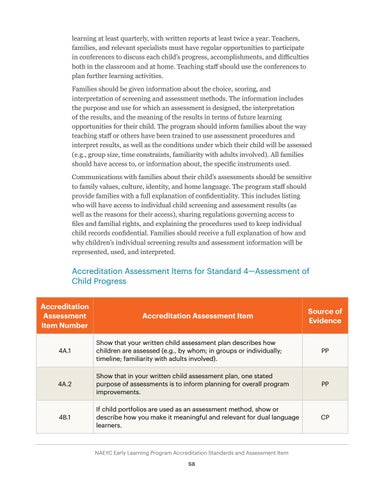
learning at least quarterly, with written reports at least twice a year. Teachers, families, and relevant specialists must have regular opportunities to participate in conferences to discuss each child’s progress, accomplishments, and difficulties both in the classroom and at home. Teaching staff should use the conferences to plan further learning activities. Families should be given information about the choice, scoring, and interpretation of screening and assessment methods. The information includes the purpose and use for which an assessment is designed, the interpretation of the results, and the meaning of the results in terms of future learning opportunities for their child. The program should inform families about the way teaching staff or others have been trained to use assessment procedures and interpret results, as well as the conditions under which their child will be assessed (e.g., group size, time constraints, familiarity with adults involved). All families should have access to, or information about, the specific instruments used. Communications with families about their child’s assessments should be sensitive to family values, culture, identity, and home language. The program staff should provide families with a full explanation of confidentiality. This includes listing who will have access to individual child screening and assessment results (as well as the reasons for their access), sharing regulations governing access to files and familial rights, and explaining the procedures used to keep individual child records confidential. Families should receive a full explanation of how and why children’s individual screening results and assessment information will be represented, used, and interpreted.
Accreditation Assessment Items for Standard 4—Assessment of Child Progress Accreditation Assessment Item Number
Accreditation Assessment Item
Source of Evidence
4A.1
Show that your written child assessment plan describes how children are assessed (e.g., by whom; in groups or individually; timeline; familiarity with adults involved).
PP
4A.2
Show that in your written child assessment plan, one stated purpose of assessments is to inform planning for overall program improvements.
PP
4B.1
If child portfolios are used as an assessment method, show or describe how you make it meaningful and relevant for dual language learners.
CP
NAEYC Early Learning Program Accreditation Standards and Assessment Item 58