02
singapore he alth
MAY⁄ JUN 2012
News
A guide for kidney transplant patients A new book by SGH’s renal transplant team aims to help transplant patients extend the life of their kidney transplants Don’t visit the Bird Park or any bird exhibition, and avoid exotic animals.
PHOTOs: simon ong
This piece of advice comes from My LifeBook, a publication for kidney transplant patients by physicians and transplant coordinators of Singapore General Hospital’s (SGH) Department of Renal Medicine. The authors wrote that rejection of the new organ, drug toxicity, infections, heart disease and cancer are long-term concerns for these patients. Learning how to prevent them from happening can help
extend the life of a kidney transplant, hence the warning by the renal transplant specialists to avoid contact with exotic or wild animals. It is fine to have pets, but they should be kept clean and healthy, and have regular checkups and vaccinations. This and other information and practical advice are aimed at helping transplant patients live well with their transplanted kidneys. “If you have been on dialysis before, a working kidney transplant should offer you a better quality of life. When
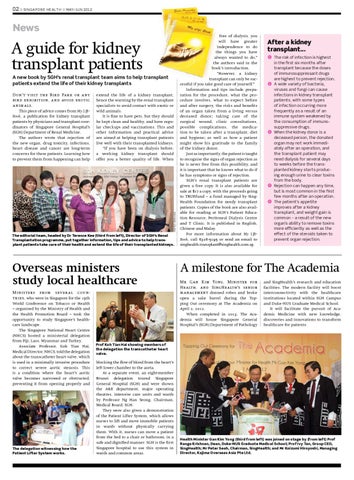
The editorial team, headed by Dr Terence Kee (third from left), Director of SGH’s Renal Transplantation programme, put together information, tips and advice to help transplant patients take care of their health and extend the life of their transplanted kidneys.
Overseas ministers study local healthcare Ministers from several countries, who were in Singapore for the 15th World Conference on Tobacco or Health – organised by the Ministry of Health and the Health Promotion Board – took the opportunity to study Singapore’s healthcare landscape. The Singapore National Heart Centre (NHCS) hosted a ministerial delegation from Fiji, Laos, Myanmar and Turkey. Associate Professor, Koh Tian Hai, Medical Director, NHCS, told the delegation about the transcatheter heart valve, which is used in a minimally invasive procedure to correct severe aortic stenosis. This is a condition where the heart’s aortic valve becomes narrowed or obstructed, preventing it from opening properly and
The delegation witnessing how the Patient Lifter System works.
free of dialysis, you will have greater independence to do the things you have always wanted to do,” the authors said in the book’s introduction. “However, a kidney transplant can only be successful if you take good care of yourself.” Information and tips include preparation for the procedure, what the procedure involves, what to expect before and after surgery, the risks and benefits of an organ taken from a living versus deceased donor; taking care of the surgical wound, clinic consultations, possible complications, the medication to be taken after a transplant, diet and hygiene; as well as how a patient might show his gratitude to the family of the kidney donor. Just as importantly, the patient is taught to recognise the signs of organ rejection as he is never free from this possibility, and it is important that he knows what to do if he has symptoms or signs of rejection. SGH’s renal transplant patients are given a free copy. It is also available for sale at $17 a copy, with the proceeds going to TRUEfund – a fund managed by SingHealth Foundation for needy transplant patients. Copies of the book are also available for reading at SGH’s Patient Education Resource, Peritoneal Dialysis Centre and T Clinic. It is published in English, Chinese and Malay. For more information about My LifeBook, call 6326-5195 or send an email to singhealth.transplant@singhealth.com.sg.
After a kidney transplant... The risk of infection is highest in the first six months after transplant because the doses of immunosuppressant drugs are highest to prevent rejection. A wide variety of bacteria, viruses and fungi can cause infections in kidney transplant patients, with some types of infection occurring more frequently as a result of an immune system weakened by the consumption of immunosuppressive drugs. When the kidney donor is a deceased person, the donated organ may not work immediately after an operation, and the transplant patient may need dialysis for several days to weeks before the transplanted kidney starts producing enough urine to clear toxins from the body. Rejection can happen any time, but is most common in the first few months after an operation. The patient’s appetite improves after a kidney transplant, and weight gain is common – a result of the new organ’s ability to remove toxins more efficiently as well as the effect of the steroids taken to prevent organ rejection.
A milestone for The Academia Mr Gan Kim Yong, Minister for Health, and SingHealth’s senior management donned robes and broke open a sake barrel during the Topping Out ceremony at The Academia on April 2, 2012. When completed in 2013, The Academia will house Singapore General Hospital’s (SGH) Department of Pathology
and SingHealth’s research and education facilities. The modern facility will boost interconnectivity with the healthcare institutions located within SGH Campus and Duke-NUS Graduate Medical School. It will facilitate the pursuit of Academic Medicine with new knowledge, discoveries and innovations to transform healthcare for patients.
Prof Koh Tian Hai showing members of the delegation the transcatheter heart valve.
blocking the flow of blood from the heart’s left lower chamber to the aorta. At a separate event, an eight-member Brunei delegation toured Singapore General Hospital (SGH) and were shown the A&E department, major operating theatres, intensive care units and wards by Professor Ng Han Seong, Chairman, Medical Board, SGH. They were also given a demonstration of the Patient Lifter System, which allows nurses to lift and move immobile patients in wards without physically carrying them. With it, nurses can move a patient from the bed to a chair or bathroom, in a safe and dignified manner. SGH is the first Singapore hospital to use this system in wards and common areas.
Health Minister Gan Kim Yong (third from left) was joined on stage by (from left) Prof Ranga Krishnan, Dean, Duke-NUS Graduate Medical School; Prof Ivy Tan, Group CEO, SingHealth; Mr Peter Seah, Chairman, SingHealth; and Mr Koizumi Hiroyoshi, Managing Director, Kajima Overseas Asia Pte Ltd.