LIFE at SGH Campus | Jul/Aug 2013
bench press
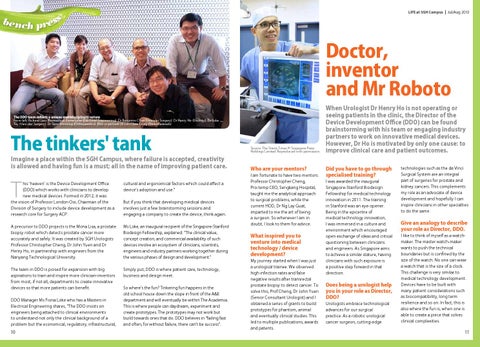
Doctor, inventor and Mr Roboto The DDO team reflects a unique multidisciplinary nature From left: Richard Lieu (Biomedics), Fiona Loke (Electrical Engineering), Dr Benjamin Chua (Vascular Surgery), Dr Henry Ho (Urology), Dr Luke Tay (Vascular Surgery), Dr Siow Weiming (Orthopaedics). (Not in picture) Dr Lim Chee Tiong (Nanomaterials)
The tinkers' tank
Imagine a place within the SGH Campus, where failure is accepted, creativity is allowed and having fun is a must; all in the name of improving patient care.
T
his ‘heaven’ is the Device Development Office (DDO) which works with clinicians to develop new medical devices. Formed in 2012, it was the vision of Professor London Ooi, Chairman of the Division of Surgery to include device development as a research core for Surgery ACP.
cultural and ergonomical factors which could affect a device’s adoption and use.”
A precursor to DDO projects is the Mona Lisa, a prostate biopsy robot which detects prostate cancer more accurately and safely. It was created by SGH Urologists Professor Christopher Cheng, Dr John Yuen and Dr Henry Ho, in partnership with engineers from the Nanyang Technological University.
Ms Loke, an inaugural recipient of the Singapore-Stanford Biodesign Fellowship, explained: “The clinical value, concept creation, and commercial availability of such devices involve an ecosystem of clinicians, scientists, engineers and industry partners working together during the various phases of design and development.”
The team in DDO is poised for expansion with big aspirations to train and inspire more clinician-inventors from most, if not all, departments to create innovative devices so that more patients can benefit.
Simply put, DDO is where patient care, technology, business and design meet.
DDO Manager Ms Fiona Loke who has a Masters in Electrical Engineering shares, "The DDO insists on engineers being attached to clinical environments to understand not only the clinical background of a problem but the economical, regulatory, infrastructural,
10
But if you think that developing medical devices involves just a few brainstorming sessions and engaging a company to create the device, think again.
So where’s the fun? Tinkering fun happens in the old school house down the slope in front of the A&E department and will eventually be within The Academia. This is where people can daydream, experiment and create prototypes. The prototypes may not work but build towards ones that do. DDO believes in “failing fast and often, for without failure, there can’t be success”.
Source: The Straits Times © Singapore Press Holdings Limited. Reproduced with permission
Who are your mentors?
I am fortunate to have two mentors. Professor Christopher Cheng, Pro-temp CEO, Sengkang Hospital, taught me the analytical approach to surgical problems, while the current HOD, Dr Ng Lay Guat, imparted to me the art of being a surgeon. So whenever I am in doubt, I look to them for advice.
What inspired you to venture into medical technology / device development?
My journey started when I was just a urological trainee. We observed high infection rates and false negative results after transrectal prostate biopsy to detect cancer. To solve this, Prof Cheng, Dr John Yuen (Senior Consultant Urologist) and I obtained a series of grants to build prototypes for phantom, animal and eventually clinical studies. This led to multiple publications, awards and patents.
When Urologist Dr Henry Ho is not operating or seeing patients in the clinic, the Director of the Device Development Office (DDO) can be found brainstorming with his team or engaging industry partners to work on innovative medical devices. However, Dr Ho is motivated by only one cause: to improve clinical care and patient outcomes. Did you have to go through specialised training?
I was awarded the inaugural Singapore-Stanford Biodesign Fellowship for medical technology innovation in 2011. The training in Stanford was an eye-opener. Being in the epicentre of medical technology innovation, I was immersed in a culture and environment which encouraged open exchange of ideas and critical questioning between clinicians and engineers. As Singapore aims to achieve a similar stature, having clinicians with such exposure is a positive step forward in that direction.
Does being a urologist help you in your role as Director, DDO? Urologists embrace technological advances for our surgical practice. As a robotic urological cancer surgeon, cutting-edge
technologies such as the da Vinci Surgical System are an integral part of surgeries for prostate and kidney cancers. This complements my role as an advocate of device development and hopefully I can inspire clinicians in other specialties to do the same.
Give an analogy to describe your role as Director, DDO. I like to think of myself as a watchmaker. The master watch-maker wants to push the technical boundaries but is confined by the size of the watch. No one can wear a watch that is the size of a clock. This challenge is very similar to medical technology development. Devices have to be built with many patient considerations such as biocompatibility, long term resilience and so on. In fact, this is also where the fun is, when one is able to create a piece that solves clinical complexities.
11