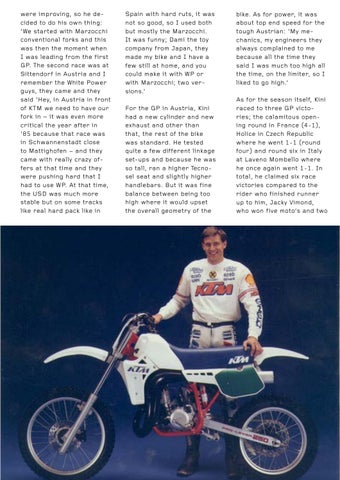
were improving, so he decided to do his own thing: ‘We started with Marzocchi conventional forks and this was then the moment when I was leading from the first GP. The second race was at Sittendorf in Austria and I remember the White Power guys, they came and they said ‘Hey, in Austria in front of KTM we need to have our fork in – it was even more critical the year after in ‘85 because that race was in Schwannenstadt close to Mattighofen – and they came with really crazy offers at that time and they were pushing hard that I had to use WP. At that time, the USD was much more stable but on some tracks like real hard pack like in
Spain with hard ruts, it was not so good, so I used both but mostly the Marzocchi. It was funny; Dami the toy company from Japan, they made my bike and I have a few still at home, and you could make it with WP or with Marzocchi; two versions.’ For the GP in Austria, Kini had a new cylinder and new exhaust and other than that, the rest of the bike was standard. He tested quite a few different linkage set-ups and because he was so tall, ran a higher Tecnosel seat and slightly higher handlebars. But it was fine balance between being too high where it would upset the overall geometry of the
bike. As for power, it was about top end speed for the tough Austrian: ‘My mechanics, my engineers they always complained to me because all the time they said I was much too high all the time, on the limiter, so I liked to go high.’ As for the season itself, Kini raced to three GP victories; the calamitous opening round in France (4-1), Holice in Czech Republic where he went 1-1 (round four) and round six in Italy at Laveno Mombello where he once again went 1-1. In total, he claimed six race victories compared to the rider who finished runner up to him, Jacky Vimond, who won five moto’s and two